
Clinical Efficacy of Shatapushpa Taila Matra Basti in PCOS – A Case Study
The most prevalent reproductive health issues in adolescent girls face nowadays are irregular periods, acne, and obesity. Polycystic ovarian syndrome is the underlying condition that causes these issues in the most severe way. Initially, PCOS was only thought to be associated to infertility, but it is now well-established that for many people, it begins during puberty and lasts until menopause. In addition to contributing significantly to infertility, the associated endocrine and metabolic disorders with PCOS raise women's risk for type II diabetes mellitus, chronic heart disease, dyslipidemia, hypertension, hyper-insulinemia, and obesity. In order to avoid the problems listed above, it is crucial to treat this illness as soon as possible, not just from the perspective of infertility. One of the Panchakarma procedures is called Basti, in which medicine is given through the anal region, urinary region, or vaginal region in the form of Kwatha or Sneha. The most successful therapies for Artava Kshaya are Basti Chikitsa. A 24-year-old female patient arrived to the OPD and complained of hair loss, acne, weight gain and menstrual irregularities. A USG abdominal scan identified PCOS. The patient sought out Ayurvedic treatment because she had tried numerous allopathic treatments without success. She was therefore treated in accordance with the Artava Kshaya fundamental course of treatment in Ayurveda. With the Ayurvedic treatment, remarkable changes in the ovaries and in menstrual bleeding were seen.
Introduction
Polycystic ovarian syndrome (PCOS) is a hormonal disorder causing enlarged ovaries with small cysts on the outer edge. The disorder can be morphological (polycystic ovaries) or predominantly biochemical (hyperandrogenemia). Hyperandrogenism, a clinical hallmark of PCOS, can cause inhibition of follicular development, microcysts in the ovaries, anovulation, and menstrual changes [1]. According to Ayurvedic aspect, it can be correlated with Artava Kshaya. Artava Kshaya is a condition where menstruation does not occur at appropriate time, or is less in quantity or occurs causing pain and discomfort [2].
Prevalence of PCOS is highly variable ranging from 2.2% to 26% globally [3]. The rates of polycystic ovarian syndrome have been reportedly high among Indian women compared to their Caucasian counterparts [4], with an estimated prevalence of 9.13% in Indian adolescents [5, 6]. Women seeking help from health care professionals to resolve issues of obesity, acne, amenorrhea, excessive hair growth, and infertility often receive a diagnosis of PCOS. Women with PCOS have higher rates of endometrial cancer, cardiovascular disease, dyslipidemia, and type-2 diabetes mellitus [7].
In the allied sciences, it is treated with hormonal therapy, which produces massive side effects. Thus, it is necessary to modulate an Ayurvedic approach towards the disease and formulate the principles of management_. Panchakarma_ therapy is designed to eliminate the vitiated Doshas through the nearest route and to maintain a state of its equilibrium. The unique feature of the Panchakarma therapy is to destroy the disease from the root level [8]. According to Acharya Kashyapa, in all the disorders of Artava use of Shatapushpa is beneficial and Shatapushpa oil is properly prepared and it should be used in the form of Nasya, Pana, Snehana, Abhyanga, and Basti [9]. In PCOS, abnormal hormone levels prevent follicles from growing and maturing to release egg cells. So Matra Basti with Shatapushpa Taila is the appropriate therapy for extrusion of ovum from the follicles and ovulation.
Case Report
24 years old unmarried female patient came to our OPD of Striroga and Prasuti Tantra at Gurukul campus (Reg. no. 9104/680), with complain of irregular menses since 12 years. She was taking allopathy treatment for last one year but she didn’t get complete result from it.
Her Other Complaints Were As Follows
- Menstrual irregularity (oligomenorrhea/Amenorrhea) since 12 years
- Weight gain since 11 years
- Unwanted hair growth since 6 years
- Acne since 2 years
- Pelvic pain since 2 years Past history- No H/O DM/HTN or any other major medical or surgical history. Family history- No history of same illness in any of the family members.
- Occupational history- Student Menstrual/obstetric history- Spotting/above 65 days, irregular cycle, moderate flow sometimes with clots, dysmenorrhea.
Marital Status: Unmarried Psychological Aspect- Disturbed, Tense General Examination
- Built – Moderate
- BP- 120/84 mm Hg,
- Pulse- 78/min,
- RR- 18/ min,
- BMI- 28.6 kg/m2,
- Tongue- slightly coated,
- Temperature- 98.4°F.
Dashavidha Pareeksha
- Prakriti – Vata Kaphaja
- Vikriti – Balwaan
- Sara – Madhyama
- Samhanana – Madhyama
- Pramana – Madhyama
- Satmya – Madhyama
- Satva – Madhyama
- Ahara Shakti – Madhyama
- Vyayama Shakti – Madhyama
- Vaya - Yuvati
Systemic Examination
- CVS- S1S2 Normal
- CNS- Well conscious, oriented
- RS- Breath sounds heard normal
- P/A- Soft, No tenderness Investigations-
- Hb% - 11.2 gm
- RBS – 89.0 mg/dl
- LH – 9.88 m IU/ml
- FSH – 5.81 m IU/ml
- AMH – 5.73 ng/ml
- Thyroid profile- T3 – 92.78 ng/dl, T4- 7.30 ug/dl, TSH- 3.2449 uIU/ml
- Sr. testosterone – 58.55 ng/dl
- Sr. prolactin – 12.59 ng/ml
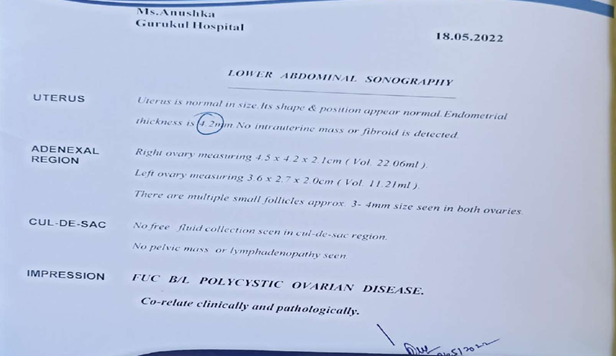
- USG (pelvis) – B/L PCOS Management of patient-
- Patient was given Shatapushpa Taila Matrabasti 60 ml for 21 days after cessation of menses for 3 consecutive cycles.
- Duration – 3 months
- Pathya-Apathya – The patient was instructed to change their eating habits, stay away from junk food, and have a diet high in fiber and less amount of diet than required. It was advised that she perform Pranayam, Surya Namaskar, Pavanmuktasana, Pachhimottasana, and Bhujangasana to the best of his ability.
Result
| S.no | Assessment criteria | BT | AT |
|---|---|---|---|
| 1 | Interval between two cycles | Above 65 days | 21-35 days |
| 2 | Duration of bleeding | Spotting | 3-5 days |
| 3 | Quantity of menstrual blood | 1 pad/day | 3-4 pad/day |
| 4 | Hirsutism (Ferriman & Gallwey scoring) | Mild hirsutism | Mild hirsutism |
| 5 | Pain during menstrual period | Menstruation is painful but daily activities are not affected, no need of analgesics | No pain |
Result of investigation
| Investigation | Before treatment | After treatment (3 months) |
|---|---|---|
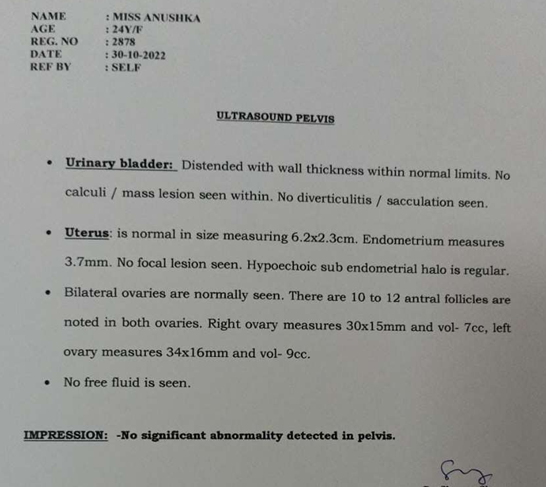
| USG | Endometrial thickness – 4.2mm | Endometrial thickness – 3.7mm |
| Right ovary volume – 22 cc | Right ovary volume – 7 cc | |
| Left ovary volume – 11 cc | Left ovary volume – 9 cc | |
| Impression- Bilateral Polycystic ovarian syndrome | Impression – no significant abnormality detected in pelvis |
Before treatment
After treatment
Discussion
Menstrual irregularities are equated to PCOS in Ayurveda. It is a condition that affects the Vata, Pitta, and Kapha Doshas as well as the Meda Dhatu, Rasa Dhatu, and Artava Upadhatu. Therefore, in this case, the patient experienced relief from menstrual irregularities after three months of consistent treatment, which included Shatapushpa Taila Matra Basti along with yoga, exercise, and meditation therapy, and her ultrasound results revealed a decrease in ovarian volume.
After entering Pakvashaya or Guda, Basti begins to work on the entire body. Guda is described as a Sharira Mula with Shiras and Dhamanies that cover the entire body [10]. It has both local and systemic effects. Apana Vata is normalized by Basti Dravyas, enabling normal functioning.
According to modern appraisal, any medication administered via the rectal route absorbed through the mucosal layer of the rectum and into the circulatory system.
Since the enteric nervous system (ENS) and central nervous system (CNS) are similar [11, 12], when Basti enters the gastro intestinal tract (GIT), it activates the ENS and produces stimulatory impulses for the CNS. These signals activate the GIT’s endogenous opioids, primarily -endorphin, which limit the release of gonadotropin-releasing hormone. As a result, Basti administered to PCOS patients modulates the Hypothalamic-Pituitary-Ovary axis, which normalises both the ovarian cycle and the menstrual cycle.
Basti was made using Shatapushpa Taila, which has following Gunas like Yonivishodhana, Artavajanana, Beejotsarga, Balya, Deepan, and Pachan.
Shatapushpa exhibit phytoestrogenic activity. The main action of phytoestrogen is due to their adaptogenic activity. They can be beneficial in both hyper estrogenic and hypo estrogenic state in the body. Thus, they may have mixed estrogenic and anti-estrogenic action depending on target tissue, that’s why it works in amenorrhea and menorrhagia too as described by Maharshi Kashyapa. A second mechanism for action of phytoestrogen may be their ability to affect the endogenous production of estrogen. The pituitary gland releases gonadotrophin that stimulates estrogen synthesis in the ovaries. This may enhance ovulation and may be effective in the management of infertility.
Conclusion
Due to its recurrence, PCOS continues to be one of the main issues in reproductive medicine. Amongst them bulky ovaries with increased ovarian volume was the challenging part. There were numerous variables that affected the natural menstruation in this case, but with proper treatment and systematic management, the case was successful. Because of this, we should concentrate on many causes and aetiologies that have been discussed in literature and their applicability in the current situation.
References
-
Lin LH, Baracat MC, Gustavo AR, Soares JM, Baracat EC (2013) Androgen receptor gene polymorphism and polycystic ovary syndrome. Int J Gynaecol Obstet 120(2): 115-118.
-
Sushruta (2003) Ambikadatta shastri. Sushruta samhita, sutrasthana 15/16, 16th (Edn.), Varanasi; Chowkambha Sanskrit Sansthan publishers, India, pp: 77.
-
Lauritsen MP, Bentzen JG, Pinborg A, Loft A, Forman JL, et al. (2014) The prevalence of polycystic ovary syndrome in a normal population according to the Rotterdam criteria versus revised criteria including anti- Mullerian hormone. Hum Reprod 29(4): 791-801.
-
Wijeyaratne CN, Balen AH, Barth JH, Belchetz PE (2002) Clinical manifestations and insulin resistance (IR) in polycystic ovary syndrome (PCOS) among South Asians and Caucasians: is there a difference? Clin Endocrinol (Oxf) 57(3): 343-350.
-
Nidhi R, Padmalatha V, Nagarathna R, Amritanshu R (2011) Prevalence of polycystic ovarian syndrome in Indian adolescents. J Pediatr Adolesc Gynecol 24(4): 223-227.
-
Kalra P, Bansal B, Nag P, Singh JK, Gupta RK (2009) Abdominal fat distribution and insulin resistance in Indian women with polycystic ovarian syndrome. Fertility and Sterility 91(4): 1437-1440.
-
McFarland C (2012) Treating polycystic ovary syndrome and infertility. MCN Am J Matern Child Nurs 37(2): 116- 121.
-
Agnivesha, Trikamji AY (2009) Charaka samhita, Sutrasthana 16/21, 1st (Edn.), Chaukambha Sanskrit Sansthan publishers, Varanasi, India.
-
Jivaka V, Samhita K, Tantram VJ, Sharma PH (1998) the Vidyotini hindi commentary, 6th (Edn.), Ka Kalpa Shatpushpashatavri kalpadhyaya, Chaukhamba Samskrit Samsthan, Varanasi, India, pp: 185-186
-
Agnivesha, charaka, Drudabala, Dutta C (2011) Charaka Samhita. Siddhi Sthana 1/31. 1st (Edn.), Chaukhamba orientalia, Varanasi, India.
-
Gershom MD (2005) Nerves, reflexes and the enteric nervous system: Pathogenesis of the irritable bowel syndrome. J Clin Gastroenterol 39((5, Suppl 3)): S184- 193.
-
Furness JB (2006) The Enteric Nervous System. Wiley Online Library, New Jersey, United States, pp: 274.
- Management of Ear Keloid with Ksharsutra: A Case Study
- Yoga and Global Sustainability: A Holistic Path to One Earth, One Health
- Autoimmune Diseases in Ayurveda: A Narrative Review with Classical and Modern Perspectives
- Management of Cluster Headache Associated with Pituitary Apophysitis by CERT (Chakrasiddh Energy Release Technique): A Case Report on Energy Rebalancing
- Zygophyllum Geslini Coss : Biochemicals and Antioxidant Activity
- Observations of a Beginner Vaidya