
Assessment of the In-vitro Potential of Two Different Genotypes of Bacopa Monnieri L. Pennell
Jal Brahmi (Bacopa monnieri L.) is an important medicinal herb rendering mental health-promoting activities. In-vitro mass multiplication of elite genotypes of Jal Brahmi may bring off its high industrial demand. In the present study, the comparative in-vitro responses of two diverse genotypes (DBM-4 and DBM-12) were assessed. Direct shoot organogenesis was reported in both genotypes studied in basal MS medium media. However, both genotypes formed calli in the presence of 2, 4-D and IAA. Germplasm DBM-4 observed significantly higher antioxidant potential than that of DBM-12. Further, in both genotypes, methyl jasmonate elicitation significantly improved the antioxidant potential and total phenolic contents of the callus. Hence, DBM-4 has the potential for in-vitro mass multiplication and secondary metabolites production.
Introduction
Jal Brahmi, a creeping perineal herb, has been emerging as a miraculous medicinal herb and is known for its mental health-promoting activities [1, 2, 3]. In the present global scenario, mental illness is causing interferences in our routine work. In this, Jal Brahmi may be used as a nerve tonic to improve memory and overall mental health. To make Jal Brahmi-based formulations, it needs germplasm/variety in which its active biomolecules are accumulated in high quality [2, 3]. The pharmacological properties of Jal Brahmi are due to the presence of its characteristic saponins like bacosides. The accumulation of these metabolites is influenced by the type of source genotypes [4]. The herbal industries prefer germplasms or varieties which have proven to accumulate above metabolites at standard levels. In this context, some germplasms were identified, out of which DBM-4 germplasm Research Note was found to have a high abundance of Bacosides [4]. Hence, conservation and rapid multiplication of elite germplasm are necessary which can be achieved through in-vitro techniques. Along with this, plant material from in-vitro culture can also be given to the farmers as per their demands. As far as in-vitro culture is concerned, the behaviour of different germplasms may be different. For example, some germplasms respond well in in-vitro while others show poor in-vitro growth. Also, their ability to form callus and the level of accumulation of active metabolites in them is also affected by the type of germplasm. Callus is a type of undifferentiated cell mass extensively exploited for important secondary metabolites production. Also, callus offers a way to study the effects of a variety of biotic and abiotic elicitors on the accumulation of particular active metabolites. In the present study, two different germplasms of Jal Brahmi were studied in-vitro. These germplasms have shown a good accumulation of metabolites in open fields. These germplasms were assessed for their multiplication potential and callus-forming abilities through the in-vitro system. Both these germplasms were easily multiplied in the basal media without requiring any plant hormone. These can be exploited for generating high- quality planting material for the farmers.
Materials and Methods
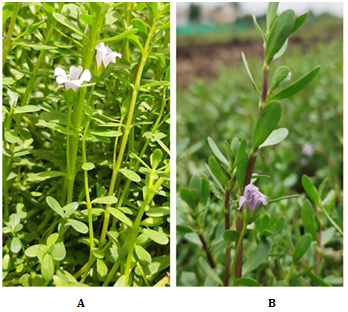
Two morphologically diverse accessions, DBM-4 and DBM-12 were grown at ICAR-DMAPR, Anand, and India research farm (Figure 1). Fully expanded leaves were collected from these plants. Leaves were washed with lab detergent and rinsed with water to remove any dust materials. To establish axenic leaf cultures, leaves were treated with 0.1 % mercuric chloride under laminar air flow for 4-5 min followed by 4 items of washing with sterile water. After washing, excess water was drained off by placing leaves on autoclaved filter paper. Finally, leaves were abaxially inoculated in the MS media having different concentrations of IAA (0, 0.5, 1 and 1.5 mg/l), 0.7 g/L agar, and 30 g/L sucrose. For callus induction, MS media supplemented with 0.5 mg/L of IAA was inoculated with different concentrations of 2, 4-D (0.5, 1.0 and 1.5 mg/L), agar, and sucrose. The culture vials were incubated at 25 ± 1 °C temperature and 16 h photoperiods. All experiments were conducted in triplicate.
Callus Suspension Culture and Elicitation by Methyl Jasmonate (MeJ)
Three to four small clumps of callus were inoculated in Erlenmeyer flasks containing 100 ml MS media and 1.0 mg/L
2,4-D and 0.5 mg/L IAA. These cultures were placed on a rotary shaker with a speed of 150 rpm at 25 ± 1°C temperature and 16 h photoperiod. For elicitation, these cultures were supplemented with 25 µM MeJ for 40 days.
Total Phenolic Contents (TPC) and Antioxidant Analysis of Callus
The total phenolic content of extracts was measured using folin-ciocalteu (FC) reagent as described earlier [5]. At first, 2.0 g callus was completely dried, powdered, and extracted by 5 ml of methanol in a water bath at 45°C for 3 h. The extract was centrifuged and the supernatant was used for TPC and antioxidant analysis. For TPC analysis, 0.5 ml methanolic extract of callus was mixed with 5 ml of 10 % FC reagent and 4 ml of 1 M Na2CO3 solution. The mixture was incubated in dark for 15 min. The absorbance of the mixture was taken at 765 nm wavelength using a UV-Vis spectrophotometer and TPC was expressed as gallic acid equivalents / 100 g of DW. Comparative free radical scavenging activities were assessed by DPPH analysis [6]. Briefly, 3 ml of extract was mixed with 1 ml of 0.1 mM DPPH solution and incubated for 30 min. The discoloration of DPPH was monitored at 517 nm wavelength using a UV-Vis spectrophotometer. The % radical scavenging activity of DPPH was calculated as % RSA = (Abs of control – Abs of the sample) / Abs of control × 100. IC50 of the extracted sample was calculated by the linear regression analysis.
Results and Discussion
Various factors like the type of explant, age of explant, the season of explant collection, etc influence in-vitro performance of a plant species. The present study was conducted to assess the potential of two different genotypes of Jal Brahmi on direct shoot organogenesis and callus-forming ability. In our previous study, DBM-4 showed a higher accumulation of Bacosides, industrially important metabolites, in the field condition [4]. Also, another germplasm DBM-12 with diverse chemical and morphological characteristics (data not shown) was taken to compare its in-vitro potential. Leaf explants from DBM-4 and DBM-12 were cultured for direct organogenesis and callus induction. Direct organogenesis is important for the rapid multiplication and conservation of a particular species whereas callus is used for the production of desired secondary metabolites. Both types of explants in the present study showed direct shoot organogenesis on basal MS media in the absence of any hormonal treatment (Figures 2 A, B). In basal media, explants showed the emergence of micro shoots 10 days after culture initiation. On the 15th day of culture, rooting was initiated from the basal part of the explants and 5-7 shoots were initiated from each explant. In all explants, 100 % shooting was achieved irrespective of the type of genotypes.
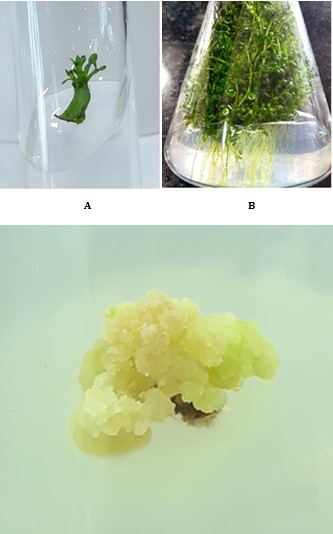
After 30 days of culture initiation, all adventitious shoots attained a height of 5-6 cm, and numerous roots having a length of 3-4 cm were observed. Similar results were observed on 2017 by Sarkar and Jha, [7]. Results in the present study indicated that DBM-4 and DBM-12 both showed similar direct organogenesis. Hence, the effect of genotypes of Jal Brahmi may not be a limiting factor for direct organogenesis. Explants cultured on MS media supplemented with 2,4-D induced callus. The explants showed swelled regions after 4-5 days and true callus was observed 10 days of culture. Explant cultured on 0.5 mg/l 2,4-D induced yellow-green colored callus whereas 1 and 1.5 mg/l 2,4-D resulted in cream-colored callus (Figure 2C). These calli were sub- cultured after 30 days on the same media composition. After 60 days of callus induction, a suspension culture was initiated this was further used for elicitation analysis.
C Figure 2C: C represents callus formation in DBM-4 under 1.5 mg/L 2, 4-D in MS media.
Methanolic extracts of callus obtained from DBM-4 and DBM-12 were used for comparative antioxidant potential analysis. The TPC in callus derived from DBM-4 and DBM-12 was 4.84 ± 0.23 and 3.32 ± 0.124 mg GAE g-1 FW, respectively. Elicitation of callus by MeJ significantly enhanced the TPC in DBM-4 (8.75 ± 0.18 mg GAE g-1 FW) and DBM-12 (6.87 ± 0.212 mg GAE g-1 FW). MeJ (25 µM) treatment increased the TPC and antioxidant potential of callus derived from leaf explants. However, The MeJ treatment increased the TPC in callus derived from both genotypes. The callus derived from the DBM-4 showed significantly high antioxidant potential (DPPH IC50, 0.214 ± 0.121 mg ml-1) as compared to the callus derived from the DBM-12 genotype (DPPH IC50, 0.288 ± 0.212 mg ml-1). The probable reason behind the comparative higher antioxidant activity of DBM-4 may be attributed to the inherent higher accumulation of bacosides. MeJ (25 µM) elicited antioxidant potential in callus derived from DBM-4 (DPPH IC50, 0.113 ± 0.059 mg ml-1) and DBM-12 (DPPH IC50, 0.179 ± 0.142 mg ml-1). MeJ treatment increased the TPC and antioxidant potential of callus derived from leaf explants. However, The MeJ treatment increased the TPC in callus derived from both genotypes. Similarly, shoot cultures of Jal Brahmi plants induced with MeJ showed enhanced secondary metabolite accumulation [8]. The high antioxidant potential of Brahmi is also used fully in herbal tea formulations [9]. The DBM-4 also showed better performance when grown under partial shade conditions [10]. Hence, DBM-4 accession may be suitable for open fields, under partial shade, and in- vitro culture.
Conclusion
Jal Brahmi accessions DBM-4 and DBM-12 both may be used for the establishment of in-vitro cultures for mass multiplication and secondary metabolites production. For, mass multiplication of Jal Brahmi, only basal MS media is required irrespective of the source of the explant. But the antioxidant potential is greatly affected by the type of genotypes of the explants. Comparative in-vitro analysis suggested that DBM-4 may be used for mass multiplication and secondary metabolites production.
References
-
Roshni LS, Gangaprasad A, Siril EA (2014) Evaluation of variability in _Bacopa monnieri_ (L.) Pennell using morphological and biochemical markers. International Journal of Applied Research in Natural Products 7: 25- 31.
-
Saran P L, Patel R B (2019) Plastering technique: An easy and cost-effective way of _Bacopa monnieri_ L. Pannell multiplication. Academia Journal of Medicinal Plants 7(8): 181-186.
-
Saran PL, Damor HI, Kalariya KA (2021) Physiologically diverse morphotypes of _bacopa monnieri_ L. pannell. Journal of Plant Development Sciences 13(10): 779-783.
-
Saran PL, Damor HI, Lodaya DH, Suthar MK, Kalariya KA, et al. (2022) Identification of potential accessions of Bacopa monnieri L. for herbage yield and bacosides a content. Industrial Crops and Products 176: 114348.
-
Singleton VL, Orthofer R, Lamuela-Raventos RM (1999) [14] Analysis of total phenols and other oxidation substrates and antioxidants by means of folin-ciocalteu reagent. Methods in Enzymology 299: 152-178.
-
Golkar P, Taghizadeh M (2018) In vitro evaluation of phenolic and osmolite compounds, ionic content, and antioxidant activity in safflower (_Carthamus tinctorius_ L.) under salinity stress. Plant Cell Tissue Organ Culture 134(3): 357-368.
-
Sarkar S, Jha S (2017) Morpho-histological characterization and direct shoot organogenesis in two types of explants from _Bacopa monnieri_ on unsupplemented basal medium. Plant Cell Tiss Organ Cult 130: 435-441.
-
Jauhari N, Bharadwaj R, Sharma N, et al. (2019) Assessment of bacoside production, total phenol content and antioxidant potential of elicited and non-elicited shoot cultures of _Bacopa monnieri_ (L.). Environmental Sustainability 2: 441-453.
-
Hegde PG, Jadeja GR, Kamaliya KB, Damor HI, Saran PL (2022) Herbal tea with bacoside loaded saponins: formulation and characterization for food fortification from Bacopa monnieri L. J Food Sci Technol 59(11): 4510-4519.
-
Saran PL, Singh S, Solanki VH, Kansara RV, Damor HI, et al. (2022) Impact of Partial Shades on Bacopa monnieri L. for Nootropic Parameters. Current Journal of Applied Science and Technology 41(48): 70-81.
- Management of Ear Keloid with Ksharsutra: A Case Study
- Yoga and Global Sustainability: A Holistic Path to One Earth, One Health
- Autoimmune Diseases in Ayurveda: A Narrative Review with Classical and Modern Perspectives
- Management of Cluster Headache Associated with Pituitary Apophysitis by CERT (Chakrasiddh Energy Release Technique): A Case Report on Energy Rebalancing
- Zygophyllum Geslini Coss : Biochemicals and Antioxidant Activity
- Observations of a Beginner Vaidya