
Ayurvedic Management of Ek-Kushtha (Psoriasis): Review Article
Ek- Kustha is a kind of Kshudra Kushtha that resembles psoriasis in its clinical presentations and is primarily caused by an imbalance of the Vata and Kapha doshas. It bears a greater resemblance with Psoriasis, which is a long-lasting autoimmune and chronic inflammatory skin disorder clinically characterized by erythematous, sharply demarcated papules and rounded plaques, covered by silvery micaceous scale predominantly affecting the skin of elbows, knees, gluteal cleft, and scalp. Some people may have severe Psoriasis is involving their entire body. The quality of life of patient with Psoriasis is often diminished because of the appearance of skin. The mainstays of psoriasis treatment include immune system suppressing drugs like methotrexate, PUVA, vitamin D3 lotion, and steroid creams. Some contemporary therapeutic methods do have serious drawbacks, particularly when used for an extended period of time. These modern treatment modalities are not devoid from grave complications mainly in long term use. Owing to these reasons, there is a need for treatment having good efficacy and no toxicity profile. So this case study was conducted considering Psoriasis as Ek-kuhstha and Ayurvedic management was planned accordingly. Drastic results were witnessed by Shodhana (Vasantik Vaman & Shardik Virechana) and Shamana (Some internal herbo-mineral preparations, External oil application).
Introduction
All the dermatological disorders in Ayurvedic system of medicine are described under Kushtha. Ek-Kushtha is a disease of Shakhagata Rog Marga and it manifest in Amashaya and occurs due to dominancy of Kapha and Vata.
“Kushtha” is a broad term and it covers almost all skin diseases. It is one among Ashtamahagada mentioned in Charaka Samhita [1]. • Acharya Suhsruta has described Kushtha under Aupsargika Roga or Sankramaka Roga [2].
• Acharya Vagbhata has described Kushtha under Sapta
Mahavyadhi.
• Ek-Kushtha is a type of Kshudra Kushtha.
Ek-Kushtha is considered as psoriasis as symptoms are coinciding with clinical features of psoriasis rather than any other Kushtha. Psoriasis is one of the most common dermatologic diseases, affecting up to 1% of the world’s population. It occurs in all age groups and about equally in men and women. It is a chronic, recurrent inflammatory disease of the skin. The exact aetiology is still unknown, but many precipitating factors like genetic, environmental, immunological and psychological have been found to be influential in the expression of the disease. The skin lesions of psoriasis are variably pruritic. Traumatized areas often develop lesions of psoriasis (Koebner or isomorphic phenomenon). Additionally, other external factors may exacerbate psoriasis including infections, stress, and medications (lithium, beta blockers, and antimalarials) [3].
Nidana
In Ayurvedic classics specific etiology of Ek-Kushtha has been not described. So, as being a type of Kushtha its etiology can be understood on the basis of general etiology of Kushtha. Ayurvedic texts have described Samanya Nidana for all types of Kushtha instead of specific Nidana for any particular type of Kushtha. Thus, Nidana can be categorized as follows: All the Samanya Nidana are classified into groups as:
- Aharaja Nidana
- Viharaja Nidana Aharaja Nidana [4]: Aharaja Nidana- improper food habits are one of the leading causes of Kushtha. It includes:
- Viruddha Ahara: The substances which are opposite in nature to normal Dhatu of the body is known as Viruddha. E.g., combination of fish with milk, it is Samyoga and Virya Viruddha. Gramya, Anupa or Audaka Mamsa with milk, it is Samyoga Viruddha.
• Mithya Ahara: It means faulty food patterns i.e., to take meal before the previous one is digested; and leads to Dushti of Jatharagni.
• Atyaashana: Intake of excessive amount of heavy food is called Atyaashana. Acharya Charaka has also stated that “Gurubhojanam Durvipakakaranam”. Guru Ahara also causes Dushti of Mamsavaha Srotasa[5].
• Adhyashana and Ajirna: Taking food before the digestion of previous food is called Adhyashana. Intake of food in state of indigestion is called Ajirne Anna.
Viharaja Nidana: According to Acharya Gayadas Viharaja
Nidanas has been divided into 3 categories viz. Kayika, Vachika and Manasika [6].
- Kayika: it includes
- Acharya Charaka has mentioned that suppression of natural urges like vomiting causes Kushtha [7].
- Divaswapna: It causes vitiation of Kapha and Pitta due to its Snigdha Guna and causes Kandu, Kotha, Pidika. It is also Kledakara, Srotorodhakara and Agnimandyakara.
- Sudden change from cold to hot and vice versa without following the rules of that change, this causes Dushti in Swedavaha Srotasa.
- Improper administration of Panchakarma.
- Performing Santarpana and Apatarpana during improper time. This result either in Ama formation or Tridosha vitiation, which leads to Kushtha.
• Vachika It includes the activities like behavioural problem or verbal sinful activities like abusing teachers, deity etc. and verbal offensive activities. These Vachika Nidanas causes psychogenic stress which plays a prominent role in the pathogenesis of psoriasis. They are responsible for aggravation of Raja and Tama, which in turn causes imbalance of Shareerika Dosha i.e., Vata, Pitta and Kapha and further responsible for the pathogenesis of Kushtha. Nidana like Chinta, Bhaya, Krodha are Vata Prakopaka. Bhaya, Krodha and Shoka also causes Dushti of Swedavaha Srotasa [8] and Chinta causes Dushti of Raktavaha Srotasaa.
• Mansika The diseases, in which no clinical result obtained even after the best treatment were considered as Papakarmaja Vyadhi. Both Acharya Charaka and Sushrut have described Kushtha as chronic disorder and all Acharyas including B.P and Madhavakara have included it to be due to Papa-Karma.
Samprapti
In Ayurvedic literature Samprapti of Ek Kushtha is not mentioned but being one of the Kshudra Kushtha, it can be explained through Samprapti of Kushtha (Figure 1).
According to Acharya Charaka seven Dravyas are involved in the Samprapti. It includes all the three Doshas (Vata, Pitta, Kapha) along with four Dushyas i.e., Twaka, Rakta, Mamsa and Lasika. Acharya Charaka has stressed upon the dual part played by Nidana i.e., simultaneous vitiation of Tridosha and disturbance in normal configuration i.e., ‘Shaithilya” in Dhatus. This leads to the final manifestation of Kushtha [9].
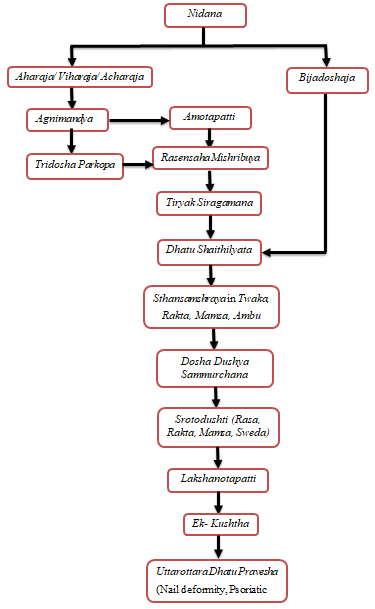
Samprapti Ghataka
| Dosha | Tridosha (Vata- Kapha Pradhana) |
|---|---|
| Dushya | Twakaa, Rakta, Mamsa, Lasika |
| Srotasa | Rasa, Rakta, Mamsa, Meda |
| Srotodushti | Sanga and Vimargagamana |
| Agni | Jatharagni and Dhatwagnimandya |
| Udbhavasthana | Amashaya, Pakwashaya |
| Adhishthana | Twacha |
| Vyadhimarga | Bahya |
| Swabhava | Chirkari |
Table 1: Represents Samprapti Ghataka of Ayurvedic treatment.
Purvarupa
- In classical texts there is no specific mention of Purvarupa of Ek-Kushtha [10]. However, being a type of Kshudra Kushtha, Purvarupa of Kushtha may be considered as its Purvarupa
- Sparshagyatvam (Anaesthesia)
- Ati- Sweda (Hyperhidrosis)
- Vaivaranya (Discoloration)
- Kotha (Eruption of rashes)
- Lomharsha (Horripilation)
- Kandu (Pruritis)
- Toda (Pricking pain)
- Shrama (Fatigue).
• Klama (Exhaustion)
• Shoola (Excessive pain)
- Shighra Uttapati and Chirsthiti (Rapid formation and chronicity of ulcers)
- Daha (Burning sensation)
- Suptangta (Numbness in limbs)
- Twakaa Paurushya[11] (Dryness of skin)
Rupa
According to Acharya Charaka Ek- Kushtha is Vata- Kapha Pradhan and Acharya Sushrut considered it as Kapha Pradhan Vikara. Ashtanga Hridaya has followed Charaka but has used the word Mahashrayam instead of Mahavastu [12].
Ek-Kushtha is a type of Ashtadash Kushtha and is defined as: The condition which causes discoloration of skin is called Kushtha. As the time passes it affects the whole body. Acharya Charaka characterized Ek-Kushtha as: [13]
- Aswedanam & Absence of perspirations
- Mahavastu-Extensive localization or bigger lesions
- Matsyashaklopamam & Fish like scales.
According to Acharya Sushrut, Ek-Kushtha is defined as the disorder which makes the body blackish or reddish [14]. Dalhana has commented that blackish colour is due to Vata Dosha.
In Ek- Kushtha lesions are very wide (covers a large area) non sweating and resembles the skin of fish.
Chikitsa
Ek-Kushtha is a long-time consuming disease and require treatment for a longer duration.
- Nidana Parivarjana
- Shodhana Therapy
- Shamana Therapy
Nidana Parivarjana
Disease manifestation starts from Nidana, first step in the management is to avoid Nidana Sevana as it will stop the further progression of the disease, by restricting vitiation of Dosha.
Shodhana
According to Sharangdhar, Kushtha Roga occurs due to Dosha Bahulyata, Doshas are Tiryagagami and are very difficult to treat by Shamana Chikitsa. Acharyas have emphasized on Shodhana therapy in the management of Kushtha.
For this purpose, Acharya Sushruta has advised to follow Vamana every 15 days, Virechana every month, Raktamokshana every 6 months while Nasya every 3rd day.
Acharya Vagbhata says that, Snehapana should be given in Purvarupa Avastha in Kushtha.
- Snehapana: Acharya Sushrut mentioned that treatment of Kushtha has to be started with Snehapana and also mentioned different Ghrita Yogas according to Doshas [15]. Acharya Charaka has mentioned that the Madhyam Matra should be administered in Kushtha for Shodhanartha [16].
- Swedana: Nadi or Vashpa Swedana is done in Kushtha. This procedure liquifies the Dosha.
- Raktamokshana: Acharya Sushrut have described to perform Siravedha from five main superficial veins. Charaka have advised Siravedha by classical instrument Alabu, Shringa etc.[17]
Shamana Chikitsa The purpose of Shamana Chikitsa is:
- To subside Kushtha in the patients who are unfit for Shodhana Karma.
- To subside the remaining Doshas after Shodhana Karma. For the treatment of Kushtha Roga, selection of drug is based upon below mentioned principles. Drugs having the properties of
- Rasa, Rakta Prasadana
- Rasa, Rakta Shuddhikara
- Rasavaha, Raktavaha & Swedavaha Sroto Shodhana. Acharya Charaka has advised Shamana therapy with Tikta and Kashaya Dravyas.
There are some medicine yogas for ek-kushtha mentioned in texts are [18] Patoladi kwath Triphaladi churna Mahatiktaka ghrita Mahakhadir ghrita Lepana: External application is also important as Sthanasamshraya and Vyaktasthana is Twacha. Acharya Sushrut has suggested Shodhana Lepa for the management of Twakagata Kushtha. i.e. Sidhma lepa , Vipadikahara ghrita taila, Edgajadi lepa
- Treatment on psoriasis depends on the type, locations and extent of disease most patient with localized plaque- type psoriasis can be managed with midpotency topical glucocorticoids. Crude coal tar (1-5% is an ointment base) is an old but useful method of treatment in conjunction with ultraviolet light therapy. A topical vitamin D analogue (calcipitriol) is also efficacious in the treatment of psoriasis.
- The ultraviolet B (UA-B) spectrum is effective alone, the combination of ultraviolet A (UA-A) spectrum with either oral or topical psoralens (PUVA) is also extremely effective for the treatment of psoriasis [19].
Conclusion
The complete eradication of this disease is not possible but Ayurvedic medications and Panchkarma therapy gives highly significant results in Ek-Kushtha (psoriasis). And prevents the relapse of disease and improve the quality of life.
References
-
Agnivesha (2009) Charaka Samhita. In: Chaturvedi G, et al. (Eds.), Vidyotni Hindi commentary. Indriya sthana, 9/8-9, Chaukhamba Bharati Academy, Varanasi, India, pp: 1004.
-
Maharsi Susruta (2011) Sushruta Samhita. In: Shastri KA (Eds.), Ayurveda Tattva Sandipika, Part-I, Nidana Sthana, Chapter-5/33, Verse No. 10, Chaukhambha Sanskrit Sansthan, Varanasi, India, pp: 325.
-
Fauci AS, Braunwald E, Kasper DL, Hauser SL, Longo DL, et al. (2008) Harrison’s principles of internal medicine. 17th (Edn.), In: Fauci AS, et al. (Eds.), The Mc Graw-Hill, Newyork, pp: 315-316.
-
Agnivesha (2009) Charaka Samhita. In: Pamdey K, et al. (Eds.), Vidyotni Hindi commentary. Chikitsa Sthana, Kushtha Chikitsa Adhyaya 7/4-8, Chaukhamba Bharati Academy, Varanasi, India, pp: 248.
-
Agnivesha (2009) Charaka Samhita. In: Pamdey K, et al. (Eds.), Vidyotni Hindi commentary. Sutra Sthana, Yajyapurushiya Adhyaya, 25/40, Chaukhamba Bharati Academy, Varanasi, India, pp: 469.
-
Gayadaas (2009) Sushruta Samhita. chaukhambha orientalia, Varanasi, India, pp: 283.
-
Agnivesha (2009) Charaka Samhita. In: Pamdey K, et al. (Eds.), Vidyotni Hindi commentary. Nidana Sthana, Kushtha Nidanam, Adhyaya, 5/6, Chaukhamba Bharati Academy, Varanasi, India, pp: 644.
-
Agnivesha (2009) Charaka Samhita. In: Pamdey K, et al. (Eds.), Vidyotni Hindi commentary. Vimana Sthana, Sroto Vimana Adhyaya 5/22, Chaukhamba Bharati Academy, Varanasi, India, pp: 714.
-
Agnivesha (2009) Charaka Samhita. In: Pamdey K, et al. (Eds.), Vidyotni Hindi commentary. Chikitsa Sthana, Kushtha Chikitsa Adhyaya 7/9-10, Chaukhamba Bharati Academy, Varanasi, India, pp: 248.
-
Agnivesha (2009) Charaka Samhita. In: Pamdey K, et al. (Eds.), Vidyotni Hindi commentary. Chikitsa Sthana, Kushtha Chikitsa Adhyaya 7/12, Chaukhamba Bharati Academy, Varanasi, India, pp: 249.
-
Maharsi Susruta (2011) Sushruta Samhita. In: Shastri KA (Eds.), Ayurveda Tattva Sandipika, Part -I, Nidana Sthana, Chapter-5/4, Verse No.8, Chaukhambha Sanskrit Sansthan, Varanasi, India, pp: 320.
-
Vagbhata S (2009) Ashtanga Hridaya. In: Tripathi B (Ed.), Nirmala Hindi Commentary. Nidana Sthana, Chapter-14/20, Verse No.65, Chaukhamba Sanskrit Pratishthan, Varanasi, India, pp: 370.
-
Charaka (1st century) Charaka Samhita. Chikitsa Sthana, Kushtha Chikitsa Adhyaya 7/21, pp: 252.
-
Maharsi Susruta (2011) Sushruta Samhita. In: Shastri AD (Ed.), Ayurveda Tattva Sandipika, Kaviraja Ambikadutta, Part-I, Nidana Sthana, Chapter-5, Verse No.10, Chaukhambha Sanskrit Sansthan, Varanasi, India, pp: 321.
-
Maharsi Susruta (2011) Sushruta Samhita. In: Shastri AD (Ed.), Ayurveda Tattva Sandipika, Kaviraja Ambikadutta Shastri, Part-2, Chikitsa Sthana, Chapter-9/7, Chaukhambha Sanskrit Sansthan, Varanasi, India, pp: 63.
-
Agnivesha (2009) Charaka Samhita. In: Pamdey K, et al. (Eds.), Vidyotni hindi commentary. Sutra Sthana 13/34, Chaukhamba Bharati Academy, Varanasi, India, pp: 266.
-
Agnivesha (2009) Charaka Samhita. In: Pamdey K, et al. (Eds.), Vidyotni Hindi commentary. Chikitsa Sthana, Kushtha Chikitsa Adhyaya 7/50, Chaukhamba Bharati Academy, Varanasi, India, pp: 257.
-
Agnivesha (2009) Charaka Samhita. In: Pamdey K, et al. (Eds.), Vidyotni Hindi commentary. Chikitsa Sthana, Kushtha Chikitsa Adhyaya 7/62, Chaukhamba Bharati Academy, Varanasi, India, pp: 259.
-
Fauci, Braunwald, Kasper, Hauser, Longo, et al. (2001) Harrison Principle of Internal Medicine 15th (Edn.), McGraw Hill, New York, USA, pp: 311.
- Management of Ear Keloid with Ksharsutra: A Case Study
- Yoga and Global Sustainability: A Holistic Path to One Earth, One Health
- Autoimmune Diseases in Ayurveda: A Narrative Review with Classical and Modern Perspectives
- Management of Cluster Headache Associated with Pituitary Apophysitis by CERT (Chakrasiddh Energy Release Technique): A Case Report on Energy Rebalancing
- Zygophyllum Geslini Coss : Biochemicals and Antioxidant Activity
- Observations of a Beginner Vaidya