
Ayurvedic Review of Hypothyroidism W.S.R Dhatvagnimandya
Hypothyroidism (also known as underactive, low thyroid). It is a disorder of absolute or relative deficiency of thyroid hormone due to dysfunction of thyroid gland or Pituitary gland. It is one of the most prevalent disorders affecting 2-5% of global population which is more prevalent among females. Due to modernization of the society, irregular food habits and stressful lifestyles leading to many metabolic conditions. In Ayurveda metabolism can be co-related with functions of Agni which are transformation and assimilation of substrate. The balanced state of Agni (enzymatic activity) Tridoshas (bodily humours) Dhatu and Mala together helps in orderly functioning and Samavastha of human body. If any one of them got disturbed it leads to diseased condition. In Hypothyroidism there is dysfunctioning of Jatharagni and Dhatwagni along with dysfunctioning of Kapha and Vata Dosha as well as Rasavaha, Raktavaha, Sukravaha and Manovaha Srotases. Dosha Dushyasamoorchhana in various Dhatus resulting is the systemic manifestation of the disease. If we look through modern eye there is only hormonal replacement treatment continuous medication make the patient drug dependent till the end of mortal life and has many side effects. So, there is a need of replacement of modern drug by a safe and effective alternative in Ayurveda. Thus, the line of management should be Deepana, Pachana Srotoshodhana and Kapha Vata Shamana
Introduction
Today in this era of globalization people are getting more civilized following western culture resulting in a major change in their lifestyles. Irregular food habits, stress, lack of proper sleep all these sedentary lifestyles have resulted in many metabolic disorders like Hypothyroidism, Diabetes Mellitus, Hypertension, Coronary Vascular diseases etc. These Lifestyle Disorders have emerged as the leading cause of death in recent years.
Thyroid gland is located in the front of neck producing two hormones Thyroxin (T4) and Triiodothyronine (T3) playing an important role in metabolism, growth and development of the body. Principle function of thyroid gland is to act as a catalyst for the maintenance of oxidative metabolism. Hypothyroidism (underactive thyroid) is a state in which thyroid gland produces inadequate thyroid hormones. It affects upto 5% of general population with a further estimated 5% being undiagnosed [1]. In modern for replacement therapy two types of preparation are available i.e L-Thyroxin sodium 0.2-0.3mg (levothyroxine) and LTriidothyronine 0.050-0.075(Liothyronine). In Ayurveda Hypothyroidism can be co-related with Agnimandhya Avastha especially Dhatuagnimandhya which has specific symptoms according to different stages, very similar with the symptoms of Hypothyroidism.
Role of Agni in Hypothyroidism
According to Ayurveda first and primary metabolism of substrate is done by movement of GIT. The movement of GIT is controlled by Saman Vayu, Pachaka Pitta and Kledak Kapha. These three factors are responsible for activity of Jatharagni. Jatharagni is responsible for transformation of substrate from poly molecular stage to monomolecular stages this monomolecular substrate is necessary for nutrition of tissues and cells This assimilation of monomolecular substrate is govern by Dhatuagni Paka which is responsible for proper function and amount of Dhatu i.e basic internal structural ingredient of the body. When Dhatuagni will be disordered then the amount and activity of Dhatu will be altered. In hypothyroidism Dhatuagni and somewhat Bhutagni is disturbed leading to excessive Meda Dhatu and degeneration of rest of Dhatu. Hormone in the body is representative of Dhatuagni and Bhutagni. As per modern the metabolic activities of the body are under control of Hypothyroidism gland. And if we look through Ayurveda all the metabolic activities are under the control of Agni. So disturbed metabolism of the body can be compared with vitiated form of Agni. The degenerative sequence that eventually results in the development of the diseased condition is brought on by the hypo functioning of Jatharagni which in turn affects Dhatwagni.
Agnimandya Nidana
Atyambu Pana – Drinking water excessively [2] Vishama Ashana- Improperly timed food intake Sandharana -Suppression of natural urges Swapna Viparyaya – Sleeping during the day, keeping awake at night Irshya- Jealousy Bhaya – Fear Krodha- Anger Lubdha – Confused Ruk Nipidita- Suffering from Pain Dainya Nipidita – Suffering from depression Pradvesha Yukta- Aversion to food Chinta- Worry Shoka- Grief Bhaya- Fear Krodha- Anger Dukha Shayya- Uncomfortable resting place Prajagara- Keeping awake at night
Comparison of Ama with Hypothyroidism
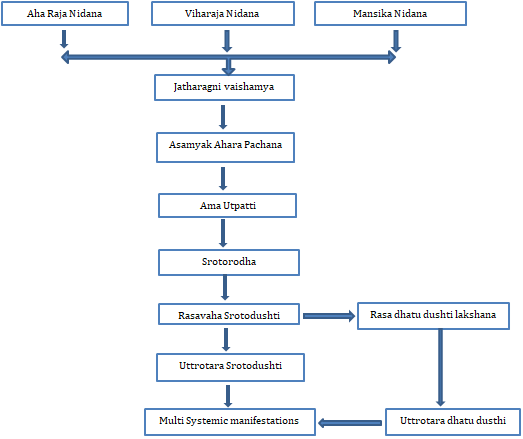
The pathogenesis of Hypothyroidism revolves around Ama. Dysfunctioning of Jatharagni leads to Dhatuagnimandhya leading to the formation of Ama. According to Acharya Vagbhatta symptoms of Ama which can be corelated with symptoms of Hypothyroidism [3] (Table 1).
| Stunted growth, Hoarseness of voice | |
|---|---|
| Balbhransha | Delayed development milestones, cold intolerance, mental impairment |
| Gaurava | Swollen, puffy, oedematous look of face, bloated face, weight gain |
| Anil Mudhta | Slow heart rate, reduced respiratory rate, joint pain, inability to concentrate. |
| Aalasya | Lethargy, Sleepiness |
| Apakti | Indigestion |
| Aruchi | Anorexia |
| Malsanga | Constipation |
| Klama | Slowing down of thought process, Fatigue |
Table 1: Acharya Vagbhatta symptoms of Ama, corelated with symptoms of Hypothyroidism.
Samprapti
| Dosha | Tridosha predominantly Vata and Kapha |
| Dushya | All Dhatus predominantly Rasa, Meda |
| Agni | Jatharagni, Dhatvagni |
| Srotas | All Srotas |
| Srotodusti | Sanga |
| Adhisthana | Sarva Sharira especially Kantha Pradesh |
| Udbhavastana | Amashaya |
| Rogmarga | Bahya, Abhyantra |
| Vyaktisthana | Sampurna Sharira |
Table 2: classifications of Samprapti.
Diagnosis
Thyroid Function Test
- TSH level – 0.3-5.0U/ml
- Triiodothyronine(T3) – 75-200ng/dL
- Thyroxine(T4) – 4.5-11.5ug/dL TPO (Thyroid Peroxidase Antibodies)
Treatment
The Chiktisa Siddhanta of Hypothyroidism revolves around Chiktisa of Ama Dosha i.e Pachana, Deepana and Shodhana after Sneha and Sweda Karma [4] The line of management aims at
- Dhatwagni Deepana
- Dhatugata mala Pachana
- Srotoshodhana
- Vata-Kapha Shaman
- Manoharshana
- Rasyana
- Yoga • Deepana The diet or medicine which stimulate digestive fire [5].
Single drug - Shatapushpa,Pippali,Maricha,Sunthi Ayurvedic formulations
- Shaddharanam Choornam
- Panchkola Choorna
- Indukanta Ghrita
- Pachana The diet or medicine which leads to digestion of undigested food or Ama. This process does not increase or stimulate digestive capacity (Agni) at primary level [5]. Single Drug- Nagkeshar Ayurvedic formulations
- Hingwashtaka Churna
- Lavanbhaskara Churna
- Panchkola Churna
- Chitrakadi Vati
- Lashunadi Vati
- Shiva Gutika
- Guduchyadi Kwatha
- Shodhana The process by which vitiated Doshas are expelled out from the body by their nearest route Doshas might sometimes aggravate even after treatment with Deepana and Pachana. But they never reoccur if they are subdued with evacuative therapy [6].
- Vaman (Kapha Chedana)- Madanaphaladi Yoga,Vacha, Yashtimadhu
- Virechana – Trivrutta Avleha
- Nasya – Shadbindu Taila
- Vata Kapha Shamana
- Punarnavadi Kwatha
- Navaka Guggulu
- Manoharshan
- Rasayana: Amalaki, Shatavari,Ashwagandha , Triphala Rasayana , Guduchi Rasayana
- Yoga: Some beneficial Yoga postures in Hypothyroidism are:
- Sarvangasana – Shoulder stand
- Viparita Karani Asana – Inverted Pose
- Janu Sirsasana – Seated head to knee pose
- Matsyasana - Fish pose
- Halasana – Plough pose
- Surya Namaskara – Sun salutation
- Pranayama – Kapalbhati, Ujjayi, Pranayama, Bhastrika,Nadi Shodhana , Pranayama
Pathya Apathya
The Pathya include Purana Ghrita Pana, Jeerna Lohita Shali, Yava, Mudga, Patola, Rakta Shigru, Ruksha Katu Dravyas and Deepana Dravyas Apathya include Kshira Vikruti, Ikshu Vikruti all types of Mamsa, Pishtaannam
Conclusion
Hypothyroidism is a condition where there isn’t enough thyroid hormone in your bloodstream and metabolism slows down. Also known as underactive thyroid disease. No disease in Ayurveda can be directly correlated with hypothyroidism it can be understood as Udanavritta Samana, Kaphavrita Udana, Pathological increase of Kapha, Meoroga, Agnimandya. So, hypothyroidism should be understood on the basis of vitiation of Doshas, tissues and channels involved in pathogenesis of the disease. Weird prevalence of Hypothyroidism leads to our scientists think about its remedy to check its complication and morbidity. Contemporary system of medicine offers palliative treatment which is basically alteration of hormones. Alteration of hormone again leads to complication and becoming cause of mortality. So, society is looking at Ayurveda for its holistic approach towards Hypothyroidism So it is a need of hour to get treatment or remedy for Hypothyroidism which has no side effect, cost effective and which does not interfere with normal production of hormone in the body. Shodhana and Shaman are the principal treatment utilities described in Ayurveda, both are subjected to establish their effect on Hypothyroidism.
References
-
Bagcchi S (2014) Hypothyroidism in India: more to be done. Lancet Diabetes Endocrinol 2(10): 778.
-
Sushruta (2009) Sushrut Samhita. In: Shastri AD (ed.) Ayurved Tattav Sandipika Hindi commentary. purvardh sutra sthan, 46/507-508, Part 1, Chaukhambha Oriental Varanasi, India, pp: 287.
-
Gupta A (2005) Vidyotini Hindi Commentary, Astanga Hridayam. Sutrasthana, 13/2324, Chaukhambha Sanskrit Sansthana, Varanasi, India, pp: 132.
-
Gupta A (2005) Vidyotini Hindi Commentary, Astanga Hridayam. Sutrasthana, 13/29, Chaukhambha Sanskrit Sansthana, Varanasi, India, pp: 133.
-
Srivastava S (2017) Sharngadhara Samhita of Acharya Sharngadhar. Jeevanprada, Purvakhanda, Chaukhambha Prakashan, Varanasi, India, Chapter 4/1, pp: 30.
-
Pandey K, Chaturvedi G (2019) Charak Samhita, Svimarsha Vidhyotni Hindivyakhyaupeta. Sutra Sthana, chapter 16, Shlok no.20, Chaukambha Sanskrit publications, Varanasi, India, pp: 321.
- Management of Ear Keloid with Ksharsutra: A Case Study
- Yoga and Global Sustainability: A Holistic Path to One Earth, One Health
- Autoimmune Diseases in Ayurveda: A Narrative Review with Classical and Modern Perspectives
- Management of Cluster Headache Associated with Pituitary Apophysitis by CERT (Chakrasiddh Energy Release Technique): A Case Report on Energy Rebalancing
- Zygophyllum Geslini Coss : Biochemicals and Antioxidant Activity
- Observations of a Beginner Vaidya