
An Outlook of Amavata W.S.R to Rheumatoid Arthritis
With modernisation dietary habits, life style, social structure and environment have been changing. Due to lack of physical activity and sedentary life style, metabolism of body is getting slower. In Ayurveda this is called dysfunction of Agni (Jatharagni and Dhatwagni). Impaired status of Agni leads to formation of Ama. Deposition of Ama hampers the functions of Vata leading to condition called Amavata. Occurrence of Amavata on large scale is one of the outcomes of this modernisation. Amavata is progressive sporadic disorder found in general population with complaints of difficulty in doing routine work due to dysfunction of joints especially due to pain, stiffness and swelling. Clinical presentation of Amavata closely resembles with Rheumatoid arthritis (RA). It is an autoimmune chronic inflammatory disease characterized by inflammation of synovial joints leading to destruction of joint and periarticular tissue. Patients are almost functionless for their work due to sluggish movement and painful condition. Amavata is one of the most troubles causing disorder for patients due to its deformity causing nature. It is also very challenging for clinicians due to its chronicity, incurability, and complications. Lack of awareness in the society about disease people suffer lifelong joint deformity. Contemporary system of medicine offers only symptomatic and palliative treatment which has more complications than benefits to the patients.
Introduction
The word Amavata is composed of two words- Ama & Vata. Where Ama is immature Dosha, Dhatu & Mala and Vata is the major cause of movement in body. The Ama when combines with vitiated Vata and occupies in Sleshma Sthana (Asthi and Sandhi) [1] results painful and deformity causing disease ‘Amavata.’ It can be correlated with Rheumatoid arthritis. The sign and symptoms of both the disease are nearly same. Rheumatoid arthritis (RA) is chronic multisystem disease of unknown cause. Although there are variety of systemic manifestations, the characteristic features of RA are persistent inflammatory synovitis, usually involving peripheral joints in symmetric distribution [2]. Amavata is first described as independent disease by Acharaya Madhavakara.
Aims and Objectives
- To know Amavata in details.
- To understand its deformities and complications.
- To understand the Ayurvedic treatment of Amavata and its efficacy.
Materials and Methods
As this is a review study, so we have collected information from Ayurvedic Samhitas, elementary books and review article to get full knowledge of the disease Amavata its complications and management.
Etiological Factors (Nidana)
विरुद्धाहारचेष्टस्य मन्दाग्नेर्निश्चलस्य च । स्निग्धं भुक्तवतो ह्यन्नं व्यायामं कुर्वतस्तथा ।। (Ma.Ni 25/1) [3] According to Acharaya Madhavakara etiological factors of Amavata are- Viruddha Ahara (incompatible diet) Viruddha Cheshta (erroneous habit) Mandagni (diminished digestive fire) Nischalata (Sedentary habits) Vyayama (physical exertion) immediately after having Snigdha Ahara
Rupa (signs & symptoms)
Acharaya Madhavkara have described the Rupa of Amavata [4]. These can be classified under the following categories: Samanya Lakshana: Angamarda (generalized bodyache), Aruchi (anorexia), Trishna (excessive thirst), Alasaya (lethargy), Gaurava (heaviness), Apaka (indigestion) and Angashunta (edema in different parts of body). Doshanubandha Lakshana: sensation), Raga (redness) and Shula (pain in joints), Pittanubandha is Daha (burning) Kaphanubandha is Staimityata, Gaurava (heaviness), Kandu (itching). Pravriddha Lakshana: Saruja Shotha (pain and swelling in hands, legs, ankle, knee, wrist, shoulder, and hip joints) Vrishchika danshavata Vedana (pain like scorpion bite), Bahumutrata (polyuria), Agnidaurbalya (diminished digestive fire), Praseka (excessive salivation), Aruchi (anorexia), Gauravata (heaviness), Utsah-hani (loss of enthusiasm), Vairasyata (tastelessness), Daha (burning sensation), Kukshikathinyata and Kukshishoola (abdominal pain), Nidraviparyaya (sleep disturbance).
Samprapti
Acharaya Madhava has described the Samprapti of Amavata. All the three doshas take part in pathogenesis of disease but Ama and vitiated Vata plays the dominant role.
Due to intake of etiological factors, function of Jatharagni diminished (Agnimandaya). This Mandagni is unable to digest the food properly leading to formation of Ama. This Ama when combined with vitiated Vata, circulates throughout the body via channels (Srotas) and cause obstruction of Srotasa. Due to obstruction of channels various symptoms (Gurugatrata & Stabdhta) appears. All this cause insufficiency of nutrition to further dhatus leading to Dhatukshaya and Daurbalya. Later, Ama lodge at Trika and Sandhi Pradesha which cause Shoola, Shotha, Stabdhta in Sandhi (joints).
Samprapti Ghataka (Table 1)
| Agni | Jatharagni and Dhatvagnimandya |
|---|---|
| Udbhava Sthana | Amashaya and Pakvashaya |
| Vyakata Sthana | Kaphasthana i.e., Sandhi, Uras, Amashya |
| Vyadhi Swabhava | Chirakari and Punah Punah Akramanasila |
| Roga Marga | Madhyama |
Table 1: Classifications of Samprapti Ghataka.
Pathophysiology (Figure 1)
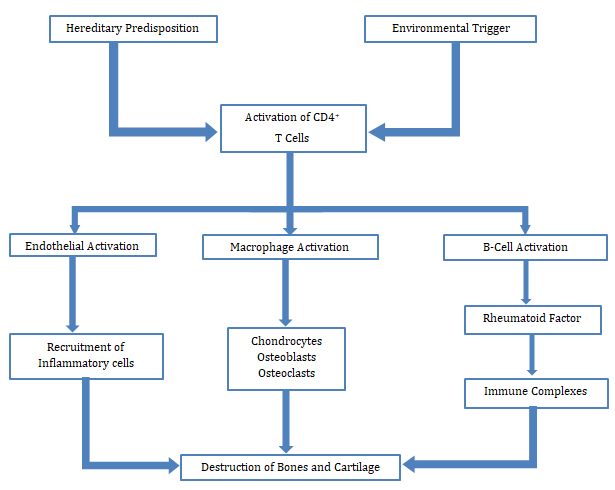
Presentation
Rheumatoid arthritis presents as acute polyarthritis developing over a period of few days or from weeks to month. Commonly affected joints are metacarpophalangeal, metatarsophalangeal and wrist. Ra usually presents in symmetrical manner along with morning stiffness.
Chikitsa Sutra
लङ्घनं स्वेदनं तिक्तदीपनानि कटूनि च । विरेचनं स्नेहपानं बस्तयश्चाममारुते ।।
रूक्षः स्वेदो विधातव्यो बालुकापोटलैस्तथा । उपनाहाश्च कर्तव्यास्तेऽपि स्नेहविवर्जिताः।। (Y.R Amavata Chikitsa Adhikara) [5] Chikitsa of Amavata can be divided in two stages Stage 1 [Chikitsa of Sama Awastha]- Langhana, Svedana and Deepana Stage 2 [Chikitsa of Jeerana Amavata]- Virechana, Snehapana & Basti etc.
Langhana: The process of bringing Laghuta in the body is Laghana [6]. In Amavata, Ama is primary cause of Agnimandya and disease. Langhna helps to get rid of Ama and increase digestive fire (agni).
Swedana: The process whichs reduces Sthabhana (stiffness), Guruta (heaviness) is Swedana (sudation) [6]. Ama is Guru and Snigdha in nature, Swedana having opposite qualities is beneficial. In Amavata Rooksha Valuka Pottali Sweda (in Naveena Amavata) and Upanaha (in Jeerana Amavata) is recommended.
Tikta Katu And Deepana Dravayas: The diet or medicine which stimulates digestive fire (Agni) is called Deepana [7]. Agnimandaya is important pathological factor in Amavata. Katu and Tikta Rasas are antagonistic to Kapha and Ama, and are useful as Amapachana and Vatanulomana. Eg: Sunthi Churana, Panchkola Churana, Trikatu Churana, etc.
Virechana: The process of eliminating doshas (toxins) through anal route is Virechana (purgation). Eranda Taila and Haritiki is considered best for Virechana in Amavata.
Basti: It is one of the chief Panchkarma procedure used to treat Vatika disorder. Acharaya Chakradutta mentioned Saindhavadi Anuvasanabasti and Ksharabasti in Amavata [8].
- Shamana Aushadis for Amavata (Table 2):
- Rasa Aushadis
- Churana
- Vati and Gugglu
- Kwatha
- Ekala Aushadis
- Agnitundi vati
- Amavatri rasa
- Sanjeevani vati
- Amavateshwara
- Sunthi Churana
- Amapramathini vati rasa
- Haritaki Churana
- Shimhanaada
- Vatagajendara
- Vaishvanar gugglu rasa churana
- Yogaraja gugglu
- Shakha bhsama
- Vatari gugglu
Table 2: classification of Shamana Aushadis for Amavata.
Discussion
According to Acharaya Vagbhata ‘रोगाः सर्वेऽपि मन्देऽग्नौ’ [9] Impaired status of Agni leads to development of various kinds of diseases. Amavata is one of those disease caused by poor digestive fire (Mandagni). This Mandagni leads to formation of Ama which is a major contributor to the development of disease Amavata. Ama combined with vitiated Vata and hamper the normal function of Vata Dosha. This Ama and vitiated Vata tends to deposit in Kapha dominant areas specially in Sandhis (joint) and produce Lakshana like Sandhishotha, Sandhishoola, Angamarda, Aruchi, Trishna, Alasaya, Gaurava etc.
Symptomatically it can be correlated with sign and symptoms of Rheumatoid arthritis (RA), it is an autoimmune and inflammatory disease of unknown cause. Although it is a multisystem disease but mainly affect joint in symmetrical manner.
Conclusion
Contemporary system of medicines offers only symptomatic treatments. NSAIDS, DMARDS and corticosteroids are the major line of treatment for this disease which has severe adverse effects and limitations for long term. So, this is the time to opt for Ayurvedic system of medicine. After proper shodhana various Shamana Aushadhis along with Rasayana can be used for better management of Amavata.
References
-
Sastri S (2009) Madhavakara, Madhav Nidana, Madhukosha Sanskrit Commentary by Vijayraksita, Srikanthadatta and Vidyotini Hindi Commentary. Upadhyaya Y (Ed.), Nidana Sthana 25/5, Chaukhambha Prakashana, Varanasi, India, pp: 509.
-
Fauci AS, Braunwald E, Kasper DL, Hauser SL, Longo DL, et al. (2001) Harrison Principle of Internal Medicine 15th Edition. Harrison TR, et al. (Eds.), McGraw Hill, USA, pp: 1928.
-
Sastri S (2009) Madhavakara, Madhav Nidana, Madhukosha Sanskrit Commentary by Vijayraksita, Srikanthadatta and Vidyotini Hindi Commentary. Upadhyaya Y (Ed.), Nidana Sthana, 25/1, Chaukhambha Prakashana Varanasi, India, pp: 508.
-
Sastri S (2019) Madhav Nidana of Shri Madhavakara, Madhukosha Sanskrit Commentary by Shrivijayraksita and Srikanthadatta and Vidyotini Hindi Commentary. Upadhyaya Y, (Ed.) Nidana Sthana, 25/6-11, Chaukhambha Prakashana Varanasi, India, pp: 511-512.
-
Sastri VL (2015) Yogaratnakara with Vidyotini Hindi commentary. Sastri BB (Ed.), Amavata Chikitsa Adhikara Shloka (1,2), Chaukhambha Prakashna Varanasi, India, pp: 566.
-
Shastri PK, Chaturvedi G (2014) Charaka Samhita of Agnivesa, Savimarsha ‘Vidyotini’ Hindi Vyakhyaopta. Sutra Sthana, Laghanabrihaniya Adhyaya (Ch-22/09), Chaukhambha Prakashna Varanasi, India, 1: 424
-
Srivastava S (2017) Sharngadhara Samhita of Acharya Sharngadhar ‘Jeevanprada’ Hindi Commentary. Purvakhanda Chapter 4/1, Chaukhambha Prakashan Varanasi, India, pp: 30.
-
Tripathi I (2015) Chakradatta of Sri Chakrapanidatta ‘Vaidayaprabha’ Hindi Commentary. Dwivedy R (Ed.), Amavata Chikitsa 25/1, Chaukhambha Prakashan Varanasi, India, pp: 166.
-
Gupta KA (2016) Astangahrdam of Vagbhata Vidyotini Hindi Commentary. Upadhaya VY (Ed.), Nidan Sthana 12/1, Chaukhambha Prakashan Varanasi, India, pp: 358.
- Management of Ear Keloid with Ksharsutra: A Case Study
- Yoga and Global Sustainability: A Holistic Path to One Earth, One Health
- Autoimmune Diseases in Ayurveda: A Narrative Review with Classical and Modern Perspectives
- Management of Cluster Headache Associated with Pituitary Apophysitis by CERT (Chakrasiddh Energy Release Technique): A Case Report on Energy Rebalancing
- Zygophyllum Geslini Coss : Biochemicals and Antioxidant Activity
- Observations of a Beginner Vaidya