
A Critical Review on Bandhyatva (Anovulation)
Infertility is defined as the failure to conceive after one year of regular intercourse without the use of contraceptive. The difficulty to conceive or subfertility constitutes a major social and psychological burden amongst couples. Premature ovarian insufficiency, polycystic ovarian syndrome, endometriosis, uterine fibroids, and endometrial polyps are all potential causes of female infertility, with ovulatory issues being the most common ones. Various factors including genetic disorders, advancing age, poor nutrition, environmental pollution, and increased stress in daily life, may all contribute to female infertility. Infertility is described as Bandhyatva in Ayurvedic literature. In Contemporary Science, treatment options mostly involve the use of hormone medications or injections, as well as Assisted Reproductive Technologies (ART). Ayurvedic treatment, on the other hand, comprises Nidana Parivarjana (removal of the cause), dietary control, Samshamana (pacificatory therapy), and Samshodhana (purification and cleansing). The aim of this study is to understand Bandhyatva along with Anovulation with Ayurveda and Modern Perspective.
Introduction
Infertility is the inability of a couple to achieve pregnancy over an average period of one year (in a woman under 35 years of age) or 6 months (in a woman above 35 years of age) despite adequate, regular (3-4 times per week), unprotected sexual intercourse [1]. Infertility may also be referred to as the inability to carry a pregnancy to the delivery of a live baby. It affects approximately 10-15% of reproductive couples. About 40% of cases are due to female factors, 30% are due to male factors, 20% are a combination of both, and in about 10% the cause is unknown [2]. The increase in the prevalence of infertility is due to at least four factors: delayed childbearing, alterations in semen quality due to habits such as cigarette smoking and alcohol, and changes in sexual behaviour. The WHO estimates the overall prevalence of primary infertility in India to be between 3.9 and 16.8 percent [3]. The most common cause of female infertility is ovulatory problems, which generally manifest themselves by sparse or absent menstrual periods [4]. There are various factors, including lifestyle changes, nutrition, disease, malformation of the uterus, increased stress, age, genetic factors, and environmental pollution, that may contribute to infertility. Moreover, in this era, women are becoming more career-focused, which frequently causes a delay in marriages. Increased maternal age may also increase the chance of infertility [5]. It is a societal stigma in which the female partner is held accountable for creating marital discord. In Ayurveda, infertility is described as Bandhyatva.
Disease Review
According to WHO, infertility can be described as the inability to become pregnant, maintain a pregnancy, or carry a pregnancy to live birth [6]. A clinical definition of infertility by the WHO and ICMART (The International Committee for Monitoring Assisted Reproductive Technology) is “a disease of the reproductive system defined by the failure to achieve a clinical pregnancy after 12 months or more of regular unprotected sexual intercourse” [7]. Infertility can be divided into two types – Primary and Secondary Infertility.
- Primary Infertility: It refers to the inability to give birth either because of not being able to become pregnant, or carry a child to live birth, which may include miscarriage or a stillborn child [8].
- Secondary Infertility: It refers to the inability to conceive or give birth when there was a previous pregnancy or live birth [8].
Causes of Female Infertility
According to the FIGO manual (1990) causes are Tubal and Peritoneal Factors (25-35 %), Ovulatory Factor (30-40 %) and Endometriosis (1-10 %) [9] (Table 1).
| Ovulation dysfunction (30-40%) | Oligoovulation, Anovulation, Corpus luteum deficiency |
| Tubal abnormalities (25-35%) | Tubal block may be due to infection, pelvic adhesions etc. |
| Uterine abnormalities (10%) | Thin endometrium, endometritis, uterine fibroids, Synechiae, congenital abnormalities |
| Cervical factors (5%) | Cervicitis, cervical polyps, cervical erosion, cervical malignancy |
| Vaginal Factors | Vaginal atresia, vaginal septum, Narrow introits, Vaginitis and purulent discharge |
Table 1: Cause of infertility in female [9].
Management
Depending on the cause it falls into two main categories:
- Medications or Surgery Fertility drugs (clomiphene citrate or FSH and LH hormone injections) for women with ovulation disorders [2]. These treatments may also be used with an intrauterine sperm injection (IUI), which is when sperm is injected directly into the uterus. Surgery may also be an option when the cause of infertility is blocked fallopian tubes or endometriosis.
- Use Assisted Reproductive Technologies (ART) These technologies include egg and embryo donation, in vitro fertilization, and intracytoplasmic sperm injection (the direct injection of a sperm into an egg).
Anovulation
Ovulation refers to the physical act of rupture of the follicle with the extrusion of the Oocyte. When the follicle does not rupture then ovulation fails and it is called Anovulation. Anovulatory Cycles are Characterised as Menstrual bleeding without Ovulation and Corpus luteum formation.
Causes of Anovulation
• Persistent Oestrogen Secretions [10]
- Abnormal Oestrogen clearance and Metabolism
- Extra Glandular Oestrogen Production
- Loss of Stimulation
- Polycystic Ovarian Disease
- Hyper Thyroidism
- Hyper – Prolactinemia
- Premature Menopause
- Hyper Insulinaemia and Hyper Androgenism
- Discontinuation of OCP.
- Genetic Considerations etc
Treatment for Anovulation
Clomiphene Citrate is the drug of Choice for Ovarian Induction. Other management includes Human Gonadotrophins, Gonadotrophin releasing hormone therapy etc.
Ayurvedic Review
Bandhyatva is described since Samhita kala in Brihattreya as well as Laghuttreya. Acharya Charaka and Acharya Vagbhata have referred Bandhya due to abnormality of Bijamsa [11, 12] and mentioned as the Upadrava of Yoni vyapada [13]. According to Acharya Charaka, Abnormality in any one out of Shadbhawas (Matraj, Pitraj, Atma, Satwa, Satmya, Rasa) will cause the failure to conceive [14]. In Sushruta Samhita, Bandhyatva has been described under Bandhya Yonivyapada, which is included amongst twenty Yonivyapadas [15]. Acharya Bhela says that due to the abnormalities of Bija of mother and father, non-consumption of congenital Rasas and disorders of Yoni, the women become Bandhya [16]. Bhavprakasha has mentioned Bandhya in Yonirogadikara and mentioned Artavanasha as one among the 80 Vatajananatmaja Vikara [17]. In Harita Samhita, Acharya Harita has described Bandhyatva as a disease, in eighty Vataja vyadhi. He has defined Bandhyatva as a failure to achieve a child rather than pregnancy, because he has included Garbhasravi, Mritavatsa also under the classification. The definition of Bandhyatva is not mentioned but the types and prognosis of the Bandhyatva individuals has been described [18]. In Kashyapa Samhita under chapter of Jatiharani one is “Pushpaghni”, which can be related with anovulatory cause of infertility and other various types of disease mentioned which leads to childlessness [19]. In Ayurveda, Anovulation refers to Abeejotsarga. The Term Utsarga means to expel or to leave. So, Expulsion of matured ovum from the Beejagranthi means Beejotsarga. As Utsarga is a Karma of Vata so Vitiliation of Apana Vata dosha causes Abeejotsarga. Abeejotsarga is symptom as well as a disease caused due to vitiation of Vata and kapha doshas as they do Marga–Avarodha to Artavaha Strotas leading to Abeejotsarga [20]. According to Acharya Kashyapa, the women having amenorrhoea, Scanty menstruation, non-ovulation or useless ovulation (ovum with minimal or absence of capacity of fertilization) should be treated with Anuvasana Basti [21].
Classification
The classification of Bandhyatva has not been given separately in any classics except Harita Samhita, Rasa Ratna Samucchaya and Bandhya Kalpdrum. Acharya Charaka has mentioned Sapraja, Apraja and Bandhya in three different contexts. Sapraja means infertility occurs after conceiving one or more children, Apraja resembles curable infertility and Bandhya resembles incurable sterility [22] (Table 2).
| Rasa Ratna Samucchaya (A.32/1-3) | Bandhya Kalpdrum (Stri Chikitsa Sammuchaya) | |
|---|---|---|
| Kakavandhya | Adivandhya | Tripakshi |
| Anapatya | Vataja | Subhrati |
| Garbhasrav | Pittaja | Sajja |
| Mritvatsa | Kaphaja | Trimukhi |
| Balakshaya | Sannipataja | Vyaghrini |
| Garbhakosa bhanga | Bhutaja | Baki |
| Daivaja | Kamili | |
| Raktaja | Vyaktini | |
| Abhicharaja |
Table 2: Classification of Bandhyatva.
Nidana: While describing Nidanas for Bandhyatva, the acharas has mentioned the important factors as constituents of Garbha which included Ritu (appropriate time), Kshetra (healthy Uterus and passage), Ambu (proper nutrition of mother), Bija (healthy ovum and sperm), normalcy of Hridaya or Psychology, properly functioning Vayu and Shadbhavas; abnormality in one of these can cause infertility [23, 24, 25]. Acharya Charaka has clearly described the Nidanas of Bandhyatva which are nearly identical to the causes of infertility according to modern science. Abnormality of Yoni, psychology (Manobhighata), Shukra, Asrik, diet and mode of life (Shukra-artava, Ahara - Vihara dosha), coitus at improper time (Akala Samyoga) and loss of Bala (Balakshaya) have been included, in the causes of delay in achieving conception by an otherwise fertile or Sapraja woman by Charaka [26].
Specific Nidanas of Anovulation: There are other scattered references to anovulation, including Beejopaghata, Pushpopaghata, and Abeejatva. Several circumstances with their Nidanas, which appear to be associated with Abeejotsarga and result in Bandhyatva, are being described here [27].
- Pushpaghni Revati Jataharini- Acharya Kashyapa described Pushpaghni as a Jataharini, a woman who menstruates on a regular basis but is unable to conceive. Pushpaghni, like Jataharini, is curable. It most likely refers to infertility caused by decreased ovarian hormones, resulting in the absence of ovulation. A slight increase in hormone secretion from the adrenal cortex causes hirsutism, or facial hair. Adharma, which can be interpreted as an infection, is the cause of Revati’s initiation. Infection causes Sanga in the Srotasa, which transforms into Vikruti, similar to anovulation.
- Ashtartava dushti- According to Acharya, if Ashtartava dushti is left untreated or improperly treated, it creates Abeejata, i.e., the inability to do prajotpadana. Acharyas have not provided a detailed explanation for the origin of these eight menstruation diseases. It can be claimed that certain circumstances responsible for the aggravation of particular Doshas, in conjunction with non-observance of reproductive system regulations, are the causal factors. Vata gets aggravated, resulting in “Dhatu- Kshaya”. Due to this Dhatu Kshaya, Rasa Dhatu diminishes, which ultimately results in the Kshaya of its Updhatu, namely Artava (Anovulation).
- Artavavaha Sroto Vighata- In this case, the Viddha of Artavavahi Dhamanyas indicates damage to the ovaries and ovarian veins, which impedes the normal ovulation process and finally causes Artavanasha (Anovulation). Abhighata vitiates Vayu as well. Therefore, once more, vitiated Vayu results in Sanga and Dhatu Kshayatmaka sthiti in Artavavaha Srotasa, followed by Artavanasha (anovulation).
- Avarana- According to Sushruta and Vagbhata’ s concept of Artavanasha, both Vata and Kapha, when aggravated, obstruct the path, and thus Artava is destroyed. Artava can be interpreted as Antahpushpa, or ovum, and its Nasha as anovulation. The Kapha and Vata obstruct the Artava Vaha Srotas, making Artava invisible (Ovulation does not occur). It is a Sanga Pradhana Vikara as well.
- Bandhya Yoni Vyapad: According to Sushruta, the Artava is destroyed at Bandhya Yoni. Artava might be interpreted as an ovum and Bandhya as an anovulatory menstrual cycle. Ovum is a microscopic structure; it was assumed to have existed in those days due to its involvement in conception. The root cause of Bandhya Yonivyapada is vitiated Vata dosha. Here, Nashtartava or anovulation is one of Bandhya’ s symptoms.
- Anuvasana yogya - Abeejatva: Here, Nashta Beeja directly indicates Anovulation.
- Use of Tikshna Virechana in Mridukostha: According to Acharya Kashyapa, when Tikshna Virechana is administered to a Mridukostha woman, Vata becomes worsened and induces Beejopaghata. Here, Apana Vayu is primarily responsible for Beejopaghata because it may inhibit the extrusion of the oocyte from the follicle.
- Beeja dushti: During the prenatal time, if the mother consumes Vata Prakopaka Ahara and Vihara, the Vata becomes inflamed and ruins the Beeja or Beeja bhaga or Beejabhagavayava in the female child, causing congenital abnormalities of the female genital organ, known as Bandhya.
- Asrik doṣha: The Word “Asrik” refers to both ovum and menstrual blood. Abnormalities of ovum and ovarian hormones produce infertility.
- Dietetic habit: In addition to these factors, poor dietary practises are a leading cause of anovulation. Because of, Ati Ushna Annapana, Veerya, Artava, Beeja becomes vitiated. Practicing improper dietary practises such as Vishamashana, Adhyashana, Anashana, and Viruddha annapana promotes agnivaishamya and Rasadushti, which culminates in artava dushti in the form of Anovulation.
Purvarupa [27]: In Kashyapa Samhita, Acharya Kashyapa has described “Bandhya Yoni” in context of Vataja Nanatmaja Vyadhi. Avyakta Purvarupa of Vata Vyadhi has been mentioned by Charaka. So, Purvarupa of Bandhyatva is not described by anyone, anywhere.
Rupa [27]: A woman, in whom Artava has been destroyed, is termed as Bandhya.
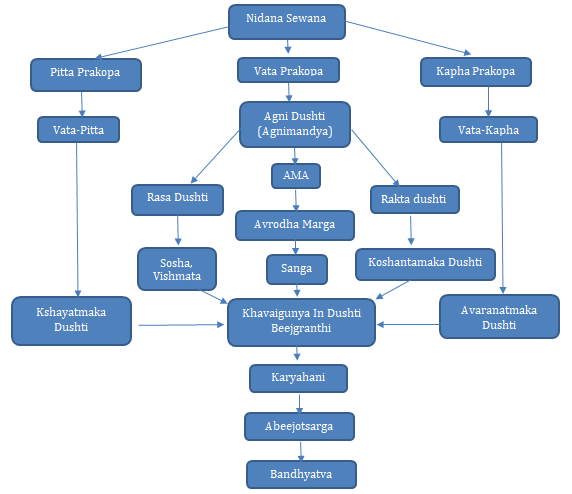
Probable Samprapti [28]( Figure 1)
Due to Nidana Sevana (causative factors), Dosha (three humours- Vata, Pitta, Kapha) and Agni (biochemical transformers) get vitiated resulting into Ama (un-metabolized food) formation. The Ama formed adheres to Srotasa (channels) and causes Avarodhatmaka Dushti (improper functioning due to obstruction of channels). Ama spreads throughout the body, propelled by the vitiated Vata along the Rasavaha Srotasa (channels carrying the nutritional essence). Due to hypo functioning of Jatharagni (gastrointestinal metabolism), Dhatvagni Mandya (slow tissue metabolism) also occurs. Due to Mandagni (slow digestion) and Nidana Sevana, Rasa (plasma), Rakta (blood) Dhatu (tissue) gets vitiated. Also, the Dhatvagni Mandya causes the Kshayatmaka (declining) effect on the Artava (ovum) i.e., the production of Artava, Updhatu (subsidiary or secondary tissue product) of Rasa dhatu or Rakta dhatu becomes less. Thus, it is the Upadhatvatmaka Dushti (malfunctioning of secondary tissue products). Vishvamitra has clarified that hair thin vessels fill the uterus for whole month to receive Bija (ovum) and due to Rasa dushti, Poshanatmaka (nourishment) Dushti can occur. The vitiated Apana Vayu (and Kapha when get mix can cause Avaranatmaka Dushti (malfunctioning due to occlusion. The vitiated Vata along with Pitta causes the Artava kshaya i.e., Kshayatmaka Dushti. All these factors may cause Abeejotsarga (anovulation) which may lead to infertility [28] (Table 3).
| Dosha | Tridosha with predominant vata |
| Dhatu | Rasa, Rakta |
| Updhatu | Artava |
| Srotas | Artavavaha |
| Srotodusti | Sanga |
| Udbhavasthana | Pakvasaya [mula sthana of vata] |
| Adhisthana | Yoni |
| Vayadhisvabhava | Chirakari |
| Marga | Abhyantara (Garbhashaya as kosthanga) |
Table 3: Samprapti Ghataka [28].
Management
The Bandhyatva Chikitsa includes-treating the underlying pathological condition of infertility, Avoiding the etiological factors (Nidana parivarjana), basic treatment methods of Bandhyatva by Garbhaprada yogas and following regimens indicated in Garbhadhana [29].
Nidana Parivarjana:
Infertility is a condition caused by different etiological factors. Identifying those causes and strictly avoiding them is the first and foremost thing in the treatment.
Treating the underlying pathology: Treatment of specific causes responsible for infertility such as all gynaecological disorders, disease of Shukra and Artava should be done because it is said that pregnancy occurs only in healthy reproductive organs (Ch. Chi. 30/125)
- Treatment for Asrik dosha
- Panchakarma- Doshanusara vamanadi prayoga
- Sthanika Chikitsa- Kalka, Pichu, Yoni Prakshalana
- Shukra doṣha hara Chikitsa- Rasayana, Vajeekarana, Mutra roga hara dravyas
- Treatment for Yonivyapad - After proper Purvakarma, Panchakarma Chikitsa should be given. As Vata is the prime cause for Yonivyapad, without vata vitiation no Yoni rogas will manifest, that should be controlled well. Application of Lavana Taila, Swedana with Pinda sweda and Kumbhika sweda, Parisheka with Sukhoshna Jala, Vatahara ahara and according to the condition after Shodhana, Uttara Basti can be administered.
- Treatment of Anartava - In a condition of Artava nasha, Acharya Kashyapa mentioned use of Shatavari – Satapushpa by use of this Bandhya or even Shanda can get a son.
Regimens indicated in Garbhadhana: As Purva Samyoga Vidhi some regimens are told, i.e., Shodhana, maintenance of Sadvritta, avoiding negative emotions. By proper purification and samskara yoni, Garbhashaya, beeja and manas will remain unvitiated and are ensured leading to healthy pregnancy by perfect unification of beeja.
Panchakarma along with other basic methods in Bandhyatva (Anovulation)
- The infertile women should be prescribed Vamana, Virechana and Asthapana Basti by which she conceives positively.
- Vamana- Vamana, when given for Kapha dosha nirharan, performs the Soumya Dhatu Shamana and ignites the Agni. Thus, Dhatus in the body, helps in Pitta vruddhi and ultimately increases the quantity and quality of Artava in the Stree.
- Virechana- According to Kashyapa Samhita, the best treatment for Akarmanya Beeja, also known as anovulation, is Virechana.
- Basti –
- Niruha Basti is considered as Amrutha for an infertile woman.
- Anuvasana Basti is an ideal treatment in Beeja Dosha sambandhit Bandhyatva.
- In cases of Beeja Dosha Bandhyatva, like Alpa dosha, Kashta Artava and Nashta Beeja, Anuvasana Basti is ideal.
- Yapana Basti is very ideal in Stree Bandhyatva. It performs both Niruha Basti and Anuvasana Basti which does both Snehana and Shodhana karma.
- Uttara Basti removes the Srotosangha and corrects the Artavagni which regulates the menstrual cycle, thus resulting in ovulation
- Nasya - The medications administered through the nasal route reaches the Shiras and helps in pulsatile action of Gonadotrophin releasing hormones and promotes the ovulation. Thus, helping in treatment of infertility. Lakshmana Kalka with Ghee or milk for Nasya is indicated.
- Ashwagandha siddha Ksheerapaka every day in morning hours after Rutu snana
- Lakshmana mula uprooted in Pushya nakshatra, pounded with milk Other yogas: Narayana Taila, Shatavari Taila, Phala Ghrita, Lasuna Ghrita, Shatavari Ghrita, Kalyanaka ghrita, Kushmanda Avaleha.
Discussion
In the ancient Ayurvedic texts, the Acharyas emphasized several essential factors that contribute to the formation of Garbha (embryo). These factors include Ritu (appropriate timing), Kshetra (healthy uterus and passage), Ambu (adequate nutrition for the mother), Bija (healthy ovum and sperm), normalcy of Hridaya or Psychology, and proper functioning of Vayu and Shadbhavas. Any abnormalities in these factors can lead to infertility. Thus, it becomes crucial to ensure the health of the uterus, vagina, cervix, tubes, ovaries, ovum, and sperm, alongside maintaining a proper diet and psychological well-being of the mother, in order to achieve a healthy pregnancy. Conception occurs when a mature ovum is successfully fertilized by a qualified sperm and attaches to the uterine wall. However, unsuccessful fertilization and infertility can arise due to poor quality of the ovum, sperm, or both, along with other contributing factors. According to Ayurveda, Vata is considered the primary causative factor for female reproductive disorders, including infertility. Without Vata, the Yoni (female genital organs) never get spoiled [30]. Additionally, Vayu plays crucial roles in Vibhajana (cell division leading to ovum development in the ovary) and Pravartana (ovulation). Vata is responsible for completing the process of cell division for ovum formation, known as Dhatu Vyuha Kara. Moreover, Apana Vayu governs the process of Pravartana [31], indicating that ovulation is under the influence of Vata. Any imbalance or vitiation of Apana Vata can affect ovulation.
As per the teachings of Charaka Samhita, the primary factor contributing to the accumulation of Ama (toxins resulting from undigested food) is Agni (digestive fire), and all diseases arise due to imbalances in Agni. In the case of Anovulation, where the release of the ovum is hindered due to Marga-avarodha (blockage of the reproductive channels) caused by Vata and Kapha, it is crucial to address these doshas and eliminate the Marga-avarodha. This can be achieved through Shodhana (cleansing) and Shamana (pacifying) treatments. Thus, the first line of treatment includes Nidana Parivarjana (avoidance of causative factors), Agni deepana (enhancing digestive fire), and Vatanulomana (normalizing Vata).
In summary, the holistic approach of Ayurveda recognizes the importance of multiple factors in achieving a healthy pregnancy, including the balance of doshas, proper functioning of reproductive organs, nutrition, psychological well-being, and digestive fire. By addressing these aspects through appropriate treatments, Ayurveda aims to promote fertility and overcome infertility.
Conclusion
Infertility has increased tremendously in the past decade and this is due to the result of a combination of social, environmental, psychological, and nutritional factors. Today, the modern medicine has the ability to find out the causes of infertility in an individual through several diagnostic tests and examinations. Using these tests, the treatment focuses on correcting and treating the dysfunction. In Ayurveda, etiology, clinical features and treatment of Bandhyatva has been described in scattered manner throughout the texts. It is described under the heading of Yonivyapad, Artava dushti, Beeja dushti, Jataharini and Matrijbhavadusti, which are comparatively as gynaecological disorders. Ayurveda addresses each body type and boosts the body systems involved in fertilisation, making it a great choice for fertilisation. Ayurveda builds Ojas, improves health, stimulates the hypothalamus and pituitary glands, and indirectly causes the ovaries to mature and release eggs by addressing internal balances and external stimuli. Ayurveda offers a non-invasive, low-cost, and non-iatrogenic alternative and complement to current western therapy for female infertility.
References
-
Cooper TG, Noonan E, von Eckardstein S, Auger J, Baker HW, et al. (2010) World Health Organization reference values for human semen characteristics. Hum Reprod Update 16(3): 231-245.
-
Marcelle Cedars, Robert B. Jaffe (2005) Infertility and Women. The Hormone Foundation, Washington, DC.
-
Shea O. Rutstein, WHO (2004) In fecundity, infertility, and childlessness in developing countries. DHS Comparative Reports No 9, World Health Organization and Calverton, Maryland, USA: ORC Macro.
-
NHS (2017) Causes of infertility. National Health Service.
-
Sauger MV (2015) Reproduction at an advanced maternal age and maternal health. Fertility and Sterility 103(5): 1136-1143
-
WHO (2023) Infertility. Health Topics, World Health Organization.
-
Zegers-Hochschild F, Adamson GD, de Mouzon J, Ishihara O, Mansour R, et al. (2009) Human Reproduction, The International Committee for Monitoring Assisted Reproductive Technology (ICMART) and the World Health Organization (WHO) Revised Glossary on ART Terminology. 24(11): 2683-2687.
-
WHO (2013) Infertility definitions and terminology. Sexual and reproductive health, World Health Organization.
-
Dutta DC (2013) Textbook of Gynecology. In: Dutta DC (Ed.) Textbook of Gynecology. Chapter 16th, 6th (Edn.), JPB Publisher, USA, pp: 229.
-
Mishra G (2003) role of shatavari taila uttar basti and combined drug therapy including shatavari taila uttar basti and some indigenous drugs on vandhyatva w.s.r. to ovulation.
-
Charak, Dridhbala (2013) Charak Samhita. In: Shastri KP, et al. (Ed.) Vidyotini Hindi commentary. Sharira Sthana. Chapter 4, shloka 30, Chaukhamba Bhartiya Academy, Varanasi, India, pp: 877.
-
Vagbhata V (2005) Ashtanga Sangrah. In: Tripathi RD (Ed.), Sharira Sthana. Chapter 2, Shloka 48, Chaukhamba Sanskrit Pratishthan, India.
-
Charak, Dridhbala (2013) Charak Samhita. In: Shastri KP, et al. (Ed.) Vidyotini, Hindi commentary. Chikitsa Sthana, Chapter 30, shloka 38, Chaukhamba Bhartiya Academy, Varanasi, India, pp: 846.
-
Charak, Dridhbala (2013) Charak Samhita. Vidyotini Hindi commentary. In: Shastri RD, et al. (Ed.) Chapapter 4, shloka 4, Chaukhamba Bhartiya Academy, Varanasi, India, pp: 867.
-
Sushruta (2015) Sushruta Samhita. In: Ambika KR (Ed.) Ayurveda Tatvasandipika Hindi commentary. Uttar Tantra. Chapter 38, Sloka 10, Chaukhamba Sanskrit Sansthan, Varanasi, India, pp: 203.
-
Krishnamurthy KH (2000) Bhel Samhita. In: Sharma PV (Ed.) Part 1, Sharira Sthana. Chapter 3, Shloka 2,3,4, Chaukhamba Vishwa Bharti, Varanasi, India.
-
Mishra B (2004) Bhawprakasha Hindi commentary. Chaukhamba Sanskrit Bhawan, Varanasi, India.
-
Tripathi HP (2001) Harita Samhita (Hindi commentary). Tritiya Sthana, Chapter 48, Shloka 1-6, Chaukhamba Krishnadas Academy, Varanasi, India.
-
Kashyap (2016) Kashyap Samhita by Vridha Jivaka Sanskrit introduction. In: Sharma H, et al. (Ed.), Vidyotini Hindi commentary. Rewati Kalp Shloka 33-34, Chaukhamba Sanskrit prakashan, India.
-
Khot B, Patil V, Shinde P (2019) A Conceptual Study on {Abeejotsarga} Anovulation – A Review. World Journal of Pharmaceutical Research 8(12): 291-298.
-
Kashyap (2016) Kashyap Samhita by Vridha Jivaka Sanskrit introduction. In: Sharma H, et al. (Ed.), Vidyotini Hindi commentary. Siddhi Sthana, Chapter 7 Shloka 11, Chaukhamba Sanskrit prakashan, India.
-
Bahadur Rd (2018) Shabdakalpadrum. 3rd (Edn.), Varanasi, Chaukhambha Sanskrit Series, India, 1: 122.
-
Sushruta (2015) Sushruta Samhita. In: Shastri AD (Ed.) Ayurveda Tatva-Sandipika Hindi commentary. Sharirasthana, Chapter 2, Sloka 33, Chaukhamba Sanskrit Sansthan, Varanasi, India, pp: 19.
-
Vagbhata (2017) Ashtanga Hridaya. In: Paradakara HS (Ed.) The Core of Octopartite Ayurveda With the Commentaries Sarvangasundara of Arunadatta and Ayurvedarasayana of Hemadri. Sharira sthana, chapter 1, shloka 8, Chaukhambha Orientalia, Varanasi, India, pp: 1079.
-
Charak, Dridhbala (2013) Charak Samhita. In: Shastri RD (Ed.) Vidyotini Hindi commentary by Pt. Kashinath Shastri. Sharira Sthana, Chapter 4, shloka 4, Chaukhamba Bhartiya Academy, Varanasi, India, pp: 867.
-
Charak, Dridhbala (2013) Charak Samhita. In: Shastri RD (Ed.) Vidyotini Hindi commentary by Pt. Kashinath Shastri. Sharira Sthana, Chapter 2, shloka 7, Chaukhamba Bhartiya Academy, Varanasi, India, pp: 838.
-
Singh P (2018) Clinical study on the Effectiveness of Lasuna Taila Uttara Basti in the management of Stree Vandhyatva due to Anovulation. MD Ayurveda Thesis Ptsr, Sdmcah, Hassan, India.
-
Jadhav S (2002) Prajasthapana Gana Siddha Ghrita– Uttar Basti-Oral Yoga-Vandhyatva- Ovarian Factor. MD Ayurveda thesis PTSR, IPGT & RA, Jamnagar, Gujarat, India.
-
Gayathribhat NV, Suru P (2021) Critical Review of Vandhyatwa w.s.r. Anovulation-Literary Review. International Journal of Ayurveda and Pharma Research 9(7): 45-52.
-
Charak, Dridhbala (2013) Charak Samhita In: Shastri RD (Ed.) Vidyotini Hindi commentary by Pt. Kashinath Shastri. Chikitsa Sthana, Chapter 30, shloka 115, Chaukhamba Bhartiya Academy, Varanasi, India, pp: 858.
-
Rani V, Ravindra Ch (2017) Uttara Basti and Ayurved protocol in the management of primary infertility-A Case Report. International Journal of Ayush Case Reports 1(1): 15-18.
- Management of Ear Keloid with Ksharsutra: A Case Study
- Yoga and Global Sustainability: A Holistic Path to One Earth, One Health
- Autoimmune Diseases in Ayurveda: A Narrative Review with Classical and Modern Perspectives
- Management of Cluster Headache Associated with Pituitary Apophysitis by CERT (Chakrasiddh Energy Release Technique): A Case Report on Energy Rebalancing
- Zygophyllum Geslini Coss : Biochemicals and Antioxidant Activity
- Observations of a Beginner Vaidya