
Potential Antiviral Herbal Therapeutics for Viral Infections
Background Ayurved, an ancient system of medicine with rich heritage and antiquity, is well known since Vedic period. Viral infections are responsible for many illnesses, and recent outbreaks have raised public health concerns. Viral infections are being managed therapeutically through available antiviral regimens with unsatisfactory clinical outcomes. The refractory viral infections immune to available antiviral drugs are alarming threats and a significant health concern. For hepatitis, the interferon and vaccine therapies solely aren't ultimate solutions thanks to recurrence of hepatitis C virus. Owing to the growing incidences of viral infections and particularly of resistant viral strains, the available therapeutic modalities got to be improved, complemented with the invention of novel antiviral agents to combat refractory viral infections. It is widely accepted that medicinal plant heritage is nature gifted, precious, and fueled with the valuable resources for treatment of metabolic and infectious disorders. The aims of this review are to assemble the facts and to conclude the therapeutic potential of medicinal plants within the eradication and management of various viral diseases such as influenza, human immunodeficiency virus (HIV), herpes simplex virus (HSV), hepatitis, and coxsackievirus infections, which have been proven in diverse clinical studies. The scientific literature mainly focusing on plant extracts and herbal products with therapeutic efficacies against experimental models of influenza, HIV, HSV, hepatitis, and coxsackievirus were included in the study. Pure compounds possessing antiviral activity were excluded, and plants possessing activity against viruses other than viruses in inclusion criteria were excluded. Hundreds of plant extracts with antiviral effect were recognized. On the basis of the work of several independent research groups, the therapeutic potential of medicinal plants against listed common viral diseases in the region has been proclaimed. In this context, the herbal formulations as alternative medicine may contribute to the eradication of complicated viral infection significantly. The current review consolidates the data of the various medicinal plants, holding promising specific antiviral activities scientifically proven through studies on experimental animal models. Consequently, the original research addressing the development of novel nutraceuticals based on listed medicinal plants is highly recommended for the management of viral disorders.
Introduction
SARS-COV2 is the causative agent of the potentially fatal disease known as Coronavirus Disease (COVID-19), which is a major issue for worldwide public health. It is hypothesised that this is probably the COVID-19 zoonotic origin due to the high number of affected individuals who were exposed to the wet animal market in Wuhan City, China. Patients who contracted the COVID-19 infection from another person had to be isolated and then received a range of therapies. To contain the present outbreak, numerous steps have been put in place to lessen Covid-19 transfer from person to person. Children, healthcare workers, and the elderly are among the sensitive populations that require special protection or transmission-reduction measures. We emphasise the symptoms, epidemiology, transmission, pathophysiology, and Phylogenetic research and upcoming strategies to stop the spread of this deadly illness [1].
Due to growing worries about the emergence of medication resistance and slow progress in the creation of antiviral drugs, there has recently been a notable advancement in the field of herbal antiviral therapy. Due to their vast therapeutic range and few to no side effects, medicinal plants have been utilised extensively throughout history in almost all nations for the treatment of illnesses and infections as traditional healing treatments. Since most viral agents cannot be treated with synthetic antivirals, every effort has been made to find new medications and complementary/alternative treatments derived from various herbal preparations [2].
Surprisingly little overlap exists in the research on the several hundred plant and herb species with potential as novel antiviral agents. Flavonoids, terpenoids, lignans, sulphides, polyphenolics, coumarins, saponins, furyl compounds, alkaloids, polyines, thiophenes, proteins, and peptides are just a few of the many active phytochemicals that have been found. A significant amount of antiviral activity has also been seen in several volatile essential oils of frequently used culinary herbs, spices, and herbal teas. The majority of the pharmacopoeia of chemicals in medicinal plants with antiviral action, however, remain unknown due to the few classes of compounds examined. Many of these phytochemicals act in ways that are complementary to one another and overlap, such as having antiviral effects by preventing the synthesis of viral DNA or RNA or by preventing the activity of viral reproduction. Multiple-arm trials, randomised crossover studies, and more compromising designs including nonrandomized crossovers and pre- and post-treatment analyses are examples of assay methods to determine antiviral activity [3].
Literature Review of Novel Antiviral Agents
Medicinal plant viewpoint Methods are required to connect laboratory-based studies on antiviral efficacy/ potency. Despite this, there is reason for optimism regarding the long-term effectiveness of phyto-antiviral agents given the recent relative success obtained using medicinal plant/ herb extracts of various species that can act therapeutically in various viral infections. This review highlights the vast array of potentially beneficial medicinal plants and herbs that are awaiting evaluation and use for therapeutic applications against genetically and functionally varied virus families like Retroviridae, Hepadnaviridae, and Herpesviridae [4].
Materials and Methods
Through searches on various websites and web pages like Google Scholar, Medscape, BMC Medicine, the MEDLINE database, ScopeMed, and other relevant information was found using keywords like COVID 19, potential antiviral herbal remedies, relevant literature was gathered to investigate NG. Literature was also taken from a variety of Ayurvedic treatises, Ayurvedic textbooks, and available dissertations and theses, and a number of research publications were looked into literature was also taken from a variety of Ayurvedic treatises, Ayurvedic textbooks, and available dissertations and theses, and a number of research publications were looked into.
Antiviral Agents
Antiviral drugs are a class of medication used specifically for treating viral infections rather than bacterial ones [5]. Most antivirals are used for specific viral infections, while a broad- spectrum antiviral is effective against a wide range of viruses [6]. Unlike most antibiotics, antiviral drugs do not destroy their target pathogen; instead they inhibit their development [7]. Antiviral drugs are one class of antimicrobials, a larger group which also includes antibiotic (also termed antibacterial), antifungal and antiparasitic drugs [8] or antiviral drugs based on monoclonal antibodies [9].
The majority of antivirals are thought to be generally safe for the host, making them useful for treating infections. It is important to separate them from viricides, which aren’t medications but instead deactivate or kill virus particles either inside the body or outside it. Some plants, including Australian tea trees and eucalyptus, naturally produce viricides [10].
Virus Life Cycle
Viruses are made up of a genome and occasionally a small number of enzymes that are kept in a protein capsule called a capsid and occasionally wrapped with a lipid coating known as a “envelope.” Since viruses are unable to reproduce on their own, they spread by controlling a host cell to make copies of themselves, giving rise to the following generation [11]. Researchers trying to create antivirals using such “rational drug design” techniques have attempted to combat viruses at every stage of their life cycles. It has been discovered that some types of mushrooms contain several antiviral compounds that work together in a similar manner [12].
Compounds broad-spectrum antiviral properties when isolated from fruiting bodies and filtrates of different mushrooms, but it will be a considerable time before these substances can be produced and made readily available as frontline antivirals [13].
- The specifics of viral life cycles vary based on the type of virus, but they all follow the same fundamental pattern:
- Attachment to a host cell.
- Release of viral genes and possibly enzymes into the host cell.
- Replication of viral components using host-cell machinery.
- Assembly of viral components into complete viral particles.
- Release of viral particles to infect new host cells.
Anti-Viral Targeting
The main goal of current antiviral medication development is to find viral proteins or segments of viral proteins that can be inhibited. To lessen the possibility of adverse effects, these “targets” should typically be as unlike to any proteins or portions of proteins found in humans as feasible. In order for a single treatment to be effective across a wide range of virus strains, or even across distinct species of virus within the same family, the targets must also be shared. For instance, a researcher may focus on a vital enzyme that is produced by all strains of the virus but not by the patient and investigate what can be done to prevent it from functioning [14].
Candidate medications can be chosen once targets have been identified, either by choosing ones that are already known to have the desired effects or by actually designing the candidate at the molecular level using a computer-aided design programme [15].
By introducing the gene that produces the target protein into bacteria or other types of cells, the target proteins can be produced in the lab for testing with potential treatments. The protein is subsequently produced in large quantities by the cells, which can then be exposed to different treatment options and assessed using “rapid screening” methods [16].
Before Cell Entry
Interfering with a virus’ ability to enter a target cell is one anti-viral tactic. To accomplish this, the virus must first bind to a certain “receptor” molecule on the surface of the host cell, and then it must follow a series of steps that culminate in the virus “uncoating” inside the cell and releasing its contents. Before they may uncoat, viruses with lipid envelopes must fuse their envelope with the target cell or with a vesicle that carries them there [17].
This Stage of Viral Replication can be Inhibited in Two Ways
1. using substances that attach to the cellular receptors and mimic the virus-associated protein (VAP). This could include anti-receptor antibodies, natural receptor ligands, and VAP anti-idiotypic antibodies 2. using substances that bind to the VAP and mimic the biological receptor. This comprises synthetic receptor mimics, exogenous receptors, anti-VAP antibodies, and antibodies against receptor idiotypes [18].
During Viral Synthesis
The processes that create virus components after a virus infects a cell are the focus of a second strategy [18].
Reverse Transcription
Creating analogues of the nucleotides and nucleosides that make up RNA and DNA and disable the enzymes responsible for RNA and DNA synthesis is one technique to achieve this. As opposed to “normal” transcriptase (DNA to RNA), reverse transcriptase inhibition is more frequently linked to this method [19]. Long dsRNA Helix Targeting Long dsRNA helices are produced by the majority of viruses during transcription and replication. Contrarily, during transcription, uninfected mammalian cells often create dsRNA helices with less than 24 base pairs. A class of investigational antiviral medications known as DRACO (double-stranded RNA activated caspase oligomerizer) was first created at the Massachusetts Institute of Technology. DRACO was discovered to be effective against influenza in vivo in weanling mice, in addition to being claimed to have broad-spectrum activity against several infectious viruses in cell culture, including dengue flavivirus, Amapari and Tacaribe arenavirus, Guama bunyavirus, H1N1 influenza, and rhinovirus. According to reports, it selectively causes fast apoptosis in virus-infected mammalian cells while sparing uninfected cells. DRACO causes cell death through one of the final stages of the apoptosis pathway, where complexes with intracellular apoptosis signals are involved. bind many procaspases at once. The procaspases kill the cell by cleaving a variety of cellular proteins, activating other caspases in the cascade, and transactivating other caspases [20].
Immune System Stimulation
Another type of virus-fighting strategies encourages the body’s immune system to combat viruses rather than directly attacking them. Some of these antivirals stimulate the immune system to attack a variety of pathogens rather than concentrating on a single pathogen [21].
Interferons, which prevent the generation of viruses in infected cells, are among the most well-known medications in this group [22]. “Interferon alpha” is a well-known kind of human interferon that is frequently used in the standard care for hepatitis B and C and other interferons are also being investigated as treatments for various diseases [23]. A more specific approach is to synthesize antibodies, protein molecules that can bind to a pathogen and mark it for attack by other elements of the immune system. Once researchers identify a particular target on the pathogen, they can synthesize quantities of identical “monoclonal” antibodies to link up that target. A monoclonal drug is now being sold to help fight respiratory syncytial virus in babies, [24] and antibodies purified from infected individuals are also used as a treatment for hepatitis B [24].
Acquired resistance
Antiviral resistance is characterised by a diminished treatment response brought on by variations in viral genotypes. Drugs’ effectiveness against their intended virus is reduced or absent in cases of antiviral resistance Since the problem has evolved to almost all specific and powerful antimicrobials, including antiviral agents, it inevitably remains a significant barrier to antiviral therapy [25].
Herbal Antiviral agents
preliminary screening by the CPE inhibition assay was carried out against BVDV-1, HSV-1, HSV-2, and influenza A to ascertain the antiviral activity of 15 medicinal plants. The samples that decreased the viral CPE by 2 logs at the MNCC were deemed to be active; their activity was verified using the MTT technique for influenza or the plaque reduction assay for BVDV-1, HSV-1, and HSV-2. For all of the active plant extracts, the Selective Index (SIextract=CC50 extract/EC50 extract), or the ratio between the cytotoxic cell concentration (CC50) and the effective concentration (EC50), was computed. S.
molle (E and I), Cor. didymus (E), M. ilicifolia (I), Phyllantus spp. (E), Er. japonica (I), N. glauca (E and I), Pa. debilis (E), and L. alba (E) were the only plants in this study that were not effective against the tested viruses. High SI values were displayed by the H. bonariensis (I and E), Ce. pachystachya (E), and Cor. didymus (I), all of which were active against BVDV-1 in the screening. Only the infusion of J. australis (E and I) and Er. japonica (E) was effective against HSV-1 and 2 [26].
List of Herbal Antiviral drugs
• Aegle Marmelos 1. (Rutaceae), Linn. Numerous traditional uses of A. marmelos, such as its antibacterial, antiviral, antidiarrheal, gastroprotective, anti- ulcerative colitis, hepatoprotective, antidiabetic, cardioprotective, and radioprotective properties, have been supported by scientific research. This plant has recently attracted interest as a potential anticancer drug for the treatment of various malignancies. This study therefore concentrates on the scientific data supporting A. marmelos’s significant pharmacological activity, including its antioxidant, antidiabetic, antibacterial, hepatoprotective, cardioprotective, and anticancer effects [27].
• The star anise plant, Illicium verum It is also the source of the shikimic acid precursor molecule, which is used in the production of the antiviral drug oseltamivir (Tamiflu®), a treatment for influenza A and influenza B. Moreover, the same plant has yielded a number of additional molecules, some of which have been reported to have biological advantages, such as antiviral effects. Aside from its antiviral potential, star anise also has anti-inflammatory, anti-nociceptive, anti- microbial, anthelmintic, secretolytic, anti-inflammatory, gastroprotective, sedative, expectorant, spasmolytic, and estrogenic properties [28].
• Ayurveda uses a comprehensive methodology to create its descriptions of illness rather than just concentrating on microbiological aetiology [29].
• For the prevention of COVID-19, Ayurveda theory offers straightforward natural methods (daily regimens), herbal combinations, herbsmineral formulations, and activities like yoga. The rejuvenating therapy known as Swasthya Urjaskara Chikitsa includes rasayana therapy. Rasayana is proven to be a very useful instrument in the prevention of any disease since it acts at the level of the Dhatus (tissues) in a Swastha person and administration of Rasayana Aushadi [30].
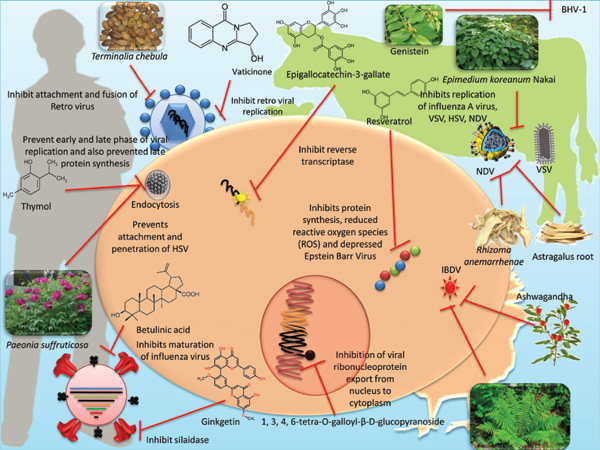
Results and Discussion
A variety of biochemical and bioactive components found in medicinal plants can be extracted and used to treat or prevent viral illnesses and infections. Although medicinal plants and natural products have been used for a very long time, scientific evidence and research into their prophylactic, therapeutic, and other health-related uses have only recently begun to pick up steam. Numerous scientific investigations have been made, covering everything from the identification of active ingredients to understanding the therapeutic mechanisms of antiviral herbs, to clinical trials and their effective use in neutralising viral pathogens. As a result, hundreds of herbs and plant metabolites have been screened, identified, and evaluated for their antiviral actions; thankfully, some of these have demonstrated notable therapeutic effectiveness in the amelioration or prevention of viral diseases.
HIV/AIDS and Ayurveda
In Ayurveda, the tridosha Siddhanta, where tridosha affects the Dushya, i.e. dhatus & malas, generating a particular quite pathologies, all the diseases mentioned in Ayurveda are frequently well understood. The discomfort, another ageing sign, a change in complexion, and other damaged organs are frequently used as the names for these illnesses. It is inevitable due to changes in environment and lifestyle; more recent conditions are gaining ground. As a result, they must be treated in accordance with the tridosha principle outlined in classical Ayurvedic texts.
Conclusion
This review discusses the importance of various herbal preparations made from various medicinal plants and their extracts in treating diseases brought on by various viral pathogens, including newly emerging and reemerging viruses that affect people, animals, poultry, and fish. This review certainly helps the approach of COVID 19 and related viral infections. Any remedies medicinal plants helps in fighting viral infections. Antiviral herbs fights with enhancing immune system and induced passive immunity. Financial Support and Sponsorship: Nil.
Conflicts of Interest: There are no conflicts of interest.
References
-
Rothan HA, Byrareddy SN (2020) The epidemiology and pathogenesis of coronavirus disease (COVID-19) outbreak. Journal of autoimmunity 109: 102433.
-
Dhama K, Karthik K, Khandia R, Munjal A, Tiwari R, et al. (2018) Medicinal and therapeutic potential of herbs and plant metabolites/extracts countering viral pathogens- current knowledge and future prospects. Current drug metabolism 19(3): 236-263.
-
Jassim SA, Naji MA (2003) Novel antiviral agents: a medicinal plant perspective. Journal of applied microbiology 95(3): 412-427.
-
Ogbole OO, Akinleye TE, Segun PA, Faleye TC, Adeniji AJ (2018) In vitro antiviral activity of twenty-seven medicinal plant extracts from Southwest Nigeria against three serotypes of echoviruses. Virology journal 15(1): 110.
-
Sankar SA, Bhat KS, Anand J (2009) Medical Mycology. In: Daw MA (Ed.) Medmicro. Chapter 52”. Department of Microbiology and Immunology Faculty of Medicine, Alfateh University Triboli, Libya.
-
Welch SR, Scholte FE, Flint M, Chatterjee P, Nichol ST, et al. (2017) Identification of 2′-deoxy-2′-fluorocytidine as a potent inhibitor of Crimean-Congo hemorrhagic fever virus replication using a recombinant fluorescent reporter virus. Antiviral research 147: 91-99.
-
Kausar S, Akram M, Riaz M, Rasool G, Hamid Khan A, et al. (2021) A review: Mechanism of action of antiviral drugs. Int J Immunopathol Pharmacol 35: 20587384211002621.
-
Daniels R, Nicoll LH (2011) Pharmacology-Nursing Management. In: Daniels R (Eds.) Contemporary Medical-Surgical Nursing. 2nd (Ed.) Cengage Learning, USA, pp:397.
-
Ko K, Tekoah Y, Rudd PM, Harvey DJ, Dwek RA, et al. (2003) Function and glycosylation of plant-derived antiviral monoclonal antibody. Proceedings of the National Academy of Sciences 100(13): 8013-8018.
-
Schnitzler P, Schön K, Reichling J (2001) Antiviral activity of Australian tea tree oil and eucalyptus oil against herpes simplex virus in cell culture. Die Pharmazie 56(4): 343-347.
-
Fenner F, Bachmann PA, Gibbs EP, Murphy FA, Studdert MJ, et al. (2014) Structure and Composition of Viruses. Veterinary Virology 1987: 3-19.
-
Lara HH, Ayala-Nuñez NV, Ixtepan-Turrent L, Rodriguez-Padilla C (2010) Mode of antiviral action of silver nanoparticles against HIV-1. Journal of nanobiotechnology 8(1): 1.
-
Seo DJ, Choi C (2021) Antiviral bioactive compounds of mushrooms and their antiviral mechanisms: a review. Viruses 13(2): 350.
-
Lessells RJ, Avalos A, de Oliveira T (2013) Implementing HIV-1 genotypic resistance testing in antiretroviral therapy programs in Africa: needs, opportunities, and challenges. AIDS reviews 15(4): 221-229.
-
Walkey AJ, Sheldrick RC, Kashyap R, Kumar VK, Boman K, et al. (2020) Guiding principles for the conduct of observational critical care research for coronavirus disease 2019 pandemics and beyond: The Society of Critical Care Medicine Discovery Viral Infection and Respiratory Illness Universal Study Registry. Critical care medicine 48(11): e1038.
-
Alberts B, Johnson A, Lewis J, Raff M, Roberts K, et al. (2002) Studying gene expression and function. In: Alberts B, et al. (Ed.) Molecular Biology of the Cell. 4th (Edn.), Garland Science, Taylor & Francis, New York.
-
Villanueva RA, Rouillé Y, Dubuisson J (2005) Interactions between virus proteins and host cell membranes during the viral life cycle. Int Rev Cytol 245: 171-244.
-
Maginnis MS (2018) Virus–receptor interactions: the key to cellular invasion. Journal of molecular biology 430(17): 2590-2611.
-
Patel PH, Zulfiqar H (2023) Reverse Transcriptase Inhibitors. In: Patel PH, et al (Eds.) StatPearls. StatPearls Publishing, Treasure Island, Florida, USA.
-
Price AM, Steinbock RT, Di C, Hayer KE, Li Y, et al. (2022) Adenovirus prevents dsRNA formation by promoting efficient splicing of viral RNA. Nucleic acids research 50(3): 1201-1220.
-
Salton MRJ, Kim KS. Structure. In: Baron S, (Ed.) Medical Microbiology. 4th (Edn.), Galveston (TX): University of Texas Medical Branch at Galveston, Texas, USA.
-
Samuel CE (2001) Antiviral actions of interferons. Clinical microbiology reviews 14(4): 778-809.
-
Mueller S, Millonig G, Seitz HK (2009) Alcoholic liver disease and hepatitis C: a frequently underestimated combination. World J Gastroenterol 15(28): 3462-3471.
-
Berkley JA, Munywoki P, Ngama M, Kazungu S, Abwao J, et al. (2010) Viral etiology of severe pneumonia among Kenyan infants and children. Jama 303(20): 2051-2057.
-
Strasfeld L, Chou S (2010) Antiviral drug resistance: mechanisms and clinical implications. Infectious Disease Clinics 24(3): 809-833.
-
Jaime MFV, Redko F, Muschietti LV, Campos RH, Martino VS, et al. (2013) In vitro antiviral activity of plant extracts from Asteraceae medicinal plants. Virology journal 10(1): 245.
-
Manandhar B, Paudel KR, Sharma B, Karki R (2018) Phytochemical profile and pharmacological activity of Aegle marmelos Linn. J Integr Med 16(3): 153-163.
-
Patra JK, Das G, Bose S, Banerjee S, Vishnuprasad CN, et al. (2020) Star anise (Illicium verum): Chemical compounds, antiviral properties, and clinical relevance. Phytotherapy Research 34(6): 1248-1267.
-
Kukade SV, Bhokardankar PS, Chauragade N, Mhaiskar B (2020) An ayurvedic approach of covid-19 (2020). Journal of Critical Review 7(10): 579-581.
-
Bhivgade V, Tirpude S, Mhaiskar B, Parwe S (2020) A review on janapadoddhvamsa with special reference to current scenario of covid-19 outbreak. International Journal of Research in Pharmaceutical Sciences 11(1S): 1635-1639.
- Management of Ear Keloid with Ksharsutra: A Case Study
- Yoga and Global Sustainability: A Holistic Path to One Earth, One Health
- Autoimmune Diseases in Ayurveda: A Narrative Review with Classical and Modern Perspectives
- Management of Cluster Headache Associated with Pituitary Apophysitis by CERT (Chakrasiddh Energy Release Technique): A Case Report on Energy Rebalancing
- Zygophyllum Geslini Coss : Biochemicals and Antioxidant Activity
- Observations of a Beginner Vaidya