
Case Study: Ayurvedic Treatment of Vatakantaka through Raktamokshana
According to Acharya, it has been observed that when an individual traverses an irregular or uneven terrain, the vata dosha becomes localized and exacerbated in the ankle joint, resulting in pain in the heel region commonly referred to as Vatakantaka. It may be likened to Plantar Fasciitis, a painful condition affecting the heel that impedes daily activities. Plantar Fasciitis is caused by the repetitive stretching and straining of the plantar fascia, resulting in injury and inflammation that presents as heel pain. A 34-year-old female patient reports experiencing left heel pain during the first few steps in the morning, which is alleviated after walking. However, the pain returns after a prolonged period of rest. The present case study employs Raktmokshana to evaluate its effectiveness in alleviating pain. According to Acharya, pain arises solely from the vitiation of Vata Dosha or Rakta Dhatu. Given the patient's severe burning sensation and pain, Raktamokshana was done through Siravedh techniques at the ankle region over the course of four sessions, spaced seven days apart. This treatment resulted in complete pain relief for the patient.
Introduction
Patients suffering from plantar fasciitis typically exhibit symptoms such as a sharp, thorny pain in the heel that is experienced during the first steps taken in the morning. This pain tends to subside after walking for a certain distance, only to reoccur after prolonged periods of rest. Diagnosis of Plantar fasciitis can typically be made based on the patient’s medical history and physical examination alone. This condition is classified as a Snayu- Asthi -Sandhi Ashrit Vyadhi, which is a painful ailment affecting the tendons, bones, and joints [1]. Diseases such as Calcaneal Knob, Bursitis, Bony Spur, Paget’s, Osteomyelitis, and Plantar Fasciitis manifest with heel pain. Of these, Vatakantaka can be associated with Plantar Fasciitis. Patients with Plantar Fasciitis typically present with symptoms such as a stabbing, thorny type of pain in the heel that occurs upon taking the first steps in the morning. This pain usually subsides after walking for some distance but may reoccur after a prolonged period of rest [2]. The diagnosis of Plantar Fasciitis can typically be made based on the patient’s history and physical examination alone. The treatment regimen for vatakantaka involves the sequential application of Raktaavasechana [3].
Case Report
History
A 34-year-old female software engineer presented with severe joint pain in her left heels, accompanied by swelling and tenderness for the past six months. The pain was particularly pronounced in the mornings and evenings. Additionally, she reported experiencing difficulty in performing day-to-day activities and a decrease in her overall energy levels.
Clinical Examination
Local examination revealed swelling and redness along with grade 4 pain and tenderness. Upon thorough examination, it was observed that the patients displayed indications of an aggravated Vata pitta dosha, including skin redness, a burning sensation, and restlessness. Furthermore, the left foot was found to be tender to the touch, slightly swollen, and exhibiting signs of limited mobility. These symptoms were indicative of a Vata rakta imbalance, which was likely a contributing factor to the ankle joint issues.
Diagnosis
Based on the clinical presentation, Ramesh was diagnosed with “she was diagnosed as Raktavarana vatakantaka [4].
Treatment Plan
The treatment plan aimed to balance the aggravated Vata dosha and alleviate the joint symptoms. One of the therapeutic measures chosen was “Raktamokshana,” a bloodletting procedure [5]. The concept behind this treatment is to remove excess Pitta and toxins from the blood, which can help in reducing inflammation, redness and alleviating pain.
Raktamokshana Procedure
The patient had been scheduled for Raktamokshana. Prior to the aforementioned procedure, her random blood sugar was noted at 116mg/dl and her blood pressure was 130/84mmHg. The patient’s consent was obtained prior to the commencement of the procedure. In this case, the procedure targeted the veins around the area of affected joints, as shown in Figure 1. A tourniquet was tied at the calf region and, under aseptic conditions, the vein near the right heel and ankle joint was identified. 40cc of blood was drawn using a scalp vein set. The patient was observed for one hour. The same procedure was carried out on the left foot after each week for 1 month.
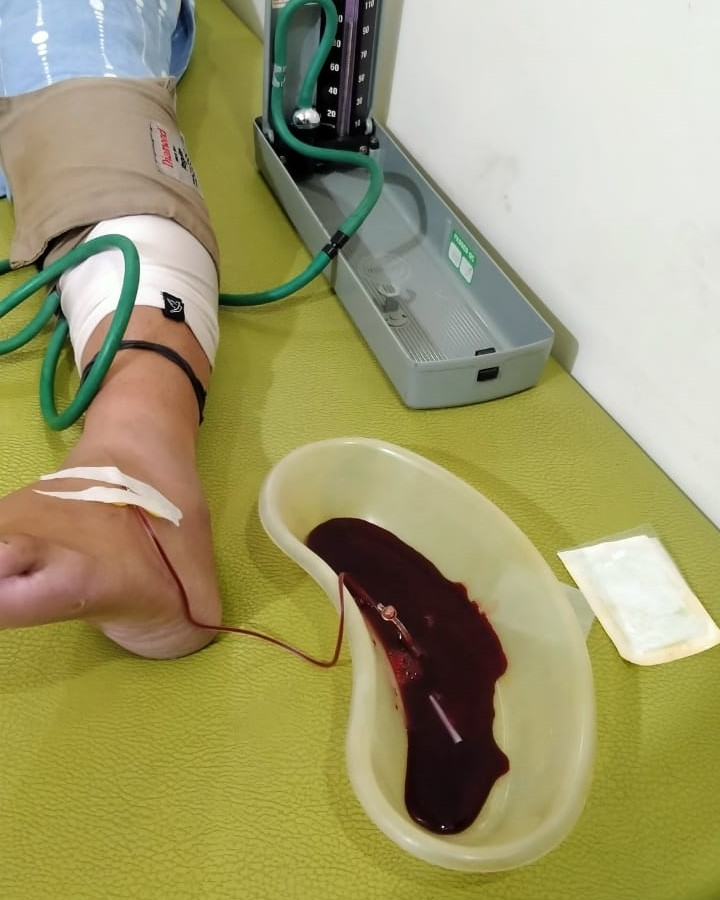
During the follow-up appointment at the fourth week, the patient reported experiencing pain (grade 0). Upon conducting a local examination, it was observed that there was no tenderness, swelling, or redness on the left foot following successive raktmokshana therapy.
| Signs and symptoms | Before treatment | After treatment | |||
|---|---|---|---|---|---|
| 1st week | 2nd week | 3rd week | 4th week | ||
| Pain | VAS 8 | VAS 6 | VAS 5 | VAS 3 | VAS 1 |
| swelling | Grade III | Grade II | Grade I | Grade I | Grade 0 |
| Redness | Grade IV | Grade III | Grade II | Grade I | Grade 0 |
| Tenderness | Present | Present | Absent | Absent | Absent |
Table 1: Showing gradation of symptoms before and after treatment.
Post-Treatment
After the Raktamokshana procedure, patient was advised to rest and avoid strenuous activities. She was prescribed dietary recommendations to include warm, cooked foods and healthy oils.
Follow-Up
Over the course of the next few weeks, patients reported gradual improvement in her joint pain and stiffness. Her energy levels started to increase, and he experienced better digestion and regular bowel movements. He continued with the recommended dietary changes.
Outcome
After a few months of consistent Ayurvedic treatment, Ramesh’s joint pain and stiffness significantly reduced. His joints became more flexible, and he was able to resume his daily activities without discomfort. The Raktamokshana procedure, combined with dietary and lifestyle adjustments, helped in balancing his Vata dosha and addressing the root cause of his joint issues.
Discussion
Raktamokshana, a therapeutic procedure in Ayurveda involving the removal of impure or vitiated blood, can have potential effects on Vatakantaka or conditions characterized by Vata imbalance, particularly joint pain, inflammation, and related issues. However, it’s important to note that the effectiveness of Raktamokshana can vary depending on factors such as the individual’s constitution, the severity of the condition.
Depending on the symptoms, involvement of vata, pitta and rakta was considered and the treatment was planned accordingly. Initially raktamokshana was planned to remove the raktaavarana [6]. The principle employed in this context is that of bloodletting, primarily utilized in avruta vata, that is, in raktavarana conditions. Through this adapted technique, the sthanikasanga in sira is alleviated, resulting in the relief of congestion and pain. Furthermore, a reduction in pain and tenderness was observed.
Conclusion
The observation of pain and tenderness management subsequent to Raktamokshana treatment in a case of raktaavarana vatakantaka has been made. A broader sample can be analyzed to determine the effectiveness of siravedha in vatakantaka. The approach can vary based on factors such as the patient’s constitution (Prakriti), the specific doshic imbalance, the severity of the condition, and more.
References
-
Vagbhata, Sangraha A, Prasad SS (2006) Shashilekha Sanskrit commentary of Indu; (Sanskrit) Choukambha Sanskrit Series Office, Varanasi, pp: 416.
-
Davies MS, Weiss GA, Saxby TS (1999) Plantar Fasciitis: How successful is surgical intervention? Foot Ankle Int 20: 803-807.
-
Susruta Samhita. Ayurveda Tatva Sandeepika Hindi Commentary by Kaviraj Vaidya Ambikadattashastri. Varanasi: Chaukhamba Sanskrit Samsthana Chikitsa Sthana 5/23.
-
Agnivesha (2009) Charaka Samhita. In: Vaidya Jadavji Trikamji Acharya (Ed.), Revised by Caraka and Drdhabala with Ayurveda-Dipika commentary of Chakrapanidatta, Varanasi: Krishnadas Academy, Chowkhamba Press, Chikitsasthana 28 (63): 413.
-
Susruta Samhita. Ayurveda Tatva Sandeepika Hindi Commentary by Kaviraj Vaidya Ambikadattashastri. Varanasi: Chaukhamba Sanskrit Samsthana; Chikitsa Sthana 5/23.
-
Agnivesha (2009) Charaka Samhita. In: Vaidya Jadavji Trikamji Acharya (Ed.), Revised by Caraka and Drdhabala with Ayurveda-Dipika commentary of Chakrapanidatta, Varanasi: Krishnadas Academy, Chowkhamba Press, Chikitsasthana 28 (63): 414.
- Management of Ear Keloid with Ksharsutra: A Case Study
- Yoga and Global Sustainability: A Holistic Path to One Earth, One Health
- Autoimmune Diseases in Ayurveda: A Narrative Review with Classical and Modern Perspectives
- Management of Cluster Headache Associated with Pituitary Apophysitis by CERT (Chakrasiddh Energy Release Technique): A Case Report on Energy Rebalancing
- Zygophyllum Geslini Coss : Biochemicals and Antioxidant Activity
- Observations of a Beginner Vaidya