
Clinical Evaluation of Mahanarayana Taila Matra Basti in Anidra (Primary Insomnia)
Sleep is a naturally recurring state of mind and body. Insomnia disorder is defined as a subjective perception or complaint of inadequate or poor-quality sleep. Anidra has been described in detail by Acharyas in various contexts like Vata Nanatmaja Vikara, Vataja Jwara etc. Panchkarma therapies like Shirodhara, Shirobasti, Shiroabhyang, Shiropichu, Padaabhyang is very useful in treatment of Anidra. Insomnia is the most commonly encountered sleep disorder and occurs 10-50% of the population. Worldwide epidemiological studies assessed the prevalence of insomnia without restrictive criteria as 33% in general population. In Ayurveda, insomnia is described as Anidra and Nidranash under the heading of different disorders and conditions. Allopathic hypnotic drugs are useful for short term treatment in insomnia which is due to acute stage. Long term uses of certain classes of sedatives cause physical dependence, Ayurvedic approach in the disease is by pacifying the Doshas, paying special attention to Vata- Shamana, Santarpana and Srotoshodhak. Hence, with the aim of identifying and establishing an alternative, safer, effective and long-lasting treatment modality, the study entitled “Clinical Evaluation of Mahanarayana Taila Matra Basti in Anidra (Primary Insomnia)” was conducted in 56 patients. They were selected on the basis of standard inclusion and exclusion criteria and randomly allocated to two different treatment groups; Group- A (Mahanarayana Taila Matra Basti) and Group- B (Zolpidem). Total duration of the treatment was of 14 days along with a follow up period of 1 month. Both the interventions were almost equally effective, but in overall improvement of the patients “Group A” had better results than Group B. For better scientific validation, further research studies and clinical trials should be carried out with large sample size and longer duration of treatment.
Introduction
Sleep is a naturally recurring state of mind and body. Insomnia is a sleep disorder that regularly affects millions of people worldwide. Insomnia disorder is defined as a subjective perception or complaint of inadequate or poor- quality sleep due to a number of factors such as difficulty in falling asleep, waking up frequently during the night with difficulty in returning to sleep, waking up too early in the morning or unrefreshing sleep [1]. Nidra is due to Sharirik Dosha Kapha and Mansik Dosha Tama so any reason which cause decrease in Kapha and Tamo Guna in body leads to Anidra [2]. Acahraya Vagbhata and Sushruta have mentioned Vata Pitta Vridhi in Nidranash [3]. Insomnia is defined as difficulty in sleep. It is a common sleep disorder. Approximately 30% to 40% of adults in the United States report symptoms of insomnia at some point in a given year. Management of insomnia, so far, is not up to the mark because medications available for insomnia are sleep inducing rather than treating the underlying cause. Many non- pharmacological remedies such as cognitive behavioural therapy are also used to overcome the adverse drug effects of insomnia but unfortunately incidences are increasing day by day. Ayurveda has a very good approach towards the treatment of insomnia by both internal and external medications. So, there is a need for an effective treatment to eradicate this problem from root base. For this purpose, an effort is put into find the effective treatment in series of patients suffering from Anidra. Considering these factors this study is taken up where in the efficacy of Mahanarayana Taila Matra Basti has been selected as treatment of Anidra.
In order to study the significance of this method of treatment, a study on another group of patients of Anidra with controlled drug zolpidem, which has already been established by previous study, is also taken up.
Aims and Objectives
- Conceptual and clinical studies on Anidra w.s.r. to Primary insomnia and its management with Ayurvedic principles.
- Clinical evaluation of the role of Mahanarayana Taila Matra Basti- trial drug & Zolpidem- control drug (which is an established study) in 2 different groups in the management of Anidra (Primary insomnia) on various scientific parameters.
- Comparison of above-mentioned trial & control drug on various scientific and statistical parameters. The study was conducted under a strict protocol to prevent bias and to reduce the sources of error in the study.
Selection of Cases
Sources of the Data
Patients with classical features of Anidra were selected from the OPD of Panchkarma, Rishikul Ayurved College, and Haridwar
Number of Patients
A total of 60 patients were planned to include in the clinical trial.
Inclusion Criteria
- Age > 20 years up to 70 years.
- Patient fulfilling DSM-V criteria for insomnia.
- Patient fit for Matra Basti procedure.
- Patients of insomnia with controlled hypertension and DM
- Anxiety disorders without any complaints of any other major diseases.
Exclusion Criteria
- Patient suffering from chronic illness.
- Patient having Anorectal disorders.
- Pregnant and lactating women.
- Patients having chronic illness like bronchial asthma, malignancies, liver diseases, chronic renal diseases were excluded from the study.
- Patient having any severe psychiatric disorder (schizophrenia, bipolar disorder)
Grouping of Patients
Patients registered for the study were randomly allotted into 2 groups namely Group A and Group B with 30 patients in each group. Group A (Trial Drug): Mahanarayana Taila Matra Basti (60ml) was administered for 14 days regular.
Group B (Control Drug): Zolpidem (5-10 mg Acc. To severity) was administered for 30 days regular before sleep.
Pathya-apathy: All patients were advised to follow the Pathya-apathya during the trial period that are beneficial for proper sleep.
Diagnostic Criteria Adopted
Assessment Criteria
For assessment of the efficacy of the trial therapy, following parameters were adopted.
Subjective Parameters
- Sleeplessness
- Disorders of Sleep-Wake (S-W) Schedule
- Sleep quality
- Sleep time
- After awakening
- Associated complaints like Akshigaurav, Shirogaurav, Alasya, Jrimbha, Angamarda, Glani, Bhrama, Ajirna, Kshudamanda etc
Psychometric assessment
Pittsburgh insomnia rating scale
| (Wilcoxon Signed Rank Test) | |||||||||
|---|---|---|---|---|---|---|---|---|---|
| Parameters | Sample size | Mean | Mean Difference | % Change | W | SD | P | Result | |
| BT | AT | (BT-AT) | |||||||
| Sleeplessness | 28 | 4.43 | 1.21 | 3.21 | 72.58 | -406 | 1.31 | <0.001 | HS |
| Disorder of SW Schedule | 28 | 3.54 | 0.93 | 2.61 | 73.74 | -406 | 0.87 | <0.001 | HS |
| Sleep Quality | 26 | 2.85 | 0.58 | 2.27 | 79.81 | -325 | 0.83 | <0.001 | HS |
| Sleep Time | 27 | 3.81 | 1.33 | 2.48 | 65.04 | -378 | 1.08 | <0.001 | HS |
| After Awakenings | 28 | 2.39 | 0.54 | 1.86 | 77.61 | -378 | 0.85 | <0.001 | HS |
| Associated Complaints | |||||||||
| Shirogaurav | 15 | 2.2 | 0.73 | 1.47 | 66.67 | -105 | 0.74 | <0.001 | HS |
| Jadya | 21 | 1.71 | 0.81 | 0.9 | 52.78 | -136 | 0.62 | <0.001 | HS |
| Glani | 21 | 1.67 | 0.57 | 1.09 | 65.71 | -171 | 0.62 | <0.001 | HS |
| Jrumbha | 26 | 1.57 | 0.61 | 0.96 | 60.98 | -276 | 0.44 | <0.001 | HS |
| Bhrama | 18 | 1.72 | 0.67 | 1.05 | 61.29 | -136 | 0.64 | <0.001 | HS |
| Apakti | 21 | 1.52 | 0.57 | 0.95 | 62.5 | -171 | 0.49 | <0.001 | HS |
| Angamarda | 26 | 1.81 | 0.81 | 1 | 55.31 | -253 | 0.56 | <0.001 | HS |
| Vataroga | 25 | 1.72 | 0.88 | 0.84 | 48.83 | -153 | 0.68 | <0.001 | HS |
Table 1: Effect of Matra Basti (Group A) on Subjective Parameters.
| (Wilcoxon Signed Rank Test) | |||||||||
|---|---|---|---|---|---|---|---|---|---|
| Parameters | Sample size | Mean | Mean Difference | % Change | W | SD | P | Result | |
| BT | AT | (BT-AT) | |||||||
| PIRS | 28 | 47.17 | 17.32 | 29.67 | 62.9 | -406 | 9.66 | <0.001 | HS |
Table 2: Effect of _Matra Basti_ (Group A) on Psychometric Scales.
| (Wilcoxon Signed Rank Test) | |||||||||
|---|---|---|---|---|---|---|---|---|---|
| Parameters | Sample size | Mean | Mean Difference | % Change | W | SD | P | Result | |
| BT | AT | (BT-AT) | |||||||
| Sleeplessness | 28 | 3.93 | 0.82 | 3.11 | 79.09 | -406 | 1.16 | <0.001 | HS |
| Disorder of SW schedule | 27 | 3.07 | 0.67 | 2.41 | 78.31 | -378 | 0.57 | <0.001 | HS |
| Sleep Quality | 26 | 2.5 | 0.35 | 2.15 | 86.15 | -325 | 0.78 | <0.001 | HS |
| Sleep Time | 28 | 3.07 | 1.04 | 2.03 | 66.27 | -325 | 1.03 | <0.001 | HS |
| After awakenings | 25 | 2.04 | 0.36 | 1.68 | 82.35 | -276 | 0.8 | <0.001 | HS |
| Associated Complaints | |||||||||
| Shirogaurav | 17 | 1.71 | 1.11 | 0.59 | 34.48 | -55 | 0.5 | <0.05 | S |
| 0.002 | |||||||||
| Jadya | 15 | 1.53 | 0.66 | 0.87 | 56.52 | -66 | 0.63 | <0.001 | HS |
| Glani | 20 | 1.55 | 0.75 | 0.8 | 51.61 | -105 | 0.62 | <0.001 | HS |
| Jrumbha | 27 | 1.88 | 0.59 | 1.29 | 68.62 | -378 | 0.46 | <0.001 | HS |
| Bhrama | 8 | 1.25 | 0.5 | 0.75 | 60 | -21 | 0.46 | <0.05 | S |
| 0.031 | |||||||||
| Apakti | 15 | 1.6 | 1.33 | 0.26 | 16.66 | -10 | 0.45 | >0.05 | NS |
| 0.125 | |||||||||
| Angamarda | 20 | 1.65 | 1.05 | 0.6 | 36.36 | -78 | 0.5 | <0.001 | HS |
| Vataroga | 18 | 1.77 | 1.16 | 0.61 | 34.37 | -66 | 0.5 | <0.001 | HS |
Table 3: Effect of Control Drug (Group B) on Subjective Parameters.
| (Wilcoxon Signed Rank Test) | |||||||||
|---|---|---|---|---|---|---|---|---|---|
| Psychometric Scale | Sample size | Mean | Mean Difference | % Change | W | SD | P | Result | |
| BT | AT | (BT-AT) | |||||||
| PIRS | 28 | 41.75 | 20 | 21.75 | 52.09 | -406 | 6.06 | <0.001 | HS |
Table 4: Effect of Control Drug (Group B) on Psychometric Scales.
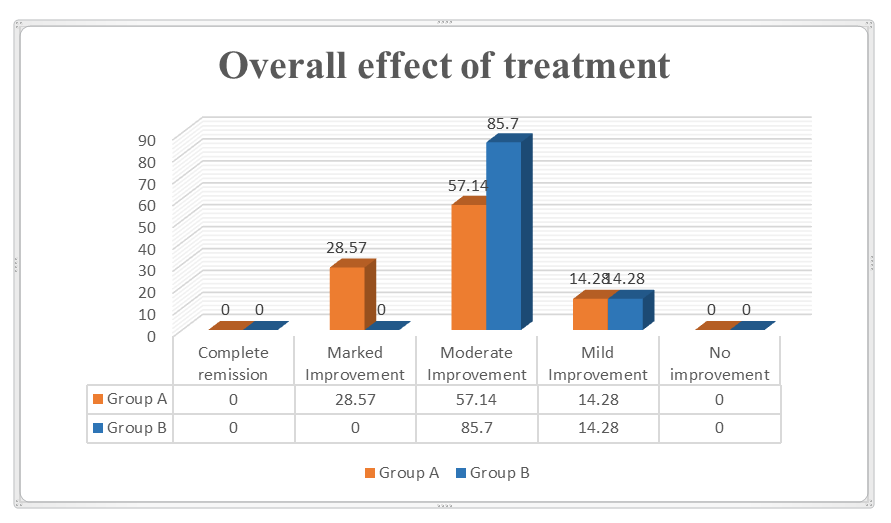
| Overall response | Group A | Group B | ||
|---|---|---|---|---|
| Frequency | Percentage | Frequency | Percentage | |
| Complete remission (100% relief) | 0 | 0 | 0 | 0 |
| Marked improvement | 8 | 28.57 | 0 | 0 |
| (<75% to 99 %) | ||||
| Moderate improvement (50% to 75%) | 16 | 57.14 | 24 | 85.7 |
| Mild improvement | 4 | 14.28 | 4 | 14.28 |
| (26% to <50%) | ||||
| No improvement | 0 | 0 | 0 | 0 |
| (< = 25%) | ||||
| Total | 28 | 28 |
Table 5: Assessment of Overall Response to Treatment.
Discussion
Sleeplessness
On the sleeplessness statistical insignificant result (P >0.05) was found in between group A and B. On the basis of percentage improvement Group B (79.09%) is marginally better than Group A (72.58%). Basti remains in the Pakvasaya, Sroni and below Nabhi and through the Srotas, the Veerya of Basti Dravya is spread to the entire body. The active components in the Basti assimilate, travel via the bloodstream to the areas of the lesions and subsequently relieve the condition. Basti works on enteric nervous system (ENS) where many neurotransmitters like GABA, Serotonin and opioid are present. Basti activates the activity of serotonin due to which proper sleep occurs.
Disorder of SW Schedule
Control drug very effective in regulating sleep cycle but study shows equally effective in condition of disturbed sleep. Mahanarayana Taila has Vatashamaka, Santarpana and Rasayana properties. In Mahanarayana Taila, Tila Taila and milk is also used. Property of Tila Taila is Balya and Rasayana, which checks Dhatukshaya and alleviates Vata while nourishing and boosting all the Dhatus. Ksheer has Vata Pitta Shamaka, Dhatuvardhaka, Ojovardhaka, Rasayana, Preenana, Brimhana, Vrishya, Prasanna, Medhya, Balya, Jeevaniya, Sandhaneeya Karmas. All these actions of Mahanarayana Taila and Basti can be well explained on the basis of known physiological and pharmacological action. Basti gives soothing effect on mind i.e., enhances the activity of serotonin that regulating the cycle of sleep and wakefulness.
Sleep Quality
Immediate release preparation of Zolpidem is effective in maintain sleep quality by rapid absorption. Zolpidem Acts like GABA, which has major role in controlling nerve cell hypersensitivity associated with anxiety, stress thus improve sleep. On other hand, Matra Basti takes time for absorption due to relatively lesser capillary permeability. It stimulates the ENS and thereby effective in treating lack of sleep. Matra Basti increases strength without requiring a rigid dietary regimen, as well as facilitating the evacuation of Mala and Mutra [4]. Drug used in this study has potential to decrease the Prakupit Vata by their Vatashamaka nature, Balya, Rasayana, Nidrajanan, Glanihar and Hrudya properties. Balya means which gives strength, these drugs give strength to body by improving Mansa and Oja Dhatu. Oja is important for strength and longevity of life and immunity. By this property body gets strength and achieves immunity. Rasayana (Rejuvenation of body and psyche) drugs helps in maintaining of homeostasis and prevents degeneration of body tissues. It increases quality and quantity of all Dhatus ultimately leads to increase in Oja. Nidrajanana drugs help in sleep regulation. It maintains the rhythm of sleep.
Sleep Time
Percentage relief in symptom of sleep time was found to be 65.04 % in Group A and 66.27 % in Group B with a statistically insignificant P value (>0.05) between them.
Insufficient sleep time is caused due to disruptions in between the sleep because the brain is constantly in stress and hence cannot relax. Hence the oil medicated with such drugs is perfect choice of drug for the treatment of neurological conditions that ensues insomnia. Drugs possess properties like Smrutiprada, Medhya, Balya, Rasayan, Nidrajanana, Medhya, Manasarogahruta, Glanihara, Apasmar, Unmad and Chetovikarnashana. They having Antioxidant activity [5], Anticholinesterase activity [6] and cognitive enhancement [7].
Basti is having two actions, expelling the Doshas and nourishing the body. First, Potency of the Basti drugs gets absorbed to have its systemic action. Its second major action is related with the facilitation of excretion of morbid substances responsible for the disease process into the colon, from where they are evacuated [8]. Basti is best treatment protocol of Vata Dosha. So, it maintains the regularity once sleep is initiated.
After Awakenings
Intercomparison group shows no significant difference between both groups. Maximum % relief was found in Group B (82.35%) is marginally better than Group A (77.61.%).
Frequent awakenings and difficulty in returning back to sleep due to discontinuation of sleep was reported by the patients of this study. Control drug administered through oral route due to which it has rapid absorption in body and it produces more effect on lack of sleep. On other hand Matra Basti gradually effect on body due to its slow absorption through anal route.
Enteric Nervous System (ENS) as ‘The brain of the gut’. ENS integrates information from mucosal receptor and organizes an appropriate motor response from a choice of predetermined programmes. The physiological and pharmacological properties of Basti chikitsa are said to be outcome of modification of gut brain up to certain extent [9]. So Basti acts on H-P-A axis and regulates cortisol secretion which is mainly responsible for alertness.
Shirogaurav
On Parameter of Shirogaurava, it was decreased by 66.67% and 34.48 % respectively in Group A and B, with a statistically significant P value (<0.05) between them.
The daily routine activities and regular sleep wake schedule are disrupted as a result of persistently disturbed sleep, which also occasionally causes head heaviness. There is involvement of Vata and Vata Pradhana Kapha Dosha. Acharya Sushruta mentions there is Tridosha involvement.
Basti fluid by its direct action on nerve endings can control the whole body by influencing hormonal secretion and CNS. Moreover, Abhyanga and Swedana prior to Basti therapy may have some role in influencing the ENS. The drugs may also be transported to the circulation by local veins and lymphatics and thus mitigates the disease elsewhere in the body [10].
Jadya
On Parameter of Jadya, it was reduced by 52.78% and 56.52 % respectively in Group A and B, with a statistically insignificant P value (>0.05) between them.
Sleep disturbances reduce an individual’s quality of life by seriously impairing cognition, mood and physical symptoms of disease. Anidra is due to Vata Prakop. Jadya, the condition i.e., due to Anidra leads to Stiffness in body. The result shows slightly difference between each group.
Control drug provide better sleep due to which body circadian rhythm maintain. On other hand Mahanarayana Taila Matra Basti is very effective in Vata Roga and also due to its Santarpana property it nourishes the body. Abhyanga and Swedana prior to Basti therapy also relieves the stiffness in body [11].
Glani
It was reduced by 65.71% and 51.61 % respectively in Group A and B, with a statistically insignificant P value (>0.05) between them. Acharya Sushruta, Glani and Tandra symptoms are same. Tandra is the condition where Indriyeshu Asamprapti occurs. It means Indriya are not able to grasp the knowledge. Again, the condition is due to Vikrita Gati of Prana Vayu as Indriya Dharana is the Karma of Prakrita Prana Vayu [12]. Basti application is useful for the normalization of the Gati of Prana Vayu. Prana Vayu with Prakrita Gati maintains the normal Karma of the Indriya and body functions. Hence there is improvement in the symptom Glani.
Jrumbha
Jrumbha shows statistically insignificant P value (>0.05) between them, it was reduced by 60.98% and 68.62 % respectively in Group A and B.
Jrumbha is one of the physiological reflexes- A deep inspiration through the widely opened mouth producing an exaggerated depression of the mandible. Due to continuous disturbances, sleep was not sound. So, Patients feels un- refreshed on waking up in the morning, despite an opportunity and attempt to sleep. Jrumbha is due to Vata Pradhanya. Due to Snigdha, Ushna Guna of Mahanarayana Taila and Vatashamaka nature of Basti. Matra Basti was very effective in Anidra (Primary Insomnia) [13].
Bhruma
Bhruma shows statistically insignificant P value (>0.05) between them. Maximum percentage relief 61.29% and 60 % respectively in Group A and B.
Bhruma is the condition generally ensues due to Raja Guna of Mana and Pitta -Vata Dosha. Mahanarayana Taila by its Santarpana property and administration of it as Matra Basti reduces the Rajo Guna of mind improves the Gati of Prana and Vata-Pittahara. Therefore, it’s useful to relieve the Bhruma in the patients of Anidra [14].
Apakti
On Parameter of Apakti, it was reduced by 62.5% and 16.66 % respectively in Group A and B, with a statistically significant P value (<0.05) between them.
Patients suffering from Anidra, there is Rajaguna Bahula Vayu continuously alters or Vaishamya in the secretion or Udirana of Prakruta Pitta in the Grahani. This imbalance or Vaishamya hampers the process of digestion of the patients and leads to condition like Ajeerna, Apakti, Anaha. Mahanarayana Taila Basti controls the Gati of Vayu and Vatashamana and prevents the further sequels and there is improvement in the symptoms like Ajeerna etc.
Angamarda
On parameter of Angamarda, shows statistically insignificant P value (<0.05) between them. it was reduced by 55.31% and 36.36% respectively in Group A and B.
Vayu is the cause for different type of pain in the body, when the normal physiological action is derailed by specific causative factor concerned. Matra Basti reduces those Raukshya, Kharatva and Vimudhatva of Pranavayu. Ruksha, Laghu and Chala Guna of Vayu leads to the symptom Angamarda [15]. Vriddha Vaayu and Pitta Dosha causes Mamsa and Meda Kshaya which also cause Angamarda. Madhura Rasa and Snigdha Guna drugs of Mahanarayana Taila bring into being Vata Shamana and Prakrita Gati of Pranavayu. Overall effect is useful for the induction of sleep. Sleep nourishes the Dhatu and Pushti ultimately reduction in the Angamarda.
Vata Roga
On Parameter of Vata Roga, it was reduced by 48.83% and 34.37% respectively in Group A and B, with a statistically insignificant P value (<0.05) between them.
It is Sthairyakara, Balya and Varnakar i.e. it endows the body with stamina, strength and complexion. It possess the property of Vrishya, Vikasi, Vishada, Sukshma,Vyavayi and Brinham due to which it spreads rapidly, absorbed fastly, minutely penetrates into the target cells very quickly without undergoing digestion and nourishes the body [16].
Taila is the main treatment remedy for the Vataroga. Mahanarayana Taila contains the drugs which are mainly Madhura, Snigdha and Rasayana properties. Hence the oil medicated with such drugs is perfect choice of drug for the treatment of neurological conditions that ensues insomnia.
Psychometric Scale
PIRS (Pittsburgh Insomnia rating scale)
PIRS shows statistically significant result (P <0.05) was found in between Group A (62.90%) and Group B (52.09%)
While assessing the effect of treatment on the symptoms of Pitts burgh Insomnia rating scale statistically highly significant result was found in both the groups. However, Matra Basti showed better relief in the symptoms like anxious mood, tension, fear, insomnia, difficulty in concentration & memory, depressed mood, muscular complains, sensory complains etc. This is due to potent anti-stress, cortisol lowering, GABAergic, serotonergic anxiolytic and antioxidant properties of drugs of Mahanarayana Taila [17]. Thus, Matra Basti was very effective as it directly acts on the sleep regulating centres through perfusion of oil.
Conclusion
Statistically, Mahanarayana Taila Matra Basti (Group A) and control drug Zolpidem (Group B) Both groups are highly significant in condition of Anidra (Primary Insomnia). Percentage wise Group A has shown better relief than Group B.
After one month of completion of treatment, it was found that the effect of Matra Basti was more long-lasting as compared to the Control drug. Through Matra Basti quality of life of patient was improved and thus promoted long-term health.
Thus, from above results, it can be concluded that all the patients of Anidra (stress induced insomnia) considered for the study showed improvement in all the parameters in Group-A after administration of Matra Basti. Strengths of the current study open a new approach for novel therapeutic and more effective agents in the management of Primary Insomnia. Every upcoming challenge should be taken as an opportunity to grow and should be dealt peacefully. So Matra Basti with Mahanarayana Taila is cost effective, rapid absorbed and no adverse effect processor i.e., superior to all other treatment.
References
-
Ahuja N (2011) A Short Textbook of Psychiatry. 7th (Edn.), Jaypee Brothers Medical Publishers, New Delhi, India, pp: 136.
-
Trikamji YV (2005) Sushruta. Sushruta Samhita with Nibandh sangraha and Nyaychandrika, Choukhambha orientalia, Varanasi, India.
-
Hemadri AAR, Krishnadas (2005) Vagbhatta. Ashtanga Hrdya with Sarvang Sundari, Varanasi, India.
-
Venkatesh A (2010) Use of Ayurvedic principles, Yoga, meditation, for addressing insomnia/sleep Disorders.
-
Shah MR, Mehta CS, Shukla VD, Dave AR, Bhatt NN (2010) A clinical study of Matra basti and an ayurvedic indigenous compound drug in management of Sandhigatavata (Osteoarthritis). Ayu 31(2): 210-217.
-
Govindarajan R, Vijayakumar M, Pushpangadan P (2005) Antioxidant approach to disease management and the role of ‘Rasayana’ herbs of Ayurveda. J Ethnopharmacol 99(2): 165-178.
-
Das A, Shanker G, Nath C, Pal R, Singh S, et al. (2002) A comparative study in rodents of standardized extracts of Bacopa monniera and Ginkgo biloba: anticholinesterase and cognitive enhancing activities. Pharmacol Biochem Behav 73(4): 893-900.
-
Vasudevan MR, Mahadevan L, Jayadeep S (2005) Principle and practice of Vasti , Sarada Mahadeva Iyer Ayurvedic Educational & Charitable Trust, Kanyakumari, India, pp: 214.
-
Vasudevan MR, Mahadevan L (2005) Principle and practice of Vasti , Sarada Mahadeva Iyer Ayurvedic Educational & Charitable Trust, Kanyakumari, India, pp: 219-234.
-
Tripathi B (2017) Astanga hirdayam of srimadvagbhata. Chaukhhamba Sanskrit Pratishthan, Delhi, India, pp: 171.
-
(2008) Agnivesha, “Charaka Samhita” revised by Charaka and Dridhbala with ayurveda Dipika commentary by Chakrapanidatta. In: Vaidya Yadavji Trikam ji Acharya (Ed.), Chaukhambha Surbharti Prakashan, Varanasi, India, pp: 424.
-
(2010) Sushruta samhita vol-2 edited with sushruta vimarshini hindi commentary along with special deliberation. In: Anantram Sharma (Ed.), Chaukhamba Surbharati Prakashan, Varansi, India, pp: 60.
-
(2008) Agnivesha, “Charaka Samhita” revised by Charaka and Dridhbala with ayurveda Dipika commentary by Chakrapanidatta. In: Vaidya Yadavji Trikam ji Acharya (Ed.), Chaukhambha Surbharti Prakashan, Varanasi, India, pp: 155.
-
Kar PK (2013) Mechanism of Panchkarma and its module of investigation. Chaukhambha Sanskrit Paristhan, Delhi, India, pp: 82.
-
(2008) Agnivesha, “Charaka Samhita” revised by Charaka and Dridhbala with ayurveda Dipika commentary by Chakrapanidatta. In: Vaidya Yadavji Trikam ji Acharya (Ed.), Chaukhambha Surbharti Prakashan, Varanasi, Sutrasthana, India, pp: 405.
-
Sitaram B (2006) Purva Khanda. In: Chunekar KC(Ed.), Bhavaprakasa of Bhavamishra Chaukhambha, 1st (Edn.), Chaukhambha Orientalia, Varanasi, India, pp: 541.
-
Singh AK, Gupta AK, Manish Singh PK (2014) Rasayana therapy: A magic contribution of Ayurveda for healthy long life. Int J Res Ayurveda Pharm 5(1): 41-47.
- Management of Ear Keloid with Ksharsutra: A Case Study
- Yoga and Global Sustainability: A Holistic Path to One Earth, One Health
- Autoimmune Diseases in Ayurveda: A Narrative Review with Classical and Modern Perspectives
- Management of Cluster Headache Associated with Pituitary Apophysitis by CERT (Chakrasiddh Energy Release Technique): A Case Report on Energy Rebalancing
- Zygophyllum Geslini Coss : Biochemicals and Antioxidant Activity
- Observations of a Beginner Vaidya