
Literature Review on Sandigata Vata w.s.r to Osteoarthritis in Ayurveda
In the present era, sandhivata is one of the most common diseases affecting a large population. The word Sandhivata is derived from “Sandhi” and “Vata”. When the vitiated vata localizes in sandhi i.e. joint, it is termed classically as sandhigata vata. It is one, among the eighty nanatmaja vata vyadhis. It has been studied in close proximity to Osteoarthritis. Sandhivata most commonly occurs in vridhaavastha due to dhatukshaya. mostly affecting the weight bearing ones. Here, vata afflicted due to nidan sewana, localizes in kha baigunya; sandhi, manifesting pain, swelling and restriction of movement locally. Material and Methods: Review of literature using ayurvedic textbooks, especially bṛihat trai and laghu trai, scientific articles from Pubmed, Google Scholar, databases searched with key words Sandhivaata, Osteoarthritis, Vatavyadhi etc. Articles were selected based on their title and relevance. The reported informations were screened and analyzed for the study. Conclusion: Sadhivata has been addressed as vatavyadhi commonly occurring in old age due to vata vitiation and depletion of body tissues. Various classical textbooks have mentioned sodhana and shamana therapy as well as multiple pathya and apathya which are helpful for preventive and curative aspect of sandigata vata.,The findings showed that with the collective approach of different shodhana procedures, including snehana (internal oleation), svedana (sudation) basti (medicated enema) and mrudu virechana (soft purgation), upanaha, jalauka, agnikarma, avagahana and shamana treatment (pacification) with vatahara, vedanahara dravya , sandhigata vata can be efficiently cured.
Introduction
Sandhigata vata is a type of vata vyadhi which commonly occurs in old age due to vata vitiation and depletion of body tissues (dhatus). The disease was first described by Acharya Charaka by the name of ‘Sandhigata Anila’ in Vata Vyadhi , Sandhivata is accepted by Acharya Chakrapani as gulpha vata or sandhigata vata. Acharya Sushruta has described the diseases in vatavyadhi chapter under the subheading of sandhigata vata [1]. In vriddhavastha, all dhatus undergo kshaya, Thus, leading to vataprakopa and making individual prone to many diseases. Among them sandhigatavata stands top in the list with the symptoms like pain, swelling, crepitus, and restricted joint movements. There is not separate explanation of sandigata vata but it is explained under vatavyadhi in every Samhita and sangraha grantha.
In modern science, janusandhigata vata is correlated with Osteoarthritis of knee. It is degenerative joint disorder which is strongly associated with ageing and is a major cause of pain and disability in older people. It is most common form of arthritis that effects all joints, especially weight bearing and frequently used joints. The disorder is characterized by progressive deterioration and loss of articular cartilage accompanied by remodelling of bones and soft tissue on and an around the involved joints due to an active response of chondrocytes in articular cartilage and inflammatory cells in surrounding tissues [2]. Primary OA is the most common one, occurring in old age and mostly affecting weight bearing joints (knee and hip), trapezio-metacarpal joint and DIP joints. While secondary OA occurs at any age after adolescence and mostly involves the hip joint. Underlying primary disease of the joint leads to the degeneration, congenital maldevelopment, post-traumatic irregularities, obesity, avascular necrosis, mal-alignment (Bow legs) or internal defragment of knee (loose body). Clinical features include involment of major joints of lower limb, frequently bilateral. Pain being the earliest symptom is initially intermittent, later constant dullull aching type at first, cramp-like later and triggered after starting an activity after a period of rest. Coarse crepitus, swelling (late feature, due to effusion by inflamed synovial tissue), stiffness (initially due to spasm, later due to capsular contracture and incongruity of joint surface), feeling of instability of the joint and locking of joint resulting from loose bodies and frayed menisci is seen.
Materials and Methods
Review of literature using ayurvedic textbooks, especially bṛihat trai and laghu trai, scientific articles from Pubmed, Google Scholar, databases searched with key words Sandhivaata, Osteoarthritis, Vatavyadhi etc. Articles were selected based on their title and relevance. The reported informations were screened and analyzed for the study.
Result
Nidana/Etiology There is no any specific description about the hetu of this disease. As it is one among the vatvyadhis, the hetu of the vatvyadhi are to be accepted as the hetu of the sandhigata vata, which are tabulated below [3],
| Aharaj Nidana | Charak [4] | Y.R.[5] | M.N[6] | B.P[7] |
|---|---|---|---|---|
| Rooksha Ahara Sevana (Dry food items) | + | + | + | + |
| Sheetha Ahara Sevana (Cold food items) | + | + | + | + |
| Alpa Ahara Sevana (In small quantity) | + | + | + | - |
| Laghu Ahara Sevana (Light diet), | + | + | + | + |
| Virudha Ahara Sevana (Incompatible food) | + | - | + | + |
| Tikta, Katu Ahara Sevanaa (Bitter or pungent in taste ) | + | - | + | - |
| Pramitha Ahara Sevana (Intake of food in improper amount) | - | - | - | + |
Table 1: Aharaj Nidana.
| Viharaj Nidana | Charak | YR | M.N | B. P |
|---|---|---|---|---|
| Ratri Jagaranam (Staying awake at night) | + | + | + | + |
| Vishama Chesta (Improper activities) | + | + | + | + |
| Athi Maithuna (Excessive sexual activity) | + | + | + | + |
| Athi Vyayamam (Excessive exercise), | + | + | + | + |
| Vegadharana (Suppression of natural urges) | + | + | + | + |
| Abhighatha(Acidental fall) | + | + | + | + |
| Vipareetaa Chestha | + | + | + | - |
| Plavanam (Swimming) | + | + | - | - |
| Sukhalpatha | - | + | + | + |
| Divaswapnam (Day sleep) | + | + | + | - |
| Poorvavayu Sevana (Confronting wind from east) | + | + | + | - |
| Anuchitha Roopena Chestha (Irrevelant activities) | + | + | - | |
| Manas Nidana | Charak | YR | M.N | B. P |
| Atichinta (Excessive stress) | + | + | + | + |
| Atibhaya (Excessive fear) | + | + | + | + |
| Ati krodha (Excessive anger) | + | + | + | - |
| Ati shoka (Excessive grief) | + | + | - | + |
| Ati ersya (Excessive jeolousy) | + | - | - |
Table 2: Viharaj Nidana.
Poorva Roopa (Primordial Symptoms)
Acharyas described Avayakta as the poorva roopa of vata vyadhi. Avayakta means which is not manifested clearly. Hence, mild sandhi shoola (joint pain) or shotha (inflammation) which occurres before the clear-cut manifestation of disease may be taken as poorva roopa of sandhigatavata [8].
Rupa (Manifested Symptoms)
The classical signs and symptoms of sandigata vata are as below:
According to Charak Samhita, vatapurna dratisparsha (tenderness), shotha (swelling), prasarana kunchan pravriti savedna (Pain during extension and flexion of joints) are sign and symptoms of sandigata vata [9]. According to Sushrutha Samhita, hanti sandhi (stiffness), sandhi sopha, sandhi shoola (pain in joints), asthishosha (degeneration) are sign and symptoms of sandigata vata [10].
According to Astanga Sangraha, vatapurna drutisparsha, sopha, sandhigataanela are are sign and symptoms of sandigata vata.
| Lakshanas | Charak | Sushruta | Astanga Sangraha [11] | Astanga Hridaya | Madhav Nidana |
|---|---|---|---|---|---|
| Sandhi Shola | - | + | - | - | + |
| Shotha or Shopha | - | + | - | - | - |
| Vatapurna Druti Sparsa | + | - | + | + | + |
| Hanti Sandhin | - | + | - | - | - |
| Prasaranaakuncanayoho Pravrttisavedana | + | - | + | + | - |
| Atopa | - | - | - | - | + |
| Shareera Gandhaliptata | - | - | - | - | - |
| Anga Peeda | - | - | - | - | - |
| Romaharsha | - | - | - | - | - |
Table 3: Rupa of Sandhigata Vata according to various Acharyas [12].
Hanti sandhin: In the commentary Nibandha Sangraha and Atanka Darpana, they give the explanation that, hanti sandhin means abhava in prasarana akunchana etc functions of the Sandhi. In Madhukosha commentary, it means complications of sandhi like sandhi vishlesha, sandhi sthambha etc. Gayadasa gives opinion about sandhi vishlesha as there will be difficulty of movement without the dislocation.
Sandhi shoola: Shoola is the main symptom of the vata vitiation. All the Acharyas have mentioned that without the vitiation of Vata, there is no shoola. Sandhi shoola is the main symptom in the sandhigata vata. Sandhi shoola is produced due to the effect of ashrayee khatu kshaya (asthi) resulted due to the vitiation of vata.
Aatopa or sandhi sputana: This specific symptom is explained by Acharya Madhava. Shabda is the indriyartha which indicates the predominance of qualities of vata. Sandhigata Vata is localized vata vyadhi in which Prakupita Vayu affects Sandhi. This Sthana Samshraya is the result of strotoriktata present at sandhi; that means akasa mahabhoota is increased at the site of sandhi. This aatopa can be correlated to the crepitus in a joint.
Prasarana akunchana pravruti savedana: There is a natural elasticity or contractility in the joint by virtue of which the movement in different direction can be performed. This is destroyed due to the vitiated vata, as a result the patient is not able to move his joint freely especially in the extension and contraction. There will be severe pain, if the affected person tries to move. This phenomenon has been explained by different terminologies such as Stambha etc.
Sandhi shotha: It is one of the main symptoms in sandhigata vata. Acharya Sushrutha has explained it as Sandhi shopha where shopha is the swelling which is ekadesha sthitha. In the commentary of shotha, Acharya Arunadatta explains that the swelling looks like the airfilled bag. In Ashtanga samgraha, Vagbhata includes shopha as one of the vyana vata vikara.
Vata purna druti sparsha: Sparsha is of two types, ushna sparsha and sheeta sparsha. In Yogarathnakara, there is reference that the person who is suffering from vata roga will have sheeta sparsha. In Sandhigata Vata, the joints appear like air filled bag and cold upon touch.
Samprapti (Pathophysiology)
No specific samprapti has been explained for Sandhigatavata. So, the samprapti of sandhigatavata is assumed to be the same as that of general samprapti of Vatavyadhi [13].
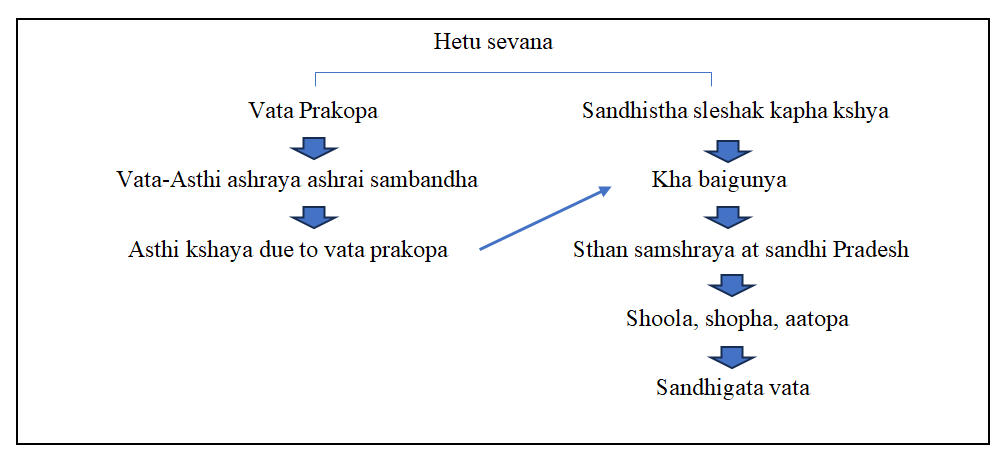
Samprapti Ghatakas [14]
- Nidana: Vata prakopaka nidana
- Dosha: Vata esp. Vyana vayu, Shleshaka kapha
- Dushya: Asthi, Majja, Meda
- Srotas: Asthivaha, Majjavaha and / or Medovaha
- Srotodusti: Sanga
- Agni: Mandagni
- Dosha Marga: Marmasthi Sandhi
- Roga Marga: Madhyam
Differential Diagnosis [15]
- Udbhavasthana: Pakvashaya
- Vyaktasthana: Asthi – Sandhi
Sadhyaasdhyata
If sandhigata vata is of recent onset, affected person has strong immunity, is without any complication, then it is sadhya. Otherwise, it is srichha Sadhya. Moreover, if there is dominance of the vata dosha & patient has developed complication of vatvyadhi, then it is yapya.
| Factors | Jaanu sandhigata vata | Amavata | Vatarakta | Koshtrukashirsha |
|---|---|---|---|---|
| Amapradhanya | Absent | Present | Absent | Absent |
| Jvara | Absent | Present | Absent | Absent |
| Hridgaurava | Absent | Present | Absent | Absent |
| Prone Age | Old age | Any age | - | - |
| Vedana | At prasarana | Vrischik dansha vata and sanchari | Mushika | Tivra |
| Akunchana | Damshavat | |||
| Pravritti | Vedana | |||
| Shotha | Vatapurna driti sparsha | Sarvang and sandhigata | Mandala yukta | Koshtruka |
| shirshvat | ||||
| Sandi | Weight bearing joint (knee jt.) | Starts from small jt. Later effects big sandhi | Small sandhi | Only janu |
| Upashaya | Abyanga | Ruksha svedana | Rakta shodhana | Rakta shodhana |
Table 4: Diagnosis of Sandhigatavata based on various factors.
Pathya
Pathya is compatible food and activities to be adopted for the course of treatment. In Ayurveda, importances of pathya and apathya has been stressed in many instances [14].
| Category | Pathya |
|---|---|
| Rasa | Madhura, Amla, Lavana |
| Dhanya varga | Raktha,shali,masha, godhuma, kulatha |
| Guna | Mridu,snighda,ushna,pitchilla |
| Saaka Varga | 1.Phala saaka: Kushmanda,varthaka, brihathi,karavellaka,sigru |
| 2.Patra saaka: Purnanava,mundi,kasama rda,vasthuka | |
| Phala | Dadima,parushaka,draksha |
| Mamsa | Jangala mamsa, kukkuta, chataka, tititri, ajja |
| Gorasa | Goksheeram,goghritham |
Table 5: Pathya based on different categories.
Apathya [16]
| Category | Apathya |
|---|---|
| Rasa | Katu,tikta,Kashaya |
| Guna | Ruksha,Guru,Sheeta,abishyandi |
| Dhanya | Yava,chanaka,kodrava,shyamaka |
| Saka | Bimbi,trapusa,sarshapa,kanda saka,alabu |
| Phala | Jambu,puga,udumbara,tala phala |
| Mamsa | Matsya,bileshaya,prasaha |
| Apathya vihara | Atimarga gamana,vegadharana, vyayama,srama,pathana,virusha chestha,chinta,bhaya,shoka |
Table 7: Apathya based on different categories.
Chikitsa of Sandhigata Vata
The main aim of the chikitsa is promotion and preservation of health in healthy individual, and elimination of the disease i.e. curative treatment. Although Acharya Charaka has not mentioned about specific chikitsa, the general vatavyadhi chikitsa can be taken into consideration. Acharya Sushruta was the first to mention the treatment principles of sandhigatavata i.e.
- Snehana
- Upanaha
- Agnikarma
- Bandhana
- Unmardana
| Chikitsa Sutra | Charak | Susruta | Astanga Sangraha | Astanga Hridyam |
|---|---|---|---|---|
| Sneha | - | + | - | + |
| Abhyanga | - | - | + | - |
| Upanaha | - | + | + | + |
| Agni karma | - | + | + | + |
| Bandhana | - | + | + | - |
| Unmardana | - | + | + | - |
| Sweda | - | - | - | - |
| Rakta mokshana | - | - | + | - |
| Pradeha | - | - | + | - |
| Shamana | - | - | - | + |
Table 6: Chikitsa According to various Acharyas [17].
Snehana
Snehana is the first and foremost phase of treatment in vatavyadhi. (Vata snehena mitravat) Taila is the best vatahara dravya. Different combination of chatursnehas ie.ghrita,taila,vasa and majja are also very effective in sandigata Vāta [18].
Swedana
Swedana karma after snehana causes liquification of stagnant doshas and relieves rigidity of Vāta. Swedana is of two type; sarvadaihika and sthanika. Sthanika swedana is used in mono articular diseasesand sarvadaihika is advisible in multiple joints involvement [19].
Vasti
Vasti is the main line of treatment in vatavyadhi. It is of two type. Anuvasana vasti : It is Sneha vasti consisting of oils with or without medicinal drugs. For sandigata vata, ksheerabala taila,dashmoola taila and mahanarayan taila is used. Niruha vasti: It is prepared of Kashaya of vatahara drugs like dashmoolaadi kwatha or ereendamooladi kwatha etc.
Upanaha
It is a process in which application of packing of cooked leaves and mamsa etc are done on sandhis.for this purpose. Sigru saka,kakolyadi gana dravyas, etc are used.
Avagaha
This is a process in which whole body or only affected joint is kept in luke warm kashayas of vatahara dravyas, taila etc.
Lepa: It is external application of thick paste of drugs on the sandhis.
Agni karma
The ushna (hot) guna of agni pacifies the shita (cold) guna of vata, removes the avarana effectively and stabilizes the movement of vata, and reduces the joint pain. Acharya Charaka mentioned that agni is the best treatment for shoola (pain). Acharyas have quoted that Agnikarma is superior in treating stambha (stiffness).
Formulations [20]
- Gugglu: Trayodasanga guggulu Rasnadi guggulu Yograj guggulu Maha yograj gugglu Salaki guggul
- Churna: Panchakola churna Haritaki churna Narsingh churna Rasnadi churna
- Rasaushadi: Vātavidhamsa rasa, Vatagajankusha, Vatachintamani rasa Prawal pisti
- Arista: Dashmoolaarista
- Kwatha: Dashmoola kwatha, Rasnadi kwatha, Rasnasaptka kwatha
- Snehana: Mahanarayan taila
Discussion
Sandigata vata is one of the most prevalent joint related diseases in the population. Sandigata vata is one of vatavyadhi which is mainly cause due to the dhatu kshaya (deplertion of tissue) mainly in old age. It includes signs and symptoms like vatapurna dratisparsha (tenderness), shotha (swelling), prasarana kunchan pravriti savedna (Pain during extension and flexion of joints). Excessively aggravated Vata inside joints causes swelling in the joints, and pain during extension & contraction of the joints. Vata prakopa factors in association of asthi kshaya causes are to presumed as nidanic factor of sandhigata vata. Rooksha and alpa ahara (dry and less diet) or langhana (fasting) will aggravates vata by virtue of rooksha and laghu gunas, dravyas of katu ,tikta and kashya are basically vata prakopa rasas.The excessive physical activities, excessive sexual intercourses ,exercise and marg gamana etc causes dryness and dhatus kshaya by causing vata prakopa. This vitated vata invades sandhi causing destruction of sandhi and manifestation of the diseases.
In sandigata vata there is usually vitiation of vata and dhatu kshaya so various sodhana and shamana therapies are done in order to restore the dynamic balance of vata and dhatu. Drugs which have properties of shothahara (anti- inflammatory), vatahara, vedanasthapana (analgesic), and rasayana (rejuvenative) are useful to treat this condition. Under panchakarma, swedana is a pre-procedure in which sweating is induced. After swedana, cellular metabolism improves that flushes the toxins away. Swedana done after abhaynga/ snehana enables free circulation in the joints, reduces pain, stiffness and swelling, strengthens and rejuvenates the joints, eases movement. Treatment of sandhivata usually begins with a basic process like mriduvirechana. It cleanses the body to restore patency of the srotas, which improve the access of healing material as well as nourishment to the body components. In addition, this also helps in maintaining or restoring the optimum equilibrium in tridosha. Eranda Taila is indicated for mriduvirechana in vatavyadhi chikitsa. The eranda beeja, having vibhedana (purgative), srotoshodhana (channel cleansing), anulomana (correct the apana vayu imbalance) actions, is used for mriduvirechana. Due to the vatahara action it is the best among the medicaments used for virechana (purgative therapy).
Pakwashaya (lower gastrointestinal tract) is the site of action for basti karma. It is the main site of Vata dosha. Hence, basti is mainly useful for the treatment of vitiated vata. It is convenient and comfortable in administration. Medicated oil and medicated decoction strengthen the joints and soft tissues and this therapy rejuvenates the tissues and eliminates the toxins from the body. A case study done by Fernando et al. in 56 yr old women suffering from janu sandhigata vata, was admitted and treated with Ksheera
vaitaran basti for 1st 7 days and vata shamak kwatha and janu vasti with Gugguladi taila in next 17 days and significant improvement in tenderness, swelling and pain upon flexion and extension was observed [21]. Another study observing the effect of Erandamooladi niruha basti and Dashamooladi anuvasana basti as yoga was done where 80.77% relieve in pain, 84.39% relieve in stiffness, 100% relieve in fatique and restricted movement reduced by 100 % and deformity reduced by 74.15% [22].
Other than that, janu basti is a strongly appreciated procedure in management of sandhigata vata. In janu basti, medicated oil is polled over the knee joint for a particular duration of time. It is beneficial in pain and swelling of the knee joint. A case study was done in a 61year old male patient with the diagnosis of knee OA since 2 yrs, and was advised to take janu basti with Mahanarayan taila followed by Dashmoola kwatha nadi-svedana. Mahanaryana Taila being vata shamaka, relieves ruksha, sheeta guna responsible for janu sandhivata and Dashmoola kwatha svedana is sothahara and vata shamaka showing significantly positive result in relieveing sotha, sandhi shola and savedana prasaran akunchan [23]. Studies have revealed that the lipid medium is highly suitable for penetration of the drug molecule through stratum corneum. On this basis, it can be assumed that the different oils used serve as a lipoidal medium for penetration of drug molecules and exert immediate effect.
Pathya ahara vihara are mainly focused in mitigating the vitiated vata and providing adequate nourishment to dhatus. Madhura, amla, lavana rasa are vata shamaka in nature. Godughda, goghrita, mamsa rasa, shali dhanya are balya, snighda and thus promote nourishment. Plain ghee is said to contain Vitamin D which plays an important role to utilize calcium and phosphorus in blood and bone building. The administration of ghrita internally has been proved effective in Sandhigata Vata. Effects of Panchatikta Ghrita and Gugulu tiktaka ghrita has been studied for successful manangement of janugata sandhhivata [24, 25]. Similarly, anti-inflammatory and anti-arthritic activities of guggulu in formaldehyde induced arthritis in albino rats, has been studied which supports the rationale behind the use of guggulu Kalpana [26]. The extract of Haridra (Curcuma domestica) was used as an anti-inflammatory drug in a trial and proved to be effective than the ibuprofen. Curcumin, an active ingredient in Haridra, inhibited the matrix degradation of articular explants and chondrocytes. Also, the extract of ginger was tested for its efficacy against ibuprofen and a placebo and the extract was found be effective in pain management due to the anti-inflammatory potential attributed due to its actions upon hydroxy-methoxy-phenyl compounds. Also, the gum resin of B. serrata, Shallaki, usually contains boswellic acids which help to preserve the structural integrity of joint cartilage and maintain a healthy immune mediator cascade at the cellular level [27].
A pilot study done in 5 patients with dietary herb formulation (Methika, Jeerak and Ajmoda) for pain reduction and vatanuloman and Shatavari and Ashwagandha as a Balya given for total 2 months and observation were done on basis of Visual Analogue Scale and significant improvement was seen [28].
Marma chikitsa is rapidly flourishing branch of ayurveda for pain management. In a study done among 15 patients, 80% relief in pain was seen upon stimulating manibandha, kshipra, kurpara and janu marma 15-18 times, thrice a day (single stimulus was for 0.8 sec) for 90 days. Stimulation of marma produces analgesia by secreting a number of prostaglandin inhibitors, and other opioid- like substances which are hundred times more potent than opium [29]. Also, leech therapy provided quick symptomatic alleviation in pain and swelling in some clinical case studies. Tenderness and restricted joint movements were also eased gradually, as were symptoms such as crepitation and stiffness in joints. The leech saliva contains a number of pharmacologically active biological substances such as hirudin and hyaluronidase which are proved to have analgesic, anti‐inflammatory, and anesthetic activities. The therapy proved more effective than the topical application of analgesics or NSAIDs [30]. Pain management is also attained by agnikarma (therapeutic heat burn). The ushna (hot) guna of agni pacifies the shita (cold) guna of vata, removes the avarana effectively and stabilizes the movement of vata, and reduces the joint pain. Acharya Charaka mentioned that agni is the best treatment for shoola (pain).
Conclusion
Sandhigata vata is one of the most prevalent joint diseases in the population. It occurs primarily because of dhatu kshaya (depletion of tissues) in vriddhavastha (old age), which restricts daily activities such as walking, dressing, bathing, etc. Since it is one of vatavyadhi, vata shamaka different shamana and shodana therapy is done to subsides the diseases. The findings showed that with the collective approach of different Shodhana procedures, including Snehana (internal oleation), Svedana (sudation) Basti (medicated enema) and Mrudu Virechana (soft purgation), upanaha, jalauka,agnikarma, avagahana and shamana treatment (Pacification) like vatahara, vedanahara dravya , sandhigata vata can be efficiently cured.
References
-
Tripathi R (2017) Charak Samhita, Chikista Sthana, Vatavyadhi Chikistha, Chaukhambha, Varanarasi, India.
-
Babu DS (2019) The Principle and Practise of Kaya Chikista. 1st(Edn.), Chaukhambha Orientalia, Varansi, India, pp: 70-71.
-
Babu DS (2019) The Principle and Practise of Kaya Chikista. 1st(Edn.), Chaukhambha Orientalia, Varansi, India, pp: 62-63.
-
Agnivesha (2020) Vata Vyadhi Chikitsa Adhyaya, Chikitsa Sthana. In: Tripathi B (Ed.), Charaka Samhita commentary. 1st(Edn.), Chaukhamba Surbharati Prakashan, Varanasi, India, Verse 15-17, Volume 2; pp: 937.
-
Yogaratnakara (1988) Vata Vyadhi Nidanam, Poorvardha. In: Shastri L (Ed.), Yogaratnakara commentary. 1st(Edn.), Chaukhambha Sanskrit Sansthan, Varanasi, India, Verse 5, pp: 435.
-
Madhavakara (2019) Vata Vyadhi Nidanam, Poorvardha. In: Upadhyaya Y (Ed.), Madhava Nidana commentary. 1st(Edn.), Chaukhamba Prakashan, Varanasi, India, Verse 21, Volume 1, pp: 463.
-
Bhavamishra (1988) Vtavyadhi Adhikara, Madhyamakhanda. In: Murthy K (Ed.), Bhavaprakasha. 5th(Edn.), Chaukhambha Orientalia, Varanasi, India, Verse 1-3, pp: 494.
-
Agnivesha (2020) Vata Vyadhi Chikitsa Adhyaya, Chikitsa sthana. In: Tripathi B (Ed.), Charaka Samhita Commentary. 1st(Edn.), Chaukhamba Surbharati Prakashan, Varanasi, India, Verse 37, Volume 2, pp: 942.
-
Dhanwantari (2020) Vata Vyadhi Nidana Adhyaya, Nidana Sthana. In: Thakral K (Ed.), Sushruta Samhita commentary. 2nd(Edn.), Chaukhamba Orientalia, Varanasi, India, Verse 28, Volume 1, pp: 685.
-
Vaghbhata (2015) Vata Vyadhi Nidanam Adhyaya, Nidana Sthana. In: Tripathi R (Ed.), Ashtanga Sangraha commentary. 1st(Edn.), Chaukhamba VIdabhawan, Varanasi, India, Verse 16: Volume 2.
-
Babu DS (2019) The principle and Practise of Kaya chikista. 1st(Edn.), Chaukhambha Orientalia, Varansi, India, pp: 64-65.
-
Agnivesha (2020) Vata Vyadhi Chikitsa Adhyaya, Chikitsa Sthana. In: Tripathi B (Ed.), Charaka Samhita commentary. 1st(Edn.), Chaukhamba Surbharati Prakashan, Varanasi, India, Verse 18, Volume 2, pp: 939.
-
Subhangi P, Nagesh G (2015) A Review on Sandhigata Vata and its Management Principles. International Journal of Ayurvedic Medicine 6(1): 8-15.
-
Dhurve SA (2021) Disease Review on Sandhigata Vata and its Management. International Journal of Creative Research Thoughts 9(4): 3885-3891.
-
Babu DS (2019) The Principle and Practise of Kaya Chikista. 1st(Edn.), Chaukhambha Orientalia, Varansi, India, pp: 69.
-
Babu DS (2019) The principle and Practise of Kaya Chikista. 1st(Edn.), Chaukhambha Orientalia, Varansi, India, pp: 70.
-
Lohit B (2016) A Textbook of Panchakarma. 1st(Edn.), Chaukhambha Orientalia, Varanasi, India, pp: 37.
-
Lohit B (2016) A Textbook of Panchakarma. 1st(Edn.), Chaukhambha Orientalia, Varanasi, India, pp: 127.
-
Sharma P (2019) Kayachikista. 2nd(Edn.), Chaukhambha Orientialia, Varanasi, India 3: 60.
-
Rathod D, Dattani K (2017) Effect of Yoga Basti in Sandhivata w.s.r. to Osteoarthritis of Knee Joint. International Journal of Ayurvedic Medicine 8(2): 73-79.
-
Kaushik R, Sharma P (2015) Janu basti and Nadi Swedana in Janu Sandhigata Vata: A Case Study, International journal of Ayurvedic and Herbal medicine 5(6): 2067- 2071.
-
Akhtar B, Mahto RR, Dave AR, Shukla VD (2010) Clinical Study on Sandhigata Vata w.s.r. to Osteoarthritis and its Management by Panchatikta Ghrita Guggulu. Ayu 31(1): 53-57.
-
Patil B, Sonaje M (2013) Role of Guggulutiktaka Ghrita in the management of osteoarthritis W.S.R. to knee joint. International Journal of Research in Ayurveda and Pharmacy 4(1): 71-73.
-
Patel MG, Pundarikakshudu K (2016) Anti-arthritic activity of a classical Ayurvedic formulation Vatari Guggulu in rats. Journal of Traditional and Complementary Medicine 6(4): 389-394.
-
Kuptniratsaikul V, Dajpratham P, Taechaarpornkul W, Buntragulpoontawee M, Lukkanapichonchut P, et al. (2014) Efficacy and safety of Curcuma domestica extracts compared with ibuprofen in patients with knee osteoarthritis: a multicenter study. Clin Interv Aging 9: 451-458.
-
Yucel C, Karatoprak GS, Acikara OB, Akkol EK, Barak TH, et al. (2022) Immunomodulatory and anti- inflammatory therapeutic potential of gingerols and their nanoformulations. Front Pharmacol 13: 902551.
-
Gupta PK, Samarakoon SM, Chandola HM, Ravishankar B (2011) Clinical evaluation of Boswellia serrata (Shallaki) resin in the management of Sandhivata (osteoarthritis). Ayu 32(4): 478-482.
-
Turale A, Khandekar V (2019) Pain Management in Sandhigata Vata by Ayurvedic Dietary formulation: pilot study. World Journal of Pharmacy and Pharmacheutical Science 8(7): 1-9.
-
Dighekar U, Vimal K, Joshi S (2020) Effect of Marma Therapy on Sandhigata Vata w.s.r. to Osteoarthritis. Journal of Ayurveda and Integrated Medical Sciences 5(5): 72-77.
-
Andereya S, Stanzel S, Maus U, Mueller-Rath R, Mumme T, et al. Assessment of leech therapy for knee osteoarthritis: A randomized study. Acta Orthop 79(2): 235-243.
- Management of Ear Keloid with Ksharsutra: A Case Study
- Yoga and Global Sustainability: A Holistic Path to One Earth, One Health
- Autoimmune Diseases in Ayurveda: A Narrative Review with Classical and Modern Perspectives
- Management of Cluster Headache Associated with Pituitary Apophysitis by CERT (Chakrasiddh Energy Release Technique): A Case Report on Energy Rebalancing
- Zygophyllum Geslini Coss : Biochemicals and Antioxidant Activity
- Observations of a Beginner Vaidya