
Study of the Trend of Respiratory and Extra-Respiratory Tuberculosis in a Southern Region of Romania between 2011- 2018
Aim: To describe the trend of Tuberculosis in an endemic area by analysing all cases of respiratory and extra-respiratory Tuberculosis (TB) in Dolj County, a Southern region of Romania, between 2011-2018 and discuss results. Method and Material: Retrospective study of all TB cases registered in official records of Clinical Hospital of Infectious Diseases and Pneumophtisiology "Victor Babeş" Craiova and TB Ambulatory Clinic of Craiova, between 01.01.2011- 31.12.2018. We used all files of all patients registered with TB. We didn’t apply any inclusion and exclusion criteria. Results: We analyzed 4112 cases of TB divided in 3353 respiratory TB cases and 759 extra-respiratory TB cases. The number of respiratory TB cases has dropped from 588 cases in 2011 to 325 cases in 2017, with a tendency to grow again in 2018 when 377 cases were registered. The same tendency for extra-respiratory TB: we registered 150 cases in 2011 dropping down to 49 cases in 2018. Most frequent extra-respiratory cases were Pleural TB-423 cases, Lymph node TB- 111 cases and bones and joints TB-80 cases. 65% of all extra-respiratory TB cases were confirmed either by histopathological or identifying acid fast bacilli. Other results will be presented in the article below. Conclusions: We consider that an analysis of the current situation of the respiratory and extra-respiratory Tuberculosis status in Dolj County in the context of a descending trend of endemic TB in our country can provide epidemiological and clinical evidence the good management of TB cases respecting National TB Control Guidelines.
Introduction
Tuberculosis is an infectious disease with various clinical and radiological symptoms which are determined Study of the Trend of Respiratory and Extra-Respiratory Tuberculosis in a Southern Region of Romania between 2011- 2018 primarily by the immune system of the host towards the infection with Mycobacterium tuberculosis. The infection with M. tuberculosis can be limited to an organ or it can spread through hematogenous or lymphatic route to J Qual Healthcare Eco
other organs (especially cases of younger or older people). Tuberculosis can be located in any organ in the body, lung being the preferred location due to its structure. Tuberculosis diagnosis always needs bacteriological or histopathological confirmation [1, 2].
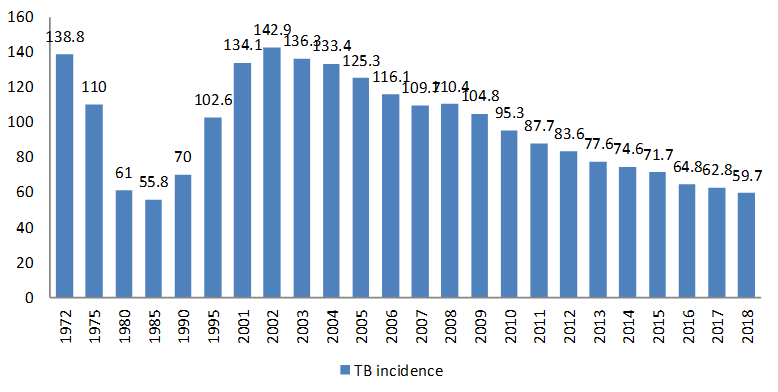
Tuberculosis is an important public health problem in Romania. Today, the value of the global incidence (new cases and relapses) of tuberculosis in our country is the highest in the European Union and one of the highest in the World Health Organization (WHO) European Region (5th place after Kazakhstan, Moldova, Georgia and Kyrgyzstan). After 1985 the incidence of tuberculosis in Romania began to gradual increase with a peak in 2002 (142.2%000). 2003 was the first year we registered a decline in TB incidence (135.7%000). The downward trend continued, and in 2018 tuberculosis incidence was 59.7%000 (Figure 1) [4, 5, 6, 7, 8, 9, 10, 11]; 2018 represented the 16th consecutive year of decrease in the incidence of tuberculosis in Romania.
Tuberculosis (TB) is a top infectious disease killer worldwide and it is among the top 5 causes of death for women aged 15 to 44. In 2014 9.6 million people fell ill with TB and 1.5 million died from the disease (over 95% of TB deaths occured in low- and middle-income countries). An alarming rise was also seen in the number of MDR and XDR –TB. Globally, in 2014 an estimated 480,000 people developed multidrug-resistant TB (MDR- TB) [3]. Each year 8-9 million persons develop the disease and approximately two million people die of TB or its complications [4].
Sadly, in the last years we have noticed a considerable increase of the incidence of extra-pulmonary tuberculosis in worldwide and also in Romania. The main factors that contribute to the increasing number of extra-respiratory tuberculosis cases are the increased number of immunocompromised persons, the increase worldwide population (especially the elderly segments) and the increasing number of medical personnel exposed to TB infection [12]. Extra-respiratory TB is more common in children than in adults. Tubercle bacilli are often located in well-vascularized areas such as the meninges, kidneys, spine or the epiphysis of long bones [12, 13].
Extra-respiratory TB can be located in different areas of the body. It can affect one organ or it can be localized simultaneously in different organs. TB can affect lungs in the same time, too. The usual organs touched by TB are lymphatic nodes, bones, pleural area, urinary and genital area, central nervous system, peritoneum and skin [14]. The diagnosis of extra respiratory tuberculosis is the responsibility of the organ specialist. This diagnosis is mainly supported by histopathology exam.
Extra respiratory TB diagnosis is difficult and is established excluding other pathological conditions by the physicians in specialties involved. The therapeutic approach in extra respiratory tuberculosis is multidisciplinary.
According to the national data register in Romania, the culture rate confirmation of extra-respiratory TB is almost 10%. In Romania, the diagnose of extra- respiratory TB is made by the “organ” specialist along with the pulmonologist, the treatment being prescribed by the respiratory physician [2].
The global rate of therapeutic success for extra- respiratory TB with precise localization was 83.2%. According to the localization, the highest success rate was seen in ganglionic intrathoracic TB (82.4%) and pleural TB (86.7%). For miliary TB, the success therapeutic rate was just 48.9% [15, 16, 17, 18].
We consider that an analysis of the current situation of the respiratory and extra-respiratory Tuberculosis status in Dolj County in the context of a descending trend of endemic TB in our country can provide epidemiological and clinical evidence the good management of TB cases respecting National TB Control Guidelines. Dolj County is placed in the top 5 county’s incidence of all TB cases in our country.
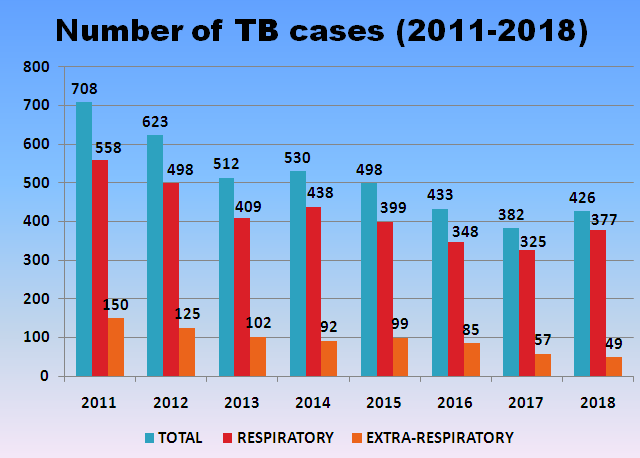
We analyzed 4112 cases of TB divided in 3353 respiratory TB cases and 759 (18.3%) extra-respiratory TB cases. The number of respiratory TB cases has dropped from 588 cases in 2011 to 325 cases in 2017, with a tendency to grow again in 2018 when 377 cases were registered. The same tendency for extra-respiratory TB: we registered 150 cases in 2011 dropping down to 49 cases in 2018 (Figure 2).
Material and Method
We performed a retrospective study of all cases of respiratory and extra-respiratory TB in Dolj County, a Southern region of Romania, using official records of all TB cases registered in the Clinical Hospital of Infectious Diseases and Pneumophtisiology "Victor Babeş" Craiova and TB Ambulatory Clinic of Craiova, between 01.01.2011- 31.12.2018. We used all files of all patients registered with TB. We didn’t apply any inclusion and exclusion criteria. The patient diagnosed with TB is according to National TB Control Guidelines is:
- the patient with bacteriologically or histopathologically confirmed TB (HP);
- Or the patient who has no confirmation, but where the pneumologist has sufficient clinical and preclinical data to decide to start antituberculosis treatment. Any antituberculosis treatment should be instituted only by a pneumologist or with the written accept a pneumologist.
The TB case is defined according to disease localization, bacteriological or histopathological confirmation, therapeutic history and HIV status [5].
Results
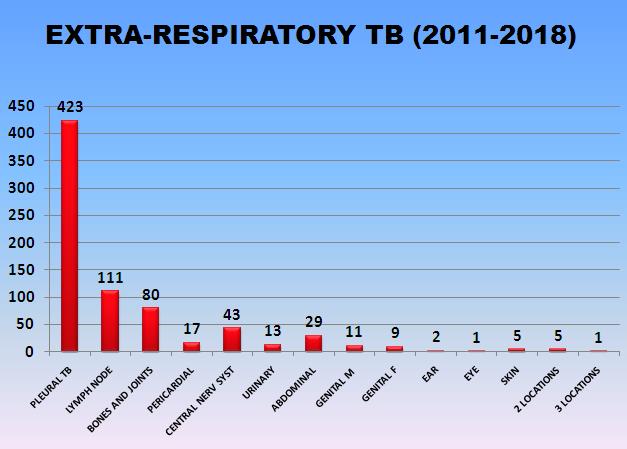
Most frequent extra-respiratory cases were Pleural TB - 423 cases, Lymph node TB-111 cases and Bones and joints TB-80 cases (Figure 3).
From the 4112 all TB cases a total of 2642 patients (64.25%) were male and 2418 (58.8%) were from urban areas.
Majority of male patients (55.1%) were from urban areas, the same being recorded in the females group (64.4%).
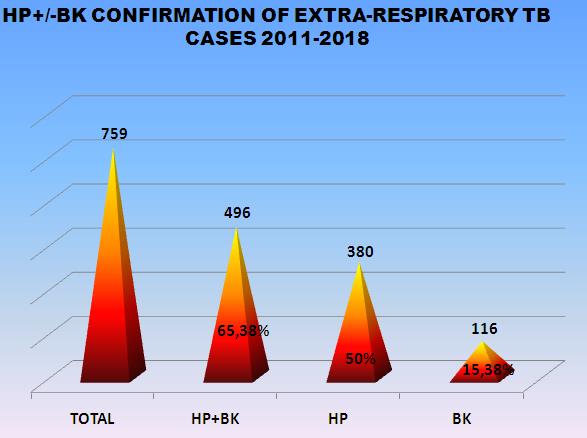
Distribution of cases by age groups showed that the most affected groups were between 41-50 (347 cases) and 51-60 years (423 cases) and the majority of patients are males. The same features were found in the other age groups. The only exception was recorded in the group > We have registered a total of 496 cases (65%) of extra- respiratory TB cases that were confirmed either by histopathological methods or by identifying acid fast bacilli in cultures (Figure 4).
80 years (26 cases) where females predominated (69%). A distribution of cases by age and environments shows that most groups patients were from urban areas. Exceptions to this were the groups 0-15 years and 61-70 years where the patients were majority from rural area. This suggests that there are different predisposing factors to the extra-respiratory localization of tuberculosis in certain age groups.
The most histopathological confirmation occurred in the age group of 31-40 years followed by groups 51-60 years and 21-30 years. The fewer confirmations were in the age group > 80 years. Bacteriological confirmation was present in higher percentage in males than in females, while histopathological confirmation prevailed in females.
The number cases diagnosed with drug resistant TB represents 8% of all cases, but these cases are also dropping down each year. 47 patients (1.14%) had HIV infection. All patients were tested for HIV. Only 2.2 % of all registered cases died because of TB, during their TB treatment.
Conclusions
The number of respiratory and extra-respiratory TB cases between 2011-2018 continues to drop down following the national trend for all TB cases.
As seen in the study population the most affected are the males, adults over 40 years old, from urban areas. Respiratory TB is most common but 18% of the cases represent extra-respiratory TB. Respiratory and extra- respiratory preponderance of tuberculosis patients in urban areas shows a higher addressability the medical services.
Diagnosis of extra-respiratory TB locations remains difficult sometimes, in the absence of laboratory diagnostics available and needs a very close collaboration between the pulmonologist and the organ specialist.
We considered that an analysis of the current situation of the respiratory and extra-respiratory TB status in Dolj County in the context of a descending trend of tuberculosis enemy in Romania can provide epidemiological and clinical evidence and true reflection of this infectious disease in a Southern area of our country. These data could help us provide new solutions to fight with this disease. The descending trend of TB cases proves also a good management of TB cases respecting National TB Control Guidelines because we can correlate the descending trend of TB cases in Romania with descending trend of TB in our specific region (Figures 1 & 2).
References
-
Olteanu M, Popescu MR, Nitu M, Calarasu C, Maceseanu AV, et al. (2016) Rare Case of Pulmonary Tuberculosis with Hematogenous Spread to Larynx and Skin. Curr Health Sci J 42(2): 213-216.
-
Nitu FM, Olteanu M, Streba CT, Jimborean G, Postolache P, et al, (2017) Tuberculosis and its particularities in Romania and worldwide. Rom J Morphol Embryol 58(2): 385392.
-
(2018) Tuberculosis.
-
Pitchenik AE, Fertel D, Bloch AB (1988) Mycobacterial disease: epidemiology, diagnosis, treatment, and prevention. Clin Chest Med 9(3): 425-441.
-
(2015) Anti-TB National Guide of PNPSCT.
-
(2013) Methodological Norms for the Implementation of the National Tuberculosis Control Program 2013-2017. Ministry of Health, Bucharest.
-
(2005) Ministry of Public Health-Center for Health Statistics and Statistics, Health Statistics Yearbook Bucharest 2005.
-
(2007) Ministry of Public Health-Center for Health Statistics and Statistics, Health Statistics Yearbook Bucharest 2007.
-
(2008) Ministry of Public Health-Center for Health Statistics and Statistics, Health Statistics Yearbook Bucharest 2008.
-
Popescu GG, Spinu V, Domnica Chiotan I (2014) Aspects of the TB endemic in Romania and the response of the National Program for Prevention, Supervision and Control of Tuberculosis (PNPSCT). Pneumologia 63(1): 12-14.
-
(2014) Review of the National Tuberculosis Programme in Romania. WHO Report.
-
Weir MR, Thornton GF (1985) Extrapulmonary tuberculosis. Expe-rience of a community hospital and review of the literature. Am J Med 79(4): 467- 478.
-
Rieder HL, Snider DE, Cauthen GM (1990) Extrapulmonary tuberculosis in the United States. Am Rev Respir Dis 141(2): 347-351.
-
Golden MP, Vikram HR (2005) Extrapulmonary tuberculosis: an overview. Am Fam Physician 72(9): 1761-1768.
-
Solovic I, Jonsson J, Korzeniewska-Koseła M, Chiotan DI, Pace-Asciak A, et al. (2013) Challenges in diagnosing extrapulmonary tuberculosis in the European Union, 2011. Euro Surveill 18(12): 20432.
-
Sharma MP, Bhatia V (2004) Abdominal tuberculosis. Indian J Med Res 120(4): 305-315.
-
Peto HM, Pratt SH, Harrington TA, LoBue PA, Armstrong LR (2009) Epidemiology of the extrapulmonary tuberculosis in the United States, 1993-2006. Clin Infect Dis 49(9): 1350-1357.
-
Călina D, Docea AO, Rosu L, Zlatian O, Rosu AF, et al. (2017) Anti-microbial resistance development following surgical site infections. Mol Med Rep 15(2): 681-688.
- Capacity Constraints in Pediatric Inpatient Psychiatric Care: A Cross-Sectional Analysis of Bed Availability and Geographic Access in North Carolina
- Why Healthcare Analytics Still Optimizes the Wrong Things
- Coding, Coverage, and Care: The Infrastructure of Transgender Health Inequities
- The Effect of Classroom Attendance on Academic Achievement of Management and Leadership Discipline of Nursing Students at Instituto Superior Cristal and Universidade de Dili, Timor-Leste, 2024: A Case Study
- The Role of Social Bonds in Facilitating Shared Investments and Resource Allocation: Addressing the “Wrong Pocket Problem” in Public Health and Healthcare
- Social-Cultural Factors Contributing to Antimicrobial Resistance in Livestock Farmers and Community Households in Kayonza District, Rwanda