
The Impact of Healthcare Workers' Mental Health during a Covid-19 Pandemic
It is noteworthy that the psychological damage of healthcare workers who work on the front lines of the fight against diseases, especially COVID-19, should be make a deep analysis about their mental behaviors. Poor mental health, due to fatigue, fear, anxiety, depression, post-traumatic stress disorder, and burnout, can negatively impact the professional's life, and can affect decision making that directly impacts the lives of their patients. This article was conducted through a thorough reading of literature review articles, in an exploratory format, to add quality content to the reader, expanding knowledge and engaging the reader in the search for strategies, resulting in minimizing such impacts. Strategies such as: tracking and psychological support from the smallest symptoms of psychic affectation, greater relevance to spread the subject in focus, and empathy with these professionals can help minimize this vulnerability
Introduction
In March 2020, according to the World Health Organization (WHO), the beginning of the COVID-19 pandemic was announced, knowing that the Emergency Committee of the international health regulations had already considered the outbreak as a global emergency since January 2020. According to data released by the organization itself, more than 572 thousand deaths had been reported by July of that year due to worsening conditions in patients diagnosed with sars-cov-2 [1].
The virus transmission happens in several ways, transmitted by droplets or contact, directly or indirectly to infected patients. saliva and infected respiratory droplets dispersed in the environment, or in the form of aerosols, transmitted through coughing, sneezing or speaking, thus the virus can remain infectious in an open environment for a long period, especially if the infected patient contaminates objects, thus causing an indirect transmission. Therefore, it is important to take the appropriate safety measures for the pandemic, social distancing, avoiding closed environments, hand washing and the correct use of the safety mask [1].
Health professionals face daily exhausting working conditions, long working hours, inadequate infrastructure, and risks to their own health. This results in high levels of professional wear and tear, physical and psychological illness, and a poor quality of life, where the priority is to provide the best health support for their patients. In this circumstance, faced with a pandemic context, healthcare workers find themselves with work overload, preoccupation with patients, and a lack of Personal Protective Equipment (PPE), especially in countries with low financial resources. High levels of stress propagate a threat to the mental health of them, increasing the rates of depression, anxiety, post- traumatic stress disorder (PTSD), In the course of, the facts about the mental health of healthcare [2].
Objectives
General objective
- Understanding one of the reasons why mental shortage in a healthcare professional is common;
- Factors that contribute to the development of Burnout Syndrome;
Specific Goal
• which the impacts on the mental health of health care workers in the pandemic period?
Methods
The method used to approach this article, was an integrative literature review, exploratory research, allowing in turn, the formulation of scientific articles, relating the topics of approach to the main subject. The review in the following guiding question: what are the impacts on the mental health of health professionals in the pandemic period? This was based on a thorough evaluation of international publications addressing the topic. Using the databases tool: Science Direct and Scientific Electronic Library Online (Scielo), between October 13, 2022 to October 17, 2022 for research. Designated inclusion criteria as: Addressing the topic in an objective way and of good understanding for the reader, how it could imply health, and articles published between the years 2020 and 2022. This search method obtained about 1740 publications. The initial selection of articles was made by means of the title and abstracts found, which did not answer the guiding question. From the exclusion method, articles were selected and submitted to reading in full, and detailed analysis the table below demonstrates the results of this research (Figure 1).
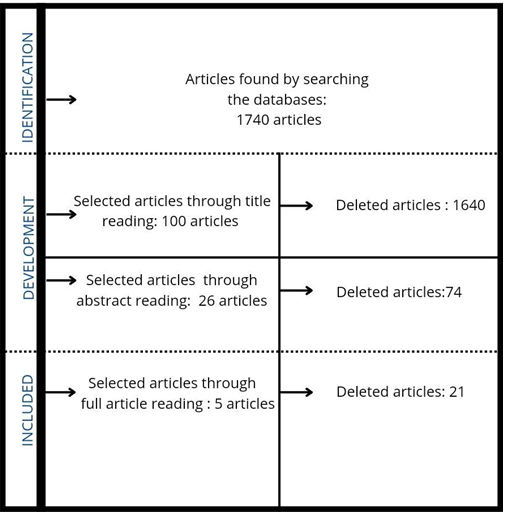
Development
On December 31, 2019, the Chinese authorities notified the world health organization WHO about the appearance of a pneumonia of hitherto unknown origin in China, Wuhan city. With the passage of time and the limited knowledge about the virus, the number of cases began to increase radically, contaminating the entire Chinese territory and several countries around the world. Thus, in March 2020, the WHO declared a pandemic for sars-cov-2 [3].
Since the beginning of the pandemic by COVID-19, health professionals have gained prominence in the fight against the disease by acting in the front line of chaos. Consequently, this has affected their mental health in the face of a varied factor of changes caused by the infection, diverse occupations, and constant exposure, which has led to concern among the professionals themselves, institutions, and governments [4].
The infection by COVID-19, can establish itself in the organism in the following ways: asymptomatic virus carriers, patients with acute respiratory disease or patients with pneumonia of various severities, knowing that some symptoms that occur in the beginning are similar to those of other respiratory infections. The most common symptoms at the beginning of the infection are fever, headache, myalgia, and some patients evolve to dyspnea [5].
Healthcare workers are exposed to transmission risks due to their work in combat, high viral loads, and less than optimal personal protective equipment as certified by the ministry of economics. Coupled with this, the abundant stress, high emotional burden, extensive workload, worry about being infected or infecting others, the lack of adequate support in the work environment, and the lack of effective supportive treatments affect the mental health of the healthcare worker [1].
Some literature proves that there are three major aspects in the working day that directly impact the mental health of professionals, the physical, cognitive and psychological, and when it comes to pandemic circumstances, these aspects tend to occur in a negative way for the health of professionals due to their great overload, especially one of the biggest challenges for the team would be the moral load because they need, at all times, make decisions that will directly affect the lives of these patients, and may generate on the part of these professionals feelings of fear, anxiety, discomfort and discomfort, consequently affecting the mental health of professionals [2].
Therefore, it is extremely important to better understand the mental health of health professionals. It is known that it was the class of workers most affected in the pandemic period, with millions of infected professionals, thus presenting a fragility in their health [3].
For health care workers such as doctors, nurses, physical therapists, among other professionals, the stress of being responsible for both infected and non- infected patients can affect their mental health, and consequently reduce their ability to work, thus causing a lack of their clinical competence. Therefore, during the pandemic of COVID-19, health care workers, regardless of age, present high levels of mental disorders when compared to other periods, highlighting the prevalence of stress, anxiety, depression, and insomnia [1].
Observe the presence of factors that contribute to psychological illness within the work environment. The presence of comorbidities among some professionals can worsen their mental health, so that pre-existing diseases can lead to serious complications. Therefore, this exposure to stress factors can lead to disorders such as depression, with risks even for suicide. Studies show that health care workers are prone to sleep disorders and/or poor sleep quality due to exposure, especially during pandemic periods when they become vulnerable. The lack of psychological support, changes in work schedules, concern about the consequences of a disease in the global scope become contributors to the appearance of sleep disorders in professionals causing insomnia and mental health problems [4].
The high rates of impaired mental health are reflected mainly in the class of female professionals, nurses, aged 26 to 40 years. They are associated with a higher risk of the possible symptoms of unbalanced mental health. It is known that the quality of sleep is extremely relevant for the physical aspect, as well as for the cardiovascular, endocrine and immunological systems, especially in mental health. Therefore, professionals who work in this line of action, consequently [2].
The impacts of the pandemic on health professionals were determinant for the appearance of psychological disorders, especially the Burnout Syndrome (BS), characterized as professional exhaustion syndrome. Burnout Syndrome is a disorder of extreme exhaustion at the psychological level, directly related to the professional occupation of the individual, and is characterized by emotional exhaustion, depersonalization, and low professional accomplishment. SB is developed in individuals who, under the effect of chronic stress from work, have their emotional resources retracted, mainly due to high levels of interpersonal demands capable of wearing out the individual and his relationships. In addition, burnout is characterized by behaviors that go beyond the normality of the individual, either in cold, negative or even insensitive attitudes, directed towards coworkers and those who use the service provided as patients [6].
According to the Mental Health and Psychosocial Care (SMAPS) Pandemic Recommendation Manual-19, it is of utmost importance that some measures are taken, such as: The recruitment and training of teams with experience in psychosocial care and mental health; formation of groups to support professionals and patients, with the SMAPS component; and, after the pandemic, attention to the mental health of the teams that worked in the front line, particularly, to those who worked with the most severe cases [7].
Some strategies to minimize the psychological impacts on healthcare workers would be to institute continuing education programs, provide appropriate protective measures, and organize psychological support services that can even be done online. Long-range telepsychiatry shares online mental health promotion resources and connects professionals around the world, thereby helping professionals regardless of distance to follow up with empathetic listening [3].
The challenges faced by healthcare workers can be a stimulus for the onset, or intensification, of burnout symptoms. Education about mental health, subsequent prevention and guidance are fundamental in moments like these, it is essential to spread the knowledge about among the workers and the population to propose effective strategies for prevention and health promotion in the field of mental health [6].
The field of psychiatry and other mental health sciences can assist in quality of life, improve coping, and aid the well- being of patients, their families, and health care professionals. In order to be successful in fighting future pandemics, it is of utmost importance to learn about the psychological and psychiatric aspects of - 19 for a better outcome [3].
Final Considerations
Due to the facts mentioned, it is evident the mental exhaustion for health professionals, in a way that directly affects their professional performance. It is known that a balanced mental health generates a better quality of life, control of emotions, reasoning, decision making, and behavior with other people.
Faced with an unprecedented situation, lack of preparation, and ignorance of the virus itself, professionals who dealt on the front lines amidst the chaos, gave up their own health and that of their families to care for their patients. Full-time professionals on alert, afraid, insecure, anguished, and anxious, always seek the best care for the patient. burnout syndrome characterized by professional burnout due to extreme exhaustion.
Thus, it is essential that governments can act at this time to minimize the psychological problems of the post- pandemic and prevent disorders such as stress, anxiety, depression, and insomnia from being established for a long time, especially in those who helped fight the virus, the health professionals acting in the front line.
It is of utmost importance that there can be psychological screening and support for the professionals who show the least possible warning sign of these characteristics, a better care for those who care for other lives.
As for future studies, it would be important to identify if the concepts described by the professionals are reflected in their professional practice or if they only reproduce the discourses absorbed from official documents and academic discussions. That is, automatically repeated answers do not necessarily guarantee the internalization of the concept. Thus, additional studies that use the technique of observation of work processes and behaviors adopted by professionals in day-to-day life in front of a person with mental disorders would be essential to deepen such discussions [8, 9].
To conclude that the protection of healthcare workers should be a priority measure for health systems to face pandemics or health problems, since, in a post-pandemic period, it is necessary to know how to deal with readjustments of losses, emotional and socioeconomic transformations, since this period directly affected the economic sector and the general health of the majority population. The contribution and notoriety in studies for mental health exposes its associated factors, which can collaborate to the creation of new strategies and interventions able to help these professionals to mitigate the effects of the pandemic in the short, medium, and long term.
References
-
Reiser M (2021) Mental health of health professionals in the middle of the corona virus pandemic. REIS 8(3): 12.
-
Bezerra GD (2020) The impact of the COVID-19 pandemic on the mental health of health professionals: integrative review. Information and Knowledge for Health Portuguese spanish english français pp: 20.
-
Almeida CARPN, Almeida GARPN, Carvalho MRCT, Marcolino AB (2020) Mental Health Aspects of Health Professionals during The Covid-19 Pandemic: An Integrative Literature Review. pp: 11.
-
Silva FV (2022) Effects of the Pandemic and Factors Associated with the Mental Health of Healthcare Professionals pp: 16.
-
Prado EM (2021) Hematological, cardiovascular and pulmonary repercussions in the prognosis of patients infected by COVID-19: A literary review. pp: 20.
-
Costa AV (2022) Therapeutic interventions for burnout syndrome in healthcare professionals during the covid-19 pandemic: integrative reading review. 3(1): 22.
-
Noal DS, Passos MFD, Freitas CM (2020) Recomendações E Orientações Em Saúde Mental E Atenção Psicosocial Na Covid-19. Fundação Oswaldo Cruz Ed. Brasilia: Fiocruz. Intervenções Terapêuticas Para A Síndrome De Burnout Em Profissionais Da Saúde Durante A Pandemia De Covid-19: Revisão Integrativa De LeiturA pp: 22.
-
Menezes NNT, Schulz VL, Peres RS (2011) Psychological impact of breast cancer diagnosis: a study based on patient reports in a support group. pp: 20.
-
Ross EK (2005) About death and dying: Martins Fontes pp: 119.
- Capacity Constraints in Pediatric Inpatient Psychiatric Care: A Cross-Sectional Analysis of Bed Availability and Geographic Access in North Carolina
- Why Healthcare Analytics Still Optimizes the Wrong Things
- Coding, Coverage, and Care: The Infrastructure of Transgender Health Inequities
- The Effect of Classroom Attendance on Academic Achievement of Management and Leadership Discipline of Nursing Students at Instituto Superior Cristal and Universidade de Dili, Timor-Leste, 2024: A Case Study
- The Role of Social Bonds in Facilitating Shared Investments and Resource Allocation: Addressing the “Wrong Pocket Problem” in Public Health and Healthcare
- Social-Cultural Factors Contributing to Antimicrobial Resistance in Livestock Farmers and Community Households in Kayonza District, Rwanda