
Institutional Deliveries at Public and Private Health Institutions in Punjab: A Comparative Study of Pre-Lockdown, Lockdown and Post-Lockdown Periods in Selected Districts
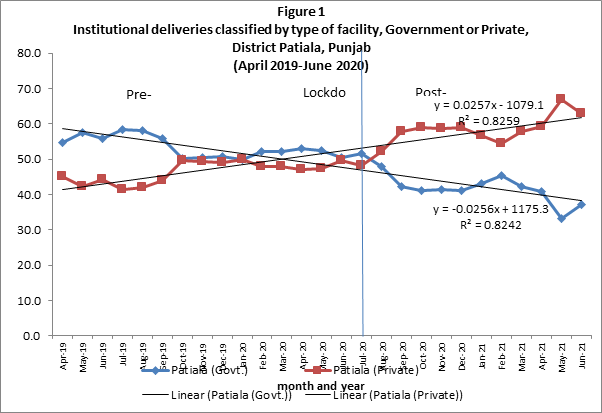
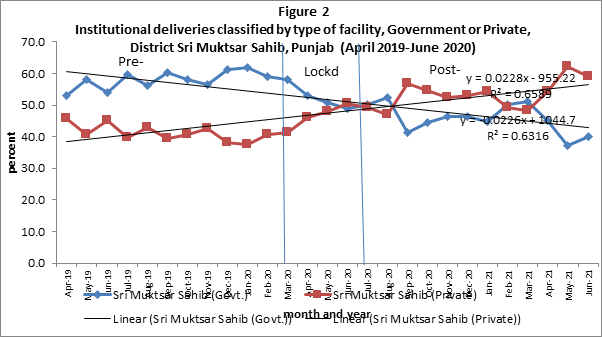
From 25 March 2020, there was a complete lockdown in Punjab till 31 May 2020 in four different phases affecting almost all types of services except delivery of essential services. Further, lockdown restrictions continued for night movement in the State in various phases. Out-patient (OPD) services were closed and entry to medical institutions was restricted to emergency services. Since institutional deliveries constitute an important ingredient of maternal and child health care facilities, it is important to study and examine the impact on institutional births in Punjab in the context of lockdown. The main objectives of the research paper are to find out the patterns of actual institutional deliveries in the selected districts of Punjab; to study the variations in three-distinct phases such as pre-lockdown (before March 2020), lockdown (March-July 2020) and the post-lockdown (after July 2020). Further, all deliveries have been classified in different categories-normal, caesarean, public, private, core and periphery, etc. Among various things, paper finds there was an edge of government sector in both the selected districts during pre-lockdown period which started intermingling during the lockdown period and completely reversed in favour of private sector during the post- lockdown period.
Rajesh Kumar Aggarwal1* and Aswini Kumar Nanda2
Abbreviations
HIMS: Health Management Information System; OPD: Out- patient; DCHC: Dedicated Covid Health Centres; JSY: Janani Suraksha Yojana; JSSK: Janani Shishu Suraksha Karyakaram; CCC: Covid Care Centres.
Introduction
Lockdown was imposed in India across various States in different phases as a preventive measure to control Investigation Paper spread of COVID-19. Starting from 25 March 2020, there was a complete lockdown in Punjab till 31 May 2020 in four different phases affecting almost all types of services except delivery of essential services. Out-patient (OPD) services were closed and entry to medical institutions was restricted to emergency services. The four distinctive phases of lockdown were 25 March 2020 – 14 April 2020 (21 days, phase-1), 15 April 2020–3 May 2020 (19 days, phase-2), 4 May 2020–17 May 2020 (14 days, phase-3), and 18 May 2020–31 May 2020 (14 days, phase 4). Further, lockdown restrictions continued for night movement in the State in various phases.
Transport services were drastically cut-down and mobility was controlled. Most of the district hospitals in Punjab were made Level-2 Dedicated Covid Health Centres (DCHC) for critical COVID Care. In some of the district hospitals like one in Sri Muktsar Sahib district, labour room services were shifted to another hospital namely the mission hospital. Since institutional deliveries constitute an important ingredient of maternal and child health care facilities, it is important to study and examine the impact on institutional births in Punjab in the context of lockdown and suggest future policy implications. Ezenwa BN, et al. [1] assessed the effect of COVID-19 lockdown on deliveries and neonatal admissions in Lagos, Nigeria. During lockdown (April–June 2020) and found there was a marked fall of about 50% in in- hospital deliveries and admissions to the neonatal wards for both in and out-born infants compared with pre-lockdown (January–March 2020) and a comparison period (April–June 2019). On the other hand, Subedi A, et al. [2] on the basis of the performance of their health facility found that there was no significant change in the number of deliveries during the lockdown period on comparing to the non-lockdown period and this may be due to the diversion of patients to their center from the government hospital which was converted to COVID dedicated center, Additionally, they found that the percentage of maternal complications (17.38%) was similar to that of non-lockdown period (18.43%) with no case of maternal mortality in the study period. Sharma S, et al. [3] also analyzed the Health Management Information system (HIMS) data from and observed that there was a decreasing trend noted in institutional deliveries in 2020 and 2021 among all major states. Sehgal A, et al. [4] found that COVID-19 pandemic resulted in fall in institutional delivery and rise in still birth rate and maternal mortality ratio. Gestational hypertension remained the leading cause of maternal mortality during COVID-19 pandemic.
Objectives
The paper analyzes the patterns of actual institutional deliveries in the selected districts of Punjab and to study the variations in three-distinct phases, i.e. pre-lockdown (before March 2020), lockdown (March-July 2020) and the post- lockdown (after July 2020). In addition, an attempt has been made to study the delivery by type (normal or caesarean) and delivery by location (core or periphery).
Methods and Area
The study assesses the impact on institutional deliveries in two randomly selected districts of Punjab namely Patiala and Sri Muktsar Sahib. Month-wise data have been procured for all delivery points (facility-wise) from District Programme Management Unit (DPMU) of the respective district for the periods April 2019 to June 2021 (total 27 months). For study purpose, the data have been classified into three continuous time periods, such as (April-March 2020 as pre-lockdown, April-July 2020 as lockdown and August 2020-June 2021 (as post-lockdown) periods. Further, institutional delivery data have been classified into normal deliveries and caesarean (C-Section) deliveries, both for both the government and for private sector health institutions.
Institutional Deliveries Classified by type of Health Institution
Table 1 clearly shows that the deliveries at government health institutions fell during the lockdown period and fell further during the post-lockdown period during 2020- 21 and in the first quarter of 2021-22 in both the selected districts. The share of public sector health institutions in all reported institutional deliveries fell during 2019-20, 2020- 21 and first quarter of 2021-22 in both the selected districts (from 54% to 46% to 37% in Patiala district and from 58% to 48% to 41% in Sri Muktsar Sahib district respectively). On the other hand, the share of private sector institutional deliveries is rising continuously since the onset of COVID-19. Home deliveries constituted an extremely low proportion (0.1% in Patiala district and 0.8% in Sri Muktsar Sahib district) of total deliveries during this period.
| Total Deliveries Reported (N) | Government | Private | Home | |
|---|---|---|---|---|
| Patiala | ||||
| 2019-20 | 29114 | 53.7 | 46.2 | 0.1 |
| 2020-21 | 27091 | 45.6 | 54.3 | 0.1 |
| 2021-22 (April-June 2021) | 5379 | 36.9 | 63.1 | 0 |
| Sri Muktsar Sahib | ||||
| 2019-20 | 11831 | 58.2 | 41 | 0.8 |
| 2020-21 | 10348 | 48 | 51.1 | 0.9 |
| 2021-22 (April-June 2021) | 2051 | 40.7 | 58.6 | 0.8 |
Table 1: Classification of all deliveries by type of health institution in selected districts, Punjab (April 2019-June 2021). Sou
Deliveries Classified by Type of Delivery
For normal deliveries during 2019-20 (pre-COVID), the clients were more inclined towards government sector health facilities both in Patiala and Sri Muktsar Sahib districts (35% in government health facilities as compared to 27% in private health care facilities in Patiala and 48% in government health facilities as compared to 24% in private health care facilities in Sri Muktsar Sahib district). After onset of COVID-19, the share of private sector started rising again while the share of public sector hospitals went on declining. (Table 2) Similarly, in case of caesarean deliveries, the public-private share was nearly equal in Patiala during 2019-20 while the share of private sector was higher in Sri Muktsar Sahib district. After the onset of COVID-19 restrictions, the share of public sector in total caesarean deliveries also declined after COVID-19 onset in both the districts, the decline was much more in case of Sri Muktsar Sahib district as compared to Patiala district. On the other hand, the share of private sector health institutions continues to rise in case of Caesarean deliveries after March 2020.
| District/period | Total Institutional Deliveries (N) | Government Facilities | Private Facilities | ||
|---|---|---|---|---|---|
| Normal | Caesarean | Normal | Caesarean | ||
| Patiala | |||||
| 2019-20 | 29083 | 34.7 | 19 | 26.7 | 19.6 |
| 2020-21 | 27075 | 27.8 | 17.8 | 31.1 | 23.3 |
| 2021-22 (April-June 2021) | 5376 | 21.3 | 15.6 | 34.3 | 28.8 |
| Sri Muktsar Sahib | |||||
| 2019-20 | 11732 | 48.1 | 10.6 | 24.5 | 16.8 |
| 2020-21 | 10252 | 43.2 | 5.2 | 30.6 | 21 |
| 2021-22 (April-June 2021) | 2035 | 37.1 | 3.9 | 36 | 23 |
Table 2: All institutional deliveries classified by type of delivery and type of facility. Source: Calculated from data provided
Peripheral Distribution of Deliveries
This section attempts to know how people behaved in different phases of lockdown and where more deliveries were undertaken in core (district headquarter) or periphery (surrounding areas in near residence of household).
Normal Deliveries, Public Sector Facilities
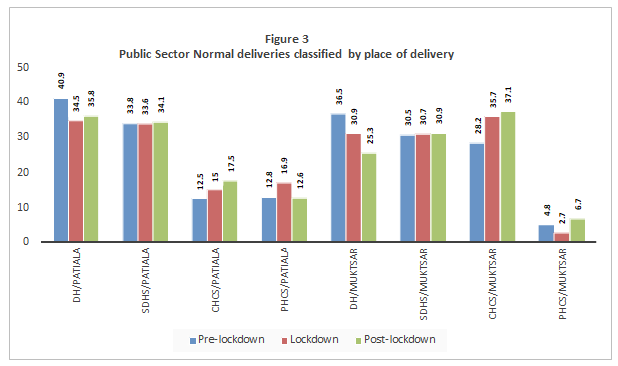
Table 3 shows distribution of total normal deliveries by type of facility for selected districts. It shows clearly that after the lockdown the share of peripheral health facilities like CHC and PHC had increased while the share of district hospitals declined. This is somewhat unique as residents, irrespective of their past behaviour, showed more trust in peripheral health institutions near to their residences for normal deliveries. This observation is quite distinct as it was expected that the share of DH deliveries will increase because of better infrastructure and manpower available at these hospitals.
| Public sector | Pre- lockdown | Lockdown | Post lockdown | |||
|---|---|---|---|---|---|---|
| April 2019- March 2020 | April 2020- July 2020 | August 2020-June 2021 | ||||
| Patiala | ||||||
| DH | 2418 | 41 | 533 | 35 | 1399 | 36 |
| SDH | 1997 | 34 | 519 | 34 | 1334 | 34 |
| CHC | 738 | 13 | 232 | 15 | 686 | 18 |
| PHC | 759 | 13 | 261 | 17 | 492 | 13 |
| Total | 5912 | 100 | 1545 | 100 | 3911 | 100 |
| Sri Muktsar Sahib | ||||||
| DH | 2,062 | 37 | 403 | 31 | 975 | 25 |
| SDH | 1,721 | 31 | 400 | 31 | 1,192 | 31 |
| CHC | 1,589 | 28 | 465 | 36 | 1,432 | 37 |
| PHC | 270 | 4.8 | 35 | 2.7 | 259 | 6.7 |
| Total | 5,642 | 100 | 1303 | 100 | 3858 | 100 |
Table 3: District-wise distribution of deliveries in public sector facilities for normal deliveries. Source: Calculated from data
Figure 3 depicts the percentage of normal deliveries classified by type of facility in public sector. The figure clearly shows that the share of DH has declined across both the districts while the share of peripheral institutions is increasing.
Caesarean Deliveries, Public Sector Facilities
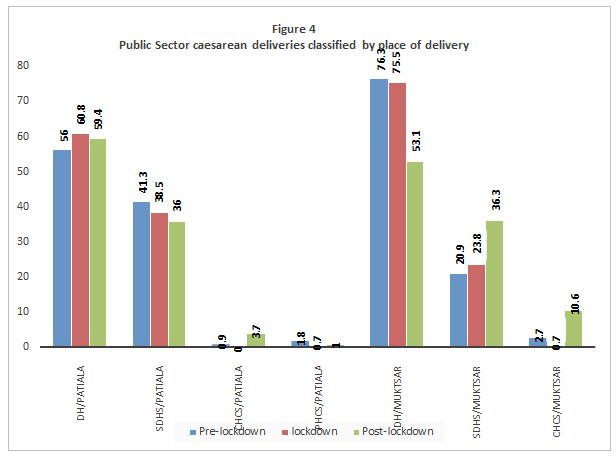
Table 4 and Figure 4 shows the distribution of caesarean deliveries in public sector facilities in both the Patiala and Sri Muktsar Sahib districts. The percentage share of DH in public sector caesarean deliveries increased in Patiala district during the lockdown and post- lockdown period (from 56% to around 60%). In case of Sri Muktsar Sahib district, the share of DH remained unchanged during the lockdown period but declined thereafter in favour of peripheral health facilities.
| Public sector | Pre-lockdown | Lockdown | Post lockdown | |||
|---|---|---|---|---|---|---|
| April 2019 to March 2020 | April 2020 to July 2020 | August 2020 to June 2021 | ||||
| Patiala | ||||||
| DH | 1769 | 56 | 546 | 61 | 1402 | 59 |
| SDH | 1305 | 41 | 346 | 39 | 849 | 36 |
| CHC | 28 | 0.9 | 0 | 0 | 87 | 3.7 |
| PHC | 57 | 1.8 | 6 | 0.7 | 23 | 1 |
| Total | 3159 | 100 | 898 | 100 | 2361 | 100 |
| Sri Muktsar Sahib | ||||||
| DH | 948 | 76 | 114 | 76 | 246 | 53 |
| SDH | 260 | 21 | 36 | 24 | 168 | 36 |
| CHC | 34 | 2.7 | 1 | 0.7 | 49 | 11 |
| Total | 1242 | 100 | 151 | 100 | 463 | 100 |
Table 4: District-wise distribution of deliveries in public sector facilities for caesarean deliveries. Source: Calculated from d
In case of caesarean deliveries, the share of district hospital increased in case of public sector Caesarean deliveries, while in Sri Muktsar Sahib district, the share of DH declined sharply from 76 percent to 53 percent.
Normal Deliveries, Private Sector Facilities
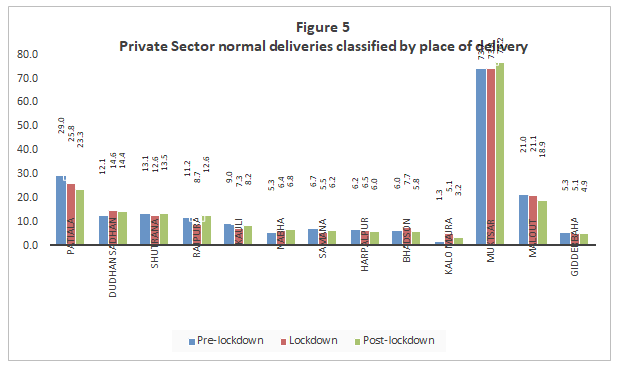
Table 5 and Figure 5 shows the spatial distribution of deliveries in private sector. It examines whether people preferred going to district headquarter or remained near their place of residence in peripheral towns. While the share of normal deliveries held in Private sector declined at District headquarter i.e., Patiala in Patiala district (from 29% before lockdown to 26 percent during lockdown and 24 percent post-lockdown), it remained more or less similar in Muktsar district. The table shows that more people in Patiala preferred to have normal deliveries at a place which was nearer to their residence rather than visiting the district headquarter. Among the places showing an increase was Rajpura (11.2% during pre-lockdown to 8.7% during lockdown and 12.6% during post-lockdown) and Nabha blocks ((5.3% during pre-lockdown to 6.4% during lockdown and 6.8% during post-lockdown). Others towns in Patiala showed mixed trends, sometimes increasing and other times declining and vice versa. In case of two peripheral towns namely Malout and Gidderbaha, of Muktsar district, the share of normal deliveries declined during the post-lockdown period.
| Pre-lockdown | Lockdown | Post lockdown | ||||
|---|---|---|---|---|---|---|
| Block | (April 2019- March2020) | (April 2020-July 2020) | (August 2020-June 2021) | |||
| Patiala | ||||||
| Patiala | 1920 | 29 | 483 | 26 | 1668 | 23 |
| Dudhan Sadhan | 803 | 12 | 272 | 15 | 1032 | 14 |
| Shutrana | 870 | 13 | 236 | 13 | 969 | 14 |
| Rajpura | 744 | 11 | 162 | 8.7 | 905 | 13 |
| Kauli | 595 | 9 | 136 | 7.3 | 591 | 8.2 |
| Nabha | 351 | 5.3 | 119 | 6.4 | 488 | 6.8 |
| Samana | 441 | 6.7 | 102 | 5.5 | 442 | 6.2 |
| Harpalpur | 410 | 6.2 | 121 | 6.5 | 431 | 6 |
| Bhadson | 397 | 6 | 143 | 7.7 | 413 | 5.8 |
| Kalo Majra | 88 | 1.3 | 95 | 5.1 | 226 | 3.2 |
| District total | 6619 | 100 | 1869 | 100 | 7165 | 100 |
| Sri Muktsar Sahib | ||||||
| Muktsar | 2120 | 74 | 550 | 74 | 2376 | 76 |
| Malout | 605 | 21 | 157 | 21 | 589 | 19 |
| Gidderbaha | 152 | 5.3 | 38 | 5.1 | 154 | 4.9 |
| District total | 2877 | 100 | 745 | 100 | 3119 | 100 |
Table 5: Location-wise distribution of deliveries in private sector facilities for normal deliveries. Source: Calculated from dat
Caesarean Deliveries, Private Sector Facilities
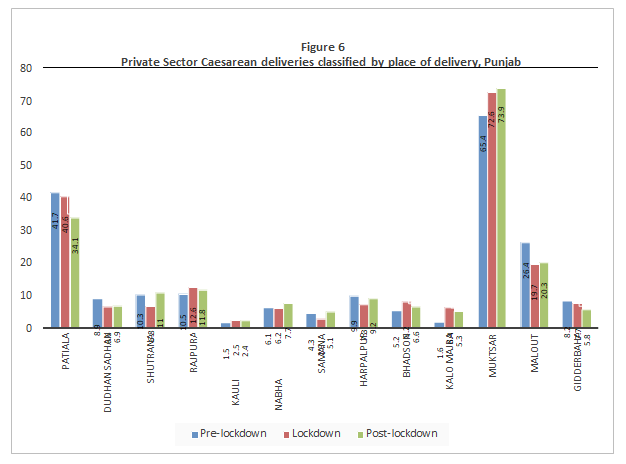
Both the Sri Muktsar Sahib district and Patiala showed somewhat distinct patterns so far as place of caesarean deliveries is concerned. Table 6 shows that more households preferred caesarean deliveries at district headquarter in Sri Muktsar Sahib (from 65% during pre-lockdown period to 73% during lockdown and 74% during post-lockdown period) the share of district headquarter in caesarean deliveries declined in Patiala (from 42% during pre- lockdown to 41% during lockdown and 34% during the post-lockdown period) indicating that households preferred caesarean deliveries also nearer to their place of residence to avoid travel.
| Block | Pre-lockdown | Lockdown | Post lockdown | |||
|---|---|---|---|---|---|---|
| (April 2019- March2020) | (April 2020-July 2020) | (August 2020-June 2021) | ||||
| Patiala | ||||||
| Patiala | 2111 | 42 | 626 | 41 | 1911 | 34 |
| Samana | 450 | 8.9 | 101 | 6.6 | 386 | 6.9 |
| Rajpura | 524 | 10 | 105 | 6.8 | 619 | 11 |
| Nabha | 533 | 11 | 194 | 13 | 662 | 12 |
| Shutrana | 78 | 1.5 | 39 | 2.5 | 136 | 2.4 |
| Dudhan Sadhan | 307 | 6.1 | 95 | 6.2 | 430 | 7.7 |
| Harpalpur | 220 | 4.3 | 44 | 2.9 | 285 | 5.1 |
| Bhadson | 501 | 9.9 | 112 | 7.3 | 515 | 9.2 |
| Kauli | 263 | 5.2 | 127 | 8.2 | 373 | 6.6 |
| Kalo Majra | 80 | 1.6 | 98 | 6.4 | 295 | 5.3 |
| Total | 5067 | 100 | 1541 | 100 | 5612 | 100 |
| Sri Muktsar Sahib | ||||||
| Muktsar | 1289 | 65 | 454 | 73 | 1464 | 74 |
| Malout | 520 | 26 | 123 | 20 | 403 | 20 |
| Gidderbaha | 162 | 8.2 | 48 | 7.7 | 114 | 5.8 |
| Total | 1971 | 100 | 625 | 100 | 1981 | 100 |
Table 6: Location-wise distribution of deliveries in private sector facilities for caesarean deliveries. Source: Calculated from
Summary and Conclusions
Skilled attendance at delivery by a competent health care provider is a fundamental requirement for safe motherhood; confinement of COVID-19 significantly affected Maternal and Child Health Services, leading to adverse outcomes in several crucial aspects. National Family Health Survey-5 (NFHS-5) , based on births in the last 5 years before the survey shows that overall institutional births have increased in the state (92% as against 90.5%) as well as selected districts (97.3% as against 96.9% in Patiala district and 96.4% as against 93.6% in Sri Muktsar Sahib district) during NFHS-5 and NFHS-4 respectively. HMIS data also shows that home deliveries as a percentage of total deliveries constituted an extremely low proportion in both the selected districts (0.1% in Patiala district and 0.8% in Sri Muktsar Sahib district).
NFHS-5 fact sheets , based on births in the last 5 years before the survey, further reveals that the share of public sector in overall institutional births fell in the State (47% in NFHS-5 from 51.7 in NFHS-4) but rose in the two selected districts (57.1% in Patiala from 55.5% and 61.3% in Sri Muktsar Sahib) during NFHS-5 and NFHS-4 respectively. However, the share of public sector health facilities in overall institutional deliveries fell continuously during 2020-21 and during the first quarter of 2021-22 in both the Patiala and Sri Muktsar Sahib districts from the pre-Covid period (2019- 20) while the share of private sector institutional deliveries is rising continuously since the onset of COVID-19. Home deliveries constituted only a very low proportion of total deliveries (< 0.1% in Patiala district and < 0.8% in Sri Muktsar Sahib district). The overall classification of deliveries by type of delivery and by type of institution shows that for normal deliveries during pre-COVID times, the clients were more inclined towards public health facilities in both the selected districts. However, after onset of COVID-19, the share of private sector started rising while the share of public sector hospitals went on declining. NFHS-5 shows that the private sector had a high share in Caesarean or C-Section deliveries in the State (53.7% for private sector as against 31.4% for public sector) and in selected districts (54.7% in private as against 45.7% in public sector in Patiala district and 24.1% in private sector as against 16.5% in public sector in Sri Muktsar Sahib district). But, HMIS data reveals a trend shift. For caesarean deliveries, the public-private share was nearly equal in Patiala during 2019-20 while the share of private sector was higher in case of Sri Muktsar Sahib district. After the onset of COVID-19 restrictions, the share of public sector in total caesarean deliveries also declined in both the districts. This decline was much sharper for Sri Muktsar Sahib district as compared to Patiala district. The share of private sector in caesarean deliveries continues to rise after March 2020. This may be due to the fear of getting COVID-19 infection among the patients as almost all of the public sector hospitals were also designated as Covid Care Centres (CCC). As the data on CCC variable was not available, a general pattern was observed as revealed by the available data. [5, 6].
The distribution of total normal deliveries by type of facility in public sector for selected districts shows that after the lockdown the share of peripheral health facilities like CHC and PHC had increased while the share of district hospitals declined. The above observation is somewhat unique as residents, irrespective of their past behaviour, relied more on peripheral health institutions near to their residences for normal deliveries. This observation is quite distinct as it was expected that the share of DH deliveries will increase because of better infrastructure and manpower available at these hospitals. However, the actual delivery data showed a contrary behaviour due to people’s concerns of COVID-19 cases being attended in district hospitals and the risk involved. On the other hand, the distribution of caesarean deliveries in public sector facilities in both the Patiala and Sri Muktsar Sahib districts shows that the percentage share of DH increased in Patiala district during the lockdown and post-lockdown period (from 56% to around 60%) while in case of Sri Muktsar Sahib district, the share of DH remained unchanged during the lockdown period but declined thereafter in favour of peripheral health facilities.
The authors had a discussion with the health functionaries in both these districts. It was found that absolute number of institutional deliveries declined in both the districts during 2020-21 in comparison to 2019-20 at government health institutions, as their clientele, primarily consisting of poor and labour class, left for their native places in their home states. The work was not available to them even in the post-lockdown period. Moreover, all District Hospitals were made Level-2 Covid Centres and labour rooms were also shifted to other institutions such as Mission Hospital in case of Sri Muktsar Sahib district. As undertaking COVID-19 test was mandatory for government health institutions, the households who could afford financially, avoided visiting government health institutions and went straight to private sector hospitals. Fear of being positive after the test made them do so. Among the other reasons, in Sri Muktsar Sahib district, the Gynecologist post was lying vacant at district hospital for almost 11 months (October 2021-July 2022) and some other key specialists also left their jobs to join private sector hospitals.
The month-wise data on institutional deliveries by type of health facilities (government or private) clearly shows that there was an edge of government sector in both the selected districts during pre-lockdown period which started intermingling during the lockdown period and completely reversed in favour of private sector during the post-lockdown period. This reversal indicates that people in general lost confidence in government health facilities and started relying more on private health facilities. This might have serious repercussions for poorer households with larger out of pocket expenditure. There is further need to assess the performance of several centrally or state sponsored Schemes such as Janani Shishu Suraksha Karyakaram (JSSK), Janani Suraksha Yojana (JSY), Mata Kaushalya Scheme, etc. from this angle. What forced so many clients to shift to private sector? Whether the shift was by choice or was it thrust upon them forcibly due to lack of available resources such as manpower, equipment and medicines, etc. in government health facilities during post-lockdown periods?
References
-
Ezenwa BN, Fajolu IB, Nabwera H, Wang D, Ezeaka CV, et al. (2021) Impact of COVID-19 lockdown measures on institutional delivery, neonatal admissions and prematurity: a reflection from Lagos, Nigeria. BMJ Paediatrics Open 5: e001029.
-
Subedi A, Magar P, Shrestha J, Subedi S (2022) Impact of Lockdown of COVID 19 Pandemic in Pregnancy Outcomes in a Tertiary Care Centre: What to Expect?. Journal of Lumbini Medical College 9(2): 7.
-
Sharma S, Singh L, Yadav J, Gupta U, Singh KJ, et al. (2023) Impact of COVID-19 on utilization of maternal and child health services in India: Health management information system data analysis. Clinical Epidemiology and Global Health 21: 101285.
-
Sehgal A, Dubey S, Satodiya M (2023) Direct and indirect impact of COVID-19 pandemic on maternal mortality at tertiary care institute of north India. International Journal of Reproduction, Contraception, Obstetrics and Gynecology 12(8): 2431-2436.
-
International Institute for Population Sciences (2019- 20) Fact Sheets (NFHS-5).
-
(2021) National Family Health Survey-5 (2019-21). International Institute for Population Sciences 1: 208.
- Capacity Constraints in Pediatric Inpatient Psychiatric Care: A Cross-Sectional Analysis of Bed Availability and Geographic Access in North Carolina
- Why Healthcare Analytics Still Optimizes the Wrong Things
- Coding, Coverage, and Care: The Infrastructure of Transgender Health Inequities
- The Effect of Classroom Attendance on Academic Achievement of Management and Leadership Discipline of Nursing Students at Instituto Superior Cristal and Universidade de Dili, Timor-Leste, 2024: A Case Study
- The Role of Social Bonds in Facilitating Shared Investments and Resource Allocation: Addressing the “Wrong Pocket Problem” in Public Health and Healthcare
- Social-Cultural Factors Contributing to Antimicrobial Resistance in Livestock Farmers and Community Households in Kayonza District, Rwanda