
The Emotional Intelligence Development in the Context of a Problem-based Approach to Intellectual Activity
The article shows that the considering of emotional intelligence as one of the types of general and single intelligence, leads us to the most fundamental point - is the tasks it solves. Therefore, the use of the problem situation tasks in emotional intelligence development in adolescence is a prerequisite for the actualization of individual emotional and cognitive activities. The paper also represents the theoretical and methodological analysis of the psychological foundations of individual emotional intelligence genesis in early adolescence, which became the basis for the development of the author’s concept of this study. Thus, the theoretical model of the emotional intelligence genesis in early adolescence is formulated and substantiated; the quantitative and qualitative analysis of the structure, levels and features of emotional intelligence development of young people is made; the system of psychological factors, mechanisms and laws of emotional intelligence genesis in early adolescence is determined. The materials of the article can be used to solve practical problems of modern institutions of general secondary, vocational and higher education, in particular, to diagnose the level of emotional intelligence of pupils and/or students, to work out effective programs of psychological support in early personality development; to elaborate the individual programs for the emotional intelligence development. Theoretical provisions and research results can be used for the studying process in general secondary education, vocational training and/or higher education institutions, as well as in the psychological education practice and social and psychological centres for the development and implementation of psychological support programmes for both personal counselling and educational process. The main attention in emotional intelligence studies is focused on its psychological structure and relationships with other intrapersonal manifestations. This trend has led to contradictions between ideas about the place of emotional intelligence in the structure of personality and understanding of structural and functional features of emotional intelligence as a metacognitive construct, as well as between criteria for determining a sufficient level of emotional intelligence for mental development and scientifically reasonable psychological and pedagogical tools of emotional intelligence formation, functioning and development. However, the problem area remains the question of the peculiarities of emotional intelligence development at different age stages of individual mental development. Problems of the emotional intelligence genesis in adolescence have not been studied, respectively, there is a lack of clear understanding of the psychological conditions and specifics of the emotional intelligence development in adolescence.
How to cite this Paper
Novelty and Significance The novelty and significance of the study lie in:
- The approach to the emotional intelligence genesis in adolescence as a process of emergence, formation and optimal functioning of a specific metacognitive construct that provides the young person’s ability to understand their own and others’ emotions, as well as their management in the process of intellectual activity;
- Developed theoretical model of the emotional intelligence genesis in adolescence;
- Detailed quantitative and qualitative analysis of the structure, levels and features of the emotional intelligence development of young people;
- Determining the system of psychological factors, mechanisms and patterns of the emotional intelligence genesis in adolescence;
- Elaboration and testing of diagnostic and developmental programs that can be used to solve practical problems of emotional intelligence development.
Introduction
Modern scientific researchers are characterized by the consideration of a variety of psychological phenomena as “intellects” [1, 2, 3]. Karpenko IE [2] approach is quite representative in terms of illustrating such “reproduction” of intelligence types. The scientist considers emotional intelligence in the discourse of personal realization and revealed the content of related concepts, namely - social, professional, motivational and existential intellects. It is stated that the first type contributes to the establishment of effective interpersonal interaction, the second one - to achieve success in the field of a particular activity, the third - focuses on achieving personally meaningful goals, and the fourth - stimulates the answer to transcendent questions [2]. It should be also noted that sometimes in studies there are more exotic “intellects”, such as bodily.
In our opinion, all these names reflect only different types of intelligence on a certain classification basis, and, as we know, there are many such classifications [3, 4]. Teplov BM [5] «principle of a single intellect» seems to be more substantiated. According to it, a person’s intellect is the only one and its main mechanisms are also holistic, however, the forms of intellectual activity differ because the tasks facing the human intellect differ in one case or another [5, 6, 7]. In other words, the analysis of a particular type of intelligence, for instance, an emotional, should focus primarily on the tasks that it sets and solves in activities and interactions. This approach is called by us a problem-based approach to intellectual activity [3, 8, 9, 10]. It corresponds to our definition of intelligence, according to which intelligence is understood as a holistic (integral) mental formation, which is responsible for generating, constructing and rebuilding mental models of the world by setting and solving problems. The integral nature of intelligence does not exclude its structure, namely the presence of a number of components (structural elements) that define intelligence as a mental formation. These are, first of all, basic cognitions, among which the basic mental processes (sensation, perception, memory, attention as control), thinking and imagination, language and speech. However, intelligence is not reduced to a system of cognitions, but also includes metacognition, metacognitive integrators, among which the leading ones are intellectual initiation (independent problem statement), decentralization, reflection and strategicness. It is the metacognitions dynamics, in turn, determine the potential for development and self-development of intelligence in general. All structural components of intelligence, both cognitive and metacognitive, interact and integrate (create coalitions in intellectual activity) “under the task” in a particular moment of time, providing appropriate amplification and transformation of mental models of the world, which determines intellectual development [3, 11].
Thus, the most important point in the problem of studying emotional intelligence (EI) and factors which influence its development are the tasks EI solves. The most frequent and understandable one is the recognition of emotions and self- management of own emotions. However, it should also be added, in our opinion, the complex task of ensuring effective communication and/or negotiations, which includes understanding the state of the communication partner, influencing him, enjoying communication, etc. As a result, we can talk about the leading role of emotional intelligence in effective interpersonal interaction, in particular, play, learning or studying process and professional occupations [12]. In addition, there is a separate task connected to conflicts and searching for effective strategies for resolving them and effective cooperation. Therefore, emotional intelligence works in parallel and together with basic intelligence, solving many problems, among which narrowly specific-recognizing emotions and managing individual own emotions. Such structure is only one of the possible areas of classification.
It should also be noted that the psychological laws of the processes of solving emotional intelligence problems correspond to the laws of their solution in general intellectual activity. In our research, We have shown that the task from its finding (feeling of its presence, sprout) in life or activity to the probable solution goes through several stages [10, 13]. The problematic (initial) situation has among its features the feeling of discomfort, often unconscious, a feeling of something unusual, dissimilar, etc., a rupture, «backlash» in the activity. Then a subject does a step to awareness this discomfort, but still, it’s not the problem itself. In other words, it is a step towards problematization. And only after that, the problem is realized in the most general form, however, the subject does not yet understand whether he/she has the means to deal with it.
At the next stage, the task is set independently on the basis of a perceived problem and the actual process of solving it begins. There the metacognition works, which we call intellectual initiation. The statement of the task takes place so far in a non-systemic, or, in other words, in a non- systematized form. It means that a subject tries to figure out the contours of the idea and find the solution strategy. When the task is built as a system, according to Ball HA [8], when the subject already understands and is able to describe not only the initial state of the problem system but also the necessary, desired one-in this case, the strategy as a trend is already planned [8].
To move directly to the process of solving it is necessary to take another step, called the construction of the task structure, when there is a symbolic interpretation of the problem in a particular sign system, strategy as a system of tools is almost defined, namely there was a choice or selection of tools. Then the subject realizes himself directly in the process of solving, which may or may not end with finding a solution [10, 11, 13].
Accordingly, the paradigm of setting and solving problems (tasks) in intellectual activity has become the original theoretical and methodological construct for the development of the concept of studying emotional intelligence genesis in adolescence [3, 9, 10, 13, 14, 15]. The concept is also based on the position of an integrated approach to the emotional intelligence phenomenon, genetic and modelling method [12, 16, 17], and also the structural and functional completeness of the analysis of emotional intelligence, taking into account the reflective, value-oriented, predictive and transformative functions of general intelligence [3, 11, 14]. Based on the problem approach, we believe that the use of the problem situation in emotional intelligence development in adolescence is a prerequisite for the actualization of the individual emotional and cognitive activity.
The starting points of our integrated approach of emotional intelligence genesis in adolescence are:
- Emotional intelligence is a metacognitive formation, a hierarchical system of human abilities to process emotions as information, which provides a functional unity of emotional and intellectual processes for setting and solving problems of perception, recognition and understanding of own emotions, other people’s emotions, management of emotional manifestations and the individual higher adaptability and the effectiveness in communication and activities.
- The emotional intelligence genesis in adolescence is the process of emergence, formation and optimal functioning of the metacognitive construct, which provides the ability of a young person to understand their own and others’ emotions, as well as to manage these emotions. The ability to understand emotions is the ability to recognize emotion, that is, to establish the fact of having an emotional experience in yourself or another person; the ability to identify an emotion, namely to establish what kind of emotion the individual or another person is experiencing, and to find a verbal expression for it; understanding the factors that caused it and the consequences it can lead to. The ability to control emotions is manifested in the ability to manage the intensity of emotions, in particular to dull excessively strong emotions, ability to control their external expression; ability to arbitrarily evoke a certain emotion if it is necessary. The ability to understand and the ability to manage emotions can be focused on both own emotions and the emotions of others.
- The structure of a young person emotional intelligence consists of affective and cognitive (perception, recognition and understanding of their own emotions and emotions of other people), behavioural (adaptive and effective personality in communication and activity), motivational and reflexive components (emotional management and their manifestations). Тhe analysis and theoretical understanding of the personal and activity aspects of young person emotional intelligence showed that the structural and functional completeness of this construct can be achieved by considering the problem of the EI genesis in adolescence in the personal and activity dimensions.
The psychodiagnostic program, which is developed in research, is intended for the definition of criteria of emotional intelligence development and its components, levels and features in adolescence, and also its inter structural interrelations and relations with dynamic features of the neuropsychological activity, theoretical and practical intelligence, personal characteristics. The empirical referents of emotional intelligence components consist: MSCEIT v. 2.0 (The Mayer-Salovey-Caruzo Emotional Intelligence Test) scales: «identification of emotions», «use of emotions», «understanding of emotions», «conscious regulation of emotions»; indicators of neuropsychological activity strength and mobility according to E. Ilin’s tapping test, scales of theoretical and practical intelligence according to R. Amtkhauer’s test of diagnostics of intelligence structure, scales of R. Kettell’s multifactor research technique of personality that includes diagnostic blocks of communicative properties and features of interpersonal interaction, volitional features and intellectual properties. Assumptions on the theoretical model are presented in Figure 1.
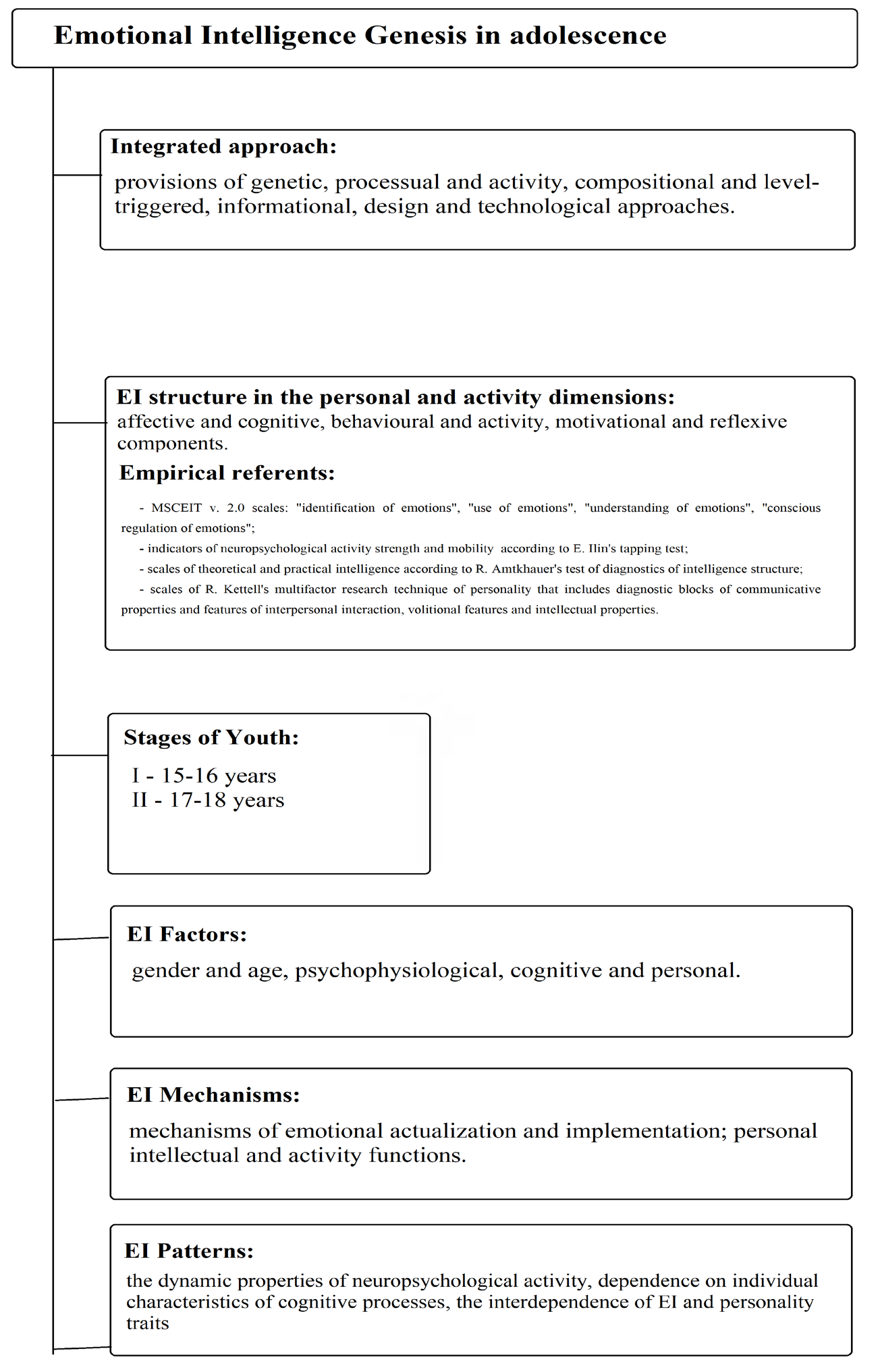
An integrated approach to the study of emotional intelligence genesis in adolescence provides an opportunity to structurally and functionally highlight the process of emergence, formation and optimal functioning of the individual’s ability at different stages of adolescence to understand and manage their own and others’ emotions. A comparative empirical study of the structure, levels and features of the development of emotional intelligence affective and cognitive, behavioural and activity, motivational and reflexive components of pupils of the upper classes in general secondary education and students of higher education showed that the affective and cognitive component of the subject is at the middle level of its manifestation with the general tendency to a high level among young people [18]. In contrast, among the studied adolescents behavioural, motivational and reflexive components of emotional intelligence are expressed at the average level of development with a general tendency of their indicators to a low level. The emotional intelligence genesis of youth is the result of the metacognitive education emergence and formation, which involves deepening, combining into certain categories, expansion and actualization of personal emotional, cognitive, communicative, motivational components in educational activities. Emotional intelligence development contributes to the youth ability to adapt to the social environment and optimization of interpersonal interactions. The study of emotional intelligence, factors, mechanisms and patterns of its development may become evidence of its greater openness to further scientific research and, in particular, applied research.
Methods
In the process of preparing materials for this article, we used theoretical, empirical and statistical research methods. Theoretical methods included ordering and systematization of knowledge about emotional intelligence and psychological features of its development in adolescence, systematic analysis, generalization of theoretical and methodological approaches to this problem, development and justification of theoretical models of emotional intelligence genesis in adolescence. Empirical methods were used at the ascertaining stage of the experimental study and included psychodiagnostic methods. At different stages of experimental research of emotional intelligence components, levels and features of its development it was used such psychodiagnostic techniques as: J. Meyer, P. Salovey and D. Caruzo’s MSCEIT v. 2.0 (The Mayer-Salovey-Caruzo Emotional Intelligence Test), adapted by E. Serhiienko and I. Vetrovoiu; E. Ilyin’s tapping test, D. Lucin’s method «EmIn», N. Hall’s method of emotional intelligence diagnosis, R. Amthauer’s test of diagnostics of the intelligence structure, R. Kettell’s method of multifactorial study of personality, A. Rean’s questionnaire «Motivation of success and fear of failure», N. Kalina’s questionnaire of person’s self-actualization; A. Karpov’s methods of reflexivity diagnostics. At the stage of the formative experiment, the active socio-psychological learning (group discussions, brainstorming, role-playing, business games, project method, situation analysis, individual creative tasks) methods were used to elaborate and implement a program of emotional intelligence components and levels development of young people. Among statistical methods, we actively used such methods of mathematical statistics and data analysis as correlation analysis, factor analysis, analysis of variance which were calculated with the help of the SPSS program (version 20.0).
Results
Quantitative indicators of the central tendency measures in the emotional intelligence structure of high school pupils from general secondary education institutions (GSEI) and students from institutions of higher education (IHE) are given in Table 1.
| The central tendency measures | ЕІ Components | |||
|---|---|---|---|---|
| ІЕ | UЕ | UnЕ | СRЕ | |
| Expected/average value | 4,15 | 4,65 | 3,75 | 3,95 |
| Index of variability (standard deviation) | 2,03 | 1,72 | 1,74 | 1,57 |
| Maximal value | 8 | 8 | 8 | 8 |
| Minimum value | 1 | 2 | 1 | 3 |
| Median | 4 | 4,5 | 3,5 | 3 |
| Mode | 3 | 3 | 3 | 3 |
| Skewness | -0,0168 | 0,19628 | 0,36004 | 1,89,760 |
Table 1: The quantitative indicators of the central tendency measures of the emotional intelligence structure of high school p
Сonventional symbols: EI - emotional intelligence; IE - identification of emotions, UE - use of emotions, UnE - understanding of emotions, CRE - conscious regulation of emotions. Table 1: The quantitative indicators of the central tendency measures of the emotional intelligence structure of high school pupils from GSEI and students from IHE.
According to the correlation analysis results, it was found that the individual ability to identify emotions in adolescence at the level of statistical significance p≤0.05 correlates with: the neuropsychological activity strength and mobility, intellectual properties of theoretical and practical intelligence, the ability to adequately perceive current life situations, openness to existential knowledge. A young person’s ability to use and understand emotions correlates with individual communicative, emotional and volitional properties, the individual general tendency to mutually beneficial and pleasant contacts with others, tenderness, sensitivity to their own desires and needs. The ability of a young person to consciously regulate emotions correlates with the motivation to succeed, the desire for a harmonious life and relationships with other people, an active attitude towards reality, reflexivity.
Statistical processing of the results (Mann-Whitney U-test, p≤0.05) revealed significant differences in the emotional intelligence structure of high school pupils and students. The identified differences are manifested in the fact that the level of high school pupils’ ability to identify emotions is due to the properties of the individual practical intelligence and emotional and volitional characteristics. Unlike high school pupils, students’ level of ability to perceive and recognize emotions is due to the properties of theoretical intelligence and their need for knowledge. The ability to use and understand emotions in high school pupils is due to communicative, emotional and volitional personality traits, and in students, this ability is due to the individual tendency to mutually beneficial and pleasant contacts with others, tenderness, sensitivity to their own desires and needs. The level of ability to consciously regulate emotions in pupils is determined by the success achievement motive, and in students are determined by their desire for harmonious existence and relationships with other people, an active position in relation to reality, situational, retrospective and perspective reflexivity.
It was found that gender differences in emotional intelligence in adolescence are associated with such groups of measurable traits as dynamic properties of neuropsychological activity; theoretical and practical intelligence; personal qualities (emotional and volitional, communicative, motivational); values of personal self- actualization. At the same time, the level of emotional intelligence is more developed in girls than in boys. Girls, compared to boys, have more developed emotional abilities in situations, where the emotional assessment of people is required; recognizing emotions that are effective for facilitating any activity or mood, as well as recognizing the emotions of others. Whereas the ability to combine emotions into more integrative units and the ability to regulate emotional states are more prevalent in boys.
The results mentioned above led to the general conclusion that emotional intelligence as a process consists of three stages:
- Emotional information perception and analysis,
- Verbalization of poorly differentiated emotional information,
- Use of verbalized emotional information to understand and regulate emotional states.
Moreover, the emotional intelligence of adolescents includes the feminine, masculine and androgynous aspects that have the following meaningful characteristics: the level of femininity is higher in emotional identification, recognition, using and understanding of emotions; the level of masculinity manifests in the conscious regulation of emotions; the level of androgyny-in the identification, using, understanding, and conscious regulation of emotions.
Discussion and Conclusion
In the context of considering emotional intelligence as one of the types of general intelligence, the most fundamental point is the tasks it solves. Therefore, the use of the problem situation method in the development of emotional intelligence in adolescence is a prerequisite for the actualization of individual emotional and cognitive activities. The starting point of an integrated approach to the study of the emotional intelligence genesis in adolescence according to the developed concept in this research is that emotional intelligence is a metacognitive formation, a hierarchical system of young people’s ability to process emotions as information that provides functional unity of emotional and intellectual processes; solving problems of perception, recognition, and understanding of one’s own emotions, emotions of other people, management of emotional manifestations and determines the individual higher adaptability and efficiency in communication and activities. The emotional intelligence genesis in adolescence is the process of emergence, formation, and optimal functioning of the metacognitive construct, which provides the young person’s ability to understand their own and others’ emotions and manage them. The emotional intelligence structure of a young person, which also depends on the situations and tasks of emotional and cognitive activity, consists of affective and cognitive (perception, recognition, and understanding of their own emotions, emotions of others), behavioral (adaptive and effective personality in communication and activity), motivational and reflexive components (management of emotional manifestations).
Emotional intelligence of adolescents includes the feminine, masculine and androgynous aspects that have the following meaningful characteristics:
- There is a particular level of femininity in emotional identification, recognition, using, and understanding of emotions;
- There is a particular level of masculinity in the conscious regulation of emotions and
- There is a particular level of androgyny in the identification, using, understanding and conscious regulation of emotions. The authors see the prospects for further research in the development of a fundamental ontogenetic model of individual emotional intelligence development as a type of general or holistic intelligence.
References
-
Ivashkevych EZ (2017) Social intelligence of a teacher: monograph. TOV «Prynt-Khauz», Kyiv, Ukraine, pp: 1-536.
-
Karpenko IE (2020) Emotional intelligence in the discourse of personal life: a monograph. Posvit, Drogobych, Ukraine, pp: 1-436.
-
Gutiérrez Cobo MJ, Cabello R, Berrocal PF (2017) The three models of emotional intelligence and performance in a hot and cool go/no-go task in undergraduate students. Front Behav Neurosci 11: 33.
-
Smulson ML (2003) Psychology of intelligence development: monograph. Nora-Druk, Kyiv, Ukraine, pp: 1-298.
-
Teplov BM (1961) The mind of a commander. Individual Difference Problems. APS RSFSR, Moscow, Russia, pp: 252-344.
-
Kholodnaia MA (1997) The psychology of intelligence. Research paradoxes. Tomsk, Moscow, Russia, pp: 1-392.
-
Kidwell B, Hasford J, Hardesty DM (2015) Emotional ability training and mindful eating. Journal of Marketing Research 52(1): 105-119.
-
Ball HA (2019) The Basic Concepts of the General Theory of Tasks. Collection of scientific articles of G. S. Kostiuk Institute of Psychology of the National Academy of Educational Sciences of Ukraine. Vol. VIII, Psykholohichna teoriia i tekhnolohiia navchannia/Issue 10, Kyiv, Ukraine, pp: 33-54.
-
Smulson ML (2017) The place of the problem in intellectual activity. Pedagogy and psychology_:_ Collection of scientific articles NAES of Ukraine 2(95): 40-48.
-
Smulson ML (2020) A problem-based approach to constructing personal experience. Actual problems of psychology, Collection of scientific articles of G. S. Kostiuk Institute of Psychology of the National Academy of Educational Sciences of Ukraine. Vol. 2. Psychological hermeneutics. In: Vol 2(12), Kyiv, Ukraine, pp: 41-57.
-
Smulson ML (2016) Development of Intelligence and Subjectivity of Adults in Virtual Space. Intelligence Development Technologies 2(13): 1-21.
-
Ihnatovych OM, Liashch OP (2020) Psychological Patterns of Emotional Intelligence Development in Adolescence as a Condition of Mental Health. Psychiatry, Psychotherapy and Clinical Psychology 11(4): 802-811.
-
Smulson M (2019) The significance of problem-solving in the professional activity. Psychological basis of professional problem-solving: collective monograph. Liga-Pres, Lviv-Torun, pp: 1-21.
-
Liashch OP (2019) The emotional intelligence genesis in adolescence: a monograph. TOV «Tvory», Vinnytsia, Ukraine, pp: 1-448.
-
Yefimenko SM (2019) Ways of intellectual and creative development of students in the new Ukrainian school. Scientific notes Scientific notes of the Volodymyr Vynnychenko Central Ukrainian State Pedagogical University. Pedagogical sciences 177(1): 156-161.
-
Hodzic S, Scharfen J, Ripoll P, Holling H, Zenasni F (2017) How Efficient Are Emotional Intelligence Trainings: A Meta-Analysis. Emotion Review 10(2): 138-148.
-
Maksymenko SD (2019) Current issues of genetic psychology. Actual problems of psychology: Collection of scientific articles of G. S. Kostiuk Institute of Psychology of the National Academy of Educational Sciences of Ukraine. Psychological theory and learning technology. In: 8(10), Kyiv, Ukraine, pp: 8-20.
-
Lyasch O (2018) Empirical research of features of emotional intelligence and personal properties of young men. Psychological Journal 4(10): 91-104.
- Systematic Review and Meta-analysis Investigating the Prevalence of Depression, Anxiety, Loneliness and Help seeking among International Students
- Family Experiences and their Interpretations as a Source of Adaptive Behaviour in Young Adults: A Qualitative Model of Adaptive Behaviour
- The Development of Responsibility in Teenage Mothers: A Qualitative Model
- Post-Truth Reality: Worldwide Infodemia and Mental Health Concerns during and Post COVID-19 Pandemic Scenarios
- Psycho-Emotional Rehabilitating Means of Overcoming Extreme and Stressful Impact
- The Paradox of Humbleness, Arrogance and the Concept of Fluid Individuality