
The Importance of Periodic Educational Programs in Augmenting Dialysis Nurses Competences
Hemodialysis (HD) is a lifesaving procedure which depends largely on effective and healthy vascular access to the patient’s circulation. Preservation of veins in both arms is essential as HD is often a life-long commitment for survival. That is why the dialysis vascular access should not be used for routine procedures such as blood sampling, infusions or transfusions; such procedures should be via smaller veins like those in the dorsum of the hand [1].
Editorial
Hemodialysis (HD) is a lifesaving procedure which depends largely on effective and healthy vascular access to the patient’s circulation. Preservation of veins in both arms is essential as HD is often a life-long commitment for survival. That is why the dialysis vascular access should not be used for routine procedures such as blood sampling, infusions or transfusions; such procedures should be via smaller veins like those in the dorsum of the hand [1].
Nurses play a pivotal role in the care for vascular access as they see the patient and handle the blood access every dialysis. Vascular access cannulation for HD is a delectate procedure that should be done only by experienced medical personnel; and it is recommended that the vascular access should be checked before and after each cannulation [2].
Training programs using standard guidelines for best practices are vital to enhance nurses’ competences in areas of HD practice [3]. The Kidney dialysis Outcome Quality Initiative (K/DOQI) guidelines for vascular access care are accepted in many parts of the World as standard recommended procedures for good practice in HD [4]. The question remains on whether it is important to repeat such training programs periodically for nurses who already had previous courses. We recently tested this question by conducting a study on the competences of vascular access care in 57 experienced dialysis nurses chosen by proportionate sampling from nine dialysis centers in Khartoum State, Sudan [5]. The nurses participated in a questionnaire testing their knowledge about vascular access care principals and were then observed over their practical techniques while doing their routine dialysis care. They were then admitted to a training course with the aim of refreshing their knowledge and practices of vascular access care. Four weeks later, the nurses answered the same questionnaire and were observed again for their practical skills while handing vascular access. The results were amazingly different between the two testing-periods (Figure 1). There was a huge improvement in the performance both in knowledge and practical skills post educational program (P <0.001).
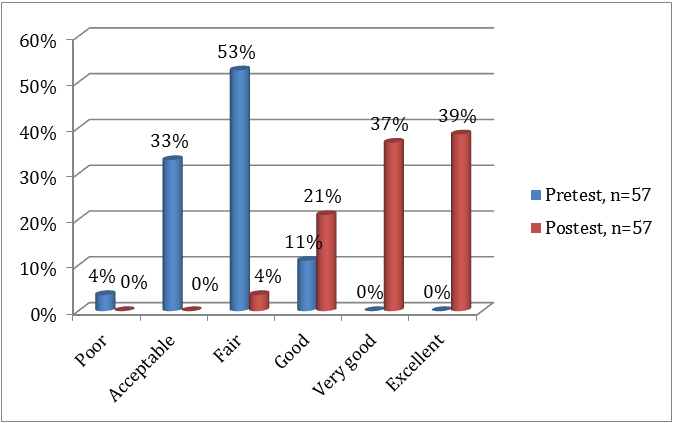
Figure1: Comparison between the levels of knowledge among nurses participating in the study before and after the educational intervention.
The second question that occurred to us was whether it was enough to train new nurses by apprenticeship to experienced nurses dealing with peritoneal dialysis (PD) patients. Forty PD nurses, who had one or more years’ experience in PD, were evaluated for their knowledge and practice skills as judged by the standard PD guidelines in Khartoum State, Sudan (unpublished data). It turned out that only nine of them had formal training courses on PD in the past, and the remaining 31 nurses joined the units at various periods and got their experience by apprenticeship to the trained nurses. All the 40 nurses were exposed to a questionnaire and observational check list testing their knowledge and practice on recommended procedures according to the Sudan PD care guidelines. The nurses were then given refreshing lectures, tutorials and practical sessions on the subject and retested after four weeks. The results were very different between the two tests. As expected the nine nurses who had formal training courses before did better than the novice nurses, but even the trained nurse did significantly better after the refresher course (Table 1).
| Pretest score | Post test score | ||||||||
|---|---|---|---|---|---|---|---|---|---|
| Variables tested | mean | SD | mean | SD | P | ||||
| Total score out of 70 | 51.9 | 6.12 | 66.96 | 2.74 | <0.001 |
Table1: Total scores obtained prior to and after the refresher training course.
In conclusion, it seems imperative that dialysis nurses should have periodic training/refresher courses in standard recommended guidelines to ensure best- practices in dialysis procedures. Moreover, training by apprenticeship without structured educational and training program does not seem enough to confer the required level of good care for dialysis patients. This may well apply to other fields in the nursing careers.
References
-
Konner K (2002) Venous preservation. Blood Purif 19: 115.
-
Hayes J (1998) The role of nurses in maintenance of vascular access. EDTNA/ERCA J 9-12.
-
Gelmez M, Akçaoglu T (2002) Effect of integrated education on nurses' knowledge of hemodialysis vascular access. EDTNA ERCA J 28(1): 33-35.
-
Vascular Access 2006 Work Group (2006) Clinical practice guidelines for vascular access: update 2006. American Journal of Kidney Diseases 48(1): S176- S276.
-
Yousif KI, Abu Aisha H, Abboud OI (2017) The Effect of an Educational Program for Vascular Access Care on Nurses’ Knowledge at Dialysis Centers in Khartoum State, Sudan. Saudi J Kidney Dis Transpl 28(5): 1027-1033.
- Teaching Cognitive Behavioral Therapy to Graduate Psychiatric Mental Health Nurse Practitioner Students: Utilizing A Mixed Methods Course Evaluation
- The Role of Pharmacogenetic Testing in Clinical Practice: A Path toward more Effective, Personalized and Cost-effective Care
- Implementing Screening with the GAD-7 in an Outpatient Mental Health Setting: A Quality Improvement Project
- Social Media and Health Promotion
- Impact of Covid-19 Pandemic on the Academic Performance and Attitude of Nursing Students towards E-Learning
- A Study to Assess the Knowledge Regarding Ill Effects of Tobacco Consumption on Health among Adolescents in Selected Higher Secondary School in Nadiad City