
Prevalence of Diarrhea in Summer Season in the Coldest Valley of Kalam Swat
Introduction: Diarrhea is one of the leading causes of death in developing countries and its prevalence is very high in rural areas like district Kalam, Swat, because there is no system of chlorination and purification of drinking water. Objective: The objective of the study was to estimate the prevalence of diarrhea in the valley of Kalam Swat in summer season of 2017. Methods: A descriptive cross sectional study was conducted over a period of six months in government civil hospital of tehsil Kalam Swat. The statistics of frequency of age wise and gender wise distribution of diarrhea were calculated. Tables, bar charts and plotted charts were used to present the data. Results: Total 2057 cases of diarrhea were identified in the six months duration of the study. The total number of males with the diarrhea disease were 1226 (59.6 %), whereas, total females with diarrhea were 831(40.3%). In addition, the total number of diarrheal cases less than 5 years was 767, and that of more than five years were 1290. Conclusion: The prevalence and percentage of diarrhea in the coldest valley of Kalam Swat was much high as compared to other big cities of the country.
Imran Uddin1* and Muhammad Younas2
1(Post RN, BScN, RN, BA (Sociology) Charge Nurse in Civil Hospital Kalam Swat, Pakistan
2(MScN, BScN, BSc) Clinical Nurse Manager, Shaukat Khanum Memorial Cancer Hospital, Pakistan Kalam Swat, Pakistan, Email: imranuddinusn@gmail.com drinking water.
season of 2017.
Tables, bar charts and plotted charts were used to present the data.
to other big cities of the country.
Introduction
Diarrhea is a disease in which the patient has three or more than three loose stools in a day [1]. It is one of the leading causes of deaths in underdeveloped countries. According to an estimate 165 million people suffers from shigellosis worldwide and 99% cases occur in developing countries, 69% victims are children in the age group of 1- 5 years [2]. It is a general assumption by many, that diarrhea is related to consumption of contaminated water, food and would mostly occur in hot areas. However, a lot of patients were observed presenting with frequency of loose stool in civil hospital of tehsil Kalam Swat.
Kalam valley is the coldest valley in the province of Khyber Pakhtunkhwa of Pakistan. It is famous for its natural beauty and therefore remains a popular spot for tourists. In addition, as per the local residents the food and water here are considered pure and free from any sort of contamination.
Diarrhea remains the leading cause of morbidity and mortality in children under 5 years of age worldwide [3]. The burden is disproportionately high among children in low- and middle-income countries and is very fatal in the young age and may cause death if not treated properly. Although, how fatal disease diarrhea is, but unfortunately, there is no data available on the prevalence of diarrhea in Kalam valley because no such research has been done. The magnitude of diarrheal cases is high enough in the valley in summer season. This study was planned to find out the prevalence of diarrhea in summer session in the valley of Kalam Swat.
Aim of the Study
The aim of the study was to “estimate the prevalence of diarrhea cases in the valley of Kalam Swat in summer season of 2017”.
Methodology
A Descriptive Cross-Sectional Study was Employed
This descriptive cross sectional study was conducted in government civil hospital of tehsil Kalam Swat. The data was collected using the hospital records of patients from 1st March 2017 to 31th August 2017. The duration of six months was taken because the weather in these months is a little warmer and is consider as summer. In addition, the population also gets increase in this season because the residents as well as many tourists visit the valley. The study participants were all the OPD and emergency patients.
Microsoft excel 2013 was used to analyze the data. The two variables taken were, gender wise prevalence of diarrhea and age wise prevalence of diarrhea. The age wise distribution was taken as having diarrhea for less than five years and more than five years. The statistics of frequency of distribution of diarrhea in age wise as well gender wise were obtained. Moreover, the percentages of diarrhea patients in the separate months were obtained.
The tables, bar charts and plotted charts are used to represent the data.
Ethical Consideration
Written permission was obtained from in charge of the government civil hospital Kalam Swat.
Results
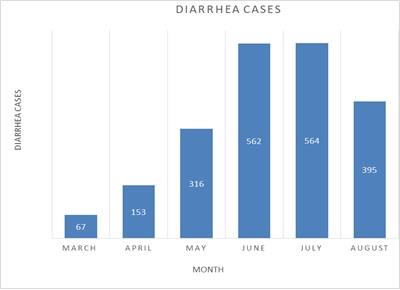
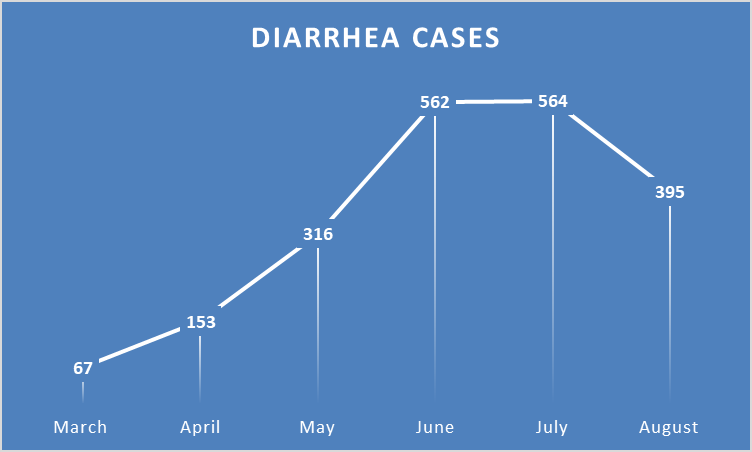
The total admissions in the six months duration from March 01 to July 31, 2017 were 21,523. These admissions included the daily OPD patients and emergency patients. The diarrheal cases among these admissions were 2,057 as shown in the Table 1. The month wise prevalence of diarrheal cases was 67 in March, 153 in April, 316 in May, 562 in June, 564 in July and 395 in August respectively. The bar graph in figure-2 shows the month wise prevalence of diarrhea. The gender wise prevalence of diarrhea among total cases of diarrhea was 1,226 male patients and 831 female patients. In addition, the age wise prevalence of diarrheal cases was 767 less than 5 years patients and 1,290 more than five years patients. The peak incident of diarrhea was in the months of June and July, which were 562 and 564 respectively, as illustrated in the graph chart in Figure 1.
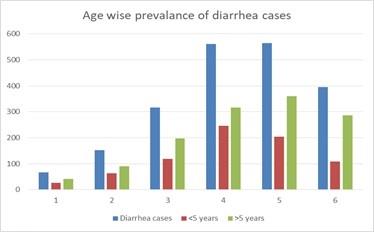
The age wise prevalence of diarrhea in separated months is delineated in Figure 2. The month wise total cases of diarrhea less than five years were 26, 63, 119, 246, and 204, 109 respectively. Whereas, the month wise cases of diarrhea more than five years were 41, 90, 197, 316, 360 and 286 respectively as shown in Table
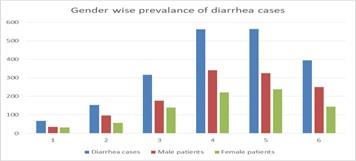
The age wise prevalence of diarrhea in separated months is delineated in Figure 2. The month wise total cases of diarrhea less than five years were 26, 63, 119, 246, and 204, 109 respectively. Whereas, the month wise cases of diarrhea more than five years were 41, 90, 197, 316, 360 and 286 respectively as shown in Table 1. The gender wise prevalence of diarrhea of male patients in the months of March, April, May, June, July and August were 35, 97, 177, 341, 326, and 250 respectively. Among the female patients, the prevalence in these months was 32, 56, 139, 221, 238 and 145 respectively as shown in Figure 3. By looking to the percentage of diarrhea in different months of summer, it becomes clear from Table 2 that it was increased in the months of June and July that were 13.6 % and 10.9 % respectively.
| Month | Total | Diarrhea | Male | Female | <5 | >5 | Other | ||||||||||||||
|---|---|---|---|---|---|---|---|---|---|---|---|---|---|---|---|---|---|---|---|---|---|
| admission | cases | patients | patients | years | years | cases | |||||||||||||||
| March | 1711 | 67 | 35 | 32 | 26 | 41 | 1644 | ||||||||||||||
| April | 2154 | 153 | 97 | 56 | 63 | 90 | 2001 | ||||||||||||||
| May | 4307 | 316 | 177 | 139 | 119 | 197 | 3991 | ||||||||||||||
| June | 4127 | 562 | 341 | 221 | 246 | 316 | 3565 | ||||||||||||||
| July | 5136 | 564 | 326 | 238 | 204 | 360 | 4572 | ||||||||||||||
| August | 4088 | 395 | 250 | 145 | 109 | 286 | 3693 | ||||||||||||||
| Grand Total | 21523 | 2057 | 1226 | 831 | 767 | 1290 | 19466 |
Table 1: The diarrheal cases.
- Month Diarrhoea %
- % of males with
- % of females with
- Diarrhoea
- <5 years %
- >5 years %
- Other cases %
- March
- 3.91583869
- 52.23880597
- 47.76119403
- 38.80597015
- 61.19403
- 96.08416
- April
- 7.10306407
- 63.39869281
- 36.60130719
- 41.17647059
- 58.82353
- 92.89694
- May
- 7.33689343
- 56.01265823
- 43.98734177
- 37.65822785
- 62.34177
- 92.66311
- June
- 13.6176399
- 60.67615658
- 39.32384342
- 43.77224199
- 56.22776
- 86.38236
- July
- 10.9813084
- 57.80141844
- 42.19858156
- 36.17021277
- 63.82979
- 89.01869
- August
- 9.66242661
- 63.29113924
- 36.70886076
- 27.59493671
- 72.40506
- 90.33757
- Diarrhoea
Table 2: The percentage of diarrhea in different months of summer.
Discussion
As the previous researches also show that diarrhea is very prevalent in different regions of Pakistan. Beside this, it is more common in urban and sub urban areas. Diarrheal diseases are frequent in Pakistan claiming about 118,000 lives each year, most of which are children <5 years living in rural communities. In addition, it was often observed that adult urban and suburban dwellers also face diarrheal episodes [4]. The findings of this study also showed that the proportion of diarrhea was high enough in the region. There were total of 2,057 cases of diarrhea among 21,523 admitted patients. The percentage of diarrhea was round about 10% (9.55%), which is high enough because the population of Kalam is not as large as other big cities of Pakistan.
In addition, the weather has also great impact on the health of the population. It was also found out that the ratio of diarrhea was increased in hot weathers (Figure 4). The weather in August and after words becomes colder in the valley, so the incidents of diarrhea also get decrease. The occurrence of infectious disease in hot weather is due to a number of reasons. In hot and humid weather, the growth of pathogenic organisms in the food and other material get increased, also summer is the breeding season for flies that act as mechanical vectors carrying enter pathogens to food and water [6]. Moreover, the prevalence of diarrhea in summer season was high, that was 42.6% [2, 6, 8].
The findings of a study across Pakistan showed that in a duration of two years, the total numbers of patients with acute watery diarrhea from April 2006 to May 2008 were: 23,212 in LCH (Lahore), 2,028 in RGH (Rawalpindi), 937 in MHPMC (Peshawar), 2,417 in NICH (Karachi) and 1,991 in KGH (Karachi) [5]. In comparison to the above study, the results of our study are alarmingly high, because this data was collected in six months duration and valley Kalam is a comparatively small region as compared to the mentioned big cities of Pakistan.
The total males with the diarrhea disease were 1226 (59.6 %), and the total females with the diarrhea disease were 831(40.3%) as shown in Table 1. This significant difference may be due to the consumption of street food by males in hotels and bazars. This particular is in line with the findings of a study in Pakistan where, there was significant difference in pin point prevalence of diarrhea males (10.4%) were more prone to diarrhea than that of females (8.1%) [6]. The same finding is also confirmed by another study, that rotavirus is the single most common cause of acute watery diarrhea worldwide and studies have shown that rotavirus affect male gender more than female [7].
corroboration with the above mentioned study as Kalam valley is also a rural area where most of the drinking water resources such as water tanks and springs are contaminated by above mentioned impurities when there is heavy rain fall. Through rain water these contaminants get mixed with the drinking water, which ultimately leads to spread of infectious diseases like diarrhea. Approximately 44 % of Pakistani communities have no access to safe drinking water and the situation is far worse in rural areas 90% of the population is deprived of safe drinking water [10]. This clearly indicates that drinking water in rural areas cannot be considered safe.
Limitations of the Study
The main limitation of the study is that data was collected from one hospital only. Although, this civil hospital is the biggest in the region, still majority of the people visits other centers as well. So, if the data was collected from all health centers of the region, the results would be more fruitful.
Conclusion
In conclusion, based on the study findings it can be stated that infectious diseases like diarrhea is not confined to hot and populated regions only. The study results clearly showed that the prevalence of diarrhea is much high in the region as compared to the other big cities of the country. There were total 2,057 cases of diarrhea cases identified in only one hospital of the region.
Recommendations
It is suggested that the government should give proper attention to this issue. Moreover, efforts should be made to improve the sanitation system of the residential areas of Kalam valley. Provision of safe drinking water has to be made sure for people of the region. For this purpose, water purification plants should be installed. Further research studies should be carried out on larger scales to identify the burden of different water borne diseases.
Acknowledgment
We acknowledge the support and cooperation of Dr. Masood (incharge of the civil hospital Kalam Swat) and Ms. Yasmeen Parpio (our respected teacher).
References
-
Maheshwary N, Noor S, Nawaz H, Wajid Z, Qaiser F, et al. (2017) Awareness of Mothers about Diarrhea; A Cross Sectional Comparative Study Focusing on Consciousness of Diarrhea among Different Socioeconomic Classes in Pakistan. International Journal of Pediatrics & Child Care 2(1): 1-6.
-
Mengistie B, Berhane Y, Worku A (2013) Prevalence of diarrhea and associated risk factors among children under-five years of age in Eastern Ethiopia: A cross-sectional study. Open Journal of Preventive Medicine 3(7): 446-453.
-
Akhtar U, Syed NM, Malik IA, Naqvi MH, Bhatti JA (2012) Bacterial Pathogens Causing Severe Acute Watery Diarrhea During a Summer Month in a Tertiary Care Setting, Islamabad. Pakistan Journal of Medical Research 51(3): 104-107.
-
Kazi AM, Warraich GJ, Qureshi S, Qureshi H, Khan MMA, et al. (2014) Sentinel hospital-based surveillance for assessment of burden of rotavirus gastroenteritis in children in Pakistan. PloS one 9(10): e108221.
-
Ahmed SF, Farheen A, Muzaffar A, Mattoo GM (2010) Prevalence of Diarrhoeal Disease, its Seasonal and Age Variation in under-fives in Kashmir, India. Int J Health Sci (Qassim) 2(2): 126-133.
-
Khattak TA, Ali S, Safdar CA, Aslam MS (2011) Frequency of rotavirus infection in children with acute diarrhea. Pakistan Armed Forces Medical Journal 61(1): 1-6.
-
Nisar M, Ahmed M, Mushtaq MH, Khan SA, Hussain A, et al. (2014) Clinico-epidemiology of shigellosis in children suffering from Diarrhea in District Lahore, Pakistan. Int J Curr Microbiol App Sci 3(2): 950-957.
-
Musengimana G, Mukinda FK, Machekano R, Mahomed H (2016) Temperature variability and occurrence of diarrhoea in children under five- yearsold in Cape Town metropolitan sub-districts. International journal of environmental research and public health 13(9): 859.
-
Pirsaheb M, Sharafi K, Ahmadi E, Moradi M (2017) Prevalence of the waterborne diseases (diarrhea, dysentery, typhoid, and hepatitis A) in West of Iran during 5 years (2006–2010). Annals of Tropical Medicine and Public Health 10(6): 1524-1528.
-
Qasim M, Anees MM, Bashir A (2014) Unhygienic water is the cause of water borne disease among villagers: A case of Gujrat-Pakistan. World Applied Sciences Journal 29(12): 1484-1491.
- Teaching Cognitive Behavioral Therapy to Graduate Psychiatric Mental Health Nurse Practitioner Students: Utilizing A Mixed Methods Course Evaluation
- The Role of Pharmacogenetic Testing in Clinical Practice: A Path toward more Effective, Personalized and Cost-effective Care
- Implementing Screening with the GAD-7 in an Outpatient Mental Health Setting: A Quality Improvement Project
- Social Media and Health Promotion
- Impact of Covid-19 Pandemic on the Academic Performance and Attitude of Nursing Students towards E-Learning
- A Study to Assess the Knowledge Regarding Ill Effects of Tobacco Consumption on Health among Adolescents in Selected Higher Secondary School in Nadiad City