
Overview of Early Postpartum Perineal Wound Repair Management During Home Care with Hydrotherapy Cold Sitz Bath and Infra Red Therapy
Background & Aim: The delivery process can be a problem in post partum mothers who find it difficult to adapt to various measures of trauma care for the perineum salama in the postnatal period, this results in a risk of infection in the perineal wound. The appearance of perineal infection can spread to the bladder or in the birth canal which can cause complications. This study aims to assess the effectiveness of sitz bath hydrotherapy interventions and infrared therapy in repairing perineal wounds. Methods & Materials: This study is a comparative study that compares two perineal wound care therapies, namely sitz bath hydrotherapy interventions with infrared therapy Perineal wound repair assessment is performed using the southampton wound rating scale. Assessment and intervention in perineal wounds is carried out twice a day for three consecutive days. The purposive sampling technique was carried out on 20 people with sitz bath hydrotherapy interventions, and 20 people with infrared therapy using Mann-Whitney statistics. Results: Statistically proven that group 1 interventions (cold sitz bath hydrotherapy) (p = 1.00) and group 2 (infra red therapy) (p = 1.00) on the first and second day did not have a significant effect on perineal wound healing . However, cold water sitz bath hydrotherapy intervention was significantly effective in improving the perineal injury process on the third day (p value = 0.037). Conclusion: The method of treating perineal wounds with cold sitz hydrotherapy can be used as a procedure for postpartum maternal perineal repair in health care and at home.
Introduction
Fear of perineal injury requiring suturing and fears of infection and wound damage are a major problem for women throughout the world [1, 2]. In addition to infection, complications such as adhesion and excess tissue area may arise and cause long-term morbidity, which can damage the effects on women’s physical, psychosocial, and sexual well-being [3, 4]. As the risk of infection increases and a potentially significant source of pain, perineal trauma can negatively impact maternal postpartum recovery. Various nursing interventions aimed at relieving perineal pain are largely based on local cooling [5].
Some steps are needed so that women can reach it moving through their recovery journey. There is the need to manage pain and discomfort perineum so that the body’s functions must be done as comfortable as possible. Next The steps involved move from being dependent on others to help carry out activities to manage more independently and need a little help. The final step is to regain the body they know [5]. Various factors can affect the process of repair of perineal wounds, including wound suturing techniques, as well as the skills of health workers in suturing wounds, various strategies to accelerate the process of healing perineal wounds continue to be counseled to postpartum mothers. This is because many postpartum mothers still cannot adapt to the discomfort caused by wound pain, and perineal wound care techniques while in the hospital or at home. It is estimated that quite a lot of postpartum mothers complained about this but were not detected by health workers [6].
This research is useful as an intervention method that can be applied in provide nursing services to normal postpartum mothers in the hospital and at home. This study aims to determine the effectiveness of cold sitz bath hydrotherapy and infrared therapy on repairing perineal wounds of postpartum.
Methods
Study Design
This study is a comparative study to assess the effectiveness of cold water sitz bath interventions and infrared radiation therapy on postpartum maternal perineal wounds.
Sample Size
The sample technique in this study using purposive sampling. Participants were 40 postpartum mothers. The interventions carried out in this study were carried out individually in two groups. The first group was given cold sitz bath hydrotherapy intervention, and in group 2 the intervention was infra red therapy. The sampling technique was done by purposive sampling, carried out on 40 postpartum mothers, 20 postpartum mothers were given sitz bath hydrotherapy interventions, and 20 mothers with infra red therapy interventions, with normal contraception criteria, 1-2 degree perineal wounds, with inclusion criteria including postnatal mothers during day 1, 2, and 3, normal delivery with grade 2 perineal wounds.
The exclusion criteria included postpartum mothers with a history of diabetes, eclampsia, infectious diseases sexual, puerperal sepsis, perineal tear, instrumental delivery, episiotomy, undergoing lower segment caesarean section, and disability. A total of 40 postpartum mothers were divided into 2 groups, consisting of 20 people in group 1 (group with hydrotherapy cold sitz bath), and 20 people in group 2 (group with infrared intervention).
Population, Settings, and Sampling
The interventions carried out in this study were carried out individually in two groups. The first group was given cold sitz bath hydrotherapy intervention, and in group 2 the intervention was infra red therapy. The sampling technique was done by purposive sampling, carried out on 40 postpartum mothers, 20 postpartum mothers were given sitz bath hydrotherapy interventions, and 20 mothers with infra red therapy interventions, with normal contraception criteria, 1-2 degree perineal wounds, with inclusion criteria including postnatal mothers during day 1, 2, and 3, normal delivery with grade 2 perineal wounds. The exclusion criteria included postpartum mothers with a history of diabetes, eclampsia, infectious diseases sexual, puerperal sepsis, perineal tear, instrumental delivery, episiotomy, undergoing lower segment caesarean section, and disability. A total of 40 postpartum mothers were divided into 2 groups, consisting of 20 people in group 1 (group with hydrotherapy cold sitz bath), and 20 people in group 2 (group with infrared intervention).
Measures
Data was collected using a questionnaire, which includes data on the characteristics of postpartum mothers and with data on the perineal wound healing process in 2 groups of hydrotherapy cold sitzbath and infrared therapy.
The assessment of the wound healing score used the Southampton and the Bates-Jensen advanced wound rating scale, with the result of the trial result that the correlation coefficient value was r = 0.99 and was considered reliable. The modified Southampton scale was used to assess wound healing rates in the experimental and comparison groups. Wound scale scores ranging from 0 to 10 had wound regeneration and >11 had wound degeneration. Further descriptions of the grading pattern are as follows, 0-4 is considered good wound regeneration, 5-10 is considered moderate wound regeneration, 11-15 is considered as poor wound degeneration, and >15 is considered severe wound degeneration. Subjects from the experimental group and the comparison group were given sitz baths of cold water and infrared radiation. The observations were carried out over 3 days using a modified Southampton scale and the total scores were compared against the grading pattern.
Different interventions were applied to the two intervention groups. Group 1 was given cold sitzbath hydrotherapy intervention referring to the procedure protocol for immersing perineal wounds in a sitzbath soaking device filled with ¼ of cold water at 120C-140C with a duration of 10 minutes. In group 2, infrared therapy using an infrared lamp that was highlighted at a distance of 50 cm from the perineal wound lasted 10 minutes. Both interventions were carried out for three days, in postpartum mothers on days 1, 2, and 3 at home.
Ethical Consideration
The data collection procedure for postpartum mothers began by explaining the intervention procedure and obtaining approval after explanation or informed consent. The principles of confidentiality and anonymity were explained to postpartum mothers and guaranteed by the investigators. Ethical studies in the implementation of this research intervention were carried out by the Faculty of Nursing, Universitas Sumatera Utara (1724 / IV / SP / 2019), who then gave research permission to researchers.
Data Collection Procedure
This research is a quantitative study aimed at evaluating the effectiveness of interventions in the treatment of perineal wound repair. The interventions carried out in this study were carried out individually in two groups. The first group was given cold sitz bath hydrotherapy intervention, and in group 2 the intervention was infra red therapy. The sampling technique was done by purposive sampling, carried out on 40 postpartum mothers, 20 postpartum mothers were given sitz bath hydrotherapy interventions, and 20 mothers with infra red therapy interventions, with normal contraception criteria, 1-2 degree perineal wounds using pre-post test design. Each intervention was given twice a day ie after the post partum mother took a shower in the morning and evening for three days. Indicators of the wound repair process were assessed using the Southampton instrument with the results of the trial instrument r = 0.99 (Karl Pearson correlation coefficient), and the reliability value of 0.99 (brown spearmen).
Indicators of wound repair are assessed from the condition of erythrma, echimosis, and edema in perineal wounds. This study was conducted in the postpartum ward intervention group 1 (cold water sitz bath) at the Madina maternity clinic, Tembung, Indonesia, while in the intervention group 2 (infrared therapy) it was conducted at the Sundari general hospital in Medan, Indonesia. Cold water sitz bath hydrotherapy in this study refers to the procedure of soaking the hips and buttocks of a postnatal mother with perineal wounds in a basin filled with ¼ of cold water (Temperature 120C-140C) for 10 minutes.
Data Analysis Process
In data management, all complete questionnaires are captured and administered in the Statistical Package for Social Sciences (SPSS) version 19. database management system. Data is then cleaned to ensure that only valid responses to questions are present in the database. In data management, all complete questionnaires are captured and administered in the Statistical Package for Social Sciences (SPSS) version 19. database management system. Data is then cleaned to ensure that only valid responses to questions are present in the database. Logic checks are also carried out. To make data more meaningful, frequency or percentage tables, descriptive statistics, and inferential statistics are used to analyze and present data by using Mann Whitney.
Results
The results of the progress of this study obtained a description of the characteristics of perineal wounds as a result of the progress of the research results. In Figure 1 below it is proven that the average wound repair from day to day for three consecutive days with two interventions every day, shows that cold sitz bath hydrotherapy shows more effective perineal repair compared to infrared therapy.
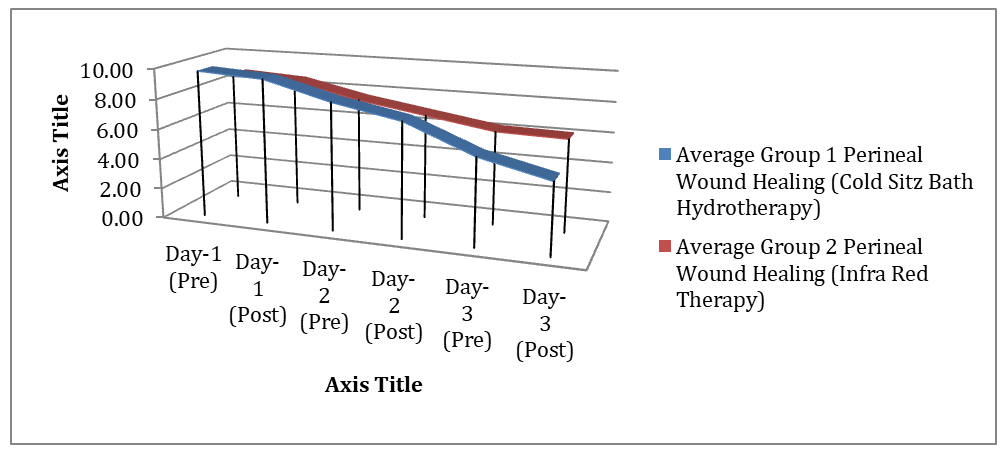
Healing of perineal wounds in post partum mothers was also proven based on the results of statistical tests that there were differences in the process of perineal wound healing between sitz bath hydrotherapy interventions in group 1, and infra red interventions in group 2. The explanation can be seen in Table 1.
| Pre – Post Intervention | Group | Mean ± SD | t-Test | P |
|---|---|---|---|---|
| Pre - Post intervention day 1 | Group 1 (Hydrotherapy Cold Sitz Bath) | 4,10±1,861 | 2,179 | 0,042 |
| 3,90±1,832 | ||||
| Group 2 (Infra Red) | 5,95±2,188 | 2,131 | 0,046 | |
| 5,50±1,906 | ||||
| Pre - Post intervention day 2 | Group 1 | 3,45±1,605 | 3,943 | 0,001 |
| (Cold Sitz Bath) | ||||
| 3,00±1,376 | ||||
| Group 2 (Infra Red) | 4,85±1,981 | 4,359 | 0,000 | |
| 4,35±1,785 | ||||
| Pre - Post intervention day 3 | Group 1 | 2,25±1,164 | 3,327 | 0,004 |
| (Cold Sitz Bath) | ||||
| 1,80±1,056 | ||||
| Group 2 (Infra Red) | 3,65±1,814 | 2,990 | 0,008 | |
| 3,25±1,410 |
Table 1: The Difference Between Effects of Cold Sitz Bath Hydrotherapy and Infra Red Therapy on the Perineum Wound Healing Proces
Based on the table above it can be seen that the mean score of pre-post intervention in group 1 (hydrotherapy sitz bath) on the first day (4.10 ± 1.861) is lower than that of intervention in group 2 (infra red therapy) (5.95 ± 2,188). On the third day intervention the mean decrease in pain scale in group 1 (1.80 ± 1.056) was lower than in group 2 (3.25 ± 1.410). In table 2 it can be seen that the average score of pain reduction occurred significantly from consecutive days for three days in group 1 (cold sitz bath hydrotherapy) compared to group 2 (infrared therapy).
Statistically proven that both group 1 interventions (cold sitz bath hydrotherapy) and group 2 (infra red therapy) proved to be influential in healing perineal wounds after intervention until the third day. Cold sitz bath hydrotherapy had a significant effect (p=0.004), infra red therapy was also shown to have a significant effect (0.008). However, the changes in the mean score of wound healing indicate that cold sitz bath hydrotherapy is significantly more influential in healing perineal wounds compared to infra red therapy interventions. The effectiveness of the intervention method is proven through inferential statistical tests using Man- Whitney because the data distribution is not normal in Table 2.
| Group | Day - 1 | Day -2 | Day - 3 | |||
|---|---|---|---|---|---|---|
| Mean | Mann-Whitney | Mean | Mann-Whitney | Mean | Mann-Whitney | |
| Group-1 (Hydrotherapy Cold Sitz Bath | 20,50 | 20,50 | 22,50 | |||
| 0,037 | ||||||
| Group-2 (Infra Red Therapy) | 20,50 | 1,00 | 20,50 | 1,00 | 18,50 |
Table 2: The Effectiveness of Cold Sitz Bath Hydrotherapy and Infra Red Therapy on the Perineum Wound Healing Process.
Based on the table above, cold sitz bath hydrotherapy is more effective in repairing perineal wounds in postpartum mothers (p value = 0.037).
Discussion
Results of previous studies, show that in cold sitz bath hydrotherapy interventions the majority of post partum mothers have characteristic features of wounds with ecchymoses, and erythema that persists on the first day and the second day. The mean characteristics of ecchymoses wounds, and erythema change in the appearance of wound repair on the third day. The characteristics of ecchymosis on the first day were 2.15 ± 0.48 and there was a change in the characteristics on the third day 1.15 ± 0.36. The characteristics of erythema wound on the first day were 2.85 ± 0.58, which also showed a characteristic change on the third day 1.45 ± 0.51. Whereas the characteristics of edema wounds on the first day were 2.80 ± 0.52, and the characteristic changes were 1.80 ± 0.69 [7]. In the infra red therapeutic intervention (group 2) that wound degeneration was found until the first post-intervention day (1.95 ± 0.22), poor wound regeneration occurred until the second day of pre-intervention (1.95 ± 0.22), and wound regeneration was undergoing changes from the first day to the pre-intervention second day (1.05 ± 0.22). These results indicate that infrared therapy does not show significant changes if only done for one day.
This research prove cold sitz bath hydrotherapy is more effective in repairing perineal wounds in postpartum mothers (p value = 0.037), the literature search results state that sitz bath hydrotherapy with cold water at a temperature of 55-75 ° F (12°C -24°C) is useful in repairing perineal wounds. Hydrotherapy with cold water results in a decrease in cell metabolism and a reduction in the use of oxygen around uninjured tissue. Some research also shows cold water therapy causes vasoconstriction and increases venous circulation. The occurrence of venous vasoconstriction, greatly helps the process of drainage in edema tissue by lymph vessels. Vasoconstriction in edema tissue, the intercellular fluid that is maintained will flow slowly through the connective tissue between the muscle fibers into the lymphatic channel. In addition, the drainage process is also facilitated by pumps that occur due to muscle contraction and relaxation [8, 9, 10]. Therefore, hydrotherapy with cold water in spontaneous postpartum mothers who experience perineal laceration can be one of the management of perineal wounds for the treatment of perineal edema.
In several studies the theory also states that compressing ice water can minimize edema in perineal wounds. The way it works is ice water can reduce capillary permeability [11]. Another theory states that cold water compresses can prevent edema by controlling blood flow through vasoconstriction mechanisms [12]. Cold water produces a local anesthetic effect produced by the mechanism of peripheral nerve block. The effect of cold water also gives changes to collagen by increasing its elasticity. Viscoelastic changes in collagen and reduction in muscle spasticity reduce edema in perineal wounds [13, 14].
Postpartum mothers should be advised to maintain perineal wounds in a dry and clean state, with a splash or bathing regularly, and ensure good hand hygiene. Good sanitation is a protection to avoid perineal contamination. Warnings to postpartum mothers about signs and symptoms of possible infection, such as increased pain, swelling, greater blood loss, and odorous discharge and who to contact for immediate review if there is a very important problem. Some systemic factors can delay healing, such as anemia, poor diet, smoking, and underlying health conditions [3, 4]. Nurses play an important role in carrying out regular pain assessment of perineal wounds during the postpartum period including discomfort associated with perineal trauma, and applying appropriate perineal wound care procedures for postpartum mothers.
Limitations
In this study, the limitations encountered were the number of respondents who were not so large. This is because the traditional views of society are different from modern practices in the technique of treating perineal wounds at home. Traditional culture in society is considered the most appropriate action because it has been carried out for generations.
Implications
This research also proves that consistent treatment with cold sitz bath hydrotherapy and infrared therapy can help repair perineal wounds. The limitations of this study prove that it is necessary to review several research variables related to cultural views that affect the management of perineal wound care while at home. The end result is expected to be able to overcome pain in the wound and can reduce the traumatic feeling of giving birth because the mother can overcome the problems faced in early postpartum.
Suggestion
The number of samples that are not so large is a drawback of this study, this is because a number of respondents’ rejection of interventional wound care therapy is contrary to the hereditary culture that has been embraced by the community. In future research, it is necessary to prepare a survey of public acceptance of cultural views on perineal wound care interventions that are safe, effective, inexpensive, and can be done independently at home.
Conclusion
Degeneration of wounds was found only until the first day of post-intervention (1.95 ± 0.22), poor wound regeneration occurred until the second day of pre-intervention (1.95 ± 0.22), and wound regeneration was being encountered changes from the first day to the second day pre-intervention (1.05 ± 0.22). These results indicate that infrared therapy does not show significant changes if only done for one day.
References
-
Muhith A (2009) Hubungan antara Perawatan Luka Jahitan Perineum dengan Proses Kesembuhan Luka Perineum di RSUD Sidoarjo. Medica Majapahit. Jurnal Ilm Kesehat Sekol Tinggi Ilmu Kesehat Majapahit 1(1): 42-48.
-
Glazener CM (1997) Sexual function after childbirth: women’s experiences, persistent morbidity and lack of professional recognition. BJOG An Int J Obstet Gynaecol 104(3): 330-335.
-
Dudley L, Kettle C, Ismail K (2013) Prevalence, pathophysiology and current management of dehisced perineal wounds following childbirth. Br J Midwifery 21(3): 160-171.
-
Webb DA, Culhane J (2002) Hospital variation in episiotomy use and the risk of perineal trauma during childbirth. Birth 29(2): 132-136.
-
Petersen MR (2011) Review of interventions to relieve postpartum pain from perineal trauma. MCN Am J Matern Nurs 36(4): 241-245.
-
Sheoran P, Chand S, Kaur S (2014) Comparison of Infra Red Light Therapy vs. Sitz Bath on episiotomy in terms of wound healing among postnatal mothers. Asian J Nurs Educ Res 4(1): 70-75.
-
Girsang BM, Darti NA, Simamora R, Karo EI (2019) Gambaran karakteristik luka perineum pada ibu post partum dengan hidroterapi sitz bath. J Keperawatan Respati Yogyakarta 6(3): 666-671.
-
Geytenbeek J (2002) Evidence for effective hydrotherapy. Physiotherapy 88(9): 514-529.
-
McPhee SJ, Papadakis MA, Rabow MW (2010) Current medical diagnosis & treatment 2010. New York: McGraw- Hill Medical.
-
Netter FH (2017) Atlas of human anatomy, plate 46. Philadelphia, PA: Elsevier.
-
Bobak Lowdwermilk J (2005) Buku Ajar Keperawatan Maternitas. Jakarta: EGC.
-
Hidayat A, Nurchasanah A (2007) Metode Penelitian Keperawatan Dan Teknik Analisis Data. Jakarta: Salemba Medika, pp: 179-180.
-
Ramler D, Roberts J (1986) A comparison of cold and warm sitz baths for relief of postpartum perineal pain. J Obstet Gynecol Neonatal Nurs 15(6): 471-474.
-
Susilawati E, Ilda WR (2019) Efektifitas Kompres Hangat dan Kompres Dingin Terhadap Intensitas Nyeri Luka Perineum Pada Ibu Post Partum di BPM Siti Julaeha Pekanbaru. Journal Midwifery Sci 3(1): 7-14.
- Teaching Cognitive Behavioral Therapy to Graduate Psychiatric Mental Health Nurse Practitioner Students: Utilizing A Mixed Methods Course Evaluation
- The Role of Pharmacogenetic Testing in Clinical Practice: A Path toward more Effective, Personalized and Cost-effective Care
- Implementing Screening with the GAD-7 in an Outpatient Mental Health Setting: A Quality Improvement Project
- Social Media and Health Promotion
- Impact of Covid-19 Pandemic on the Academic Performance and Attitude of Nursing Students towards E-Learning
- A Study to Assess the Knowledge Regarding Ill Effects of Tobacco Consumption on Health among Adolescents in Selected Higher Secondary School in Nadiad City