
African Medical School Academic Success and Social Drug use among Undergraduate Students
Background: It has long been known that using drugs like alcohol, khat, and tobacco is one of the main causes of human suffering. It is now regarded as one of the most significant socioeconomic and public health concerns in the world. Although it has an impact on many facets of society, juvenile substance abuse is alarmingly on the rise. Objective: This study’s goal is to evaluate how social drug usage affects students’ academic performance, specifically among those who will undergraduate from Africa medical college in 2023. Methodology: A cross-sectional study that was done on an institutional level among Africa medical college undergraduates. For the current study, a sample of 173 students was selected using a straightforward random selecting procedure from nine departments. Result: This survey included a total of 173 graduating students from various departments. Overall, 97.4 women, or 64.2%, and 174.5 women, or 35.8%, were present. Social drugs were taken by 33.6% of people at some point in their life. The most often used social drugs, according to this study, were beer, khat, and cigarettes (41.8%, 40.7%, and 12.1%, respectively). The most frequent effects of social drug use on students’ academic performances were higher absenteeism from class (31.9%) and a decline in cumulative grade point (27.5%), followed by a lack of interest in routine activities (25.3%) and worsening academic performance (15.2%), according to respondents. Peer pressure and socialization (17.8%) were the two most frequent reasons given by respondents, whereas academic unhappiness (13.3%), the desire to improve academic performance (11.1%), and loss of family control (8.9%) were the least frequent. Age, Religion, Ever Social Drug Use, Current Social Drug Use, Started Using Social Drug Use, and Impact of Social Drug Use show statistically significant associations with CGPA, according to statistical analysis and p-value. Conclusion and Recommendation: The studies revealed that social drug use had a negative impact on kids’ academic performance. The most prevalent outcomes were an increase in absences from school, a drop in cumulative grade point, and a decrease of interest in everyday chores. Khat, alcohol, and cigarettes were the most popular social drugs. This finding calls for further in-depth investigation into the various challenges connected to social drug use as well as instruction by responsible organizations about the detrimental effects that social drug use has on students’ academic performance, particularly when they first enrol in college.
Background
The use of drugs and alcohol, including cigarettes, khat, and other drugs, is one of the primary causes of human suffering and a growing public health and socioeconomic problem on a global scale. Although drug use affects every sector of society, it is increasing among young people at a dangerously rapid rate [1]. Although it impacts every aspect of society, substance misuse is especially common among college students. It also increases the chance of developing HIV and other STDs, accidents, workplace intoxicated driving, and absenteeism, violent crime, theft, and psychiatric issues like lethargy, hopelessness, and sleeplessness [1]. University students are a high-risk group for engaging in risky activities like smoking, binge drinking, and using illegal drugs. Numerous factors can affect when college students start using drugs or alcohol. According to surveys, peer pressure, along with their newly obtained independence, is one of the main reasons college students use drugs. A third factor that raises students’ risk of substance abuse and other risky behaviours is the stress they experience as they get used to their new environment [2]. Young people experience a variety of new sources of stress as they make the transition to college, including the separation from family, living in close quarters with strangers, the formation of new social groups, intense academic pressures, and juggling social obligations with academic and other responsibilities. Around 190 million people worldwide or 3.1% of the world’s population or 4.3% of those who are 15 years of age or older, were drug users in 2006. According to a survey done among college students in Eldoret, Western Kenya, lifetime prevalence rates for all drug use were 69.8%, while those for alcohol and tobacco use were 51.9% and 42.8%, respectively [1]. Substance use is one of the most burning and growing public health problems in Ethiopia, as in many developing countries; alcohol, khat and tobacco are the most frequently used substance. However, hard drugs such as heroin and cocaine are rarely used. In Ethiopia, khat is commonly used for stimulation and social recreation. A significant number of students consume khat to be alert and wakeful at night, especially during examination periods. Availability of substances, age, gender, having friends and families who use substances were the commonly mentioned factors that influence substances use [1].
Social drugs use and associated problems are of current global concern. It has become an epidemic in some parts of the African region with adolescents being the main victims of health problems due to substance addiction. The common substances abused in most African countries including Ethiopia are alcohol, khat and tobacco which are reported to be abused widely among students in colleges and high schools [3]. Khat contains substance that stimulates the CNS. The key constituent of khat responsible for its euphoric effect is called cathine or norseudoephedrine. Another compound with powerful CNS stimulant termed as cathinone (a-aminopropiophenone) [3]. Tobacco is one of the abused substances that could cause addiction .the nicotine in cigarette smoke is known to have an addictive effect, so that they develop dependency and tolerance. Then this dependency exposed them to withdrawal symptoms such as restlessness, irritable behaviour, less able to concentrate if they try to stop abruptly. Smoking is currently considered one of the greatest problems in public health worldwide, and it is one of the most preventable causes of death [4].
Alcoholism is an international problem and had touched every corner of the world, both developed and developing countries. There is doubt that every country in the world, including Ethiopia incurs substantial cost as result of physical effects seen in sexual activity with excessive drinking is de generation and dysfunction of sex glands though small amount can lower inhibition and make the person more relaxed and more eager to engage in social and sexual activity [4]. Impact of substance use on students: some studies looked at the adverse impact of substance use. The identified problems included increased absenteeism from class, loss of interest in their daily activities, deterioration in their academic performance, manifesting as failure in examination or declines students CGPAs [2]. As literature revealed that psychoactive substance use became an urgent problems among under graduate university students, with the most commonly used substances being alcohol, khat and cigarette. Most of the students started substance use during their preparatory school and first year university study period and the most commonly mentioned reason for khat, alcohol and cigarette use among university students were to keep alert while reading, for relaxation with friends and to get relief from stress respectively The students indicated peer acquaintances and family member substance usage as the two most important risk factors for using psychoactive substances [1]. This study’s objective is to evaluate drug use in society and how it affects kids’ academic performance. Therefore, there is no current information available at CIVIL SERVICE UNIV about the effects of social drug use on graduating students’ academic achievement. Additionally, this study will give researchers a starting point for further research. Furthermore, the discovery might prompt decision-making from interested agencies.
Method and Materials
Study Area and Period
Africa medical college found in Addis Ababa Ethiopia. Africa medical college is public educational institution established in December 1993, located in centre of Addis Ababa. Study periods from May 2023-August 2023.
Study Design
Institution based cross-sectional study design was conducted among graduating students at Civil Service University.
Populations
Source Population: All regular; graduating students at Africa medical college will be source population.
Study Population: Health science graduating class of 2023 students available during the study period and fulfilling eligibility criteria.
Inclusion and Exclusion Criteria
Health science graduating students attending their study in the year 2023 and willing to participate in the study was included. While, Students who left the campus for practical attachments and who are critically sick during the study period were excluded.
Sampling Size and Sampling Technique
Sample Size: The sample size for the study is determined by using the single population proportion formula:
2
2 z pq ni d =
Where,
- z= the standard normal value at confidence interval of 95%= 1.96
- p=Prevalence estimate at 50%, q=1-p
- d= Margin of sampling error tolerated
- n= Minimum sample size required Therefore, the sample size is:
( ) ( )( )
2 1.96 0.5 0.5 = 384 0.05 ni =
2 ( ) The total population is less than 10,000 we can use the following correctional formula:
f n n n N
= +
1
384 246 384 1 688 fn = = +
Where,
- nf = final sample size
- n=sample size which is 384
- N=source of population which is 688 By adding 10% of the non-respondent the actual sample size is 173 and the simple random sampling technique will be used for data collection.
Sampling Technique: Stratified sampling methods together with simple random sampling method were used to recruit samples for this study. The list of graduating students of Africa medical college was obtained from the university registrar. Students were stratified based on their department. Then, samples were elected proportionally from each department. Finally Simple random sampling method was used to select samples from each department.
Study Variable
Independent Variable: Age, Sex, Religion, Ethnicity, Monthly income, Family occupation, Field of study, and Social drug use. Dependent Variable: The dependent variable was student’s performance.
Data Collection Instrument and Techniques
A questionnaire and supplemental supplies, including a pen, pencil, eraser, and sharpener, were utilized to gather the data. Data were gathered using a pretested structured, self-administered questionnaire. The questionnaire’s first portion allows researchers to learn about the socio- demographic characteristics of the students, while the sections that follow ask questions crucial for identifying the most popular social drugs and determining how they affect academic performance. The lead investigator verified that every question on the questionnaire was answered fully and completely. Every day, the acquired data was appropriately handled, evaluated, and reviewed for accuracy and consistency of answers.
Ethical Consideration
Formal permission letter was written from school of Pharmacy, college of health and medical science. All respondents were informed about the objective of the study and their verbal consent was obtained. Additionally, confidentiality and privacy of the information were seriously respected.
Result
Socio-Demographic Characteristics
173 participants totalled, of which 174.5 (64.2%) were men and 97.4 (35.8%) were women. Participants aged 24-29 were 170 (62.7) years old on average, whereas those aged 18-23 were 101 (37.2%). The bulk of the respondents—93, or 36.2%—were orthodox, followed by 83 Muslims, or
31.4%, and the least number—14 Catholics, or 5.2%—were orthodox. The majority of the participants, 119 (43.8%), were Oromo; 62 (23.6%), then 32 (11.7%), and the least number of participants, 7, were Tiger (2.2%). Monthly income status of the study respondents showed that the majority 80(29.5%) of their monthly income were 3000 followed by 79 (29.2%) were >500 while <1000 were 38 (14%) is the least. family job status showed that majorities of family job were 95(35.1%) farmer followed by 85(31.4%), 62(22.9%) government employer, 18(6.4%) while NGO were 11(4.1%) which is the least. Department status of the study participant showed that 106(39.1%) medicine, 34 (12.2%) nurse, 30 (11.1%) pharmacy, 27 (10%) medical laboratory, 19 (7%) HO, 18 (6.6%) midwifery, 16 (5.9%) environmental health, 11(4.1%) dental medicine and 10 (3.7%) respectively (Table 1).
| Variables | Frequency | Percent | P-Value | |
|---|---|---|---|---|
| Sex | Male | 174.5.5.5 | 64.2 | 0.42 |
| Female | 97.4 | 35.8 | ||
| Age | 18-23 | 101 | 37.3 | 0.041 |
| 24-29 | 170 | 62.7 | ||
| Religion | Orthodox | 98 | 36.2 | 0.02 |
| Muslim | 85 | 31.4 | ||
| Protestant | 64 | 23.6 | ||
| Catholic | 14 | 5.2 | ||
| Others | 10 | 3.7 | ||
| Ethnicity | Oromo | 119 | 43.9 | 0.61 |
| Amara | 64 | 23.6 | ||
| Gurage | 32 | 11.8 | ||
| Tigre | 7 | 2.6 | ||
| Others | 49 | 18.1 | ||
| Monthly income | <1000 | 38 | 14 | 0.77 |
| 1000 | 74 | 27.3 | ||
| 3000 | 80 | 29.5 | ||
| >5000 | 79 | 29.2 | ||
| Family’s job | Farmer | 95 | 35.1 | 0.208 |
| Trader | 85 | 31.4 | ||
| Government Employer | 62 | 22.9 | ||
| NGO | 18 | 6.4 | ||
| Others | 11 | 4.1 | ||
| Department | Anaesthesia | 10 | 3.7 | 0.94 |
| Dental Medicine | 11 | 4.1 | ||
| Environmental Health | 16 | 5.9 | ||
| HO | 19 | 7 | ||
| Medical Laboratory | 27 | 10 | ||
| Medicine | 106 | 39.1 | ||
| Midwifery | 18 | 6.6 | ||
| Nurse | 34 | 12.5 | ||
| Pharmacy | 30 | 11.1 |
Table 1: Socio-demographic characteristics of graduating class students of Civil service University, 2023.
Prevalence of Social Drugs Use
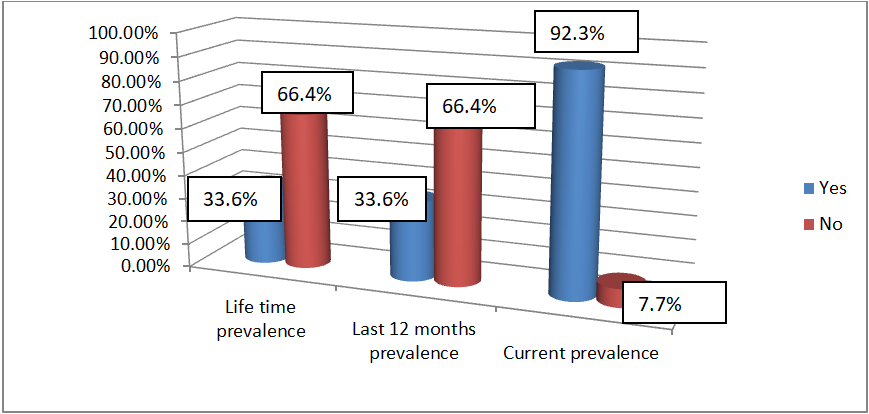
The study revealed that out of 173 respondents, 91 (33.6%)
were used social drug at least once in their life time, 91 (33.6%) used in a last 12 months and 264 (92.3%) were current social drug users (Figure 1).
Commonly Used Social Drugs
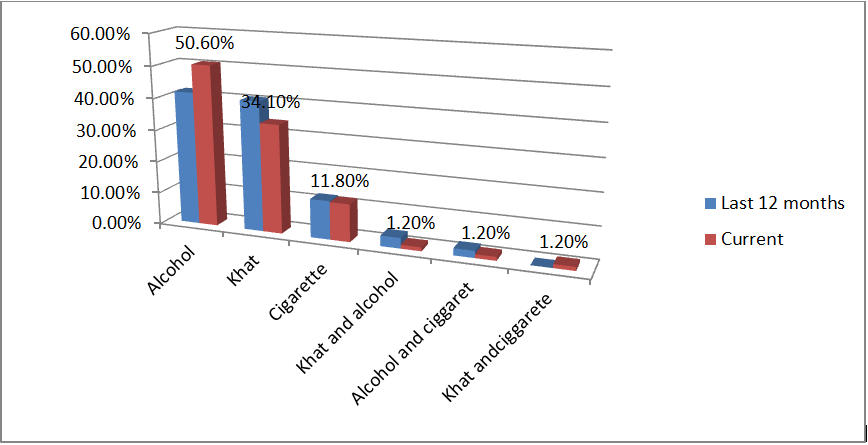
The study show that the most commonly used social drugs in the last 12 months were alcohol 38(41.8%), khat
37(40.7%) and cigarette 11(12.1%) respectively and currently used social drug were alcohol 43(50.6%), khat 29(34.1%) and cigarette 10 (11.8%) respectively (Figure 2).
Pattern of Social Drug Used
Out of 173 study participants who have used social drug were 91; out of 91 study participant pattern of social drug status showed that 33 (36.3%) were weekly, 32 (35.2%) daily, 20 (22%) were occasionally, 4 (4.2%) monthly and 2 (2.2%) were every two weeks respectively (Table 2).
| Variables | Frequency | Percent | P-Value |
|---|---|---|---|
| Daily | 32 | 35.20% | 0.165 |
| weekly | 33 | 36.30% | |
| Every two weeks | 2 | 2.20% | |
| Occasionally | 20 | 22% | |
| Monthly | 4 | 4.40% |
Table 2: Pattern of social drug used among graduating class students of Civil Service University, 2023.
Duration of Social Drug Used
Out of 173 study participant who have used social drug were 91; out 91 study participant, duration of social drug used status showed that 33(36.3%) of them were used >4 year, 23(25.3%) were 3-4 year, 22 (24.2%) were 1-2 year and 13 (14.3%) of them were use <1 year (Table 3).
| Variables | Frequency | Percent | P-Value |
|---|---|---|---|
| <1 year | 13 | 14.30% | 0.76 |
| 1-2 year | 22 | 24.20% | |
| 3-4 year | 23 | 25.30% | |
| >4 year | 33 | 36.30% |
Table 4: Duration of social drug used since started among; graduating class students of Civil Service University, 2023.
Started using Social Drugs
Out of 173 study participant who have used social drug were 91 (100%) social drug started status showed that 55 (60.4%) of them were during university, 26(28.6%) of them were during secondary, 8(8.8%) of them were during elementary education and 2(2.2%) (Table 4).
| Variables | Frequency | Percent | P-Value |
|---|---|---|---|
| During Childhood | 2 | 2.20% | 0.04 |
| During Secondary | 26 | 28.60% | |
| During Elementary Education | 8 | 8.80% | |
| During University | 55 | 60.40% |
Table 5: When started using social drug use among graduating class students of Civil Service University, 2023.
Social Drug Started Year at University
Out of 173 study participant who have used social drug were 55 (20.29%) were started social drug use at university level, social drug started year at university status showed that 16 (29.1%) of them were started social drug use at first year, 13(23.6%) third year, 12(21.8%) were at first year, 9(16.4%) final year, 3(5.5%) fourth year and 2(3.6%) were fifth year (Table 5).
| Variables | Frequency | Percent | P-Value |
|---|---|---|---|
| First year | 12 | 21.80% | 0.075 |
| Second year | 16 | 29.10% | |
| Third year | 13 | 23.60% | |
| Fourth year | 3 | 5.50% | |
| Fifth year | 2 | 3.60% | |
| Final year | 9 | 16.40% |
Table 3: At which year social drug use started after joining university among; graduating class students of Civil Service Univers
Reason for Social Drug Use
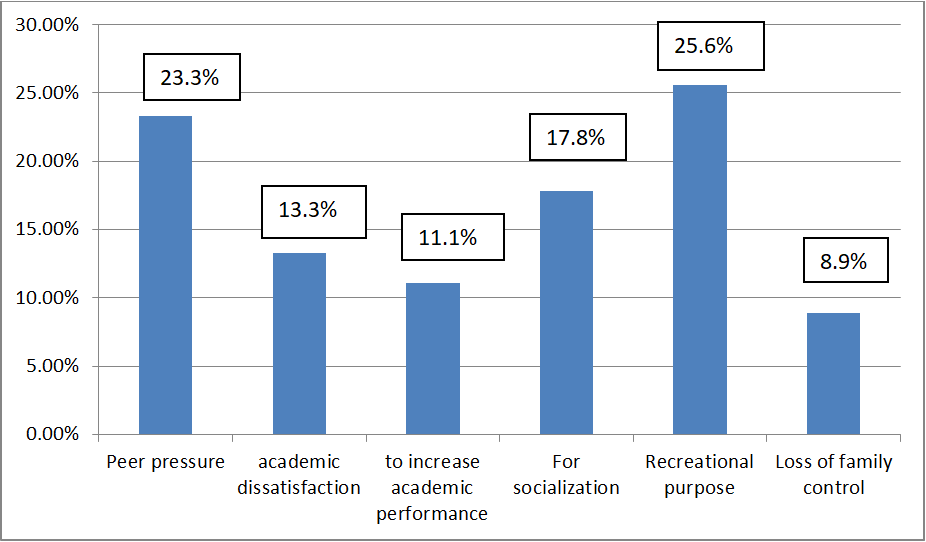
The most reason mentioned for use of social drug were 23(25.6%) were for recreational purpose, 21 (23.3%) were due to peer pressure, 16 (17.8%) were for socialization, 12(13.3%) were due to academic dissatisfaction, 10(11.1%) were to increase academic performance and 8(8.9%) loss of family control (Figure 3).
The Effect of Social Drug after using
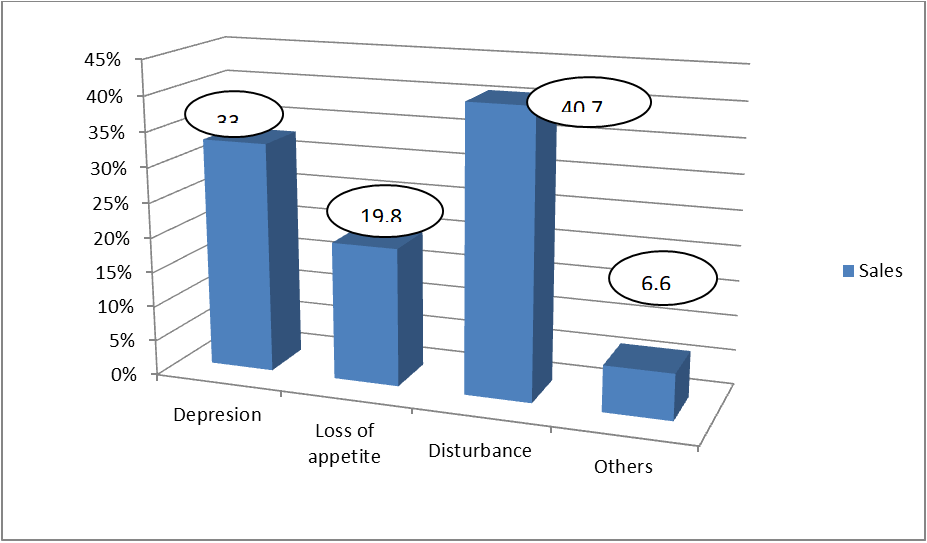
Out of 91 study participant; the effect of social drug after using status showed that 37 (40.7%) were disturbance, 30(33%) depression, 18 (19.8%) loss of appetite and 6 (6.6%) were others (Figure 4).
Impact of Social Drug use on Educational Performance
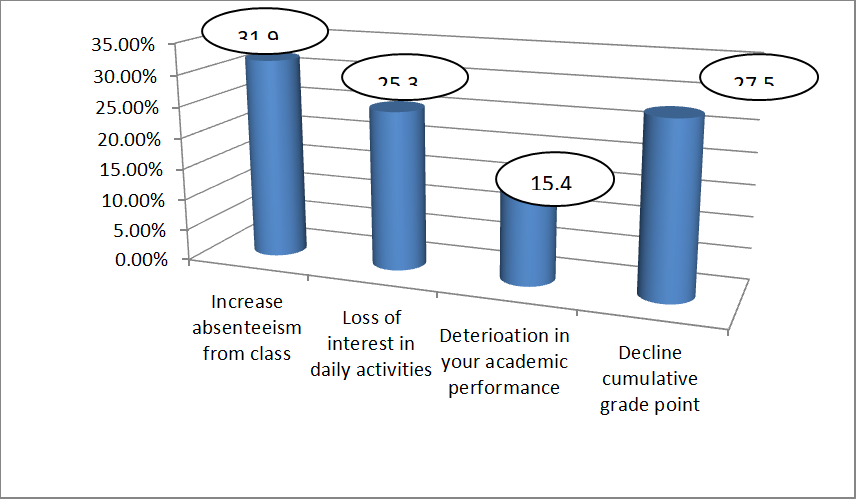
The most common impact of social drug use on educational performance were 29(31.9%) increase absenteeism from class, 25 (27.5%) were decline cumulative grade point, 23 (25.3%) loss of interest in daily activities and 14 (15.4%) deterioration in your academic performance (Figure 5).
Educational Performance
Concerning, educational performance, 146 (53.9%) of students were promoted to their next level. While, 125 (46.1%) scored great distinction (Table 6).
| Variables No | Have you ever use Social Drug? | Total | P-Value | ||
|---|---|---|---|---|---|
| Yes | |||||
| CGPA category | Promoted | 74 | 72 | 146 | 0 |
| Great Distinction | 106 | 19 | 125 | ||
| Total | 180 | 91 | 173 |
Table 6: Category students grade status among graduating class students of Civil Service University, 2023.
The test of significance was done between the CGPA or educational performance which is dependent variables and the factor affecting dependent variables which are the independent variables by chi-square and p-value. According to the statistical analysis and p- value, age (p<0.05), Religion (p<0.05), Ever social drug use (p<0.05), Current social drug use (p<0.05), Started using social drug use and impact of social drug use (p<0.05) have statistically significant association with CGPA (Table 7).
| Independent Variables | Chi-Square | Dependent variables(CGP) (df) | P-Value |
|---|---|---|---|
| Age | 3.491 | 1 | 0.041 |
| Religion | 11.627 | 4 | 0.02 |
| Ever social drug use | 35.141 | 1 | 0 |
| Current social drug use | 11.73 | 1 | 0.004 |
| Started using social drug use | 13.3 | 3 | 0.004 |
| Impact of social drug use | 11.687 | 3 | 0.009 |
Table 7: The significance association between the independent variables and CGPA among graduating class of Civil Service Universi
Discussion
This study assessed how drug use in society impacted pupils’ academic performance. This survey included a total of 173 graduating students from various departments. Overall, 97.4 women, or 64.2%, and 174.5 women, or 35.8%, were present. Students who have used at least one social drug in their lifetime are considered substance users by the operational definition applied in this study. As a result, 33.6% of adults said they had ever used social drugs. This is lower than studies conducted at Hawasa University (53.6%) and Debremarkos Polytechnic College (61.7%), according to Tesfahun A, et al. [5] & Kassa A, et al. [6]. The small sample size of the study may have contributed to the alleged lower prevalence. The prevalence of social drugs in last 12 months was33.6 % which is lower than study reported in Hawassa University (45.7%). The current prevalence of social drugs in the present study was 92.3 % which is greater than study reported in Debremarkos poly-technique College (38%).The low prevalence of last 12 months due to the respondents’ answer were the same as life time prevalence. High current prevalence in this study were probably due to differences in study area [5, 6].
According to this study the most commonly used social drugs were alcohol, khat and cigarette (41.8 %, 40.7 %& 12.1 % respectively) which was higher than studies conducted in Axum University(34.5%, 28.7% & 9.5% respectively) and University of Gondor (41%, 24% & 4% respectively) [1, 7]. This might be due to respondents who use social drugs at least once in their life included as drug users. Alcohol was lower than study conducted in Kenyatta University (92.1%). This might be due to different in study setting, availability and cost of social drugs. The prevalence of alcohol was high. This might be due to most khat chewer need alcohol to reduce stimulant effect of khat or for ‘chabsi,’ most of the respondents were orthodox which use alcohol than other social drugs and most respondents’ drink alcohol to celebrate holiday. The prevalence of khat (40.7%) was also high when compared with studies conducted in University of Gondor (24%) and Axum University (28.8%). This probably due to khat is used mostly during examination time for reading to increase performance. The low prevalence of cigarette smoking (12%) when compared alcohol(41.8%) & khat(40.7%)probable due to of fear of bad odour of tobacco and easily identified by other students, cigarette smoking disadvantage are disseminated by media as well as cigarette not related with increasing academic performance and for special celebrations of holiday unlike khat and alcohol [1, 7, 8].
The most common impact of social drug use on student educational performances reported by respondent were increase absenteeism from class (31.9%) and decline cumulative grade point (27.5%) followed by loss of interest in daily activities (25.3%) and the least impact were deterioration in your academic performance (15.2%). In Kenya, public secondary school of Nyamire North sub- country, indiscipline (21.9%), missed class (20.2%), affected students had low concentration span (19.7%), perform poorly in exam (19.6) and do not do assignment (18.6%). In this study increase absenteeism from class (31.9) and decline cumulative grade point (27.5%) were higher than Nyamire secondary school (20.2%, 19.6%) respectively. This difference might be due to most commonly used social drug in this study were alcohol because of this student missed class due to hangover, difference in study area and sleep disturbance [9].
The most common reasons reported by respondents were recreational purpose (25.6%), & peer pressure (23.3%) followed by for socialization (17.8%) and the least reasons were academic dissatisfaction (13.3%), to increase academic performance (11.1%) and loss of family control (8.9%). These reasons similar with report showed in university of Gondar (for relaxation (29.1%), increase academic performance (14.7%), peer pressure (12.4%), for socialization (9.1%), to kill extra times (6.1 %), academic dissatisfaction and loss of family control) and Axum university common reason reported by study (to keep alert, for relaxation and relief from stress. The similarity might be due to students need social drugs for similar purpose. The high prevalence of peer influence may be caused by the fact that most students celebrate holidays and engage in social interactions mostly including alcohol and khat. Students who are older than 18 and capable of making their own decisions may be the reason for the low incidence of loss of parental control [6, 9, 10, 11]. According to statistical analysis and p-value, there are statistically significant correlations between age, religion, ever use of social drugs, current use of social drugs, first use of social drugs, and impact of social drug use and CGPA.
Conclusion
According to studies, one-quarter of medical college graduates in Africa use social drugs. Academic achievement and the usage of social drugs are closely associated. In this study, it was discovered that alcohol, khat, and cigarettes were the most often used social drugs. The three most common justifications for using drugs in a social situation were peer pressure, recreation, and sociability. Additionally, social drug use leads to sadness and instability. It should be a top priority to promote awareness of the detrimental impacts of social drug use on students’ academic performance, especially when new college students initially enrol. Students at universities need to be observed and taught about the effects of social drug use on academic performance and health risks. Parents need to be more worried about harm done to their kids. The government ought to give the rehabilitation centre top priority. Putting a lot of effort into preventive advertising. Building anti-drug clubs and youth associations, as well as creating a strong youth network working on the issue of drug usage at the school level. There should be more study done and information shared with the relevant organizations.
References
-
Gebreslassie M, Feleke A, Melese T (2013) Psychoactive Substances use and Associated Factors among Axum University Students, Axum Town, North Ethiopia. BMC Public Health 13: 693.
-
Tefera S (2018) Substance Use among University Students in Ethiopia: A Systematic Review and Meta- Analysis. Ethiop J Health Dev 32(4): 265-277.
-
Kalayu M, Andualem M, Yeshigeta G (2009) Effect of Substance Use on Academic Achievement of Health Officer and Medical Students of Jimma University, Southwest Ethiopia. Ethiop J Health Sci 19(3): 155-163.
-
Kumesa ST, Mohammed MA, Gebemariam ET, Gelaw BK, Seifu MF, et al. (2015) The Prevalence and Pattern of Social Drug Abuse among Students of Rift Valley University College, Bishoftu Campus, 2014, Bishoftu, Ethiopia. J Pharma care health Sys 2(1): 131.
-
Tesfahun A, Gebeyaw T, Girmay T (2013) Assessment of Substance Abuse and Associated Factors among Students of Debre Markos Poly-Technique College in Debre Markos Town, East Gojjam Zone, Amhara Regional State, Ethiopia. Global Journal of Medical Research 13(B4): 5-15.
-
Kassa A, Fiker T, Aweke Y (2014) Prevalence and Factors Determining Psychoactive Substance (PAS) Use among Hawassa University Under Undergraduate Students, Hawassa, Ethiopia. BMC Public Health 14: 1044.
-
Desalegn B, Deribew A, Belayneh K, Gobezie T (2014) Assesswoment on the Prevalence and Contributing Factors of Social Drugs Utilization among University of Gondar Regular Under Undergraduate Students, Maraki Campus, 2013. International Journal of Pharma Sciences and Research 5(8): 518-530.
-
Sammy T, Tabitha W, Evelyn W, Alice K (2014) Prevalence, Drugs used Sources and Awareness of Curative and Preventive Measure among Kenyatta University Students, Nairobi, Kenya. Journal of Emerging Trends in Educational Research and Policy Studies 5(3): 352-361.
-
Gilberto OO (2017) Influence of Drug Abuse on Academic Performance among Students in Public Secondary School in Nyamire. Ethiopia.
-
Wakgari D, Aklilu A (2011) Substance Use and Its Predictors among Undergraduate Medical Students of Addis Ababa University, Ethiopia. BMC Public Health 11: 660.
-
Mekonen T, Fekadu W, Mekonnen TC, Workie BS (2017) Substance Use as Strong Predictor of Poor Academic Achievement among University Students. Psychiatry J 2017: 7517450.
- Teaching Cognitive Behavioral Therapy to Graduate Psychiatric Mental Health Nurse Practitioner Students: Utilizing A Mixed Methods Course Evaluation
- The Role of Pharmacogenetic Testing in Clinical Practice: A Path toward more Effective, Personalized and Cost-effective Care
- Implementing Screening with the GAD-7 in an Outpatient Mental Health Setting: A Quality Improvement Project
- Social Media and Health Promotion
- Impact of Covid-19 Pandemic on the Academic Performance and Attitude of Nursing Students towards E-Learning
- A Study to Assess the Knowledge Regarding Ill Effects of Tobacco Consumption on Health among Adolescents in Selected Higher Secondary School in Nadiad City