
SARS CoV-2 Disease Incidence, Transmission and Mortality in Bangladesh (2020-2023)
COVID-19 was the worst devastation of the current century that undermined health, the economy, and daily life. This study assessed the status and correlates of SARS-CoV-2 testing, infection, recovery, and death from March 2020 to January 2023 (N=1061 days) to comprehensively understand Bangladesh’s position toward COVID-19. The study obtained data from various government agencies. Total cases, infections, recoveries, and deaths during the study period were 13119034, 1988858, 1854732, and 33301, respectively. In 2020, the total cases, infections, recoveries, and deaths were 2390782, 462586, 365235 and 6582. In 2021, total cases, infections, recoveries, and deaths were 6633977, 1004738, 1004738, 10919,591,591, and 5928. Infections, recoveries, and deaths were 1690239, 91421, 168047 and 391. In 2023, total cases, infections, recoveries, and deaths were 69942, 436, 4201, and 0. Results revealed a moderate association between testing and infection, moderate to strong correlations between infection and testing, recovery and testing, and death and testing. Test vs infected, recovery, and death were significant at 0.00 and 0.01 where the mean was 12478.66, 12517.66, and 14383.63. Infected versus recovered, mortality was significant at 0.00 and 0.05 while the mean was 39.01, 1904.98. Recovery versus mortality was significant at 0.00 where the mean was 1865.97. SARS-CoV-2 spread throughout Bangladesh and affected sixty-four districts. The continued incidence of COVID-19 infection has emphasized the importance of rapid accurate and advanced laboratory diagnostics to limit its spread. In such a situation, people avoided public gatherings and returned home after finishing work as soon as possible. A major factor in mitigating the impact of Corona was widespread vaccination across the country.
Introduction
Bangladesh is an emerging agricultural country that will become a middle-income country in 2026. The coronavirus affects various sectors globally such as the economy, agriculture, and environment [1] and many more [2]. Coronavirus is not a new viral disease now, it is known as a deadly disease [3]. Everyone, young and old, knows that coughing means spreading the coronavirus to other people. Because of this, people have become cautious since the outbreak of the coronavirus stopped. Now everyone in the city tries to keep their distance [4], but in the village, it is the same as before. The impact of the coronavirus cannot be seen or understood by going to the village every week. However, there is clear evidence that the current government has been successful in dealing with COVID-19. This was an exciting issue that was well managed by the present Awami League government. During the coronavirus people are doing many things including social distancing, coronavirus vaccination, doctor, medicine, hospital system, coronavirus tests, and following mosque distance, as a result, coronavirus has been kept far away from Bangladesh [5]. The government’s policy to switch the coronavirus was to keep the general public away from public places through lockdowns, curb market activity, and tight security at schools, colleges, universities, and places of worship, such as mosques with a small number of worshipers or madrasa-based institutions. This virus disease also affects the environment [5]. Dealing with coronavirus was a seriously challenging issue for Bangladesh. Confirmation of the coronavirus vaccine within a short time of this system has reduced the mortality rate of coronavirus as well as control the percentage of infections. The country’s budget also included coronavirus incentives that helped the poor financially. Priority is given to working people of Bangladesh, senior citizens above 50 years of age. Later mass vaccinations were given to help control the virus.
Human infection with SARS-CoV-2 the virus causing the respiratory disease COVID-19, was first perceived in China in the last month of the year 2019 [6]. It was conspicuously matching (88%) to two bat-derived SARS-like coronaviruses and additional identically similar to SARS-CoV (79%) and MERS-CoV (50%) [7]. It is a contagious epidemic that has disease-ridden more than 200 countries worldwide. It has spread to different countries and is now recognized as a global epidemic [8]. On January 30, 2020, the WHO declared the severe outbreak a public health emergency of international concern, and it became a pandemic on March 11 [9]. In this pandemic situation, the COVID-19 tests, infestation, and death were increased during this period in Bangladesh. Compared to other countries of the world, the number of infected and dead has increased slowly in this country [10]. The present study describes the status of tests, infections, recoveries, and fatalities in Bangladesh from May 1 to June 30, 2021.
Methods
Study Design and Period
COVID-19 was confirmed in Bangladesh on March 8, 2020. We collected publicly shared daily data from the websites DGHS [11] and IEDCR [12]. The data collection period was from March 2020 to January 2023 (N=1061 days).
Tests of COVID-19
There are two types of tests:
- Diagnostic (virus) test on bronchial samples (nasal samples). It remains to be seen whether a human has COVID-19 at the moment.
- Antibody tests: in the past, COVID-19 was tested to determine if it was present.
Data Retrieval
This study included patients with tests, infections, recoveries, and deaths of COVID-19 based on a positive result of the SARS-CoV-2 test by the official websites of IEDCR, DGHS, and MoHFW. Data were acquired from various medical units in Bangladesh states, including 59 different institutions that comprise the Bangladesh health system.
Code of Ethics
All the data are real, and the data collected from governmental websites, local newspapers, internet news sites, and social networks were cross-checked [13, 14].
Statistical Analysis
All obtained data were double-checked, coded, and entered into a database with Microsoft Excel 2016. From 2020 to 2023, the regression connection was calculated. The Spearman rank correlation compared the correlation of two variables, and statistical significance was accepted at p values of 0.01, 0.05, and 0.1. SPSS version 25.0 (USA) was used to perform all statistical analyses.
Results and Discussion
The Number of Coronavirus Tests, Infections, Recoveries and Deaths Per Month from March 2020 to January 2023 in Bangladesh
In March 2020, the number of COVID-19 tests, infested, recovered, and death were 1482, 49, 25 and 6. In April 2020, the number of COVID-19 tests, infested, recovered, and death were 69252, 7616, 135 and 163. In May 2020, the number of COVID-19 tests, infested, recovered, and deaths were 244064, 39486, 7904, and 472. In June 2020, the number of COVID-19 tests, infested, recovered, and deaths were 460528, 98330, 34845, and 1198. In July 2020, the number of COVID-19 tests, infested, recovered, and deaths were 409503, 92125, 76517, and 1264. In August 2020, the number of COVID-19 tests, infested, recovered, and deaths were 362113, 73070, 69452, and 1125. In September 2020, the number of COVID-19 tests, infested, recovered, and deaths were 397452, 50457, 71600, and 970. In October 2020, the number of COVID-19 tests, infested, recovered, and deaths were 389452, 44205, 48658 and 666. In November 2020, the number of COVID-19 tests, infested, recovered, and deaths were 43682, 57248, 56099 and 718. In December 2020, the number of COVID-19 tests, infested, recovered, and deaths were 454892, 58948, 70367, and 938. Similar results were observed by Khan AU, et al. [15] in Bangladesh. This virus has increased the number of cases, infections, recoveries, and deaths.
In January 2021, the number of COVID-19 tests, infested, recovered, and deaths were 424034, 21629, 22285, and 568. In February 2021, the number of COVID-19 tests, infested, recovered, and death were 392403, 11077, 17140, and 277. In March 2021, the number of COVID-19 tests, infested, recovered, and deaths were 580409, 63366, 42772, and 618. In April 2021, the number of COVID-19 tests, infested, recovered, and deaths were 722848, 128555, 150816, and 2237. In May 2021, the number of COVID-19 tests, infested, recovered, and deaths were 439111, 36858, 49147, and 975. In June 2021, the number of COVID-19 tests, infested, recovered, and deaths were 661250, 112718, 87012, and 1889. In July 2021, the number of COVID-19 tests, infested, recovered, and deaths were 1094072, 336545, 261962, and 6182. In August 2021, the number of COVID-19 tests, infested, recovered, and deaths were 1182451, 251134, 347770, and 5510. In September 2021, the number of COVID-19 tests, infested, recovered, and deaths were 812638, 55303, 89965, and 1315. In October 2021, the number of COVID-19 tests, infested, recovered, and deaths were 602317, 13517, 16909, and 360. In November 2021, the number of COVID-19 tests, infested, recovered, and death were 538881, 6742, 7542, and 113. In December 2021, the number of COVID-19 tests, infested, recovered, and death were 584064, 8743, 7746, and 89. Similar results were observed by Khan AU, et al. [16] in Bangladesh. This virus has increased the number of cases, infections, recoveries, and deaths (Figure 1).
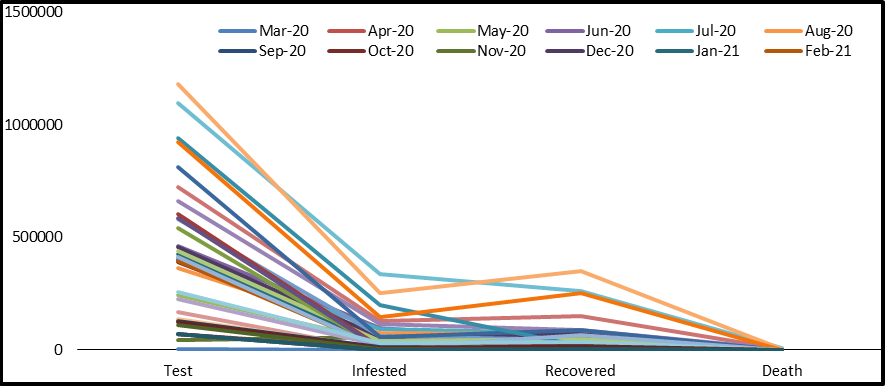
In January 2022, the number of COVID-19 tests, infested, recovered, and deaths were 941836, 199793, 16544, and
284. In February 2022, the number of COVID-19 tests, infested, recovered, and deaths were 922657, 143744, 250422, and 643. In March 2022, the number of COVID-19 tests, infested, recovered, and death were 413302, 7925, 65755, and 84. In April 2022, the number of COVID-19 tests, infested, recovered, and death were 166471, 1114, 14100, and 7. In May 2022, the number of COVID-19 tests, infested, recovered, and death were 130506, 1032, 6613, and 4. In June 2022, the number of COVID-19 tests, infested, recovered, and death were 225463, 20278, 4855, and 18. In July 2022, the number of COVID-19 tests, infested, recovered, and deaths were 254908, 31106, 34033, and 139. In August 2022, the number of COVID-19 tests, infested, recovered, and death were 138957, 6475, 13791, and 32. In September 2022, the number of COVID-19 tests, infested, recovered, and deaths were 125718, 12251, 8768, and 41. In October 2022, the number of COVID-19 tests, infested, recovered, and death were 123485, 9619, 14826, and 55. In November 2022, the number of COVID-19 tests, infested, recovered, and death were 111429, 1621, 5306, and 11. In December 2022, the number of COVID-19 tests, infested, recovered, and death were 70215, 591, 1821, and 7. Similar results were observed by Khan AU, et al. [11] in Bangladesh. This virus has increased the number of cases, infections, recoveries, and deaths. In January 2023, the number of COVID-19 tests, infested, recovered, and death were 69942, 436, 4201, and 0.
Spearman’s Rho Correlation Analysis among Tests, Infections, Recoveries and Deaths of COVID-19
Spearman’s rank-order correlation investigated the association between variables (tests, infections, recoveries, and deaths) in Bangladesh. Variables were determined to have statistically significant correlations. At the 0.01 level in two-tailed analysis, the results demonstrated a positive, moderate to strong correlation between the variables. Tests: The results revealed a moderate relationship between tests and infections (rs=0.811), recoveries (rs=0.711), and deaths (rs=0.668) of COVID-19. Infections: The results revealed a moderate to strong relationship between infections and tests (rs=0.811), recoveries (rs=0.712), and deaths (rs=0.789) of COVID-19. Recoveries: The results revealed a moderate to strong relationship between recoveries and tests (rs=0.711), infections (rs=0.712), and deaths (rs=0.819) of COVID-19. Deaths: The results revealed a moderate to strong relationship between deaths and tests (rs=0.678), infections (rs=0.789), and recoveries (rs=0.819) of COVID-19. Before calculating rs, a visual inspection of the scatterplot of tests, infections, recoveries, and deaths confirmed that the relationship between these variables was non-linear and monotonic.
Similar results were observed by the Spearman correlation. The case study and mortality rated 0.20 and 0.35 and another study also found similar results, and the mean results of Spearman correlation for tests, infections, recoveries, and deaths were 0.31, 0.35, 0.796, and 0.808 in Bangladesh in April [11]. In May and June, a positive correlation was observed between the tests and infections, recoveries, and deaths, and a negative relationship was found between dates and daily tests of COVID-19. Similar results were observed in a study, and the results showed a positive correlation between infections and recoveries and a negative relationship between tests and deaths by COVID-19 in Bangladesh in April 2021 [17]. Similar findings were observed in the positive correlation between infection recoveries and deaths in 2020 [5]. The virus is significantly transmissible, suggesting that the second wave will become even more dispersed in Bangladesh in 2020 and 2021. The total tests (722,848), infections (128,555), recoveries (150,816), and deaths (2237) were counted in April 2021 [18] (Table 2).
| Items | Test | Infested | Recovered | Death |
|---|---|---|---|---|
| Correlation Coefficient | 1 | 0.811** | 0.711** | 0.678** |
| Significance | 0 | 0 | 0 | |
| N | 1061 | |||
| Correlation Coefficient | 0.811** | 1 | 0.712** | 0.789** |
| Significance | 0 | 0 | 0 | |
| N | 1061 | |||
| Correlation Coefficient | 0.711** | 0.712** | 1 | 0.819** |
| Significance | 0 | 0 | 0 | |
| N | 1059 | |||
| Correlation Coefficient | 0.678** | 0.789** | 0.819** | 1 |
| Significance | 0 | 0 | 0 | |
| N | 1061 |
Table 2: Spearman’s rho correlation analysis among tests, infections, recoveries, and deaths of COVID-19 in Bangladesh. (**. Corr
Correlation between Infestation People with Recovered and Death People Since 19 June 2020
A correlation study was done to establish the relationship between the test of people with infested, recovered, and death of people by COVID-19 in Table 3 and Figure 2. In April, a positive correlation was observed in infested and recovered people and a negative relation was found in tests and death by COVID-19 in Bangladesh. It was evident that the positive and negative equations were y=0.2297x-1321.9, 0.2297x- 1321.9, and y= -317.45x+1E+07, y=-0.0019x+132.9 gave a good fit to the data and the coefficient of determination R2= 0.5289, 0.0000006 and 0.2567, 0.3614 fitted regression line had a significant regression coefficient. Similar results were also noted in Bangladesh and the finding was a positive correlation found between infestation with recovered and death by people (R2= 0.4804 and 0.3159; 0.7242 and 0.4902; 0.4432 and 0.3449, p<0.05) in April to June 2020 [17].
| Month | Regression Items | Regression Equation | % Role of Individual Factor | Significant | R2 Value |
|---|---|---|---|---|---|
| 2020 | Tests vs. Infested | y=0.1321x + 14743 | 55.48 | NS | 0.5548 |
| Tests vs. Recovered | y=0.1131x + 11537 | 43.46 | 0.0087 | 0.4346 | |
| Tests vs. Death | y=0.002x + 192.12 | 68.09 | 0.0364 | 0.6809 | |
| 2021 | Tests vs. Infested | y=0.3755x - 164201 | 79.07 | 0 | 0.7907 |
| Tests vs. Recovered | y= 0.406x - 180068 | 86.37 | 0 | 0.8637 | |
| Tests vs. Death | y=0.0075x - 3340.9 | 82.96 | NS | 0.8296 | |
| 2022 | Tests vs. Infested | y=0.2007x - 24321 | 90.26 | NS | 0.9026 |
| Tests vs. Recovered | y=0.1539x - 10080 | 46.26 | 0.0087 | 0.4626 | |
| Tests vs. Death | y=0.0005x - 50.271 | 77.53 | 0.0364 | 0.7753 |
Table 3: The relationships between the infestation of people of COVID-19 with recovery and death of people during the study perio
![Figure 2: In April, a positive correlation was observed in infested and recovered people and a negative relation was found in tests and death by COVID-19 in Bangladesh. It was evident that the positive and negative equations were y=0.2297x-1321.9, 0.2297x- 1321.9, and y= -317.45x+1E+07, y=-0.0019x+132.9 gave a good fit to the data and the coefficient of determination R2= 0.5289, 0.0000006 and 0.2567, 0.3614 fitted regression line had a significant regression coefficient. Similar results were also noted in Bangladesh and the finding was a positive correlation found between infestation with recovered and death by people (R2= 0.4804 and 0.3159; 0.7242 and 0.4902; 0.4432 and 0.3449, p<0.05) in April to June 2020 [17].](/fulltextimages/12446/fig_2.png)
The Paired Test among Test, Infested, Recovered and Death of COVID-19 People in Bangladesh
A paired test study was done to establish the relationship between the test vs infested, recovered, and death, infested vs recovered, death of people by COVID-19 in Table 4. The test vs infested was significant at 0.00 where the mean was 12478.66, the standard deviation was 8602.25, the standard error mean was 264.47, and the t was 47.18. The test vs recovered was significant at 0.01 where the mean was 12517.66, the standard deviation was 9008.45, the standard error mean was 276.95 and the t was 45.20. The test vs death was significant at 0.00 where the mean was 14383.63, the standard deviation was 10787.93, the standard error mean was 331.66, and the t was 43.37. The infested vs recovered was significant at 0.05 where the mean was 39.01, the standard deviation was 2208.35, the standard error mean was 67.89, and the t was 0.58. The infested vs death was significant at 0.00 where the mean was 1904.98, the standard deviation was 2912.42, the standard error mean was 89.54, and the t was 21.28. The recovered vs death was significant at 0.00 where the mean was 1865.97, the standard deviation was 2829.22, the standard error mean was 86.98, and the t was 21.45. Khan AU, et al. [11] observed the number of infections during the COVID-19 outbreak in Bangladesh indicates the spread of the infection. The government takes the necessary steps to develop appropriate policies, such as absolute social isolation. People should avoid going to public places as much as possible in this scenario. It would be inappropriate to go out unless there is an urgent necessity [19].
- Paired Differences
- 95% Confidence Interval of the Difference
- Items t df
- Significance
- Mean
- Std.
- Deviation
- Std. Error
- Mean
- Lower
- Upper
- Test-Infested
- 12478.66
- 8602.25
- 264.47
- 11959.72
- 12997.59
- 47.18
- Test-Recovered
- 12517.66
- 9008.45
- 276.95
- 11974.22
- 13061.11
- 45.2
- 0.01
- Test-Death
- 14383.63
- 10787.93
- 331.66
- 13732.84
- 15034.42
- 43.37
- 0
- Infested-
- Recovered
- 39.01
- 2208.35
- 67.89
- -94.21
- 172.23
- 0.58
- 0.05
- Infested-Death
- 1904.98
- 2912.42
- 89.54
- 1729.28
- 2080.67
- 21.28
- 0
- Recovered-Death
- 1865.97
- 2829.22
- 86.98
- 1695.29
- 2036.64
- 21.45
- 0
Table 4: The Paired Test among test, infested, recovered, and death of COVID-19 people in Bangladesh.
Conclusion
Within a very short time, SARS-CoV-2 spread across Bangladesh and affected sixty-four districts. With the ongoing SARS-CoV-2 infection, the government has taken necessary measures to know the exact results. The governing body of Bangladesh has developed one hundred and eighteen laboratory diagnoses to limit the spread of the disease and effectively treat infected persons. People of Bangladesh have avoided traveling to public places. It was unacceptable to leave the house unless absolutely necessary. To control COVID-19, the government established new megaprojects to help the poor.
References
-
Khan AU, Akter R, Khan FU, Khanom S, Tasnim S, et al. (2022) COVID-19: Increase the Infestation and Death Rate on July-August 2021 in Bangladesh. Qubahan Academic Journal 2(1): 14-23.
-
Khan AU, Khan AU, Afsana AS (2021) Information about the COVID-19 in Bangladesh. International Conference on Social Sciences Business Management and Education, Philippines 1(2): 13.
-
Khan AU, Proma AA, Akter M, Rahaman MM, Das S (2020) A Review on Coronavirus Disease (COVID-19) Epidemic Threat for Global Health in 2020. American Journal of Microbiological Research 8(2): 57-62.
-
Khan AU, Khan AU (2020) The Impact of COVID-19 Pandemic Threat on Agriculture Sector. Proceeding of 8th International Conference of Biotechnology, Environment and Engineering Sciences, Sweden, pp: 15.
-
Khan AU, Khan FU, Khanom S, Khan AU (2020) Novel Coronavirus Disease (COVID-19): Pandemic Situation in Bangladesh. Nujs Journal of Regulatory Studies 5(2): 1-10.
-
Khan AU, Akter R, Khan FU, Khanom S, Das B, et al. (2022) Comorbidities, Infections, and Mortalities of COVID-19 in Bangladesh During May-June 2021. International Journal of Infection 9(2): e118083.
-
Farooq S, Ngaini Z (2020) Natural and Synthetic Drugs as Potential Treatment for Coronavirus Disease 2019 (COVID 2019). Chemistry Africa 4: 1-13.
-
Alanagreh L, Alzoughool F, Atoum M (2020) The Human Coronavirus Disease COVID-19: Its Origin, Characteristics, and Insights into Potential Drugs and Its Mechanisms. Pathogens 9(5): 331.
-
WHO (World Health Organization) (2020) Coronavirus (COVID-19) events as they happen.
-
Khan AU, Khan AU, Roy R, Uddin M, Noreen S, et al. (2022) A Review on the Positive and Negative Effects of COVID-19 in the Human Life and Environment. Azerbaijan Medical Journal 62(6): 4181-4202.
-
MHFWD (Ministry of Health and Family Welfare and Directorate of Health Studies) (2020) Bangladesh Health Observatory.
-
IEDCR (Institute of Epidemiology Disease Control and Research) (2020) Coronavirus Disease 2019 (COVID-19) Information Bangladesh.
-
DGHS (Dashboard of Directorate General of Health Services) (2020) The Government Republic of Bangladesh.
-
CCD (Coronavirus COVID-19 Dashboard) (2020)
-
Khan AU, Akter R, Khan FU, Khanom S, Khan AU, et al. (2021) Second Wave and Pandemic Situation of COVID-(2020-2021) in Bangladesh. Qubahan Academic Journal 1(4): 25-31.
-
Khan AU, Noreen S, Tasnim S, Khan AU, Pane YS (2022) Design Telemedical Systems in Control of Pandemics Like COVID-19. In: Mittal M, et al. (Eds), Information and Communication Technology (ICT) Frameworks in Telehealth, TELe-Health, Springer, Chem pp: 145-158.
-
Khan AU, Khan FU, Khanom S, Khan AU, Afsana AS (2020) COVID-19 Pandemic Situation in Bangladesh. International Conference on Multidisciplinary Industry and Academic Research (ICMIAR), Candelaria, Philippine 1(1): 24.
-
Iacobucci G (2021) Covid-19: Outcomes Worsened in Second Wave for Pakistanis and Bangladeshis in England. BMJ 372: n572.
-
Simeon JO, Tosin JO, Ibukun FT, Ogwuche OJ, Daniel MF, et al. (2021) Effect of the Demographic of Covid-19 on Different Countries; Using the USA for Comparism. International Journal of Multidisciplinary Research and Analysis 4(2): 193-201.
- Teaching Cognitive Behavioral Therapy to Graduate Psychiatric Mental Health Nurse Practitioner Students: Utilizing A Mixed Methods Course Evaluation
- The Role of Pharmacogenetic Testing in Clinical Practice: A Path toward more Effective, Personalized and Cost-effective Care
- Implementing Screening with the GAD-7 in an Outpatient Mental Health Setting: A Quality Improvement Project
- Social Media and Health Promotion
- Impact of Covid-19 Pandemic on the Academic Performance and Attitude of Nursing Students towards E-Learning
- A Study to Assess the Knowledge Regarding Ill Effects of Tobacco Consumption on Health among Adolescents in Selected Higher Secondary School in Nadiad City