
Effectiveness of Jigsaw Learning Strategy on Administration of Pediatric Medications among 3rd Year BSc Nursing Students Posted in Pediatric Wards at Selected Hospital, Mysuru
Background: Patient safety and quality care are issues of major concern worldwide and are significant challenges facing healthcare systems, clinical practice and Nursing education. Administering medications to children is a unique challenge requiring specialized knowledge and skills. Each child’s age, background and level of physical and psychosocial development must be considered. Children are at increased risk of medication errors. This is due to a combination of factors including the need for calculation to be performed at all stages of the process. Reducing medication errors and increasing patient safety has recently become a really critical issue in nursing. Improving medication administration skills of nursing students takes an important place in nursing education systems too. Objectives: To evaluate the effectiveness of Jigsaw Learning strategy on knowledge regarding administration of pediatric medications among 3rd year BSc Nursing students posted in pediatric wards at selected hospital, Mysuru, Karnataka. Methodology: A pre-experimental design and evaluative approach was used in the study. The data was collected from 50 subjects through simple random sampling technique. Data was collected using structured questionnaire. Results: Findings of the study concluded that majority 31 (62%) of the subjects had moderately adequate knowledge and 19 (38%) of the subjects had inadequate knowledge regarding administration of pediatric medications in the pre-test. Where as in post-test, majority 45 (90%) of them had adequate knowledge and 5 (10%) of them had moderately adequate knowledge. Hence the study concluded that, the Jigsaw learning strategy was effective in enhancing knowledge regarding medication administration among 3rd year BSc Nursing students. Therefore, the study reinforces the need to organize health campaigns and teaching programs which sensitize the 3rd year BSc Nursing students to enhance the knowledge regarding administration of pediatric medications among 3rd year BSc Nursing students. Conclusion: Findings of the study show that there was a significant difference in pre-test and post-test level of knowledge of 3rd year BSc Nursing students posted in pediatric wards. Hence it is concluded that the Jigsaw Learning strategy is effective in improving the level of knowledge of 3rd year BSc Nursing students posted in pediatric wards. There was no significant association between level of knowledge of 3rd year BSc Nursing students posted in pediatric wards and selected demographic variables such as Age, gender, type of family, source of information and religion.
Introduction
Administering medications to children is a unique challenge requiring specialized knowledge and skills. Children are at increased risk of medication errors. This is due to a combination of factors including the need for calculation to be performed at all stages of the process. Calculation is required in the prescribing, dispensing, and administration of medicine because drug doses tend to vary with the age and weight of the child. The lack of suitable dosage formulation also means that it is necessary to use vial, tablets and liquid that have been designed for adults [1].
Errors can also be generated because children and their carer tend to remember doses in millilitres rather than microgram or liquid may be available in a variety of strength. It is the responsibility of the nurse to calculate and administer medication. So the nurse should have thorough knowledge in the medicine administration to children [2].
Medication error is defined as any preventable event that may lead to inappropriate medication use or patient harm while the medication is in the control of the health- care professional or patient. Such events may be related to professional practice, health-care products, procedures, and systems, including prescribing, order communication, product labelling, compounding, dispensing, administration, monitoring, and use [3].
There are different factors that contribute to the occurrence of medication errors in pediatrics such as ignorance and lack of proper training among professionals, the use of abbreviations in prescriptions, illegible prescriptions, fatigue among professionals, inconsistencies in different formulations of drugs available, language barriers and the lack of good communication skills are some of the major factors that lead to medication errors [4].
Nurses have a unique role and responsibility in administration of medication and they are the final persons to check, to see that the medication is correctly prescribed and dispensed before administration. Administration of the medication is the most important Nursing responsibility [5].
Cooperative learning is the greatest innovation in education. In this, students learn within small groups with a common aim to be fulfilled by discussing and cooperating with their peers. In this way each student is responsible for learning of his own along with all the group members. The Jigsaw method helps the students to learn effectively in a cooperative environment. As students work together in a group, Jigsaw encourages development of basic skills like listening and Empathy amongst the students. The Jigsaw process requires equal contribution in academic activity from each member of the group. Thus one succeeds when the group succeeds [6].
Research findings warn that more than half of life -threatening errors is related to rapid infusion of high alert medication. Nurse’s insufficient drug calculation skills contribute to 1.5 to 4.9 % of error rare in infusion preparation task [7]. Research has demonstrated that an educational program can raise nurse’s awareness about medication errors and other medication related safety issues. Patient safety is increasingly recognized as essential in the practice of Nursing and medical profession. Patient in paediatric intensive care unit require high intensity care and may be at high risk for iatrogenic injury. Individual have right to safe and effective quality health care [8].
A prospective observational study was conducted to assess medication error and its contributing factors among pediatric patients diagnosed with infectious diseases admitted to Jimma University Medical Center. The patient’s written informed consent was obtained after explaining the purpose of the study. Findings showed that out of 325 study participants, 136 (41.8%) patients had at least one medication error during their hospital stay. A total of 273 medication errors were identified among 136 patients. Medication errors frequently occurred at prescribing stage 94 (34.4%). The most common types of medication errors were wrong dosing 72 (26.4%) and wrong frequency 47 (17.2%). Presence of disease comorbidity, being male and presence of two infectious diseases and more than three infectious diseases were independent predictors of medication error occurrence [9].
Nurse must know proper diluents of each drug and they should be expert in calculating the dose of medication to prevent errors. Each nurse should be aware of indication, action, contraindication, adverse reaction and interactions of drugs to prevent errors. The investigator’s experience in pediatric wards showed that the newly joined nurses have inadequate knowledge about the action of various drugs with changing dosage. Also there is always a chance for administration errors during prescribing and diluting the medication. Hence the investigator planned to conduct an innovative teaching as Jigsaw learning strategy to enhance the student nurses knowledge on administration of pediatric medication.
Statement of the Problem
A study to assess the effectiveness of Jigsaw Learning Strategy on administration of pediatric medications among 3rd year BSc Nursing students posted in pediatric wards at selected hospital, Mysuru.
Objectives of the Study
1. To assess the knowledge regarding administration of pediatric medications among 3rd year BSc Nursing students posted in pediatric wards at a selected hospital of Mysuru.
2. To determine effectiveness of jigsaw learning strategy on knowledge regarding administration of pediatric medications among 3rd year BSc Nursing students posted in pediatric wards at a selected hospital of Mysuru.
3. To find the association between level of knowledge regarding administration of pediatric medications among 3rd year BSc Nursing students posted in pediatric wards and their selected personal variables.
Hypotheses
H1: There will be significant difference between pre-test and post-test knowledge cores regarding administration of pediatric medications among 3rd year BSc Nursing students.
H2: There will be a significant association between the level of knowledge of 3rd year BSc Nursing students regarding administration of pediatric medication and their personal selected variables.
Operational Definitions
Jigsaw Learning Strategy: refers to a method of teaching and learning though organizing the 3rd year BSc Nursing students into even groups and assigning the reading material or content on administration of paediatric medications to groups in which students need to read and discusses in their groups and must be able to explain to other groups. Then combine the knowledge through mixing of groups through discussion, comments and asking questions and group members can return to their groups after discussion. Assessment will be done through quiz, assignment and discussion.
Knowledge: refers to the correct responses of the 3rd year BSc Nursing students to the items included in the structured knowledge questionnaire regarding administration of paediatric medications and expressed in terms of knowledge scores.
Administration of Paediatric Medications: It refers to administering the medications to children for treatment of illness.
Materials and Methods
Research Approach
Evaluative approach Research Design
A pre-experimental design and evaluative approach with one group pre-test post-test design
Research Setting
The present study was undertaken in JSS Hospital, Mysuru.
Sample
3rd year BSc Nursing students posted in pediatric wards in selected hospitals in Mysuru.
Sample Size: 50, 3rd year BSc Nursing students posted in pediatric wards.
Sampling Technique: Simple random sampling technique.
Sampling Criteria
- Inclusion Criteria 3rd year BSc Nursing students who are
- Posted in pediatric wards
- Willing to participate in the study
- Exclusion Criteria
- 3rd year BSc Nursing students who are not available during the time of data collection.
Data Collection Procedure
Part-I
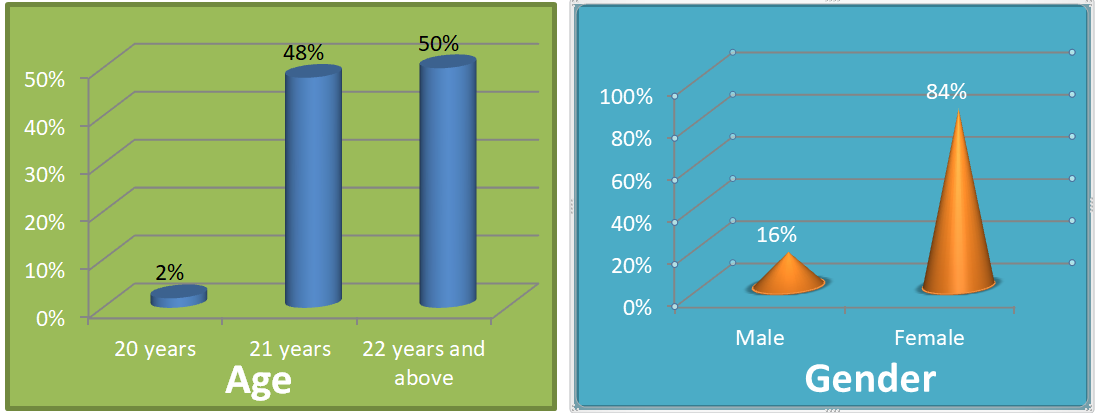
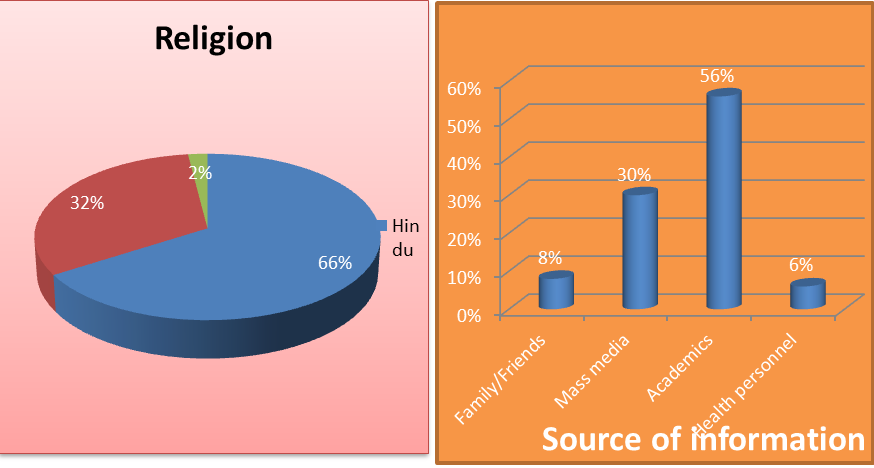
Demographic Data: This section consisted of 5 items seeking personal information (Table 1) such as Age, gender, type of family, source of information and religion (Figures 1 & 2).
Part-II
Knowledge Questionnaires: The knowledge questionnaires consisted of 30 items on knowledge (Table 2) regarding General information on administration of pediatric medications.
Adequate knowledge: > 75 % (23-30) Moderately adequate: 50-75 % (16-22) Inadequate adequate: less than 50 % (less than 15)
Results
| Sl. No | Sample characteristics | Frequency (f) | Percentage (%) |
|---|---|---|---|
| 1. | Age | ||
| 20 years | 1 | 2 | |
| 21 years | 24 | 48 | |
| 22 years and above | 25 | 50 | |
| 2. | Gender | ||
| Male | 14 | 28 | |
| Female | 36 | 72 | |
| 3. | Type of family | ||
| Nuclear family | 45 | 90 | |
| Joint family | 5 | 10 | |
| 4. | Source of information | ||
| Family/Friends | 4 | 8 | |
| Mass media | 15 | 30 | |
| Academics | 28 | 56 | |
| Health personnel | 3 | 6 | |
| 5. | Religion | ||
| Hindu | 16 | 32 | |
| Christian | 33 | 66 | |
| Muslim | 1 | 2 |
Table 1: Frequency and Percentage Distribution of 3rdyear BSc nursing students according to their selected personal variables (n
| Knowledge level | Pre-test f (%) | Post-test f (%) |
|---|---|---|
| Inadequate knowledge(0-15) | 19 (38%) | 0 |
| Moderately adequate knowledge(16-22) | 31 (62%) | 5 (10%) |
| Adequate knowledge(23-30) | 0 | 45 (90%) |
Table 2: Frequency and percentage distribution of level of knowledge of 3rd year BSc Nursing students according to their pre- tes
| Test | Mean | Median | Range | SD |
|---|---|---|---|---|
| Pre test | 15.6 | 17 | Sep-20 | 3.201 |
| Post test | 26.22 | 27 | 20-30 | 2.558 |
Table 3: Mean, Median, Standard deviation and Range of pre-test and post-test knowledge score of 3rd year BSc Nursing students (n
| Knowledge scores | Mean | Mean Difference | S.D. Difference | Standard Error | Paired ‘t’ test Value |
|---|---|---|---|---|---|
| Pre-test | 15.6 | 10.62 | ±3.714 | 0.525 | 20.221* |
| Post-test | 26.22 |
Table 4: Mean, mean difference, standard deviation difference, standard error and paired‘t’ value of pre-test and post-test knowl
t(49)=1.671; p<0.05* significant. Table 4: Mean, mean difference, standard deviation difference, standard error and paired‘t’ value of pre-test and post-test knowledge scores of 3rd year BSc Nursing students (n=50).
The data revealed that mean difference between knowledge pre-test score and post test score is 10.62. To find the significant difference in mean knowledge scores, a paired‘t’ test (Table 4) was computed and obtained value of paired‘t’= 20.221, p<0.05 is found to be significant. Hence the null hypothesis is not accepted. It is inferred that there is significant improvement of knowledge after Jigsaw Learning strategy. Findings of the study were similar to the study which revealed that there was a significant difference between the mean pre-test score (69.5%) and the mean post test score (87.3%) which is concluded that there was improvement in nurses’ knowledge regarding the use of emergency medication in pediatric intensive care units.
| Sl. No. | Sample Characteristics | Inadequate knowledge | Moderate knowledge | Chi Square value |
|---|---|---|---|---|
| 1. | Age in years | |||
| 20-21 years | 13 | 12 | 4.160* # | |
| 22 years and above | 6 | 19 | ||
| 2 | Gender | |||
| Male | 2 | 12 | 4.641* | |
| Female | 17 | 19 | ||
| 3 | Type of family | |||
| Nuclear family | 18 | 27 | 0.764 | |
| Joint family | 1 | 4 | ||
| 4 | Source of information | |||
| Family/Mass media/ Health personnel | 11 | 11 | 2.401# | |
| Academics | 8 | 20 | ||
| 5 | Religion | |||
| Hindu | 6 | 10 | 0.002# | |
| Christian and Muslim | 13 | 21 |
Table 5: Chi-square values between level of knowledge of 3rd year BSc Nursing students and their selected personal variables (n=
χ2 (1)=3.84; p>0.05, p<0.05 *- significant, # = Yates correction. Table 5: Chi-square values between level of knowledge of 3rd year BSc Nursing students and their selected personal variables (n= 50).
Chi square test was computed and the data depicted that, there was no statistically significant association between the level of knowledge of the 3rd year BSc Nursing students with their selected personal variables except their age and gender (Table 5). The findings of the study were similar with the study which revealed that there was a statistically significant association between nurses’ sex and qualification and their practice regarding medication administration.
Conclusion
The study concluded that, the Jigsaw Learning strategy was effective in enhancing knowledge regarding administration of pediatric medications among 3rd year BSc Nursing students. Therefore, the study reinforces the need to organize health campaigns and teaching programs which sensitize the 3rd year BSc Nursing students to enhance the knowledge regarding administration of pediatric medications among 3rd year BSc Nursing students.
Acknowledgement
We express our deepest gratitude to authority of JSS Hospital Mysuru and JSS College of Nursing Mysuru, providing the permission for conducting the study. Sincere thanks to all the participants for their cooperation in the study. Also we are grateful to ethical committee of JSS Academy of Higher education for providing ethical clearance to conduct the study among 3Rd year Bsc. Nursing Students posted in pediatric ward.
References
-
Commission A (2001) A Spoonful of Sugar: Medicines Management in NHS Hospitals. London Audit Commission.
-
Hughes RG, Edgerton EA (2005) Reducing Pediatric Medication Errors Children are Especially at Risk for Medication Errors. Am J Nurs 105(5): 79-80.
-
Nair VS (2011) A Study to Assess the Knowledge of Nurses about the Pediatric Medicine Administration in Congenital Heart Intensive Care Unit.
-
(2005) National Coordinating Council for Medication Error Reporting and Prevention. The PSNet Collection.
-
Giacoia GP, Zapata P, Mattison D (2007) Need for Appropriate Formulations for Children the National Institute of Child Health and Human Development Pediatric Formulations Initiative. Int J Pharm Compd 11(1): 5-8.
-
Slight SP, Howard R, Ghaleb M, Barber N, Franklin BD, et al. (2013) The Causes of Prescribing Errors in English General Practices. Br J Gen Pract 63(615): e713-20.
-
Wilmer A, Louie K, Dodek P, Wong H, Ayas N (2010) Incidence of Medication Errors and Adverse Drug Events in the ICU: A Systematic Review. Qual Saf Health Care 19(5): e7.
-
Elliott M, Liu Y (2010) The Nine Rights of Medication Administration an Overview. Br J Nurs 19(5): 300-305.
-
Simones J, Neal DO, Schug V, Blazovich LM, Cynthia P, et al. (2014) Student Nurses Thinking During Medication Administration. Journal of Nursing Education and Practice 4(11): 136.
- Teaching Cognitive Behavioral Therapy to Graduate Psychiatric Mental Health Nurse Practitioner Students: Utilizing A Mixed Methods Course Evaluation
- The Role of Pharmacogenetic Testing in Clinical Practice: A Path toward more Effective, Personalized and Cost-effective Care
- Implementing Screening with the GAD-7 in an Outpatient Mental Health Setting: A Quality Improvement Project
- Social Media and Health Promotion
- Impact of Covid-19 Pandemic on the Academic Performance and Attitude of Nursing Students towards E-Learning
- A Study to Assess the Knowledge Regarding Ill Effects of Tobacco Consumption on Health among Adolescents in Selected Higher Secondary School in Nadiad City