
Homogeneous Anodic and Cathodic Ions on Battery Performance
This paper proposes a novel battery with zinc oxalate (ZnC2O4) electrode exhibiting superior charging and rechargeable characteristics compared to an original zinc-carbon battery. ZnC2O4 electrode provides homogeneous anodic Zn+2 and catholic C2O4 -2 ions. The effect of adding different percentages of ZnC2O4 on the charging voltage and current are investigated. The possibility of achieving charging and discharging recycles in the cell electrolyte are studied. The electrode ZnC2O4 was prepared by the sol-gel method. Based on the voltage, current, and energy calculations, it concludes that adding different percentages of ZnC2O4 to the battery electrolyte have different effects on the internal resistance of the battery.
Introduction
A zinc-carbon battery is one of the most simple and cheap commercially used batteries. This battery was developed from Leclanche cells [1]. The battery reaction mainly involves redox processes. The anode of this battery is a zinc can, and the cathode is a carbon rod (graphite rod), but the carbon rod is an inert electrode, acting only as an electron path. The part between the two electrodes is filled with ammonium chloride (NH4Cl) for the electrolyte, manganese dioxide (MnO2), zinc chloride (ZnCl2) saturated solution, and some inert paint wet paste. When the electrode is connected, the zinc anode is oxidized to lose electrons. The lost electrons travel through the wires to the cathode, reducing NH4 + ions from NH4Cl to NH3 and thus forming hydrogen. The released hydrogen is then oxidized by MnO2, while the NH3 is utilized to form the complex Zn (NH3)2Cl2. The overall reaction within the battery could be expressed as follows. 2MnO2(s) + 2NH4Cl(aq) + Zn(s) → Zn(NH3)2Cl2 + Mn2O3(s) + H2O(l) (1) A battery described in a previous study involves the application of gel electrolytes for increased capacity [2]. As the zinc shell becomes thinner over time, the paste cause leaks in the battery. When the zinc-carbon battery power is exhausted, it must be discarded because it is difficult to reuse. This is mainly because the standard reduction potential of zinc ions is smaller than the hydrogen electrode standard reduction potential. When the negative voltage is applied, the hydrogen ions are reduced to hydrogen before electrons are accepted from the zinc ions.
Rechargeable batteries are also referred to as secondary batteries; that is, they can be reused after being discharged. The current rechargeable battery types include lead-acid batteries, nickel-metal hydride batteries, nickel-cadmium batteries, and lithium batteries. Rechargeable batteries can be prepared by various methods. For example, rechargeable batteries can be used with aqueous electrolytes [3]. Rechargeable MnO2/zinc batteries can be prepared with an alkaline electrolyte [4]. This can be explained using models of the cathode and anode processes during cycling. The Zn/ZnCl2 dry battery can be made to be rechargeable by changing the electrode composition [5, 6, 7]. The capacity of the battery depends on the composition of the cathode material. The recharge cycles can be improved by adding a surface-active agent to the electrolyte solution. The electrode can be modified and used for the lithium secondary battery [8].
Purpose of this Work
A zinc-carbon battery offers long-term use and is rather cheap. This battery’s power cannot be improved, and it cannot be used as a secondary battery. This work examined the addition of oxalate materials to the battery in order to alter its discharge characteristics. Furthermore, the study attempts to increase the stored energy density and also examined the charge and discharge cycle in order to determine the feasibility of recharging the battery.
Experimental Details
In this study, zinc oxalate (ZnC2O4) was prepared by the sol-gel method. The morphology of the synthesized ZnC2O4 was observed by scanning electron microscopy, and the structure of ZnC2O4 was characterized by X-ray diffraction. ZnC2O4 at 0 wt.%, 1 wt.%, 5 wt.%, 10 wt.%, 25 wt.%, and 75 wt.% was added to the original battery, and the discharging and charging recycle experiments were then carried out. The electrolyte was dried and weighed to be approximately 52.05 g. The electrolyte and ZnC2O4 were ground for 10 min. This was mixed with the electrolytic solution and ZnC2O4. The porous diaphragm, graphite rod, and ZnC2O4 electrolyte mixture were then packed into the battery can. The graphite rod was placed in the middle of the zinc can, and pure water was then added. The metal cap and the negative metal sheet were then restored, and a sealed plastic tape was used instead of the plastic layer in order to fix the battery parts firmly.
The setup of the discharge experiment and the hardware structure of the charge and discharge cycle experiment are described as follows. There were three components to use, for example, switches, resistors, and wires for the discharge circuit. The discharge tests were carried out at loads of 4 and 20 Ω. The current was measured after 10 mins of the discharge connection, and the battery voltage was measured after 150 sec after short of the recharging. This cycle study selected 0% and 5% of zinc oxalate batteries to carry out the charge and discharge cycle. The voltage was measured after 10 mins of the discharge test, and measured after charging 1 hr. The experiments repeated charge and discharge test for 10 times.
Results and Discussion
Figure 1(a) shows a scanning electron microscopy image of ZnC2O4. ZnC2O4 normally exhibits an elongated tetrahedral geometry with a basic structure (i.e., α-ZnC2O4) [1]. The crystal form of α-ZnC2O4 is triclinic, and the adjacent metal ions are linked in a one-dimensional chain structure, but the interchain is linked in a three- dimensional network structure through hydrogen bonding. The octahedral structure through zinc cobonding is the optimal place for the insertion of impurities. Figure 1(b) shows an X-ray diffraction spectrum of ZnC2O4, revealing the structure of α-ZnC2O4. The powder was determined to be white and to be slightly soluble in water.
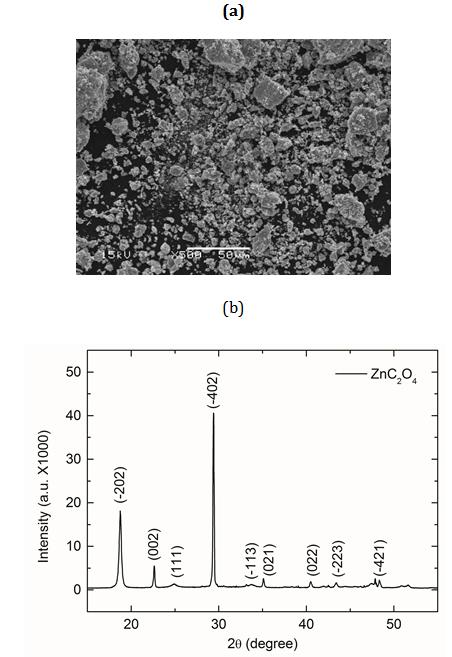
Figure 2(a) shows the discharge curves of the 4 Ω load with respect to time. For the 4 Ω load, the voltages decreased with time for 0 wt.% ZnC2O4. For 1 wt.% ZnC2O4, the voltage was higher than that in the case of 0wt.% ZnC2O4. The charge voltage was lower than 1.38 V, and it was the higher than that of the prototype after approximately 100 min. For 5–10 wt.% ZnC2O4, the same tendency as that for the 0 wt.% ZnC2O4 was observed. The overall voltages tended to decrease for 25 and 75 wt.% ZnC2O4. For the 20 Ω load, as shown in Figure 2(b), the voltage was higher than that in the case of the 4 Ω load. The voltage for 0 wt.% ZnC2O4 decreased with the time. The voltages for 1 and 5 wt.% ZnC2O4 decreased slowly as compared with that for 0 wt.% ZnC2O4, whereas those for 10 and 75 wt.% ZnC2O4 mostly decreased with increasing time. The results for 25 wt.% ZnC2O4 were the same as those for 0 wt.% ZnC2O4. In general, discharge tendencies for ZnC2O4 additions lower than 10 wt.% were determined to be quite similar.
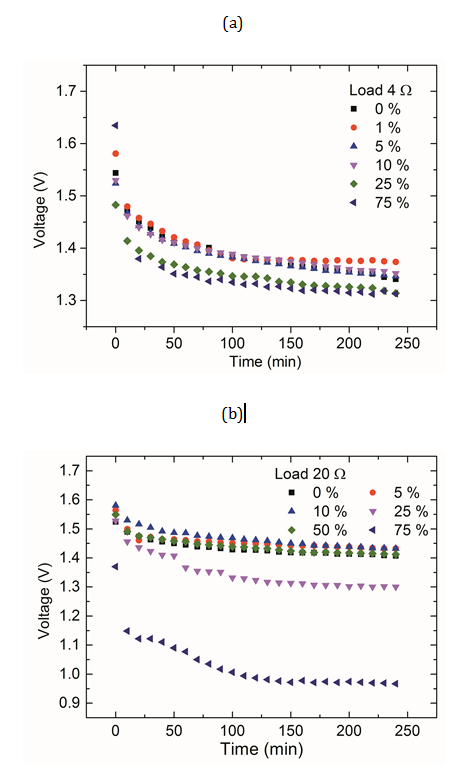
Figure 3 illustrates a graph of the discharge current versus time at the two loads. At the 4 Ω load, for 0 wt.% ZnC2O4, the current decreased with time and was significantly reduced. The battery current for 1 wt.% ZnC2O4 was largely reduced. The battery current for 5 wt.% ZnC2O4 was the largest, followed by those for 0, 10, and 25 wt.% ZnC2O4. At the 20 Ω load, the current generally slightly increased and remained constant or decreased. The current for the 0 wt.% ZnC2O4 battery was the largest. The currents for the 1 and 25 wt.% ZnC2O4 batteries were largely reduced, followed by those for the 5, 10, and 75 wt.% ZnC2O4 batteries. Clearly, as the load increased, the current decreased. The variation in the currents could be the result of the variation in internal resistance with the amounts of ZnC2O4. Dissolving a small amount of ZnC2O4 in water could increase the conductivity until equilibrium. Subsequently added ZnC2O4 would dissolve and remain as solids, causing an increase in the resistivity.
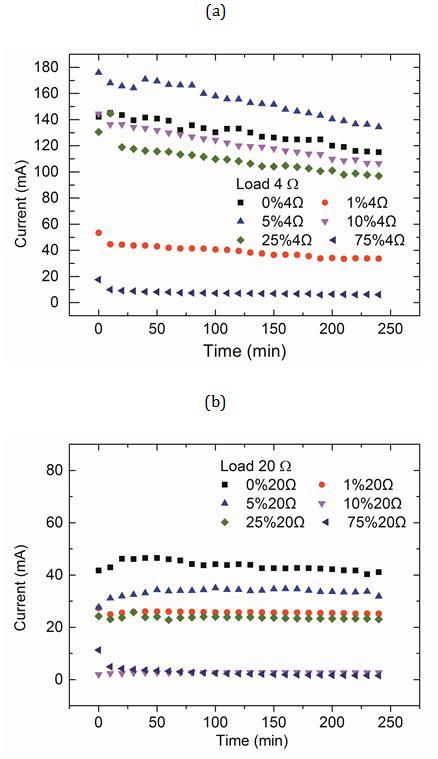
Figure 4 shows the relationship between voltage and time for charge and discharge cycles of 0 and 5 wt.% ZnC2O4 batteries; in this figure, the high point (red dot) is the voltage at which the charge is completed, and the low point (black dot) is the voltage at which the discharge is completed. For 0 wt.% ZnC2O4, the charge and discharge voltage averaged at approximately 1.45 V, whereas for 5 wt.% ZnC2O4, the charge and discharge voltage was nearly 0.05 V higher on average, indicating that 5 wt.% ZnC2O4 could increase the charge. This means that ZnC2O4 could increase the voltage level. The discharge cycle was slightly lower at a lower voltage, indicating a slight increase in the discharge rate. Thus, the addition of ZnC2O4 can increase the battery cycle life.
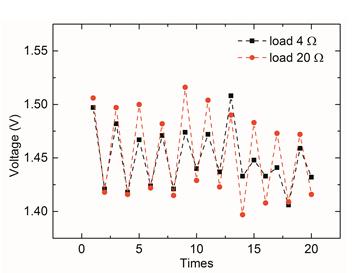
Figure 4: Relationship between voltage and time for the 0 and 5 wt.% ZnC2O4 batteries. Figure 5 shows the relationship between power and time. The formula of voltage (V) × current (mA) yields power (mW) with respect to time (min). For the 4 Ω load, the experimental results showed that the power of the 0 wt.% ZnC2O4 battery was lower than that of the 5 wt.% ZnC2O4 battery. The power of the 5 wt.% ZnC2O4 battery was the highest. The power levels of the 10, 25, and 75 wt.% ZnC2O4 batteries decreased with the amount of ZnC2O4 added. The power of the 1 wt.% ZnC2O4 battery also decreased and was higher than only that of the 75 wt.% ZnC2O4 battery. For the 20 Ω load, the experimental results revealed that the power decreased with the addition of ZnC2O4, except for the 1 and 10 wt.% ZnC2O4 batteries. The power of the 1 wt.% ZnC2O4 battery was higher than only that of the 25 wt.% ZnC2O4 battery. Furthermore, the power of the 10 wt.% ZnC2O4 battery was similar to that of the 75 wt.% ZnC2O4 battery.
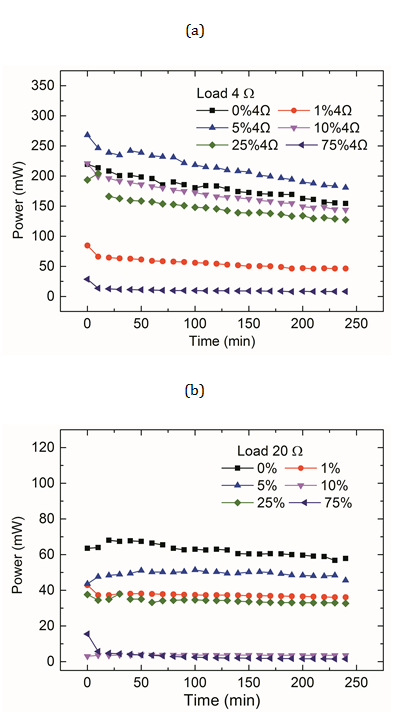
Figure 5: Relationship between power (mW) and time (min) for various weight percentages of ZnC2O4 under loads of (a) 4 Ω and (b) 20 Ω. Figure 6 illustrates the energy (J/hr) persisted after 240 min with the addition of different weight percentages of ZnC2O4. For the 4 Ω load, the 0 wt.% ZnC2O4 battery had an energy of approximately 650 J/hr after 240 min. The 1 wt.% ZnC2O4 battery exhausted energy to a higher extent than did the 0 wt.% ZnC2O4 battery. By contrast, the 5 wt.% ZnC2O4 battery had higher energy than the other batteries. The 10 wt.% ZnC2O4 battery had lower energy than the 5 wt.% ZnC2O4 battery. The 25 wt.% ZnC2O4 battery also had lower energy than the 5 wt.% ZnC2O4 battery. The 75 wt.% ZnC2O4 battery had the lowest energy. This means that the internal resistance plays an important role in the retained energy. For the 10 Ω load, the 5 wt.% ZnC2O4 battery had only slightly lower energy than that of the 0 wt.% ZnC2O4 battery. This trend is similar to that observed in the case of the 20 Ω load.
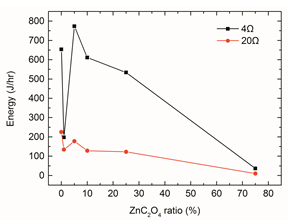
The preceding experimental results demonstrate that the internal resistance plays a critical role in the oxalate battery performance. The 0 wt.% ZnC2O4 battery provided the reference energy level. The addition of 1 wt.% ZnC2O4 reduced the battery resistance since ZnC2O4 could dissolve in water until the dissolution limit was reached. Next, the addition of 5 wt.% ZnC2O4 crossed the maximum solubility and therefore increased the internal resistance. Subsequently, the addition of ZnC2O4 increased the internal resistance and caused more energy exhaustion. The 5 wt.% ZnC2O4 battery showed a similar discharge curve. This means that the internal resistance is quite similar to that of the zinc-carbon battery.
The high signals of the oxalate battery indicate that the battery had high capacity. This is attributable to the oxidation reaction at the anode. The voltage of this battery was observed to increase with the addition of ZnC2O4. ZnC2O4 is an open-structured substance that is slightly soluble in water. The ZnC2O4 reaction at the anode can be expressed by the following equation:
ZnC2O4→ Zn2++C2O42- (2)
The reduction reaction at the cathode could decompose ZnC2O4 into ions. The dissolved ZnC2O4 involve in the reaction at both of anode and cathode. The hydrogen could be dissolved in water and transported to the oxalate ion to form oxalate, according to the following reaction:
C2O4-2+2H+(aq)→ H2C2O4 (3) This gives the battery its rechargeable characteristic. In this study, 10 runs of the recycle test were carried out.
This demonstrates that the ZnC2O4 battery can function under multiple recharge and charge cycles.
Conclusions
This study was conducted to clarify the effect of adding different weight percentages of ZnC2O4 on the charging voltage and current of a novel ZnC2O4 battery. The rechargeability of the ZnC2O4 battery was also discussed. The voltage and current during charge varied with the amount of ZnC2O4 based on the internal resistance. The experiments revealed that the optimum ZnC2O4 addition amount was 5 wt.%, when compared with the 0 wt.% ZnC2O4 battery. The discharge trend demonstrated the long life of the ZnC2O4 battery. The ZnC2O4 batteries with other weight percentages exhibited lower performance levels than that of the 5 wt.% ZnC2O4 battery. The high voltage of the ZnC2O4 battery indicate the high capacity. In the recharge test, small addition of ZnC2O4 (e.g., 5 wt.%) could improve the rechargeability of the ZnC2O4 battery.
Conflicts of Interest
There is no conflict of interest
References
-
Dell RM (2000) Batteries fifty years of materials development. Solid State Ionics 134(1-2): 139-158.
-
Khalid NH, Baba Isnail YM, Mohamad AA (2008) ZnCl2- and NH4Cl-hydroponics gel electrolytes for zinc-carbon batteries. Journal of Power Sources 176(1): 393-395.
-
Beck F, Rüetschi P (2000) Rechargeable batteries with aqueous electrolytes. Electrocimica Acta 45(15- 16): 2467-2482.
-
Kordesh K, Weissenbacher M (1994) Rechargeable alkaline manganese dioxide/zinc batteries. Journal of Power Sources 51(1–2): 61-78.
-
Shaolin M, Jinhai Y, Wang Y (1993) A rechargeable Zn/ZnCl2, NH4Cl/polyaniline/carbon dry battery. Journal of Power Sources 45(2): 153-159.
-
Trinidad F, Montemayor MC, Fatás E (1991) Performance Study of Zn/ZnCl2, NH4Cl/Polyaniline/Carbon Battery. J Electrochem Soc 138(11): 3186-3189.
-
Mirmohseni R, Solhjo (2003) Preparation and characterization of aqeous polyaniline battery using a modified polyaniline electrode. European Ploymer Journal 39(2): 219-223.
-
Lee YS, Kumada N, Yoshio M (2001) Synthesis and characterization of lithium aluminum-doped spinel (LiAlxMn2-xO4) for lithium secondary battery. Journal of Power Sources 96(2): 376-384.
- Solution-Processed Chiral Perovskites for Biomedical Applications
- Nanotechnology in Health Chemistry and Medicine: Current Challenges and Future Directions
- Human Exposure to Micro- and Nanoplastics: Pathways, Toxicity, and Intervention Strategies
- Exosome Nanomedicine for Cancer Therapy
- Micro and Nanoplastics–Plastisphere, Biotoxicity, Impact on Human Health, and Mitigation Strategies
- Process Validation of Cefixime Powder for Suspension Dosage Form, 50 mL