
Approaches for the Synthesis of Nanomaterials, Historical Development and Applications in Different Sectors: A Review
Nanomaterials are a class of biomaterials with at least one dimension in the nanoscale, which is between 1 and 100 nanometers. Nanomaterials (NMs) are divided into many categories based on size, composition, capping agents, form, and origin. Nanomaterials will support a variety of industries, and their applications will lead to the development of lighter, stronger, and cleaner materials and intelligent medications. This study aims to provide a comprehensive overview of distinct nanomaterials, their history, approaches for the synthesis of nanomaterials, and their applications in different fields. In addition, this study also summarizes the environmental impact, so that this research could become the torchbearer for futuristic researchers working in this area.
Introduction
Due to its enormous potential for use in a variety of fields, including healthcare, the environment, agriculture, and energy, nanotechnology has emerged as one of the most important fields for researchers in biochemistry, biotechnology, chemistry, physics, and electronics [1]. These unique properties, which set them apart from other macro- scale materials, include an eminent surface-to-volume ratio, considerable confinement, and a high number of particles per unit volume that activate specific selective active sites. Three aspects are involved: a thorough grasp of matter’s atomic characteristics; advancements based on the two-molecule theory, which living things may also use; and the emergence of information processing. These elements contribute to the growing integration of several scientific fields, particularly chemistry, biology, and physics, at the nanoscale. The Greek word nanos, which means midget, is where the name nano originates. Particles with at least one dimension between 1 and 100 nm are categorized as nanoparticles.
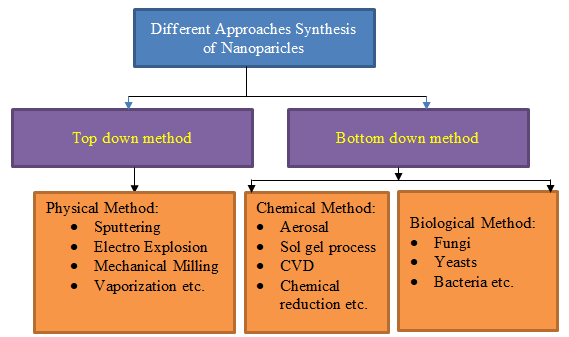
The enhanced chemical and physical characteristics of nanoparticles make them highly intriguing. As a result, nanotechnology is regarded as a fascinating new field within the field of promising research. The manipulation of matter at the nanoscale by chemical and biological methods is known as nanotechnology. These days, the odd terms “nanoscience” and “nanotechnology” are often employed to describe a wide variety of space studies and explorations. Since it has demonstrated the importance of plants in the environmentally friendly synthesis of metal and metal oxide nanoparticles (M/MO NPs) rather than hazardous chemicals and solvents, nanotechnology plays a critical role in the remediation of a variety of environmental problems. Because of its straightforward methodology, long-term stability, quick synthesis, and environmental friendliness, plant-mediated synthesis of M/MO NPs, particularly silver, gold, and palladium NPs and zinc, copper, titanium, and zirconium oxide NPs, has been advancing. Metal/metal oxide nanoparticles, or M/MO NPs, have been shown to be highly useful in a variety of fields, including the physical, chemical, and medicinal sciences. In the fields of materials science and engineering, such as nanomedicine, quantum dots, anticancer, and biological activity, metal and metal oxide nanoparticles have opened up new possibilities. Since the previous decade, nanotechnology has been increasingly relevant because of its capacity to create materials with a consistently large nanoscale range, which has attracted exceptional research focus to the synthesis of M/MO NPs. Recent technical advancements demonstrate that evolution is a crucial component of nanotechnology and nanoscience. Almost every field of research and technology is utilizing nanotechnology [2, 3, 4, 5]. Nanotechnology, which offers tailored nanomaterials with the enormous potential to manufacture items with significantly superior performances, is an excellent example of an emerging technology [6]. Commercial items that incorporate nanomaterials include paints that are resistant to scratches, sporting goods, electronics, clean-up products for the environment, surface coatings, cosmetics, energy storage devices, and sensors [7]. This review aims to highlight the significance of technology and nanomaterials through production methods, the study of properties, and various applications by talking about pertinent information, synthesis techniques, properties, and potential opportunities related to the vast and fascinating field of nanomaterials. The categorization of many processes for producing metal and metal oxide nanoparticles is shown in Figure 1.
Richard Adolf Zsigmondy coined the word “nanometer” in 1914. The development of several spectroscopic methods has accelerated nanotechnology research and innovation. Scanning tunneling microscopy (STM) was created by IBM researchers in 1982, and it made it possible to capture pictures of individual atoms on “flat” (that is, non-tip) surfaces. Since its invention in 1986, atomic force microscopy (AFM) has grown to be the most important scanning probe microscope method. The measurement of magnetic and electrostatic forces was prompted by the need to create hard disks with high storage densities. As a result, Kelvin probes, electrostatics, and magnetic force microscopy were developed. At the moment, nanotechnology is developing quickly and permeating practically every area of material chemistry. The necessity of creating such newly developed multifunctional hybrid nanoparticles for energy storage and heat transfer applications has been highlighted by a number of authors’ recent advances in hybrid nanomaterials (also known as new types of nanomaterials). Hybrid nanomaterials demonstrate a noteworthy impact on enhancing the overall efficiency of sophisticated heat transfer devices. Additionally, they can offer exceptional performance as electrodes for energy storage devices [8, 9, 10, 11].
History of Nanotechnology
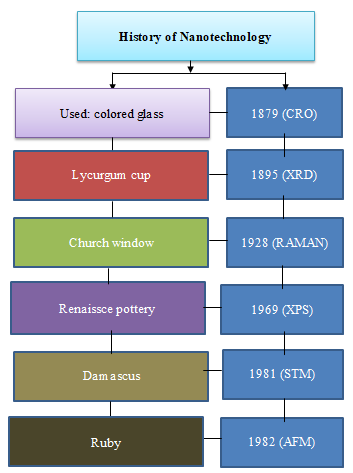
One of the most intriguing instances of nanotechnology in antiquity was revealed by the Romans in the fourth century AD, when they employed nanoparticles and structures [12, 13]. The history development in nanotechnology is shown in Figure 2.
| Author | Year | Term with Definition |
|---|---|---|
| Kreyling WG, et al. | 2010 | Nano manufacturing: Using either top-down or bottom-up techniques, nano manufacturing is the process of manufacturing at the nanoscale level. |
| Bhushan, et al. | 2017 | Nanomaterial: A material is called a nanomaterial if at least one of its dimensions falls between 1 and 100 nm in the nanoscale range. |
| Bhushan, et al. | 2017 | Nanotube: Nanotubes are hollow nanofibers. |
| Kreyling WG, et al. | 2010 | Engineered nanomaterials: Engineered nanomaterials are intentionally created materials with one or more dimensions of less than 100 nm. |
| Chen B, et al. | 2008 | Nanocomposite: Multicomponent materials with several distinct phase domains, where at least one phase has at least one dimension in the order of nanometers, are referred to as nanocomposites. |
Table 1: Terms used in nanomaterials.
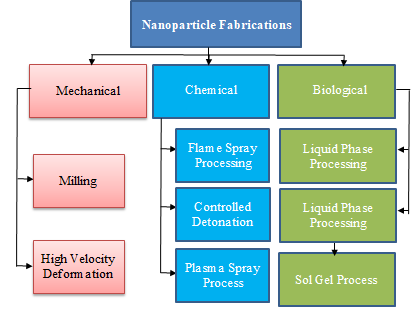
The various methods used for manufacturing of biomaterial are shown in Figure 3 [14].
Approaches for the Synthesis of Nanomaterials
Two main approaches are used for the synthesis of nanomaterials: top-down approaches and bottom-up approaches (Figure 4) [15].
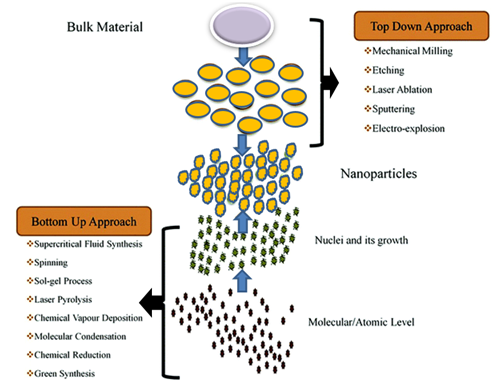
Top-Down Approaches: In top-down approaches, bulk materials are divided to produce nanostructured materials. Top-down methods include mechanical milling, laser ablation, etching, sputtering, and electro-explosion. Mechanical Milling: One economical way to convert bulk materials into nanoscale materials is by mechanical milling. For the purpose of creating nano composites, mechanical milling is a useful technique that yields blends of various phases [16]. The majority of research on how a structure changes microstructurally when it is ball milled has been done on single-phase materials like elements or compounds. However, when multicomponent powders are mechanically alloyed (MA), nanocrystalline grains are also seen. The phase formation and microstructural evolution of Ti and Al powder blends with an overall composition of Ti25Al25 were monitored by Klassen, et al. during MA [17]. Particle flattening due to plastic deformation, particle welding, equiaxed particle formation, random welding of powder particles, and steady-state deformation are the five stages of powder evolution that occur during the milling process. As microstructural refinement advances, a balance between fracture and cold welding is established. The milling period controls the overall deformation strain because severe plastic deformation during milling is a cyclic process. Therefore, sufficient grinding time is needed to produce a microstructure with nanoscale grain sizes. An efficient way to quicken the fracture processes and quickly reach steady-state conditions is to cool the milling medium and powders. When compared to milling at normal temperature, cryomilling has a number of benefits [18]. If one takes into account the contributions of several strengthening mechanisms, such as the grain size effect, solid solution hardening, dispersion strengthening, precipitate strengthening, and maybe others, the observed high strength in cryomilled materials may make sense. The strengthening of cryomilled Al alloys and composites was thought to be significantly influenced by the grain size effect [19, 20, 21]. Electrospinning: One of the most straightforward top- down techniques for creating nanostructured materials is electrospinning. Nanofibers are most commonly synthesized by using polymers, but there are variety of materials that can be used. The coaxial electrospinning is a fruitful and simple top down method for producing core-shell ultrathin fibers.
The core materials may be extended several centimeters and hollow polymers, core shell, inorganic, and hybrid materials may all be synthesized using this technique [22, 23, 24]. The electrospinning process, which was first introduced as the electrospray technique in the 1890s, is a very efficient and adaptable nanofiber fabrication technology. In the 1900s, it was changed into electrospinning. The low-cost method of electrospinning is used to create nanofibers with remarkable properties, including high porosity, huge surface area, and spatial interconnectivity. These nanofibers range in size from a few micrometers to several hundred nanometers. The “electrostatic interactions” of charges are the fundamental operating mechanism of the electrospinning process. A conductive collector, a spinneret (the syringe and needle assembly), and a high-voltage power source make up the three basic components of the electrospinning apparatus. In
short, a high potential (measured in kV) is delivered between the conductive collector and the syringe and needle assembly once they are optimally spaced apart. As per Mingfa Z, et al. [25]. Outlined how to develop functional nanostructures using electrospinning for biosensor applications and talked about how electrospinning is a quick and easy way to create materials and nanofibrous structures with huge surface-to- volume ratios and desired tailored features [26, 27, 28]. Lithography: A low-cost method for creating large-area periodic nanostructures with tunable nanostructure size, period, and material is called nanosphere lithography, or NSL. A concentrated light or electron beam can be utilized to create nanoarchitectures through the use of lithography. Maskless and masked lithography are the two primary subtypes of lithography. In masked nanolithography, a particular mask or template is used to transfer nanopatterns across a sizable surface area. Photolithography, soft lithography, and nanoimprint lithography are examples of masked lithography. Electron beam lithography, focused ion beam lithography, and scanning probe lithography are examples of maskless lithography. The top-down approach uses a variety of lithography techniques, including as serial and parallel approaches for patterning two-dimensional nanoscale structures. On the other hand, necessary material in traditional lithography is typically shielded by a mask, and exposed material is removed by etching [29, 30, 31]. Sputtering: The technique of sputtering involves subjecting solid surfaces to high-energy particles like gas or plasma in order to create nanomaterials. Sputtering is thought to be a useful technique for creating thin nanomaterial films. The sputtering gas is introduced to an evacuated chamber, where the sputtering process is carried out. Gas ions are created when free electrons clash with the gas at a high voltage supplied to the cathode target. Atoms are constantly ejected from the cathode target’s surface as a result of the positively charged ions’ rapid acceleration towards it in the electric field [32, 33]. Arc Discharge Method: Carbon nanostructures can be produced by DC or AC arc discharge. When the anode is being consumed in a DC arc discharge, a deposit forms at the top of the cathode. Polyhedral particles and carbon nanotubes are present in the deposit. When producing fullerene nanomaterials, the arc discharge process is very important. Arc discharge is a valuable technique for producing diverse nanostructured materials. It is well recognized for creating materials based on carbon, such as amorphous spherical carbon nanoparticles, few-layer graphene (FLG), carbon nanotubes, fullerenes, and carbon nanohorns (CNHs). Two graphite rods are adjusted in a chamber that maintains a certain helium pressure during the formation process. It is crucial to fill the chamber completely with helium, as fullerene synthesis is inhibited by moisture or oxygen. Arc discharge between the graphite rod ends propels the vaporization of carbon rods. Arc discharge makes it possible to create many types of carbon nanostructures. Madhurima VP, et al. [34] the traditional arc discharge method was used to prepare the carbon nanomaterials (CNMs). By adjusting the arc voltage and buffer gas pressure, higher yields were achieved [34, 35, 36, 37]. Laser ablation: Due to its advantages, including its uncontaminated, simple, and remarkably pure manufacturing, ZnO nanostructure material is now prepared using the novel pulse laser ablation in liquid (PLAL) technology [18, 19]. Furthermore, it is possible that this technique will be used to create unique nanomaterials with morphologies that can be altered by modifying the laser process. Characteristics like Laser ablation in synthesis is the process of creating nanoparticles by striking the target material with a strong laser beam. Because of the high intensity of the laser irradiation during the laser ablation process, the source material or precursor vaporizes, forming nanoparticles. Since no additional chemicals or stabilizing agents are required for the production of noble metal nanoparticles, using laser ablation for this process may be regarded as environmentally friendly. This method can be used to create a wide variety of nanomaterials, including metal nanoparticles, carbon nanomaterials, oxide composites, and ceramics. The properties of the prepared nanomaterial are also affected by the liquid type and its height over the plate, as well as the wavelength, energy, and number of laser pulses [38, 39, 40, 41, 42].
Bottom-up Approaches
Chemical Vapor Deposition (CVD): The processes of chemical vapor deposition are very important for producing carbon-based nanomaterials. In CVD, vapor-phase precursors react chemically to generate a thin coating on the substrate surface. CVD is a well-known technique for creating two- dimensional nanoparticles and is a great way to produce high-quality nanomaterials. CVD is a flexible method of deposition. It is now one of the primary processing techniques used for coatings and thin-film deposition for a variety of uses. The following are a few instances: Semiconductors for microelectronics, optoelectronics, and energy conversion devices (Si, Ge, Sil-xGex, III-V, II-VI) Dielectrics used in microelectronics, such as SiO2, Si3N4, A1N, etc. Materials (A1203, BN, MoSi2, TiN, TiB2, HfN, ZrO2, etc.) used in refractory ceramics are used as diffusion barriers, strong coatings, and defense against oxidation and corrosion. Metal films, such as A1, Au, Cu, Mo, Pt, W, TiN, and silicides, are used in protective coatings and microelectronics. Saeed HZ, et al. [39] results revealed that compared to traditional filters, nano filters were better at adsorbing aluminum; this might be because of the makeup of their cartridges. SEM The structural and morphological properties of the particles inside the nano filter were investigated by studies [43, 44]. The deposition temperature, pressure, input gas ratio, and flow rate are the primary CVD process parameters. The primary factor is the temperature of deposition. CVD can also be categorized based on the kind of precursor that is employed. For instance, metalorganic-assisted CVD (MOCVD) has been developed as a result of the use of a metalorganic precursor. Metal atoms are joined to organic radicals to form metalorganic compounds. On the other hand, substances with direct metal-carbon connections are known as organometallics. As a result, the procedure was renamed organometallic CVD (OMCVD). For instance, because they have high vapor pressures, source temperatures that are close to room temperature, and the ability to deliver the vapor precursors using a carrier gas like H2, simple metal alkyls (methyl and ethyl derivatives) are the most frequently used precursors for the growth of III-V compound semiconductors. Cold-wall reactors with a single temperature zone can be employed since the deposition temperature is lower than that of hydrides or halohydrides and includes endothermic processes. However, compared to hydrides, halides, and halohydrides, metalorganic precursors are often much more costly, and they are not readily accessible commercially for use in some coating systems. As a result, they frequently need to be specially synthesized for specified uses. Organometallic vapor phase epitaxy (OMVPE) and metalorganic VPE (MOVPE) are other names for the CVD process. Furthermore, metallic, dielectric, and superconducting oxide thin films have all been grown using MOCVD [45]. Solvothermal and Hydrothermal Methods: The term “thermothermal method” refers to a group of methods for creating or crystallizing materials at high vapor pressures and temperatures in aqueous solutions. When it comes to crystallization procedures, hydrothermal synthesis is a technique that relies on a mineral’s solubility in hot water under high pressure in order to create single crystals. The crystal development process is carried out in a device that consists of an autoclave, a steel pressure vessel that holds water and nutrients. In order to dissolve nutrients at the hotter end of the growth chamber and encourage extra development in seeds at the cooler end, a temperature gradient is maintained at the opposite ends. The hydrothermal process is one of several procedures that are often combined these days. Hydrothermal hybrid methods are widely used in the production of chemical compounds, mostly inorganic ones, and materials, including nanomaterials. To add to one of the most well-known and widely applied processes for creating nanostructured materials is the hydrothermal process. The hydrothermal method and the solvothermal method are similar. The fact that it’s done in a non-aqueous liquid is the only distinction. Exciting and practical techniques for creating different nano-geometries of materials, such as nanowires, nanorods, nanosheets, and nanospheres, are hydrothermal and solvothermal methods [46, 47]. Sol–Gel Method: A more chemical (wet chemical) approach for creating different nanostructures, particularly metal oxide nanoparticles, is the sol-gel procedure. One wet chemical process that is widely employed in the creation of nanomaterials is the sol-gel method. Metal alkoxides are the typical precursors used in the sol-gel process to create nanomaterials. There are many processes involved in the creation of nanoparticles using the sol-gel technique. In order to create a sol, the metal oxide is first hydrolyzed in water or with the help of alcohol. The following stage involves condensation, which raises the solvent’s viscosity and creates porous structures that are then allowed to mature. Metal-hydroxo- or metal-oxo-polymer formation in solution is the consequence of hydroxo- (M-OH-M) or oxo- (M-O-M) bridges forming during the condensation or polycondensation process. Large amounts of nanomaterial may be produced using this approach (the sol-gel method), which is more popular and has more industrial applications than other currently used techniques. This process can produce high-quality nanoparticles of the same size on an industrial scale because of its special qualities and traits. By combining two or more metal (or metal oxide) precursors in certain ratios, this technique can create two or more types of nanoparticles at the same time, allowing alloy products to be created in a single process [48, 49, 50]. Soft and Hard Templating Methods: The production of nanoporous materials involves considerable use of both soft and hard template techniques. A straightforward traditional technique for creating nanostructured materials is the soft template approach. The development of materials with a variety of morphologies, easy implementation, and very moderate testing conditions have all contributed to the perceived benefits of the soft template approach. In order to create a mesoporous structure, the soft templating approach depends on the surfactant and the precursor cooperatingly self-assembling. The method relies on the way inorganics and surfactants interact to form inorganic-organic mesostructured composites in the field. The nanocasting technique has been successfully used to create many kinds of mesoporous MOXs. In addition, the unique qualities include high surface areas, the ability of non-magnetic elements to become magnetic at the nanoscale, strong quantum effects at the nanoscale, superior mechanical qualities, and antibacterial activities that address illnesses caused by pathogens [51, 52, 53, 54, 55].
Nanomaterials Applications in Different Sectors
Nanomaterials have several uses, and advancements in nanoscience and nanotechnology have been applied in various scientific domains. In the physics sector, for example, nanomaterials have been employed for R&D in 1885, SEM 1937, TEM 1938, XPS 1969, and AFM 1982. As mentioned in the section below, additional application sectors include energy storage, water treatment, nanomedicine, sensor applications, etc. Energy Storage: The potential of platinum-based nanoparticles in the areas of environmental and energy- related catalysis has sparked a lot of attention. In a variety of catalytic processes, such as fuel cells, hydrogen generation, organic synthesis, vehicle exhaust gas treatment, and petroleum refining, platinum (Pt) has a rich electronic structure and excellent catalytic activity [56]. Water Treatment: The use of nanoparticles in the treatment of water and wastewater has garnered a lot of interest. Nanomaterials have high specific surface areas and adsorption capabilities because of their tiny sizes. Various types of nanomaterials have been claimed to be successful in eliminating heavy metals, organic contaminants, inorganic anions, and microorganisms. Metal oxide nanoparticles, such as TiO2, have been effectively used in photocatalytic degradation to break down contaminants in water and wastewater in recent years [57, 58]. Nanomedicine: A growing body of research has focused on biocompatible gold nanoparticles because of their intriguing size-dependent chemical, optical, and electrical characteristics, which may have uses in nanomedicine. Photothermal treatment, medication delivery, photodynamic therapy, gene therapy, biolabeling, biosensing, and other pertinent applications are transforming the biomedical area, which is receiving a great deal of research attention [59]. Sensors: The creation of a diverse range of nanomaterials has made it possible to use them in the construction of high-performing electrochemical sensing instruments for environmental and food safety as well as medical diagnosis. The study revealed that various nanomaterials have beensynthesizedd for the electrochemical determination of common contaminants and additives, such as hydrazine (N2H4), malachite green (MG), bisphenol A (BPA), ascorbic acid (AA), caffeine, caffeic acid (CA), sulfite (SO3 2−), and nitrite (NO2−), which are commonly found in food and beverages [60].
Impact of Nanomaterials on the Environment
Every material has a positive and negative impact. The examples of the most common positive and negative impacts are as follows: Positive Impacts: Reduce aircraft weight, use stronger and lighter wind turbine blades, use nanosensers to detect pesticides, condensation of low-volatility compounds, food processing and packaging, food supplements, nanofertilizers, etc [61, 62]. Negative Impacts: Reduction in plant growth, DNA damage, genotoxic effects, biological systems, aquatic life, etc [63].
Conclusion
The application of nanomaterials in several industries has accelerated the study of novel nanomaterials. A thorough examination of the literature has been done in order to investigate the many approaches to synthesis using various techniques as well as their applications. The creation of novel nanomaterials continues to have an impact on human health and the environment, both positively and negatively. The risks that nanomaterials pose to microorganisms, plants, and animals have an indirect impact on people. Since our understanding of these nanoparticles is still developing, more focus needs to be placed on the novel nanomaterials. To completely understand the creation, characterization, and potential toxicity of nanoparticles, a great deal of study is required, given that the form, size, and composition of these particles can have a substantial impact on their function and potentially pose dangers to human health. Therefore, this study will undoubtedly help futuristic researchers choose the best synthesis techniques for a certain application.
Acknowledgement
The authors are highly thankful to Chandigarh Group of Colleges Landran and Auxein Medical Pvt. Ltd. (Haryana) for offering the chance to carry out this research work.
References
-
Zhu M, Nie G, Meng H, Xia T, Nel A, et al. (2012) Physicochemical Properties Determine Nanomaterial Cellular Uptake, Transport, and Fate. Accounts of Chemical Research 46(3): 622-631.
-
Shamaila S, Sajjad AKL, Ryma NA, Farooqi SA, Jabeen N, et al. (2016) Advancements in nanoparticle fabrication by hazard free eco-friendly green routes. Applied Materials Today 5: 150-199.
-
Wang Y, Xie Y, Li J, Peng ZH, Sheinin Y, et al. (2017) Tumor- Penetrating Nanoparticles for Enhanced Anticancer Activity of Combined Photodynamic and Hypoxia- Activated Therapy. ACS Nano 11(2): 2227-2238.
-
Nagajyothi PC, Cha SJ, Yang IJ, Sreekanth TVM, Kim KJ, et al. (2015) Antioxidant and anti-inflammatory activities of zinc oxide nanoparticles synthesized using Polygala tenuifolia root extract. Journal of Photochemistry and Photobiology B: Biology 146: 10-17.
-
Medici S, Peana M, Nurchi VM, Zoroddu MA (2019) Medical Uses of Silver: History, Myths, and Scientific Evidence. Journal of Medicinal Chemistry 62(13): 5923- 5943.
-
Qu X, Brame J, Li Q, Alvare PJJ (2012) Nanotechnology for a Safe and Sustainable Water Supply: Enabling Integrated Water Treatment and Reuse. Accounts of Chemical Research 46(3): 834-843.
-
Faria M, Bjornmalm M, Thurecht KJ, Kent SJ, Parton RG, et al. (2018) Minimum information reporting in bio– nano experimental literature. Nature Nanotechnology 13(9): 777-785.
-
Muhamad Azim MK, Arifutzzaman A, Saidur R, Khandaker MU, Bradley DA (2022) Recent progress in emerging hybrid nanomaterials towards the energy storage and heat transfer applications: A review. Journal of Molecular Liquids 360: 119443.
-
Tong Y, Boldoo T, Ham J, Cho H (2020) Improvement of photo-thermal energy conversion performance of MWCNT/Fe3O4 hybrid nanofluid compared to Fe3O4 nanofluid. Energy 196: 117086.
-
Liu Y, Yu J, Guo D, Li Z, Su Y (2020) Ti3C2Tx MXene/ graphene nanocomposites: Synthesis and application in electrochemical energy storage. Journal of Alloys and Compounds 815: 152403.
-
Butt HJ, Cappella B, Kappl M (2005) Force measurements with the atomic force microscope: Technique, interpretation and applications. Surface Science Reports 59(1-6): 1-152.
-
Bayda S, Adeel M, Tuccinardi T, Cordani M, Rizzolio F (2019) The History of Nanoscience and Nanotechnology: From Chemical–Physical Applications to Nanomedicine. Molecules 25(1): 112.
-
Freestone I, Meeks N, Sax M, Higgitt C (2007) The Lycurgus Cup - A Roman nanotechnology. Gold Bulletin 40(4): 270-277.
-
Chow SF, Weng J, Xuan B, Wan KY (2019) How can the challenges faced by nanoparticle-based pulmonary drug formulations be overcome. Therapeutic Delivery 10(2): 87-89.
-
Trotta F, Mele A (2019) Nanosponges: Synthesis and Applications. Supramolecular Chemistry pp: 336.
-
Campea MA, Majcher MJ, Lofts A, Hoare T (2021) A Review of Design and Fabrication Methods for Nanoparticle Network Hydrogels for Biomedical, Environmental, and Industrial Applications. Advanced Functional Materials 31(33): 2102355.
-
Ahmed S, Ahmad M, Swami BL, Ikram S (2016) A review on plants extract mediated synthesis of silver nanoparticles for antimicrobial applications: A green expertise. Journal of Advanced Research 7(1): 17-28.
-
SPIE (2017) Satoshi Kawata: Optical 3D nano-fabrication: top-down and bottom up approaches. SPIE Newsroom.
-
Koch CC (1997) Synthesis of nanostructured materials by mechanical milling: problems and opportunities. Nanostructured Materials 9(1-8): 13-22.
-
Lavernia EJ, Han B, Schoenung JM (2008) Cryomilled nanostructured materials: Processing and properties. Materials Science and Engineering A-Structural Materials Properties Microstructure and Processing 493(1-2): 207-214.
-
Maham ABK (2023) Mechanism of structural and functional coordination between enzymes and nonstructural cues. Bionanocatalysis: Design to Applications Micro and Nano Technologies pp: 57-86.
-
Han B, Lee Z, Witkin DB, Nutt S (2005) Deformation behavior of bimodal nanostructured 5083 Al alloys. Metallurgical and Materials Transactions 36(4): 957- 965.
-
Li Y, Zhao YB, Ortalan V, Liu W, Zhang ZP, et al. (2009) Investigation of aluminum-based nanocomposites with ultra-high strength. Materials Science and Engineering A-Structural Materials Properties Microstructure and Processing 527(1-2): 305-316.
-
Kumar PS, Sundaramurthy J, Sundarrajan S, Babu VJ, Singh G, et al. (2014) Hierarchical electrospun nanofibers for energy harvesting, production and environmental remediation. Energy Environ Sci 7(10): 3192-3222.
-
Peng S, Jin G, Li L, Li K, Srinivasan M, et al. (2016) Multi- functional electrospun nanofibres for advances in tissue regeneration, energy conversion & storage, and water treatment. Chemical Society Reviews 45(5): 1225-1241.
-
Thenmozhi S, Dharmaraj N, Kadirvelu K, Kim HY (2017) Electrospun nanofibers: New generation materials for advanced applications. Materials Science and Engineering: B 217: 36-48.
-
Nascimento MLF, Araujo ES, Cordeiro ER, De Oliveira AHP, De Oliveira HP (2015) A Literature Investigation about Electrospinning and Nanofibers: Historical Trends, Current Status and Future Challenges. Recent Patents on Nanotechnology 9(2): 76-85.
-
Pimpin A, Srituravanich W (2012) Review on Micro- and Nanolithography Techniques and their Applications. Engineering Journal 16(1): 37-56.
-
Szabó Z, Volk J, Fülöp E, Deák A, Bársony I (2013) Regular ZnO nanopillar arrays by nanosphere photolithography. Photonics and Nanostructures - Fundamentals and Applications 11(1): 1-7.
-
Seyedi SS, Shabgard MR, Mousavi SB, Heris ZS (2021) The impact of SiC, Al2O3, and B2O3 abrasive particles and temperature on wear characteristics of 18Ni (300) maraging steel in abrasive flow machining (AFM). International Journal of Hydrogen Energy 46(68): 33991-34001.
-
Biswas A, Bayer IS, Biris AS, Wang T, Dervishi E, et al. (2012) Advances in top–down and bottom–up surface nanofabrication: Techniques, applications & future prospects. Advances in Colloid and Interface Science 170(1-2): 2-27.
-
Wender H, Migowski P, Feil AF, Teixeira SR, Dupont J (2013) Sputtering deposition of nanoparticles onto liquid substrates: Recent advances and future trends. Coordination Chemistry Reviews 257(17-18): 2468- 2483.
-
Madhurima VP, Kumari K, Jain PK (2023) Synthesis and Study of Carbon nanomaterials through arc discharge technique for efficient adsorption of organic dyes. Diamond and Related Materials 141: 110538.
-
Muñoz García J, Vázquez L, Castro M, Gago R, Redondo Cubero A, et al. (2014) Self-organized nanopatterning of silicon surfaces by ion beam sputtering. Materials Science and Engineering: Reports 86: 1-44.
-
Zhang D, Ye K, Yao Y, Liang F, Qu T, et al. (2019) Controllable synthesis of carbon nanomaterials by direct current arc discharge from the inner wall of the chamber. Carbon 142: 278-284.
-
Contini V, Mancini R, Marazzi R, Gattia DM, Antisari MV (2007) Quantitative evaluation of nanotube content produced by arc discharge in a raw material. The Philosophical Magazine a Journal of Theoretical Experimental and Applied Physics 87(7): 1123-1137.
-
De Nicola M, Gattia DM, Traversa E, Ghibelli L (2013) Maturation and demise of human primary monocytes by carbon nanotubes. Journal of Nanoparticle Research 15(6): 1711-1715.
-
Sarvari AA, Heris SZ, Pourfard MM, Mousavi SH, Estellé P (2022) Numerical investigation of TiO2 and MWCNTs turbine meter oil nanofluids: Flow and hydrodynamic properties. Fuel 320: 123943-123943.
-
Yan Z, Chrisey DB (2012) Pulsed laser ablation in liquid for micro-/nanostructure generation. Journal of Photochemistry and Photobiology C: Photochemistry Reviews 13(3): 204-223.
-
Mohammed MKA, Mohammad MR, Jabir MS, Ahmed DS (2020) Functionalization, characterization, and antibacterial activity of single wall and multi wall carbon nanotubes. IOP Conference Series: Materials Science and Engineering 757(1): 012028.
-
Khashan K, Sulaiman G, Mahdi R, Kadhim A (2018) The effect of laser energy on the properties of carbon nanotube—iron oxide nanoparticles composite prepared via pulsed laser ablation in liquid. Materials Research Express 5(10): 105004.
-
Malandrino G (2009) Chemical Vapour Deposition. Precursors, Processes and Applications. Jones AC, Hitchman ML (Eds.), Angewandte Chemie International Edition 48(41): 7478-7479.
-
Nami SH, Mousavi SB (2023) Nitrate Removal Performance of Different Granular Adsorbents Using a Novel Fe-Exchanged Nanoporous Clinoptilolite. Industrial & Engineering Chemistry Research 62(8): 3659-3671.
-
Choy KL (2000) Vapor processing of nanostructured materials. Handbook of Nanostructured Materials and Nanotechnology 1: 533-577.
-
Kharisov BI, Kharissova OV, Méndez UO (2012) Microwave Hydrothermal and Solvothermal Processing of Materials and Compounds. In: Cao W (Ed.), Development and Application of Microwave Heating.
-
Niederberger M, Garnweitner G (2006) Organic Reaction Pathways in the Nonaqueous Synthesis of Metal Oxide Nanoparticles. Chemistry: A European Journal 12(28): 7282-302.
-
Rahman IA, Padavettan V (2012) Synthesis of Silica Nanoparticles by Sol-Gel: Size-Dependent Properties, Surface Modification, and Applications in Silica-Polymer Nanocomposites—A Review. Journal of Nanomaterials 2012: 1-15.
-
Gupta S, Tripathi M (2012) A review on the synthesis of TiO2 nanoparticles by solution route. Open Chemistry 10(2): 279-294.
-
Liu Y, Goebl J, Yin Y (2013) Templated synthesis of nanostructured materials. Chem Soc Rev 42(7): 2610- 2653.
-
Savic S, Vojisavljevic K, Počuča Nešić M, Zivojevic K, Mladenovic M, et al. (2018) Hard Template Synthesis of Nanomaterials Based on Mesoporous Silica. Metallurgical and Materials Engineering 24(4).
-
Mannix AJ, Zhou XF, Kiraly B, Wood JD, Alducin D, et al. (2015) Synthesis of borophenes: Anisotropic, two- dimensional boron polymorphs. Science 350(6267): 1513-1516.
-
Geoffrion LD, Guisbiers G (2020) Quantum confinement: Size on the grill. Journal of Physics and Chemistry of Solids 140: 109320.
-
Krishnan SK, ESingh E, Singh P, Meyyappan M, Nalwa HS (2019) A review on graphene-based nanocomposites for electrochemical and fluorescent biosensors. RSC Adv 9(16): 8778-8881.
-
Duan S, Du Z, Fan H, Wang R (2018) Nanostructure Optimization of Platinum-Based Nanomaterials for Catalytic Applications. Nanomaterials 8(11): 949.
-
Kalhapure RS, Sonawane SJ, Sikwal DR, Jadhav M, Rambharose S, et al. (2015) Solid lipid nanoparticles of clotrimazole silver complex: An efficient nano antibacterial against Staphylococcus aureus and MRSA. Colloids and Surfaces B: Biointerfaces 136: 651-658.
-
Nakata K, Fujishima A (2012) TiO2 photocatalysis: Design and applications. Journal of Photochemistry and Photobiology C: Photochemistry Reviews 13(3): 169- 189.
-
Chavan JJ, Ghadage DM (2018) Biosynthesis, Characterization and Antibacterial Capability of Silver and Copper Nanoparticles Using Aqueous Leaf Extract of Salacia chinensis L. Journal of Nanomedicine & Nanotechnology 9(1).
-
Rahman A, Ali I, Al Zahrani SM, Eleithy RH (2011) A REVIEW OF THE APPLICATIONS OF NANOCARBON POLYMER COMPOSITES. Nano 6(3): 185-203.
-
Kausar A, Rafique I, Muhammad B (2017) Aerospace Application of Polymer Nanocomposite with Carbon Nanotube, Graphite, Graphene Oxide, and Nanoclay. Polymer-Plastics Technology and Engineering 56(13): 1438-1456.
-
Raj B, Van de Voorde M, Mahajan Y (2017) Nanotechnology for Energy Sustainability. Wiley-VCH Verlag GmbH & Co KGaA.
-
Etim UJ, Bai P, Yan Z (2018) Nanotechnology Applications in Petroleum Refining. Topics in Mining, Metallurgy and Materials Engineering.
-
Bleeker EAJ, Evertz S, Geertsma RE, Peijnenburg WJGM, Westra J, et al. (2014) Assessing healthand environmental risks of nanoparticles current state of affairs in policy, science and areas of application. RIVM Report 157: 1-146.
-
Ravindran A, Chandran P, Khan SS (2013) Biofunctionalized silver nanoparticles: Advances and prospects. Colloids and Surfaces B: Biointerfaces 105: 342-352.
- Solution-Processed Chiral Perovskites for Biomedical Applications
- Nanotechnology in Health Chemistry and Medicine: Current Challenges and Future Directions
- Human Exposure to Micro- and Nanoplastics: Pathways, Toxicity, and Intervention Strategies
- Exosome Nanomedicine for Cancer Therapy
- Micro and Nanoplastics–Plastisphere, Biotoxicity, Impact on Human Health, and Mitigation Strategies
- Process Validation of Cefixime Powder for Suspension Dosage Form, 50 mL