
A Review on Advancing Sustainability: Exploring the Potential of Cork and Granite Sludge Composite Materials in Infrastructure Development
In recent years, material scientists have been focusing on the utilization of materials from natural resources due to environmental concerns. The previous researches and investigations show the importance of cork and granite sludge in the Construction activities. The study is based on the use and tests carried out on Cork and Granite Sludge to know about their properties. With the same context the aim of this research paper is to highlight the use and credibility of using the natural materials Cork and Granite sludge in combination with Cement in building construction. Cork displays a high degree of stability under varying conditions. This is paramount to its continual usage and success throughout the world today. Cork is a tough, durable substance with a remarkable capacity for retaining its initial properties. Cork’s many air cells also contribute to excellent acoustic benefit, providing efficient sound resistance above and below the floor. Cork is an effective way to muffle the sound of children playing in a room above, or reduce the echo found with “other” hard surface floors in a media room. Cement replacement with granite in small amounts leads to better dispersion of cement particles in the mix which results in better cement reactions and finally improvements in strength and other characteristics of concrete. The various properties and characteristics of Cork and Granite Sludge are highlighted in this paper which make them the most sustainable materials and contribute to Resilient Structures.
Introduction
Natural fibers provide several advantages over most synthetic fibres, including lower costs, simpler handling, low density, suitable mechanical qualities, and a requirement of just 20% to 40% of the energy used in manufacture. While encouraging the idea of sustainability, the use of natural materials improves energy efficiency [1, 2, 3]. Because of the consumption of non-renewable raw materials and the significant amount of embodied energy in the constructive components, the building sector is accountable for major environmental repercussions. Using renewable resources to manufacture building components is part of the building industry’s push for sustainability. By using recycled or reclaimed materials in building projects and turning waste materials into new, valuable goods, trash disposal can be drastically decreased while also greatly lowering the consumption of raw materials [4]. Researchers have looked into ways to use sustainable materials—either natural or recycled—in the construction of buildings in order to comply with policy requirements to use materials with minimal environmental impact. For acoustic applications in buildings, tea-leaf fiber waste [5], coir fiber [6], cotton, flax, ramie, wool, jute, hemp, sisal (fibers), straw and reeds have been studied for sound absorption purposes [7]. With a quota of more than 54% of global cork output, Portugal is the world’s top cork producer [8, 9]. Cork is a material that has a wide range of applications and a great deal of promise for use in construction. Cork is utilized in applications like vibration dampers and control systems because of its cellular microstructure and internal morphology. Cork has a variety of uses, including impact absorption, acoustic liners, base isolation for heavy machinery, and more [10, 11, 12, 13, 14]. Cork has a variety of uses, including impact absorption, acoustic liners, base isolation for heavy machinery, and more [15, 16, 17, 18, 19, 20].
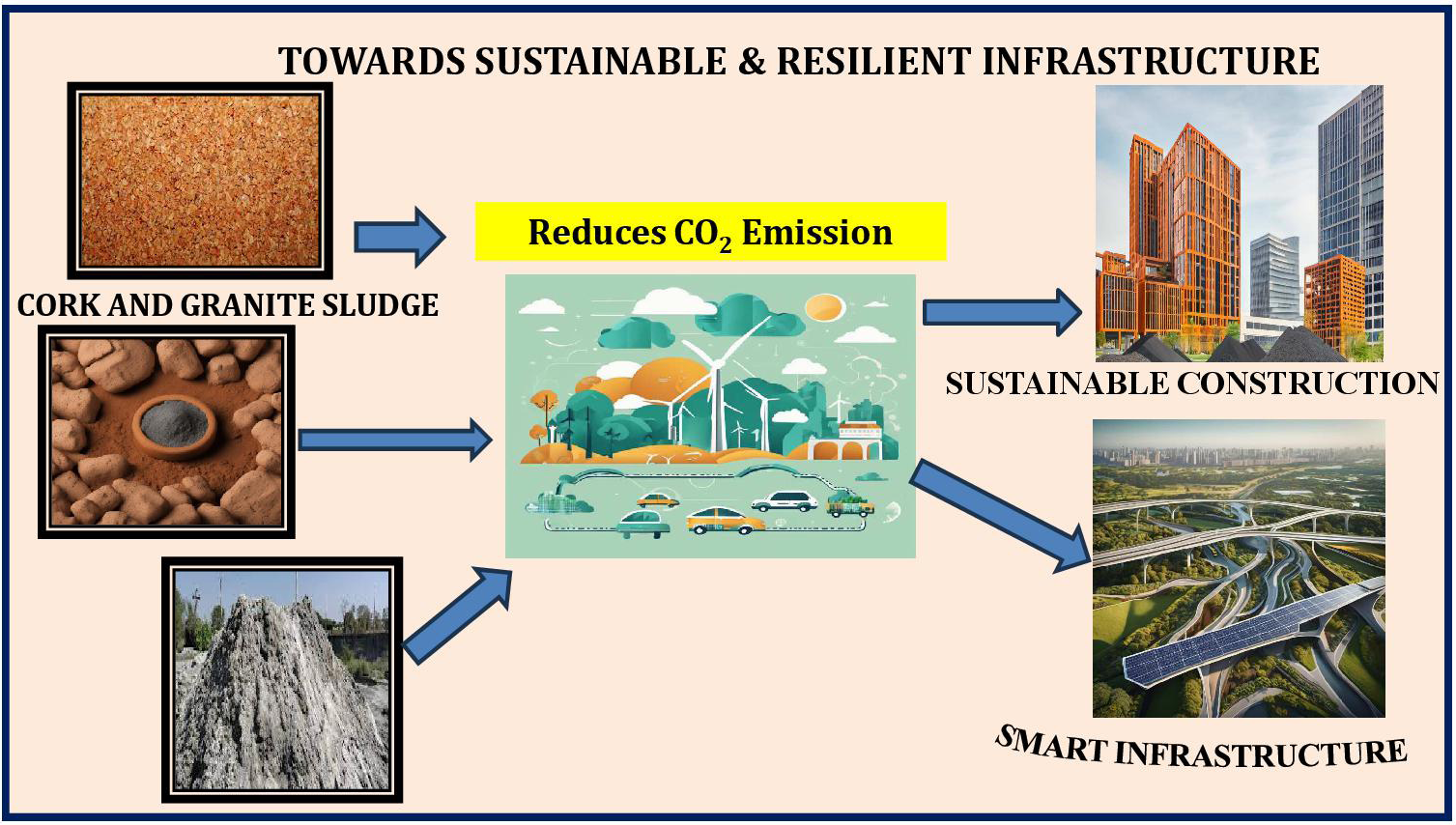
Currently, the granite stone industry in India generates about 17.8 million tons of solid granite waste annually, of which 12.2 million tons are rejected at industrial sites, 5.2 million tons are undersized or cuttings, and 0.4 million tons are granite slurry at processing and polishing units. Over time, the industry has produced a significant amount of waste granite. The remaining amounts have been carelessly dumped, causing environmental problems, and only negligible amounts have been used. The test findings obtained by Felixkala T, et al. [21] showed that the mechanical properties, such as compressive strength, split tensile strength, and modulus of elasticity, benefit from the partial replacement of sand with granite powder at a marginal quantity. Furthermore, compared to the conventional concrete specimens, it was demonstrated that the drying shrinkage and plastic shrinkage values of the concrete in the granite powder specimens were insignificant. There is enough research on the subject of granite slurry waste to demonstrate that it possesses both pozzolanic and cementitious properties that make it a viable substitute for cement. Additionally, because of its great fineness, waste from granite slurry has been demonstrated to be incredibly inventive in innovating the cohesiveness of concrete. Studies that have been conducted on the use of granite slurry waste in a variety of industrial applications, including cement, concrete, mortar, ceramics, and composite materials, have shown that doing so improves the applications’ mechanical and physical qualities [22, 23, 24]. Hence in this paper the importance of Cork and Granite sludge as sustainable materials is highlighted with their properties with their use and credibility as natural resources in building construction. The schematic graphical abstract of the work is shown in Figure 1.
Cork
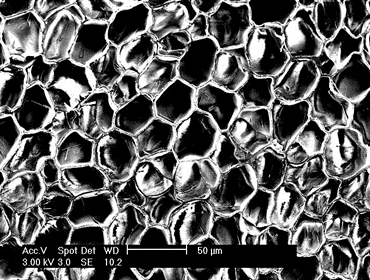
Cork is one of the most useful natural raw materials in the market. Cork is a substance that is incredibly light, flexible, elastic, impermeable to liquids or gases, imperishable, and effective at insulating against vibration, sound, and heat [25] and a dielectric material. Its closed cell structure gives it special qualities as a cellular material (Figure 2).
When compressive loads are present, cork is a great material for thermal insulation because of its low thermal conductivity and moderate compressive strength. Because of its friction-reducing (anti-sliding) qualities, it works well
Historic Survey
in handles or floor coverings. Cork products are utilized as stoppers, energy-absorbing medium in flooring, shoes, and packaging and as thermal insulation in refrigerators and rockets [25].
| Properties | References | |||
|---|---|---|---|---|
| Friction coefficient(cork/cork),boiled | 0.97(radial direction) | 0.77(non-radial directions) | Vaz and Fortes [26] | |
| Density(Kg/m3) | 120–180(amadia) | 160–240(virgin) | Fortes and Rosa [27] | |
| Thermal conductivity(W/m.K) Electrical conductivity (S/m) | 1.2×10⁻¹⁰(25°C) | 0.045 | 1.67×10⁻¹³(50°C) | Gil, et al. [28] |
| A coustic resistivity(Kg/m2.s) | 1.2×10⁵ | Fortes and Nogueira [29] | ||
| Specific heat (J/Kg.K) | 350 | Gil, et al. [28] | ||
| Thermal diffusivity(m2/s) | 1.0×10⁻⁶ | Gil, et al. [28] |
Table 1: Properties of cork.
| Value | References | ||
|---|---|---|---|
| Mechanical Properties | Radialdirection | References | Non-radialdirections |
| Compressive modulus, unboiled (MPa) | 8–20 | 13–15 | Vaz and Fortes [26], Rosa, et al. [30] |
| Compressive modulus, boiled (MPa) | 6 | 8–9 | Rosa, et al. [30] |
| Compressive modulus, heat treated at100°C, 28days (MPa) | 11 | 11 | Rosa and Pereira [31] |
| Compressive modulus, heat treated at150°C, 28days (MPa) | 15 | 14 | Rosa and Pereira [31] |
| Tensile modulus, boiled (MPa) | 38 | 24–26 | Rosa and Fortes [32] |
| Collapse(bucking) stress, boiled (MPa) | 0.75–0.80 | 0.6–0.7 | Vaz and Fortes [32] |
| Collapse (bucking) strain (%) | 4 | 6 | Gibson, et al. [33] |
| Fracture stress under tension (MPa) | 1 | 1.1 | Gibson, et al. [33] |
| Fractures train under tension (%) | 5 | 9 | Gibson, et al. [33] |
Table 2: Mechanical properties of cork.
In Tables 1&2 are presented quantitatively, the general and the mechanical properties of cork, respectively.
The distinct blend of qualities that cork possesses makes it suitable for a variety of uses. Cork has experienced a tremendous expansion since the early 20th century, mostly as a result of the growth of agglomerates based on cork [34].
Cork Processing and Materials
Because using raw cork (cork planks) or natural cork components is uncommon and restricted to specific designs, the majority of cork building uses are dependent on the creation of cork agglomerates. Cork agglomerates are made from the numerous leftover byproducts from the production of cork stoppers and discs, as well as from the leftover raw cork planks and other cork raw materials like virgin cork [9]. Because the cork materials range in terms of their purity and cork tissue properties, they are sorted into distinct production lines based on the specific requirements of each line.
The mechanical, and thermal characteristics of industrial cork mortars meant for thermal bridge correction have been evaluated by Bras, et al. [35] in the last ten years. In this investigation, 0.5 mm to 2 mm cork granules at several dosages (ranging from 0 to 80%) were assessed. In an effort to better understand the mechanical, thermal, and physical characteristics of cork mortars, Ziregue, et al. [36] substituted the same volume of 3–8 mm expanded cork granules from the leftovers of the cork panel business for 20,
30, 40, 50, 60, and 70% of the matrix. The generated mortars had densities ranging from 590 to 1980 kg/m3, depending on the proportion of cork. The generated mortars had densities ranging from 590 to 1980 kg/m3, depending on the proportion of cork. Barnat Hunek D, et al. [37] experimental study looked at the effectiveness of expanded cork hydrophobization prior to incorporation in cork mortars. After completing this investigation, the researchers came to the conclusion that cork mortar durability had significantly increased while using the hydrophobization procedure.
Granite Sludge/Slurry
The development of the building sector is being hampered in many regions of the nation by the lack of ordinary river sand in sufficient quantities for the production of cement concrete. The Indian state of Tamil Nadu has recently placed restrictions on the collection of sand from riverbeds because of the hazardous effects that pose a threat to numerous areas of the state. Conversely, over time, the industry’s waste granite has accumulated. Currently, the granite stone industry in India generates about 17.8 million tons of solid granite waste annually, of which 12.2 million tons are rejected at industrial sites, 5.2 million tons are undersized materials or cuttings and trimmings, and 0.4 million tons are granite slurry at processing and polishing units. Over time, the industry has produced a significant amount of waste granite. The remaining amounts have been carelessly dumped, causing environmental problems, and only negligible amounts have been used.
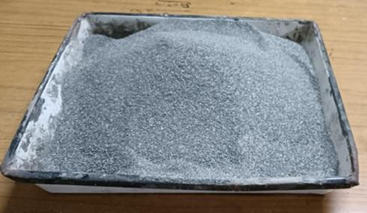
The test findings obtained by Felixkala T, et al. [31] showed that the mechanical properties, such as compressive strength, split tensile strength, and modulus of elasticity, benefit from the partial replacement of sand with granite powder at a marginal quantity. Additionally, they showed that the drying and plastic shrinkage values of the concrete in the granite powder concrete specimens were negligible compared to those in the regular concrete specimens. They investigate the feasibility of replacing some of the cement in concrete utilizing granite powder in place of sand. In place of the sand used in concrete, 0.25, 50, 75, and 100% of granite powder was added by weight; the cement was substituted with 7.5% silica fume, 10% fly ash, 10% slag, and 1% super plasticizer. The study examined and compared the mechanical characteristics, plasticity, and drying shrinkage strain of concrete with natural fine aggregate concrete.
According to Williams K, et al. [38], high-performance concrete with granite powder as fine aggregate underwent experimental research. 10% fly ash, 10% slag, 1% super plasticizer, and 7.5% silica fume were substituted for the sand in the concrete and cement, with a weight range of 0, 25, 50, 75, and 100% for the granite powder. Concrete’s compressive strength, split tensile strength, modulus of elasticity, drying shrinkage, and water penetration were all examined in relation to the curing temperature at 32 Sand 0.40 water-to-binder (w/b) ratio for 1, 7, 14, 28, 56, and 90 days. Their findings showed that the concrete’s compressive strength decreased as the quantity of granite powder increased.
The consequences of disposing of granite on land, vegetation, and ground water are lessened when granite slurry is used in construction applications, which minimizes the pollution caused by granite slurry waste. Using waste from granite slurry in place of cement can significantly reduce CO2 emissions since the production of cement produces a significant quantity of CO2. Environmental contamination will be reduced by reducing CO2 emissions. The Concrete sustainability requires using very few natural resources. Cement manufacture will require fewer natural resources if waste from granite slurry is used efficiently in place of cement. These natural resources will remain available for a longer period of time.In addition to providing a consistent, high-quality supply for Fine aggregates, substituting natural sand for granite slurry waste would protect the natural sand supply, which is running out. Therefore, more sustainable concrete will be produced by using waste from granite slurry as a variety of substitutes for cement or natural sand (F.A.). Therefore, using waste from granite slurry will benefit and improve human welfare since it will lessen pollution in the environment, use fewer natural resources, and support the environmentally friendly growth of the cement and concrete industries.
To create a material with excellent compressive strength and workability, granite slurry waste (GSW) can be combined with cement concrete cubes. Additionally, lowering the cost of construction can help with the environmental problem’s ultimate solution [39]. A study on the mechanical strength properties of design concrete made with leftover granite slurry instead of cement was carried out by Abubaker, et al. [40]. Divakar, et al. [39] research examines the impact of substituting different degrees of tiny particles in concrete with granite slurry dust. The durability test was conducted by Rubanincheran and Ganeshan on fiber concrete with partial OPC replacement using waste from granite slurry for cure times of 7 and 28 days. Using OPC 43 grade cement, M20 grade concrete has been created for this experiment. As can be shown from the experiment investigations that came before it, green concrete might be designed with GSW in order to replace cement. Several problems with waste production, the use of natural resources, and CO2 emissions will be resolved by using GSW in fresh concrete [41, 42]. The environment will suffer from higher CO2 emissions brought on by this increased demand for cement [43].
| Percentage | |
|---|---|
| SiO2 | 71.24% |
| Fe2O3 | 0.58% |
| Al2O3 | 12.50% |
| TiO2 | 0.17% |
| CaO | 1.45% |
| MgO | 0.78% |
| LOI | 1.15% |
| Na2O | 6.19% |
| K2O | 4.58% |
Table 3: Chemical composition of granite sludge.
Abd Elmoaty [44] investigated the characteristics of concrete that had been altered by adding and replacing cement with waste granite dust. The test findings demonstrated that while the mechanical qualities of concrete improved at high levels of granite dust waste as cement addition, the corrosion resistance and mechanical characteristics of concrete were improved when 5% of granite dust was substituted for cement. Concrete’s compressive strength is unaffected by replacing 10% of its cement with waste granite powder, according to Al-Humaiedeh, et al. [45]. However, adding up to 20% of this substitution to fine aggregate increased the concrete’s compressive strength. According to research by Ramos, et al. [46], granitic sludge waste can partially substitute cement in mortar to increase its durability without sacrificing its strength or workability. Remaining marble and granite were examined by Bacarji, et al. [47] to see if they might be used as a sustainable cement substitute. It was discovered that 5% might be regarded as a viable and sustainable substitute for cement [48, 49, 50, 51].
Conclusion
In conclusion, the study highlights the potential of a novel composite material incorporating cork and Granite Sludge. Through a historical survey and examination of existing commercial cork composites, the research identifies promising developments. The utilization of Granite slurry waste as a cost-effective alternative for fine aggregate and cement in concrete production demonstrates a sustainable approach. This innovative composite not only reduces the environmental impact by minimizing pollution and resource consumption but also aligns with the growing need for sustainable concrete solutions in today’s rapidly developing infrastructure landscape.
References
-
Faruk O, Bledzki AK, Fink HP, Sain M (2012) Bio composites reinforced with natural fibers: 2000–2010. Prog Polym Sci 37(11): 1552-1596.
-
Dittenber DB, GangaRao HVS (2012) Critical review of recent publications on use of natural composites in infrastructure. Compos Part A: Appl Sci Manuf 43(8): 1419-1429.
-
Gil L (2015) New cork-based materials and applications. Materials 8(2): 625-637.
-
Sev A (2009) How can the construction industry contribute to sustainable development? A conceptual framework. Sustainable Development 7(3): 161-173.
-
Ersoy S, Küçük H (2009) Investigation of industrial tea-leaf-fiber waste material for its sound absorption properties. Applied Acoustics 70(1): 215-220.
-
Fouladi MH, Nor MJM, Ayub Md, Leman ZA (2010) Utilization of coir fiber in multilayer acoustic absorption panel. Applied Acoustics 71(3): 241-249.
-
Oldham DJ, Egan CA, Cookson RD (2011) Sustainable acoustic absorbers from the biomass. Applied Acoustics 72(6): 350-363.
-
Silva R (2008) Melhoria da resposta sísmica de um edifício com recurso a paredes deCorBE. MEng thesis. University of Aveiro.
-
Pereira H (2007) Cork: biology, production and uses. In: 1st (Edn.), Elsevier Science.
-
Hooke R (1665) Micrographia: or some physiological descriptions of minute bodiesmade by magnifying glasses. In: Martyn J, et al. (Eds.), 1st (Edn.), Library of Congress.
-
Gibson LJ, Easterlinge KE, Ashby MF (1981) The structure and mechanics of cork. ProRoy Soc Lond A377: 99-117.
-
Gibson LJ, Ashby MF (1997) Cellular solids: structure and properties. Cambridge University Press.
-
Pina P, Fortes MA (1996) Characterization of cells in cork. J Phys D29: 2507-2514.
-
Pereira H, Rosa ME, Fortes MA (1987) The cellular structure of cork from quercussuber. IAWA Bull 8(3): 213-218.
-
Gameiro CP, Cirne J, Miranda V, Pinho-da-Cruz J, Teixeira- Dias F (2007) Dynamic behavior of cork and cork-filled aluminum tubes: numerical simulation and innovative applications. Holzforschung 61(4): 400-405.
-
Abdallah FB, Cheick RB, Baklouti M, Denchev Z, Cunha AM (2006) Characterization of composite materials based on pp-cork blends. J Reinf Plast Compos 25(14): 1499-1506.
-
Oprea S (2008) Effects of fillers, namely cork, on polyurethane resin based polyurethane elastomeric bearing materials for passive isolation. J Compos Mater 42(25): 2673-2685.
-
Nóvoa PJRO, Ribeiro MCS, Ferreira AJM, Marques AT (2004) Mechanicalcharacterization of lightweight polymer mortar modified with corkgranulates. Compos Sci Technol 64(13-14): 2197-2205.
-
Pereira C, Jorge F, Irle M, Ferreira J (2006) Characterizing the setting of cement whenmixed with cork, blue gum, or maritime pine, grown in Portugal – I:temperature properties and compatibility indices. J Wood Sci 52: 311- 317.
-
Hernández-Olivares F, Bollati MR, del Rio M, Parga-Landa B (1999) Development ofcork-gypsum composites for building applications. Constr Build Mater 13(4): 179- 186.
-
Felixkala T, Partheeban P (2010) Granite powder concrete. Indian Journal of Science and Technology 3(3): 311-317.
-
Pappu A, Saxena M, Asolekar SR (2007) Solid wastes generation in India and their recycling potential in building materials. Building and Environment 42(6): 2311-2320.
-
Ribeiroa SV, Holandaa JNF (2014) Soil-cement bricks incorporated with granite cutting sludge. IJESIT 3(2).
-
Ramos T, Matos AM, Schmidt B, Rio J, Sousa-Coutinho J (2013) Granitic quarry sludge waste in mortar: Effect on strength and durability. Construction and Building Materials 47: 1001-1009.
-
Gil L, Moiteiro C, (2003) Cork. In: 6th (Edn.), Ullmann’s Encyclopedia of Chemical Technology. Wiley, Germany.
-
Fatima Vaz M, Fortes MA (1998) Friction properties of cork. Journal of Materials Science 33: 2087-2093.
-
Emilia Rosa M, Fortes MA (1988) Rate effects on the compression and recovery of dimensions of cork. 23: 879-885.
-
Gil L, Cortiço P (1998) Cork hygroscopic equilibrium moisture content. European Journal of Wood and Wood Products 56: 355-358.
-
Fortes MA, Teresa Nogueira M (1989) The poison effect in cork. Materials Science and Engineering: A 122(2): 227-232.
-
Emília Rosa M, Fortes MA (1993) Water Absorption by Cork. Wood and Fiber Science 25(4): 339-348.
-
Emília Rosa M, Pereira H (1994) The Effect of Long- Term Treatment at 100°C–150°C on Structure, Chemical Composition and Compression Behavior of Cork. Holzforschung 48(3): 226-232.
-
Rosa ME, Fortes MA (1991) Deformation and fracture of cork in tension. Journal of Material Science 26: 341-348.
-
Gibson LJ, Easterling KE, Ashby MF (1981) The structure and mechanics of cork. Proc R Soc Lond A 377(1769): 99-117.
-
Luis G (2015) New Cork-Based Materials and Applications. Materials 8(2): 625-637.
-
Brás A, Leal M, Faria P (2013) Cement-cork mortars for thermal bridges correction. Comparison with cement- EPS mortars performance. Constr Build Mater 49: 315- 327.
-
Ziregue A, Khenfer MM, Quéneudec-T’Kint M, Montrelay N (2016) Developmental potentiality of insulating lightweight concrete based on cork and calcareous sand. J Adhes Sci Technol 30(9): 934-946.
-
Barnat-Hunek D, Siddique R, Łagód G (2017) Properties of hydrophobised lightweight mortars with expanded cork. Constr Build Mater 155: 15-25.
-
Kanmalai Williams C, Partheeban P, Felixkala T (2008) Mechanical properties of high-performance concrete incorporating granite powder as fine aggregate. International Journal on Design and Manufacturing Technologies 2(1).
-
Divakar Y, Manjunath S, Aswath MU (2012) Experimental Investigation on Behavior of Concrete with the Use of Granite Fines. International Journal of Advanced Engineering Research and Studies 1(4): 84-87.
-
Abubakar KA, Sasi D (2013) Strength Properties of Concrete with Partial Substitute of Cement by Granite Quarry. International Journal of Engineering Research & Technology 3(9): 344-348.
-
Kumar R, Kumar S (2015) Partial Substitute of Cement with Marble Dust Powder. International Journal of Engineering Research and Applications 5(8): 106-114.
-
Singh J, Bansal RS (2015) Partial Substitute of Cement with Waste Marble Powder with M25 Grade. International Journal of Technical Research and Applications 3(2): 202-205.
-
Chouhan DS, Agrawal Y, Gupta T, Sharma RK (2017) Utilization of Granite Slurry Waste in Concrete: A Review. Indian Journal of Science and Technology 10(6): 1-9.
-
Abd Elmoaty MA (2013) Mechanical properties and corrosion resistance of concrete modified with granite dust. Constr Build Mater 47: 743-752.
-
Al-Humaiedeh HD, Khushefati WH (2013) Granite sludge reuse in mortar and concrete. J Appl Sci 13 (3): 444-450.
-
Ramos T, Matos AM, Schmidt B, Rio J, Sousa- Coutinho J (2013) Granitic quarry sludge waste in mortar: effect on strength and durability. Constr Build Mater 47: 1001- 1009.
-
Bacarji E, Toledo Filho RD, Koenders EAB, Figueiredo EP, Lopes JLMP (2013) Sustainability perspective of marble and granite residues as concrete fillers. Constr Build Mater 45: 1-10.
-
Lakreb N, Şen U, Toussaint E, Amziane S, Djakab E, et al. (2023) Physical properties and thermal conductivity of cork-based sandwich panels for building insulation. Construction and Building Materials 368: 130420.
-
Pacheco Menor MC, Caballero MJA, García AM, Ros PSA (2024) Multiproperty characterization of non-structural concrete for block made with granulated cork with bark. Construction and Building Materials 418: 135404.
-
Anand Pai, Marcos Rodríguez-Millán (2024) Experimental Behavior of Cork-Based Structures Under Impact Conditions. Home Cork-Based Materials in Engineering Chapter Part of the Green Energy and Technology book series (GREEN).
-
Abouelnour MA, Abd EL-Aziz MA, Osman KM, Fathy IN, Tayeh BA, et al. (2024) Recycling of marble and granite waste in concrete by incorporating nano alumina, Construction and Building Materials 411: 134456.
- Solution-Processed Chiral Perovskites for Biomedical Applications
- Nanotechnology in Health Chemistry and Medicine: Current Challenges and Future Directions
- Human Exposure to Micro- and Nanoplastics: Pathways, Toxicity, and Intervention Strategies
- Exosome Nanomedicine for Cancer Therapy
- Micro and Nanoplastics–Plastisphere, Biotoxicity, Impact on Human Health, and Mitigation Strategies
- Process Validation of Cefixime Powder for Suspension Dosage Form, 50 mL