
Performance of Physicochemical Processes for the Removal of Cu2+ from Water: A Review
Today, in many regions of the world, fresh water resources for the production of drinking water are non-existent or insufficient in relation to population growth or industrial production, making it necessary to resort to water treatment processes. Elimination likely to rid this water of toxic elements before any discharge. Several purification techniques based on physicochemical and biological processes are used, including ion exchange, coagulation-flocculation, membrane separation and adsorption methods. The main objective of this work is to compare the performances of these techniques for the retention of Cu2+ ions. The results obtained indicate that the selected processes have great potential for the elimination of Cu2+ ions in aqueous solution and in particular the process of adsorption.
Introduction
Throughout the world, the quality of water continues to deteriorate due to various sources of human and natural pollution; for this reason, it is estimated that only 1% of the total reserves of water quantity is actually available to humans [1]. Among the pollutants widely researched because of their proven toxicities, we cite heavy metals. The target organs of this toxicity are: the nervous system, blood, bones and other organs. In most countries, industrial and agri-food activities produce emissions that are heavily loaded with heavy metals. Industrial effluents such as Cu2+ ions represent a major environmental problem which requires the implementation of treatment techniques for the reuse of purified water [2]. In this context, much effort has been devoted to the effective removal of Cu2+ ions. Traditional methods commonly used for the removal of Cu2+ ions in aqueous solution include ion exchange [3], membrane filtration [4], coagulation and flocculation [5] and adsorption [6, 7]. The adsorption process is suitable for a wide pH range. The adsorbent material is easily bonded to the metal and the operating conditions are easy and efficient. In this short review, we will develop the different Cu2+ ion treatment processes, namely the operating principle, performance, advantages and disadvantages of each process.
Processes using for Eliminating Cu2+ ions in Aqueous Solution
Coagulation-Flocculation: Coagulation-flocculation is a process used to reduce water turbidity by removing suspended solids and collecting them in the form of flocs, which are separated by settling, flotation and/or filtration [8]. The flocculation aids most commonly used in the flocculation process are: Polyelectrolytes and activated silica-based adjuvants. The removal of Cu2+ ions from aqueous solutions by the coagulation-flocculation process has been the subject of several studies [9, 10, 11]. Ion Exchange: Ion exchange is a process that has been widely used to remove heavy metals due to its many advantages, such as high treatment kinetics, speed and increased metal retention efficiency [12]. Ion exchange resins, either natural or solid synthetic resins, have a specific ability to exchange their cations with metals in wastewater. Among the most widely used materials in the ion exchange process, synthetic resins are commonly preferred as they are effective in removing virtually all heavy metals, and in particular Cu2+ ions, from solution [13, 14]. Membrane Processes: Membrane processes are physical treatment processes in which the water to be treated is passed through a porous membrane that stops the passage of any molecule larger than the pore size. The removal of Cu2+ ions from aqueous solutions by membrane processes has been carried out by various research teams [15, 16, 17, 18]. Adsorption: Absorption is one of the most widely studied physico-chemical processes, particularly at solid-liquid interfaces. It involves the retention of ions or molecules on the surface of a solid (Figure 1).
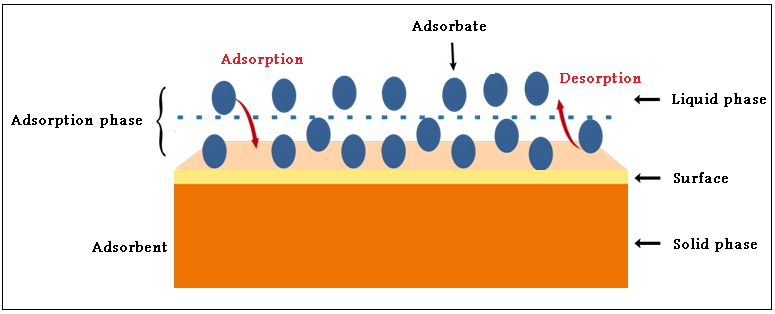
In other words, it is the passage from the dissolved state to the adsorbed state. The opposite phenomenon is desorption. During retention, and depending on the categories of attractive forces, the amount of energy released and the nature of the bonds involved, two types of adsorption can be distinguished: physical adsorption and chemical adsorption.
Adsorption capacity depends on a number of parameters, such as the physicochemical properties of the adsorbent, i.e. specific surface area, granulometry and porosity. And the chemical properties of the adsorbate, such as pH of the reaction medium and temperature (Tables 1-3).
| Properties | Physisorption | Chemisorption | |
|---|---|---|---|
| Température | Relativement basse | Plus élevée | |
| Type of connection, | Type physics | Chemical type | |
| Adsorbate-adsorbent | Van der Waals | Covalent or ionic | |
| Energy | Weak | High | |
| Desorption | Easy | Difficult | |
| Kinetics | Very fast | Very slow | |
| Separation techniques | Advantages | Disadvantages | |
| Physicochemical methods | Adsorption | High adsorption capacity for all heavy metals | Low surface area for some adsorbents |
| Physicochemical methods | Membrane filtration | Effective for all heavy metals with high quality effluents | Suitable for treating low volume and production of sludge. |
| Physicochemical methods | Ion exchange | No loss of sorbents | Organic contamination of resin |
Table 1: Main characteristics of physisorption and chemisorption.
| Ci (mg.L-1) | pH | R (%) | T (°C) | Reference | |
|---|---|---|---|---|---|
| Orange peel | 50 | 5.5 | 100 | 25 | [20] |
| Activated carbon from Rice Hulls | 15 | 5.5 | 98 | 25 | [21] |
| chitin-based | 300 | 7 | 75 | 25 | [22] |
| Chitosane | 300 | 7 | 70 | 25 | [22] |
| Modified chitosane | 300 | 7 | 85 | 25 | [22] |
| Modified orange peel | 50 | 5.5 | 95 | 30 | [23] |
| Sawdust of Meranti wood | 100 | 95 | 95 | 30 | [24] |
| Natural bentonite | 50 | 5 | 65 | 30 | [25] |
Table 2: Performance of adsorption processes for the elimination of Cu2+ using different adsorbents.
Conclusion
In this study, the selected physicochemical processes show great performance for the retention of Cu2+ ions. Adsorption is an alternative solution for retaining metal ions in wastewater, particularly Cu2+ ions. In this process the adsorption parameters such as, the initial concentration of adsorbent, Temperature, pH of the solution well control the difference in the retention rate for the different materials.
References
-
Bouhdadi R, El Moussaouiti M, George B, Molina S, Merlin A (2011) Acylation de la cellulose par le chlorhydrate de chlorure de 3-pyridinoyl : Application dans l’adsorption du plomb Pb2+. Comptes Rendus Chimie 14(6): 39-547.
-
Guo L, Liu Y, Dou J, Huang Q, Lei Y, et al. (2020) Surface modification of carbon nanotubes with polyethyleneimine through “mussel inspired chemistry” and “mannich reaction” for adsorptive removal of copper ions from aqueous solution. J Environ Chem Eng 8(3): 103721.
-
Joseph J, Radhakrishnan RC, Johnson JK, Joy SP, Thomas J (2020) Ion-exchange mediated removal of cationic dye- stuffs from water using ammonium phosphomolybdate. Mater Chem Phys 242: 122488.
-
Mansor ES, Alib H, Abdel Karim A (2020) Efficient and reusable polyethylene oxide/polyaniline composite membrane for dye adsorption and filtration. Colloids Interface Sci Commun 39: 100314.
-
Beluci NCL, Mateus GAP, Miyashiro CS, Homem NC, Gomes RG, et al. (2019) Hybrid treatment of coagulation/ flocculation process followed by ultrafiltration in TIO2- modified membranes to improve the removal of reactive black 5 dye. Sci Total Environ 664: 222-229.
-
Chang PR, Zheng P, Liu B, Anderson DP, Yu J, et al. (2011) Characterization of magnetic soluble starch- functionalized carbon nanotubes and its application for the adsorption of the dyes. J Hazard Mater 186(2-3): 2144-2150.
-
Shan R, Yan L, Yang Y, Yang K, Yu SJ, et al. (2014) Magnetic Fe3O4/ MgAl-LDH composite for effective removal of three red dyes from aqueous solution. Chem Eng J 252: 38-46.
-
Harrelkas F, Azizi A, Yaacoubi A, Benhammou A, Pons MN (2009) Treatment of textile dye effluents using coagulation-flocculation coupled with membrane processes or adsorption on powdered activated carbon. Desalination 235(1-3): 330-339.
-
Pang FM, Teng SP, Teng TT, Omar AKM (2009) Heavy metals removal by hydroxide precipitation and coagulation- flocculation methods from aqueous solutions. Water Qual R J Canada 44(2): 174-182.
-
El Samrani AG, Lartiges BS, Villiéras F (2008) Chemical coagulation of combined sewer overflow: heavy metal removal and treatment optimization. Water Res 42: 951- 960.
-
Hargreaves AJ, Vale P, Whelan J, Alibardi L, Constantino C, et al. (2018) Impacts of coagulation–flocculation treatment on the size distribution and bioavailability of trace metals (Cu, Pb, Ni, Zn) in municipal wastewater. Water Res 128: 120-128.
-
Kang SY, Lee JU, Moon SH, Kim KW (2004) Competitive adsorption characteristics of Co2+, Ni2+ and Cr3+ by IRN- 77 cation exchange resin inn synthesized wastewater. Chemosphere 56(2): 141-147.
-
Salleh MAM, Mahmoud DK, Karim WAWA, Idris A (2011) cationic and anionic dye adsorption by agricultural solid wastes: A comprehensive review. Desalination 280: 1-13.
-
Dawood S, Sen TK (2012) Removal of anionic dye Congo red from aqueous solution by raw pine and acid- treated pine cone powder as adsorbent: equilibrium, thermodynamic, kinetics, mechanism and process design. Water Res 46(6): 1933-1946.
-
Hamid S Abd, Shahadat M, Ballinger B, Farhan Azha S, Ismail S, et al. (2020) Role of clay-based membrane for removal of copper from aqueous solution. J Saudi Chem Soc 24(10): 785-798.
-
Li R, Ren Y, Zhao P, Wang J, Liu J, et al. (2019) Graphitic carbon nitride (g-C3N4) nanosheets functionalized composite membrane with self-cleaning and antibacterial performance. J Hazard Mater 365: 606-614.
-
Abdullah WNAS, Tiandee S, Lau W, Aziz F, Ismail AF (2020) Potential use of nanofiltration like-forward osmosis membranes for copper ion removal. Chin J Chem Eng 28: 420-428.
-
Zunita M, Irawanti R, Koesmawati TA, Lugito G, Wenten IG (2020) Graphene oxide (GO) membrane in removing heavy metals from wastewater: A Review. Chem Eng Trans 82: 415-420.
-
Ayob S, Othman N, Altowayti WAH, Khalid FS, Bakar NA, et al. (2021) Review on Adsorption of Heavy Metals from Wood-Industrial Wastewater by Oil Palm Waste. Ecol Eng 22(3): 249-265.
-
Liang S, Guo X, Feng N, Tian Q (2010) Isotherms, kinetics and thermodynamic studies of adsorption of Cu2+ from aqueous solutions by Mg2+/K+ type orange peel adsorbents. Journal of Hazardous Materials 174(1-3): 756-762.
-
Teker M, İmamoğlu M and Saltabaş Ö (1999) Adsorption of Copper and Cadmium lons by Activated Carbon From Rice Hulls. Turkish Journal of Chemistry 23(2): 185-192.
-
Labidi A, Salaberria AM, Fernandes SCM, Labidi J, Abderrabba M (2016) Adsorption of copper on chitin- based materials: Kinetic and thermodynamic studies. Journal of the Taiwan Institute of Chemical Engineers 65: 140 148.
-
Feng N, Guo X (2012) Characterization of adsorptive capacity and mechanisms on adsorption of copper, lead and zinc by modified orange peel. Transactions of Nonferrous Metals Society of China 22(5): 1224-1231.
-
Anees A, Mohd R, Othman S, Mahamad HI, Yap Yee Chii, et al. (2009) Removal of Cu(II) and Pb(II) ions from aqueous solutions by adsorption on sawdust of Meranti wood. Desalination 250: 636-646.
-
Bourliva A, Michailidis K, Sikalidis C, Filippidis A, Betsiou M (2015) Adsorption of Cd(II), Cu(II), Ni(II) and Pb(II) onto natural bentonite: study in mono- and multi-metal systems. Environ Earth Sci 73: 5435-5444.
- Solution-Processed Chiral Perovskites for Biomedical Applications
- Nanotechnology in Health Chemistry and Medicine: Current Challenges and Future Directions
- Human Exposure to Micro- and Nanoplastics: Pathways, Toxicity, and Intervention Strategies
- Exosome Nanomedicine for Cancer Therapy
- Micro and Nanoplastics–Plastisphere, Biotoxicity, Impact on Human Health, and Mitigation Strategies
- Process Validation of Cefixime Powder for Suspension Dosage Form, 50 mL