
Constraining the Milky Way Dynamic Mass and Newtonian Gravity through the Proper Motion of Messier’s Globular Clusters
The estimation of the proper motion of globular clusters is presented from the oldest observations of Messier's Globular clusters, comparing with NASA-NED and GAIA. The period-distance relationship, without assuming Dark matter models, allows us to limit the dynamic mass of the Milky Way and the invalidity of the Keplerian movement of Globular Clusters. The best fitting data are 2.3± 0.321014 M for the dynamical mass, and β ≅ −5 3 in agreement with the generalization of the Virial Theorem in large-scale modified Newtonian gravity models.
Introduction
In 1778, Charles Messier included in his catalog of comet-like objects the most notable globular clusters (GC) in the northern celestial hemisphere [1]. There are 29 globular clusters on Messier’s list; in galactic Halo. Although the Messier’s Globular Clusters are a small sample, their importance lies in the fact that their positions have been known for more than two centuries, which makes it possible to estimate their proper motion (PM), which must be small considering that they are objects in the galactic halo. A century later, Johann LE Dreyer expanded the Messier Catalog, listing the 7840 of the deep sky objects [2], known as the New General Catalog (NGC). Currently the GCs are listed in the “Catalog of Parameters for Milky Way Globular Clusters” which contains the basic parameters for the 157 Milky Way Globular clusters [3]; that is permanently updated and available on the website [4].
Timing of the apparent positions of the GC is important to measure its proper motion, on the order of only a few milliarcsecond per year for distant objects, such as GCs with a parallax distance in the range of 1 to 20 kiloparsec. The latest satellite technologies have made it possible to evaluate proper motion in just a few years of observation, with fewer uncertainties than astrometric measurements evaluated in several different decades or centuries. Hence recent satellite telescopes, such as the High Precision Parallax Collecting Satellite (HIPPARCOS), operational mission 1989-1993; and its successor, the Global Astrometry Interferometer for Astrophysics. (GAIA), launched in 2013, has allowed us to estimate the period of revolution around the center of the Milky Way for Messier globular clusters, with better or similar astrometric parallax than the accumulated observations.
Also, recently the distance of the CGs has been able to be measured independently of their apparent motion, in all Messier’s GCs using Cepheid and RR-Lyrae stars [5, 6]. Then the period-distance relationship can be evaluated directly for Messier’s GCs, and useful as test of Newtonian gravity in the range of 1-20 kpc of the comoving distance. Remember that the thirds Kepler’s law predict that the period of the anybody, under Newtonian Gravity, is proportional to r3/2. This is important because the rotation curves in the galactic disk are usually related to the hypothetical dark matter halo, so we can ask if the GCs obey Kepler’s law?, and if not, what is the period- distance relationship within those GCs galactic scales?.
The rotation curves for the stars of the galactic disk and the GCs proper motion seem to indicate that Kepler’s third law is not verified and that, consequently, there are strong discrepancies between observations and gravitation. Although it is true that the mass of the Milky Way has been estimated in the order of 1012 M ε, in recent reports [7, 8, 9, 10] using data from GAIA and HIPPARCOS, it must be noted that they have assumed the existence of a certain amount of dark matter, i.e. virial mass of the Milky Way dark matter halo. This implies that these estimates cannot be considered with certainty, at least until the nature and composition of that hypothetical and paradigmatic dark matter is elucidated.
For the other hand, there are several alternatives cosmological paradigms to explain FRW-cosmology without assuming the unobservable non-baryonic dark matter. The modification of Newtonian dynamics MoND- Milgrom M [11]; Yukawa’s cosmology [12], and the modification of the gravity by explicitly incorporating Mach’s Principle through an additional term large-scale in the gravitation [13, 14].
The objective of the present report is to constrain the mass of the Milky Way derived from observations of the proper motion of globular clusters independently of the assumed cosmology, its is the crude estimations of dynamical Milky Way mass. For this, we describe the processing of the GCs and the calculation of the period in section 2. Next, the results of the period-distance relationship are shown in section 3, for the original catalogs of Messier, Dreyer, and Harris, along with the comparison with data of GAIA and NASA Extragalactic Data System (NED-NASA). The discussion on the estimation of the dynamical mass of the Milky Way and its link to Kepler’s third law is summarized in section 4, using the formal generalization of the virial theorem in a modified gravity cosmology [15]. Finally, the conclusions are shown in the last section.
Methodology
The objective is to evaluate the proper motion of the most notable globular clusters, with historical records of their apparent position in the catalogs of Messier, Dreyer and Harris. Knowing the apparent angular displacement and assuming that the orbits of the GCs are regular conical, the period of revolution around the galactic center can be estimated. Regardless, the distance to the galactic center is obtained from recent catalogs of observations of Cepheid and RR-Lyrae stars in CG. The CGs apparent positions, in equatorial coordinates ( ) , α δ listed in each catalog, are corrected by equinox for epoch 2025. Next, both ephemeris are converted to galactic coordinates: old-catalogue (b0,l0) and NED-NASA (b,l) , estimating the proper motion between both ephemeris. Also the heliocentric distances (D), from the direct measurements of Cepheids and RR-Lyrae stars, are converted to galactocentric distances (r), using the geometry of Figure 1. It is assumed d_SMW_=8 kpc for the sun-galactic center distance [16]. The M54 is omitted because it is currently considered part of the Sagittarius Dwarf A galaxy stream [17]. M107 is not included either, which was added later to the publication of the Messier catalog, by Pierre Mechain. We use the proper motion of Messier’s GCs measure, reported by Vasiliev from the GAIA data [18]. We use the distances (D) of the globular clusters inferred from the periodic variable stars [5, 6] and not those obtained through parallax and/or kinetic estimates.
![Figure 1: It is assumed d_SMW_=8 _kpc_ for the sun-galactic center distance [16]. The M54 is omitted because it is currently considered part of the Sagittarius Dwarf A galaxy stream [17]. M107 is not included either, which was added later to the publication of the Messier catalog, by Pierre Mechain. We use the proper motion of Messier’s GCs measure, reported by Vasiliev from the GAIA data [18]. We use the distances (D) of the globular clusters inferred from the periodic variable stars [5,6] and not those obtained through parallax and/or kinetic estimates.](/fulltextimages/12284/fig_1.png)
The thirds Kepler’s law predict that:
2 3 M T r A yr M kpc =
ε (1) Where
$$ A = \frac {4 \pi^ {2} k p c ^ {3}}{G 1 . 9 9 1 0 ^ {3 0} y r ^ {2}} \approx 9. 2 9 1 0 ^ {2 4}, $$
, and the number of solar masses is M M η ≡ ε , then:
12 $$ \operatorname {L o g} \left| \frac {T}{y r} \right| = \operatorname {L o g} \left| \frac {3 1 0 ^ {1 2}}{\eta^ {1 / 2}} \right| + \frac {3}{2} \operatorname {L o g} \left| \frac {r}{k p c} \right| \tag {2} $$ As the period T of the motion of the globular clusters is obtained from the proper motion, and independently the distance r from the variable stars, for the catalogs of the GCs, then relations (Equation 2) allow obtaining the dynamic mass of the Milky Way, thus How to evaluate how far the distribution is from the proportionality of r3/2.
Result
The Table 1 repot the basic data for GCs in Messier’s catalogue. The first columns are the name, the equatorial coordinates, right ascension (𝛼) and declination (𝛿), by epoch in original measurement and the corrections for the equinox 2025, the next columns to shown the galactic coordinates, and finally the proper motion and the GC’s orbital period.
| M | Messier Position | Position 2025 | Galactic Coordinates 2025 | PM | Period | ||||
|---|---|---|---|---|---|---|---|---|---|
| 𝛼 [h: ’ :”] | 𝛿 [ ° : ‘ : ‘’ ] | Epoch | 𝛼 [h:’:”] | 𝛿 [ ° : ‘ : ‘’ ] | l [ ° ] | b [ ° ] | [ °/yr ] | [Myr] | |
| 2 | 21:21:08 | -01:47:00 | 1760 | 34:46.8 | -00:37:14.8 | 53.472 | -35.73 | 0.00155 | 1.06 |
| 3 | 13:31:25 | +29:32:57 | 1764 | 43:27.5 | 28:13:31 | 42.074 | 78.683 | 0.00098 | 1.67 |
| 4 | 16:09:08 | -25:55:40 | 1764 | 25:04.8 | -26:33:30.9 | 350.985 | 15.995 | 0.00035 | 4.63 |
| 5 | 15:06:36 | +02:57:16 | 1764 | 19:46.7 | 59:15.4 | 3.845 | 46.802 | 0.00136 | 1.19 |
| 9 | 17:05:22 | -18:13:26 | 1764 | 20:37.3 | -18:31:11.6 | 5.557 | 10.724 | 0.00556 | 0.29 |
| 10 | 16:44:48 | -03:42:18 | 1764 | 58:32.7 | -04:07:54.9 | 15.153 | 23.063 | 0.00188 | 0.87 |
| 12 | 16:34:53 | -02:30:28 | 1764 | 48:30.7 | -02:30:41 | 14.763 | 25.79 | 0.00653 | 0.25 |
| 13 | 16:33:15 | +36:54:44 | 1764 | 42:33.8 | 24:09.6 | 58.993 | 40.915 | 0.00058 | 2.82 |
| 14 | 17:25:14 | -03:05:45 | 1764 | 38:55.2 | -03:16:21 | 21.312 | 14.797 | 0.00267 | 0.61 |
| 15 | 21:18:41 | +10:40:03 | 1764 | 31:19.5 | 48:03.2 | 64.623 | -27.64 | 0.00187 | 0.87 |
| 19 | 16:48:07 | -25:54:46 | 1764 | 04:13.3 | -26:18:44.5 | 356.866 | 9.368 | 0.00706 | 0.23 |
| 22 | 18:21:55 | -24:06:11 | 1764 | 37:51.0 | -23:54:50.8 | 9.856 | -7.551 | 0.00081 | 2.01 |
| 28 | 18:09:58 | -24:57:11 | 1764 | 26:01.3 | -24:50:20.7 | 7.805 | -5.561 | 0.00223 | 0.73 |
| 30 | 21:27:05 | -24:19:04 | 1764 | 41:57.8 | -23:08:51.3 | 27.08 | -46.9 | 0.0021 | 0.78 |
| 53 | 13:02:02 | +19:22:44 | 1777 | 14:11.1 | 03:30.9 | 333.072 | 79.779 | 0.0012 | 1.29 |
| 55 | 19:26:02 | -31:26:27 | 1778 | 41:44.1 | -30:53:35 | 8.817 | -23.3 | 0.00202 | 0.76 |
| 56 | 19:08:00 | +29:48:14 | 1779 | 17:35.4 | 13:54.1 | 62.664 | 8.333 | 0.00086 | 1.78 |
| 62 | 16:47:14 | -29:45:30 | 1779 | 02:51.7 | -30:08:29 | 353.587 | 7.313 | 0.00441 | 0.35 |
| 68 | 12:27:38 | -25:30:20 | 1780 | 40:34.7 | -26:51:16.6 | 299.564 | 36.074 | 0.00106 | 1.44 |
| 69 | 18:16:47 | -32:31:45 | 1780 | 32:46.8 | -32:22:55 | 1.652 | -10.25 | 0.00579 | 0.26 |
| 70 | 18:28:53 | -32:31:07 | 1780 | 44:51.0 | -32:18:00.4 | 2.822 | -12.53 | 0.00521 | 0.29 |
| 71 | 19:43:57 | +18:13:00 | 1780 | 54:52.3 | 50:36.4 | 56.742 | -4.562 | 0.0006 | 2.54 |
| 72 | 20:41:23 | -13:20:51 | 1780 | 54:51.5 | -12:26:03 | 35.173 | -32.69 | 0.00179 | 0.85 |
| 75 | 19:53:10 | -22:32:23 | 1780 | 07:38.4 | -21:51:20 | 20.304 | -25.77 | 0.00201 | 0.76 |
| 79 | 5:15:16 | -24:42:57 | 1780 | 25:21.1 | -24:28:50.7 | 227.217 | -29.31 | 0.00072 | 2.13 |
| 80 | 16:04:00 | -22:25:13 | 1781 | 18:31.2 | -23:02:27.6 | 352.667 | 19.462 | 0.02065 | 0.07 |
| 92 | 17:10:32 | +43:21:59 | 1781 | 18:01.3 | 05:49.6 | 68.325 | 34.834 | 0.00053 | 2.85 |
Table 1: Basic Data GCs in Messier’s Catalogue.
Messier’s catalog is more than two hundred years old and, therefore, the CG movement itself is notable.
The equivalent results for the Dreyer J [2] and Harris W [3] catalogs are similar, although with less proper motion and larger uncertainties (Tables A1 & A2 in the appendix).
Table 2 shows the Messier number and NGC for each globular cluster in the first two columns, followed by the heliocentric and galactocentric distances compiled from the references, the NED coordinates and the proper motion and orbital period [18].
| M | NGC | D kpc | r kpc | NED Position 2025 | Galactic Coordinates | GAIA PM [ °/Yr ] | Period [Myr] | ||
|---|---|---|---|---|---|---|---|---|---|
| 𝛼 [h:’:”] | 𝛿 [ ° : ‘ : ‘’ ] | l [ ° ] | B [ ° ] | (Vasiliev 2019) | |||||
| 2 | 7089 | 11.7 | 10.5 | 33:33.2 | -00:48:51.7 | 53.371 | -35.77 | 4.12035787 | 5.49 |
| 3 | 5272 | 10.2 | 12 | 42:16.8 | 21:55.4 | 42.217 | 78.707 | 2.6508061 | 8.53 |
| 4 | 6121 | 1.85 | 6.27 | 23:42.8 | -26:31:48.3 | 350.973 | 15.972 | 22.7384718 | 0.99 |
| 5 | 5904 | 7.48 | 6.21 | 18:39.8 | 04:31.7 | 3.859 | 46.796 | 10.6644925 | 2.12 |
| 9 | 6333 | 8.1 | 1.72 | 19:18.8 | -18:31:05.6 | 5.544 | 10.707 | 3.91072628 | 5.78 |
| 10 | 6254 | 5.07 | 4.22 | 57:15.3 | 06:08.5 | 15.137 | 23.076 | 8.09956771 | 2.79 |
| 12 | 6218 | 5.11 | 4.44 | 47:20.8 | -01:57:04.7 | 15.715 | 26.313 | 6.80346125 | 3.32 |
| 13 | 6205 | 7.6 | 8.64 | 41:45.9 | 27:27.3 | 59.007 | 40.913 | 4.08762034 | 5.53 |
| 14 | 6402 | 9.1 | 3.96 | 37:42.5 | -03:14:49.2 | 21.52 | 14.91 | 6.21295622 | 3.64 |
| 15 | 7078 | 10.7 | 10.7 | 30:04.2 | 10:32.4 | 65.013 | -27.313 | 3.81754083 | 5.93 |
| 19 | 6273 | 8.34 | 1.49 | 02:45.1 | -26:16:14.5 | 356.869 | 9.382 | 3.63749708 | 6.22 |
| 22 | 6656 | 3.3 | 4.82 | 36:31.5 | -23:54:06 | 9.892 | -7.552 | 11.2946066 | 2 |
| 28 | 6626 | 5.37 | 2.84 | 24:40.3 | -24:52:07.1 | 7.798 | -5.581 | 8.91808107 | 2.54 |
| 30 | 7099 | 8.46 | 7.25 | 40:28.8 | -23:10:11.8 | 27.179 | -46.836 | 7.30404525 | 3.1 |
| 53 | 5024 | 18.5 | 19 | 13:01.1 | 09:30.7 | 332.964 | 79.764 | 1.36305869 | 16.59 |
| 55 | 6809 | 5.35 | 3.84 | 40:07.0 | -30:57:26.5 | 8.793 | -23.272 | 9.87981584 | 2.29 |
| 56 | 6779 | 9.6 | 9.28 | 16:40.2 | 11:17.4 | 62.66 | 8.336 | 2.60444543 | 8.68 |
| 62 | 6266 | 6.41 | 2.02 | 01:20.3 | -30:06:54.7 | 353.574 | 7.318 | 5.84174503 | 3.87 |
| 68 | 4590 | 10.4 | 10.3 | 39:34.4 | -26:45:14.4 | 299.626 | 36.051 | 3.26774356 | 6.92 |
| 69 | 6637 | 8.9 | 1.74 | 31:31.1 | -32:20:47.2 | 1.723 | -10.27 | 7.74168832 | 2.92 |
| 70 | 6681 | 9.36 | 2.33 | 43:20.5 | -32:17:23.3 | 2.853 | -12.51 | 4.90949162 | 4.61 |
| 71 | 6838 | 4 | 6.7 | 53:51.5 | 47:01.3 | 56.746 | -4.565 | 4.30060705 | 5.26 |
| 72 | 6981 | 16.7 | 12.6 | 53:34.5 | -12:31:45.9 | 35.163 | -32.683 | 3.51345827 | 6.44 |
| 75 | 6864 | 20.7 | 14.6 | 06:11.9 | -21:54:59 | 20.304 | -25.747 | 2.85329371 | 7.93 |
| 79 | 1904 | 13.3 | 19.2 | 24:15.5 | -24:31:21 | 227.23 | -29.35 | 2.9258192 | 7.73 |
| 80 | 6093 | 10.3 | 4.06 | 17:09.7 | -22:58:47.8 | 352.673 | 19.463 | 6.30117806 | 3.59 |
| 92 | 6341 | 8.2 | 9.57 | 17:11.0 | 43:08:04 | 68.338 | 34.859 | 4.95408125 | 4.57 |
Table 2: Basic Data GCs in NED-GAIA Catalogue.
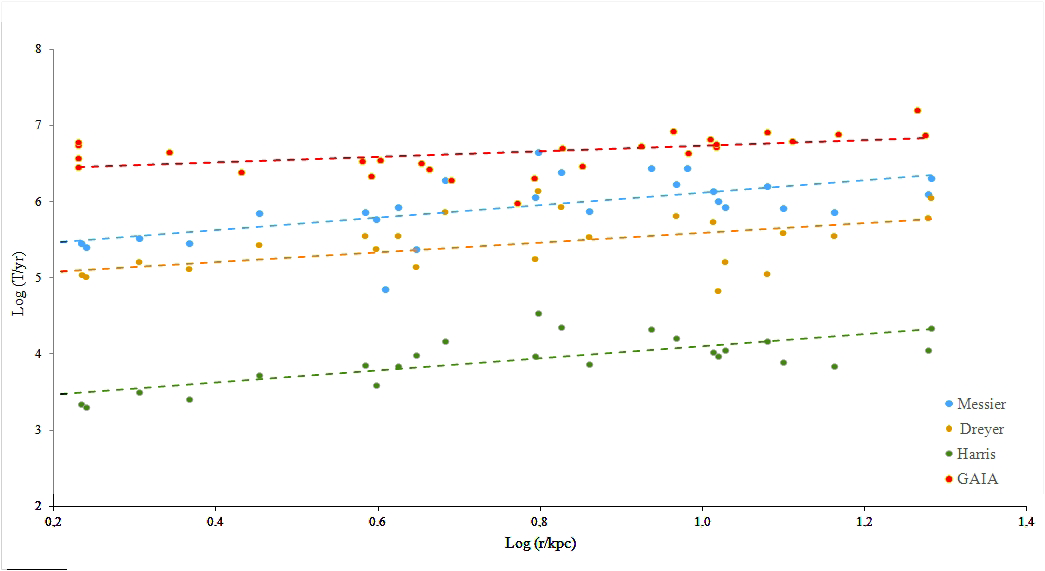
In Figure 2, Equation 2 is used together with the data on the galatocentric distances (Table 2) and the GC periods for each catalogue. It is evident that the dynamics of Gc does not obey Kepler’s third law and consequently, the dynamics of these objects do not verify the law of the inverse square of the Newtonian gravitation distance. The data from the different catalogs are consistent with each other. Table 3 summarizes the parameters of the linear distribution.
On average, the slope is less than 50% of that expected, with the minimum value for the GAIA data (0.37) and the highest for the Harris catalog (0.79). The linear fit is weakly in the GAIA catalogue, and is significant in the other
- historical catalogues: Messier M [1], Drayer J [2] and Harris
- W [3]. The intercept in Equation 2 allows us to evaluate the mass of the Milky Way. The results show different values according to the statistics of each catalog, then the Harris
- Catalogue
- Slope
- Interception
- Pearson Coeff. β
- (
- )
- 14
- 10
- M η
-
- GAIA
- 0.37 ± 0.25
- 6.36 ± 0.33
- 0.47
- -2.3
- 0.017
- Messier
- 0.83 ± 0.42
- 5.30 ± 0.32
- 0.64
- -1.4
- 2.26
- Dreyer
- 0.64 ± 0.41
- 4.95 ± 0.34
- 0.53
- -1.7
- 11.3
- Harris
- 0.79 ± 0.35
- 3.31 ± 0.33
- 0.75
- -1.4
- 261.6
- Mean
- 0.66 ± 0.21
- 4.98 ± 1.26
- 0.6
- -1.7
- 9.87
Table 3: Tuning Parameters of the Period-Distance Relation for CG Catalogs.
Discussion
For the Messier’s Catalog, which would correspond to the largest proper motion, it prescribes 2 14 10 M ε, one hundred times more than the aforementioned estimates, with a significant correlation in the linear fit. Table 4 summarizes the comparison of the mass of the Milky Way with recent previous reports. Be warned that the other assumed non- baryonic dark matter in the virial halo of the Milky Way.
| M (1012 $M_{\odot}$) | |
|---|---|
| Falcon et al (present report) | 230 ± 25% |
| Fragione and Loeb 2017 | 1.55 ± 0.35 |
| Watkins et al 2019 | 0.21 ± 0.04 |
| Callingham et al 2019 | 1.17 ± 0.20 |
| McMillan et al 2016 | 1.30 ± 0.30 |
| Kafle et al 2012 | 0.90 ± 0.40 |
Table 4: Dynamic Mass of the Milky Way, Ref: Watkins, et al. [19].
The CGs move in the halo of the Milky Way. The structure, composition, density and temperature of the galactic halo continue to be the subject of debate and precise measurements with several X-ray and gamma- ray space telescopes. Recent observations with eROSITA telescope, report soft-X-ray-emitting bubbles, that extend approximately 14 kpc above and below the Galactic centre [20]. This double bubble is the envelope of the already known Fermi Bubble, which is the double bubble that emits gamma rays, known for a decade. How this hot plasma interacts with galactic dynamics and how magneto hydrodynamic waves propagate in the halo is currently the subject of important theoretical advances and observations [21, 22]. However, uncertainty still prevails regarding the radius of the galactic halo, and its average density is estimated to be of the order of 3-7 10-25 g/cm3. The Clusters AM1 035 02.3 -493655 is the most distant globular cluster in the Milky Way, located 124.6 kpc from the galactic center [3, 4], so we can affirm that this is the lower limit of the radius of the galactic halo. Then the gas masses in the halo is the order to ~1014 M⊙, in agreement with previous results.
But the mass, calculated by the Virial Theorem, implicitly assumes that gravitation is the Inverse Law of the Square of Distance (Newtonian Gravity). In the general Falcon N [15] the Virial Theorem is: Beginning the Clausius's Virial Expression then (Equation 3):
$$\frac{1}{\tau} \int_{0}^{r} \frac{dG}{dt} dt' = \frac{1}{\tau} \sum_{i} -\nabla U_{i} \vec{r} dt' + \frac{1}{\tau} \sum_{i} \frac{p_{i}^{2}}{2m_{i}} dt'$$ (3)
The left member of the Virial expression of Clausius cancels out when the motion is periodic. Now, we considered any large scale Newtonian Gravity modification; such as that proposed by Falcon N [14]. The general idea is that all particles with non-null rest mass are subject to the force of gravity through the inverse square law of gravitation, plus an additional term that varies with the comoving distance (Equation 4) [14].
$$U(r) = U_{N} + U_{VF} = -\frac{GM}{r} + U_{0}(M)(r-r_{0})e^{-\alpha/r}$$ (4)
Where $r$ is the comoving distance, and $\alpha$ and $r_{0}$ are known parameters [14, 15]. This complementary contribution to the inverse square law would be caused by the large-scale distribution of baryonic mass, in the sense of Mach's principle. The additional force term would be zero at comoving distance ranges on the order of the Solar System, weakly attractive at interstellar distance ranges, very attractive at distance ranges comparable to galaxy clusters, and repulsive at cosmic scales. Then, the Clausius's Virial looks like [15].
The second term in Equation 5 is null for the range of GCs distances, but the last term is not null. To calculate the integral it is necessary to model the mass distribution of the Milky Way, with details of the geometry of the bar, the disk, the arms and the satellite dwarf galaxies, among other uncertainties. Note that this term is usually omitted in the simplified Virial expression; that is, in Newtonian gravity. But we can approximate this integral by arguing that its mean value is proportional to the baryon mass distribution (Milky Way), and also proportional to $r-\beta$. Therefore, the Virial of Clausius is:
$$\frac{4\pi^{2}r^{2}}{T^{2}} = \frac{GM}{r} + \frac{GM(kpc)^{\beta-1}}{r^{\beta}}$$ (6)
Then, the period-distance relation in logarithmic scale is now:
$$\log \left| \frac{T}{yr} \right| = \log \left| \frac{3 \times 10^{12}}{\eta^{1/2}} \right| + \frac{3+\beta}{2} \log \left| \frac{r}{kpc} \right|$$ (7)
Thus, if $\beta \approx -5/3$, we obtain the results $\eta \alpha 10^{14} M_{\odot}$. Figure 2 without invoking non-baryonic dark matter.
Conclusions
The Messier's GCs have proper motion measurable in historical astrometric catalogues. The movement of GCs is not Keplerian and consequently they do not comply with the law of the inverse square of distance (Newton's gravity). The method used of astrometric measurements to evaluate the proper motion of the CGs, and the independent use of distance using regular variable stars, allows us to limit the mass of the Milky Way without assuming the hypothetical and undetected non-baryonic dark matter. So our results can describe the dynamics of the galaxy independently of cosmological hypotheses. It is interesting that the large-scale modification of Newtonian Gravitation, through the widespread use of the Virial Theorem, would explain the deviation observed in Kepler's third law applied to the dynamics of Globular clusters.
On the other hand, the recent detections of hot gas in the galactic halo will allow us to evaluate the masses content of the halo, which is an important fraction of the mass and which must have dynamic effects on the movement of the CGs and the stars of the halo. Let us remember that the mass in gas is the main contribution to the mass of clusters of galaxies, since the dimensions grow with the radius cubed despite their low density, on the order of one thousandth of the interstellar medium. Therefore, the detection of CG at hundreds of kiloparsecs in the Milky Way invites us to set up models to estimate the electron density and plasma temperature in the X- and gamma-ray bubbles. The electronic density would result from the order of the atomic density of the medium, since in a first approximation the halo gas must be in hydrodynamic equilibrium.
The best fitting data are $2.3 \pm 0.3210^{14} M_{\odot}$ for the dynamical mass, and $\beta \approx -5/3$, in agreement with the generalization of the Virial Theorem in large-scale modified Newtonian gravity models [14, 15, 23]. The distribution of the globular clusters, the halo stars, the stellar streams of Minor Can and Sagittarius, as well as the satellite galaxies including the Magellanic clouds, should cause a gravitational potential that affects the proper motion of each globular cluster considered, diverting them from his Keplerian trajectory. These effects are not prescribed in Newtonian gravitation; its incorporation through an additional large-scale term, justified by Mach's principle, could solve the problem without the hypothesis of an undetectable non-baryonic matter (dark matter).
Acknowledgment
Thanks by the open facilities in website: (1) High Energy Astrophysics Department Space Research Institute (IKI). Universal Coordinates Converter. http://hea.iki. rssi.ru/AZT22/ENG/cgi-bin/c_prec4.htm (2) NASA/IPAC Extragalactic Database: http://nadwww.ipac.caltech.edu/
References
-
Messier C (1781) Catalog of Nebulae and Star Clusters Observed at the Marine Observatory, Clugni hotel, rue des Mathurins. In: Knowledge of the Times (Edn.), Royal Academy of Sciences pp: 225-251.
-
Dreyer J (1888) A New General Catalogue of Nebulæ and Clusters of Stars. In: late Sir John FW (Eds.), Herschel, Bart, revised, corrected, and enlarged. Memoirs of the Royal Astronomical Society 49: 1.
-
Harris W (1996) A catalog of parameters for globular clusters in the Milky Way. Astronomical Journal 112: 1487.
-
Harris WE (2010) A New Catalog of Globular Clusters in the Milky Way arXiv pp: 1-6.
-
Baumgard H, Vasiliev E (2021) Accurate distances to Galactic globular clusters through a combination of Gaia EDR3, HST, and literature data. MNRAS 505(4): 5957- 5977.
-
Ferro AA (2022) A vindication of the RR Lyrae Fourier light curve decomposition for the calculation of metallicity and distance in globular clusters. RMAA 58(2): 257-271.
-
Kafle PR, Sharma S, Lewis GF, Hawthorn JB (2012) Kinematics of the Stellar Halo and the mass distribution of the Milky Way using blue horizontal branch stars. ApJ 761(98): 1-17.
-
Fragione G, Loeb A (2017) Constraining Milky Way mass with Hypervelocity Stars. New Astronomy 55: 32-38.
-
Sohn ST, Watkins LL, Fardal MA, Deason AJ, Besla G, et al. (2018) Absolute Hubble Space Telescope Proper Motion (HSTPROMO) of Distant Milky Way Globular Clusters: Galactocentric Space Velocities and the Milky Way Mass. ApJ 862(52): 1-17.
-
Callingham TM, Cautun M, Deason AJ, Frenk CS, Wang W, et al. (2019) The mass of the Milky Way from satellite dynamics. MNRAS 484(4): 5453-5467.
-
Milgrom M (2001) MOND: A Pedagogical Review. Acta Phys Polon B 32(2001): 3613-3627.
-
Jusufi K, Leon G, Millano AD (2023) Dark Universe phenomenology from Yukawa potential. Physics of the Dark Universe 42: 1-10.
-
Falcon N (2013) Modification of the Newtonian Dynamics in ΛFRW-Cosmology an Alternative Approach to Dark Matter and Dark Energy. JMP 4(8): 10-18.
-
Falcon N (2023) Modified Gravitation and Mach’s Principle: An Alternative to the Dark Matter and Dark Energy Cosmological Paradigm. OAJA 1(1): 1-9.
-
Falcon N (2021) A large-scale heuristic modification of Newtonian gravity as an alternative approach to dark energy and dark matter. J Astrophys Astron 42: 102.
-
McMillan PJ (2017) The mass distribution and gravitational potential of the Milky Way. MNRAS 465(1): 76-94.
-
Siegel M, Dotter A, Majewski SR, Sarajedini A, Chaboyer B, et al. (2007) The ACS Survey of Galactic Globular Clusters: M54 and Young Populations in the Sagittarius Dwarf Spheroidal Galaxy. ApJL 667(1): 57-60.
-
Vasiliev E (2019) Proper motions and dynamics of the Milky Way globular cluster system from Gaia DR2. MNRAS 484(2): 2832-2850.
-
Watkins L, Van Der Marel RP, Sohn ST, Evans NW (2019) Evidence for an Intermediate-mass Milky Way from Gaia DR2 Halo Globular Cluster Motions. ApJ 873(118): 1-16.
-
Predehl P, Sunyaev RA, Becker W, Brunner H, Burenin R, et al. (2020) Detection of large-scale X-ray bubbles in the Milky Way halo. Nature 588: 227-231.
-
Sarkar S, Sett A, Pramanick S, Ghosh T, Das C, et al. (2022) Homotopy Study of Spherical Ion-Acoustic Waves in Relativistic Degenerate Galactic Plasma. IEEE Transactions on Plasma Science 50(6): 1477-1487.
-
Chandra S, Chaudhuri C, Sarkar J, Das C (2023) Degeneracy affected stability in ionospheric plasma waves. Pramana 98(2): 1-13.
-
Falcon N, Aguirre A (2014) Theoretical Deduction of the Hubble Law Beginning with a MoND Theory in Context of the ΛFRW-Cosmology. IJAA 4(4): 551-559.
- Asymmetry Irreversible Heterogeneity Quantum Cosmology Grand Mathematical PHYSICS
- Early Universe: Hadronic Crystals Coherent Micro Gravitational Wave Emitters PHYSICS Part II
- The Solar System Constraint Maze: A Scientific Dead-End Revealing the Interuniversal Machine
- Assessment of Radiofrequency Radiation from 2G and 3G Mobile Phone Handsets
- Early Universe Magneto-Gravitational Coupling Genesis Physics: Part I
- Falsifiability of the Classical Law of Gravitation and Unveiling the Time-temperature Entanglement of the Universe