
On the Origin of the Moon and the Continents
All astronomical bodies originate inside clouds of gas and dust, therefore there should be a common process that leads to their condensation. In a galactic cloud there is always a gradient of speeds from point to point. Thanks to it, vortices originate that rake the material of the surrounding cloud gradually forming large gaseous disks, inside which vortices of second order develop that concentrate the matter of their orbits forming smaller and much denser disks, within which third order vortices further concentrate the matter. The dense cores of these vortices finally condense in massive bodies: sun, planets and satellites. The result should be a well ordered planetary system with no “debris” around and where both planets and satellites obey to a precise rule of the distances from their central body. The solar system complies with these conditions with three main exceptions. First, in an orbit where a large planet should be there is only a huge number of scattered asteroids. Second, Earth and its moon with all evidence were not formed in the same vortex, which means that Moon originated somewhere else. Third, Neptune’s satellite system has been shattered by the intrusion of a foreign body, Triton, and its largest satellites are missing. These exceptions seem to be strictly connected to each other and all due to a unique event, that is: Triton has diverted the largest Neptune satellite towards the Sun. This satellite impacted at high speed against the missing planet, scattering myriads of fragments from its mantle and pushing it towards the sun, where it eventually fell. The planet had at least 4 satellites some of which remained in their previous orbit, but two of them were dragged towards the sun and were captured by Earth. The largest became its lonely moon while the second fell on its surface giving origin to the continents. This event happened about 3,96 billion of years ago, as it is proven by the ages of the numerous samples brought from the moon.
Introduction
The current theory about the origin of our moon maintains that it was formed by material removed from Earth by a catastrophic impact with a foreign body. Not a very convincing hypothesis because, among other things, it assumes that our satellite was born as a result of an extraordinary and unrepeatable event not applicable to other similar satellites of the solar system [1].
No more convincing are the theories about the origin of the other satellites and even less those about the formation of the planets and the stars [2, 3, 4]. For each of them, in fact, different explanations are provided, which seems unlikely. All astronomical bodies, in the end, originate from clouds of gas and dust. The process that leads to their condensation within these clouds should be the same regardless of their size.
Let’s start from stars. Astronomical observations assure that millions of them are still forming in huge galactic clouds of gas so rarefied that in their comparison the strongest vacuum obtainable on Earth is of an exceptional density [5]. Yet it is from this ”vacuum” that the stars are formed. Somehow gas and dust dispersed in vast spaces must be compressed until they are reduced to the tiny size of a star.
The current opinion among astronomers is that the cloud contracts under its own gravitation and starts to rotate until it becomes a huge, flat disk of gas which eventually collapses into a star, while planets, satellites, asteroids and comets condense from the so called planetesimals [6]. This in a nutshell, but it is far from convincing.
How Clouds of Gas Can be Condensed to Form Massive Bodies
The Theory of Vortices: The formation of countless stellar gaseous disks inside a galactic cloud is due to the fact that gas and dust are not stagnant, but there is always a gradient of velocity between their particles [7].
Suppose we are at any fixed point in such a cloud. Looking on one side we would see gas and dust ”flowing” in one direction with speed increasing with the distance; looking on the other side we will see the particles moving in the opposite direction, also with speed increasing with the distance. Therefore, we would be in the middle of two “currents” of matter that move in opposite directions.
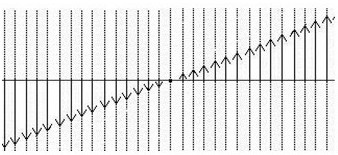
Obviously this is valid whatever the point of the cloud that we take as a reference. If the cloud was homogeneous and the gradient of velocity constant, this situation would remain unchanged indefinitely. There are a several causes, however, that can perturb such a movement, like the explosion of a nova, gravitational actions by nearby bodies and so on. These disturbances can produce local turbulence and cause vortices to arise.
Suppose that in some point of the cloud a thickening of matter has formed, for any reason; it will exert a gravitational action certainly very weak but nevertheless sufficient to divert the slow flow of particles that pass in its immediate vicinity. These instead of continuing in their straight motion begin to rotate around the weak center of gravity, thus creating a vortex. Whichever particle enters the vortex can no longer get out of it and therefore increases its overall mass; and with mass also the intensity of the gravitational force increases, diverting the motion of more distant particles and so on.
The vortex then slowly but steadily expands. It can be seen as a “whirlpool” in which two opposite streams of matter continue to pour. In this way little by little a large, dense and flat disk is formed, the matter of which does not come from a huge spherical volume but from a narrow strip at the most as wide as the diameter of the disk. No problems, therefore, with the angular momentum.
Following the path of a particle captured on the periphery of the vortex we see that, after having completed a quarter of a turn, it begins to collide with the particles which are entering in the opposite side of the vortex, loosing cinetic energy and therefore ”falling” towards its centre.
In this way there is a slow but continuous transfer of matter and angular momentum from the periphery to the centre of the vortex. Therefore the final disk of gas will have the maximus density and rotational speed at its
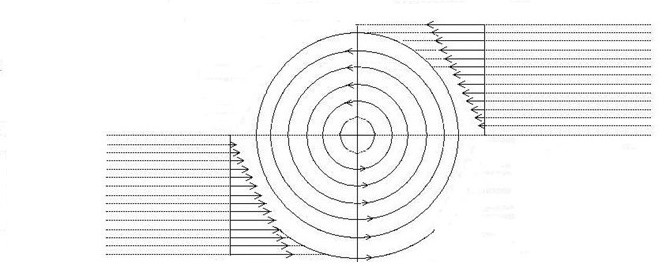
centre, gradually decreasing towards the edge. Of course, the mix of gases will be the same of the original galactic cloud everywhere, but the percentage of heavy materials will be increasing from the edge to the centre.
It goes without saying that the final size of the disk depends essentially on the gradient of velocity of the original galactic cloud and on its density. The first determines the size of the initial vortex, while the density affects the rate of accumulation of the materials.
Formation of Planets and Satellites: The problem now is to understand how the sun, planets and satellites were formed from this large disk of gas. The implicit opinion of the various theories is that their formation takes place in hierarchical order: first the sun, then the planets and finally the satellites [8]. But the process cannot happen in this order. It is not possible that the sun was the first massive body to condense. When the atomic combustion was triggered, in fact, a torrent of light invested the gases of the vortex dispersing them.
Necessarily, therefore, planets and satellites must have formed before. How did this happen? The solution to the problem lies in the fact that the gaseous disk grows and rotates always keeping in dynamic equilibrium (the opposite is not possible), which means that the speed with which the gases move around the center of the vortex respects Newton’s law and in particular Kepler’s third law, according to which T2 = KD3, which translated means: the square of the period of time that the gases take to travel an entire circle around the center of the vortex is proportional to the cube of their distance from the center itself.
This means that there is a gradient of speed increasing from outside to inside of the gaseous disk, a necessary condition for vortices to form. This inevitably happens sooner or later, especially on the periphery of the disk, where there is a continuous accumulation of new materials. Here a first stable secondary vortex is formed that begins to ”rake” the gases present in its orbit with the same process of Figure 2, concentrating them in a gaseous disk with the extension of the satellite system of the future planet. At that point the planetary disk begins to exert gravitational actions on the gases of the solar disk as if it was a solid planet.
These actions consist in ”emptying” certain orbits, in particular those that have a period of revolution equal to 1/2 and 1/3 of its own (clear evidence is provided by the so called “Kirkwood gaps” in the distribution of the asteroids because of Jupiter gravitational action [9]).
The gases of these orbits are recalled outwards, therefore close to them there will be thickenings of material that give rise to new secondary vortices, which in turn begin to ”rake” the materials of their orbit.
For some good reasons (demonstrated by the Lagrange’s equations [10]) two or more independent vortices cannot coexist on the same orbit or on a too near one. Inevitably those of the same orbit sooner or later merge into a single vortex. If, on the other hand, several vortices arise in separate but relatively close orbits, the strongest of them exerts gravitational actions such as to dissolve the others.
Thus, a single stable vortex is formed, which grows until all the materials present in that orbit are exhausted. This in turn perturbs the inner orbits characterized by a period of 1/2 or 1/3 giving rise to a new stable vortex and so on until you get close to the core of the stellar disk. Here the density of the gases is maximum and little by little they settle down from the heaviest to the lightest until they form a massive body.
In the solar system, therefore, the first planetary vortex to form was that of Neptune with a period of revolution of about 165 years, which caused the onset of Uranus’ vortex in an orbit with a period of 84 years, just over 1/2. In turn, Uranus caused the onset of Saturn’s vortex, with a revolution period of 29.4 years, just over 1/3 of Saturn’s and so on.
A rule of distances is therefore established that must be respected in all planetary systems. We can express it in the following way: each planet must have a period of revolution just over 1/2 or 1/3 of the period of revolution of the outer planet immediately following.
The process that leads to the birth of the planets from the solar vortex is also valid for the formation of the satellites that are originated from third- order vortices arised at the edge of the planetary vortices. The first of them must have caused the onset of a vortex close to one or the other of the two most perturbed orbits and so on. Good last the planet itself was formed by slow condensation of the dense inner core. It goes without saying, therefore, that the rule of distances established for the planets must also apply to the satellites.
The process of formation and condensation of planetary vortices obviously takes a long time. Meanwhile, the materials concentrated in the core of the solar vortex continue to condense and their temperature gradually increases to the point of triggering atomic combustion. It is the moment of the actual birth of the sun, which begins to release a torrent of light and particles that completely disperses all the materials of the original gaseous disk.
The nearest planetary vortices, that have not yet completed the condensation process, are depleted of most of the light materials and their satellite vortices are dismantled. Only the farthest and therefore oldest planetary vortices retain most of the captured materials and their satellites.
Verification of the Theory of Vortices
Physical Characteristics of Planets and Satellites: This in summary is the process that concentrates the disperse materials of extremely rarefied galactic clouds step by step through a series of vortices, until they condense into massive bodies from stars to planets and their satellites.
It is quite evident that the initial size and concentration of the materials of a vortex depend essentially on the density and velocity gradient of the cloud in which it forms. Low density and low gradient of speed provoke vortices of large diameter and vice versa.
Knowing the characteristic parameters of the original galactic cloud we should be able, through a mathematical model, to determine a priori with good approximation the system that will originate, namely: mass of the central star, extension of the planetary system, number and position of the planets, mass and density of each of them and finally also the consistency of their satellite systems.
In principle, in fact, the primary vortex will have density and gradient of speed increasing from outside to inside. Then the rule of the distances will let we know the orbits where the second-order vortices would arise, allowing to evaluate the dimensions of each planetary vortex and therefore to evaluate the mass and composition of the planet that will originate, taking into account that each vortex will “rake” all and only the materials of a (flat) strip along the entire orbit.
Obviously, the reverse is also true, that from the physical and orbital characteristics of actual planets and satellites it is possible to find out the characteristics of the gaseous disk from where they originated, that is extension, density and composition point by point, and have precise information about the original galactic cloud.
Lonely Planets and Multiple Stars: According to this process, stars, planets and satellites are all born in the same way, from the condensation of gaseous vortices. The only difference is in the ”rank” of these vortices: primary for stars, secondary for planets, tertiary for satellites. The vortex from which our solar system was formed did rake enough material to originate a medium-size hot star.
But not all vortices can collect a mass sufficient to trigger the atomic reaction. According to the characteristics of the original cloud, a primary’ vortex can rake a quantity of matter by far smaller than that of a star. The resulting body would be technically a star but being not warm enough it would only be an isolated planet with some satellites around. Large, lonely planets of that kind should exist in great number, but of course they are difficult to be detected being not associated to any hot star. It seems however that clusters of them have been discovered (to their surprise!) by the hunters of exoplanets [11].
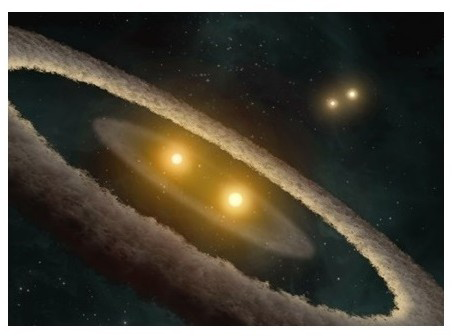
On the other hand, if the primary vortex is larger than that of the sun and has amassed a much larger quantity of materials, at least one of the planetary vortices would be able to rake a quantity of mass large enough to trigger the nuclear combustion. In this case, instead of a giant planet like Jupiter we will have a real star, or even a couple of stars because if they were borne in contiguous orbits, they ended up capturing each other.
Still, they behave like planets rotating around a central star, or maybe a couple of stars because in this case it is likely that the central core of the vortex would be large and flat, and therefore two stable vortices could arise in the L3 Lagrangian points relative to its center of gravity, originating two stars rotating around each other [12].
Such systems are far from uncommon in the universe: it seems that more than 50 % of the planetary systems of our galaxy have two or more suns [13]. They are the so-called “multiple stars”, which originate in rarefied galactic clouds with a low gradient of velocity and therefore give rise to very large vortices capable of capturing huge amounts of matter.
Nowadays astronomers are engaged in a gigantic hunt for the so-called exoplanets [14]. A mathematical model allowing to establish a priori the characteristics of planetary systems would be useful.
Orbital Data, Mass and Density of Planets and Satellites: The theory of vortices is demonstrated in first place by the rule of the distances established for both the planets and the satellites. Let’s start with the planets. Uranus has a period of 84 years, just over half that of Neptune; Saturn consequently must have a period of revolution just over 42 or 28 years: and in fact it is 29.46 years. The next planet, Jupiter, will have a period of more than 14.75, or 9.8 years; we find that it is 11.86, a value that does not contradict the rule, but nevertheless is a little bit higher than what one might expect, that is, between 10.5 and 11 years.
We immediately realize, however, that this is due to an “accident”. The planet following Jupiter, in fact, does not exist; in its place we find a myriad of fragments scattered on a very wide belt.
The opinion commonly accepted by astronomers holds that these fragments condensed from the original nebula as they are now. This hypothesis, however, is not compatible with the theory of vortices. It is impossible, in fact, to imagine a myriad of tiny independent and stable vortices on the same orbit, each of which gave rise to a ”mini-planet” whose diameter ranges from the order of centimeters to that of kilometers. Especially since almost all of them are far from spherical. Moreover, their orbits are the most varied and disordered you can think about; many invade the orbits of the major planets, penetrating almost to the height of Mercury, or going as far as Saturn and beyond; many others come out of the plane of the ecliptic for considerable values.
Not to mention the fact that they are made up of the most disparate materials: some are made entirely of metal, others, the majority with about 75% of the total, of carbonaceous rocks and another 15% of silicates [15]. In any case, all rocks and metals that must necessarily have formed inside some massive body at very high pressure and temperature [16].
In the end, the disappearance of the 5th planet, which I will call planet X, has provoked an “enlargement” of the remaining planets with respect to its original orbit. Therefore, the solar system is not the ideal model to check the rule of the distances, that might be not so precise as it was formulated. The following tables, however, will show that the differences are not relevant both for planets and satellites.
A few years ago, the astronomers thought that they are fragments of an exploded planet. Then the thesis prevailed that they are pieces of a planet that never formed, because for some reason they could not aggregate. This second opinion is justified by the fact that the total mass of all known asteroids is very small, probably no more than 5% of the mass of our moon, too little to represent the relics of a planet worthy of the name. The vortex theory, however, leaves no alternative that between Jupiter and Mars there must have been a massive planet that was later “expelled” from its orbit due to some accident that left in place a myriad of its fragments, along with some of its former satellites, such as Pallas and Ceres.
The planet probably fell on the sun, but its disappearance must have caused an imbalance in the system of the planets. Jupiter, no longer subject to its gravitation, moved away from the sun in direction of Saturn, slowing down its run. This would explain its period of 11,8 years, instead of 10,5 - 11 as would be expected. Its displacement must have influenced the remaining outer planets in a gradually decreasing way. On the other side Mars moved in the direction of the sun and to a decreasing extent also Earth, Venus and Mercury.
| Initial Period of Revolution | Actual Period of Revolution | Mass | Density | Perturbed Inside Orbit | |
|---|---|---|---|---|---|
| Neptune | 164,79 years | 164,79 years | 17 | 1,76 | 1/2 |
| Uranus | 84 years | 84,02 years | 14,5 | 1,3 | 1/3 |
| Saturn | 29.40 years | 29,46 years | 95 | 0,70 | 1/3 |
| Jupiter | 10,40 years | 11,86 years | 317 | 1,33 | 1/3 |
| Planet X asteroids | 3,90 | — | 20-30 | 1,5 - 2 | 1/3 |
| Planet X asteroids | — | 3,4 - 6 | — | — | — |
| Mars | 750 days | 687 days | 0,107 | 3,94 | 1/2 |
| Earth | 390 days | 365 days | 1 | 5,5 | 1/2 |
| Venus | 230 days | 224 days | 0,82 | 5,24 | 1/2 |
| Mercury | 88 days | 88 days | 0,055 | 5,43 | 1/3 |
| Sun | 24? | 333 | 1,409 |
Table 1: Revolution periods and physical characteristics of the planets.
In the second column of Table 1 the presumable periods of revolution of the original planetary system, before the disappearance of planet X, are reported; in the third column the current periods. A part these small anomalies we see that the rule of the distances is perfectly verified. Further confirmation of the vortices’ theory comes from the values of the masses and densities of the planets.
- The rule of distances is respected also by the “natural” satellites of the planets, even though in the past billions of years the impact of large asteroids has caused significant perturbation. Their density and size are also in line with what is expected according to the theory of vortices, as can be seen from Table 2.
- The Natural Satellites of the Planets
- Satellites
- Distance from Planet (103 km)
- Revolution Period ( days)
- Diameter (km)
- Density
- Earth Moon
- 384
- 27,32
- 3476
- 3346
- Jupiter
- Jo
- 421
- 1,77
- 3.92
- 3528
- Europe
- 670
- 3.55
- 3.36
- 3,01
- Ganymede
- 1.069
- 7,16
- 5.51
- 1,94
- Callisto
- 1.881
- 16,69
- 5.05
- 1,83
- Saturn
- Enncedalus
- 238
- 1,37
- 500
- 1,61
- Tethys
- 295
- 1,89
- 1200
- 0,98
- Dione
- 377
- 2,73
- 1300
- 1,48
- Rhea
- 527
- 4,51
- 1800
- 1,23
- Titan
- 1221
- 15,95
- 5000
- 1,88
- Hyperion
- 1482
- 21,28
- 300
- 0,55
- Iapetus
- 3558
- 79,33
- 1500
- 1.08
- Uranus
- Miranda
- 120
- 1,3
- 470
- 1,2
- Ariel
- 192
- 2,52
- 1160
- 1,2
- Umbriel
- 267
- 4,91
- 1170
- 1,4
- Titania
- 438
- 8,71
- 1580
- 1,72
- Oberon
- 586
- 13,46
- 1520
- 1,63
- Neptune
- Despina
- 52
- 0,34
- 150
- 1,2
- Galatea
- 62
- 0,43
- 176
- 1,3
- Larissa
- 73
- 0,55
- 194
- 1,3
- Proteus
- 117
- 1,12
- 420
- 1,3
- Triton
- 355
- 5,87 retrograde
- 2700
- 2,06
- Nereid
- 5.513
- 360
- 340
- 1.5
Table 2: Characteristics of the main natural satellites of the planets.
Anomalies and their Explanation
The solar planetary system responds very well to the predictions of the vortices’ theory, except for three significant ”anomalies”, apparently not related to each other.
The first is the existence of millions of fragments of different materials that have invaded the whole planetary system, but are mainly concentrated in the belt between Jupiter and Mars where, according to the theory, there should be only a planet with its satellites.
A second anomaly is constituted by the system of the satellites of the outermost planet, Neptune that looks disrupted. In fact at least two or three of its largest members are missing and one, Nereid, has been displaced from its original orbit. Astronomers agree in pointing to Triton as the culprit of this mess, a large body that cannot possibly have originated inside that planetary vortex because it is counter-rotating with respect to planet. Triton has the same order of magnitude and same physical characteristics as Pluto, which belongs to a class of bodies, called “plutinos”, that move outside the orbit of Neptune. For some reason, the “plutino” Triton sneaked inside the satellite system of Neptune, disrupting it and provoking the disappearance of its largest satellites.
A third “anomaly” is the Moon, the satellite of Earth placed on an orbit not complanar with the Earth’s equator and very far from it. They cannot have formed in the same planetary vortex. A further anomaly is also the existence of the terrestrial continents that cannot be explained by the slow condensation of the original planetary vortex.
These “anomalies” seem to have no relation with each other, but we will see that they can be traced back to a single event that happened about 3.96 billion years ago.
When the sun’s planetary system was formed, about 4.6 billion years ago, it was perfectly ordered as predicted by the vortices’ theory. The planets were all at the precise distance predicted by the rule of the distances, each had a well- ordered system of natural satellites perfectly aligned to the equatorial plane, except the three innermost planets, which had none. All bodies were spherical. There were no asteroids and stray bolides. Earth, under an ocean of hydrocarbons and water, had a smooth surface with a composition similar to that of the Pacific seabed, with not the smallest mountain.
Where today there are asteroids there was a large planet, with a mass of 20 to 30 times that of Earth, a diameter of about 30,000 km and a score of at least four or five satellites. (These dimensions can be determined by its position in the sequence of planets, by the fact that the moon was almost certainly its larger satellite and that the next planet, Mars, has a very modest mass. The orbit in which it was formed, in fact, must have been depleted of most materials by the combined gravitational action of this planet and the giant Jupiter).
Planet X was covered by an ocean of hydrocarbons and water on a thick silicon/magnesium shell and a core of iron and nickel, the materials of most asteroids. We cannot think to any possible cause that could justify the explosion of such a planet, so we must assume that it was the object of an impact of apocalyptic proportions by a large celestial body, which scattered around myriads fragments of its mantle and core. The bulk of the planet, however, cannot have been destroyed by the impact; its disappearance can only be explained by the fact that it received a push strong enough to expell it from its orbit, eventually causing it to fall on the sun. This would explain the existence of the asteroids, the various materials of which they are composed, the disorder of their orbits and also the disappearance of the planet that originated them.
It remains to find out what may have hit planet X, since there were no stray bodies at that time. There is a precise clue that leads us directly to the outermost planet of the solar system, Neptune. The irruption of the plutino Triton has torn from its orbit at least one of its major satellites, with a diameter that had to be between one thousand and two thousand km. This satellite cannot be found anywhere in the solar system so it must have precipitated on some planet. Why not planet X?
For an extraordinary coincidence it was directed exactly towards it. After a long run during which it acquired a speed of 70 or 80 km/sec, it bumped against the planet deeply penetrating into its mantle down to the metal core. An apocalyptic explosion ensued that projected myriads of large frag- ments around. Despite the mutilation most of the planet remained intact, but the power of the impact was enough to accelerate it to a speed of the order of hundreds of meters per second in direction of the sun, causing it to ”spiral” toward its star where it eventually fell.
(The speed imparted to planet X can be evaluated thanks
to the principle of conservation of energy, according to which
the kinetic energy of the bolide
$$ E _ {b} = \frac {1}{2} M _ {b} V _ {b} ^ {2} $$
must have been entirely acquired by the planet. With a mass of the bolide:
21 5.10 b M kg = , mass of planet X: Mp = 1,5.1026 kg and speed of the bolide: Vb = 70 km/sec, it would be:
M V V mt M
$$ , = \sqrt {\frac {M _ {b}}{M}} V _ {b} = 5. 7. 1 0 ^ {- 3}. 7. 1 0 ^ {4} = 4 $$
, that is about 35,000 km
3 4 5.7.10 .7.10 400 sec b p b p per day).
Probably planet X had at least four satellites. What happened to them? Obviously they were very close to it and some were fully invested by large chuncks coming from its mantle. Besides, all of a sudden the planet deviated from its previous orbit at the speed of several thousand kms per day. A couple of them lost contact almost immediately and are now floating amongst the wreckage of their mother-planet in the belt of the asteroids.
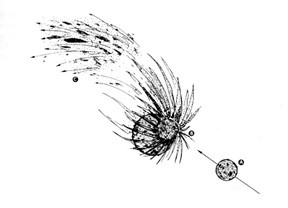
The two largest of them, instead, were dragged towards the sun, at least for a while. In the end, however, they also lost contact, invading the orbits of the inner planets and were both captured by Earth. One fell on the planet ending his life as a free aster, but starting an extraordinary and perhaps unrepeatable adventure. It broke into four or five large fragments that stuck deeply into the mantle of Earth, beginning all the geological phenomena that characterize its history. Based on the total volume of the mass of the continents it can be estimated that the diameter of this satellite was at least 2,500 km. The other, the largest of the family, managed to keep a safe distance and today illuminates our nights with its pale light.
The original system of planet X, therefore, had to count at least 4 satellites, in order: Vesta, Moon, then the satellite that originated the terrestrial continents and last Ceres.
The density of the continents is around 2,7 kg/dm3 and that’s why they float on the Earth’s sima, that has a mean weight of about 3.3 kg/dm3. The overall density of the satellite from which they originated, however, had to be a little bit more than 3 kg/dm3, thanks to its metallic core that must have sunk into the mantle.
| Diameter (km) | Mass 1021 kg | Density (kg/dm3) | |
|---|---|---|---|
| Vesta | 530 | 0,267 | 3,44 |
| Moon | 3.475 | 73,47 | 3,34 |
| Continents | 2500 | 15 | 2,7 (3) |
| Ceres | 950 | 0,95 | 2,12 |
Table 3: Physical Characteristics of Satellites.
Seas and Mountains of the Moon
At this point the physicists come into play with their methods of dating the rocks that allow to calculate with relative precision the epoch of the events described in this scenario. The various Apollo and Russian missions have brought to Earth a considerable amount of rocks taken in the most disparate locations, so we have a sufficiently large sample to get a precise idea of the various phases of the formation of the lunar soil.
Looking at our satellite we notice that its entire surface is pockmarked by a myriad of craters produced by the impact of asteroids and meteorites. Originally, however, it was supposed to be flat and smooth: the bombardment, like in all other bodies of the solar system, began after the explosion of planet X. But not all the irregularities of the lunar surface can be attributed to meteorite impacts. In addition to the circular craters, large flat surfaces are clearly visible, very depressed, the so called “seas”, and mountainous areas with peaks that rise for thousands of meters.
Several hypotheses have been put forward about the origin of the seas and mountains, without reaching any definitive conclusion. Not even the numerous lunar missions have been able to dispel the mystery; however, they have led to a number of unforeseen and important discoveries. First of all, when the Russian satellites photographed for the first time the other side of the Moon, whose vision had always been denied to man, we were faced with a real surprise: on the other side there are no seas, no mountain ranges, but only an immense expanse of meteorite craters.
Why so much difference? And again, is it a coincidence or is there a specific reason why the Moon presents to Earth only that face? The answer to these questions is linked to the origin of the so-called lunar “seas”.
There are significant differences between the rocks of the seas and those of the highlands. The latter consist of rocks similar to the terrestrial anorthosites, while the seas are made of basalt-like rocks. Both of these rocks are classified as plutonic, that is, originated by the cooling of molten magma. But while anorthositic rocks, at least on Earth, were formed by very slow cooling of magma in depth, basalt rocks are essentially eruptive rocks.
Another big difference is the density: about 2.9 kg/dm3 for the highlands, 3.3 for the seas. Since the average density of the Moon is 3.34, we must exclude that it is formed mainly by rocks such as those of the seas, which at great depths would assume a density of about 3.7, too high to be compatible with the average density of the Moon. The satellite, therefore, must be made up mainly of rocks similar to those of the high lands. Finally, the rocks of the high lands have an age of about 4.6 billion years, the same of the oldest rocks in the solar system, while those of the seas have an age between 3.9 and 3.2 billion years. Add to this the fact that the seas are located only on one of the lunar faces. What do these data tell us?
Let’s go back in time and reconstruct the vicissitudes of our satellite in the course of its existence. The Moon was born 4.6 billion years ago from one of the third order vortices of planet X, in a completely normal way: its surface had to be smooth and uniform with the same composition everywhere. Since there were no meteorites in the solar system, for hundreds of millions of years there was nothing that could change its appearance.
Then suddenly Planet X exploded. The Moon was invested by the matter projected by the impact, that is, by oceanic liquids and large fragments of the planet’s mantle. However, only the side that at the moment of the explosion was facing the planet was hit. The other side, being behind, was necessarily spared.
The liquids soon evaporated, leaving no obvious traces and residues. Not so for the solid fragments that stuck to the surface, opening wide wounds. Obviously they were made of heavier material than that of the lunar surface and probably they melted down immediately once freed from the pressure of the layers above.
Stuck on the lunar surface, they created huge basins of molten lava, which began to solidify again, but volcanic phenomena, with massive surface lava spills, continued for a long time, for millions of years (at least 600 judging by the different ages of the seas), until the entire mass of the individual fragments cooled and solidified completely. First the smaller fragments must have solidified, those that created the smaller seas, and then in succession the larger ones.
Since the lunar seas consist of heavy rocks, their surface has fallen below the lunar average, but to do this they compressed and moved the surrounding original rocks sideways; so tall mountain ranges were formed at the edges of the seas.
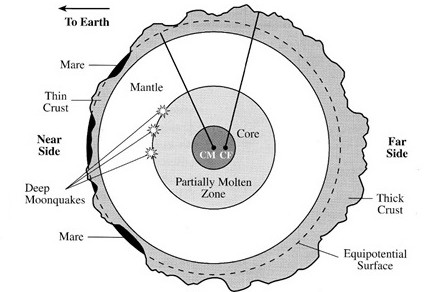
Figure 5: Schematic section of the moon showing its internal structure. The ”seas” are found only on the face facing the Earth and have a density higher than that of the original crust. As a result they settled at a level at least two km lower than the crust of the opposite face, which has a homogeneous composition similar to that of the ”high lands” that are located around the seas. The difference in density of the seas appears in all evidence from the equipotential surface (in hatching) determined by gravimetric surveys.
In conclusion, the seas are formed by rocks from the mantle of planet X while the high lands are made by the original lunar rocks. This explains why seas and mountains exist only on one side of the Moon and why they have different densities and different chemical and morphological characteristics and above all different ages. It also explains why the Moon always presents this face to Earth; the seas are made by rocks heavier then the rest of the surface and therefore they undergo to a greater extent the Earth’s gravitational action. It was inevitable that the initial rotational motion of the Moon was slowed down and the satellite stopped with the heaviest side facing Earth.
Epoch of the Explosion of Planet X
The conclusions we have reached are important to understand the characteristics of our satellite; at the same time they allow us to establish the epoch of the impact against planet X. The moon was hit by large fragments of Planet X on the very day of the impact. From that moment on the satellite was subjected to an incessant bombardment of meteorites and asteroids. That event can be dated with precision. The meteorite bombardment was particularly intense in the early days and quickly formed a layer of “breaches”, consisting of fragments of the ancient lunar soil crumbled by impacts. The oldest breaches have an age of about 3.9 billion years, therefore the meteorite bombardment must have started a short time before that date.
The dates provided by the rocks collected on the lunar seas are consistent with the described scenario. The oldest rocks are those taken from the Sea of Nectar, the smallest of the lunar seas, and have provided a date of 3.92 billion years. Plutonic rocks are becoming more and more recent in the larger seas, depending on their size. The most recent are 3.2 billion years old. At that date all volcanic activity on the lunar surface ceased.
The impact against planet X, therefore, must have occurred sometime before 3.92 billion years ago. How long before it depends on the time it took the fragment that originated the sea of Nectar to solidify and completely cease volcanic activity. Time that, judging by what has happened in the neighboring seas, should be of the order of millions of years.
Greater precision can be achieved by returning to Earth. We said that the continents are made by the materials of a satellite of planet X. Falling to Earth the satellite must have split into four or five large fragments, which stuck into the mantle. From that moment on, erosion and sedimentation phenomena began that gave origin to the first sedimentary rocks of our continents. Well, the oldest known continental sedimentary rock is about 3.96 billion years old, just 40 million more than the oldest effusive rock on the moon. Earth captured the satellite not too long after the impact, presumably in the order of thousands of years, and soon after started the formation of the first continental sedimentary rocks [17, 18, 19, 20, 21, 22, 23].
We conclude, therefore, that the impact against Planet X must have occurred approximately 3.96 billion years ago, million plus million less.
Conclusion
The mechanism proposed for the formation of astronomical bodies, from stars to planets and satellites through vortices seems consistent and able to predict the characteristics of whatever planetary system once the characteristics of the gaseous cloud in which it originates are known. The theory is verified by the orbital and physical data of both planets and satellites of our solar system, with some notable ”anomalies” apparently not related to each other. A close analysis, however, reveals that they have been provoked by a single event happened about 3.96 billion years ago, when the plutino Triton deviated a Neptune’s satellite, which impacted at high speed against a planet between Jupiter and Mars.
The impact produced millions of debris that spread throughout the solar system and pushed the planet towards the sun, where it eventually fell. As for its original satellites, the two largest were dragged towards the sun and were captured by Earth, one becoming its actual satellite, the other crashing on its surface giving origin to the continents.
It’s a simple scenario, perfectly coherent and able to provide a comprehensive explanation to a long series of problems and to reconstruct in a plausible way the history of our solar system. Is it realistic? Mr Occam would probably have no doubts.
References
-
Caitlin Ahrens Origin of the Moon. Impactor Theory. Planetary Science Institute.
-
Peale SJ, Canup R (2015) The Origin of the Natural Satellites. SCISpace 10: 559-604.
-
(2019) The Origin of the Solar System. Royal Museums Greenwich.
-
Nigel H (1992) The Planets. Viking Penguin Books, USA, pp: 1-216.
-
Smith MD (2004) The Origin of Stars. Armagh Observatory, UK, pp: 1-264.
-
Lang KR (2003) The Cambridge Guide to the Solar System, Tufts University, Medford, USA, pp: 1-468.
-
Paredes JB, Klessen RS, Mac Low MM, Semadeni EV (2007) Molecular Cloud Turbulence and Star Formation. In: Protostars and Planets (Edn.), Reipurth B, Jewitt D, Keil K (Eds.). University of Arizona Press, US, pp: 63-80.
-
Desch SJ (2007) Mass Distribution and Planet Formation in the Solar Nebula. The Astrophysical Journal 671(1): 878-893.
-
Ferraz-Mello S (1993) Kirkwood Gaps and Resonant Groups. Kluwer Academic Publishers, Italy, pp. 175-188.
-
(2001) Lagrange equations (in mechanics). Encyclopedia of Mathematics. EMS Press.
-
NASA Exoplanet Exploration – Planets Beyond our Solar System. The National Aeronautics and Space Administration.
-
Messier (2007) Binary and multiple stars.
-
Tokovinin A (2001) Statistics of multiple stars: Some clues to formation mechanisms. The Formation of Binary Stars. IAU Symposium 200: 84-92.
-
Exoplanets, Center for Astrophysics. Harvard University.
-
Norton RA (2002) The Cambridge Encyclopedia of Meteorites. Cambridge University Press, New York, USA, pp: 1-15.
-
McSween HY (1999) Meteorites and their Parent Planets. Cambridge University Press, New York, USA.
-
Burgess E (1991) Far Encounter: The Neptune system. Columbia University Press, New York, USA.
-
Almeida AJC, Peixinho N, Correia ACM (2009) Neptune Trojans and Plutinos: Colors, sizes, dynamics, their possible colli-sions. Astronomy and Astrophysics 508(2): 1021-1030.
-
Spudis PD (1996) The Once and Future Moon. Washington: Smithsonian Institution Press, Washington DC, USA.
-
(2009) Origin of Continents. Cambridge University Press, Newyork, USA.
-
Geralds N (2000) Observing the Moon: the Modern Astronomer’s Guide. Cambridge University Press, New York, USA, pp: 1-21.
-
Harland DM (1999) Exploring the Moon: The Apollo Expeditions. In: 2nd (Edn.), Praxis Publishing, New York, USA, pp: 1-447.
-
Barbiero F (2020) Altri Occhi Come i Nostri - Biografia di un Pianeta, (Italian Edition), Kindle book.
- Asymmetry Irreversible Heterogeneity Quantum Cosmology Grand Mathematical PHYSICS
- Early Universe: Hadronic Crystals Coherent Micro Gravitational Wave Emitters PHYSICS Part II
- The Solar System Constraint Maze: A Scientific Dead-End Revealing the Interuniversal Machine
- Assessment of Radiofrequency Radiation from 2G and 3G Mobile Phone Handsets
- Early Universe Magneto-Gravitational Coupling Genesis Physics: Part I
- Falsifiability of the Classical Law of Gravitation and Unveiling the Time-temperature Entanglement of the Universe