
Dusty Plasma: A Comprehensive Review
Dusty plasmas, characterized by the presence of micron or submicron-sized particles (dust) within a plasma of ions, electrons, and neutral species, represent a complex and intriguing state of matter. This review article provides a comprehensive overview of dusty plasmas, covering their formation mechanisms, fundamental properties, theoretical models, experimental techniques, and diverse applications. Dusty plasmas occur naturally in environments such as space, planetary atmospheres, and industrial processes, where they are formed through various mechanisms including micrometeorite impacts, volcanic eruptions, and cometary outgassing. In laboratory settings, they are generated in controlled discharge chambers using radio frequency or direct current sources, facilitating studies on their dynamic interactions and behavior. The physical characteristics and behavior of dusty plasmas are influenced by a range of forces including electrostatic, ion drag, gravitational, thermophoretic, and magnetic forces. These interactions give rise to collective phenomena such as dust acoustic waves, ion-dust interactions, and the formation of ordered structures like Coulomb crystals. Understanding these phenomena is essential for applications in astrophysics, materials science, semiconductor manufacturing, and environmental research. Theoretical approaches, including fluid dynamics, kinetic theories, and Particle-in-Cell (PIC) simulations, provide insights into the complex dynamics of dusty plasmas. Experimental methods such as Langmuir probes, laser scattering, and high-speed imaging are employed to characterize their properties and behaviors. Applications of dusty plasmas span diverse fields, from studying planetary formation processes to enhancing semiconductor device fabrication and environmental monitoring. Despite significant advancements, challenges remain in accurately modeling plasma dynamics and controlling dust particles in industrial applications. Future research directions include advancing diagnostic techniques, refining theoretical models, and exploring novel applications in materials science and technology. The interdisciplinary nature of dusty plasma research ensures continued exploration and innovation in understanding and utilizing this unique state of matter.
Abbreviations
PECVD: Plasma-Enhanced Chemical Vapour Deposition; PIC: Particle-in-Cell; RF: Radio-Frequency; OML: Orbital Motion Limited.
Introduction
Dusty plasma, also known as complex plasma, is a type of plasma that contains micron or submicron-sized particles (dust) in addition to the usual ions, electrons, and neutral particles. These particles are in the range of nanometers to micrometers and their charges are due to contact with ions. Dusty plasma (also known as complex plasma) involves understanding its fundamental properties, formation, applications, and the various research studies conducted in this field. These particles, or “dust,” become charged and interact with the plasma’s electric and magnetic fields. This results in unique physical phenomena that are not observed in ordinary plasmas [1, 2, 3, 4, 5, 6, 7, 8, 9, 10].
In laboratory conditions, low-pressure gas discharges, like those found in glow discharge and radio-frequency (RF) plasma reactors, can be used to create dusty plasmas. The factors like particle size, dust density, and plasma properties (ion density, electron temperature) control the stability of dusty plasmas.
Research focuses on the interaction between dust particles and plasma species. This covers the investigation of waves, instabilities, and sheath development surrounding dust particles in dusty plasmas.
Investigations, both theoretical and experimental, look at how dust particles impact the temperature and electron density of plasma. Dusty plasmas are common in space, especially in comet tails, planetary rings, and interstellar clouds. Understanding their behaviour helps in the study of cosmic phenomena. Space missions, such as NASA’s Cassini spacecraft, have provided valuable data on dusty plasmas in Saturn’s rings. In the processing of materials, dusty plasmas are employed in the synthesis of nanomaterials and the deposition of thin coatings. They are also significant in plasma etching and microelectronics fabrication.
This state of matter has garnered significant interest due to its unique properties and the variety of physical phenomena it exhibits. Dusty plasmas occur naturally in environments such as space, the Earth’s atmosphere, and industrial processes. Dusty plasma study has brought together concepts in plasma physics, solid state physics as well as fluid dynamics, thus forming a unique, multidisciplinary domain.
They also have numerous applications in fields ranging from astrophysics to material science and semiconductor manufacturing. This review article provides a comprehensive overview of dusty plasma, including its formation, characteristics, theoretical models, experimental techniques, and applications [11, 12, 13, 14, 15, 16, 17, 18, 19, 20, 21, 22, 23, 24, 25, 26, 27, 28, 29, 30, 31].
Formation of Dusty Plasma
Natural Occurrences: Dusty plasmas are prevalent in space environments, including interstellar clouds, cometary comas, planetary rings, and the ionospheres of planets. In these regions, dust particles can originate from processes like micrometeorite collisions, volcanic eruptions, or the outgassing of comets. The interaction between these dust particles and the surrounding plasma gives rise to a complex plasma environment. Laboratory and Industrial Environments: In laboratory settings, dusty plasmas are typically created in discharge chambers where a gas is ionized using radio frequency (RF) or direct current (DC) power sources. Dust particles are introduced into the plasma, where they become charged and interact with the plasma components. In industrial processes, dusty plasmas are often encountered in plasma- enhanced chemical vapour deposition (PECVD) systems and plasma etching, where they can influence the quality of thin films and micro-fabricated structures.
Characteristics of Dusty Plasma
Charging Mechanisms: Dust particles in plasma acquire charge primarily through interactions with the surrounding electrons and ions. The charging process is predominantly governed by the collection of electrons, which are more mobile than ions due to their smaller mass. Consequently, dust particles typically acquire a negative charge. Several factors influence the charging process, including: Electron and Ion Fluxes: The balance between the fluxes of electrons and ions to the dust particle determines its net charge. The electron flux is higher than the ion flux due to the higher thermal velocity of electrons, leading to a net negative charge on the dust particle. Photoelectric Emission: In the presence of ultraviolet (UV) radiation, dust particles can emit electrons through the photoelectric effect, reducing their negative charge or even becoming positively charged. Secondary Electron Emission: High-energy electron or ion impacts can cause the emission of secondary electrons from the dust particle surface, influencing its charge state. Ion and Electron Recombination: Dust particles can also gain positive charge through recombination processes where electrons recombine with ions on the particle surface. Dust Charging Mechanisms: The charging of dust particles in a plasma primarily occurs through the collection of electrons and ions from the plasma. The potential on the dust grain surface is determined by the balance between the fluxes of electrons and ions. The equilibrium charge on a spherical dust particle is given by the condition:
0 e i I I + = (1)
where Ie and Ii are the electron and ion currents to the dust grain, respectively. These currents can be described by the Orbital Motion Limited (OML) theory:
=
kT e I a en m kT φ π π
2 exp 2 e d e e e e (2)
= −
kT e I a en m kT φ π π
2
1 2 i d i i i i where:
- a is the radius of the dust particle
- ne and ni are the electron and ion densities
- Te and Ti are the electron and ion temperatures
- me and mi are the electron and ion masses
- ϕd is the dust potential
Interactions in Dusty Plasmas
Dust particles in plasma interact with each other and with the plasma components through various forces: Electrostatic Forces: The primary interaction between dust particles is the electrostatic force due to their charges. This force can be either attractive or repulsive, depending on the charge polarity of the particles. In most cases, the electrostatic force is repulsive because dust particles acquire similar charges. Ion Drag Force: The motion of ions relative to dust particles exerts a drag force on the particles. This force depends on the ion density, temperature, and relative velocity between ions and dust particles. Gravitational Force: In terrestrial environments, gravity affects the behavior of dust particles, influencing their distribution and dynamics. Thermophoretic Force: Temperature gradients in the plasma can create a force that pushes dust particles from hotter to cooler regions. This force arises due to the differential momentum transfer from gas molecules on the particle surface. Magnetic Force: In the presence of magnetic fields, charged dust particles experience a Lorentz force that can alter their trajectories and dynamics.
Dust-Plasma Interactions
Dust particles in plasmas interact with the plasma and each other through several processes: Coulomb Collisions: Charged dust grains interact with plasma species via Coulomb forces. The interaction between a dust grain and an ion or electron is given by:
2 , 2 d i e Z Z e F r = (3)
Where Zd is the charge number of the dust grain, Zi,e is the charge number of the ion or electron, and r is the distance between them.
Collective Phenomena: Dusty plasmas exhibit collective behaviour such as waves and instabilities. For example, the dust-acoustic wave (DAW) is a low-frequency wave mode in dusty plasmas, described by:
2 2 2 d d Z e n k m ω = (4)
d where ω is the wave frequency, k is the wavenumber, nd is the dust density, and md is the mass of the dust particle. Ion-Dust Interaction: Ion drag force acts on the dust particles due to the streaming ions, which can be described as:
ion i i in i F n m v ν = ρ (5)
Where, νin is the ion-neutral collision frequency, and is the ion velocity.
Chemical Reactions in Dusty Plasmas
The presence of dust can lead to new chemical pathways in plasmas, particularly in astrophysical environments and laboratory settings: Surface Reactions: Dust grains provide surfaces for heterogeneous reactions. For instance, in interstellar clouds, dust surfaces catalyze the formation of molecules like H2:
H+H→H2 (6)
Dust Growth: Dust particles can grow by accreting atoms and molecules from the plasma. This growth process is critical in various astrophysical contexts, such as planet formation:
final initial dm a a t dt = + (7)
Where afinal is the final radius, afinal is the initial radius, dm dt is the mass accretion rate, and t is the time.
Ion-Molecule Reactions: Charged dust particles can influence ion-molecule chemistry in plasmas. For example, in cometary comae, dust grains can affect the production of complex organic molecules: CH4++H2O→CH3OH++H2 (8)
Wave Phenomena
Dusty plasmas support various wave modes that are not present in conventional plasmas. These wave phenomena arise from the coupling between the dust particles and the plasma components: Dust Acoustic Waves (DAWs): DAWs are low-frequency waves that propagate through the dust component of the plasma. These waves are driven by the pressure of the dust particles and the electrostatic interactions between them. DAWs can be used to study the properties of dusty plasmas and to probe the interaction forces between dust particles. Dust Ion Acoustic Waves (DIAWs): DIAWs are similar to ion acoustic waves in conventional plasmas but are modified by the presence of dust particles. These waves propagate through the ion component, with the dust particles providing additional inertia. Dust Lattice Waves (DLWs): In strongly coupled dusty plasmas, where dust particles form ordered structures (Coulomb crystals), DLWs can propagate through the lattice. These waves are analogous to phonons in solid-state physics and provide insights into the structural properties of dust crystals.
Plasma Sheath and Dust Traps
In dusty plasma, the presence of charged dust particles alters the properties of the plasma sheath—a boundary layer near solid surfaces where the plasma properties transition to those of the surface. Dust particles can be trapped in the sheath region due to electric fields. These dust traps are critical for confining and controlling dust particles in laboratory experiments.
Collective Behavior and Coulomb Crystals
One of the most intriguing aspects of dusty plasma is its ability to form Coulomb crystals, where dust particles arrange themselves in a regular lattice structure due to mutual electrostatic repulsion. These structures can exhibit solid-like, liquid-like, or gas-like behavior depending on the plasma conditions and particle interactions. Coulomb crystals are valuable for studying fundamental physics phenomena such as phase transitions and wave propagation.
Instabilities in Dusty Plasma
These are phenomena where small perturbations grow over time, potentially leading to significant changes in the plasma’s structure and behavior. These instabilities can arise from various sources, such as differences in charge-to- mass ratios among the particles, interactions between dust grains and the plasma’s electric and magnetic fields, and energy exchanges between different particle populations. For instance, the dust-acoustic instability occurs when the relative motion between ions and dust particles generates waves that grow in amplitude, disrupting the plasma equilibrium. Similarly, the charging of dust grains in the presence of fluctuating electric fields can lead to electrostatic instabilities. These instabilities are crucial to understanding because they can significantly influence the transport properties, wave propagation, and overall dynamics of dusty plasmas, with implications for both natural systems like planetary rings and artificial environments such as plasma processing in industry.
Structural Formations
One of the most intriguing aspects of dusty plasmas is their ability to form ordered structures known as Coulomb crystals. These structures arise due to the balance between the electrostatic repulsion between similarly charged dust particles and the confining forces in the plasma. Coulomb crystals can exhibit different phases depending on the plasma parameters and dust particle interactions: Crystalline Phase: In the crystalline phase, dust particles arrange themselves in a regular lattice structure, similar to atoms in a solid crystal. This phase occurs at low temperatures and high dust densities, where the kinetic energy of the particles is low compared to their interaction energy. Liquid Phase: At higher temperatures or lower dust densities, the dust particles can exhibit liquid-like behavior, where the particles are free to move relative to each other while maintaining some short-range order. Gaseous Phase: In the gaseous phase, dust particles move independently and exhibit random motion, similar to particles in a gas. This phase occurs at high temperatures or low dust densities, where the kinetic energy dominates the interaction energy.
Theoretical Models
Fluid and Kinetic Models: The behavior of dusty plasma can be described using fluid and kinetic models. Fluid models treat the plasma as a continuous medium and use equations of motion, continuity, and energy conservation to describe the macroscopic properties of the plasma. Kinetic models, on the other hand, consider the distribution functions of the plasma species and solve the Boltzmann or Vlasov equations to capture the microscopic interactions. The basic governing eqations are given as:
• Continuity Equation:
( ) 0 n nv t ∂+ ∇⋅ = ∂ (9)
• Momentum Equation:
1 ( ) v q v v P t m m φ ∂+ ⋅∇ = − ∇ − ∇ ∂ (10)
• Poisson’s Equation:
ρ φ ∫ ∇ = − (11)
2
0 Here symbols have usual meanings.
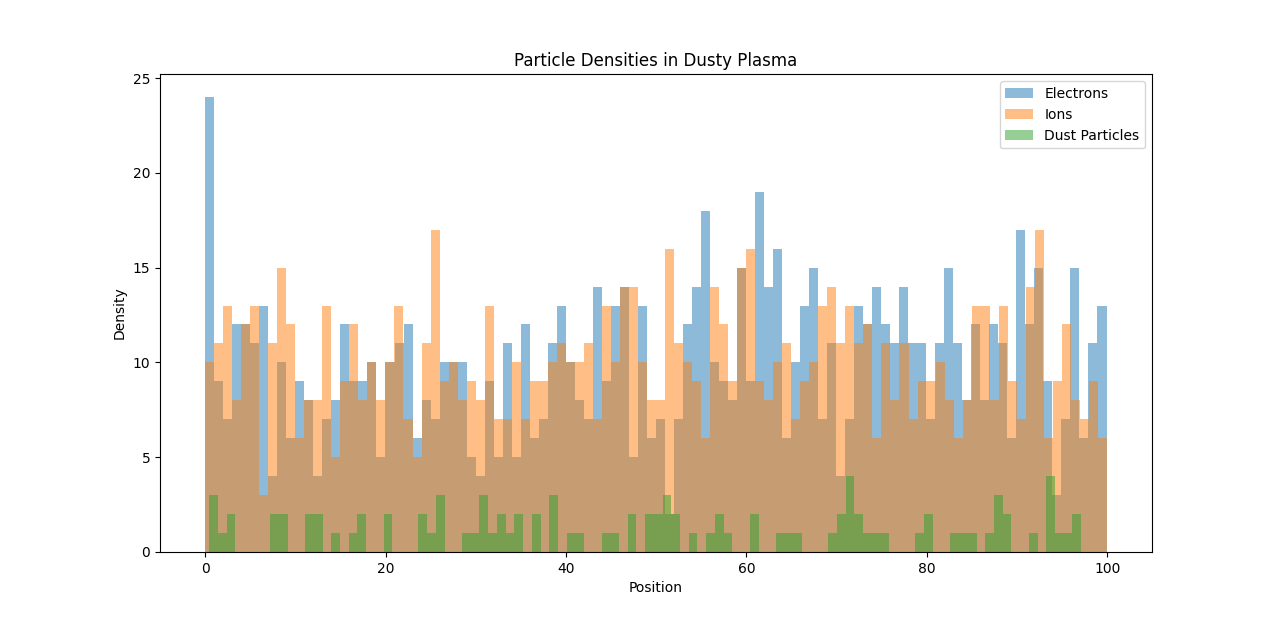
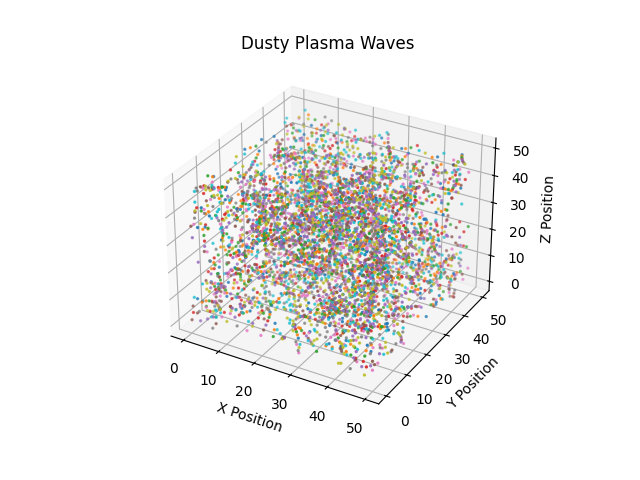
Particle-in-Cell (PIC) Simulations Particle-in-cell (PIC) simulations are widely used to study dusty plasmas. These simulations track the motion of individual particles (electrons, ions, and dust) under the influence of electric and magnetic fields, solving Maxwell’s equations and the equations of motion for each particle. PIC simulations provide detailed insights into the dynamics of dusty plasmas, including particle charging, dust-plasma interactions, and the formation of structures (Figures 1 & 2).
Experimental Techniques
Diagnostic Methods: Diagnosing dusty plasmas involves a variety of techniques to measure the properties of the plasma and the dust particles. Common diagnostic methods include: Langmuir Probes: Used to measure plasma parameters such as electron density and temperature. Laser Scattering: Utilized to determine dust particle size, charge, and density by analyzing the scattered light from a laser beam. Electrostatic Probes: Employed to study the charge on dust particles by measuring the current collected by a probe in the plasma. Imaging Techniques: High-speed cameras and laser- induced fluorescence (LIF) are often used to visualize the behavior of dust particles in a plasma. These techniques allow researchers to observe dust particle motion, formation of structures, and interactions with plasma waves in real- time.
Applications and Implications
The Unique Properties of Dusty Plasmas have Significant Implications for Various Fields
Astrophysics: Dusty plasmas are prevalent in space environments, such as interstellar clouds, planetary rings, and comet tails. Understanding the physics of dusty plasmas helps explain the formation and evolution of celestial bodies, the behavior of dust in space, and the interaction between dust and electromagnetic radiation. Material Science: In laboratory settings, dusty plasmas are used to study fundamental processes such as phase transitions, wave propagation, and particle interactions. These studies can lead to the development of new materials with tailored properties, such as photonic crystals and metamaterials. Semiconductor Manufacturing: In the semiconductor industry, dusty plasmas are encountered in processes like PECVD and plasma etching. Dust particles can impact the quality and performance of semiconductor devices by introducing defects or contaminants. Controlling and mitigating dust in plasma processing is essential for producing high-quality microelectronic components. Industrial Applications: Dusty plasmas play a crucial role in semiconductor manufacturing, where they are encountered in processes like plasma-enhanced chemical vapor deposition (PECVD) and plasma etching. Controlling dust particles in these processes is essential for producing high-quality microelectronic devices. Environmental and Atmospheric Studies: Dusty plasmas are also relevant to atmospheric science, where they are found in regions such as the Earth’s mesosphere. Studying dusty plasmas in the atmosphere can provide insights into phenomena such as noctilucent clouds and the behavior of meteoric dust.
Challenges and Future Directions
Despite significant progress in understanding dusty plasmas, several challenges remain. One major challenge is accurately modeling the charging and dynamics of dust particles in complex plasma environments. Additionally, controlling dust particle distribution and behavior in industrial applications requires further research.
Future directions in dusty plasma research include the development of advanced diagnostic techniques, improved theoretical models, and novel applications. For example, dusty plasmas could be used in the development of new materials with tailored properties, such as photonic crystals and metamaterials. Advances in dusty plasma research will continue to enhance our understanding of fundamental physics and drive innovation in various technological fields.
Conclusion
Dusty plasma is a fascinating and complex state of matter that exhibits a wide range of physical phenomena. Its study provides valuable insights into both fundamental and applied physics, with implications for astrophysics, industrial processes, and environmental science. As research in this field progresses, new diagnostic tools, theoretical models, and applications will continue to emerge, expanding our understanding and utilization of dusty plasmas. The interdisciplinary nature of dusty plasma research ensures that it will remain a vibrant and impactful area of study for years to come.
Dusty plasma research is a vibrant and multidisciplinary field, with significant contributions to both fundamental plasma physics and practical applications. Continued advancements in experimental techniques, theoretical models, and computational simulations are expected to further unravel the complexities of dusty plasmas and expand their applications across various scientific and industrial domains.
References
-
Swastik B, Ansuman D, Suman P, Swarniv C (2022) Plasma shock wave in gamma-ray bursts: Nonlinear phenomena and radiative process. IEEE Transactions on Plasma Science 50(6): 1488-1494.
-
Himangshu S, Chinmay D, Swarniv C, Basudev G, Kumar MK (2022) Quantum and Relativistic Effects on the KdV and Envelope Solitons in Ion-Plasma Waves. IEEE Transactions on Plasma Science 50(6): 1610-1623.
-
Swarniv C, Jyotirmoy G, Jit S, Chinmay D, Basudev G, et al. (2021) Formation of electron acoustic shock wave in inner magnetospheric plasma. Indian Journal of Physics 96: 3413-3427.
-
Ankur D, Swarniv C, Chinmay D, Surajit M, Trisita D (2022) Rogue Wave Generation Through Non-Linear Self Interaction Of Electrostatic Waves In Dense Plasma. IEEE Transactions on Plasma Science 50(6): 1557-1564.
-
Jit S, Swarniv C, Ankita D, Chinmay D, Aritra M, et al. (2022) Forced KdV and Envelope Soliton in Magnetoplasma with Kappa Distributed Ions IEEE Transactions on Plasma Science 50(6): 1565-1578.
-
Soumya S, Anuradha S, Suman P, Tamal G, Chinmay D, et al. (2022) Homotopy Study of Spherical Ion-Acoustic Waves in Relativistic Degenerate Galactic Plasma. IEEE Transactions on Plasma Science 50(6): 1477-1487.
-
Sharry, Debiprosad D, Mittka G, Swarniv C (2022) Magnetosonic Shocks and Solitons In Fermi Plasma With Quasiperiodic Perturbation. IEEE Transactions on Plasma Science 50(6): 1585-1597.
-
Swarniv C, Rupanjan B, Jit S, Soureen Z, Chinmay D, et al. (2022) Multistability Studies on Electron-Acoustic Wave in a Magnetized Plasma with Supra-thermal Ions. Journal of Astrophysics and Astronomy 43(71): 1-17.
-
Swarniv C, Sharry K, Debapriya N, Chinmay D, Dayita B (2022) Bifurcation Analysis of EAWs in Degenerate Astrophysical Plasma: Chaos and Multistability IEEE Transactions on Plasma Science 50(6): 1495-1507.
-
Gobinda M, Suman D, Jyotirmoy G, Swarniv C, Jit S, et al. (2022) Formation of Nonlinear Stationary Structures in Ionospheric Plasma. IEEE Transactions on Plasma Science 50(6): 1464-1476.
-
Berumen J, Goree J (2021) Experiment and model for a Stokes layer in a strongly coupled dusty plasma, Phys Rev E 104(3): 035208.
-
Goertz CK (1989) Dusty plasmas in the solar system. Rev Geophys 27(2): 271-292.
-
Bliokh P, Sinitsin V, Yaroshenko V (1995) Dusty and Self-Gravitational Plasmas in Space. Kluwer Academic Publishers, Boston 193: 250.
-
Shukla PK, Mendis DA, Chow VW (1996) The Physics of Dusty Plasmas. World Scientific, Singapore, pp: 252.
-
Mendis DA, Rosenberg M (1992) Cosmic Dusty Plasmas. Annu Rev Astrophys 32: 419-463.
-
Mendis DA (1997) Advances in Dusty Plasmas. In: Shukla PK, Mendis DA, (Eds.), World Scientific, Singapore, pp: 3-19.
-
Verheest F (2000) Waves in Dusty Space Plasmas. Kluwer Academic, Boston, pp: 245.
-
Gurnett DA, Grun E, Gallagher D, Kurth WS, Scarf FL (1983) Micron-sized particles detected near Saturn by the Voyager plasma wave instrument. Icarus 53(2): 236- 254.
-
Tsintikidis D, Gurnett DA, Kurth WS, Granoth LK (1996) Micron-sized particles detected in the vicinity of Jupiter by the Voyager plasma wave instruments. J Geophys Res 23(9): 997-1000.
-
Gurnett DA, Ansher JA, Kurth WS, Granroth LJ (1997) Micron-sized dust particles detected in the outer solar system by the Voyager 1 and 2 plasma wave instruments. Geophys Res Lett 24(24): 3125-3128.
-
Horányi M (2000) Dust streams from Jupiter and Saturn. Phys Plasmas 7(10): 3847.
-
Abrahamson J, Dinniss J (2000) Ball lightning caused by oxidation of nanoparticle networks from normal lightning strikes on soil. Nature, London, UK, 403: 519.
-
Cho JYN, Kelley MC (1993) Polar mesosphere summer radar echoes: Observations and current theories. Rev Geophys 31(3): 243-265.
-
Zao QH, Kelley MC (1997) Meteor observations by the Arecibo 430 MHz incoherent scatter radar. II. Results from time-resolved observations. J Atmos Sol Terr Phys 59(7): 739-752.
-
Kelley MC, Alcala C, Cho JYN (1998) Detection of a meteor contrail and meteoric dust in the Earth’s upper mesosphere. Journal of Atmospheric and Solar Terrestrial Phy 60(3): 359-369.
-
Havnes O, Naesheim LI, Hartquist TW, Morfill GE, Melandso F, et al. (1996) Meter-scale variations of the charge carried by mesospheric dust. Planet Space Sci 44(10): 1191-1194.
-
Havnes O, Trøim J, Blix T, Naesheim LI, Thrane E, et al. (1996) First detection of charged dust particles in the Earth’s mesosphere. J Geophys Res 101(A5): 10839- 10847.
-
Zadorozhny M (2000) On the role of charged dust in mesospheric electric fields. Geophys Res Lett 27(4): 493-496.
-
Bernhardt PA, Ganguli G, Kelley MC, Swartz E (1995) Enhanced radar backscatter from space shuttle exhaust in the ionosphere. J Geophys Res 100(12): 23811-23818.
-
Prabhuram G, Goree JA (1995) Cosmic Dust Synthesis by Accretion and Coagulation. Astro J 441: 830-838.
-
Holland P, Garscadden A, Ganguly B (1996) Physics of Dusty Plasmas. In: Shukla PK, Mendis DA, (Eds.), World Scientific, Singapore, pp: 171-176.
- Asymmetry Irreversible Heterogeneity Quantum Cosmology Grand Mathematical PHYSICS
- Early Universe: Hadronic Crystals Coherent Micro Gravitational Wave Emitters PHYSICS Part II
- The Solar System Constraint Maze: A Scientific Dead-End Revealing the Interuniversal Machine
- Assessment of Radiofrequency Radiation from 2G and 3G Mobile Phone Handsets
- Early Universe Magneto-Gravitational Coupling Genesis Physics: Part I
- Falsifiability of the Classical Law of Gravitation and Unveiling the Time-temperature Entanglement of the Universe