
Dark Comets: Mysterious Visitors from the Unknown Deep Space
Dark comets are a serious hazard to Earth, as they could collide with Earth without warning. Thousands of these unseen comets are currently traveling near Erath. Only a few of them are identified. They are hard to detect due to their nearly invisible nature. This paper gives a concise overview of the dark comets and the risks associated with such celestial invisible objects. Additionally, we try to highlight the modern technology tools to identify and detect dark comets.
Abbreviations
JWST: James Webb Space Telescopes; AI: Artificial Intelligence; DART: Double Asteroid Redirection Test; AIDA: Asteroid Impact & Deflection Assessment; PDCO: Planetary Defense Coordination Office; NEOs: Near-Earth Objects.
Introduction
Dark comets are near-Earth celestial invisible objects. Such hidden comets have no tails and no bright visible coma. They usually come from the asteroid belt and buzz around Earth [1]. Such unseen comets do not reflect much light, which makes them very difficult to detect like ordinary comets that have visible glowing tails [2]. Dark comets have little or no ice covering, which prevents them from having a glowing tail or visible coma. In addition, macromolecular carbon compounds on dark comet surfaces appear to be associated with the existence of very low-albedo material on these bodies.
In other words, dark comets are a hazardous threat, as they could strike our planet without warning [1, 2]. Motivated by this, we present this work to sound the alarm on the dark comets threat. The rest of the paper is organized as follows. In Section 2, a brief discussion about the dark comets is presented, while in Section 3, we highlight the role of dark comets in supplying Earth with water. Section 4 is devoted to discussing the modern technology techniques that can be used in detecting dark comets.
Dark Comets: The Great Threat to Earth
Comets and asteroids are celestial objects in our solar system. Asteroids are stony or metallic objects, while comets are composed of ice, dust, and organic materials. Asteroids are mostly found in the asteroid belt between Mars and Jupiter. On the other hand, comets originate in far-off places like the Oort Cloud or Kuiper Belt. Comets’ ice vaporizes as they get closer to the sun, producing a shining coma and tails that extend outward. Asteroids and comets are considered a danger to Earth. They could hit Earth and have devastating consequences. So, detecting and tracking such objects is a crucial aspect. In the last few decades, ground telescopes were used to track earlier detected asteroids like Ceres and Vesta, and comets like Halley’s Comet and Hale-Bopp. Recently, modern advanced observational technology has improved our understanding of these objects, particularly with space missions like the Rosetta mission, which provided us with detailed study of Comet 67P/Churyumov– Gerasimenko). In addition, the utilization of modern space telescopes like Hubble space telescope and James Webb space telescopes (JWST) plays significant roles in studying comets and asteroids. Such space telescope provide high- resolution images and detailed spectroscopic data.
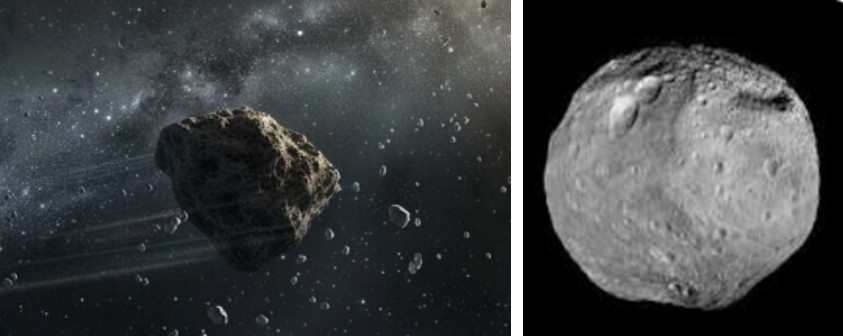
Dark comets have the properties of both asteroids and comets. They are a bigger hazard to Earth than scientists realized. Dark comets are invisible objects traveling at rapid speeds and could strike the Earth without warning, causing potential effects on Earth [3]. Although they represent about 60% of the objects near-Earth, only a small percentage of them are known, like comet 67P/Churyumov– Gerasimenko, comet Borrelly (19P/Borrelly), Comet Encke and comet Tempel 1 (9P/Tempel 1) [4]. Their unstable and unpredictable orbits make them very dangerous to Earth. Dark comets have the properties of both asteroids and comets. They are challenging to identify as they don’t really reflect much light (Figure 1).
Did Earth’s Water Come From Dark Comets a Long Time Ago?
Since dark comets are most likely near Earth and contain water ice, they may play a significant role in supplying Earth with water, but scientists are unsure if water was brought to Earth by dark comets. We may claim that there is still great debate on the exact process by which water on Earth arrived. Several Modern researches have demonstrated that this is an additional route for ice to reach the Earth’s atmosphere from the solar system [4]. “We don’t know if these dark comets delivered water to Earth. We can’t say that. But we can say that there is still debate over how exactly the Earth’s water got here. The work we’ve done has shown that this is another pathway to get ice from somewhere in the rest of the solar system to the Earth’s environment,” Taylor said [4].
Detection of Dark Comets
Detecting dark comets is very difficult because they reflect very little sunlight and are unseen to the naked eye through standard telescopes [5]. Instead of depending just on reflected light, new technology such as infrared telescopes helps to detect dark comets by sensing the heat they emit. Currently, artificial intelligence (AI) is revolutionizing the detection of dark comets. By analyzing large datasets from telescopes, AI algorithms can identify and detect dark comets [5, 6, 7, 8, 9, 10, 11, 12].
In order to deflect asteroids or comets that could hit, NASA and other space organizations have developed a number of programs and projects, like Double Asteroid Redirection Test (DART) in 2022 to deflect Asteroid Didymos and its moonlet Dimorphos [13], Asteroid Impact & Deflection Assessment (AIDA) to study the effects of DART mission on the asteroid [14] and Planetary Defense Coordination Office (PDCO) to detect, track near-Earth objects (NEOs) that could hit our planet [15, 16].
Conclusion
This paper highlights the importance of studying dark comets, which are thought to pose one of the biggest risks to human civilization as they can strike Earth suddenly. Dark comets reflect very low light, which makes them challenging to observe using traditional ground telescopes. To gain a better understanding of their behavior and their unpredictable nature, scientists have to develop new detecting and tracking techniques. This work also addresses a brief idea about the sophisticated technology tools that are essential to enhance tracking and detection performance of such unseen dangerous objects to reduce the threats associated with dark comets. Additionally, this work also briefly addresses sophisticated technological tools that are essential to improving the tracking and detection performance of these elusive objects. Modern advancements like space-based observation systems, infrared telescopes, and enhanced computer models for orbital path prediction have become more and more crucial in reducing the risks associated with black comets. We greatly recommend developing the early-warning systems and defense projects to defend our planet against these invisible dark comets.
References
-
Khalil M, Said M, Osman H, Younis N, Khaled N, et al. (2020) Dark comets: the cosmic catastrophic threat to earth. International Journal of Advanced Astronomy 8(1): 27-28.
-
Jonas FM, Allahdadi F (2015) Potentially Hazardous Asteroids and Comets. In: Pelton J, Allahdadi F (Eds.), Handbook of Cosmic Hazards and Planetary Defense. Reference work entry, pp: 875-889.
-
Cruikshank DP (1989) Dark surfaces of asteroids and comets: Evidence for macromolecular carbon compounds. Advances in Space Research 9(2): 65-71.
-
Taylor AG, Steckloff JK, Seligman DZ, Farnocchia D, Dones L, et al. (2024) The dynamical origins of the dark comets and a proposed evolutionary track. Icarus 420: 116207.
-
Seligman DZ, Farnocchia D, Micheli M, Vokrouhlický D, Taylor AG, et al. (2023) Dark comets? Unexpectedly large nongravitational accelerations on a sample of small asteroids. The Planetary Science Journal 4(2): 35.
-
Khalil M, Said M, El Sedfy S, Ahmed AI, Khaled M, et al. (2023) Detecting Asteroids and Comets using Machine Learning and Deep Learning. MSA Engineering Journal 2(2): 967-972.
-
Khalil M, Said M, Osman H, Khaled M, Khaled N, et al. (2023) The gigantic comet Bernardinelli-Bernstein: a review. International Journal of Advanced Astronomy 11(1): 1-2.
-
Khalil M, Said M, Osman H, El-Sedfy SM, Abdellah N, et al. (2022) The Mysterious Asteroid Apophis: Hazardous Asteroid, or Just a Passing Giant Space Rock. International Journal of Advanced Astronomy 10(1): 11-12.
-
Khalil M, Said M, Osman H, Younis N, Khaled N, et al. (2021) Oumuamua: A Mysterious Visitor From Deep Space. International Journal of Advanced Astronomy 9(1): 24-25.
-
Khalil M, Said M, Ibrahim A, Gamal M, Mobarak MA (2021) Tracking comets and asteroids using Machine Learning and Deep Learning: A review. International Journal of Advanced Astronomy 9(1): 26.
-
Khalil M, Said M, Osman H, Younis N, Khaled N, et al. (2020) The dazzling comet C/2020 F3 (NEOWISE): The comet of the century. International Journal of Advanced Astronomy 8(2): 35.
-
Khalil M, Said M, Osman H, Ahmed B, Ahmed D, et al. (2019) Big data in astronomy: from evolution to revolution. International Journal of Advanced Astronomy 7(1): 11-14.
-
Stickle AM, Rainey ESG, Syal MB, Owen JM, Miller P, et al. (2017) Modeling impact outcomes for the Double Asteroid Redirection Test (DART) mission. Procedia Engineering 204: 116-123.
-
James T (2018) Asteroid Impact and Deflection Assessment Mission (AIDA): Space Mining Concepts. Deep Space Commodities. Exploration Production and Trading pp: 93-105.
-
Schmidt N (2018) Planetary defense: Global collaboration for defending earth from asteroids and comets. Springer pp: 475.
-
Cheng AF, Rivkin AS, Michel P, Atchison J, Barnouin O, et al. (2018) AIDA DART asteroid deflection test: Planetary defense and science objectives. Planetary and Space Science 157: 104-115.
- Asymmetry Irreversible Heterogeneity Quantum Cosmology Grand Mathematical PHYSICS
- Early Universe: Hadronic Crystals Coherent Micro Gravitational Wave Emitters PHYSICS Part II
- The Solar System Constraint Maze: A Scientific Dead-End Revealing the Interuniversal Machine
- Assessment of Radiofrequency Radiation from 2G and 3G Mobile Phone Handsets
- Early Universe Magneto-Gravitational Coupling Genesis Physics: Part I
- Falsifiability of the Classical Law of Gravitation and Unveiling the Time-temperature Entanglement of the Universe