
Hazard Analysis and Safety Design of Manned Spacecraft Capsule Leakage
The primary goal of manned spacecraft is to ensure the safety of personnel in orbit. If space debris collides with the sealed cabin during in orbit operation, it may cause a dangerous event of sealed cabin leakage. The rapid decrease in total pressure caused by the leakage of the sealed cabin directly threatens the life safety of astronauts and belongs to an emergency major malfunction. In response to the leakage of the sealed cabin of manned spacecraft after impact, the influence of multiple factors on the leakage process of the sealed cabin of manned spacecraft was analyzed. An emergency response system with the main goal of astronaut crew safety was established, and technical measures were proposed to control the pressure loss of the sealed cabin of manned spacecraft under limited resource conditions and ensure the safety of the astronaut crew. Research has shown that the diameter of leakage holes is the main influencing factor of pressure loss in sealed cabins, and in orbit gas supply and personnel protection are important safety measures. Taking a manned spacecraft with a pressurized cabin volume of 400m³ as an example, if the diameter of the leakage hole is 20mm, and 0.05MPa is used as the environmental pressure survival lower limit, the emergency response cannot exceed 9000s (150min); if the oxygen content is 19.5%, the emergency response cannot exceed 12000s (200min).
Abbreviations
POF: Pareto Optimal Frontier; NSGA-Ⅱ: Non-Dominated Sorting Genetic Algorithm -Ⅱ.
Introduction
Manned spacecraft provide guarantee for astronauts’ in-orbit stay, can continuously carry out space scientific research and technical test exploration, and also can provide necessary technical support for visiting spacecraft. Large manned spacecraft assemblies are generally composed of multiple cabin sections or multiple spacecraft, with one cabin section responsible for unified management and control, and other cabin sections mainly supporting the conduct of payload tests. Multiple spacecraft form an assembly through rendezvous and docking [1, 2, 3, 4, 5]. Manned spacecraft operate in low Earth orbit, and the rapid growth in the number of space debris poses serious challenges to the safety of spacecraft. The movement trajectories of large debris with a diameter of greater than or equal to 10 cm can be predicted through debris observation, and spacecraft actively avoid them based on orbital collision warnings. Small debris with diameters between 1 and 10 cm and micro debris with diameters not greater than 1 cm are difficult to accurately determine the spatial distribution due to the limitation of observation levels.
Therefore, spacecraft cannot take effective active avoidance measures [6]. After space debris impacts the sealed cabin of the spacecraft, dangerous events such as leakage of the sealed cabin and a decrease in the total pressure of the sealed cabin may occur. For the multi-cabin and multi-spacecraft manned spacecraft assembly, in the case of pressure loss in the sealed cabin, an effective disposal strategy needs to be formulated. The operational capabilities of the astronaut crew should be fully exerted within the time supported by the limited in-orbit resources to complete the in-orbit leak point location and leak stoppage operations. At the same time, guarantee measures in emergency situations should be reserved to ensure the safety of the astronaut crew.
Containment Chamber Pressure Control
Modeling of Cabin Pressure Control: In terms of pressure control of the manned spacecraft sealed chamber, Liang Z, et al. [7] established a mathematical model of cabin pressure change under emergency conditions by using the total parameter method, and analyzed the cabin pressure change curve under different leak diameter and different emergency air supply modes.
Rui J, et al. [8] analyzed the analytical solutions of the changes of the total pressure and partial oxygen pressure in the sealed chamber under different working conditions, established theoretical solution equations considering the influence factors such as the atmospheric environment leaking gas into the chamber during the ground test, and designed tests for comparative analysis. Xu X, et al. [9] used the centralized parameter model and the ideal gas model to analyze the mathematical model of the partial pressure and total pressure changes of the gas components in the cabin, and calculated the pressure changes of the astronauts under different metabolic intensity conditions and different oxygen supplement methods. Jin J, et al. [10] conducted a large number of simulation analyses on pressure control of the sealed cabin under different conditions, established the simulation model of the cabin pressure control system by lumped parameter method, and used the Ecosimpro mathematical analysis software platform to solve the variation trend of the total air pressure and partial oxygen pressure in the sealed cabin under different working modes, different oxygen supply modes and different number of cabin segments. Chen Y, et al. [11] established the matter, energy and power consumption model of atmospheric environmental control system, and proposed the evaluation function of the use time of non-renewable materials. With the maximum use time of non-renewable materials and the minimum power demand as the objective function, and the adjustable operating parameters of the subsystem as the optimization parameters, the Pareto optimal frontier (POF) is obtained by using the fast non-dominated sorting genetic algorithm -Ⅱ (NSGA-Ⅱ) under the constraints of five environmental parameters of the cabin.
Pressure Control Method in Sealed Chamber: Manned spacecraft operate in vacuum environment, and the pressure control system is responsible for providing the pressure environment for the astronauts to stay in orbit to meet the survival needs. Under normal circumstances, considering the economy and sustainability of the project, electrolytic oxygen production equipment is usually used to provide oxygen to the sealed chamber to control the partial pressure of oxygen; When the total pressure in the sealed chamber drops, a hyperbaric oxygen bottle is used to supply air or nitrogen to the sealed chamber for controlling the total pressure.
When a leak occurs in the sealed cabin, the high-pressure gas cylinder is used to provide oxygen, nitrogen and air to the sealed cabin, and the pressure emergency control system shall maintain the total pressure and partial pressure of oxygen in the sealed cabin above the minimum limit within the specified time, so as to support the astronauts to locate the leak point, plug the leak in orbit or perform various operations before emergency evacuation.
When a perforated capsule occurs, the gas in the capsule leaks into the external environment, resulting in a change in the pressure in the capsule.
Mechanical Model of the Atmosphere and Pressure Change in a Sealed Chamber: By establishing the mass conservation equation and the gas state equation, the perforation leakage is calculated, and the pressure change mechanism is analyzed. Mass conservation equation of gas in sealed chamber [12]:
, , 1, j i i j o o j j dm w x w x w dt = + + (1)
N = = ∑ (2) air j j M m
1 m x M = (3)
, j air j air x
, air j M y x
, , , w j air j N air j = ∑
(4) M =
1 , j w j
M V ρ = (5) air air air
Where mj is the mass of the Jth substance component in the air in the cabin, wi is the mass of the air in the incoming cabin, x(i,j) is the mass percentage of the Jth substance component in the air in the incoming cabin, wo is the mass percentage of the air in the outgoing cabin, x(o,j) is the mass percentage of the Jth substance component in the air in the outgoing cabin. w(1,j) is the mass of the Jth air substance component produced by the astronaut metabolism, and t is the calculation time. Mair is the total mass of the air in the sealed cabin, N is the number of air substance components, x(air,j) is the mass fraction of the J-type air substance components in the sealed cabin, y(air,j) is the molar fraction of the J-type air substance components in the sealed cabin, M(w,j) is the molar mass of the J-type air substance components in the sealed cabin, and m(W,j) is the molar mass of the J-type air substance components in the sealed cabin. ρair is the air density in the sealed cabin, and Vair is the volume of the sealed cabin. Energy conservation equation of gas in sealed chamber:
air i i o o air dU w h w h q dt = − + (6)
Where, Uair is the internal energy of the air in the sealed chamber, hi is the enthalpy of the air flowing into the sealed chamber, ho is the enthalpy of the air flowing out of the sealed chamber, and qair is the total heat added to the air.
According to formula (1) ~ (6), the density ρair, internal energy Uair and molar percentage y(air,j) of the air in the sealed cabin can be determined, and the cabin air pressure Pair, air temperature Tair and air enthalpy value hair can be calculated by the ideal gas correlation equation. Partial pressure Pair = yair Pair of various material components.
The oxygen supply component and the nitrogen supply component respectively monitor the oxygen partial pressure and total pressure in the sealed chamber. When the oxygen partial pressure or total pressure is lower than the lower limit, the air replenishment process is started and the air replenishment process is completed at the set fixed rate. Therefore, the rate of change of air supply over time is the rate of air supply, and the governing equations for oxygen and nitrogen supply are as follows: (7) ~ (8):
, O m o dM w dt = (7)
, N m N dM w dt = (8)
Where MO is the oxygen supplement mass, w(m,o) is the oxygen supplement mass rate, MN is the nitrogen supplement mass, w(m,N) is the nitrogen supplement mass rate.
When the air flow rate of the leak hole is in the subsonic range, see equation (9):
γ γ γ − ≥ + (9)
( ) 1 2 / 1 R
Where, the ratio of pressure at the outlet and inlet of the leak hole R=po/pi, po and pi are the pressure at the outlet of the leak hole and the pressure at the inlet of the leak hole, respectively, γ is the ratio of the specific heat of the air at constant pressure and the specific heat at constant volume. For air mass flow through the leak hole, see Equation (10):
+ = − − ⋅ ⋅ ⋅ ⋅
2 1 2 1 t d t i i w C A p R R
γ γ γ γ ρ γ (10)
Where, wt is the air mass flow rate of the leak hole, Cd is the exhaust coefficient of the leak hole, and the value is 1. Leaky
2 / 4 tA d π = , d is the equivalent diameter of the leaky hole, ρi is the air density at the leaky hole inlet.
hole flow area When the air flow rate of the leak hole is in the sonic range, see equation (11) ~ (12):
γ γ γ − < + (11)
( ) 1 2 / 1 R
i i t d t p w C A γ γ ρ γ ⋅ ⋅ = ⋅ ⋅
(12)
1 1 2 1 + −
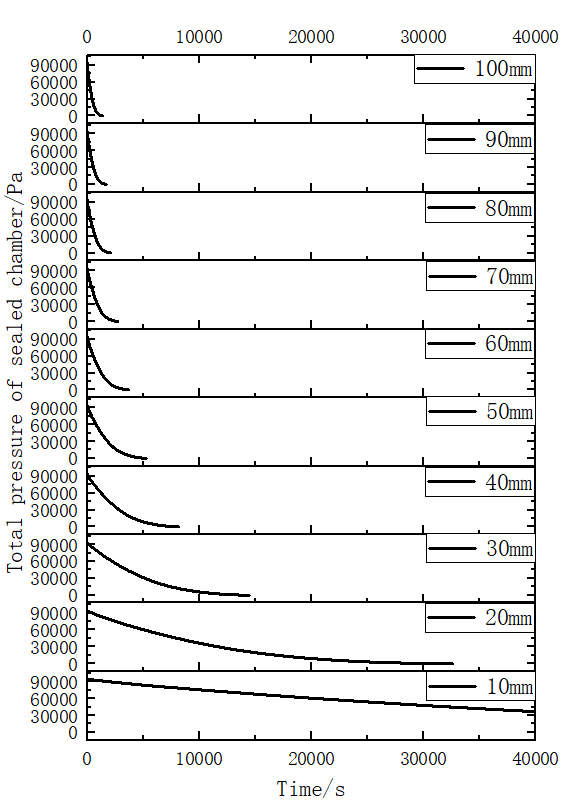
+ ( ) γ Variation of Key Leakage Parameters in Sealed Chamber: Assume that the volume of the sealed chamber of the manned spacecraft assembly is 400m³, and the initial condition of the total pressure of the sealed chamber is 95kPa [5]. Figure 1 shows the total pressure change curve of the sealed chamber when the manned spacecraft assembly has a leak hole with an equivalent diameter of 10mm, 20mm, 30mm, 40mm, 50mm, 60mm, 70mm, 80mm, 90mm and 100mm respectively.
As can be seen from the calculation results in Figure 1, under the same initial conditions, the time for the total pressure of the sealed chamber to drop to the minimum limit value gradually decreases with the increase of the equivalent leak diameter. When the equivalent leak diameter is greater than or equal to 30mm, the time for the total pressure of the sealed cabin to drop to the minimum limit value is sharply shortened, and it can only support the astronauts to carry out the most urgent operations in orbit. When the equivalent leak diameter is less than or equal to 20mm, the time when the total pressure of the sealed cabin drops to the minimum limit value can support the astronauts to carry out the operation of on-orbit leak location and plugging.
The minimum environmental pressure that a person can survive is 0.05MPa, which is taken as the lower limit. For leaks with a diameter of 20mm, the emergency treatment should not exceed 9000s (150min) at the latest.
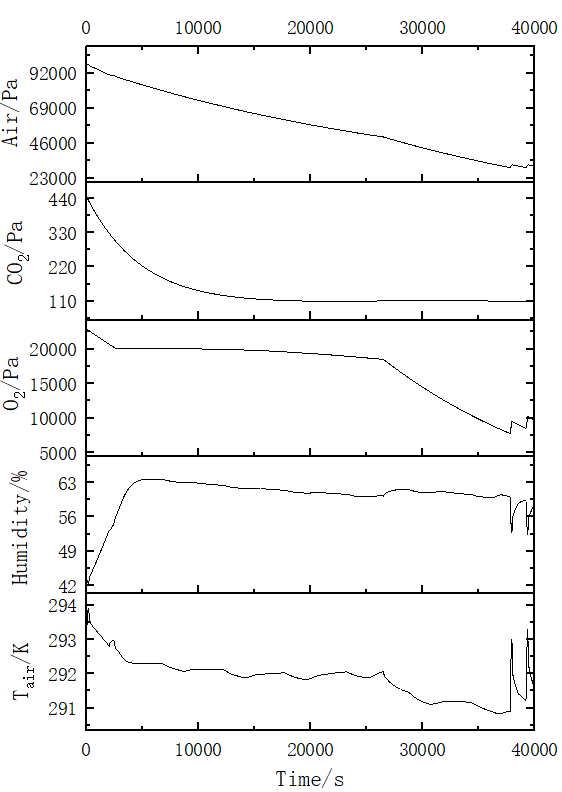
The total pressure, partial pressure of oxygen, partial pressure of carbon dioxide, temperature and humidity of the sealed cabin are the key parameters that affect whether the crew can stay in orbit. When the equivalent leak diameter is less than or equal to 20mm, the changes of total pressure, partial pressure of oxygen, partial pressure of carbon dioxide, temperature and humidity in the sealed cabin are simulated and analyzed. Figures 2-4 show the changes of manned environmental parameters when the equivalent leak diameter is 10mm, 15mm and 20mm respectively. The initial calculation conditions are the total pressure of the sealed cabin 95kPa, temperature 293K, humidity 40%, oxygen partial pressure 22kPa and carbon dioxide partial pressure 450Pa.
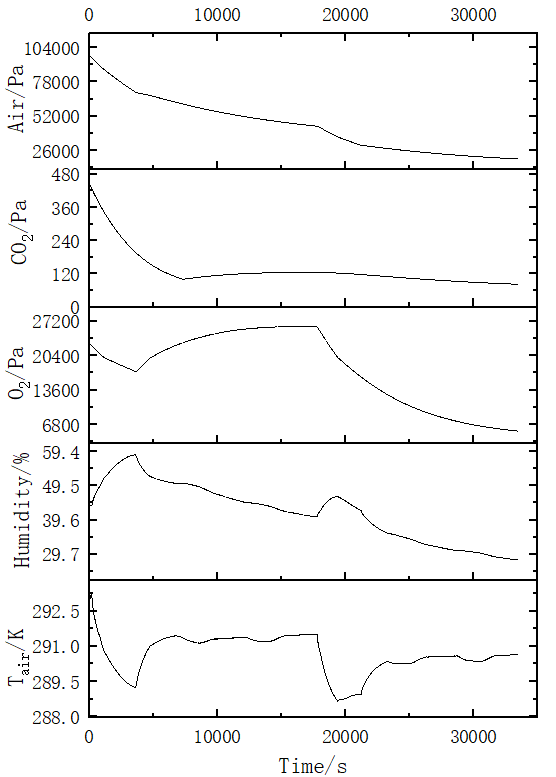
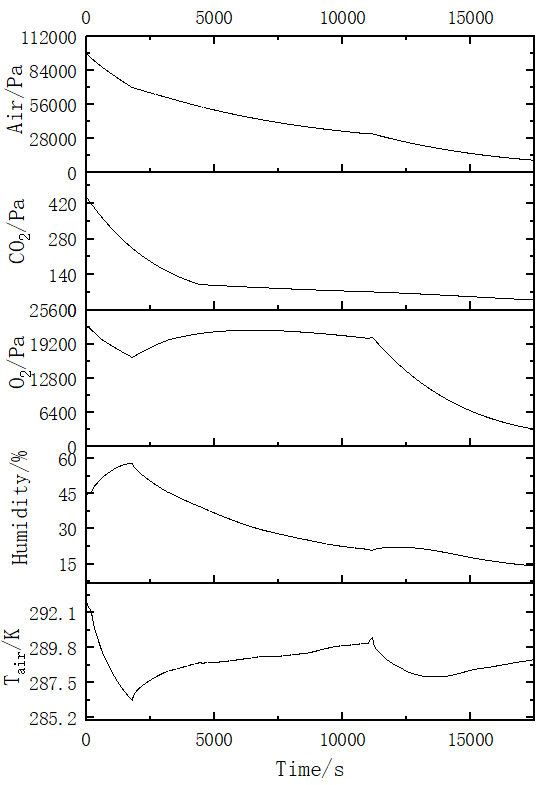
As can be seen from the calculation results in Figures 2-4, the temperature, humidity, partial pressure of oxygen and partial pressure of carbon dioxide in the sealed chamber can be maintained within an acceptable range during the time when the total pressure of the sealed chamber is maintained above the minimum limit value. When the equivalent leak diameter is less than or equal to 20mm, the spacecraft gas supply can effectively reduce the drop rate of the total pressure of the sealed cabin and maintain the cabin pressure at a higher level. With the decrease of the total pressure of the sealed capsule, the partial pressure of oxygen also dropped below the index that the human body can withstand, and the safety of the astronauts could not be guaranteed. The partial pressure of carbon dioxide concentration in the sealed chamber also showed a decrease trend, and the changes in temperature and humidity were also within the acceptable range.
The oxygen concentration that people can live normally is 19.5% to 23.5%, with oxygen 19.5% as the lower limit, for the leak hole with a diameter of 20mm, the emergency treatment cannot exceed 12000s (200min) at the latest.
Fault Handling Measure
Emergency treatment of the loss of pressure in the manned spacecraft capsule is an important part of the in- orbit safety guarantee of the spacecraft. The deterioration of the environment in the spacecraft capsule can be controlled through accurate positioning, gas supply, rapid leakage plugging, isolation and rescue measures, so as to achieve the effective recovery of the spacecraft and the crew safety state.
Leakage Monitoring and Leakage Location Measures: The leak fault can be determined by monitoring parameters such as the total pressure and partial pressure of the sealed cabin. Since the sealed cabin of each cabin segment in the manned spacecraft assembly is in a connected state, the total pressure of the sealed cabin of each cabin segment is at the same level, and the leakage of any cabin segment can be detected in time through the change of total pressure. The change in oxygen partial pressure is related to the diffusion rate of oxygen concentration, and it takes longer to determine that a leak has occurred by monitoring the oxygen partial pressure parameter. In order to determine the leak of the sealed cabin in the shortest time, the total pressure and its change rate of each cabin and each aircraft are monitored in real time. When the total pressure of the sealed cabin drops rapidly, the total pressure drop rate exceeds the limit, or the total pressure drops slowly beyond the normal control limit, the alarm device will give an alarm prompt in time.
The leak monitoring and positioning system collects the high-frequency elastic wave response of the cabin structure caused by on-orbit impact events to determine the occurrence of hypervelocity impact events and impact locations [13, 14]. The leakage monitoring and positioning system can realize the real-time monitoring and rapid positioning of the impact events at all positions of the cabin body, but the sensors and control computers in the system pay the weight cost when the spacecraft is launched and consume energy during the operation of the spacecraft.
In addition, the handheld ultrasonic leak detector contacts the bulkhead structure at close range through the ultrasonic probe, determines whether there is leakage in the detection area according to the enhancement of ultrasonic signals, and locates the leak point by the astronaut [15, 16]. The handheld ultrasonic leak detector is powered by a mobile power supply, and is used in the case of leakage alarm, and does not consume resources in the spacecraft. However, due to its small detection range, it is necessary for the astronaut to detect the leak point one by one, and the detection time is longer.
Considering the resource cost and the time requirements of emergency response, the leak monitoring and positioning system is configured in the area with high risk of spacecraft impact to conduct real-time monitoring of impact events, and the impact area can be determined immediately after the impact. For areas with low impact risk, a handheld ultrasonic leak detector is uniformly configured, and after determining the occurrence of leakage, the astronaut will carry out leak detection and positioning by handheld equipment.
Gas Supply Measure: In the case of pressure emergency, the most effective control measure is to supply gas to the capsule, which can reduce the drop rate of the total pressure of the capsule immediately. The maintenance ability of the gas supply system depends on the total amount of gas resources stored in orbit, and the spacecraft should use the least gas resources to maintain the longest operation time. The control computer independently judges and decides the time to turn on the gas supply and the rate of gas release to the sealed cabin, so as to maintain the total pressure and partial pressure of oxygen in the sealed cabin above the minimum allowable limit, and support the astronauts to carry out on- orbit emergency treatment within this time.
After the astronaut completes in-orbit disposal, in the case of remaining gas resources, by supplying gas to the sealed cabin, the total pressure and oxygen partial pressure in the sealed cabin will be restored to the normal control range as far as possible. If the human body cannot be restored to the manned environment after the completion of the disposal, the astronaut must evacuate the spacecraft and return to the ground.
Astronaut Protective Measures: It can be seen from the simulation analysis results that when the total pressure of the sealed chamber decreases during the leakage process, the partial pressure of oxygen also decreases, and it will always remain within the index range that the human body cannot bear. In this case, the configuration of oxygen supply equipment to provide breathing support to the astronauts can effectively reduce the impact of the leak on the astronauts’ bodies and ensure that the in-orbit operation can be carried out when the oxygen concentration in the sealed module is low.
On-Orbit Plugging Measures: Failure modes such as cracks, pinholes or holes may appear in the bulkhead due to leakage of the sealed cabin caused by the impact event. The leak plugging equipment in manned spacecraft can repair the leak of cracks, pinholes or holes.
The amount of equipment installed in each area of the sealed capsule is different, the difficulty of astronauts to operate the sealed capsule bulkhead in orbit is different, and the time cost is different. The leak plugging equipment should support the astronauts to complete the rapid operation in various areas in orbit, and repair or reduce the size of the leak hole in the shortest time.
Cabin Isolation Measures: There are hatch doors between each cabin and each vehicle of the manned spacecraft, and under normal circumstances, the hatch doors are open to make the sealed space of the manned spacecraft connected. In the event of a leak, the leaking cabin or aircraft can be isolated by closing the cabin door. After the isolation, the other segments of the manned spacecraft are in a safe state and may continue to support the crew’s stay in orbit.
Emergency Life-Saving Measure: Manned spacecraft is a spacecraft for transporting astronauts to and from heaven and earth in groups. The ground launch site adopts the mode of rolling manned spacecraft and rockets for backup [17]. If the manned spacecraft has a serious failure during the astronaut’s stay in orbit and cannot support the astronaut to return to the ground by team, the ground can decide to launch the rescue spacecraft. Through the astronaut crew emergency evacuation program design [18] and the ground emergency launch process design [19], it can be ensured that in the case of a major emergency failure, the astronauts can be isolated from the fault danger in the shortest time and return to the ground safely through the emergency rescue spacecraft.
Emergency Handling Process
When the spacecraft detects that the total pressure drop rate of the sealed cabin exceeds the limit, it should first confirm the alarm information, check the leaking aircraft and the real-time cabin pressure drop rate through the alarm information, and eliminate the false alarm.
After confirming the alarm information, immediately carry out the leak location. When there is an impact alarm information, preliminary positioning can be carried out according to the location information of the impact area, and the astronauts will go to the area for detailed investigation and finally determine the specific location of the leak. When there is no impact alarm information, the astronauts first locate the leaking aircraft by observing whether the cabin pressure drops after closing the cabin door. The handheld leak detection is then performed region-by-region to determine the exact location of the leak. This situation takes a long time, and there is a risk of not being able to complete the positioning when a leak with a large leakage rate occurs.
Since the manned spacecraft is the only means of survival for the astronaut crew during their stay in orbit, an astronaut is required to confirm whether the manned spacecraft is leaking when the leak point is located. If it is confirmed that there is a leak in the manned spacecraft, the specific area of the leak will first be determined and the leak area will be disposed of in orbit. Depending on the specific situation after disposal, the ground will decide whether to re- launch the emergency rescue spacecraft to ensure the safety of the astronauts. In the case that in-orbit disposal cannot be completed, the astronaut should immediately close the door of the manned spacecraft that has leaked, isolate the danger of loss of pressure in the sealed capsule, and the astronaut should continue to stay in other compartments, waiting for the ground to launch the emergency rescue spacecraft, and return to the ground through the emergency rescue spacecraft.
Since the cargo spacecraft is a vehicle that carries materials for spacecraft and astronauts, it stores a lot of materials. In the case of leakage of cargo spacecraft, astronauts use handheld leak detection equipment to determine the specific area of leakage and carry out on-orbit disposal of the leak area. In the event that in-orbit disposal cannot be completed, the astronaut should immediately carry out material transfer work, transfer the materials in the cargo spacecraft to the non-leaking module or other aircraft as far as possible, close the cargo spacecraft cabin door before the total pressure of the sealed cabin drops to the minimum limit, and isolate the danger of pressure loss of the sealed cabin. After the transfer of materials is completed and the cargo ship is isolated, the astronaut crew has the conditions to continue to stay in orbit.
The manned spacecraft control module and work support module are the main activity places of astronauts during their stay in orbit. In case of leakage, astronauts should try their best to locate the leak point and plug the leak in orbit, so that the key functions of the spacecraft can be retained. If it is difficult to complete the in-orbit operation within the maintenance time, in order to ensure the safety of the astronauts, the danger of closing the door of the module with leakage and isolating the pressure loss of the sealed module should be considered first. In the case that the leak hole is too large and the total pressure of the sealed capsule drops very fast, the astronauts cannot complete the judgment of the leaking cabin within the maintenance time, that is, they cannot judge the leaking cabin and cannot isolate the danger of pressure loss of the sealed capsule by closing the cabin door. In order to ensure the safety, the astronauts can be transferred directly to the manned spacecraft and close the cabin door of the manned spacecraft. The manned spacecraft is evacuated from the spacecraft and returned to the ground by the ground decision. Figure 5 shows the de-pressurization disposal strategy of the manned spacecraft capsule.
Failure warning
Confirm alarm
information Leakage location
Yes
Whether there is an impact alarm?
No No
Determine whether there is
Determine whether
a leak inShenzhou there is leakage in the docked aircraft spacecraft Yes Yes
Leakage location in
Leakage location in
Shenzhou
docked aircraft Determine the feasibility of plugging Determine the feasibility of plugging Leakable unLeakable Leakable unLeakable Plugging Transfer materials Isolation of Plugging Shenzhou Isolation of Repressuriz docked aircraft Repressuriz ation Launch rescue craft ation $$ \mathrm {I} = \mathrm {I} _ {1} + \mathrm {I} _ {2} + \dots + \mathrm {I} _ {n} $$ $$ \therefore \mathrm {即} \mathrm {当} x = 1 \mathrm {时} x = 1 $$ Space station leak Finish Finish module location Finish Finish Leakage location in Space Station Determine the feasibility of plugging Leakable unLeakable Plugging Decision to evacuate Evacuation Repressurizati Decision to on evacuate Space Station setting Continue to reside Unable to reside $$ \mathrm {I} = \mathrm {I} _ {1} + \mathrm {I} _ {2} + \dots + \mathrm {I} _ {n} $$ $$ \square $$ Evacuation Finish Finish Space Station setting $$ \mathrm {C O} _ {2} + \mathrm {H} _ {2} \mathrm {O} = \mathrm {H C O} _ {3} + \mathrm {H} _ {2} \mathrm {O} $$ Finish Figure 5: Disposal strategy of cabin depressurize.
Risk Analysis
For the loss of pressure of the manned spacecraft capsule caused by the impact of space debris, the event sequence is established. Figure 6 shows the event sequence diagram.
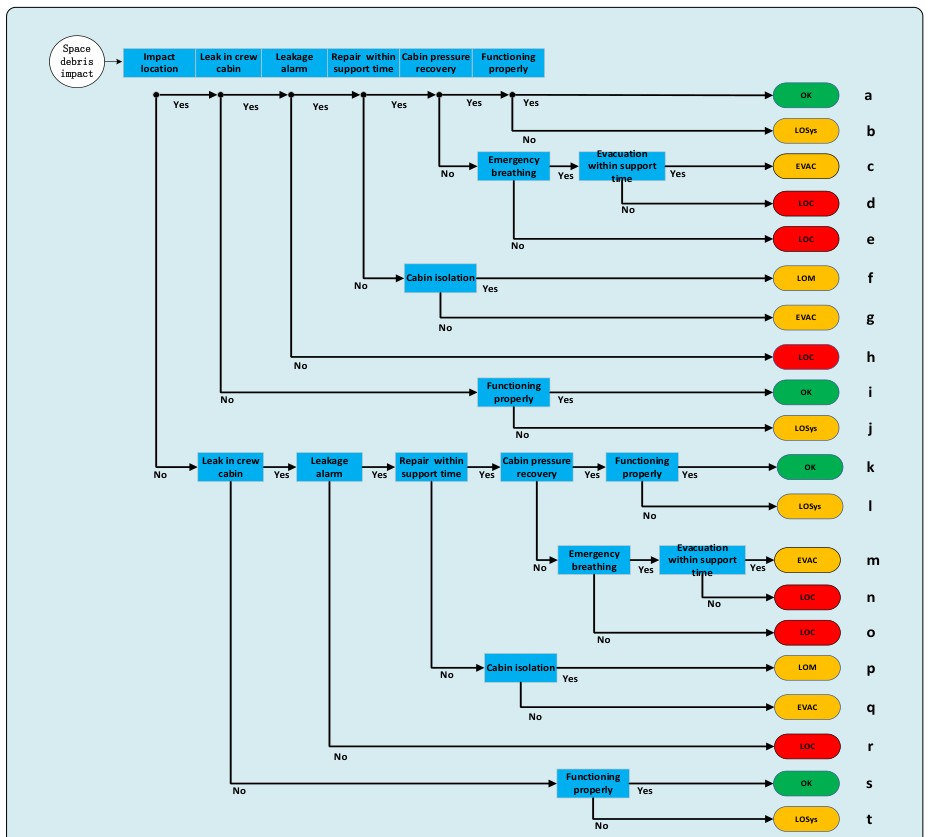
According to the analysis results, there are five possible impacts of space debris impacts on manned spacecraft: • Normal: the impact of space debris on the sealed module does not cause leakage and functional damage, or it is restored to normal after being disposed of by astronauts in orbit; • Astronaut Casualties: Space debris impact caused the loss of pressure in the sealed module accident, because the cabin pressure monitoring system failed to detect the danger in time, resulting in astronaut casualties; • Cabin Loss: The function of the sealed cabin is lost after being affected by the impact of space debris. Isolation measures are adopted to prevent the spread of the fault without affecting the function of other cabin segments;
• System Loss: space debris impact causes equipment damage, resulting in the loss of a spacecraft function, but does not affect the astronaut’s stay, will not spread the fault to other segments; • Evacuation: When the astronaut has a cabin pressure leak and cannot locate the leak hole, or the leak hole is beyond the scope of repair and recovery, the established stay mission is interrupted and the manned spacecraft is evacuated to return to the ground.
In the sequence analysis of space debris impact events, there are 16 paths leading to dangerous consequences. Table 1 shows the analysis results of the sequence of events.
| Impact location | Leak in crew cabin | Leakage alarm | Repair within support time | Cabin pressure recovery | Functioning properly |
|---|
Table 1: Analysis of space debris impact event chain.
| Event Chain Number | Intermediate Event | End State | |
|---|---|---|---|
| 1 | b | Positioning of impact position, leakage of containment chamber, Hull leak monitoring system alarm, The repair can be completed within the system support time, The cabin pressure is back to normal, Spacecraft function loss | LOSys |
| 2 | c | Positioning of impact position, leakage of containment chamber, Hull leak monitoring system alarm, The repair can be completed within the system support time, Astronaut emergency breathing support | EVAC |
| 3 | d | Positioning of impact position, leakage of containment chamber, Hull leak monitoring system alarm, The repair can be completed within the system support time, Astronaut emergency breathing support, Unable to complete evacuation within emergency respiratory support time | LOC |
| 4 | e | Positioning of impact position, leakage of containment chamber, Hull leak monitoring system alarm, The repair can be completed within the system support time | LOC |
| 5 | f | Positioning of impact position, leakage of containment chamber, Hull leak monitoring system alarm, Fault section isolation | LOM |
| 6 | g | Positioning of impact position, leakage of containment chamber, Hull leak monitoring system alarm, Failure module cannot be isolated | EVAC |
| 7 | h | Positioning of impact position, leakage of containment chamber, Hull leak monitoring system did not alarm | LOC |
| 8 | j | Positioning of impact position, leakage of containment chamber, Spacecraft function loss | LOSys |
| 9 | l | Positioning of impact position, leakage of containment chamber, Hull leak monitoring system alarm, The repair can be completed within the system support time, The cabin pressure is back to normal, Spacecraft function loss | LOSys |
| 10 | m | Positioning of impact position, leakage of containment chamber, Hull leak monitoring system alarm, The repair can be completed within the system support time, Astronaut emergency breathing support | EVAC |
| 11 | n | Positioning of impact position, leakage of containment chamber, Hull leak monitoring system alarm, The repair can be completed within the system support time, Astronaut emergency breathing support, Unable to complete evacuation within emergency respiratory support time | LOC |
| 12 | o | Positioning of impact position, leakage of containment chamber, Hull leak monitoring system alarm, The repair can be completed within the system support time | LOC |
| 13 | p | Positioning of impact position, leakage of containment chamber, Hull leak monitoring system alarm, Fault section isolation | LOM |
| 14 | q | Positioning of impact position, leakage of containment chamber, Hull leak monitoring system alarm, Fault section isolation | EVAC |
| 15 | r | Positioning of impact position, leakage of containment chamber, Hull leak monitoring system did not alarm | LOC |
| 16 | t | Positioning of impact position, leakage of containment chamber, Spacecraft function loss | LOSys |
Table 2: Analysis of space debris impact event chain.
In terms of safety control measures, there are safety design measures for all possible hazardous transmission paths. There are at least 3 intermediate events on the hazardous transmission path, and there are 16 transmission paths from the occurrence of space debris impact to the occurrence of catastrophic consequences, among which the longest path experiences 6 intermediate events and the shortest path experiences 3 intermediate events. Meet the requirements of ensuring the safety of astronauts and spacecraft in case of failure.
In order to quantify the risk of pressure loss of the sealed capsule of A manned spacecraft, it is assumed that the manned spacecraft is composed of three compartments, and that module A is the main control module of the manned spacecraft, which runs in orbit for 10 years. During the operation of manned spacecraft in orbit, the probability of space debris breaking through the capsule is assumed to be constant and follows exponential distribution. The pressure loss monitoring equipment and positioning equipment of the sealed chamber are electronic equipment, and are exponential distribution; Whether the breakdown area can be repaired, in-orbit repair, and astronaut emergency evacuation are based on the success or failure type. Table 2 shows the pressure loss analysis data of sealed chamber.
| Mean value | Data type | Distribution | |
|---|---|---|---|
| Segment A has been punctured | 0.03 | Interval estimation | Exponential |
| Segment B has been punctured | 0.03 | Interval estimation | Exponential |
| Segment C has been punctured | 0.03 | Interval estimation | Exponential |
| Pressure loss monitoring | 0.999 | Interval estimation | Exponential |
| Can be repair | 0.9993 | Point estimation | Success/failure |
| Leak location | 0.99 | Interval estimation | Exponential |
| Leak repair | 0.99 | Point estimation | Success/failure |
| Evacuation | 0.99 | Point estimation | Success/failure |
Table 3: Pressure loss analysis data of sealed chamber.
Table 3 shows the probability of a dangerous outcome of astronaut injury or death.
| Aircraft | Mean | Fractile | ||
|---|---|---|---|---|
| Value | 5% | 50% | 95% | |
| Segment A | 5.19E-06 | 1.41E-06 | 3.77E-06 | 1.29E-05 |
| Segment B | 1.96E-06 | 1.00E-07 | 7.60E-07 | 7.07E-06 |
| Segment C | 1.92E-06 | 8.00E-08 | 7.40E-07 | 6.81E-06 |
| Combination | 9.07E-06 | 2.72E-06 | 6.83E-06 | 2.14E-05 |
Table 4: Probability of dangerous consequences of astronaut loss Table 4 shows the probability of a dangerous consequence of loss
| Aircraft | Mean | Fractile | ||
|---|---|---|---|---|
| Value | 5% | 50% | 95% | |
| Segment A | 1.99E-05 | 1.18E-06 | 8.04E-06 | 7.06E-05 |
| Segment B | 1.96E-05 | 9.70E-07 | 7.74E-06 | 7.59E-05 |
| Segment C | 1.93E-05 | 7.20E-07 | 7.45E-06 | 7.08E-05 |
| Combination | 5.87E-05 | 9.47E-06 | 3.69E-05 | 1.71E-04 |
Table 5: Probability of dangerous consequences of manned spacecraft system loss Table 5 shows the probability of astronaut evacua
| Aircraft | Mean | Fractile | ||
|---|---|---|---|---|
| Value | 5% | 50% | 95% | |
| Segment A | 5.14E-04 | 1.40E-04 | 3.71E-04 | 1.28E-03 |
| Segment B | 1.94E-04 | 9.53E-06 | 7.68E-05 | 7.07E-04 |
| Segment C | 1.91E-04 | 7.36E-06 | 7.35E-05 | 7.09E-04 |
| Combination | 8.97E-04 | 2.68E-04 | 6.85E-04 | 2.14E-03 |
| Value | 5% | 50% | 95% | |
| Segment A | 5.43E-04 | 1.65E-04 | 4.26E-04 | 1.26E-03 |
| Segment B | 2.88E-04 | 6.37E-05 | 2.00E-04 | 7.73E-04 |
| Segment C | 2.55E-04 | 4.22E-05 | 1.66E-04 | 7.37E-04 |
| Combination | 5.43E-04 | 1.65E-04 | 4.26E-04 | 1.26E-03 |
Table 6: Probability of astronaut evacuation.
Table 6 shows the probability of a dangerous consequence of cabin loss.
| Aircraft | Mean | Fractile | ||
|---|---|---|---|---|
| Value | 5% | 50% | 95% | |
| Segment A | 0.0295 | 6.83E-03 | 0.021 | 0.0777 |
| Segment B | 0.0265 | 4.85E-03 | 0.0179 | 0.0746 |
| Segment C | 0.0236 | 2.96E-03 | 0.0147 | 0.0713 |
| Combination | 0.0775 | 0.2878 | 0.0652 | 0.1603 |
Table 7: Probability of manned spacecraft being normal after being impacted by space debris As can be seen from the results in Ta
Table 7: Probability of manned spacecraft being normal after being impacted by space debris As can be seen from the results in Table 3 & 4, the pressure monitoring equipment of the sealed capsule is the key equipment to cope with the loss of pressure of the sealed capsule, and its failure will lead to the dangerous consequences of astronaut casualties or manned spacecraft module losses and system losses.
Under the assumption that the reliability of the pressure monitoring equipment of the sealed capsule is 0.999 at the end of 10 years, the probability of astronaut casualties or manned spacecraft module losses and system losses is low. In the case that the manned spacecraft platform equipment can cope with the danger of pressure loss of the sealed capsule normally, there are more means to ensure the safety of the astronauts, and only in the case of ineffective treatment will lead to the astronaut evacuation.
Since cabin A performs the control function of manned spacecraft, astronauts can continue to stay in cabin A and still ensure safety in case of failure and loss of cabin B or C. Cabin A is the refuge for the loss of pressure in cabin B and C. According to the calculation results in Table 5, the probability of astronaut evacuation caused by cabin A is higher than that of cabin B and C. However, in the case of module A failure, the astronaut cannot continue to stay in the manned spacecraft, so the probability of the loss of module A in Table 6 is the same as that of the loss of the manned spacecraft.
As can be seen from the results in Table 7, the probability that astronauts can normally complete in-orbit disposal and keep the manned spacecraft in orbit after being impacted by space debris is much higher than the probability of unintended consequences. At the end of 10 years of in- orbit operation, the proportion of normal spacecraft in all consequential states is higher than 98%, and the manned spacecraft can ensure safety.
Conclusion
The diameter of the leak hole is the main factor affecting the pressure loss of the sealed chamber.
If the diameter of the leak hole of the sealed chamber with a volume of 400m³ is 20mm, and the survival limit of the environmental pressure is 0.05MPa, the emergency treatment should not exceed 9000s (150min) at the latest. Oxygen 19.5% as the lower limit of survival, emergency treatment should not exceed 12000s (200min) at the latest.
With the safety of astronauts as the primary goal of manned spacecraft decompression disposal, the accurate positioning of leakage holes and feasibility study and judgment of leakage plugging are the basis of emergency disposal, and a series of response measures are proposed, including the whole-system disposal and positioning of spacecraft manned spacecraft, docked aircraft, visiting spacecraft, etc., as well as the disposal time process of air replenishment, leakage plugging and evacuation.
Data Availability
The data of this study are available from the corresponding author upon reasonable request.
Conflicts of Interest
The authors declare that there is no conflict of interest regarding the publication of this article.
Authors’ Contributions
Li Wei is responsible for the research paper writing, simulation model building and calculation, data sorting and analysis, Wang Zhen participates in the research of fault disposal measures, Hou Yongqing and Xia Qiaoli participate in the research of risk analysis, and Luo Zihao participates in the simulation calculation.
Acknowledgments
The paper is supported by Chinese manned spaceflight program.
References
-
Zhou J (2013) Chinese space station project overall vision. Manned Spaceflight 19(2): 1-10.
-
Yang H, Zhang H, Zhou H (2022) Engineer technology and management innovation of China Space Station. Frontiers of science and technology of engineering management 41(03): 1-
-
Wang X, Zhang Q, Wang W (2022) System characteristics and prospect of China Space Station. Spacecraft Engineering 31(6): 26-39.
-
Wang X, Zhang Q, Wang W (2023) Design and application prospect of China’s Tiangong Space Station. Space: Science & Technology 3: 0035.
-
Zhu G (2022) Development on configuration technology of China manned spacecraft. Spacecraft Engineering 31(06): 46-53.
-
Qi L, Sun Li, Gong Zi, Rui Xi, Zhang P, et al. (2021) Micro space debris detection technology and applications. Space Debris Research 21(2): 10-16.
-
Liang Z, Yin Y, Zhu Y (2000) A simuation study of cabin pressure changes under accidental leakage. Space Medicine & Medical Engineering 2000(2): 128-131.
-
Rui J, Zheng C, Wang P (2001) Analytic Solution and Experimental Verification of Pressure Control Function of the Sealed Module of Manned Space Vehicle. Space Medicine & Medical Engineering (04): 264-267.
-
Xu X, Ren J, Liang X, Guo Z (2002) Dynamic analysis of the cabin atmosphere in a manned spacecraft. Journal of Tsinghua University (Science and Technology) (11): 1492-1495.
-
Jin J (2017) Analysis of air pressure control in pressurized cabin of manned spacecraft during cabin leaking. Manned Spaceflight 23(01): 21-27.
-
Chen Y, Pang L, Yin Y, Li G, Wang J (2017) Emergency strategy operation optimization for atmosphere environment control system in space station. Journal of Beijing University of Aeronautics and Astronautics 43(9): 1924-1930
-
Jin J, Yang C, Hou Y (2015) Simulation Model for Air Pressure Control System of Manned Spacecraft. Spacecraft Engineering 24(3): 51-57.
-
Liu Z (2014) Onboard monitoring technique for detection of impact on manned pressurized cabin by space debris. Harbin Institute of Technology.
-
Wang Z (2018) Perception and location of Whipple structure of manned space capsule impacted by space debris. Harbin Institute of Technology.
-
Zhang W (2021) Research on the detection technology of artificial gas leakage in spacecraft shell structure. Harbin Institute of Technology.
-
Qi L, Yue G, Sun L, Shao R, Rui X, et al. (2020) A leak location method of spacecraft stiffened structure. Spacecraft Engineering 29(2): 134-139.
-
Li Y, Chen W (2022) Emergency rescue technology development for China manned spacecraft. Spacecraft Engineering 31(6): 241-247
-
Yang H, Xiao X, Yin X (2023) Implementation of system- level safety assurance technology for manned spacecraft in Space Station Mission. Spacecraft Engineering 32(01): 35-
-
Meng Q, Fan T, Xu S, Pi C, Zhu X (2023) Design and optimization of process for Space Station Mission emergency launch. Missiles and vehicles (01): 140-145.
- Asymmetry Irreversible Heterogeneity Quantum Cosmology Grand Mathematical PHYSICS
- Early Universe: Hadronic Crystals Coherent Micro Gravitational Wave Emitters PHYSICS Part II
- The Solar System Constraint Maze: A Scientific Dead-End Revealing the Interuniversal Machine
- Assessment of Radiofrequency Radiation from 2G and 3G Mobile Phone Handsets
- Early Universe Magneto-Gravitational Coupling Genesis Physics: Part I
- Falsifiability of the Classical Law of Gravitation and Unveiling the Time-temperature Entanglement of the Universe