
Cosmic Baby-Does it Hint at the Existence of BEC in Strong Magnetic Field: A Possibility
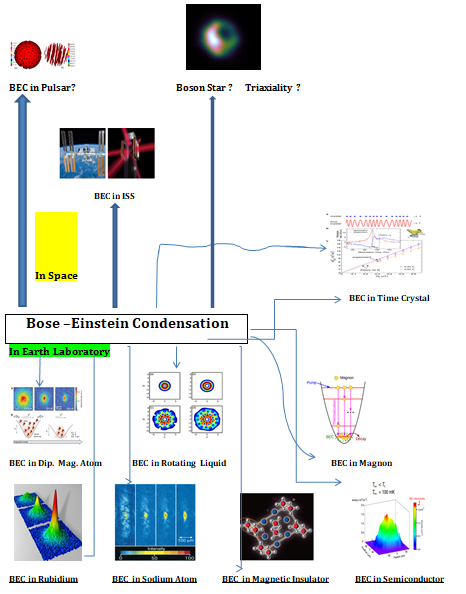
This paper is a remembrance of S. N. Bose for his serendipitous invaluable theoretical idea of the fifth state of matter that leads to the origin of Bose Einstein Condensation (BEC). The correspondence between Bose and Einstein was happened in 1924 i.e. 100 years ago through a forwarding letter (enclosed with the manuscript). Since then a lots of development on BEC have been occurred and still going on indicating its existence from micro-level such as atom, molecules to macro-level inside the compact objects of white dwarf, neutron stars. This BEC also exhibits its own style under low magnetic field, constant magnetic field but remains unclear in strong, ultra-strong magnetic fields. BEC opens new fields on “Triaxiality in self magnetized BEC stars or Boson stars (similar one as observed in magnetar), Magnon Q-ball , Time Crystals for understanding the exact role of BEC towards understanding the structure of the universe. In this paper I have discussed the possible role of BEC at different stages, including under ultra-strong magnetic field environment , towards understanding the secrets inside the universe. We are hopeful that future investigations on the new windows of BEC in the form of Triaxiality of Boson stars, Magnon Q-ball, Time Crystal definitely be able to unravel the secrets of the Universe.
Abbreviations
BEC: Bose Einstein Condensation; nK: Nanokelvins; PM: Paramagnetic; QD: Quantum Disordered; FM: Field-Aligned Ferromagnetic.
Graphical Abstract
Introduction
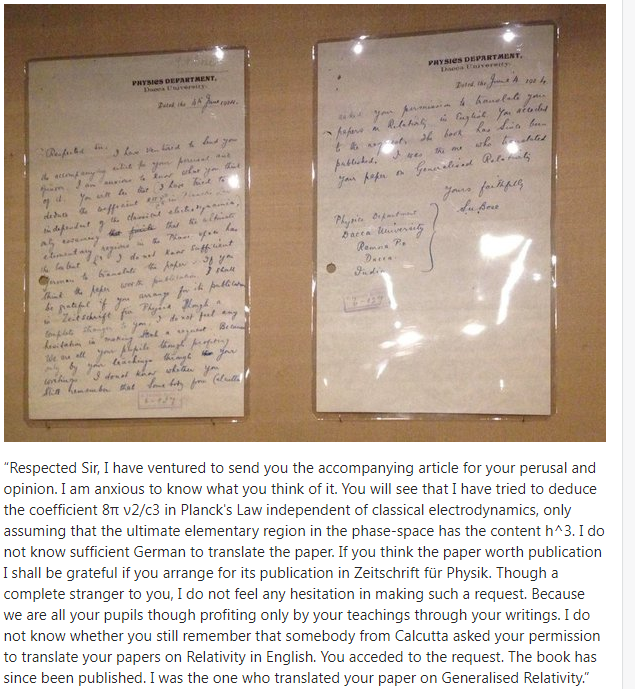
Figure 1: Photocopy of S N Bose’s hand written letter addressed to Einstein requesting to evaluate his paper. This is for the readers for knowing what was the humble actual correspondence between Bose and Einstein that stimulated for the origin of Bose Einstein Condensation (adopted from the writing of Samarth E entitled: Satyendra Nath Bose letter to Einstein which accompanied his paper describing the first developments towards Bose-Einstein statistics).
![Figure 3: Schematic diagram showing the formation BEC at low temperature (adopted from ref [13]).](/fulltextimages/13587/fig_3.png)
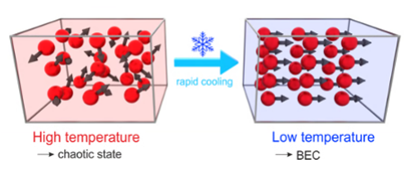
Our known four primary states of matter are — gasses, liquids, solids and plasmas. In the 1920’s another new form of matter appeared when Bose SN and Einstein A, et al. [1, 2] first conceived a strange form of matter in which a large number of individual atoms clump together behaving like a single super-atom. The condensed form of this super-atom is known as Bose-Einstein Condensation or BEC. This BEC forms only when materials are super-cooled i.e. within a hair of absolute zero. What happens in this stage is that atoms are hardly relative to each other because they have no free energy to move. As a result, all the atoms begin to clump together entering the same energy state (Figure 3).
During the period 1924 – 1995 this theoretical idea was confined within the theoretical research works [3, 4, 5] and attempts was to its realistic form in laboratory experiments. In 1995 a breakthrough occurred when in one side a team led by Eric A Cornell and Carl E Wieman from Joint Institute for Laboratory Astrophysics (JILA), Boulder, Colorado, USA [6] and in another side Wolfgang Katterle and his team colleagues Katterle W [7] announced the observation of BEC in rubidium atoms and sodium atoms, respectively. So, their experimental observations finally confirmed the existence of BEC although it was confined in the laboratory experimental level only.
Another major breakthrough occurred in July 2018 when in an experiment aboard the International Space Station (ISS) BEC was observed in a cloud of Rubidium atoms under ten millionth of a degree above absolute zero temperature (Figure 4) [8]. Note that this was the first experiment in space under such a temperature that was observed by human in space. This also led two important areas:
- It is possible the occurrence of BEC in space ;
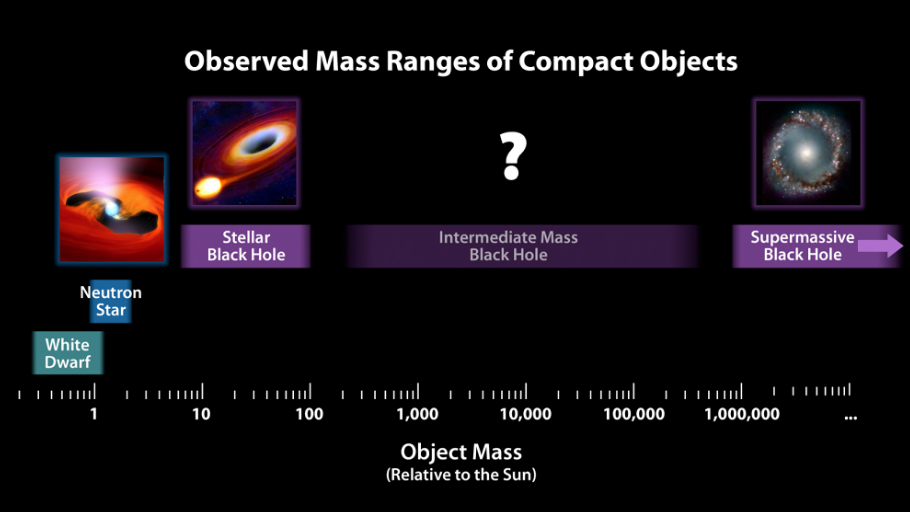
- The possible existence of BEC in astrophysical objects such as white dwarf, neutron star, pulsars, magnetars, other supermassive compact objects in galaxies, even may be in black hole also.
![Figure 5: Schematic diagram showing the criterion for Bose-Einstein condensation from high temperature to cool state. Note that when the temperature approaches absolute zero, the thermal cloud vanishes leaving a pure Bose condensate [11].](/fulltextimages/13587/fig_5.png)
Basic Physics of Bose Einstein Condensation
In 1924 Louis de Broglie in his Ph.D. thesis —“Rechershes sur la theorie der quanta “de Broglie L [9] suggested that electron around a nucleus could be thought of as being a standing wave such that electrons with all matter could be considered as a wave [10].
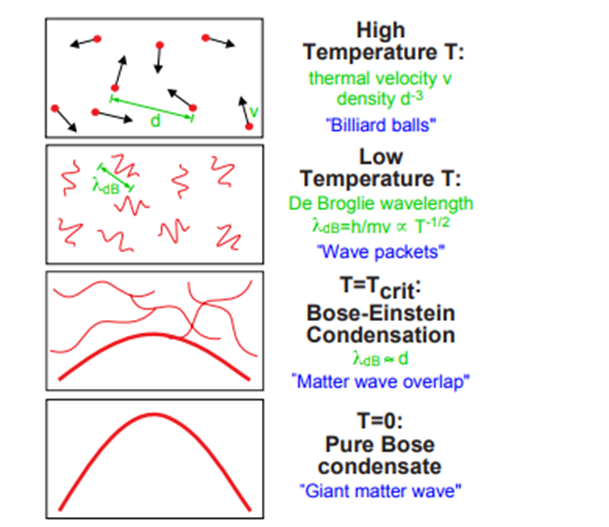
Bose-Einstein condensation is based on the above mentioned wave nature of particles. Figure 5 shows a simplified picture in which atoms in a gas can be considered as quantum-mechanical wave packets having of the order of thermal de Broglie wavelength. Initially at lower temperature this de Broglie wave length is longer. When the atoms are cooled gradually, the thermal de Broglie wavelength comes closer and comparable to the inter-atomic separation. This means at a certain cooling the atomic wave packets “overlap” and in-distinguishability of particles becomes a significant role where Bose gas i.e. “Bosons” undergo a phase transition and form a Bose-Einstein condensate (so called Bose-Einstein Condensation or BEC). In this situation a dense and coherent cloud of atoms arises where all the atoms are occupying the same quantum mechanical state [10]. The peak atomic density (n) follows the transition temperature (T) obeying the relation [11] :
$$ n \lambda_ {d B} ^ {3} = 2. 6 1 2 \tag {1} $$
where the thermal de Broglie wavelength $$ \lambda_ {d B} = \left(2 \pi \hbar^ {2} / m k _ {B} T\right) ^ {1 / 2} \tag {2} $$
“m” being the mass of the atom and kB = Boltzmann
constant.
( )
BEC Observed in Laboratory Experiment under Different Conditions
BEC Observed by Cornell & Wieman in Rubidium Atoms On 5 June 1995, the first gaseous condensate was produced by Eric Cornell and Carl Wieman at the JILA laboratory , in a gas of rubidium atoms cooled to 170 nanokelvins (nK). They cooled the system using laser cooling techniques which give a significant head start when performing the final forced evaporative cooling to cross the condensation threshold (Figure 6 ).
![Figure 7: shows the direct observation of BEC of sodium atoms (right) which were magnetically trapped . Schematic diagram of magnetic trap is shown in (left). The dense core is the condensate, and the more diffuse cloud is the normal component [12,13].](/fulltextimages/13587/fig_7.png)
BEC Observed by Katterle Group using Magnetic Trapped Sodium Atoms W. Katterle and his group used magnetic traps and optical dipole traps for tightly confining and stable state of the evaporative sodium atoms as well as cooling. Note that atoms are lost from this trap due to non-adiabatic spin flips when the sodium atoms pass near the center. Their observed BEC of sodium atoms are shown in Figure 7.
![Figure 8: represents the observation of BEC , as observed by Aftalion, et al. [14] , through the Density profiles of a rotating condensate for different rotation parameters for (a) Ω = 0.25, (b) Ω = 0.9, (c) Ω = 0 p .99 and (d) Ω = 0.994. Distances are measured in units of ~/(mω).](/fulltextimages/13587/fig_8.png)
BEC in Rotating Gases or Liquid
In a numerical study Aftalion, et al. [14] considered rotating atomic gases , placed in a harmonic plus Gaussian trap and observed the appearance of BEC when the rotational frequency is below the trapping frequency of the harmonic potential. The observed condensate has an annular shape containing a triangular vortex lattice. As soon as the rotational frequency (Ω) approaches the width of the condensate. The circulation inside the central hole gets large tuning like a hollow BEC. Their analytical estimates of the size of the condensate and the circulation both stay in the lowest Landau Level limit and the Thomas-Fermi limit (Figure 8).
![Figure 9: shows the observation of BEC by Morita Y, et al [15]. in their investigation of the Emergence of the exciton condensate in the density distribution at Ppump = 1.6 mW when Tmix < 400 mK. Left panel shows the spatial distribution of the para-exciton density measured by induced absorption imaging at Tmix = 500 mK (100 mK). Note that the vertical axis shows the paraexciton density, and the horizontal plane shows the position in the trap potential. The density of a local dense signal at Tmix = 100 mK exceeds the BEC transition density of 1.7 × 1015 cm−3.](/fulltextimages/13587/fig_9.png)
As per observation vortices first appears at the maximum density located at a distance r = 4.2 when Ω = 0 instead of close to the center of the condensate. With the increase in Ω , the vortex lattice appears at the initial circle of vortices, the condensate’s size increases. This increase in size is visible and finally turns into a hole i.e. hollow BEC.
Observation of BEC in Bulk Semiconductor In realistic view BEC is a quantum statistical phase transition in matter as a macroscopic level occupation in the ground state. But ambiguity has raised as a long outstanding problem in observing BEC of excitons in a photo-excited bulk semiconductor. Recently, Morita Y, et al. [15] observed quantum phase transition and BEC in a bulk Cu2O at below 400 mK. This was the first time direct visualization of the exciton cloud in real space although it was an unconventionally small condensate fraction of 0.016 with spatial profile of the condensate. Significance is that this discovery was a new type of BEC in the field of quantum statistical mechanics of non- equilibrium open system.
![Figure 10: BEC observed by Bigagli et al [16] in dipolar NaCs molecules enabled by microwave shielding. Note that (a), (b) indicate the evaporative cooling of NaCs molecules from a thermal cloud to a BEC. The molecules are held in an optical dipole trap and dressed by circularly polarized (σ +) and linearly polarized (π) microwave fields.](/fulltextimages/13587/fig_10.png)
Figure 9: shows the observation of BEC by Morita Y, et al [15]. in their investigation of the Emergence of the exciton condensate in the density distribution at Ppump = 1.6 mW when Tmix < 400 mK. Left panel shows the spatial distribution of the para-exciton density measured by induced absorption imaging at Tmix = 500 mK (100 mK). Note that the vertical axis shows the paraexciton density, and the horizontal plane shows the position in the trap potential. The density of a local dense signal at Tmix = 100 mK exceeds the BEC transition density of 1.7 × 1015 cm−3.
BEC in Dipolar Magnetic Atoms
In 2004 the experimental observation of gases of Chromium atoms under ultra-cold condition showed that these atoms can be treated as highly magnetic atoms. These highly magnetic atoms exhibit their identity separating from their electronic ground state configuration by possessing a large spin. This means that they have large magnetic moment. Utilizing this property Bigagli N, et al. [16] manipulated a complex system, consisting of NaCs dipolar magnetic atoms, under ultracold cooling and trapping and found a dense spectrum of resonances in their scattering behavior. Significance of this observation is that these resonances can be useful in (a) controlling the interatomic interaction, (b) understanding the physics of few- and many body dipolar quantum magnetic gases. For example: dipolar effects in magnetic quantum gases based on elastic and inelastic anisotropic scattering in determining the affected shape, stability , dynamics and excitations (Figure 10).
![Figure 11: it shows the schematic diagram of BEC of magnons in dimerized quantum antiferromagnets. (a), Dimers in the real material TlCuCl3 with S = 1/2 from Cu2+ ions and superexchange via Cl−. (b), Dimers on a square lattice with dominant antiferromagnetic intradimer interaction J0 and interdimer interactions Ji. Triplet states (grey, top) are mapped onto quasiparticle bosons (triplons, bottom). (c), Zeeman splitting of the triplet modes with gap 1 and bandwidth D at k0 = (π/a, π/a). Inset, Dispersion of triplons at the critical field Hc1. (d), Resulting phase diagram with paramagnetic (PM), quantum disordered (QD) and field-aligned ferromagnetic (FM) phases and canted-antiferromagnetic (XY-AFM) phase, where a magnon BEC occurs (adopted from ref. [17]).](/fulltextimages/13587/fig_11.png)
BEC in Magnetic Insulators
It has been observed that the appearance of BEC in that system in which particles obey the Bose Statistics. This means that the general view of BEC is possible with bosonic atoms in liquid helium, ultra-cold gases. Recently, Giamarchi, et al. [17] observed BEC in magnetic insulator where excitons are the main contributors. It is known that the elementary excitations in anti-ferromagnets are “ Magnon”, “Quasiparticles” having integer spin and obey Bose Statistics.
If the density of magnons in a excitation system is controlled by magnetic field then interactions between the excitations, magnons and their interplay with the crystalline lattice would be able to show a formation of BEC in compare to the canonical BEC. This fact was experimentally observed in the magnetic insulator TlCuCl3 [18] (Figure 11).
![Figure 12: Schematic diagram showing the creation of the magnon BEC. In a typical scheme, quanta of spin-wave excitations (magnons) are pumped into a high energy level (band) by a radio frequency pulse or parametric pumping so that the magnons then thermalize with time constant sE, falling to the ground level (band). Note that the Magnon decay from the ground state is characterized by the decay time sN. Under sufficiently strong pumping or if the magnon decay time is much longer than the thermalization time, sN sE, a macroscopic number of magnons occupy the ground state of the system, forming a BEC (adopted from Makinen et al 2024 [19] and for details see the text of the ref. [19]).](/fulltextimages/13587/fig_12.png)
Figure 11: it shows the schematic diagram of BEC of magnons in dimerized quantum antiferromagnets. (a), Dimers in the real material TlCuCl3 with S = 1/2 from Cu2+ ions and superexchange via Cl−. (b), Dimers on a square lattice with dominant antiferromagnetic intradimer interaction J0 and interdimer interactions Ji. Triplet states (grey, top) are mapped onto quasiparticle bosons (triplons, bottom). (c), Zeeman splitting of the triplet modes with gap 1 and bandwidth D at k0 = (π/a, π/a). Inset, Dispersion of triplons at the critical field Hc1. (d), Resulting phase diagram with paramagnetic (PM), quantum disordered (QD) and field-aligned ferromagnetic (FM) phases and canted-antiferromagnetic (XY-AFM) phase, where a magnon BEC occurs (adopted from ref. [17]).
In this context, antiferromagnets can be described by an analogy between spins and bosons. In anti-ferromagnet closely spaced pairs of spins S = ½ while others are sing singlet (S = 0) and spin triplet (S = 1). Spin = ½ forms “dimers” with a spin singlet (S = 0) ground state while other one is triplet (S = 1) whose bosonic excitations is known as “Triplon”. This triplons, in fact are similar to magnetic excitons in an ordered antiferromagnet, known as “Magnon” (Figure 12) [18].
![Figure 13: Schematic diagram showing formation of Phonon in a magnon-BEC time crystal. (a) In a crystal (in a ground state) atoms occupy periodic locations in space indicated by (empty circles o), while phonon excitation results in a periodic shift from these positions (filled circles ●). A time crystal is manifested by a periodic process (thin line), and a phonon excitation leads to periodic variation of the phase of that process (thick line). (b) In a magnon-BEC time crystal, the periodic process is the precession of magnetization M at frequency x. For details see the text in ref. [19]) (adopted from ref. [19]).](/fulltextimages/13587/fig_13.png)
Figure 12: Schematic diagram showing the creation of the magnon BEC. In a typical scheme, quanta of spin-wave excitations (magnons) are pumped into a high energy level (band) by a radio frequency pulse or parametric pumping so that the magnons then thermalize with time constant sE, falling to the ground level (band). Note that the Magnon decay from the ground state is characterized by the decay time sN. Under sufficiently strong pumping or if the magnon decay time is much longer than the thermalization time, sN sE, a macroscopic number of magnons occupy the ground state of the system, forming a BEC (adopted from Makinen et al 2024 [19] and for details see the text of the ref. [19]).
Thus, Magnon i.e. the quanta of spin wave excitations, are pumped into a higher energy level (band) by applying radio frequency pulse or parametric pumping. Then these magnons fall to the ground level and decay. If the magnon’s decay time is much larger than the thermalization time, then a large number of magnons occupy the ground state of the system, forming a BEC.
Magnon as Time Crystal
Bose-Einstein Condensation (BEC) is a phenomenon where stable particles with integer spin occupy the ground state of the system. For example, superfluidity that arises in liquid 4He due to macroscopic phase coherence. In other words, this superfluidity can be as a consequence of the spontaneous breaking of the global U (1) gauge symmetry in relation to the consequence of the conservation of the particle number (N) of 4He atoms. Another significant spontaneous breaking is the “Time Crystals” which are the quantum systems for which time translation symmetry is spontaneously broken in the ground state. It is believed that like superfluids, bose gases, magnon condensates, magnon time crystal is possible. If so, then magnon time crystal can be possible based on relaxation time:
• The life time of the quasi-particles τN is much more greater than the thermalization time τE i.e. τN >> τE during which BEC is formed.
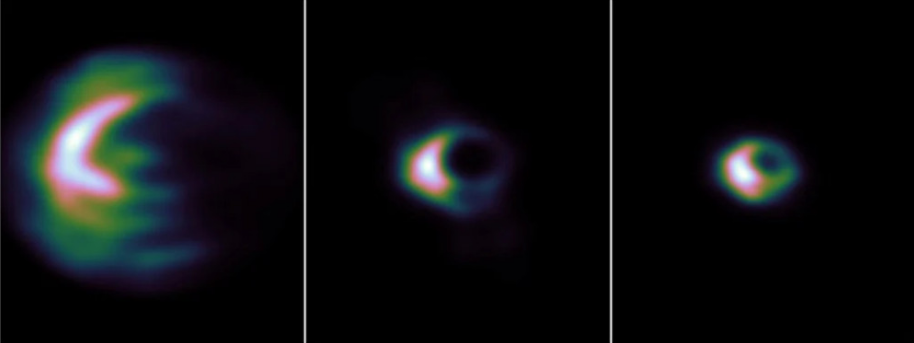
![Figure 14: Snapsot of a non-rotating black hole, a rotating black hole and a boson star as they’d appear to the Event Horizon Telescope. Unlike black holes, boson stars would be transparent as they lack an absorbing surface to stop photons, and do not have an event horizon [37].](/fulltextimages/13587/fig_14.png)
Figure 13: Schematic diagram showing formation of Phonon in a magnon-BEC time crystal. (a) In a crystal (in a ground state) atoms occupy periodic locations in space indicated by (empty circles o), while phonon excitation results in a periodic shift from these positions (filled circles ●). A time crystal is manifested by a periodic process (thin line), and a phonon excitation leads to periodic variation of the phase of that process (thick line). (b) In a magnon-BEC time crystal, the periodic process is the precession of magnetization M at frequency x. For details see the text in ref. [19]) (adopted from ref. [19]).
Magnonic Q-Bll
In our daily life we observe macroscopic objects are made of fermionic matter. On the other hand, if the objects are made of purely from bosons then for stabilization in relativistic quantum theory an additional quantum number “Q” is required for conservation. This means that Q-balls are spherically symmetric non-topological Q-Charge in the form of soliton [20, 21] i.e. they arise for charge conservation in relativistic scalar field. They play an important role in our visible universe. For example, these are the candidates of observing Q-balls in our universe :
BEC in Strong Magnetic Field
From the discovery time to till date a lot of researches have been done on possible effects on BEC under strong magnetic field. Some important results are shown in Table 1 [28].
| Used Materials / Particles | Magnetic Field Strength | Observation / Prediction | |
|---|---|---|---|
| Lermer [29] | Coherent pair of electron-hole | Strong magnetic field | Formation of Bose-Einstein condensation of excitons in a single particle state with wave vector K = 0 |
| Alexandrov, et al. [30] | Charged Bose gas (CBG) | Ultrahigh Magnetic field | Dielectric liquid phase of Bose-Einstein -excitons at low damping rate is more stable than electron-hole metallic liquid phase |
| Perez-Rojas, et al. [31] | Non-interacting charged particles in 3D and 1D | Extreme strong magnetic field ~ 1019G | Support to the existence of superconductivityPrediction of superconductive-ferromagnetic behavior in the vector field case |
| Moskalenko, et al. [32] | Electron-hole system with random phase approximation. | Strong magnetic field | BEC of the correlated pairs turns into a single particle state with arbitrary wave vector K in single 2D model. |
| Dey, et al. [33] | Antikaons in cold and dense beta-equilibrated matter | Magnetic field > 5 x 10¹⁸G. | Phase spaces of charged particles changes into a modified compositional charge.Threshold density of K – condensation shifted to higher density compared to the free particle caseEquation of state (EoS) becomes stiffer than that of the zero field caseBEC of the correlated electron hole pair turns into a single particle state with an arbitrary wave vector. |
| Botan et al. 2004 [34] | Ideal 2D electron-hole system | Strong magnetic field | Ground state energy per one exciton and the chemical at low exciton together with form a metastable states of dielectric liquid phase with positive compressibility.Dielectric liquid phase of BEC of magneto-exciton is more stable then the electron-hole metallic liquid phase. |
| Arghirescu, et al [28] | Gammons | Magnetic field ≥ 108G | Pre-clusters of gammons transform into a fragmentation of the BECPossibility of a cold genesis of elementary particles is comparable to those of a Magnetar or Gravistar. |
Table 1: List of some important works on BEC under strong magnetic field.
Magnetized BEC Stars
It is seen from above that magnetic field plays a significant role on the Equation of State (EoS) and also in structure formation of BEC stars. A Boson star is compact object composed of a gas of spin one (S=1) bosons formed up pairing of two neutrons. If we assume particle-magnetic field and particle-particle interactions are independent then we can consider two configurations made by magnetic field i.e.
- One where it (i.e. magnetic field) is constant and externally fixed;
- Another one it is i.e. the magnetic field is produced by the boson itself through self magnetization.
Again, splitting of magnetic pressure, produced inside the star by the magnetic field, thus gives two components:
- One in the direction long , and
- the other one perpendicular to the magnetic axis.
Investigation of magnetized BEC stars [35] shows that BEC stars are , in general, spheroid, less massive and smaller than the non-magnetic ones. Regarding the inner profiles of magnetic field of a (self) magnetized BEC stars the value of magnetic field strength at the surface and at the core are in agree with that of the compact object like magnetar. A comparison with cosmic baby is given below:
| Parameters | Boson Star | Cosmic Baby | |
|---|---|---|---|
| 1 | Suface Magnetic field | 1.62406 x 10¹⁴ G | 2.7 x 10¹⁴ G |
| 2 | Internal Magnetic Field | 1.89435 x 10¹⁷ G | 8.924 x 10¹⁷ |
| 3 | Triaxiality | Not yet detected. Simulation study shows no such triaxiality. appears | It is a triaxial star and its ellipticity is ϵ ~ 8.924 x 10– 3 |
From the above table it is clearly seen that all though magnetic field strength both of cosmic baby and Boson star are of the same order of magnitude yet Boson star is not exhibiting its triaxiality. This is the “Boson Star’s Triaxiality Puzzle “ [36] . The main question is — why Boson star not facing its triaxial phase ? that still remains unsolved.
Discussion & Conclusion
Bose-Einstein Condensation (BEC) is a fundamental macroscopic manifestation of quantum mechanics.
Like many particle i.e. electrons, protons, neutrons involved in stellar evolution bosons also involved with zero or integer spins. Naturally, it would revealed that bosons are involved somewhere in building the universe. For example:
- Superconductivity, super-fluidity are present inside the compact objects like neutron star, pulsars, magnetars, the evidence of which are in the form of glitches;
- Confinement of magnetic fields in the interior of the compact star and its splitting due pressure raises the “triaxility “ i.e. the deformation of the star.
- In the cores of Boson stars triaxiality not yet detected through simulation study but Magnon Q-ball provides a new window of “time -crystal” to the scientists to rethink about it.
- Not only that, (self) magnetized BEC stars or Boson stars have created a new impetus to the astronomers to unravel the secrets inside our visible universe.
We are hopeful that BEC would play a crucial role towards understanding the structure of the universe, in particular charged bosons at high temperature and high density towards understanding the physics of matter under extreme conditions.
Acknowledgement
The author expresses his sincere gratitude to the anonymous referee for his/ her invaluable suggestions and comments. He is greatly indebted to Dr Ramon Clerk and the editorial team for kind invitation and suggestions, and related computer works, respectively. He wishes to thank Prof. H N K Sarma, Dept. of Physics, Manipur University, B K Ganguly, Mrs. Tapati Parui and specially to Rajarshi Parui for his help in computer works.
• Author Contribution: I have done the complete manuscript. • Funding: Not applicable. • Data Availability: Data sharing is not applicable as no data sets were analyzed. • Ethical Conduct: Not applicable.
References
-
Bose SN (1924) Plancks Gesetz und Lichtquantenhypothese. 26(1): 178-181.
-
Einstein A (1924) Quantentheorie des einatomigen idealen Gases. pp: 261-267.
-
Bonazzola S, Frieben J, Gourgoulhon E (1996) Triaxial Neutron Star-A possible source of Gravitational Radiation. In Proc. XXXI Ren Contres de Moriond- Dark matter in Cosmology, Quantum Mechanics and Experimental Gravity. Les Arces, France.
-
Bonazzola S, Gourgoulhon E, Grandelement P, Novak J (2003) Constraints scheme for Einstein equation based in Dirac gauge and spherical candidates. Phys Rev D 70: 10400.
-
Bonazzola S, Frieben J, Gourgoulhon E (1998) Spontaneous symmetry breaking of rapidly rotating stars in general relativity. Astron. Astrophys 331: 280.
-
Cornell EA, Monroe C, Wieman CE (1991) Multiply loaded, ac magnetic trap for neutral atoms. Phys Rev Lett 67: 2439.
-
Katterle W, Andrews MR, Davis KB, Durfee DS (1996) Bose-Einstein Condensation of ultracold atomic gases. Phys Scripta T 66: 31.
-
Aveline DC , Williams JR, Elliott ER, Dutenhoffer C, Kellogg JR, et al. (2020) Observation of Bose–Einstein condensates in an Earth-orbiting research lab. Nature 582: 193-197.
-
de Broglie L (1924) Researches on the quantum theory. Thesis, USA 10(3): 22.
-
Huang K (1964) Imperfect Bose gas. In: Studies in Statistical Mechanics de Boer J, Uhlenbeck JR (Eds.), USA, pp: 3.
-
Durfee D S , Katterle W (1998) Experimental studies of Bose-Einstein Condensation. Optics Express 2: 299.
-
Davis KB, Mewes MO, Andrews MR, Van Druten NJ, Durfee DS, et al. (1995) Bose-Einstein Condensation in a Gas of Sodium Atoms. Phys Rev Lett 75: 3969.
-
Hillebrands B (2020) Bose-Einstein Condensation of Quasiparticles by rapid cooling. Nature Nanotechnology.
-
Aftalion A, Mason P (2009) Rotation of a Bose-Einstein Condensate held under a toroidal trap. Phys Rev A81: 023607.
-
Morita Y, Yoshioka K, Kuwata-Gonokami M (2022) Observation of Bose Einstein Condensates of Excitons in a bulk semiconductor. Nature Comm 13: 5388.
-
Bigagli N, Yuan W, Zhang A, Bulatovic B, Karman T, et al. (2023) Observation of BEC of dipolar magnetic molecules. arXiv: 2312.10968.
-
Giamarchi T, Riiegg C, Tchernyshyov O (2008) Bose- Einstein Condensation in Magnetic Insulator. Nature 4: 198.
-
Ruegg C (2003) Bose–Einstein condensation of the triplet states in the magnetic insulator TlCuCl3. Nature 423: 62-65.
-
Mäkinen JT, Autti S, Eltsov VB (2024) Magnon Bose- Einstein Condensates: From time crystals and quantum chromodynamics to vortex sensing and cosmology. Applied Phhys. Lett 124: 100502.
-
Heikkinen PJ , Autti S, Eltsov V, Hosio J, Krusius M, et al. (2014) Relaxation of Bose-Einstein condensates of magnons in magneto-textural traps in superfluid 3He-B. J Low Temp Phys 175: 3-16.
-
Kusenko A, Shaposhnikov M (1998) Supersymmetric Q-balls as dark matter. Physics Letters B 418: 46-54.
-
Kasuya S , Kawakami E , Kawasaki M (2016) Axino dark matter and baryon number asymmetry production by the Q-ball decay in gauge mediation. J Cosmology Astroparticle Physics 16(3): 11.
-
Cotner E , Kusenko A (2017) Primordial black holes from supersymmetry in the early universe. Phys Rev Lett 119: 031103.
-
Kasuya S, Kawasaki (2014) Baryogenesis from the gauge-mediation type Q-ball and the new type of Q-ball as the dark matter. Phys Rev D89: 103534.
-
Troitsky S (2016) Supermassive dark-matter Q-balls in galactic centers?. Journal of Cosmology and Astroparticle Physics pp: 027.
-
Enqvist K, Laine M (2003) Q-ball dynamics from atomic Bose-Einstein condensates. JCAP 0308: 003.
-
Autti S , Heikkinen PJ , Volovik GE , Zavjalov VV , Eltsov V (2018) Propagation of self-localized Q-ball solitons in the 3He universe. Phys Rev B 97: 014518.
-
Arghirescu M (2018) The possibility of particles forming from a Bose-Einstein Condensate, in an intense Magnetic or Gravitational Field. Int J High Energy Phys 5(1): 55-62.
-
Lerner IV, Lozovik Yu E (1981) Two-dimensional electron–hole system in a strong magnetic field as an almost ideal exciton gas. Sov J Exp Theor Phys 53: 763.
-
Alexandrov AS, Neere WH, Kbanov VV (1996) Theory of the charged Bose gas: BEC in ultrastrong high magnetic field. Phys Rev B 54 : 15363.
-
Perez Rojas H, Villegas-Lelovski (2000) Bose Einstein Condensation in a constant magnetic field. Brazilian J Phys 30: 410.
-
Moskalenko SA, Liberman MA, Snoke SW, Botan VV (2002) Bos Einstein Condensation on Exciton in ideal 2D system in strong magnetic field. Moldavian J Phys Sci 1: 5.
-
Dey P, Bhattacharyya A, Bandyopadhyay D (2002) Eose- Einstein Condensation in dense nuclear matter and strong magnetic field. J Phys G28: 2179.
-
Botan VV, Liberman MA, Moskalenko SA , Snoke DW, Johansson B (2004) Bose-Einstein condensation of Magnetoexcitons in ideal two-dimensional system in a strong magnetic field. Physica 346-437: 460 -464.
-
Auintero-Angulo G, Manreza Peret D (2019) (Self) Mangtized Bose-Einstein Condensate Stars. IJMP D 28: 1950135.
-
Parui RK (2024) Cosmic Baby and Boson Star’s Triaxiality Puzzle. Manuscript submitted to Euro Phys J C.
-
Olivares H, Younsi Z, Fromm CM, de Laurentis M (2020) How to tell an accreting boson star from a black hole. MNRAS 497: 521-535.
- Asymmetry Irreversible Heterogeneity Quantum Cosmology Grand Mathematical PHYSICS
- Early Universe: Hadronic Crystals Coherent Micro Gravitational Wave Emitters PHYSICS Part II
- The Solar System Constraint Maze: A Scientific Dead-End Revealing the Interuniversal Machine
- Assessment of Radiofrequency Radiation from 2G and 3G Mobile Phone Handsets
- Early Universe Magneto-Gravitational Coupling Genesis Physics: Part I
- Falsifiability of the Classical Law of Gravitation and Unveiling the Time-temperature Entanglement of the Universe