
Enhancing Maize Productivity through Nitrogen Application Methods and Timing in Pakistan
Agriculture sector plays an important role in the economy of Pakistan and is one of the major determinants of the economic growth and well-being. It contributes about 21% to Gross Domestic Product (GDP) and employs 45% of labor force. Majority of the population i.e-62% belongs to rural areas, and their livelihood directly or indirectly depends on agriculture. Poor nutrient management is one of the key factors contributing to decline in the productivity of maize in Pakistan. This review article is mainly focus on role of nitrogen and its application methods in growth, development, and production of the maize. Despite the fact that maize productivity is relatively better than other major cereal crops, its current maize productivity is still far below its potential productivity. The rate, time and method of nitrogen (N) fertilizer application are among the major abiotic factors limiting the productivity of the crop and are strongly related to growth, development, and yield of the crop. Nitrogen affects various physiological and biochemical processes in plant cells that ultimately affect the growth and development of the plant. Crop yield increases up to certain limit and declines if applied in an excess amount of nitrogen. Proper nitrogen application at proper growth stages and sufficient amount are need to be necessary for higher grain yield of maize. This review will serves for maize researchers to enhance maize productivity through nitrogen application timing and methods.
AR, Ali Z, Ahmad M, Saleem A, Rahman KU and Saifullah,
Production Sciences, The University of Agriculture Peshawar, Pakistan, Email:
junaid.agri@aup.edu.pk through nitrogen application timing and methods.
Keywords: Maize; Nitrogen; Timing; Method; Growth and yield
Role of Nitrogen in Maize Production
Poor nutrient management is one of the key factors contributing to decline in the productivity of maize. Nitrogen (N) deficiency is the key constraints in Maize production [1, 2]. N is a vital plant nutrient that determines the yield; important for maize production [1].
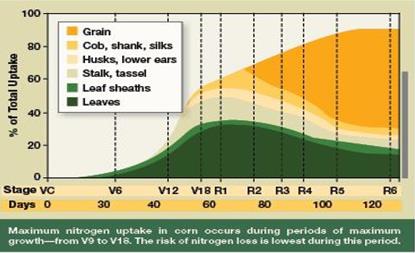
A sufficient quantity of N throughout the growing season is a must for optimum maize growth. It plays an important role in plant growth as an essential constituent of cell components and require for the synthesis of chloroplast, amino acids, proteins and cell division [3, 4]. The maize kernel is composed of approximately 72% starch, 10% protein, 5% oil, 2% sugar, and 1% ash with the remainder being water [5]. Maize is a plant that requires a high quantity of nutrients due to its enormous nutrient utilizing capacity. A higher volume of nitrogen is required for higher yield. Nitrogen is required in a more significant amount than other nutrients. The use of nitrogen fertilizers results in higher biomass and protein yield and increases the concentration of protein in the plant tissue [6]. Maize plants deficient in N will develop poor root system, which reduces their anchorage capacity [7]. When nitrogen deficiency occurs, maize will be stunted, photosynthesis gets reduced and consequently has a profound influence on grain yield. Reduced N is also associated with lower protein content of seeds and vegetative parts [8, 9]. Also, low level of N causes early maturity which results in a significant reduction in yield and quality. Further, N deficiency in maize may develop thin and spindly stems which could be prone to lodging by wind. Nitrogen regulates the efficiency of the use of nutrients in the plant. The nitrogen affects various physiological and biochemical processes in plant cells and, ultimately, affects growth and development [10]. Nitrogen uptake by the maize plant increases its concentration in both the plant or in the grain due to the higher total dry matter content.
Maize Response to Foliar Nitrogen Application
Modern technologies for maize production require a soil fertilization to be combined with application of foliar fertilizers [11]. Soil fertilization, and particularly the nitrogen fertilization, may be reduced by means of additional application of foliar biologically active fertilizers [12]. Foliar fertilization is a widely used practice to correct nutritional deficiencies in plants caused by improper supply of nutrients to roots [13]. Hu Y, et al. observed the foliar nitrogen application to determine the effect of foliar N on dry land wheat [14]. A field experiment was conducted during 2010-11 with randomized complete block design using four replications. The application of 80 kg N ha-1 applied in urea form, 70 kg N ha-1 at sowing time while 10 kg N ha-1 in the form of spray having (2 % N). The remaining N was given with different combination at various growth stages (30, 60, 90 and 120 days) after emergence. The yield was enhanced with foliar N over control. The experiment resulted that foliar application of 2 % in a single split or 120 DAE in dry land condition could increase wheat productivity. Bhattarai EM, et al. conducted research to determine the response of foliar fertilization, drought and salinity on the growth of maize [15]. At green house maize were planted in soil with drought and salinity after 23 days of sowing. The expanding leaves, dry weight of the blades, plant height, shot biomass length and fresh weight were investigated at harvest stage with element and minerals like (Na, K, Ca, Mg, P and N) in each leaf were analyzed. The minimization occurred in evapotranspiration, maize growth, shoots fresh and also in dry weight and leaf fresh and dry weight under salinity and drought and the foliar fertilization failed to enhance growth of plant under drought and salinity stress. The saline condition is responsible for plant reduction because of osmotic and no exchange on the concentration of nutrient in leaves.
Time and Methods of Nitrogen Application in Maize
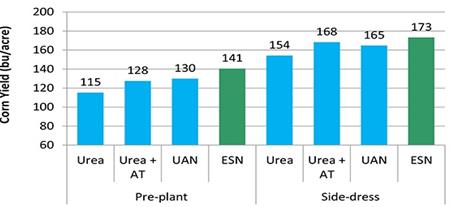
The timing of nitrogen application affects the yield [16]. Use of nitrogen in early plant growth improves yield and improves vegetative growth and development, and when is given in later stages of plant growth, late maturity and maturation cannot adequately promote the final yield. Although the level of nitrogen in the grain increases, it is used in later growth stages [17]. Diallo AO, et al. found that the application of nitrogen fertilizer @ 80 kg N/ha gave higher benefit cost ratio (1.5) [18]. Thakur DR, et al. found that during the sowing, earthing up and silking stages, the nitrogen applied at 3 equal divided doses to 60 kg/ha, maximized the yield of corn grain [19]. Hati N, et al. found that leaf senescence got increased due to smaller leaf area and less photosynthesis due to nitrogen deficiency [20]. Yadav DN, found that increment of amount of Nitrogen applied results more leaf number and thicker stem [21]. Leaf area and leaf number significantly increased by both rate and application of Nitrogen [22].
Growth and Yield of Maize Effected by Nitrogen
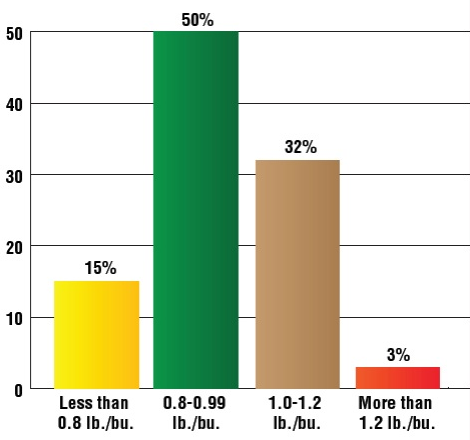
Adhikari P, et al. also found earlier silking occurred due to a higher percentage of Nitrogen applied [23]. Sherchan DP, et al. found that the application of higher nitrogen dose (200 kg N/ha) gave the highest number of cobs/plant (1.09), cob length (15.90 cm), cob diameter (5.10), number of grains/grain row (32.54,the number of grain rows/cob (14.11), number of grains/cob (459.9) and the greatest test weight (318.2g) and shelling recovery (72.14%) [24]. Adhikari P and Dawadi DR also reported that response of nitrogen and its application time to maize differs due to genetic characters, growing season (winter, spring, and summer), maturity period (early and full season), and growing domain (mountain/hill and Terai) [23, 25]. Muza L, et al. found a higher application rate of Nitrogen effectively increased kernel number per ear and kernel rows number per cob [26]. A higher level of Nitrogen (180 kg N/ha) improved seed yield to 2.85 t/ha of inbred (NML-1) maize [27]. Hati N, et al. found that the commercial maize hybrids require high nitrogen levels and fertile soils and hybrids are more responsive to nitrogen fertilizer [20]. Plant population ranging between 69,000 and 81,000 plants/ha, showed a significantly higher uptake of nitrogen than the 57,000 plant population/ha observed during 12 leaf and tasseling stages [21]. Hanway JJ, founded that use of nitrogen in early plant growth improves yield and improves vegetative growth and development, and when is given in later stages of plant growth, late maturity and maturation cannot adequately promote the final yield [28].
Conclusion
The amount of nitrogen fertilizer varies with soil and environmental condition as well as genetic architecture of plants. The nitrogen uptake in grain increases with application of increased level of nitrogen up to 150 kg N/ha applied in soil. The application of nitrogen up to 200 kg N/ha increased the growth traits, yield and yield attributing traits. This study suggests that recommended nitrogen application as basal dose at planting stage, split doses at critical growth stages namely knee high, and flowering stages should be applied for enhancing maize production. The nitrogen is essential for physiological and biochemical processes that ultimately affects growth and development.
References
-
Adediran JA, VA Banjoko (2015) Response of Maize to Nitrogen, Phosphorus and Potassium fertilizers in the savanna zone of Nigeria. Communcations in Soil Science and Plant Analysis 26(3-4): 593-606.
-
Asghar A, Ali A, Syed H, Asif W, Khaliq MT, et al. (2010) Growth and yield of maize (Zea mays L.) cultivars affected by NPK application in different proportion. Pakistan Journal of Science 62(4): 211- 216.
-
Schrader LE (2014) Functions and transformation of nitrogen in higher plants. In: Hauck RD (Ed.), Nitrogen in Crop Production. pp: 55-60.
-
Marschner H (2016) Mineral nutrition of higher plants. Academic Press 2nd (Edn.), Inc., San. Diego, USA, pp: 148–173.
-
Perry WP (2008) Corn as a livestock feed. In: Sprague CE, Dudley JW (Eds.), Corn and corn improvement, 3rd (Edn.), American Society of Agronomy, Madison, WI, pp: 941-963.
-
Tsai CY, Dweikat I, Huber DM, Warren HL (2012) Interrelationship of nitrogen nutrition with maize (Zea mays L.) grain yield, nitrogen use efficiency and grain quality. Journal of the Science of Food and Agriculture 58(1): 1-8.
-
Brady NC, Weil RR (2010) The nature and properties of soils. 10th (Edn.) New York: Macmillan
-
Warren HL, Huber DM, Nelson DW, Nann OW (2015) Stalk rots incidence and yield of corn as affected by inhibiting nitrification of fall-applied ammonium Agronomy Journal 67(5): 655-660.
-
Gangwar B, Kalra GS (2008) Influence of maize legume associations and nitrogen levels on maturity, grain quality and protein productivity. Field Crop Abstracts 41(11): 917.
-
Chien SH, Gearhart MM, Villagarci S (2011) Comparison of ammonium sulfate with other nitrogen and sulfur fertilizers in increasing crop production and minimizing environmental impact: a review. Soil Science 176(7): 327-335.
-
Fageria NK, Baligar VC, Li YC (2008) The role of nutrient efficient plants in improving crop yields in the twenty first century. Journal of Plant Nutrition 31(6): 1121-1157.
-
Shaaban M (2001) Effect of Trace-nutrient Foliar Fertilizer on Nutrient Balance. Pakistan Journal of Biological Sciences 4(7): 770-774.
-
Alam I, Khan I, Kumar M, Shah A (2015) Foliar nitrogen management for improving growth and yield of dry land wheat. Cercetari Agronomice in Moldova 48(3): 23-31.
-
Hu Y, Burucs Z, Schmidhalter U (2008) Effect of foliar fertilization application on the growth and mineral nutrient content of maize seedlings under drought and salinity. Soil Science and Plant Nutrition 54(1): 133-141.
-
Bhattarai EM, Shrestha SP, Panta BB (2004) Soil fertility management in maize and maize based cropping system in the western hills of Nepal. In Proceedings of the 24th National Summer Workshop on Maize Research and Production in Nepal. Organized by NARC, NMRP, pp: 198- 206.
-
Sankaran S, Subbiah Mudaliar VT (2009) Principles of Agronomy. 7th (Edn.), The Banglore Printing and Publishing Co. Ltd., Mysore Road, Bangalore, pp: 0267.
-
Nurudeen AR, Tetteh FM, Fosu M, Quansah GW, Osuman AS (2015) Improving maize yield on ferric lixisol by NPK fertilizer use. Journal of Agricultural Science 7(12): 233-237.
-
Diallo AO, Adam A, Akanvou RK, Sallah PYK (2007) Response of S4 maize lines evaluated under stress and non-stress environments. Developing drought- and low N-tolerant Maize. In Proceedings of a Symposium; El Batan, CIMMYT, Mexico.
-
Thakur DR, Prakash O, Kharwara PC, Bhalla SK (1998) Effect of nitrogen and plant spacing on yield, nitrogen uptake and economics in baby corn (Zea mays L.). Indian Journal of Agronomy 43(4): 668-671.
-
Hati N, Panda UN (2001) Varietal response of maize (Zea mays L.) to levels of fertilization. Indian Journal of Agronomy 15(4): 393-394.
-
Yadav DN (2010) Growth and productivity of maize under different crop sequences and nitrogen rates. Doctoral dissertation, Ph. D. Thesis, GB Pant Univ. of Agric. and Tech, Pantanagar, India.
-
Shrestha J (2015) Growth and Productivity of Winter Maize (Zea mays L.) Under Different Levels of Nitrogen and Plant Population. Dissertation.com, Boca Raton, USA.
-
Adhikari P, Baral BR, Shrestha J (2016) Maize response to time of nitrogen application and planting seasons. Journal of Maize Research and Development 2(1): 83-93.
-
Sherchan DP, Neupane DD, Uprety R, Adhikary BH, Maskey SL (2004) Effects of micronutrients on grain production and improving quality of maize in acidic soils of the Chitwan valley. In Proceedings of the 22nd National summer crops research workshop on maize research and production in Nepal, Nepal Agricultural Research Institute, NARC.
-
Dawadi DR, Sah SK (2012) Growth and yield of hybrid maize (Zea mays L.) in relation to planting density and nitrogen levels during winter season in Nepal. Tropical Agricultural Research 23(3): 218- 227.
-
Muza L, Waddington SR, Banziger M (2004) Preliminary results on the response of nitrogen use efficient OPV and hybrid maize to N fertilizer on smallholder fields in Zimbawe. In: Integrated approaches to higher maize productivity in the new millennium: Proceedings of the seventh eastern and southern Africa regional maize conference, Nairobi, Kenya, CIMMYT African Livelihoods Program.
-
Al-Kaisi MM, Yin X (2003) Effects of nitrogen rate, irrigation rate, and plant population on corn yield and water use efficiency. Agronomy journal 95(6): 1475- 1482.
-
Hanway JJ (2003) Growth stages of corn (Zea mays, L.) 1. Agronomy Journal 55(5): 487-492.
- Enhancement of Vegetative Growth and Fruit Yield in Cucumber (Cucumis sativus L.) via Spiritual Blessing (Biofield) Energy Intervention
- Production of Açaí (Euterpe oleracea Mart.) under Different Agroforestry System Management Intensities in Amazonian Floodplain (Varzea) Forests
- Coffee and the Production Region: What is the Secret to the Expression "Quality"?
- Experiential Agripreneurship Training in Sub-Saharan Africa: Integrating a Business Incubator into Postgraduate Livestock Education at the University of Buea
- Advances in Agricultural High-Quality Development
- Linking Compost Residue to ABAGE in Plants - a Short Note