
Cacao Root Decay (Caused by Rosellinia Pepo) in Colombia
Root decay is a disease that causes the death of the cacao and shade trees affected and slowly disseminates forming patches of dead trees within the crop. It is caused by Rosellinia spp. but in Colombia the most common specie is Rosellinia pepo. Although cultural control is the recommended practice, however, the results and costs of the work limit its acceptance for the cacao producer. Then, it is necessary to seek other control methods and within them the effect of soil dissinfectans like Formaldhyde and Sodium Hypoclorite and others applied on the soil surface they can be good alternatives.
Background
Cacao root decay caused by Rosellinia spp., is a disease of silence expansion which is reported in production countries from Central and South America, West Africa and Asia [1]. In Colombia is found in the largest part of grow zones, especially in warm moderate climate. Aranzazu, et al. [2], report that in some regions more than 50% of the grows are affected by the disease. The disease is generally found in small patches, finally causing the death of the greater part of the tree population.
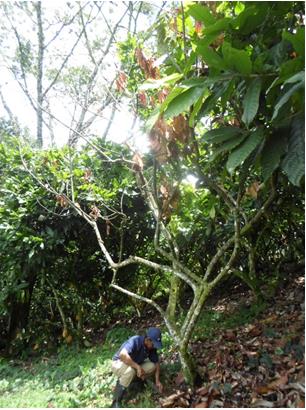
The symptoms consist in a progressive yellowing of leaves, withering, defoliation, drying up of branches and death of the tree (Figure 1).
Importance and Recognition of the Disease in Colombia
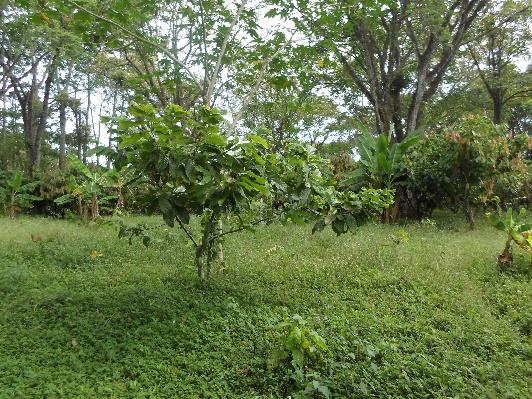
The pathogen expands principally by contact between roots from diseased and healthy trees. The dead trees form patches (Figure 2) which grow larger as the inoculum production increases. In Colombia is known like Star Decay and is reported in the departments of Santander and Antioquia whose produced 50% of the national production in the year 2018. Its presence is common found especially in regions of warm moderate climate. In a monitoring carried out in the year 1987 at La Margarita estate localized at 1,300 meters about sea level in the municipality of Palestina, Caldas department, Colombia S.A., it was found an incidence of 2.2% from 25,000 hybrid trees [3].
Control
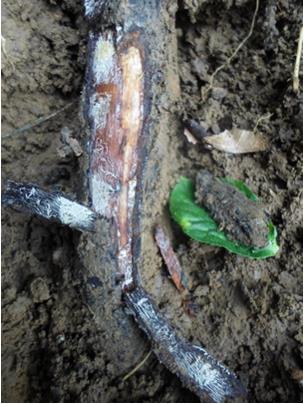
The first step is to recognize the causal agent. If below land conditions the examination of main roots with symptoms of Root decay shows the presence of white or yellow in color strands in form of fans or stars under the bark it confirms that Rosellinia pepo is the causal agent (Figure 3).
Although the control in Colombia have been focused to the Cultural Control [2, 3, 4], especially the uprooted of the diseased trees (cacao or shade) and its burn in situ, the high cost that the labor implicate causes the unwilling of cacao grower.
Then, it is necessary to explore other control methods seeking efficacy, low in cost, innocuous for the ecosystem and sustainable in the time. Within this context it should to prove some soil disinfectants like Formaldehyde, Sodium Hypoclorite and others that would can to stop the dissemination of the infective organs of the pathogen.
Cubillos G. Cacao Root Decay (Caused by Rosellinia Pepo) in Colombia. J Agri Res 2019, 4(5): 000231.
References
-
Flood J, ten Hoopen GM, Krauss U, Akrofi A (2016) Root-infecting Fungi attacking Theobroma cacao. In: Bailey BA, Meinhardt LW (Eds.), Cacao Diseases. A History of Old Enemies and New Encounters. Springer, pp: 449-480.
-
Aranzazu F, Cárdenas LJ, Mujica JJy, Gómez QR (1999) Management of radical sores (Rosellinia sp.). Colombian Agricultural Research Corporation 2(3): 35.
-
Merchán VM (1990) La Rosellinia del cacao. El Cacaotero Colombiano 13: 13-19.
-
Federación Nacional de Cacaoteros (2015) Rosellinia: en Guía Técnica para el cultivo de Cacao. pp: 145-150.
- Enhancement of Vegetative Growth and Fruit Yield in Cucumber (Cucumis sativus L.) via Spiritual Blessing (Biofield) Energy Intervention
- Production of Açaí (Euterpe oleracea Mart.) under Different Agroforestry System Management Intensities in Amazonian Floodplain (Varzea) Forests
- Coffee and the Production Region: What is the Secret to the Expression "Quality"?
- Experiential Agripreneurship Training in Sub-Saharan Africa: Integrating a Business Incubator into Postgraduate Livestock Education at the University of Buea
- Advances in Agricultural High-Quality Development
- Linking Compost Residue to ABAGE in Plants - a Short Note