
Quantification of Forage Evapotranspiration Dynamics Cultivated in the Southern Amazon with SIMDualKc Model
tudies of the dynamics of water in the Soil-Plant-Atmosphere system have been constantly studied, as they directly contribute to the increase in production and the rational use of water for the most diverse cultures. In this approach, the aim of the study was to assess the water demand in forage Urochloa decumbens, with application of the SIMDualKC model. The meteorological variables used in the paper were obtained by an automatic INMET station. And to estimate forage production, cuts were made at a height of 15 cm, then removing it, simulating cattle grazing. Each cut was determined to accumulate degree-days and the base and cut temperatures were 10°C and 30°C, respectively. For the dynamics of crop water demand, the SIMDualKc model was used, in a daily time interval to estimate the basal crop coefficient (Kcb), evaporation coefficient (Ke), crop evapotranspiration (ET), in addition to Kc and the water available in the soil in the forage growing cycle. Kcb and Ke had an inverse relationship, which means that when Kcb increased, Ke showed a decreasing trend. The Kc values did not change until the 3rd cut, but in the 4th cut there were changes with a reduction in rainfall and water availability in the system. It is observed that the model showed good ability to estimate the amount of water available in the soil, in addition to the physiological attributes of the forage, being a great option in the study of water dynamics for the forage.
de Souza Maria L*, da Rocha AM and de Faria RT
Júlio de Mesquita Filho São Paulo State University, Brazil *Corresponding author: Luciano de Souza Maria, Júlio de Mesquita Filho São Paulo State University, Brazil, Tel: 556699234-3600; Email: luciano.maria@unesp.br, tiolucio123@gmail. com
Introduction
The development of tropical forages, especially those of the Urochloa sp., shows medium developmental aptitude under water stress conditions. However, it is clear that its development is compromised and the search for maximum crop response is affected by the unbalance of the water dynamics in the system [1]. The judicious management of water resources in plant development is important information for optimizing [2] and improving the water use efficiency [3]. Therefore, information about water in soil and plants lack information in scientific research to maximize the loss of productive water and minimize the loss of unproductive water [4]. Crop evapotranspiration (ETc) is divided into two parts that includes soil evaporation (Es) and plant transpiration (Tp) [3] these important process are of water movement through the Soil-Plant-Atmosphere system [5]. Therefore, the evaluation of the ETc of forages and the real water requirements tend to influence the frequency of cuts is a possibility to help a more efficient management of pastures [6]. However, the measurement of this parameter is hampered by obtaining information on contribution of physiological activities of plant cultures [7]. In addition, some problems are observed in some evaluation methodologies, being costly, time-consuming and requiring precision in the evaluation processes [4].
Therefore, some parameters and easy indicators are given in order to understand the soil water deficit factor (Ks), using a double crop coefficient (KC), which in turn consider the evaporation coefficient (Ke) and the basal culture coefficient (Kcb) [8]. In view of the difficulties of measuring the dynamics of water flow, the importance of using simulation models is observed [9].
The SIMDualKc simulation model [2] was developed based on the calculation of crop evapotranspiration (ETc), with a daily estimation of soil water balance which allows dual coefficients methodology application [8, 9] . The applicability of the model to partition the ETc of a natural pasture was used in northern China, but scientific studies in this area are limited [10] and partitioning ET of Tyfton 85 bermudagrass in southern Brazil [6]. Therefore, the SIMDualKc model can be used for forages cultivated in the Southern Amazon. Thus, the proposed study evaluated the water demand in Urochloa decumbens forage using the SIMDualKC model.
Material and Methods
Study Area
The experiment was carried out in a rural area located city of the Alta Foresta, State Mato Grosso, in the Southern Amazon, Brazil (09° 53’ 25.93” S and 56° 4’ 3.87” W). The climate of the region, according to Köppen’s classification, is defined as Awi, having two well-defined seasons, rainy summer and dry winter, with an average temperature of 26 °C and average rainfall between 2000 and 2600 mm [11], with an average altitude of 283 meters.
Climatic Variables
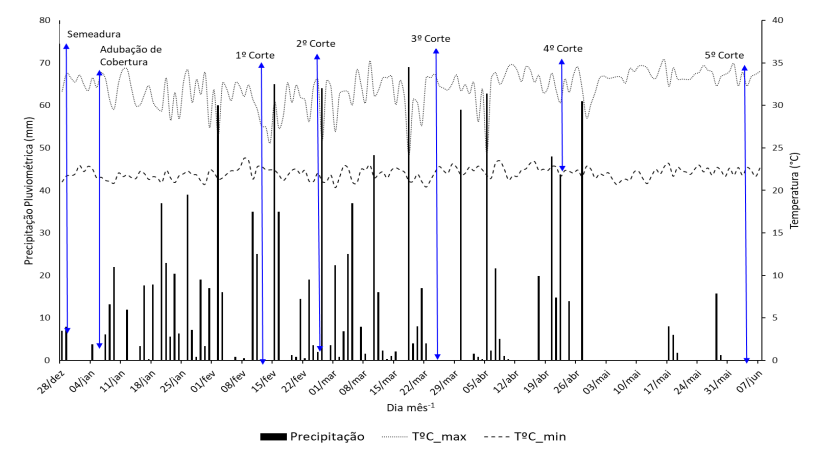
The important meteorological variables in the analysis of the experiment came from the automatic station located 5 km from the experimental area [12] (Figure 1).
Soil Variables
For the characterization of the physical properties of the soil in 5 different initial layers every 10 cm (0-10, 10- 20, 20-30, 30-40 and 40-50 cm) through the removal of undisturbed samples before seeding the forage crops in order to characterize the porosity and density of the soil using the tension table method (Table 1). The determination of soil texture was obtained by evaluating its granulometric structure of the sand, silt and clay fractions (g kg-1), using the pipette methodology, following Embrapa recommendations [13].
| Layers | Bd | TP | Ma | Mi | FC* | WD* | Sand | Silt | Clay |
|---|---|---|---|---|---|---|---|---|---|
| (m) | (g cm-3) | (cm³ cm-3) | (%) | ||||||
| 0.0 – 0.1 | 1.45 | 0.48 | 0.16 | 0.32 | 0.26 | 0.16 | 67.3 | 7.5 | 25.2 |
| 0.1 – 0.2 | 1.47 | 0.48 | 0.14 | 0.34 | 0.26 | 0.16 | 64.8 | 7.5 | 27.7 |
| 0.2 – 0.3 | 1.53 | 0.39 | 0.11 | 0.28 | 0.26 | 0.16 | 54.8 | 5 | 40.2 |
| 0.3 – 0.4 | 1.48 | 0.45 | 0.13 | 0.32 | 0.26 | 0.16 | 54.8 | 2.5 | 42.7 |
| 0.4 – 0.5 | 1.47 | 0.47 | 0.13 | 0.35 | 0.26 | 0.16 | 54.8 | 2.5 | 42.7 |
Table 1: Physical attributes of the experiment area.
Bd- Bulk density; TP –Total Porosity; Ma – Macroporosity; Mi – Microporosity; FC – Field Capacity; WD – Water Deficit. *Parameters not evaluated in the field. data from table FAO-56 was used. Elaborated by the authors (2021). Table 1: Physical attributes of the experiment area.
Observations of forage
In 2017, samples of the Urochloa decumbens forage were evaluated by the simulation model, with the cutting height of the forage being determined according to the methodology of [14] by the rotated grazing method with variable grazing rate, using the grazing height for the 15 cm exit and 35 cm entry for forage. The dates of cuttings of the forage Urochloa decumbens were carried out on 02/02/2017, 02/25/2017, 03/18/2017, 04/23/2017 and 06/15/2017, 1st cut, 2nd cut, 3rd cut, 4th cut and 5th cut, respectively. Collections were considered whenever approximately 50% of the plots reached grazing height (above 30 cm), through a hollow metallic square measuring 50 x 50 cm (250 cm²), which was placed in the center of the plots.
After collecting the plant material in the experiments to estimate forage production (kg ha-1), the forage was mowed at a height of 15 cm, then removing it, simulating cattle grazing. Each cut was determined to accumulate degrees- days (GD) and the base and cut temperatures were 10 °C and 30 °C, respectively [6].
Determination of Forage Production
For the production estimate of Urochloa decumbens forage (kg ha-1), a hollow metallic square measuring 50 x 50 cm (250 cm²) was used, which was placed in the center of the plots. With the aid of a trimmer, the material present inside the metal square was cut. Afterwards, the samples were placed in paper bags and taken to an oven, where they were dried at 65 ºC ± 2 ºC, until obtaining constant weight.
The Water Demand of Forage
Water demand dynamics assessment was based on, the SIMDualKc simulation model [2] it makes it possible to set a soil water balance model considering a daily time interval to estimate crop evapotranspiration (ET), using a dualized crop coefficient approach [5]. After the collection procedures, the data were adapted to the model so that it could be run, and variable values that were established by SIMDualKc were obtained, providing the analysis of Kcb and K values.
Results and Discussion
Rainfall throughout the experiment was directly concentrated in the first months of 2017, with a greater distribution of these rains being observed, either with intensity and frequency in all initial stages present within the first 75 days of the cycle, with daily variations from 0 to 76 mm, where March had the greater rainfall in the period (Figure 2).
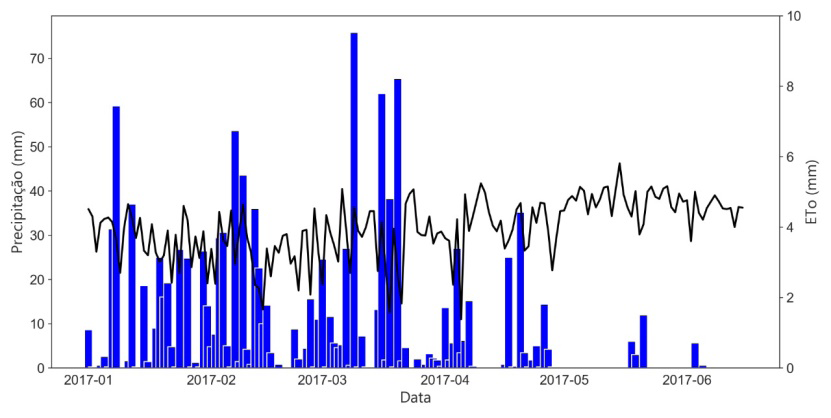
Thus, we can observe that the reference evapotranspiration (ETo) had the lowest values whenever rainfall occurred, suggesting that in the presence of water entering the system, the plant is supplied and ET tends to be less intense from the non- forage stress.
On the other hand, we can observe that from April onwards, there was a notable reduction in rainfall within the system, and the reflection of this was the increase in the reference ET rates of these plants (ETo). Everything indicates that the water deficit conditions induce a series of stress on the forage and the conditions are more vulnerable to increased transpiration. Thus, this variation in ET is confirmed by other works, such as okra [4]; Tifton 85 Bermudagrass [6] and hot pepper grown [15] observed in experiments evaluating the loss of productive water through the ET using a cropping by SimDualKc model. This occurred because the authors observed that in periods of greater drought, the plant affected by the greatest stress always tended to present the highest results of ET in the field.
However, even going through conditions of water deficit, ET is an important factor that regulates the production of plant biomass [15]. Because even with this water condition in the system, one of the main points that will regulate transpiration is the amount of water available in the soil [16]. Thus, according to the readily available quantity water, relative air humidity and temperature, they will have a direct influence on the greater or lesser plant ET, so the possibility of the water deficit being more accentuated is in the month of July. This condition is due to non-irrigated conditions the amount of water available in the soil decreases and hence may also be in the decrease of physiological processes such as transpiration [15].
There was a direct influence of rainfall with radiation (Degree’s days) in the system, which reflected in the variation of dry mass production per hectare. The 1st cutting season, we can observe that it presented the highest values of accumulated rainfall in the system (341.8 mm) compared to the other periods studied, with radiation showing 159.1 degrees days less than the 5th cutting season. However, to Tifton 85 Bermudagrass adopting of 248 degrees days is likely the most favorable [6]. This difference is justified by the location of very different regions. The values of degree days caused a tendency to reduce the cutting cycle of forages.
On the other hand, it is observed that the lower the accumulated rainfall, which was observed in the 5th cutting season (51.6 mm) and the greater the radiation as observed in degrees days, the longer the forage cutting cycle, with approximately 350 % increase in the cycle when compared to the 1st cutting season which consisted of the highest rainfall.
However, it is noteworthy that, even with this variability in the forage cycle in times of greater accumulated precipitation compared to that of lesser precipitation, productivity showed notable differences, where the period of lesser precipitation showed an increase of approximately 268% in dry mass production. Probably, due to the low rainfall combined with the effect of greater radiation, this induced the plant to accumulate more fiber in its structure, which reflected in higher forage productivity and longer cycle.
For the values of basal crop coefficient (Kcb) and soil evaporation (Ke), it is observed that over the days and months, an inverse relationship was observed between the two, which means that, when Kcb increased, Ke presented a trend of decrease (Figure 3). This is because, after the cuts being made at their respective times, there is an interruption in the forage development cycle, and the consequence of this is the reduction in Kcb. system.
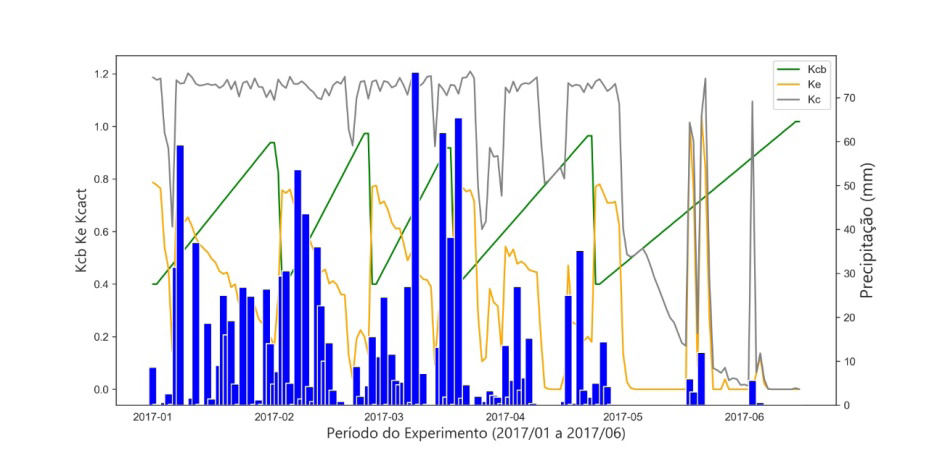
Kcb increase and decrease values are explained by authors such as Petry, et al. [17] that noted the Kcb value of the soybean crop has a linear increase in its initial vegetative development, as the more the plant develops, it tends to have an increase in ET up to a point of stabilization, so that at the end of the crop cycle the Kcb values enter and decline. These same conditions are seen in the research, because whenever there was a cutting period, Kcb was tending to increase due to plant growth and, consequently, to greater forage ET, also being confirmed by Paredes, et al. [6].
Ke highest values happened after the rains in the system, after that, it tends to have a decreasing condition, these results are confirmed by Rosa, et al. [18] and Paredes, et al. [6] demonstrated that the main characteristic of Ke is to increase after irrigation or precipitation, after a reduction in the accumulated amount of evaporated water. Furthermore, their Ke decrease rates are directly influenced by land cover [19]. Thus, whenever grass cutting was used, with the presence of rainfall, the Ke values were higher (Table 2).
| Corte | N | GD | DMP | PP | Kcb | Ks | Ke | Kc act | ETo | ET act | Esg. | ASW | ASW max | Taw | Raw |
|---|---|---|---|---|---|---|---|---|---|---|---|---|---|---|---|
| (° C dia) | (Kg ha -¹) | ------------------------------------------------- (mm) ---------------------------------------------------- | |||||||||||||
| 1º | 33 | 590,10 | 1069,90 | 341,80 | 0,83 | 1,00 | 0,35 | 1,18 | 2,39 | 2,82 | 0,00 | 53,76 | 58,54 | 53,76 | 29,56 |
| 2º | 56 | 341,50 | 1628,20 | 278,60 | 0,97 | 1,00 | 0,13 | 1,11 | 3,92 | 4,33 | 1,78 | 35,97 | 35,97 | 53,76 | 29,56 |
| 3º | 77 | 311,70 | 1609,70 | 304,80 | 0,92 | 1,00 | 0,24 | 1,16 | 1,57 | 1,82 | 0,00 | 53,76 | 88,87 | 53,76 | 29,56 |
| 4º | 113 | 504,20 | 1909,70 | 222,40 | 0,96 | 1,00 | 0,18 | 1,14 | 4,56 | 5,22 | 0,76 | 46,17 | 46,16 | 53,76 | 29,56 |
| 5º | 116 | 749,20 | 2871,20 | 51,60 | 0,00 | 0,00 | 0,00 | 0,00 | 4,55 | 0,00 | 0,50 | 40,96 | -0,54 | 53,76 | 29,56 |
Table 2: ** Values of environmental variables and water balance of the experiment.
N-Day Julian; GD-Degrees day (°C day); DMP- Dry Mass Production (kg ha-1); PP-Rainfall (mm); Kcb - Basal culture coefficient (mm); Ks- Stress crop coefficient (mm); Ke- Soil evaporation coefficient (mm); Kc Actual crop coefficient (under stress) (mm); ETo- Reference evapotranspiration (mm); ETact- Actual evapotranspiration (mm); Esg.- Soil Depletion (mm); ASW- Available soil water (mm); ASWrmax- Available soil water for plant roots (mm); TAW- Total available water (mm), RAW- Easily available water storage (mm). Elaborated by the authors (2021). Table 2: Values of environmental variables and water balance of the experiment.
The values of Kc did not vary until the third cut, since the accumulated rainfall in the period provided water availability for forage. However, from the fourth cut onwards, a reduction in rainfall and water availability in the system was observed. The Kc values reported for this study with Urochloa decumbens were larger than those reported by Wherley, et al. [20], by Graham, et al. [21] and Paredes, et al. [6]. Justified by the different edaphoclimatic condition.
Kc tends to vary according to the crop cycle, where the highest values of Kc are at times when the forages need even more water demand. Therefore, in the post-sowing to vegetative periods in order to restored the stand, it always presented the highest values within the vegetative cycle of the forages. The oscillations observed mainly in Kc may have been influenced by the conditions of AWS (water available in the soil), because in the months that there is need, since the first 75 days of forage development, the available water presented adequate values. After that, the first decline in this parameter evaluated from the middle to the end of March was noticed, caused by the lack of efficiency in the system, until in May the ASW reduction was clearly due to the high values in the dry season in the region (Figure 4).
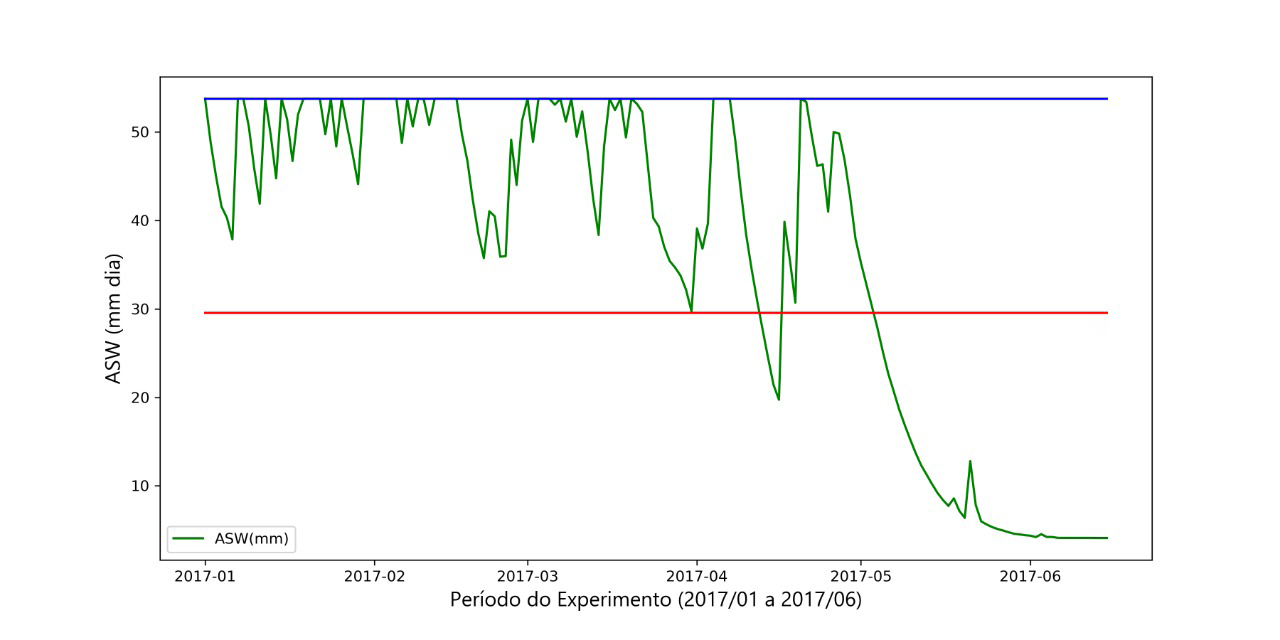
These Kc and ASW values are confirmed by other authors such as Petry, et al. [17] showed that with the presence of water in the system, the ASW value in the system tends to have higher values, since it contains the values of water available in the soil, with the decrease in the amount of water within the system after cutting the water available in the soil tends to decrease, causing the Kc to decrease as well (Figure 4). In addition, the soil water dynamics using the SIMDualKc model and they demonstrate that the decrease in values for the TAW flax (red line) downwards causes the crop to be in an environment with no water available for its supply and a value low from Kc. Other authors observed the potential use of SIMDualKc, [22, 23] and evaluating the soybean crop and Pereira, et al. [24] who also had good results using this model, being an important tool for modeling programs in agriculture.
Study Limitations and Areas for Further Studies
The southern region of Amazonia has a great diversity of soil conditions. And great diversity of cultivated exotic forages. Therefore, for new studies on water efficiency, it is necessary to expand research and test new soil characteristics and for a longer evaluation period.
Conclusion
The SIMDualKc model showed potential use in evaluating the water demand in Urochloa decumbens forage.
The study found that the oscillation in the Ke variable is directly related to soil cover and the entry of water into the crop via precipitation or irrigation. As with water available in the soil, there was also a reduction in the period of lower precipitation. The values of Kc, Ke and Kcb were higher than in other regions, very related to different edaphoclimatic conditions. But the model enabled measurements of Kc, Kcb, as well as the Ke, in a manner consistent with the edaphoclimatic characteristics and inherent to the characteristics of the cultivated forage, being important in studies on water dynamics in the soil-plant-atmosphere system.
References
-
Masetto TE, Ribeiro DM, Rezende RKS (2013) Germination of Urochloa ruziziensis seeds as a function of substrate water availability and seed water content. Agropecuária Trop 43(4): 385-391.
-
Rosa RD, Paredes P, Rodrigues GC, Alves I, Fernanado RM, et al. (2012) Implementing the dual crop coefficient approach in interactive software. 1. Background and computational strategy. Agric Water Manag 103: 8-24.
-
Xuan C, Ding R, Shao J, Liu Y (2021) Evapotranspiration and Quantitative Partitioning of Spring Maize with Drip Irrigation under Mulch in an Arid Region of Northwestern China. Water 13(22): 3169.
-
Patil A, Tiwari KN (2019) Quantification of transpiration and evaporation of okra under subsurface drip irrigation using SIMDualKc model during vegetative development. Int J Veg Sci 25(1): 27-39.
-
Paço TA, Paredes P, Pereira LS, Silvestre, Santos FL (2019) Crop Coefficients and Transpiration of a Super Intensive Arbequina Olive Orchard using the Dual Kc Approach and the Kcb Computation with the Fraction of Ground Cover and Height. Water 11(2): 383.
-
Paredes P, Rodrigues GJ, Petry MT, Severo PO, Carlesso R, et al. (2018) Evapotranspiration Partition and Crop Coefficients of Tifton 85 Bermudagrass as Affected by the Frequency of Cuttings. Application of the FAO56 Dual Kc Model. Water 10(5): 558.
-
Zhang S, Wen X, Wang J, Yu G, Sun X (2010) The use of stable isotopes to partition evapotranspiration fluxes into evaporation and transpiration. Acta Ecol Sin 30(4): 201-209.
-
Allan R, Pereira L, Smith M (1998) Crop evapotranspiration-Guidelines for computing crop water requirements-FAO Irrigation and drainage 56.
-
Allen RG (2000) Using the FAO-56 dual crop coefficient method over an irrigated region as part of an evapotranspiration intercomparison study. J Hydrol 229(1): 27-41.
-
Shengwei Z, Rui S, Hongbin Z, Tingxi L, Hongbo S, et al. (2015) Correlating between evapotranspiration and precipitation provides insights into Xilingol grassland eco-engineering at larger scale. Ecol Eng 84: 100-103.
-
Alvares CA, Stape JL, Sentelhas PC, de M Gonçalves JL, Sparovek G, et al. (2013) Köppen’s climate classification map for Brazil. Meteorol Zeitschrift 22(6): 711-728.
-
INMET (2020) INMET - Instituto Nacional de Meteorologia. Estação Meteorológica de Observação de Superfície Automática, Brasília, DF, Brasil.
-
Teixeira WG, Donagemma GK, Fontana A, Teixeira PC (2018) Manual de métodos de análise de solo.
-
Bulegon LG (2016) Residual effect of phosphorus fertilization on productivity and bromatologic composition of tropical forages.
-
Hatfield JL, Dold C (2019) Water-Use Efficiency: Advances and Challenges in a Changing Climate. Front Plant Sci 10: 103.
-
Heinemann BA, Stone LF, Fageria NK (2011) Transpiration rate response to water deficit during vegetative and reproductive phases of upland rice cultivars. Sci Agric 68(1): 24-30.
-
Petry MT, Basso LJ, Carlesso R, Armoa MS, Henkes JR (2020) Modeling Yield, Soil Water Balance, and Economic Return of Soybean Under Different Water Deficit Levels. Eng Agric 40(4): 526-535.
-
Rosa RD, Paredes P, Rodrigues GC, Alves I, Pereira LS (2016) O Modelo Simdualkc Para A Simulação Da Rega E Geração De Calendários De Rega. Gestão do Risco em Seca. Métodos, Tecnol. e Desafios, no. pp: 279-300.
-
Gava R, de Freitas PSL, de Faria RT, Rezende R, Frizzone JA (2013) Soil water evaporation under densities of coverage with vegetable residue. Eng Agrícola 33(1): 89- 98.
-
Wherley B, Dukes MD, Cathey S, Miller G, Sinclair T (2015) Consumptive water use and crop coefficients for warm-season turfgrass species in the Southeastern United States. Agric Water Manag 156: 10-18.
-
Graham SL, Kochendorfer J, McMillan AMS, Duncan MJ, Srinivasan MS, et al. (2016) Effects of agricultural management on measurements, prediction, and partitioning of evapotranspiration in irrigated grasslands. Agric Water Manag 177: 340-347.
-
Wei Z, Paredes P, Liu Y, Chi WW, Pereira LS (2015) Modelling transpiration, soil evaporation and yield prediction of soybean in North China Plain. Agric Water Manag 147: 43-53.
-
Giménez L, Paredes P, Pereira LS (2017) Water Use and Yield of Soybean under Various Irrigation Regimes and Severe Water Stress. Application of AquaCrop and SIMDualKc Models. Water 9(6): 393.
-
Pereira LS, Paredes P, Rodrigues GC, Neves M (2015) Modeling malt barley water use and evapotranspiration partitioning in two contrasting rainfall years. Assessing AquaCrop and SIMDualKc models. Agric Water Manag 159: 239-254.
- Enhancement of Vegetative Growth and Fruit Yield in Cucumber (Cucumis sativus L.) via Spiritual Blessing (Biofield) Energy Intervention
- Production of Açaí (Euterpe oleracea Mart.) under Different Agroforestry System Management Intensities in Amazonian Floodplain (Varzea) Forests
- Coffee and the Production Region: What is the Secret to the Expression "Quality"?
- Experiential Agripreneurship Training in Sub-Saharan Africa: Integrating a Business Incubator into Postgraduate Livestock Education at the University of Buea
- Advances in Agricultural High-Quality Development
- Linking Compost Residue to ABAGE in Plants - a Short Note