
Effect of Climate Change on Agricultural Production: A Case Study Khartoum State, Sudan
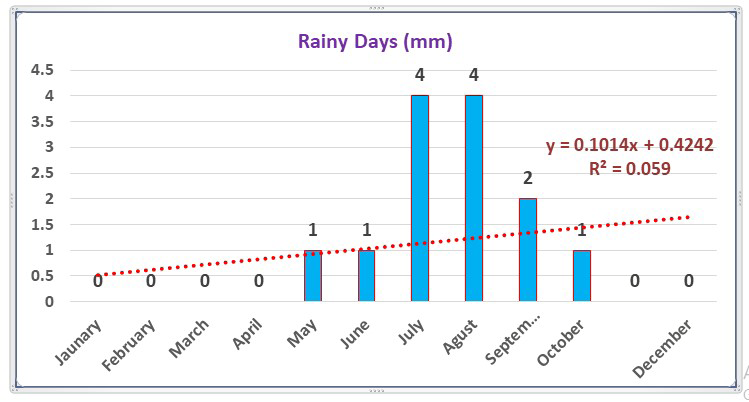
Climate change refers to weather changes that occur through time, either naturally or as a result of human activity. Climate change is now a worldwide issue, and Sudan is one of the developing countries that have suffered as a result of it. Sudan's economy is mostly based on agricultural, with Khartoum State playing a significant part in the country's economy. There are various important food crops grown in Khartoum, including wheat and sorghum. It is also known for the production of citrus fruits, particularly lemon, as well as onions, potatoes, beans, tomatoes, vegetables, fodder, and other crops. The results of this study showed that the annual highest maximum temperature was 40.8 °C in May and the lowest was in January 30 °C, while the minimum temperature ranged from 15.4 °C in January to 27.1 °C in June. For average temperature the highest degree was 34.3 °C in May and lowest was 22.7 °C in January. As for the precipitation, the highest was in August, reaching 27 mm, while the lowest was 3 mm in May, during the rainy months, which are between May and October only. As for the rainy days in the rainy months during the year, the highest value was 4 mm during July and August, while lowest was 1 mm in May, June and October, while it was 2 mm in the month of September. The highest humidity was 47% in August and the lowest was 12% in April. While for sunny days, the highest daylight hours were in June, when it was 11.7 hours, and the lowest hours were at 10.1 hours, and it was recorded in December. In this article, we specifically discussed how these climatic factors might impact the growth of important food crops in Khartoum. Climate change in Khartoum foretold that temperatures would rise to their highest point in the future, having a negative impact on agricultural crops. Due to low rainfall, drought stress on crops is also anticipated. The remedies to this issue are represented by integrated natural resource management and development, agricultural improvement and development, and the cultivation of species resistant to the impacts of climate change.
Introduction
Global climate change, the industrial revolution of the then mankind atmosphere to release the carbon dioxide, methane, ozone and nitrogen oxides as gases are very quickly heat the earth by the greenhouse effect that occurred as a result of the increase is a result of an increase above normal [1]. Increasing world population, changing climate conditions and economic activities are growing with each passing day makes it more important than water [2].
Climate change will increase food security problems facing many countries, According to the Intergovernmental Panel on Climate Change’s [3] most current assessment report, the global near-surface temperature has risen by around 1.1 °C since the late 19th century (1850–1900), nearly entirely as a result of human activity. Compared to the rate of increase in world average temperature, this increment is anticipated to be larger in the arid regions of the African continent [4]. Particularly in semi-arid and dry regions of Africa, it is argued that the effect of rising temperature mixed with unpredictable rainfall and a lack of water for irrigation will have a markedly negative influence on crop productivity [5]. As a result, this poses a challenge to the food and nutrition security situation in agro-based economies, which is the primary source of income for resource-poor communities, particularly in sub-Saharan Africa, where millions of people depend on agriculture for their subsistence [6]. Additionally, meteorological variables such as air pollutants and climate elements interact each other in atmosphere. An increase in some natural and anthropogenic air pollution sources such as population density, traffic jam, industrial activities, fossil fuel consumption, power plants can deteriorate urban climate and lead to climate change in urban areas [7&8].
World has been threatened by climate change under the effect of increased carbon emission and greenhouse gas. Carbon is one of the basic elements of life and shows search without being fixed. The amount of CO2 reduces the protective use of the bard layer. With this effect, it causes irregular precipitation and excessive temperature increases [9]. Population growth rate along with the climate change phenomenon will cause lots of problems for worldwide food supply and we will face numerous nutritional problems in the near future. By gradually reaching to the 8 billion population on the earth, the mankind is really in challenge to provide the growing population food needs [10].
Among the effects of climate change the agricultural output of both rainfed and irrigated crops are impacted by rising temperatures and shifting rainfall patterns. Increased agricultural production losses are anticipated to have a severe impact on rural incomes and food security in countries like Sudan that are already under water stress. A decline in precipitation will change hydropower production, and the increase in frequency and magnitude of floods and droughts would significantly increase the need for public investment in physical infrastructure [11]. Previous research has demonstrated that the semi-arid regions of Africa are particularly vulnerable to the effects of a changing climate [12].
In semi-arid environments, the main climatic consequences include rising temperature, shifting in dates of the beginning and end of the rainy seasons, prolonged and frequent dry spells, and changes in the length of the cropping season. Consequently, it has been claimed that the occurrence of extreme climate events, such as floods and droughts, has an impact on crop output in semi-arid regions [13]. For the previous five years, as well as in 2022, flooding in the states of Gezira, Khartoum, and the River Nile has been a worry in many parts of Sudan.
Around half of the population works in agriculture in Sudan, making it a significant economic sector that contributes about one-third of the nation’s GDP [14]. According to sources, the Sudan has experienced variations in rainfall, a rise in temperature, an increase in the frequency of floods, and recurring droughts, all of which have had a substantial impact on agricultural production [11].
Khartoum, the capital city of the Sudan, is situated in the east-central region of the country. Rich water supplies from the Blue Nile, White Nile, Nile, seasonal streams, and groundwater are available to it. People have been moving back to Khartoum for several decades due to greater work prospects, more stable livelihoods, better educational chances, and to flee violent conflicts and drought [15, 16]. The country’s population increased by 2.8% each year between 1993 and 2008, and as of late, urban populations made up 29.5% of the overall population, with 13.5% of them residing in the capital [17].
Intensive farming is being done in the accessible regions to meet the huge and rising demand for food. Urban agriculture has become economically appealing not only on Tuti Island and along the banks of the Nile, but also on the mainland within and around the metropolitan area due to the rising food demand of the expanding city and the limited opportunities for crop production in the arid environment of Khartoum’s surroundings. However, the city’s rapid growth has also put more strain on agricultural areas and caused arable land to be converted to building ground [18]. Urban agriculture is now more widely acknowledged as a significant factor in the food and nutrition security of urban residents throughout the developing world [19]. This contribution becomes even more significant in light of recent food shortages, especially for nations in Sub-Saharan Africa
[20]. Along with onions, potatoes, beans, vegetables, fodder, and other products, Khartoum is renowned for the growing of citrus fruits, particularly lemons.
In Sudan generally, and specifically in the Khartoum region, there is a lack of scientifically based evidence and assessments of how the climate affects crop productivity. In order to develop adaptation measures to lessen these effects, we performed this study to ascertain the effects of climate change on agriculture in the state of Khartoum. Fundamental to risk assessment is the identification of any connections between climatic variables and crop yield. Additionally, the results of this study can help policymakers and extension workers plan and scale up adaptation techniques to lessen the negative effects of climate change.
Material and Method
The Study Area
This study was conducted in the Khartoum state which located in the southern margin of the desert, lies between longitudes 31.5 to 34 °E and latitudes 15 to 16 °N (Figure 1).
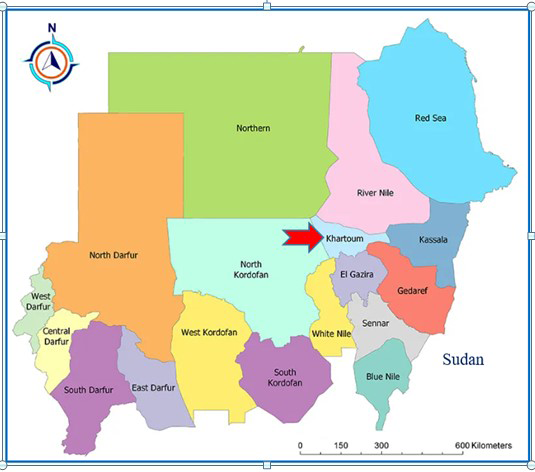
Figure1: The Location of Research Area in Sudan.
The area of Khartoum State is about 20.726 km2, equivalent to 4.9 million acres, and it is the smallest state in Sudan.it is the most populous Mahmoud, et al. [21]. Khartoum settled in central Sudan at the junction of the headstream Rivers (Blue Nile, White Nile and river Nile), Where located at the confluence of the White and Blue Nile, where is agricultural activities are mainly concentrated along the banks of the Nile River. It is bordered to the north and the east side by the River Nile State, to North Western by the Northern State, and to the east and south - eastern by states of Kassala, Gedaref and Gezira. The largest cities in Khartoum state include Khartoum, Omdurman and Khartoum North.
The weather is hot dry in summer and cold dry in winter. The average annual rainfall ranges between 150 mm and 250 mm. Urban and intensive agriculture are well-known in Khartoum State. In order to provide the enormous and expanding demand for food, intensive farming is conducted in conveniently accessible locations. In Khartoum, fast-growing green crops predominate, but they also give gardeners a quick revenue flow. Urban farmers may be better able to contribute to the city’s overall food supply by increasing their crop variety and coping with the market’s strong price swings. Khartoum is well known for growing citrus fruits, particularly lemons, in addition to onions, potatoes, beans, vegetables and other items.
Methodology
In this study, linear regression method was calculated for the analysis of climate data the standard deviation of the climatic data was also calculated. The Linear Regression
Model is the most commonly used kind of regression in applications and is one of the oldest and most researched subjects in statistics. Regression analysis is a method for describing quantitative connections between one or more explanatory factors and a response variable [7, 22, 23, 24].
Research Findings
In this study, the long-term minimum, maximum and average temperatures (°C), precipitation (mm), humidity (%), rainy days and sunny hours data of Khartoum state in Sudan were analyzed. The variation graph of the minimum temperature data is shown in Figure 2.
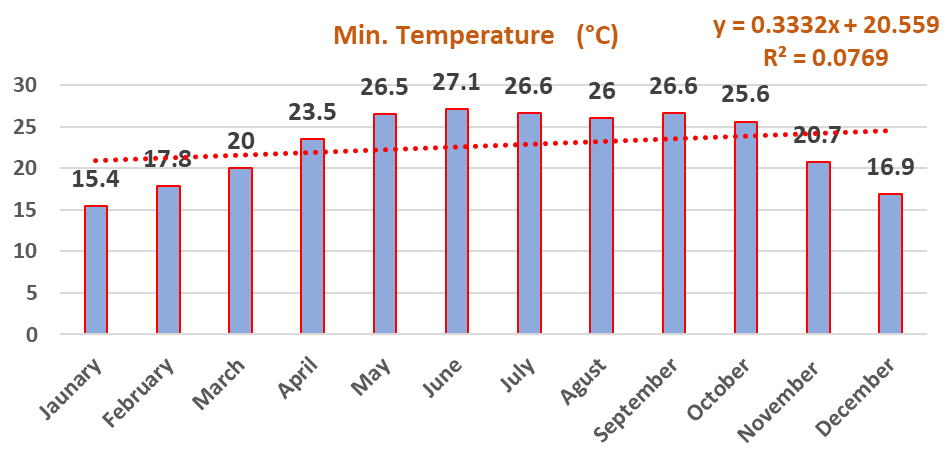
The minimum temperature ranged from 15.4°C in January to 27.1°C in June. R2 for Minimum temperature is 0.0769 which mean actual values are not closer to predicted values. The variation graph of the max temperature data is shown in Figure 3.
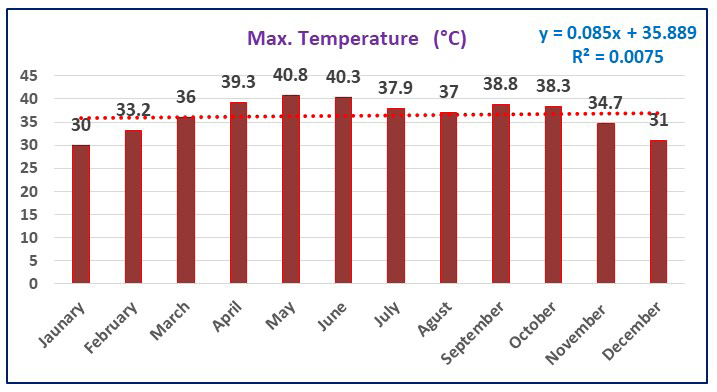
The annual highest maximum temperature was 40.8°C in May while the lowest maximum temperature was in January 30°C. The maximum temperature’s R2 is 0.0769, which indicates that actual measurements and predictions are not very closely related. The variation graph of the average temperature data is shown in Figure 4.
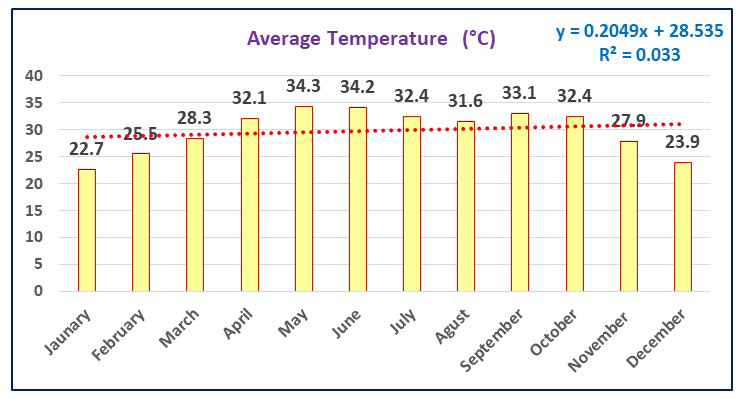
For average temperature the highest degree was 34.3°C in May and lowest was 22.7°C in January. While R2 is 0.033, this indicates that real values are not much closer to projected values. The Change graph of Precipitation data is shown in Figure 5.
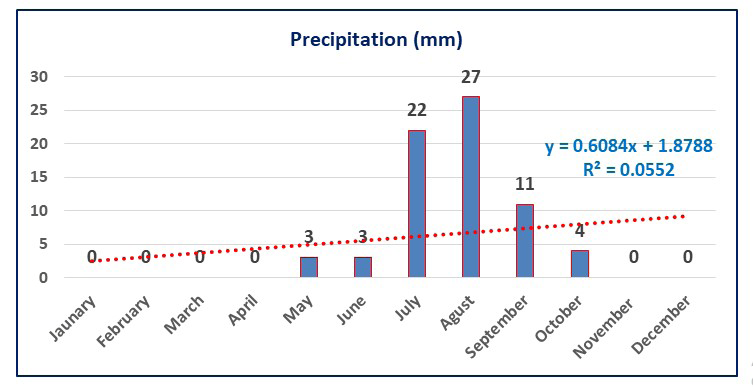
As for the precipitation, the highest was in August, reaching 27 mm, while the lowest was 3 mm in May, during the rainy months, which are between May and October only. R2 is 0.0552, which indicates that actual values are not much closer to anticipated values. The Change graph of Rainy days is shown in Figure 6.
The rainy days in the rainy months during the year, the highest value was 4 mm during July and August, while lowest was 1 mm in May, June and October, while it was 2 mm in the month of September. R2 is 0.059, which indicates that actual values are not much closer to predictions. The change graph of humudity is shown in Figure 7.
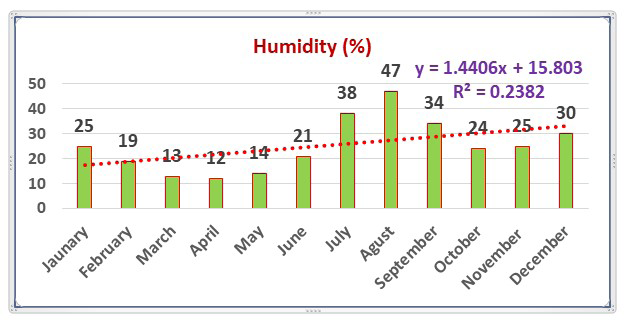
The highest humidity was 47% in August and the lowest was 12% in April. R2 was 0.2382, indicating that actual values are not substantially closer to expectations, although humidity had better R2 ratios than the other factors. The variation graph of the sunny days are shown in Figure 8.
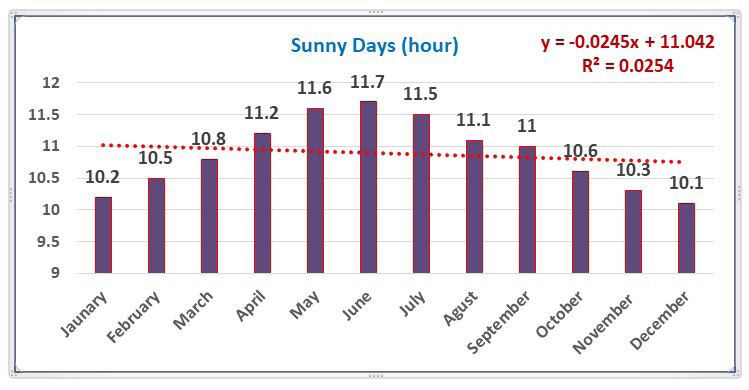
For sunny days, the highest daylight hours were in June, when it was 11.7 hours, and the lowest hours were at 10.1 hours, and it was recorded in December. R2 is 0.0254 for sunny days, which also indicates that actual values are not much closer to predictions. Annual average and total values of some climate data and their associated R2 and standard deviations are summarized in Table 1.
| Climate Parameters | Data | R2 | Standard Deviation |
|---|---|---|---|
| Min. Temperature (°C) | 22.73 | 0,0769 | 4.3315 |
| Max. Temperature (°C) | 36.44 | 0,0075 | 3.5464 |
| Average Temperature (°C) | 29.87 | 0,033 | 4.0684 |
| Precipitation (mm) (Total) | 70.00 | 0,0552 | 9.3404 |
| Rainy Days (Total) | 13 | 0,059 | 1.5050 |
| Humidity (%) | 25.17 | 0,2382 | 10.6415 |
| Sunny Hours (hour) | 10.88 | 0,0254 | 0.5540 |
Table 1: The average or Total values, R2 and Standard deviation of Some Climate Data in Capital City (Khartoum) in Sudan.
When we see on standard deviation average temperature and minimum temperature have almost same value of standard deviation but has low value as compared to Precipitation and Humidity. Rainy days and sunny hours has lower values as compared to all other variables which means these variables has very less variability in all months of whole year whether Precipitation varied so much because it has highest value of standard deviation. Values of all climatic variables data also explained by making linear regression analysis between months and climatic change variables individually. Where R2 values shows that whether these climatic variables are closer to predicted values of regression line or not. After observing R2 we found that all of these variable actual values are not closer to predicted values. humidity has higher R2 value followed by average temperature, Min. temperature, rainy days, Precipitation, sunny days and Max temperature. Which indicates that only humidity real values are somewhat closer to expected values? This leads to the conclusion that climate change has a significant impact on the actual values of climatic variables.
Discussion
The increase in the impact of global climate change will cause global water crises between countries. Necessary measures and measures should be taken in advance to reduce the impact of global climate change [25]. Excessive increase and decrease of temperatures negatively affect the life of living things. It will be difficult to find clean water in the future as the increase of temperatures will increase the evaporation level. Increasing or falling temperatures will cause climate change [26]. As a result of the effect of global climate change, an increasing trend is observed in temperatures. Rainfall, on the other hand, is gradually decreasing and endangering habitats. In order to minimize the effects of global warming, it is necessary to take measures to prevent the greenhouse effect and global warming. Reducing carbon dioxide in the air may be a solution [27].
Subsistence agriculture employs around 60% of Sudanese; it is an important economic sector as a significant supplier of raw resources, food, and foreign exchange. Agriculture, in particular, has suffered as a result of neglect since the onset of oil production in the early 2000s. Furthermore, Sudan’s agricultural growth has been uneven, with the majority of irrigated agriculture concentrated in the center Khartoum and Gezira state [28].
Apple, banana, citrus, dates, grapes, guava, mango, pineapple, strawberries, sweet tomato, oranges, and watermelon are among the chemical-free fruits and vegetables that Sudan produces. Other fruits and vegetables include cucumber, eggplant, okra, onion, potato, pumpkins, and tomato. In 2015, 3,993,000 tons of fruits and 3,650,000 tons of vegetables were produced. Estimates show that the area under cultivation for horticulture increased from about 409,000 ha in 2012 to 899,000 ha in 2016, but the proportion of that area under cultivation for horticulture decreased from 4.5 percent to 2.9 percent between those years due to significant increases in the total area under cultivation. However, it is challenging to find accurate information on the area and output of horticultural agriculture [29]. The economic impact of horticulture is unknown since it receives less attention than cash crops like cotton and groundnuts and staple cereals like maize and wheat. The state of Khartoum is famed for its fruit and vegetable production. The contribution of agriculture to Sudan’s gross domestic product is presented graphically in Figure 9.
![Figure 9: The contribution of agriculture to Gross Domestic Product (GDP) in Sudan [30].](/fulltextimages/9658/fig_9.png)
The Khartoum State generates 40% of the vegetables grown in Sudan’s states, and it also grows well-known export commodities including melons, green beans, okra, and peppers. But recently, the state has shifted its focus to the production of fodder. While having a vast landmass, the state of Khartoum has only been able to cultivate a relatively small portion of it, fewer than 500,000 acres, of which only 350,000 acres are really under cultivation. The state of Khartoum is only able to care for a small portion of its land due to the numerous issues with irrigation infrastructure that plague agriculture in the region. The major issue is the underutilization of fertile land, and agricultural initiatives also need a lot of money. In fact, the state cultivates 52% fodder [31].
Figure 9, show the contribution of agriculture to Sudan gross domestic product, which illustrates the varying level of agriculture’s contribution to the GDP and reflects the recent decline in agricultural output and productivity [30].
Elagib [32] observed an increase in temperature in Sudan between 1941 and 2005, with warming rates of 0.424, 0.357 and 0.451°C per decade for the summer, winter, and fall seasons, respectively. However, it has been suggested that a 2.6°C increase in mean temperature could be predicted in the research region by 2070, which might have a major impact on agricultural productivity. These findings are consistent with those of Osman, et al. [6], who observed that the annual maximum temperature increased by 0.03°C per year between the years 1984 and 2018, while the minimum temperature increased by 0.05°C per year, leading to a narrow range in diurnal temperature. In contrast, annual rainfall fluctuated with no evidence of a significant (p > 0.05) increasing or decreasing trend. which revealed that years with a rainfall deficit linked to the incidence of droughts in Sudan [33]. The high rate of temperature is regarded as one of the key environmental pressures limiting tomato production in the summer under dry circumstances [34].
Overall, it is obvious that the mean annual temperature between 1984 and 2018 was defined by decadal fluctuation, as opposed to the annual rainfall series, which is characterized by year-to-year variability. The results revealed that increasing the length of the rainy season enhanced sorghum and sunflower output considerably. These findings are consistent with those of Murenzi, who discovered a positive link between the length of the rainy season and maize productivity in Rwanda [6, 35]. Osman, et al. [6] highlight that: Between 1970 and 2018, the yearly output of sorghum had declined dramatically, whereas sunflower yield had increased. Temperature factors exhibited a negative connection with crop output across the board, however an increase in rainfall enhanced sorghum and sunflower yield considerably. Furthermore, the lengthening of the wet season enhanced sorghum and sunflower output greatly. Crop yields were very variable, with over 50% variability in sorghum (R2 = 0.70 and cross-validated R2 = 0.69) and sunflower (R2 = 0.64 and cross-validated R2 = 0.62), which might be attributed to climate factors.
Mean annual precipitation in Khartoum is with 164 mm very low and mostly restricted to the months of July, August and September, when evapotranspiration is highest. Virtually no precipitation occurs between October and March [36]. There was a substantial positive relationship in Sudan between rainfall features such as total monthly and yearly depths, as well as the annual number of rain days, and national agricultural production [37].
Climate change puts food production and water supply at risk, with major social and economic consequences. Daytime warming has a substantial impact on evapotranspiration, soil moisture, plant growth, and other ecological and agricultural issues, particularly in a nation that is heavily reliant on agriculture, such as Sudan. Lockwood [38], because of climate change, established commercial kinds of fruits and vegetables will perform badly in an unexpected manner. Commercial production of horticultural plants, particularly those cultivated in open fields, would be severely impacted. The physiological problem of horticulture crops will be more severe as a result of the high temperature [39].
Forage output will be substantially impacted due to huge swings in rainfall distribution during the growing season in numerous places across the world. Because agriculture is the major user of freshwater resources, diminishing water supplies will have a negative impact on forage crop output. Climate change has the potential to affect the amount and dependability of forage production, forage quality, water requirements for forage crop cultivation, and large-scale rangeland vegetation patterns. The main production of feed crops and rangelands will be the most evident consequence of climate change. Developing nations are more sensitive to climate change than industrialized countries because agriculture dominates their economy and their baseline climates are warmer, in addition to their limited resources to adapt to modern technology [40]. Climate projections for feed crops suggest that there will be potential for enhanced production as well as significant risks to agricultural output in various regions of the world during the next 20 to 50 years [41].
Conclusion and Recommendations
Khartoum State’s climate is becoming warmer, particularly during the dry season evenings, hot season, and wet season. As a result, average yearly temperatures have risen. In particular, there has been more heating of the air as indicated by the maximum and mean temperature during the rainy season than during the hot season, implying a true warming of the wet season as a result of the dry conditions that have plagued the country in recent decades. This might be because of increased radiative heat uptake at the surface during this time period. This study has revealed that climatic influences such as sunlight might be partly responsible for the observed variations in diurnal temperature, however the connections between sunshine and the other temperature variables are somewhat inconsistent and/or weak. The wet- season patterns, in particular, support the assumption that rainfall has the greatest influence on temperature regimes in Sudan.
Climate change has become present. The solutions to address this phenomenon are represented in the integrated management and development of natural resources, the improvement and development of agriculture and its management, the improvement of pastures, the maximum use of water, diversification of the composition of crops, and the cultivation of species that resist the effects of climate change. In addition hand, these data may be utilized to inform policymakers and other stakeholders about how agricultural output is impacted by climatic changes.
References
-
Bağdatlı MC, Belliturk K (2016) Negative Effects of Climate Change in Turkey. Adv Plants & Agric Res 3(2): 44-46.
-
Bağdatlı MC, Belliturk K (2016) Water Resources Have Been Threatened in Thrace Region of Turkey, Adv Plants & Agric Res 4(1): 227-228.
-
IPCC (2014) Climate Change 2014-Synthesis Report.
-
Almazroui M, Saeed F, Saeed S, Nazrul Islam M, Ismail, M, et al. (2020) Projected Change in Temperature and Precipitation over Africa from CMIP6. Earth Systems and Environment 4(3): 455-475.
-
Raza A, Razzaq A, Mehmood SS, Zou X, Zhang X, et al. (2019) Impact of Climate Change on Crops Adaptation and Strategies to Tackle its Outcome: A Review. Plants 8(2): 34.
-
Osman MA, Onono JO, Olaka LA, Elhag MM, Abdel- Rahman EM (2021) Climate Variability and Change Affect Crops Yield Under Rainfed Conditions: A Case Study in Gedaref State, Sudan. Agronomy 11(9): 1680.
-
Zateroglu MT (2021) Assessment of the Effects of Air Pollution Parameters on Sunshine Duration in Six Cities in Turkey. Fresenius Environmental Bulletin 30: 2251- 2269.
-
Zateroglu MT (2021) The Role of Climate Factors on Air Pollutants (PM10 and SO2). Fresenius Environmental Bulletin 30(11): 12029-12036.
-
Bağdatlı MC, Arıkan EN (2020) Evaluation of Monthly Maximum, Minimum and Average Temperature Changes Observed for Many Years in Nevsehir Province of Turkey. World Research Journal of Agricultural Science (WRJAS) 7(2): 209-220.
-
Bağdatlı MC, Belliturk K, Jabbari A (2015) Possible Effects on Soil and Water Resources Observed in Nevşehir Province in Long Annual Temperature and Rain Changing. Eurasian Journal of Forest Science 3(2): 19-27.
-
Siddig K, Stepanyan D, Wiebelt M, Grethe H, Zhu T (2020) Climate Change and Agriculture in the Sudan: Impact Pathways beyond Changes in Mean Rainfall and Temperature. Ecological Economics 169: 106566.
-
Lawson ET, Alare RS, Salifu ARZ, Thompson-Hall M (2020) Dealing with Climate Change in Semi-Arid Ghana: Understanding Intersectional Perceptions and Adaptation Strategies of Women Farmers. GeoJournal 85(2): 439-452.
-
Eltohami A (2016) Anthropogenic and Climatic Factors: As Causes of Drought Disaster in Sudan. 2nd World Irrigation Forum (WIF2), Thailand.
-
FAO (2020) Special Report: 2019 FAO Crop and Food Supply Assessment Mission (CFSAM) to the Sudan.
-
Jacobsen K (2008) Internal Displacement to Urban Areas: The Tufts-IDMC profiling study. Internal Displacement Monitoring Centre.
-
Abdalla SBA (2018) Characterization of Urban Agricultural Activities in Khartoum State, Sudan. Sudan Journal of Desertification Research 10(1).
-
Central Bureau of Statistics (2008) The Fifth population census in Sudan: A census with a full coverage and a high accuracy.
-
Babiker AA (1982) Urbanization and Desertification in the Sudan with Special Reference to Khartoum. GeoJournal 6: 69-76.
-
Bryld E (2003) Potentials, Problems, and Policy Implications for Urban Agriculture in Developing Countries. Agriculture and human values 20: 79-86.
-
Drechsel P (2008) The World Food Crisis: A Push for Urban Farming. Water Figures: Quarterly Newsletter of the International Water Management Institute (IWMI) 2: 5-6.
-
Mahmoud WH, Elagib NA, Gaese H, Heinrich J (2014) Rainfall Conditions and Rainwater Harvesting Potential in the Urban Area of Khartoum. Resources Conservation and Recycling 91: 89-99.
-
Rezaeianzadeh M, Tabari H, Arabi Yazdi A, Isik S, Kalin L (2014) Flood Flow Forecasting Using ANN, ANFIS and Regression Models. Neural Computing and Applications 25(1): 25-37.
-
Salihi PBA, Üçler N (2021) The Effect of the Data Type on Anfis Results, Case Study Temperature and Relative Humidity. Journal of Scientific Reports-A 46: 14-33.
-
Zateroglu MT (2022) Modelling the Air Quality Index for Bolu, Turkey. Carpathian Journal of Earth and Environmental Sciences 17(1): 119-130.
-
Bağdatlı MC, Arslan O (2019) Evaluation of the Number of Rainy Days Observed for Long Years Due to Global Climate Change in Nevşehir / Turkey. Recent Research in Science and Technology Journal 11: 9-14.
-
Bağdatlı MC, Can E (2020) Temperature Changes of Niğde Province in Turkey: Trend analysis of 50 Years Data. International Journal of Ecology and Development Research (IJEDR) 6(2): 62-71.
-
Bağdatlı MC, Can E (2019) Analysis of Precipitation Datas by Mann Kendall and Sperman’s Rho Rank Correlation Statistical Approaches in Nevsehir Province of Turkey**.** Recent Research in Science and Technology Journal 11: 24-31.
-
Mahgoub F (2014) Current Status of Agriculture and Future Challenges in Sudan. 57th(Edn.), Nordic Africa Institute (NAI), Sweden.
-
World Bank (2020) Sudan Agriculture Value Chain Analysis.
-
CBoS (2021) The Annual Report of the Central Bank of the Sudan CBoS, Sudan.
-
Ministry of Agriculture, animal resources and Irrigation, Khartoum State (2015) Annual Report. Sudan.
-
Elagib NA (2010) Trends in Intra-and Inter-Annual Temperature Variabilities Across Sudan. Ambio 39(5): 413-429.
-
Koudahe K, Kayode AJ, Samson AO, Adebola AA, Djaman K (2017) Trend Analysis in Standardized Precipitation Index and Standardized Anomaly Index in the Context of Climate Change in Southern Togo. Atmospheric and Climate Sciences 7(4): 401.
-
Abdelrazig HE, Mahmoud EH, Abdalla S (2015) Economic Evaluation of Tomato Crop Production in the Greenhouses (GH) during the Summer Season in Sudan (the case of Khartoum state). Research Journal of Agriculture and Environmental Sciences 2(1): 1-6.
-
Masambaya FN (2018) Assessing the Vulnerability of Maize Production to Climate Change in Trans Nzoia, Uasin Gishu, Nakuru and Narok Counties. UoN Digital Repository.
-
Eltayeb GE (2003) The Case of Khartoum, Sudan. Understanding Slums: Case Studies for the Global Report on Human Settlements.
-
Ayoub AT (1999) Land Degradation, Rainfall Variability and Food Production in the Sahelian Zone of the Sudan. Land Degradation & Development 10(5): 489-500.
-
Lockwood JG (1998) Future Trends in Daytime and Night‐Time Temperatures. Weather 53(3): 72-78.
-
Datta S (2013) Impact of Climate Change in Indian Horticulture-A Review. International Journal of Science Environment and Technology 2(4): 661-671.
-
Giridhar K, Samireddypalle A (2015) Impact of Climate Change on Forage Availability for Livestock. In: Sejian V, (Eds.), Climate Change Impact on Livestock: Adaptation and Mitigation. Springer, New Delhi, pp: 97-112.
-
Wheeler T, Reynolds C (2013) Predicting the Risks from Climate Change to Forage and Crop Production for Animal Feed. Animal frontiers 3(1): 36-41.
- Enhancement of Vegetative Growth and Fruit Yield in Cucumber (Cucumis sativus L.) via Spiritual Blessing (Biofield) Energy Intervention
- Production of Açaí (Euterpe oleracea Mart.) under Different Agroforestry System Management Intensities in Amazonian Floodplain (Varzea) Forests
- Coffee and the Production Region: What is the Secret to the Expression "Quality"?
- Experiential Agripreneurship Training in Sub-Saharan Africa: Integrating a Business Incubator into Postgraduate Livestock Education at the University of Buea
- Advances in Agricultural High-Quality Development
- Linking Compost Residue to ABAGE in Plants - a Short Note