
Effect of Crude Oil Pollution on the Nucleic Acid Concentration of Portulaca Oleraceae
Aim of this study is to investigate the effect of crude oil pollution on the genome size, and nucleic acid concentration of Portulaca oleracea. Varying amounts of crude oil (0ml, 200ml, 400ml, 800ml and 1000ml) were used to pollute 10kg bags of loam soil, onto which Portulaca oleracea were transplanted, and the study lasted for 4 weeks. Data were collected for nucleic acid concentration. The application of crude oil on the soil consistently decreased the mean concentration of nucleic acid from 92.83 ng/μl, for the control treatment, to the lowest mean concentration of 9.77 ng/μl, for the 1000ml crude oil treatment. This shows an 89.41% decrement in concentration of nucleic acid. This is evident in decreasing staining with increase in crude oil treatment of the 10Kb bands observed in the pictogram of the gel electrophoresis. Crude oil treatment of P. oleracea does not affect the genome size of the plant, but it has an effect on the nucleic acid concentration of the plant, as is evident in the low staining effect of the gel electrophoresis bands as the crude oil treatment increases. Considering the resilience of P. oleracea and its ability to adapt to the high amounts of crude oil in the soil, it is advised that it be employed in the possible phyto-extraction of crude oil and/or phyto-remediation in crude oil polluted soils.
Nzomiwu, Franca Uchenna, Agogbua, Josephine Udunma, Ochekwu*, Edache Bernard and Ugiomoh, Ifeoma Gladys
Introduction
The demand for crude oil as a source of energy and primary raw material for industries is on the increase. Oil pollution incidents leave the environment with some negative impacts [1]. This has led to an increase in production, transportation and refinery which have therefore resulted in glaring pollution of the environment Rowell [2]. Crude oil occurs naturally as a complex mixture of hydrocarbon and non-hydrocarbon compounds which contains a measurable toxicity towards living organisms at a certain concentration [3]. In recent decades, soil ontamination with crude oil and heavy metals has become an environmental crisis due to their long term stability and adverse effect on biological organisms. The general increase of heavy metal content in the soil has been largely caused by crude oil spillage [4]. Effects of crude oil and heavy metals pollution are very extreme on biological organisms. Crude oil pollution causes accumulation of metals in soil which adversely affects the physiological and genetic attributes of crop plants. The
effect of heavy metals from different polluted sources is very detrimental to both humans and plants.
Heavy metals are generally referred to as those metals which possess a specific relatively high density (more than 5g cm-3) and adversely affect the environment and living organisms, even at small concentrations. Heavy metal pollution of the soil is caused by various metals especially Copper, Nickel, Cadmium, Chromium, and Lead [5].
It is a common knowledge that certain types of environmental pollution does not only results in adverse effects on various parameters relating to plant quality and yield, but also causes changes in the size, composition and activity of the microbial activities [6]. In addition, these pollutants make their way into the food chain from soil and plants, and pose threat to the ecosystem on a larger perspective and to the human health specifically. Presence of heavy metal has been detected in a large number of leafy vegetables and crops [7, 8, 9]. Eco-friendly biological organisms including plants have been severally utilized in bio-remediation technology for containment of these crude oil and heavy metals pollutants. Therefore, the impact of these pollutants on the genome size and nucleic acid content of plants taking them up is a research-worthy necessity.
As a result of improved flow cytometry technique, especially nucleus staining procedure, data verification and artifact elimination [10], there is solid evidence that intraspecific genome size variability can be correlated with environmental influences such as altitude, latitude, soil type, rainfall, and mean temperature during flowering Smarda, et al. [11]. Pollution-impacted sites are particularly detrimental to plant growth; and, have been described as the potential places where micro-evolutionary processes accelerate. It only takes a few generations for a new genotype to arise Carrol, et al. [12], Medina, et al. [13].
Portulaca oleracea (purselane) plant is a small, prostrate succulent herb from family Portulacaceae with high nutritious value. Vitamin A, vitamin C, total protein, calcium, iron, potassium, magnesium, and betacyanins content have been reported to be high in vegetative parts of purselane [14].
There are reports that extreme environmental conditions such as heavy metal and/or crude oil pollution affect the genome of plants. Presence of heavy metals in purselane has been reported earlier from plants growing in area polluted with industrial pollution [15, 16]. Being a plant that often grows as a weed that thrives in certain extreme environments such as roadsides and wastelands, P. oleracea has shown its ability to withstand adverse edaphic and climatic factors; but, there seems to be a dearth of information regarding the effect of crude oil pollution on the genome size and nucleic acid concentration of the plant.
P. oleracea often grows as a weed in fields, roadside, and in wasteland area as it shows ability to withstand adverse factors, be it edaphic or climatic. Presence of heavy metals in purselane has been reported earlier from plants growing in area polluted with industrial pollution [15, 16], information regarding the influence of crude oil or heavy metal polluted environment on DNA damage: genome size and nucleic acid content of P. oleracea is limited. Therefore, this study aims to investigate the effect of crude oil pollution on the genome size, and nucleic acid concentration of Portulaca oleracea.
Materials and Methods
Experimental Site
The field study was conducted using plastic bags in the Centre for Ecological Studies, Department of Plant Science and Biotechnology, University of Port-Harcourt, Choba, Rivers State, Nigeria. The laboratory studies were done at the Regional Centre for Biotechnology and Bioresources, University of Port-Harcourt, Choba, Rivers State, Nigeria.
Plant Materials Used for the Study
The Portulaca oleracea plant materials used for the study were obtained by the road sides along the Rumuokoro, Port-Harcourt, Rivers States.
Soil Treatment with Crude Oil
Plastic bags filled with 10kg of soil were treated with varying amounts of crude oil – 0ml (control), 200ml, 400ml, 800ml and 1000ml – and allowed to stay and acclimate under environmental conditions for a 2 week period, after which whole plants of Portulaca oleracea were transplanted into the crude oil treated soils. The experiment was laid out in a completely randomized design (CRD) with four replicates. The soil was moistened every two days with potable water throughout the 4 weeks duration of the experiment. At termination (the 4th week), all data was collected and collated on the plant genomic parameters.
Protocol for Extraction of Plant DNA
For optimal performance beta-marcaptoethanol was added to the Genomic Lysis Buffer to a final dilution of 0.5% (v/v) i.e 250ul per 50ml ulor 500ul per 100ml. 150mg of finely cut plant sample was added to a ZR Bashing BeadTM Lysis Tube (2.0mm). 750 ul BashingBeadTM Buffer was added to the tube and cap tightly. The setup was secured in a bead beater fitted with a 2ml tube holder assembly and process at maximum speed for ≥5 minutes. The ZR BashingBeadTmLysis Tube (2.0) was centrifuged in a microcentrifuge at ≥10,000xg for 1minute. 400ul of the Supernatant was transferred to a Zymo-SpinTm IIIF Filter in a Collection Tube and centrifuged at 8,000 xg for 1minute. 1,200uI of Genomic Lysis Buffer was transferred in the filtrate in the collection Tube from Step 4 and mixed well. 800ul of the mixture from Step 5 was transferred to a Zymo-SpinTm IIC colum2 in a collection Tube and centrifuged at 10.000 x g for 1minute. 200ul DNA Pre-wash Buffer was added to the Zymo-SpinTm IIC colum2 in a new collection Tube and centrifuged at 10,000xg for 1 minute. 500ul g-DNA Wash Buffer was added to the Zymo- SpinTm IIC colum and centrifuge at 10,000xg for 1 minute. The Zymo-SpinTm IIC colum was transferred to a clean 1.5ml microcentrifuge tube and 100 ul (50ul minimum) DNA ELUTION BUFFER was added directly to the column matrix centrifuge at 10,000xg for 30 seconds to elute the DNA. A Zymo-SpinTm III-HRC Filter was placed in a clean collection tube and 600 ul PrepSolution was added and centrifuged at 8,000 xg for 3 minutes. The eluted DNA was transferred to a prepared Zymo-SpinTm III-HRC Spin Filter in a clean 1.5ml microcentrifuge tube and centrifuged at exactly 16,000 x g for 3 minutes
Protocol for Quantifying Nucleic Acid Concentration
Check Concentration and Purity on Nanodrop Spectrophotometer (Model of Equipment: Thermo Scientific Nanodrop 2000c). The Nanodrop app was opened on the system, and the nucleic acid option was selected on the menu. The pedestals were cleaned with a soft wipe. 1ul of elution buffer was placed on the pedestal to blank. The samples were labeled. Each sample was vortexed briefly to mix. 1ul of each sample was placed on the pedestal and lid of nanodrop placed on the pedestal. The samples were measured and the reports saved.
Gel Check
1.5% agarose gel was prepared by placing 0.75g of agarose powder in a conical flask. 50ml of Tris Boris EDTA (TBE) buffer was added to the agarose powder, and allowed to dissolve using microwave for 2 to 3 minutes. This was allowed to cool for a few minutes, and 5ul of EZ vision gel (Blue light) was added. The gel was poured into the tray and the comb(s) were inserted, and allowed to solidify for approximately 20 minutes. Samples were prepared by mixing 3ul of extracted DNA sample with 3ul of loading dye. All 6ul of sample/loading dye for each sample was loaded into a well (one sample per well). The gel was run at 100volts for 40 minutes. The gel was placed in the UV transilluminator, and visualized.
Experimental Design
The experimental design for this study followed a completely randomized design (CRD) and was replicated three times.
Data Analysis
Data collated was analyzed with Analysis of Variance (ANOVA) and the means were represented on graphical plots using MS Excel Figure 1.
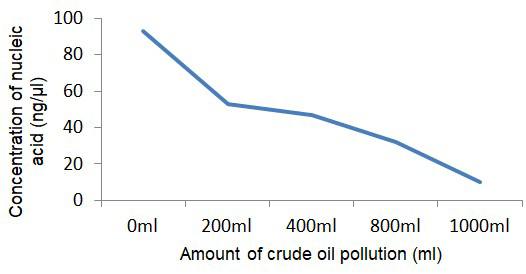
Figure 1: Plot of effect of crude oil on the concentration of nucleic acid. The application of crude oil on the soil consistently decreased the mean concentration of nucleic acid from 92.83 ng/µl, for the control treatment, to the lowest mean concentration of 9.77 ng/µl, for the 1000ml crude oil treatment. This shows an 89.41% decrement in concentration of nucleic acid, compared to the control. This shows that, compared to the control, the concentration of nucleic acid decreased with increase in the amount of crude oil pollution.
Conclusively, it can be said that, compared to the control treatment, the increase in amount of crude oil in the soil degraded the DNA of the plants, possible leading to cell death and concomitant death of plants. This is evident in decreasing staining with increase in crude oil treatment of the monomorphic 10Kb bands observed in the pictogram of the gel electrophoresis as seen in Plate 1.
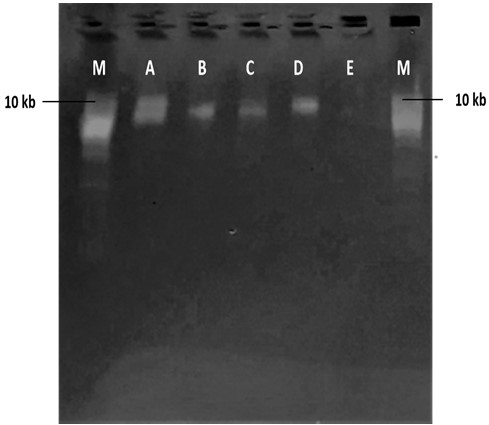
(A to E: 0ml, 200ml, 400ml, 800ml and 1000ml treatments, M: DNA ladder). Plate 1: Gel image of the samples.
Discussion
Effect of Crude Oil on Nucleic Acid Concentration
Evidence from the study showed that the application of crude oil on the soil consistently decreased the mean concentration of nucleic acid from 92.83 ng/µl, for the control treatment, to the lowest mean concentration of 9.77 ng/µl, for the 1000ml crude oil treatment. This shows an 89.41% decrement in concentration of nucleic acid, compared to the control. Conclusively, it can be said that, compared to the control treatment, the increase in amount of crude oil in the soil degraded the DNA of the plants, possible leading to cell death and concomitant death of plants. This is evident in low staining of the bands in the pictogram of the gel electrophoresis as seen in Plate 1.
Heba, et al. [17], working with consumable fish Platichthys flesus reported that crude oil further has an obvious effect on growth rates and protein synthesis. Their report disclosed that the results on RNA concentration, RNA/ DNA ratio and the protein concentration were significantly affected and ranked; and, that the protein concentration has the same pattern as of RNA concentration. Their findings are also in corroboration with those of Dorota, et al. [18]. Slomka, et al. [19] reported lack of correlationship betweem chromosome variability in root meristematic cells and genome size in peducle cells due to elimination of somatic mutations in generative meristem leading to chromosome- stable non meristematic tissues in the peducle and also as a result of greater cytological stability in genetive meristem than in vegetative meristem. Furthermore, soil polluted by heavy metals has genotoxic and phytotoxic effects in plants as reported by Nazir A, et al. [15]. Heavy metals inhibit the DNA synthesis or even block the cells in the G2_ phase of the cell cycle by preventing the cells from entering mitosis [20]. Aidid, et al. [21, 22] also stated that heavy metals inhibit plant growth by suppresing the elongation of plant cells which may be due to the inhibitory effect of mitosis
Conclusion
Findings from this study showed that the plant’s contact with increasing treatments of crude oil did not affect the size of the genome (nucleic acid); instead, it reduced the concentration of the nucleic acids, as was evident in the low staining of the 10 Kb band in the gel electrophoresis.
References
-
Ochekwu EB, Eneh CO (2012) Phytoremediation Potential of Sorghum (Sorghum Bicolor (l) Moench) and African Yam Bean (Sphenostylis Sternocarpa) Hoechest Ex a. Rich) Harms on Crude Oil Polluted Soil. Niseb Journal 12(12): 57-65.
-
Rowell MJ (1977) The Effect of Crude Oil Spills on Soils: A Review of Literature. In: Toogood JA (Ed.), the Reclamation of Agricultural Soils after Oil Spills. Part 1: Research, Alberta Institute of Pedology, Canada, pp: 1-33.
-
Adesina G, Adelasoye KA (2014) Effect of Crude Oil Pollution on Heavy Metal Contents, Microbial Population in Soil, and Maize and Cowpea Growth.Agricultural Sciences 5(1).
-
Anoliefo GO, Vwioko DE (1995) Effects of Spent Lubrication Oil on the Growth of Capsicum AnumL and Hycopersiconesculentum Miller. Environmental Pollution 88: 361-364.
-
Hinojosa MB, Carreira JA, Ruız RG, Dick RP (2004) Soil Moisture Pre-Treatment Effects on Enzyme Ac-Tivities as Indicators of Heavy Metal Contaminated and Reclaimed Soils. Soil Biology &Biochemistry 36: 1559-1568.
-
Yao H, Xu J, Huang C (2003) Substrate Utilization Pattern, Biomass and Activity of Microbial Communities in a Sequence of Heavy Metalpolluted Paddy Soils. Geoderma 115: 139-148.
-
Sharma RK, Agrawal M, Marshall F (2005) Heavy Metal Contamination of Soil and Vegetables in Suburban Areas of Varanasi, India. Ecotoxicology and Environmental Safety 66(2): 258-266.
-
Ramteke S, Sahu BL, Dahariya NS, Patel KS, Blazhev B, Matini L (2016) Heavy Metal Contamination of Leafy Vegetables. Journal of Environmental Protection 7(7): 996-1004.
-
Sharma A, Katnoria JK, Nagpal AK (2016) Heavy Metals in Vegetables: Screening Health Risks Involved in Cultivation along Wastewater Drain and Irrigating with Wastewater. Springerplus 5: 488.
-
Murray BG (2005) When Does Intraspecific C-Value Variation Become Taxonomically Significant? Ann Bot 95(1): 119-125.
-
Šmarda P, Bureš P (2010) Understanding Intraspecific Variation in Genome Size in Plants. Preslia 82: 41-61.
-
Carroll SP, Hendry AP, Reznick DN, Fox CW (2007) Evolution on Ecological Time-Scales. Functional Ecology 21: 387-393.
-
Medina MH, Correa JA, Barata C (2007) Micro-Evolution due to Pollution: Possible Consequences for Ecosystem Responses to Toxic Stress. Chemosphere 67(11): 2105- 2114.
-
Ezekwe MO, Omara AT, Membrahtu T (1999) Nutrition Characterization of Purslane Accessions as Influenced by Planting Date. Plant Foods in Human Nutrition (Dordrendit) 54(3): 183-191.
-
Nazir A, Malik RN, Ajaib M, Khan N, Siddiqui MF (2011) Hyperaccumulators of Heavy Metals of Industrial Areas of Islamabad and Rawalpindi. Pak J Bot 43(4): 1925- 1933.
-
Begum HA, Hamayun M, Zaman K, Shinwari ZK, Hussain A (2017) Heavy Metal Analysis in Frequently Consumable Medicinal Plants of khyberpaktunkhwa, Pakistan. Pak J Bot 49(3): 1155-1160.
-
Heba HM, Abu Zeid IM, Waseem A, Kelany AM, Shazly HF (2018) Effects of Short-Term Exposure to Crude-Oil on the Ultrastructure of Hepatocytes and Observations on Growth, Protein, RNA, DNA Concentration and their Ratios in Flatfish Flounder (Platichthys flesus). World Applied Sciences Journal 36(1): 66-77 .
-
Dorota N, Baršienë J, Mulkiewicz E, Podolska M, Rybakovas A (2009) Biomarker Responses in Flounder Platichthys Flesus from the Polish Coastal Area of the Baltic Sea and Applications in Biomonitoring. Ecotoxicology 18(7): 846-859.
-
Slomka S, Siwinska D, Wolyn E, Kellner K, Kuta E (2011) Infkuence of Heavy Metal Polluted Environment on Viola Tricolor Genome Size and Chromosome Number. Acta biologica cracoviensia Series botanica 53 (1): 7-15.
-
Sudhakar R, Gowda NKN, Venu G (2001) Mitotic Abnormalities Induced by Silk Dyeing Industry Effluents in the Cell of Allium Cepa. Cytologia 66: 235-239.
-
Aidid SB, Okamoto (1992) Effect of Lead, Cadnium and Zinc on the Electric Membrane Potential at the Xylem/ Symplast Interphase and Cell Elongation of Impatiens Balsamina [1992]. Environmental and Experimental Botany 32(4): 439-448.
-
Aidid SB, Okamoto (1993) Response on Elongation Rate, Turgor Pressure and Cell Extensibility of Stems Cells of Impatiens Balsamina to Lead, Cadnium and Zinc. Biometals 6: 245-249.
- Enhancement of Vegetative Growth and Fruit Yield in Cucumber (Cucumis sativus L.) via Spiritual Blessing (Biofield) Energy Intervention
- Production of Açaí (Euterpe oleracea Mart.) under Different Agroforestry System Management Intensities in Amazonian Floodplain (Varzea) Forests
- Coffee and the Production Region: What is the Secret to the Expression "Quality"?
- Experiential Agripreneurship Training in Sub-Saharan Africa: Integrating a Business Incubator into Postgraduate Livestock Education at the University of Buea
- Advances in Agricultural High-Quality Development
- Linking Compost Residue to ABAGE in Plants - a Short Note