
Penile Tri-Tubular Fracture: A Case of Partial Urethral Ruptur With Bilateral Corpora Cavernosa Fractures
Penile fracture generally manifests as a solitary rupture of the tunica albuginea in one of the two corpora cavernosa; urethral rupture is an extremely unusual complication. A tri-tubular penile fracture can occur when the erect penis is exposed to highenergy trauma. Although its diagnosis is frequently clinical, ultrasonography can assist confirm the diagnosis and pinpoint the site of the lesion. We report a case of a patient who had a tri-tubular penile fracture (bilateral corporal cavernosa injury and partial urethral ruptur). After a six-month follow-up, the patient urinated normally and had a satisfactory erection
Introduction
Penile fracture is produced by a blunt injury to the erected penis, which leads the tunica albuginea of the corpus cavernosum to rupture. Because of the penis’s mobility and protective position, such trauma is rare. During violent intercourse, the most common cause of penile fracture is striking the erected penis against the perineum of the symphysis pubis. In 6-9 percent of cases, penile fracture is accompanied with urethral lesion [1]. Surgery remains to be the undisputed therapy; nonetheless, any delay or non-use of surgery is a source of complications (functional or aesthetic). We reported a case of a 50-year-old man who was admitted to the hospital with bilateral corpora cavernosa fracture and partial urethral rupture. Urgent surgical exploration was performed. The both corpora cavernosa and the urethra were repaired. The patient urinated normally and had a satisfactory erection six months later.
A 50-year-old male presented to the emergency room with acute penile pain, fast detumescence, penile edoema, and urethrorrhagia 5 hours after sustaining a severe trauma against his partner’s perineum during sexual intercourse in doggy position. He had no previous history of penile deformity or urethral injuries.
Physical examination revealed swelling and a subcutaneous hematoma, as well as a left-sided deviation of the penis (Figure 1), and bloody urethral discharge. An echogenic collection owing to a haematoma was discovered during a penile ultrasonography (Figure 2). Surgical exploration was done through subcoronal circumferential incision. The hematoma was evacuated. There were two transverse breaches 2.5-cm and 1.5-cm in the left and right tunica albuginea, respectively, as well as a partial urethral rupture (Figure 3).
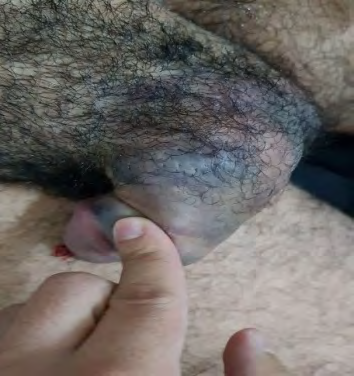
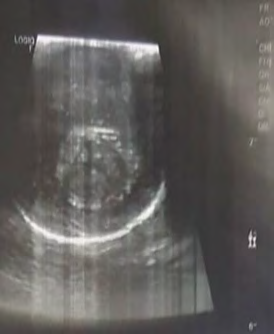
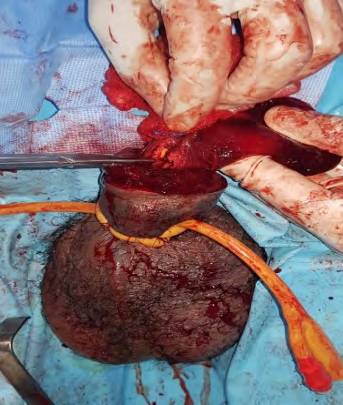
A 14 F urethral catheter was placed into the proximal urethra, followed by the insertion of a tourniquet to the base of the penis. Defects in both corpora were repaired with interrupted 4/0 vicryl suture, and the urethra was tension- free anastomosed with 4/0 vicryl sutures without incident.
After 3 days, the patient was discharged, and the urethral catheter was maintained for 21 days, after which time a pericatheter urethrogram revealed urethral continuity with no extravasation. The patient was able to pass urine freely once the catheter was removed. He was given antibiotic prophylaxis Cefixime at a dose of 400 mg daily for 10 days, but no diazepam. During follow-up visits after 6 months, the patient reported a good erection with no penile curvature and a satisfactory urine flow.
Discussion
Penile fracture is an uncommon urological trauma produced by a high-energy blunt penile injury, such as hitting a female partner’s perineum during sexual intercourse, which is accompanied by a rupture of the tunica albuginea of the corpora cavernosa.
According to a systematic review, bilateral rupture of the tunica albuginea of the corpus cavernosum occurs in 5–26% of penile fractures and is associated with urethral lesion in 15% of cases [2].
Traumatic coitus, masturbation, violent penile manipulation, or rolling over in bed onto an erect penis have all been reported as causes of penile fracture. Among these, aggressive sexual intercourse is the most common cause of urethral rupture.
In the case of interrupted coitus, the doggy position was the most common position, followed by the Andromachus. On the one hand, when the male is in a dominating position and very enthusiastic, sexual intercourse can become extremely energetic, resulting in a greater impact when the penis slides out of the vagina and strikes against the perineum or pubic symphysis. When the woman is atop the man, she may unwittingly land all of her weight on the erect penis if it slides out of the vagina [3].
The tunica albuginea is one of the strongest fascias in the human body. During erection, it stretches and thins significantly: in the flaccid state, it may be up to 2.4 mm thick; during erection, it can be as thin as 0.25 to 0.5 mm. Bitsch et al. and De Rose et al. hypothesised that an intracorporal pressure of 1500 mmHg or more during erection might rip the tunica albuginea [4].
Although it is widely acknowledged that clinical history and genital examination are the cornerstones of diagnosis, there is no consensus on how to exclude a concurrent urethral lesion, which can be present in about one-third of cases [3].
In most cases, no paraclinical examination is required to make a diagnosis. Color Doppler ultrasonography, retrograde urethrocystography, cavernography, or Magnetic Resonance Imaging (MRI) may be indicated in frustrated or late-sighted patients. The sole indication for retrograde urethrocystography is urethral rupture.
Immediate surgical repair is the gold standard therapy for penile fractures. Circumcising or a penoscrotal midline incision should be used to repair the damaged tunica with interrupted absorbable sutures. A tension-free anastomotic urethroplasty, which is a common operation for short bulbar urethral strictures, should be performed as soon as possible to heal any concurrent urethral lesion [5].
Conclusion
Penile fracture is a rare pathological condition that occurs as part of the andrological emergencies that occur most frequently during sexual intercourse. In each and every case of penile fracture accompanied by bloody urethral discharge, urethral rupture should be suspected. The urethral lesion is frequently a partial rupture at the corpora level. Immediate surgical repair is the gold standard therapy. A follow-up evaluation is recommended to look for postoperative urethral strictures and erectile sequelae.
References
-
Horiguchi A (2021) Editorial Comment to Tri‐tubular penile fracture: A case of complete rupture of urethra and bilateral corpus cavernosa. IJU Case Reports 4(3): 145.
-
Falcone M, Garaffa G, Castiglione F, Ralph DJ (2018) Current management of penile fracture: an up-to-date systematic review. Sex Med Rev 6(2): 253-260.
-
Dibingue TAC, Alafifi M, Nedjim S, Gallouo M, Hagguir H, et al. (2021) Outcomes of Surgical Repair of Penile Fracture. Am J Urol Res 6(1): 6-12.
-
Mayank V, Basavraj N, Vaibhav G, Anil H, Jignesh S, et al. (2015) Fracture of the penis: an atypical case presentation. Int J Health Sci Res 5(1): 354-357.
-
Falcone M, Garaffa G, Castiglione F, Ralph DJ (2018) Current management of penile fracture: an up-to-date systematic review. Sex Med Rev 6(2): 253-260.
- Results of 6-Month Follow-Up of Patients After B-Turp and Thulep
- The Effect of Drinking Water with a High Content of Antimony and Arsenic on the Dynamics of their Distribution in the Kidneys and the Renal Excretory Function in Rats
- Effectiveness and Safety of Tansurethral Thulium Laser Enucleation of the Prostate in the Treatment of BPH: Review
- A Systematic Review on Molecular Pathophysiology Involved in Chronic Kidney Disease and the Role of Animal Models in Drug Discovery to Manage in Chronic Kidney Disease - An Update
- Functional Development of Kidneys in Human Ontogenesis
- Testicular Metastasis: Uncommon Prostate Cancer Case Report