
Primary Malignant Melanoma of the Female Urethra, A Rare Histologic Pathology Subtype and Poor Prognosis: Case Report
Introduction: Primary malignant melanoma of the genitourinary tract is extremely rare. The recommendations for management of this cancer still undefined due to paucity of literature. We report a case of primary malignant urethral melanoma developed in an elderly female patient. Presentation of case: 72 years old Thai female presented with palpable urethral mass with contact bleeding. On physical examination, there were no suspicious lesions on her skin. On external genital examination, a lesion at urethral meatus was observed and biopsied by rural doctor. The pathological diagnosis was malignant melanoma of urethra. Discussion: Despite major surgery, radiotherapy or immunotherapy malignant melanoma usually has a poor prognosis. We performed distal urethrectomy and followed up her clinical closely but unfortunately tumor recurrence in 15 months of the follow up. Conclusion: Primary malignant melanoma of female urethra is an extremely rare and poor prognosis. The histological and immunohistochemical findings can be helpful in making an accurate diagnosis.
Introduction
Malignant melanoma is a rare neoplasm comprising approximately 1.2% of all malignancies that can affect any area of the anatomical economy. Genitourinary tract involvement is observed in less than 1% of cases [1]. Primary malignant melanoma of urethra is most rare and comprises only 0.2% of malignant melanomas. It has three times more frequent in women than men [2] with average age of presentation being 68 years [3].
We report a case of female urethral malignant melanoma. The patient experienced local recurrence 15 months after surgical resection and we discussed with patient for further treatments.
A 72 years old female presented to rural urologic outpatient with history of palpable urethral mass 1 month PTA, the mass grew up from 1cm to 4cm in 1 month with easily contact bleeding. The rural doctor biopsied mass and pathological result was shown primary malignant melanoma of urethra then the patient was referral to our hospital. She also had difficult urination and gross hematuria. On general examination, no skin discoloration or abnormality was found. On genital examination, a 4x3x2 cm mass was seen protruding from urethral meatus with contact bleeding (Figure 1).
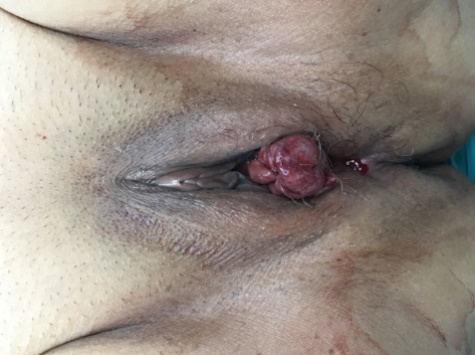
Per vaginal and speculum examination were normal. No inguinal or regional lymph node enlargement was noted. Her chest X-ray was normal. The abdominal-pelvic computerized tomography scan revealed that peri-urethral tissue and bladder were not involved. No regional or distant metastasis was noted. Cysto-urethroscopic examination revealed the mass to be localized at the urethral meatus. The proximal urethra and bladder were no abnormal lesions (Figure 2).
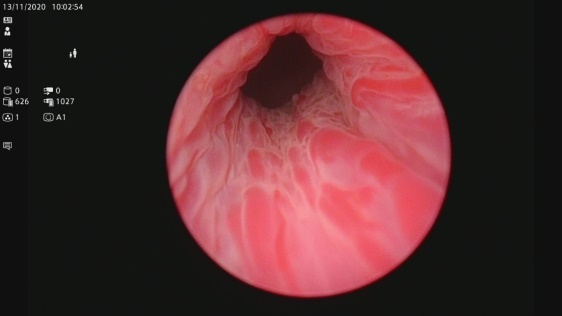
In November 2020, she underwent wide excision and distal urethrectomy (Figure 3 & 4).
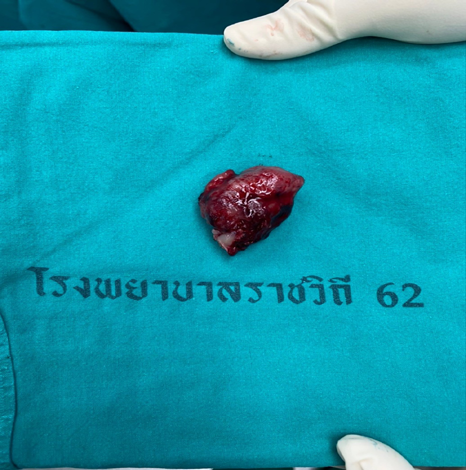
Histopathological findings were nodular melanoma, free margin Figure 5.
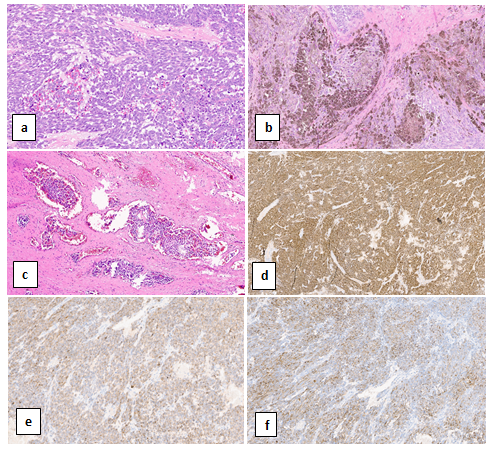
Figure 5: Pathological findings. Hematoxylin & Eosin stained sections (a) and (b). Section shows solid sheets of malignant cell. These cells have spindle nuclei, coarse chromatin granules with eosinophilic cytoplasm. Mitotic figures are frequently seen. Melanin pigments are observed. Lymphovascular invasion is identified (c). Immunohistochemical studies for S100 (d) HMB-45 (e) and MART-1/MelanA (f).
The patient was followed up the clinical periodically. In February 2022, she had local recurrence of mass at urethral meatus without inguinal lymph node enlargement. We discussed with patient and her cousin about further aggressive surgical management such as total urethrectomy with or without cystectomy. Unfortunately, her chest X-ray was shown multiple lung nodules metastases, the abdominal- pelvic computerized tomography scan revealed pelvic lymph nodes metastases and liver metastases. After consultation of medical oncologist, we changed the management to best supportive care.
Discussion
Malignant melanoma of urethra was first reported in a female by Reed in 1896 [4]. Females are more common than male. Although it is reported in different age groups, it is more common in 6th to 7th decade of life [3]. The patient may present with a urethral mass, dysuria, urethral discharge or hematuria. The differential diagnosis may include vulvar or vaginal melanoma, urethral polyps and caruncle [5]. It commonly involves distal urethra or urethral meatus. The diagnosis is confirmed by tissue biopsy. The metastatic evaluation such as abdominal-pelvic computerized tomography scan should be performed before surgical treatment. The TNM classification by the American Joint Committee on Cancer (AJCC) is an important tool for staging this neoplasm [6].
The definite management of primary malignant melanoma is surgical excision with tumor‑free margins to achieve control of local disease. The median survival rate in urethral melanoma is 26 months [2].
Oliva and co‑workers have proposed various surgical treatments including local excision, urethrectomy, vulvectomy with inguinal lymphadenectomy, urethrectomy with vaginectomy and pelvic exenteration [7]. Postoperative quality of life may reduced by radical resection depending on the site of involvement.
DiMARCO reported the procedure and treatment results of 11 female urethral malignant melanoma patients. No recurrence was observed in patients without direct invasion of bladder neck [3]. Cystectomy may not be necessary.
Several new agents have been approved for the treatment of cutaneous melanoma since 2011, including the combination of nivolumab and ipilimumab, yet there is a paucity of published information regarding the efficacy and safety of these agents in mucosal melanoma subtypes [8].
Urethral malignant melanoma shows a high rate of local recurrence, about 60% in 1 year. Overall survival in a series of 11 cases at 3 years was 27% [3]. The present patient showed local recurrence and distant metastases in 15 months of follow up.
Conclusion
Primary malignant melanoma of female urethra is an extremely rare and poor prognosis. It mostly occurs in elderly female patients. It shows a high rate of local recurrence.
Surgery is the main treatment but optimal extent of surgery still needs more data.
Consent
Written informed consent was obtained from the patient for the publication of this case report.
Conflicts of interest
The authors have nothing to declare.
References
-
Stein BS, Kendall AR (1984) Malignant melanoma of the genitourinary tract. The Journal of urology 132(5): 859- 868.
-
El-Safadi S, Estel R, Mayser P, Muenstedt K (2014) Primary malignant melanoma of the urethra: a systematic analysis of the current literature. Archives of gynecology and obstetrics 289(5): 935-943.
-
Dimarco DS, DiMarco CS, Zincke H, Webb MJ, Keeney GL, et al. (2004) Outcome of surgical treatment for primary malignant melanoma of the female urethra. The Journal of urology 171(2): 765-767.
-
Reed CA (1896) Melano-sarcoma of the female urethra: urethrectomy; recovery. The American Journal of Obstetrics and Diseases of Women and Children 134(6): 864.
-
Kindelán JA, García JAM, Cerezo IO, Rodríguez MMM, Arlanzón MMG (2000) Primary malignant melanoma of the female urethra. Report of a case. Actas Urologicas Espanolas 24(6): 488-490.
-
Kim CJ, Reintgen DS, Balch CM, AJCC Melanoma Staging Committee (2002) The new melanoma staging system. Cancer Control 9(1): 9-15.
-
Oliva E, Quinn TR, Amin MB, Eble JN, Epstein JI, et al. (2000) Primary malignant melanoma of the urethra: a clinicopathologic analysis of 15 cases. The American journal of surgical pathology 24(6): 785-796.
-
D’Angelo SP, Larkin J, Sosman JA, Lebbé C, Brady B, et al. (2017) Efficacy and safety of nivolumab alone or in combination with ipilimumab in patients with mucosal melanoma: a pooled analysis. Journal of Clinical Oncology 35(2): 226-235.
- Results of 6-Month Follow-Up of Patients After B-Turp and Thulep
- The Effect of Drinking Water with a High Content of Antimony and Arsenic on the Dynamics of their Distribution in the Kidneys and the Renal Excretory Function in Rats
- Effectiveness and Safety of Tansurethral Thulium Laser Enucleation of the Prostate in the Treatment of BPH: Review
- A Systematic Review on Molecular Pathophysiology Involved in Chronic Kidney Disease and the Role of Animal Models in Drug Discovery to Manage in Chronic Kidney Disease - An Update
- Functional Development of Kidneys in Human Ontogenesis
- Testicular Metastasis: Uncommon Prostate Cancer Case Report