
Owner Reported Clinical Outcomes of a Homeopathic Proprietary Preparation for the Treatment of Upper Respiratory and Nasal Disorders in Companion Animals
Background: Nasal and upper respiratory conditions are frequent issues in dogs and cats, presenting symptoms like sneezing, nasal obstruction, and various types of discharge. These can result from allergies, infections, foreign objects, or anatomical factors. While many cases respond to treatment, underlying issues often cause relapses. The investigational product offers a potential new approach for managing these nasal and sinus diseases in companion animals. Objectives: The primary objective of this PRO (Patient Reported Outcome) study was to assess the efficacy and safety HomeoPet® Nose Relief in Upper Respiratory Tract Disease Symptoms. Methods: This study was done on patient-reported outcome (PRO) data collected via an internet questionnaire. It is a facilitator-driven survey similar to previous studies17,18,19. Results: The study included 221 real-world patients split over four small animal species, with dogs and cats being in the majority. Runny Nose 94 (44.76%), Sneezing 73 (34.76%), Watery eyes 55 (26.19%), Nasal blockage 35 (16.67%), Upper respiratory infection 17 (8.1%), 6 (2.86%), Cold 30 (14.29%), Allergies 20 (9.52%), Nasal discharge 93 (44.29%) and Sinusitis 8 (11.94%) cases p< 0.0000001. In 61 (29.05%) pets, the symptoms were constant, while 71 (33.81%) had intermittent symptoms. The ANOVA revealed that there was an extremely weak downhill relationship between the pet type and efficacy of the medicine (p
Abbreviations
URTI: Upper Respiratory Tract Infection; URTD: Upper Respiratory Tract Disease.
Introduction
Upper Respiratory Tract Infection (URTI) was hardly considered in the list of common acute infective conditions of pets before 2007, when the subclinical infections of viral conditions were found responsible for the spread of cold-like disease [1]. Despite a few sporadic reports of respiratory infections [2], there was insufficient attention towards the condition and, thereby, its treatment. However, during the 2007 and 2016 outbreaks of avian flu, a large number of pets were infected with cold-like symptoms. The infectant had affected many pets, was tracked in the canine and feline upper respiratory tract [1]. This incident changed the perception, and upper respiratory tract infection evolved as a condition to be watched in pets. Later, this changed landscape was established even more strongly, with the addition of a viruses identified as the cause of URTI in pets.
As per a 2017 WHO report “Zoonotic influenza viruses: antigenic and genetic characteristics and development of candidate vaccine viruses for pandemic preparedness”, a significant number of influenza viruses (from H5 genetic clan) are affecting animals, especially pets, and of these several viruses were identified as infecting animals for the first time [3]. Other viruses, including Bordetella bronchiseptica, Chlamydophila Felis, Mycoplasma Felis, Feline Herpes viruses, and Feline Calicivirus, are among the leading causes of URTI or Upper Respiratory Tract Disease (URTD) in cats [4]. The pandemic of SARS-CoV-2 broke out, pets, especially cats, were also found to be infected with the novel virus, leading to COVID-19 [5]. It could be said that this leads to the misuse and potential misuse, improper use, and overuse of antimicrobials.
Antimicrobial therapies, which include antibacterial and antiviral drugs like Pheromone, Vedaprofen, Pradofloxacin, and Famciclovir, antibiotics like Doxycycline and steroids are among the popular therapies [6]. Therapy with passive antibodies is among the emerging options. However, there are many studies with either negative or unclear outcomes in various papers [7]. Many of these therapies also tend to produce certain side effects besides their cost and cause- specific short-term effects. Observed seasonality of infections appearing as outbreaks has been reported from various parts of the world.
This seasonality adds to the urgency of therapy to control the rapid spread. In an attempt to control the disease outbreaks, a vaccination program is under development.
However, the efficacy of the vaccine, or rather the vaccination program, in achieving the desired rate of immunization is our major challenge [8].
Two major concerns about the URTD8-11 of pets include the rapid spread of the URTD, which risks spreading to humans and a wide range of causative organisms, against which exact diagnosis and immunization are hard to achieve [8, 9, 10, 11]. There is an obvious relationship between the diagnostic methods available and used and the understanding of the real causative factors, so as to help the passive immunity therapy [9]. Hence, about seasonality, acuteness of the condition, unavailability of the definitive therapy, cost of diagnosis and treatment including immunization, appears to have led to alternate therapy becoming extremely popular for URTI / URTD [10, 11, 12, 13, 14].
Rationale of the Study
Homeopathic medicines have gained popularity and have generated evidence in the treatment of URTI [15]. This study was conducted to generate evidence of the safety and efficacy of the homeopathic medicine “nose relief”.
Materials and Methods
This study was a survey-based study conducted with an internet-based questionnaire, facilitated through independent facilitators. The investigational product for this study was “Nose Relief,” a proprietary homeopathic combination medicine indicated for upper respiratory tract infection.
The Homeopathic medicines included in this formula are based upon the medicines indicated under the reportorial syndromes using symptoms watery nose discharge, Nose Sneezing, Eyes Discharge, Lacrimation, coryza, and Nose blocked in Robin Murphy’s Repertory.
Results
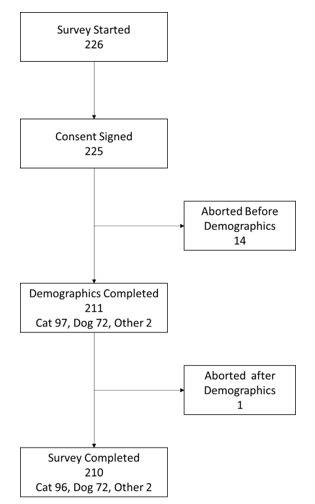
In all, 226 Respondents started the survey, of which 1 was dropped for not signing the Informed consent, and 92% of respondents continued. Of these, 14 (6.22%) respondents aborted the survey process before entering demographics details and 211 (93.77%) completed the demographics details, in which the details of 97 (45.97%) cats, 24 (34.12%) dogs, 1 (0.4%) mouse and 1 (0.4%) rabbit were captured. In all, 1 (0.4%) respondent started the survey, but aborted after entering demographics details. Thus, a total of 210 (92.92% of the initial group) respondents. This group of 210 evaluable animals consisted of 96 (45.71%) cats, 72 (34.29%) dogs, and 1 (1.06%) mouse and rabbit each. The 210 animals for which their owners added sufficient details were considered as the safety and efficacy evaluation population (Figure 1).
Demographics
Overall, 211 animals were included in the study with upper respiratory tract infections. One record mentioned having multiple animals, hence it was removed from the analysis. The group of 210 animals was analysed, having a mean age of 7.16 years, 88 (41.9%) males and 81 (38.57%) females, 41 ± 5.24 Pounds of mean weight, and 55 (26.19%) pets who had been neutered. Of the 210, 96 (45.71%) were cats. In the feline group, the mean age was 8.28 ± 6.12 years,
26 (53.06%) were males, and 22 (44.9%) were females. The average weight was 13.58 ± 17.38 pounds, and 44 (89.8%) cats were neutered. In the group, 17 (25.37%) dogs with an average age of 9.18 ± 5.23 years, 8 (47.06%) males, and 9 (52.94%) females were included. The average weight of dogs was 28.35 ± 28.55 pounds, and 11 (64.71%) had been neutered. There was one (1.49%) female mouse of 6 years, with 0.11 pounds weight, and was not neutered (Table 1). Due to the large variance among different species, reporting standard deviations of age and weight was not relevant.
| Demographics | Cat | Dog | Mouse, Rabbit | Overall |
|---|---|---|---|---|
| Species Count | 96 (45.71%) | 72 (34.29%) | 2 (0.95%) | 210 (100%) |
| Age | 8.28 ± 5.41 | 9.18 ± 5.83 | 4.5 | 7.16 ± 0.3 |
| Male | 50 (52.08%) | 37 (51.39%) | 2 (100%) | 88 (41.9%) |
| Female | 46 (47.92%) | 34 (47.22%) | 1 (50%) | 81 (38.57%) |
| Weight | 13.53 ± 13.9 | 18.16 ± 21.31 | 3.66 | 41 ± 5.24 |
| Neutered | 44 (45.83%) | 11 (15.28%) | 0 (0%) | 55 (26.19%) |
Table 1: Demographics of the pets enrolled.
Medical History
In all, 44 (20.95%) pets had received medical support by being attended to by a veterinarian. The group of 210 enrolled pets had various medical histories including Renal Dysfunction in 5 (2.38%), Arthritis in 3 (1.43%), FIV Infection and Chronic Bronchitis 2 (2.99%) patients each, Asthma, Am & Pm zoonotic infection, Fungal Infection, Calici virus infection, Digestive Problem, Diabetes, Overweight, Cardiac dysfunction, Tumour, Mycoplasma, and Seizures was observed in one (1.49%) patient each (Table 2).
| Medical Support | Cat | Dog | Mouse, Rabbit | Overall |
|---|---|---|---|---|
| Attended By Vet | 11 (11.46%) | 33 (45.83%) | 44 (20.95%) | |
| Medical History | ||||
| Arthritis | 1 (1.04%) | 2 (2.78%) | 0 (0%) | 3 (1.43%) |
| Asthma | 0 (0%) | 1 (1.39%) | 0 (0%) | 1 (0.48%) |
| FIV* | 0 (0%) | 2 (2.78%) | 0 (0%) | 2 (0.95%) |
| Renal Dysfunction | 0 (0%) | 5 (2.38%) | 0 (0%) | 5 (2.38%) |
| AM & PM Zoonotic | 0 (0%) | 1 (1.39%) | 0 (0%) | 1 (0.48%) |
| Cardio-respiratory Complication | 0 (0%) | 1 (1.39%) | 0 (0%) | 1 (0.48%) |
| Chronic bronchitis | 1 (1.04%) | 1 (1.39%) | 0 (0%) | 2 (0.95%) |
| Fungal Infection | 0 (0%) | 1 (1.39%) | 0 (0%) | 1 (0.48%) |
| Calici virus* | 0 (0%) | 1 (1.39%) | 0 (0%) | 1 (0.48%) |
| Digestive Problem | 1 (1.04%) | 0 (0%) | 0 (0%) | 1 (0.48%) |
| Diabetes | 0 (0%) | 0 (0%) | 0 (0%) | 1 (0.48%) |
| Overweight | 0 (0%) | 1 (1.39%) | 0 (0%) | 1 (0.48%) |
| Cardiac dysfunction | 0 (0%) | 1 (1.39%) | 0 (0%) | 1 (0.48%) |
| Tumour | 0 (0%) | 0 (0%) | 0 (0%) | 1 (0.48%) |
| Mycoplasma | 0 (0%) | 0 (0%) | 0 (0%) | 1 (0.48%) |
| Seizures | 0 (0%) | 1 (1.39%) | 0 (0%) | 1 (0.48%) |
Table 2: Medical History of pets enrolled.
The concomitant medication along with Nose Relief or past medication included Antibiotics in 11 (5.24%) animals (1 cast and 10 dogs), Steroids in 3 (1.43%) dogs, Chinese Medicines in 1 (0.48%) dog, Other Homeopathic Medicine in 6 (2.86%) comprising of 2 (3.51%) dogs and 4 (7.02%) cats, and Other Medication recorded in 6 (2.86%) pets of which 1 (1.75%) was cat, 5 (5.21%) were dogs. The Medication prescribed provided complete relief in 3 (1.43%) patients, 1 (1.75%) cat, and 5 (5.21%) dogs counting for overall 6 (2.86%) animals that had partial relief, 5 (8.77%). There was no relief for 16 (7.62%) patients, 6 (10.53%) cats, and 10 (10.42%) dogs. In 4 (7.02%) Dogs, the symptoms relapsed after discontinuation of the medicine (Table 3). All the outcomes were statistically significant.
| Concomitant Medication | Cat | Dog | Overall |
|---|---|---|---|
| N=96 | N=72 | N=210 | |
| Antibiotic | 1 (1.75%) | 10 (10.42%) | 11 (5.24%) |
| Steroid | 0 (0%) | 3 (3.13%) | 3 (1.43%) |
| Chinese | 0 (0%) | 1 (1.04%) | 1 (0.48%) |
| Homeopathic | 4 (7.02%) | 2 (2.08%) | 6 (2.86%) |
| Other Medication | 1 (1.75%) | 5 (5.21%) | 6 (2.86%) |
| Previous Medication Effectiveness for URTI | |||
| Complete | 1 (1.75%) | 1 (1.04%) | 3 (1.43%) |
| Partial | 1 (1.75%) | 5 (5.21%) | 6 (2.86%) |
| No | 6 (10.53%) | 10 (10.42%) | 16 (7.62%) |
| Relapse | 0 (0%) | 4 (4.17%) | 4 (1.9%) |
| p-Value | 0.025 | 0.094 | 0 |
Table 3: Concomitant Medication and Its Effectiveness.
The previous and concomitant medicines had in all 8 (3.80%) adverse effects reports. These reports included gastrointestinal Disturbance, Secondary Infection, and Sleepiness in one (0.47%) case each, while for 5 (2.38%) reports, there was no specific information (Table 4).
| Adverse Effects after Previous Medication | |
|---|---|
| Total Adverse Event Reports | 8 (3.80%) |
| Gastrointestinal Disturbance | 1 (0.47%) |
| Secondary Infection | 1 (0.47%) |
| Sleepiness | 1 (0.47%) |
| Unspecified | 5 (2.38%) |
Table 4: Adverse Events of Previous and Concomitant Medication Concomitant Medication
Baseline Disease Characteristics
The baseline and outcomes were analysed on the overall group only. All animals had one or more presenting symptoms for which Nose Relief was prescribed. These symptoms included Runny Nose 94 (44.76%), Sneezing 73 (34.76%), Watery eyes 55 (26.19%), Nasal blockage 35 (16.67%), Upper respiratory infection 17 (8.1%), 6 (2.86%), Cold 30 (14.29%), Allergies 20 (9.52%), Nasal discharge 93 (44.29%) and Sinusitis 8 (11.94%) cases p< 0.0000001. In 61 (29.05%) pets, the symptoms were constant, while 71 (33.81%) had intermittent symptoms (Table 5).
| Presenting Symptoms | |
|---|---|
| Runny Nose | 94 (44.76%) |
| Sneezing | 73 (34.76%) |
| Watery eyes | 55 (26.19%) |
| Nasal blockage | 35 (16.67%) |
| Upper respiratory infection | 17 (8.1%) |
| Dog Flu | 6 (2.86%) |
| Cold | 30 (14.29%) |
| Nasal discharge | 93 (44.29%) |
| Sinusitis | 8 (3.81%) |
| Allergies | 20 (9.52%) |
| Other | 17 (8.1%) |
| Intermittency of Symptoms | |
| Constant | 61 (29.05%) |
| Intermittent | 71 (33.81%) |
Table 6: Presenting symptoms at baseline.
Posology of the Nose Relief use
A large amount of data on posology was missing from the data. Of the available data, Nose Relief was given to 16 (7.62%) pets once per day, to 35 (16.67%) pets twice a day, for 34 (16.19%) it was thrice a day, and 7 (3.33%) were given more than 3 doses per day. Most 65 (30.95%) pets were given medicine directly by dropping in the mouth, while 57 (27.14%) were given in Food, and 16 (7.62%) through Water. In all, 88 (41.9%) respondents reported that the prescription followed dispensing Instructions, while 122 (58.1%) owners considered that there had been or may have been errors while they gave the medicine to their pet (Table 6).
| Frequency per day | |
|---|---|
| 1 | 16 (7.62%) |
| 2 | 35 (16.67%) |
| 3 | 34 (16.19%) |
| >3 | 7 (3.33%) |
| Mode of Dispensing | |
| mouth | 65 (30.95%) |
| Food | 57 (27.14%) |
| Water | 16 (7.62%) |
| Patient-owner Reported Compliance with Dispensing Instructions. | |
| Used and dosed correctly | 88 (41.9%) |
| Have / May have errors | 122 (58.1%) |
Table 5: Posology of Nose Relief.
Analysis of Outcomes
The analysis of response time was performed in 131 (62.38%) available records. Of these, 15 (7.14%) respondents replied that their pet had a quick relief (within 1 day) for their pet, while in 21 (10%) pets the relief was within 2 days, and in the majority, 67 (31.9%) pets, the speed of relief was average. Among respondents, 28 (13.33%) felt that the relief was slow, which included 1 respondent who complained that there was no relief for the pet. The estimated extrapolated average time was about 2.5 days from categorical ranking 1-5 and counts per category (Table 7). P (Chi-Sq. for equal Proportions) = 0.000002.
| Response to Symptoms | |
|---|---|
| Quick | 15 (7.14%) |
| Fast | 21 (10%) |
| Average | 67 (31.9%) |
| Slow | 28 (13.33%) |
| Extrapolated estimated average recovery time | 2.5 days |
Table 7: Outcomes of Nose Relief - patient (owner) reported outcomes.
Another set of the medicinal outcomes for efficacy in a patient-reported outcome study is customer satisfaction. In this study, customer satisfaction was estimated from their perception of whether or not the medicine could relieve the symptoms and willingness to recommend. Among the 210 respondents, 205 (97.62%) reported that the medicine relieved the symptoms of their pet, while 5 (2.38%) reported that the medicine was not effective, and one reported that the medicine was partially effective 1 (0.48%) [p < 0.00001]. In all, 123 (58.57%) respondents stated that they would recommend Nose Relief further, while 11 (5.24%) stated that they wouldn’t recommend. The data on customer satisfaction was independent of the actual efficacy of the product (McNamar Test p<0.00001). No responses were recorded by 76 (36.19%) respondents. The reason for dissatisfaction of customer dissatisfaction included product composition - Alcohol in Product for 1 (0.48%), Adverse event or Failure of Product for 7 (3.33%), and Packaging or Dosing issues for 2 (0.95%) respondents (Table 8).
| Patient Reported Medicinal Efficiency Outcomes | |
|---|---|
| Success | 205 (97.62%) |
| Failure | 5 (2.38%) |
| Partial Relief | 1 (0.48%) |
| Customer Satisfaction | |
| Recommended further | 123 (58.57%) |
| Not Recommended Further | 11 (5.24%) |
| P (McNamar Test) | <0.00001 |
| Reason for Dissatisfaction | |
| Alcohol in Product | 1 (0.48%) |
| Adverse Event / Failure of Product | 7 (3.33%) |
| Packaging / Dosing issues | 2 (0.95%) |
| P (McNamar Test) | 0.2 |
Table 8: Efficacy is represented by patient-reported outcomes.
Analysis of Safety
The pets who had received no serious or major adverse events from the medicine. One (0.48%) adverse event reported was constipation, which probably pertained to lack of hydration as per the narrative of the adverse event. In one case (0.48%), there was aggravation of the symptoms for a short while, followed by immediate complete relief. Hence, it was not considered a safety issue (Table 9).
- Adverse Events after HomeoPet Nose Relief
- Overall
- 2 (0.95%)
- Aggravation
- 1 (0.48%)
- Constipation
- 1 (0.48%)
- P (Ch-sq. Test for equal proportions)
- 0
Table 10: Safety issues from the use of Nose Relief.
An Analysis of various probable factors that may affect the outcomes revealed a relationship between these factors with the actual outcomes. The subsets had a large variability of breed, and hence, analysis by pet type could be misleading. Hence, to validate whether there was a relationship between outcome and the pet type, Analysis of variance (ANOVA) was performed. The Analysis revealed that there was an extremely weak downhill relationship between the pet type and efficacy of the medicine (p<0.0001). The analysis or correlation revealed a statistically significant, moderately high correlation between the frequency of symptoms and efficacy of Nose Relief in relieving the symptoms (R = 0.408096, p <0.0001). Frequency of daily dose and age had a moderately low relationship with efficacy, in different directions. As age grew, the effect of medicine appears to be reducing, whereas as the dose frequency increases, the efficacy of medicine appears to be increasing. Constancy of symptoms and weight of the animal have no perceivable effect on the efficacy of the medicine (Table 10).
| Relationships | R-value | P-value | Test |
|---|---|---|---|
| Dose and Relief | 0.163132 | 0.010289074 | Paired t-test |
| Age and Relief | -0.16968 | 0 | Paired t-test |
| Weight and Relief | 0.084623 | 0.00000123 | Paired t-test |
| Symptom Constancy and Relief | -0.14991 | 0.444672483 | F Test |
| Dose Frequency and Relief | 0.408096 | 0 | F Test |
| Animal Type and Relief | 0.138103 | 0.076857993 | Paired t-test |
Table 9: Analysis of the correlation between various predisposing factors and the Efficacy of Nose Relief.
Discussion
Acute URTI of companion pets has recently emerged as a concern after avian flu and COVID were observed to infect cats and dogs and facilitate spread. While various treatments, including drugs and antibodies, are used as therapy in the current landscape, there is a significant need for further research on URTI. Particularly, pertaining to the plethora of diverse pathogens that limit the specificity of targeted therapies, and hence, there are mixed observations from many studies. Chadwin et al. studied 5 cat holding rooms with 336 animals in a placebo-controlled trial of pheromone. In the study, no difference was observed between the placebo and pheromone 13. This indicates there is an ongoing search for therapies across many different approaches for this often-recurrent condition.
Lopez et al. studied 382 cats, of which 80 had febrile illness due to URTI. Vedaprofen produced rapid temperature and symptom control, pain relief, and control of inflammation [14]. However, the subset analysis of this study does not report the significance levels. Hartmann et al. studied Pradofloxacin for c Felis and Mycoplasma infection. However, the study reported that despite relief of symptoms, the infection might have continued. The two studies of Famciclovir where in which one was used as add-on therapy with doxycycline and in the second it was a single therapy, produced contradicting results. Reinhard et al. in a 22-cat placebo-controlled randomized study reported that Famciclovir was effective for the control of URTI [15]. However, Kopency, et al. did not find a difference between Famciclovir alone and Famciclovir given with Doxycycline in their 24-cat study with a similar follow-up [16]. In a 24-animal study by Friendl, et al., the use of passive antibody therapy has only a transient effect [17]. Most of these studies had a small sample or a subset analysis. Also, a majority of the population was in the cat shelters. The distribution of the study population was focused, if not biased, to cats. The current study was a real-world study that included all animals. Hence, it included 67 animals of which 49 (73.13%) were cats, 17 (25.37%) were dogs and 1 (1.49%) was a mouse. Hence, it is a good sample representative of a real-world population.
In brief, the URTI/URTD of pets has no definitive therapy and has a risk of spread and aggravation with misuse of antimicrobials. Hence, misuse, overuse, and improper use of antimicrobial agents have been common in this condition, leading to secondary bacterial infections [12]. On the contrary, alternative therapies have been extremely effective and focused [18, 19, 20]. Many research papers on the effectiveness of the Chinese medicines, Ma Huang Tang, Yinhuapinggan granules, FFYH, and Lonicera japonica Thunb, etc., have demonstrated significant effects on influenza 21 24. Herbal medicines also have efficacy and safety. Echinacea powder on URTI was among one of the additional pieces of evidence of alternative medicine use [21, 22, 23, 24, 25]. While there is no animal experience published for URTI / URTD for homeopathic medicines, several publications in homeopathic treatment of human URTI establish the effectiveness of homeopathic medicines therein 26 [16]. The current study was also able to establish the safety and effectiveness of homeopathic medicine “Nose Relief” (Homeopet LLC), based upon the owner-reported outcome survey. The sample was large enough to support a statistically and clinically significant outcome.
Limitations of the study
This was an owner-reported survey. Hence, the evidence level of the study is E2, similar to an observational study. The use of many clinical tools, such as the stress scale and other validated tools, was not possible in this study. However, the reported outcomes were based upon a comprehensible, transparent, and validated questionnaire.
Conclusion
Nose Relief, a proprietary homeopathic preparation by HomeoPet LLC, was found to be safe and effective for managing upper respiratory tract infections (URTIs) in companion animals. It can be administered orally—directly, in food, or water-with dosing 1 to 3 times daily generally sufficient. More frequent dosing was well tolerated and may be beneficial in acute or chronic nasal and upper respiratory conditions, offering a novel therapeutic option in veterinary care.
Ethical Conduct
The study was conducted in compliance with good clinical practice and ethical guidelines.
Acknowledgements
The Authors acknowledge the facilitators of the survey. The Authors also acknowledge and thank Dr. Ashish Indani for analysing the data and drafting this paper.
References
-
Maas R, Tacken M, Ruuls L, Koch G, van Rooij E, et al. (2007) Avian influenza (H5N1) susceptibility and receptors in dogs. Emerg Infect Dis 13(8): 1219-1221.
-
Tremayne J (2006) Canine flu confirmed in 22 states. DVM Newsmagazine.
-
(2017) World Health Organization Weekly epidemiological record 92: 129-144.
-
Bannasch MJ, Foley JE (2005) Epidemiologic evaluation of multiple respiratory pathogens in cats in animal shelters. J Feline Med Surg 7(2): 109-119.
-
Klaus J, Meli ML, Willi B, Nadeau S, Beisel C, et al. (2021) Detection and Genome Sequencing of SARS-CoV-2 in a Domestic Cat with Respiratory Signs in Switzerland. Viruses 13(3): 496.
-
Chadwin RM, Bain MJ, Kass PH (2017) Effect of a synthetic feline facial pheromone product on stress scores and incidence of upper respiratory tract infection in shelter cats. Journal of the American Veterinary Medical Association 251(4): 413-420.
-
Kopecny L, Maggs DJ, Leutenegger CM, Johnson LR (2020) Effects of famciclovir in cats with spontaneous acute upper respiratory tract disease. Journal of Feline Medicine and Surgery 22(6): 492-499.
-
Fenimore A, Carter K, Fankhauser J, Hawley JR, Lappin MR (2016) Evaluation of intranasal vaccine administration and high-dose interferon- α2b therapy for treatment of chronic upper respiratory tract infections in shelter cats. J Feline Med Surg 18(8): 603-11.
-
Friedl Y, Schulz B, Knebl A, Helps C, Truyen U, et al. (2014) Efficacy of passively transferred antibodies in cats with acute viral upper respiratory tract infection. Vet J 201(3): 316-321.
-
Wei W, Wan H, Peng X, Zhou H, Lu Y, et al. (2018) Antiviral effects of Ma Huang Tang against H1N1 influenza virus infection in vitro and in an ICR pneumonia mouse model. Biomed Pharmacother 102: 1161-1175.
-
Chen T, Du H, Zhou H, Yang J, Zhu J, et al. (2022) Screening of Antiviral Components of Yinhuapinggan Granule and Protective Effects of Yinhuapinggan Granule on MDCK Cells with Influenza A/H1N1 Virus. Biomed Res Int, pp: 1040129.
-
Zhang Y, Wang R, Shi W, Zheng Z, Wang X, et al. (2021) Antiviral effect of fufang yinhua jiedu (FFYH) granules against influenza A virus through regulating the inflammatory responses by TLR7/MyD88 signaling pathway. J Ethnopharmacol 275: 114063.
-
Ding Y, Cao Z, Cao L, Ding G, Wang Z, et al. (2017) Antiviral activity of chlorogenic acid against influenza A (H1N1/ H3N2) virus and its inhibition of neuraminidase. Sci Rep 7: 45723.
-
Reichling J, Fitzi J, Furst-Jucker J, Bucher S, Saller R (2003) Echinacea powder: treatment for canine chronic and seasonal upper respiratory tract infections. Schweiz Arch Tierheilkd 145(5): 223-231.
-
Raza A, Ali S, Zubair MQ, Asia R, Farhat Y (2019) Homeopathy for respiratory tract infections: A systematic review. The Pharma Innovation Journal 8(11): 333-338.
-
Respiratory Disease Animals. American Veterinary Medical Association (AVMA).
-
Miranda D, Tanya L (2012) A review of the pathology and treatment of canine respiratory infections.
-
Lex ALB Rutten (2019) Homeopathy instead of antibiotics in Respiratory Tract Infections: Certainly, less harmful, possibly more effective. The Homeopathy Journal 10(4): e47-e52.
-
“Nasal disease in dogs and cats”. Veterinary Practice
-
“Common Respiratory Problems in Dogs”. American Kennel Club
-
“Upper Respiratory Infections in Cats”. Cornell University College of Veterinary Medicine, Feline Health Center.
-
“Brachycephalic Syndrome in Dogs and Cats”. VCA Animal Hospitals.
-
“Chronic Rhinitis in Dogs”. Merck Veterinary Manual.
-
“Veterinary Pathology of Nasal and Respiratory Diseases in Small Animals”. Wiley Online Library.
-
Mayara FM, Fernando VB, Ana Paula JK (2022) Respiratory diseases in veterinary medicine: Time for some fresh air. Editorial Front Vet Sci 9: 1033768.
- The Digital Stethoscope: Harnessing AI in Veterinary Medicine Without Losing Our Healing Touch
- Meningoencephalomyelitis of Unknown Etiology: Short-Term Effect of Two Treatment Protocols on Cerebrospinal Fluid
- Safety and Efficacy of the HomeoPet Cough in Domestic Pets –A Clinical and Correction Analysis Based Upon User Response Survey
- Non Human Animals Responses to Social Loss
- Effects and Diagnostic Approach of Ultrasound in Veterinary Practice: A Systematic Review
- Everything about Nutritional Value of the Meat Ingredients and How we can Reduce its Microbial Hazards