
Better Understand Professional and Family Attitudes and Practices: A Survey in Neonatal Service in Health Centers in Dedougou (Burkina Faso)
In Burkina Faso, mothers and children are the most vulnerable groups. The maternal mortality ratio is 320 per 100,000 births in 2017. In addition to the direct obstetric causes responsible for about 80% of these deaths, there are factors such as the low nutritional status of mothers, numerous and closely spaced pregnancies and their consequences. Complications finally, this high maternal mortality rate is partly due to three major delays: (i) the delay in deciding to consult the health services, (ii) the delay in arriving at the health facility and (iii) the delay to receive adequate treatment at the health facility level. Childhood health is also characterized by high rates of morbidity and mortality. In 2010, the neonatal mortality rate was 28 per 1,000 births. The distribution of human resources remains unbalanced in favor of urban centers. Rural and peri-urban areas remain poorly equipped with road infrastructure, with an average driving time of around one hour. The Mouhoun loop region, the capital of which is Dedougou, is one of the regions in Burkina Faso, along with the Sahel and the Eastern region, where maternal and neonatal mortality is the highest. The period with the most maternal deaths concerns the lean season, between May and July.
Introduction
In Burkina Faso, mothers and children are the most vulnerable groups. The maternal mortality ratio is 320 per 100,000 births in 2017. In addition to the direct obstetric causes responsible for about 80% of these deaths, there are factors such as the low nutritional status of mothers, numerous and closely spaced pregnancies and their consequences. Complications finally, this high maternal mortality rate is partly due to three major delays: (i) the delay in deciding to consult the health services, (ii) the delay in arriving at the health facility and (iii) the delay to receive adequate treatment at the health facility level. Childhood health is also characterized by high rates of morbidity and mortality. In 2010, the neonatal mortality rate was 28 per 1,000 births. The distribution of human resources remains unbalanced in favor of urban centers. Rural and peri-urban areas remain poorly equipped with road infrastructure, with an average driving time of around one hour. The Mouhoun loop region, the capital of which is Dedougou, is one of the regions in Burkina Faso, along with the Sahel and the Eastern region, where maternal and neonatal mortality is the highest. The period with the most maternal deaths concerns the lean season, between May and July [1].
A survey was carried out between July and October 2016 in three health centers in Dédougou, a city located 330 km from Ouagadougou, the capital of Burkina Faso. The survey concerns neonatal mortality in hospital settings. The survey took place in maternity hospitals and in the families of parturient women after they left the maternity ward. Interviews were carried out with 12 nursing staff, 2 administrative staff, 29 parturient families, 9 traditional practitioners [2]. The objective of this article is to describe social (exhaustion of the pregnant woman) and health (the 3 delays) practices that have led to the death of a fetus (Figure 1).
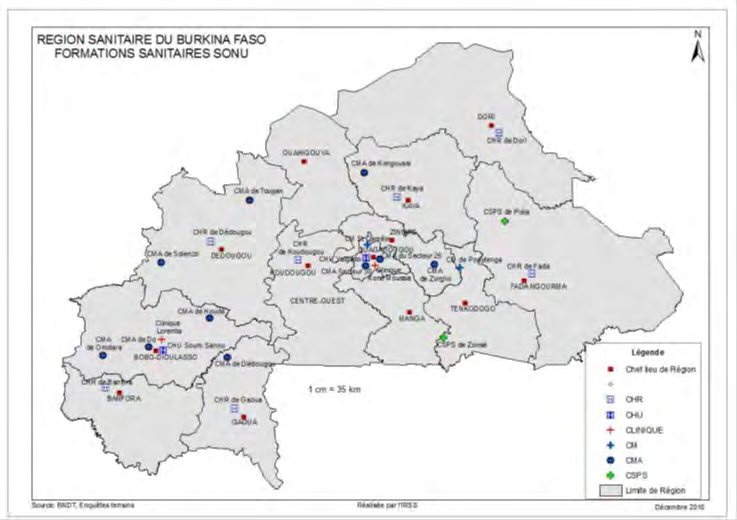
The parturient arrived by ambulance at the Regional Hospital of Dédougou (referenced SONU C), greeted by a midwife at 2:10 pm. Diara, 21, was referred from the Center for Health and Social Promotion (CSPS) in a village located 50 km from Dédougou, for not perceiving the vitality of the fetus with profuse bleeding, severe anemia in a full term pregnancy, followed coma of the patient. Her blood pressure has been 6/3 since leaving CSPS. The on-call team of a midwife, midwife and midwife reached the doctor by phone who instructed her to transfuse the patient and induce vaginal delivery. The patient had started delirious, she asked for water to drink, which does not seem to be a good sign according to the midwife. So the team made the decision to send the patient to the operating room. After receiving treatment, the blood pressure rose to 7/3 and after 30 minutes, Diara was admitted to the operating room. The baby (fresh stillborn) is extracted at 3:13 p.m. The mother is kept in intensive care for two days. On the third day, the medical team allows us to speak with her [3].
Interview with Diara
According to Diara, the bleeding started in the field in the morning while she was farming with her husband, who drove her to the village CSPS. She was greeted by a midwife who examined and looked after her throughout the morning of Day 1. Diarra was unable to give birth vaginally and lost consciousness. The caregivers tried to stop the bleeding, without success and found the fetus dead. Diara is referred to the CHR in Dédougou. Diara continued with her farm work and family chores despite her advanced state of pregnancy. This is a normal situation in rural areas. She would draw water from a good fountain, fetch dead wood, cook for the family, and cultivate her vegetable field, like any wife. Health workers find it difficult to convey to families that a woman who has reached full term should avoid heavy and arduous work.
Conclusion
This is an example describing a situation that frequently occurs in rural areas in Burkina Faso. The villages are far from the Regional Hospital Center and relatively poorly served by road networks. Evacuations of patients are often perilous due to lack of ambulance and when rural health centers take a long time to decide on a referral, the risks of death are high for pregnant women in particular.
References
-
Fatoumata O, Marc-Eric G, Fabienne R, Charlemagne O (2016) Supporting women in maternity in Burkina Faso? Anthropology and public health in a project to improve obstetric of Family Health, Ministry of Health, Burkina Faso, pp: 15.
-
UNFPA, UNICEF, IRSS (2011) Assessment of emergency neonatal obstetric care needs, coupled with the mapping of the reproductive health care offer in Burkina Faso. Burkina Faso, pp: 510.
-
ICI, UNICEF (2012) Initial situation analysis of maternal neonatal and child health (MNCH) within the framework of the MUSKOKA funds in Burkina Faso. Burkina Faso, pp: 52.
- Intersecting Epidemics and Climate Vulnerabilities in Conflict- Driven Displacement: Epidemiology, Systemic Challenges, and One Health Gaps in South Sudan
- Advancing Domestic Health Financing for Community Health System Sustainability in South Sudan: The Boma Health Initiative Model (2025–2035)
- Prevalence and Correlates of Post-Exposure Prophylaxis Uptake among Men Who Have Sex with Men in Kisumu County, Kenya
- Medical, Ethical, and Legal Conflicts Surrounding Euthanasia in Argentina. Its Global Implications
- Knowledge and Attitude on Menstrual Hygiene among Adolescent Girls Studying in Secondary Level in Public Schools of Chitwan District, Nepal
- Biological Efficacy of an Adulticide Mixture (clothianidin + deltamethrin) as an Indoor Residual Spray against Adult Anopheles flavirostris in Palawan, the Philippines