
Study of Causes Associated with Anemia among Pregnant Women Attending at El-Nuhud Teaching Hospital, West Kordufan State, Sudan-2019
Background: Anemia is a common problem in Africa, with prevalence ranging from 21.1% to 64.4%. According to WHO estimates, 56 million pregnant women were anemic in 2005, more than half of them (57.6%) would be in africa. Objectives: The main objective of this study to study prevalence of anemia among pregnant women attending at El-Nuhud Teaching Hospital, West Kordufan State, 2019. Methodology: A cross-sectional descriptive hospital based study was carried out from August to November 2019. The sample size was total coverage of all pregnant women attending at El-Nuhud Teaching Hospital, West Kordufan State. A number of 420 samples of data of structured administrated questionnaire and blood samples were collected from pregnant women. The blood samples were collected and investigated by laboratory technician by using Colorimeter to measure hemoglobin level. The data were analyzed by using Statistical Package for Social Science (SPSS), version 20 and Chi-Square test (X2) used to check difference between variables, p value less than 0.05 was considered significant. Results: The age group more than 45 years old was the most affected (100 %). This study shows that (77.4%), (69.2%) and (51.6%) anemic of pregnant women their family size (> 6 persons), (6 persons) and (< 6 persons) respectively. Pregnant women had irregular follow up during pregnancy represented 79.50% of infected pregnant women. The study revealed that folic acid and iron intake has significant effect (82.50%), (78.20%), and (44.50%) anemic of pregnant women their answer (no), (irregular) and (regular)respectively. Conclusion: The study concluded that the prevalence of anemia among pregnant women was more than half. The study recommended to implement health education programmes at all levels, use appropriate vaccinations, supplementations and vitamins during pregnancy to prevent anemia, family planning, optimum maternal and child health, and environmental Sanitation.
Introduction
Anemia is common in both developing and industrialized nations. It affects about two billion people worldwide, i.e 30% of the inhabitants of the planet, according to data from the World Health Organization (WHO). Hence it is considered a public health problem. It greatly affects a person’s life, especially in its more severe forms. Anemia cause tiredness, weakness, malaise, and making routine tasks more difficult and painful. Anemia is a common problem in Africa, with prevalence ranging from 21.1% to 64.4%. It has significant impact on morbidity and mortality. The affected person may be drowsy, with less resistance to physical activities and deterioration in cognitive function and immunity [1].
Anemia defined as low blood hemoglobin concentration has shown to be public health problem that affects low, middle and high income countries and has significant adverse impacts on social and economic development [2].
Globally anemia affects 32.4 million (38.4%) of pregnant women it is major public health problem in South Asia (48.7%) and Africa (46.3%) [3].
Pregnant woman’s anemia is a critical issue of public health due to its frequency, multifactorial nature and impact on pregnancy evolution. According to WHO estimates, 56 million pregnant women were anemic in 2005, more than half of them (57.1%) would be in Africa .It contributes to the 20% of maternal deaths related to indirect causes [4]. Anemia of pregnancy an important risk factor for fetal and maternal morbidity is considered a global health problem affecting almost 50% of pregnant women [5]. In Africa the prevalence rate of anemia among antenatal women range from 35% to 72% while in Asia 37% to 75% [6]. Anemia is a global public health problem, but is more prevalent in pregnant women and young as stated by WHO [2]. Anemia among pregnant women worldwide was 38% and Sudan among countries considered with a moderate type of anemia during pregnancy [7].
In a cross – sectional study was conducted among pregnant women in Erbil city. The result of the study was showed the prevalence of manemia among pregnant women 46.2% [8]. In India anemia is the second most common cause and accounting for 20% of total maternal, the prevalence of anemia ranges from 33% to 89% among pregnant women and is more than women from 60% among adolescent girls with wide variations in different regions of countries [9]. In fact over 20% of pregnant women in Europe are anemic during pregnancy [10]. The United Kingdom prevalence of maternal anemia in the antenatal period was estimated as 24 % in a recent cross sectional study [11].
Justifications and Problem State
Anemia is most common medical disorder in pregnancy and postpartum period [12]. Anemia in pregnancy is an important health issue resulting in high maternal morbidity and mortality [13]. The World Health Organization (WHO) has estimated that prevalence of anemia in pregnant women was found 14% in developed, 50% in developing countries and 60-75% in India Sahoo, et al. This study conducted among pregnant women attending at ElNuhud Teaching Hospital -West Kordufan State in Sudan to determine the most affected age group with anemia the daily frequency of pregnant women who attending hospital about (10- 15) pregnant women and monthly about (300-450) pregnant women (El-Nuhud Teaching Hospital, 2018). Prevalence of anemia in females was higher in most regions and age groups South Asia and Central, West and East Sub-Saharan Africa had the highest burden, while East, Southeast and South Asia saw the greatest reduction [14].
Study of pregnant Sudanese women attended delivery in River Nile State Sudan the study revealed that (64.3%) of study population were anemic. Study carried out in Ethiopia among pregnant women revealed that (34.6%) were anemic [15]. Surveys in different parts of India indicate that about 50-60% of women belonging to low socio-economic group are anemic in last trimester of pregnancy [16].
• Objective To investigate the causes associated with anemia among pregnant women attending at El Nuhud Teaching Hospital, West Kordufan State, Sudan-2019
Material and Method
- Study Design: A descriptive cross sectional hospital based study. Study area: El-Nuhud Teaching Hospital, West Kordufan State, Sudan.Sample size: The sample size was determined by total coverage of pregnant women attending at El-Nuhud Teaching Hospital –West Kordufan State during three months (August - November 2019) to obtained 420 pregnant.
- Location: Study conducted at El-Nuhud Teaching Hospital, West Kordufan State - Sudan, 2019. El-Nuhud locality located between latitude 9.25-16.3o North and latitude 27-32o East it surrounded by many areas in the East Alkhewi locality and Abuzabad locality, in the West Wadbanda locality and in the South South Kordufan State West Kordufan University.
- Building: El-Nuhud Teaching Hospital building were from stable material such as bricks and stone.
- Health Services: Regarding to health services there are
2governmental hospitals, 6 health centers, 12 private dispensaries and 8 private clinic El-Nuhud locality. • Education Services: Education services in El-Nuhud locality include basic; higher secondary schools and universities; 194 basic, 15 higher secondary schools and two universities.
• Study Population: All pregnant women attending at El-Nuhud Teaching Hospital that fulfill the inclusion criteria during the data collection period was considered as study participants. The number population (327051) persons in El-Nuhud locality, (192961) of them as women, (78819) as age reproductive women and (13115) as pregnant women [17].
1.1. Methodology: Data collected using following tools:
- Questionnaire: In the form of administrated questionnaire filled by pregnant women attending at El-Nuhud Teaching Hospital, West Kordufan State. The questionnaire includes the following variables: Socio-demographic factors (age, educational status, her husband education, her occupation, her husband occupation, family size, Gestation period and income).
- Laboratory Investigation: Hemoglobin level determined using Colorimeter hemoglobin and all laboratory investigations were done by technician’s laboratory. Pregnant women was considered anemic when her hemoglobin less than 11gm/dl according (WHO).
- Data Analysis: Data entered and analyzed by using computer-based operation practically (Statistic Package for Social Science) version 20 and Chi - Square test (x2 ) was used to check the differences between variables. The (P.value) less than 0.05 considered significant.
• Ethnical Consideration: Permission was taken from the pregnant women with her full consent and permission was obtained from the Ministry of Health, West Kordufan State, also permission was taken from the Hospital Medical Manger as well as an ethnical approval from the Department of Epidemiology, Faculty of Public and Environmental Health, University of Khartoum.
Results
A cross-sectional descriptive hospital study was conducted at ElNuhud Teaching Hospital, West Kordufan State, with an objective to study the prevalence of anemia among pregnant women (420). The study showed the following findings as explained in the figures and tables below.
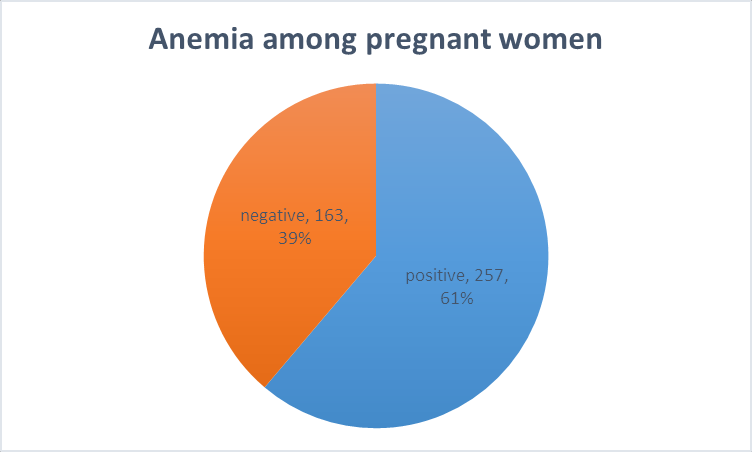
Figure 1 the proportion of anemia among pregnant anemia attending at El-Nuhud Teaching Hospital, West Kordufan State, 2019(n= 420). Figure 1: shows the proportion of anemia among pregnant women 61%.
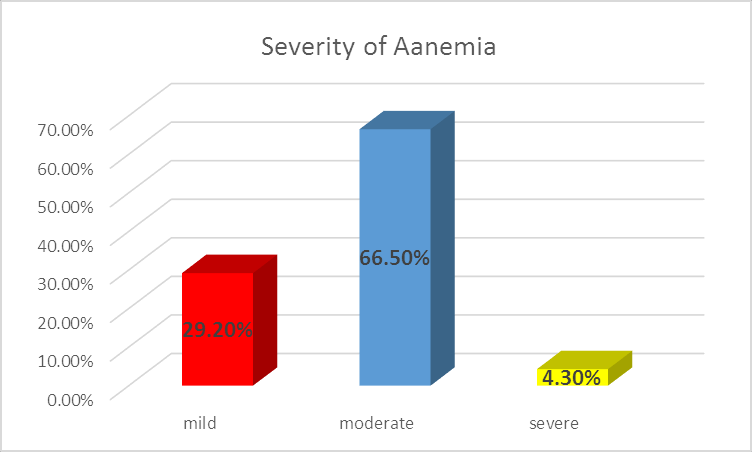
Severity of anemia among pregnant women (66.5%) moderate, (29.2%) mild and (4.3%) severe. (n=257) Figure 2: Severity of anemia among pregnant women at El-Nuhud Teaching Hospital, West Kordufan State, 2019.
| Anemia age group | Positive | Negative | Total | |||
|---|---|---|---|---|---|---|
| N | % | N | % | N | % | |
| Less than 18 years | 23 | 49 | 24 | 51 | 47 | 11 |
| 18-31years | 142 | 55 | 117 | 45 | 259 | 62 |
| 32-45years | 88 | 80 | 22 | 20 | 110 | 26 |
| more than 45 years | 4 | 100 | 0 | 0 | 4 | 0.9 |
| Total | 257 | 61 | 163 | 39 | 420 | 100 |
Table 1: Age group among pregnant women in relation to anemia at El-Nuhud Teaching Hospital, West Kordufan State, 2019 (n= 420).
X2 = 26.314 P= 0.000 Table 1: Age group among pregnant women in relation to anemia at El-Nuhud Teaching Hospital, West Kordufan State, 2019 (n= 420).
Table 1 shows high affected age group more than 45years old (100%) followed by 32-45years old (80%), 18-31years old (54.8%) and less than 18 years old (48.9%).
This significant relation between age group and anemia among pregnant women, (p value = 0.000).
| Anemia Family Size | Positive | Negative | Total | |||
|---|---|---|---|---|---|---|
| N | % | N | % | N | % | |
| < 6 persons | 22 | 52 | 114 | 48 | 236 | 56 |
| 6 persons | 63 | 69 | 28 | 31 | 91 | 22 |
| > 6 persons | 72 | 77 | 21 | 23 | 93 | 22 |
| Total | 257 | 61 | 163 | 39 | 420 | 100 |
Table 2: Family size among pregnant women in relation to anemia at El-Nuhud Teaching Hospital, West Kordufan State, 2019 (n = 420
X2 = 21.752 p= 0.000 Table 2: Family size among pregnant women in relation to anemia at El-Nuhud Teaching Hospital, West Kordufan State, 2019 (n = 420).
Table 2 shows high affected in more than 6 persons (77.4%) followed by 6 persons (69.2%) and less than 6 persons (51.6%).This significant relation between family size and anemia among pregnant women, (p value = 0.000).
Discussion
This a cross-sectional descriptive hospital based study was conducted at El-Nuhud Teaching, West Kordufan State with an objective to study the prevalence of anemia among pregnant women in period (August- November) 2019.
The proportion of anemia among pregnant women (61%) this lower than that what had been revealed by Khan NAM, et al. [18] showed the prevalence of anemia was (84.85%) of pregnant women in the rural population of Mudkhed, Maharashtra, this also lower than what had been revealed by Shwetha, et al. [19] showed the prevalence of anemia among pregnant women in Bangaluru, India was (68.6%), this higher than what had been found by Abreha A, et al. [20] showed the prevalence of anemia was (19.7%) among pregnant women in Mekelle, Ethiopia, also higher than what had been carried out by Alene KA, et al. [21]
they showed the prevalence of anemia was (56.8%) among pregnant women in Gode town, Eastern Ethiopia, also higher than what had been revealed by Alem M, et al. [22] showed overall prevalence was (21.6%) among pregnant women in Azezo health center, Gonder town, Northwest Ethiopia, also higher than what had been revealed by Bekele A, et al. [23] showed overall prevalence of anemia was (32.8%) among pregnant women in Arba Minch, Ethiopia, also higher than what had been revealed by Lebso M, et al. [24] they showed overall prevalence of anemia was (23.2%) among pregnant women in Lemo District, Southern Ethiopia, also higher than what had been revealed by Jufar AH [25].
they showed the prevalence of anemia among pregnant women attending at Tikur Anbessa Specialized Hospital, Addis Ababa, Ethiopia was (21.3%), also higher than what had been showed by Zekarias, et al. 2017 they showed the prevalence of anemia among pregnant women attending at Antenatal Care department of Mizan Tepi University Teaching Hospital, South West Ethiopia was (23.5%), also higher than what had been revealed by Fassil R [26] showed the prevalence of anemia was (16.3%) of pregnant women attending Antenatal Care at Selam Health Center, Addis
Ababa, Ethiopia, also higher than what had been revealed by Nwizu EN, et al. [27] showed the prevalence of anemia was (17%) among pregnant women attending Antenatal Care for the first time at Aminu Kano Teaching Hospital, Kano, Nigeria. And this also higher than what had been revealed by Selim NAA, et al. [28] showed the prevalence of anemia was (27.1%) among Arab pregnant women in Qatar.
The most affected age group with anemia among pregnant women was more than 45 years old (100%) this dissimilar what had been indicated by Opitasari C, et al. [29] in their study of anemia among pregnant women in a governmental hospital and a private hospital in Jakarta, Indonesia revealed those with aged 16- 20 years had 56% higher risk to be anemic and also this similar what had been revealed by Shwetha, et al. [19] in their study of anemia among pregnant women in Bangaluru, India the most anemic age group were 21-35 years old. This shows that (100%), (80%), (54.8%) and (48.9%) anemic of pregnant women in their age group (more than 45), (32-45years old), (18-31years old) and (less than 18 years) respectively, a significant relation between anemia among pregnant women and age (p value = 0.000) and this similar with study of Jufar AH, et al. [25] showed that significant associated between anemia and age group 39-45 years old (p value = 0.033) and also similar with study of Khan NAM, et al. [18] showed that sociodemographic like age, education of women, socioeconomic class, gravid status and gestation period were found to be significantly associated with anemia in pregnancy.
This study shows that (77.4%), (69.2%) and (51.6%) anemic of pregnant women their family size (> 6 persons), (6 persons) and (< 6 persons) respectively, a significant associated between family size and anemia among pregnant women (p value = 0.000) and this similar with study of Bekele A, et al. [23] revealed that had statistically significant association with family size and in pregnancy
Conclusions
This a cross- sectional descriptive hospital based study was conducted with an objective to study prevalence of anemia among pregnant women attending at El-Nuhud Teaching Hospital, West Kordufan State, 2019. The prevalence among pregnant women (61%). The most affected age group was more than 45years old (100%). The more causes associated with anemia among pregnant women were age group, family size, latrine inside house, pregnant women’s educational level, her husband educational level, pregnant women’s job, gestation period, parity, stillbirth history, abortion history, complication during pregnancy, problem health, meals per day poultry eggs intake, fruits and vegetables intake, follow up during pregnancy and folic acid and iron intake during pregnancy.
The Study Recommended To
Implementation of health education programmes at all levels, especially nutritional education to change dietary habits and feeding practices.
- Provision adequate of quality and quantity of nutrients and food during pregnancy
- Encourage family planning
- Provision universal, perfect, affordable and accessible antenatal care services.
References
-
Omer R, Ahmed B (2015) Determination of iron deficiency anemia in infants in Ahmed Gasim Hospital, Khartoum North (KN), Sudan in the Period from January to June 2011. International Journal of Innovative Research in Science Engineering and Technology (4)9: 1-4.
-
WHO (2015) The global prevalence of anemia in 2011.
-
Tadesse SE, Seid O, Mariam YG, Fekado A, Wasihum Y, et al. (2017) Determinants of anemia among pregnant women attending Antenatal Care in Dessie Town health facilities, Northern Central Ethiopia, unmatched case, control study. PLOS ONE 12(3): e0173173
-
Salifou K, Obossou AAA, Sidi IR, Hounkpatin Bib, Hounkponou ANF, et al. (2015) Factors associated with anemia in pregnant women in 2014 in Parakou. Journal of Pregnancy Child Health 2: 174.
-
Maureen M, Achebe, Gvili AG (2017) How I treat anemia in pregnancy: Iron, cobalamin and folate. American Society of Hematology 129 (8): 940-949.
-
Kumari P, Rani M, Saini N, Aparna (2017) Prevalence of anemia among pregnant mothers admitted for delivery at Distinct Hospital Ambala, Haryana: An Observational Study. International Journal of Pharmaceutical Science Review and Research 47(1): 27-30.
-
ALamain AA, Taha FAN (2016) Incidence and causes of anemia during pregnancy in Antenatal Words in KhartoumUniversity Hospitals. The Journal of Middle East and North Africa Sciences 2(12).
-
Abdulwahid RG, Ahmed HM (2017) Prevalence and severity of anemia among pregnant women in Primary Health Centers/Erbil City. Kurdistan Journal of Applied Research 2(2).
-
Rajamouli J, Ravinder A, Reddy SCK, Sujatha P (2016) Study on prevalence of anemia among pregnant women, attending antenatal clinic at rural health training Centre (RHTC) and chalmeda and Rao Institute of Medical Sciences Teaching Hospital karimnagar, Telangana, India. International Journal of Contemporary Medical Research 3(8): 2388-2391.
-
Colman C, Pavord S (2017) Oxford University Hospital NHS Foundation, OUH.
-
Rukuni R, Knight M, Murphy MF, Roberts D, Stanworth SJ (2015) Screening for Iron deficiency and Iron deficiency in pregnancy: a structured review and gab analysis against UK national screening criteria. BMC Pregnancy and Childbirth 15: 269.
-
Elnazir FA (2015) Incidence and factors of anemia among women attending delivery in River Nile State Sudan M.Sc degree Faculty of Nursing at Al-Ribat University.
-
Anlaakuu P, Anto F (2017) Anemia in pregnancy and associated factors: a cross sectional study of antenatal attendants at the Sunyani Municipal Hospital, Ghana. BMC Res Notes 10: 402.
-
Namazi A (2018) Anemia and iron supplement in pregnancy: A Mini review. JOJ Nursing & Health Care. 7(3): 1-3.
-
Nega D, Dana D, Tera T, Eshetu T (2015) Anemia associated with asymptomatic malaria among pregnant women in rural surroundings of Arba Minch, South Ethiopia. BMC Research Notes 8:110.
-
Park JE (2015) Preventive and social medicine. In: 23rd (Edn.), M/S Banaridas Bhanot Publishers pp: 642.
-
(2019) Ministry of health. West Kordufan State Records.
-
Khan NAM, Sonkar VRK, Domple VK, Inamdar SA (2017) Study of anemia and its associated risk factors among pregnant women in a Rural Field Practice Area of a Medical College. National Journal of Community Medicine 8(7): 396-400.
-
Shwetha and Prasad KN (2018) Prevalence of anemia among pregnant women a cross-sectional study. International journal medical science and public health 12.
-
Abreha A, Melkie EY, Molla MW (2014) Prevalence and associated factors of anemia among pregnant women in Mekelle town: A cross sectional study. BMC Research Notes 7: 888.
-
Alene KA, Dohe AM (2014) Prevalence of Anemia and associated factors among pregnant women in an Urban Area of Eastern Ethiopia. Hindawi pp: 7.
-
Alem M, Enawgaw B, Gelaw A, Kena T, Seid M, et al. (2013) Prevalence of anemia and associated risk factors among pregnant women attending antenatal care in Azezo Health Center Gondar town- Northwest Ethiopia. Journal Interdiscipl Histopathol 1(3): 137-144.
-
Bekele A, Tilahun M, Mekuria (2016) Prevalence of anemia and its associated factors among pregnant women attending Antenatal Care in Health Institutions of Arba Minch Town, Gamo Gofa Zone, Ethiopia- A cross- sectional study. Hindawi.
-
Lebso M, Anato A, Loha E (2017) Prevalence of anemia and associated factors among pregnant women in Southern Ethiopia: A community based cross-sectional Study. PLOS ONE 12(12): e0188783.
-
Jufar AH, Zewde T (2014) Prevalence of anemia among pregnant women attending Antenatal Care at Tikur Anbessa Specialized Hospital-Addis Ababa Ethiopia. Journal Hematology Thromboembolic Disease 2.
-
Fassil R (2016) Prevalence of anemia among pregnant women attending Antenatal Care at Selam Health Center, Addis Ababa, Ethiopia. Master Science degree in Biology.
-
Nwizu EN, Iliyasu Z, Ibrahim SA, Galadanci HS (2011) Sociodemographic and maternal factors in anemia in pregnancy at booking in Kano, Northern Nigeria 15(4): 33-41.
-
Selim NAA, Al-Mass M, Al-Kuwari M, Ismail M (2016) Assessment of anemia, IDA and ID among pregnant in Qatar: Cross sectional survey. SM Journal of Public Health and Epidemiolog 2(3): 1035.
-
Opitasari C, Andayasari L (2015) Young mothers, parity and the risks of anemia in the third trimester of pregnancy - Health Science Journal of Indenosia 6(1).
- Measuring What Matters: Data Gaps, Certificate of Need Reform, and Pediatric Psychiatric Inpatient Capacity in North Carolina
- Intersecting Epidemics and Climate Vulnerabilities in Conflict- Driven Displacement: Epidemiology, Systemic Challenges, and One Health Gaps in South Sudan
- Advancing Domestic Health Financing for Community Health System Sustainability in South Sudan: The Boma Health Initiative Model (2025–2035)
- Prevalence and Correlates of Post-Exposure Prophylaxis Uptake among Men Who Have Sex with Men in Kisumu County, Kenya
- Medical, Ethical, and Legal Conflicts Surrounding Euthanasia in Argentina. Its Global Implications
- Knowledge and Attitude on Menstrual Hygiene among Adolescent Girls Studying in Secondary Level in Public Schools of Chitwan District, Nepal