
Gender Differences in Mathematics Achievement among Learners in Chipinge Secondary Schools, Zimbabwe
This study sought to determine achievement differences in Mathematics performance by gender in Chipinge rural secondary schools. Data was collected through Mathematics Achievement tests in form 1 pupils at 10 secondary schools. A sample size of 180 learners from Chipinge rural schools participated in the study. The tests were administered to 93 male learners’ and 87 female learners. Participants were selected using stratified random sampling technique. Results from this study show that there is no significant difference between male and female performance in their Grade 7 results in Mathematics achievement. A significant difference was noted in the mathematics performance of girls and boys as they progressed to secondary school in form 1, with girls performing better than boys. Results also show that there is a moderate positive correlation (r=0.303) between male learners’ performance in Mathematics achievement and their Grade 7 results). In females, results indicated a negative correlation between female learners’ Mathematics performance and their grade 7 results (r= -0.02). The presence of the correlation implied that there existed a relationship between the students’ Mathematics performance as well as their Grade 7 results. More research has to be done on the results of correlation in both male and female learners in their performance and their Grade 7 results. There is need for qualitative research to assist with the reasons for the negative correlation.
Introduction
Gender differences are becoming the main topic in the educational sector. Of particular interest are the gender differences in Mathematics achievement. Gender plays a prominent role in Mathematics achievement and it is an important variable in teaching and learning. In a competitive world like the one we are living in today, academic achievement is becoming an important part of students’ future as well as an important goal in the process of education. Academic performance with regard to gender has raised eyebrows in educational testing over the years. A number of studies have been carried and have shown significant gender differences in school performance. The differences in academic achievement between boys and girls are likely to contribute to differences in allocating cognitive roles in the world of work, Oppong-Sekyere, Oppong-Sekyere, & Akpalu [1], Karthigeyan & Nirmala, [2]. As maintained by Abdullahi & Bichi [3], numerous studies have shown that gender has an effect on students’ Mathematics achievement.
Younger, Warrington & Williams cited by Abdullahi & Bichi [3] focused on gender disparities in secondary schools for Mathematics. They based their analysis on girls’ and boys’ performance in GCSE examinations in the United Kingdom. Results showed that girls performed better than boys. This was explained by boys’ disregard for school work, authority, achievement, attitudes to work differences and their goals and aspirations and girls’ more effective learning strategies as well as increased maturity. Ching cited in Karthigeyan & Nirmala [2] studied academic achievement of secondary school students in relation to school level and gender. The study revealed that there indeed were significant differences in gender in students’ academic performance showing how girls performed better than boys. Begum& Phukan [4] conducted a study in India to examine the relationship between school performance and intelligence in male and female students. The findings suggested a correlation between academic achievement and students’ intelligence with a greater correlation in girls than boys. Ali, Awan, Batool & Muhammad [5] explored the Middle Eastern secondary school students’ relationship of test anxiety with their achievement in Mathematics. Findings indicated a negative correlation of test anxiety with students’ achievement in Mathematics and concluded that female had higher test anxiety than male students.
Karthigeyan & Nirmala [2] examined gender differences in Mathematics achievement of 10th grade class students in Salem and Sankari educational districts of Tamil Nadu. The findings revealed that for the past five years Mathematics achievement of the students was average, further analysis on the basis of various demographic variables revealed that the mean score for girls was higher as compared to the boys in their Mathematics achievement. In both the educational districts girls showed higher academic performance in Mathematics than boys. Abdullahi & Bichi [3] assessed the academic achievement of secondary school students in Mathematics in a district and tried to find out whether gender differences in Mathematics performance exist among senior secondary school students in Kano State, Nigeria. The analysis which was based on the location of schools uncovered that statistically, there was considerable gender difference in the students’ Mathematics achievement. Based on the findings of their study, it turns out that the academic achievement of students it is little below average as measured by the mean scores of the students in their academic performance in Mathematics [3].
In Zimbabwe, Gasva and Moyo [6] inquired the influence of gender on academic performance at grade 6 levels with special reference to Mathematics in Hwange district. Findings revealed that gender has an influence on Mathematics and Mathematics performance at primary school level. It also noted that the differential gender socialization of boys and girls was the most important factor that influenced their behavior and had a direct bearing on their Mathematics and Mathematics performance. Gender differences in Mathematics achievement is still a relevant topic to be researched since there is a shift from the traditional belief that boys perform better in Mathematics than girls and there is therefore need to further look at the reasons for the change and carry out more comparative studies to support the view. Some research has been done on this topic in primary schools, however, the aim is to focus more on secondary schools. In addition to that, numerous studies are focused on gender differences in other science subjects with little research being focused on Mathematics achievement.
Considering Mathematics as one of the core subjects that is taught in Zimbabwe and in light of the literature, coupled with students’ performance in Mathematics, researchers are concerned on the public view that Mathematics is purely a male domain and that males perform better than their female counterparts in Mathematics. The study sought to investigate students’ academic achievement in Mathematics as was measured by their test scores from various rural secondary schools in Chipinge district placing more emphasis on gender as a factor.
Several studies at a global level have shown that girls outperform boys in English language and boys do better in Mathematics. However contradictory findings by Nkoma, Zirima and Chimunhu [7] revealed that girls outperformed boys in Mathematics at primary school level. There have been however few studies in gender differences in Mathematics achievement at secondary school level known to the researcher in Zimbabwe particularly in rural schools. Therefore this study compared students’ achievement in Mathematics paying more attention on the gender factor.
Purpose of the Study
The purpose of this study was to determine achievement differences in Mathematics by gender specifically in Chipinge rural secondary schools. This study seeks to fill the mentioned gap of gender differences by addressing the following objectives:
- Determine gender differences in Mathematics achievement in rural secondary schools.
- Determine gender differences in Grade 7 results in rural secondary schools.
- Determine if there is any relationship between male and female Mathematics performance and their Grade 7 results.
- Recommend ways of ensuring both sexes perform equally on the standardized tests in Mathematics achievement.
Hypothesis
- There are no significant differences between male and female learners performance in Mathematics achievement.
- There are no significant differences in male and female learners’ grade 7 results.
- There is no relationship between male learners’ performance and their grade 7 results.
- There is no relationship between female learners’ performance and their grade 7 results.
Research Methodology
This research took a quantitative orientation with specific use of the Quasi- experimental design. The population of the study comprised of secondary school learners from Chipinge district. The total number of participants in the study was 180 with 93 males and 87 females. According to the Schools Psychological Services Manicaland report of July 2015 on Chipinge district, the approximate population of learners from Chipinge rural secondary schools is 1763.
A total of 10 schools were selected for the study using stratified random sampling. This was done through dividing the strata into educational levels classified as the high, average and below average performing schools. These categories were randomly sampled such that the categories ended up as a mini representation of the population. By stratification, the schools were divided into uniform subgroups. The students were also selected randomly by dividing the strata into gender which was classified as males and females. Like in the selection of schools, the students were divided into homogenous subgroups as per their Grade 7 results. In the classrooms, students were selected by defining the population in each classroom that is clearly defining students who performed above average, the average as well as the below average students excluding those that did not meet the requirements. Thereafter, a sample size was chosen in this case 18 students from the 10 schools which reflected the limit of our budget that is the amount of time needed to carry out the test.
Data Collection Instruments
The Wide Range Achievement Test Revised (WRAT-R) Mathematics achievement subtest was used. For secondary schools, L2 is used and it is normed for children aged 12 through adults aged 94. Split half reliability was checked for the test and the Cronbach’s alpha on this instrument was 0.869 and 0.922 whilst the Guttman split half coefficient was 0.751. Based on these coefficients, the internal consistency was reasonably high and showed good levels of internal consistency [8]. This test is mostly used by Schools Psychological Services personnel in Zimbabwe for screening out students. Nkoma, Zirima and Chimunhu (2013) say that the test can be used for group testing, which is convenient for the large sample size.
Research Procedure
Permission was sought from the Provincial Education Ministry officials to conduct the study. At the schools, the researcher first sought permission from the District Education Officer. Provincial Psychological Services officials assisted in administering the tests. The Mathematics Achievement tests were administered to the students in a classroom set- up. 18 students were allocated a class at each school and they sat individually with supervision from one Provincial Psychological Services official as well as the researcher. The test lasted 30 minutes. Because of the long distances that were travelled, respondents were asked to complete the tests while the researcher waited to collect them.
Data Analysis and Interpretation
Data was analyzed using the Statistical Package for Social Science (SPSS Version 16) and Strata version 11.0. The sample size was large enough for inferential statistics. To test for differences, the t- test for independent samples was used. Analysis relied on raw scores and results were translated to Form equivalence for purposes of interpretation.
Results and Discussion
Results from this study show that there is no significant difference between male and female performance in their Grade 7 results as well as in Mathematics achievement. There were however slight differences between boys and girls at form one level where girls slightly outperformed boys. This result is in agreement with Santos, Ursini, Ramirez and Sanchez [9]’s study on sex differences in Mathematics achievement. Their results show that when sex is considered, no significant differences in students’ mathematics achievement are detected. Results from this study also show a complementary relationship in both male and female learners’ performance in Mathematics achievement and their Grade 7 results which disconfirms the study by Uzoamaka and Ajiwoju [10] which concludes that gender affects Mathematics performance.
Learners Performance in Mathematics
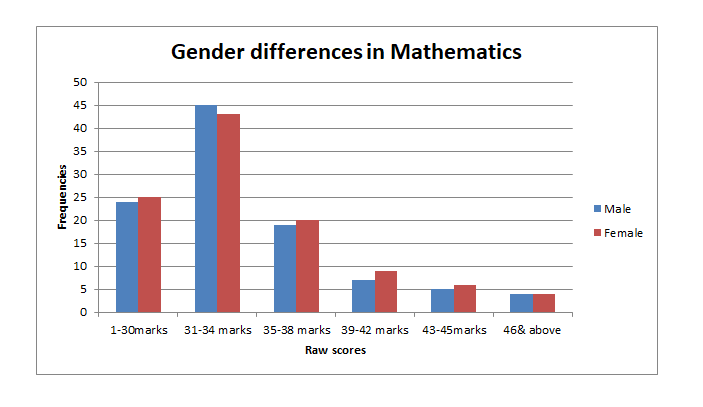
The table shows the frequencies of both male and female form 1 learners’ performance in Mathematics achievement.
Results from the table indicate that most male and female students are achieving at grade three/four levels entailing that they are performing 5/6 grades below their current form placement which is form one. However, in terms of the raw marks, females slightly outperformed males in mathematics achievement.
| Frequencies | |||
|---|---|---|---|
| Male | Female | ||
| 1-30marks | Below 3 | 24 | 25 |
| 31-34 marks | 3B, 3E | 45 | 38 |
| 35-38 marks | 4B,4E | 19 | 16 |
| 39-42 marks | 5B,5E | 4 | 7 |
| 43-45marks | 6B,6E | 1 | 1 |
| 46& above | 7 and above | 1 | 1 |
Table 1: Differences between males and females in Mathematics achievement performance.
- Hypothesis 1: There are no significant differences between male and female learners performance in Mathematics achievement
- Sex
- Sample Size
- Mean
- Std. Deviation t-value d.f.
- Male
- 93
- 2.05
- 0.861
- 0.713
- 178
- Female
- 87
- 2.09
- 0.948
Table 2: Differences between males and females in Mathematics achievement performance.
Results from the table show that females have a higher mean score than males (F= 2.09; M=2.05). Abdullahi and Bichi [3] agree in their study which showed that females had a higher mean score compared to males in their academic achievement in Mathematics. This gave an indication that the females performed better than males in Mathematics. Whitney [11] in her study also revealed from findings that female students outperformed male students in almost all indices of achievement.
The results also show that females have a higher standard deviation implying the numbers are spread out from the mean unlike for males who have a lower standard deviation showing that most of the numbers are very close to the mean (F=0.948; M=0.861). The number of participants N in each condition is 87 and 93 respectively. The critical value is 0.05. It tells us if the two condition means are statistically different with the value at 0.05. At most times this value is referred to as the p value and in this research, the Sig. (2- tailed) value is 0.713. From the results, the value 0.713 is greater than the critical value 0.05 implying that there are no significant differences between male and female learners’ performance. The researchers therefore accept the null hypothesis and conclude that there are no significant differences between male and female learners performance in Mathematics achievement in selected Chipinge rural secondary schools.
The results also concurs with Santos, et al [9]’s study on gender differences in Mathematics achievement with which their results show that when sex is considered, no significant differences in students’ mathematics achievement are detected.
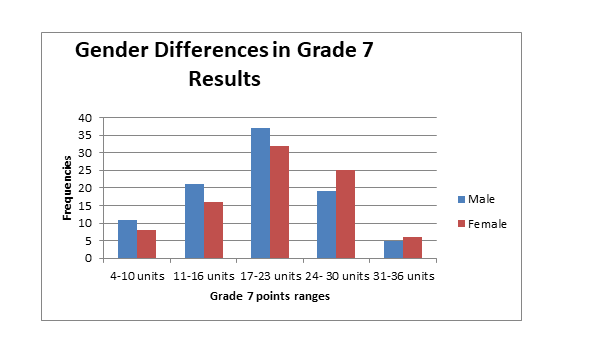
The chart shows the frequencies of both male and female learners’ Grade 7 results. Male results were better at the 4-10 units, 11-16units and 17-23units while females had higher results at 24-30units and 31-36 units. The highest frequencies for both boys and girls were at the 17-23 unit range indicating under achievement for both male and female students.
Hypothesis 2: There are no significant differences in male and female learners’ grade 7 results.
- Sex
- Sample Size
- Mean
- Std. Deviation t-value d.f.
- Male
- 93
- 2.87
- 1.054
- 0.219
- 178
- Female
- 87
- 3.06
- 1.060
Table 3: Differences between males and females Grade 7 results.
From the table, females have a higher mean score than males (F= 3.06; M=2.87). Females have a higher standard deviation implying the numbers are spread out from the mean unlike for males who have a lower standard deviation showing that most of the numbers are very close to the mean (F= 1.060; M=1.054). The number of participants N in each condition is 87and 93 respectively. The critical value is
0.05. In this research, the Sig. (2- tailed) value is 0.219. The value 0.219 is greater than the critical value 0.05 implying that there are no significant differences between male and female learners’ Grade 7 results. The researcher therefore accept the null hypothesis and concludes that there are no significant differences between male and female learners’ Grade 7 results in selected Chipinge rural secondary schools.
| Mathematics Score | Male | Female | Grade 7 results range of scores | Male | Female |
|---|---|---|---|---|---|
| 1-30marks | 24 | 25 | 4-10 units | 11 | 8 |
| 31-34 marks | 45 | 43 | 11- 16 units | 21 | 16 |
| 35-38 marks | 19 | 20 | 17-23 units | 37 | 32 |
| 39-42 marks | 7 | 9 | 24- 30 units | 19 | 25 |
| 43-45marks | 5 | 6 | 31-36 units | 5 | 6 |
| 46& above | 4 | 4 | 0 | 0 | 0 |
Table 4: Relationship between Mathematics Performance and Grade 7 Results for Males and Females.
The frequency table show that the students did not perform well in their Mathematics achievement. It also shows that males performed better in their Grade 7 results. In achievement females out-performed their male counterparts in the 39-42 mark range while males outperformed females at grade 7 in the 4-10 unit range. Generally the frequencies in both male and females in achievement and grade 7 results are depressed.
Hypothesis 3: There is no relationship between male learners’ performance and their Grade 7 results.
| Male Learners Performance (X) | Male Learners Grade 7 results (Y) | XY | X2 | Y2 | R |
|---|---|---|---|---|---|
| 24 | 11 | 264 | 576 | 121 | 0.303 |
| 45 | 21 | 945 | 2025 | 441 | |
| 19 | 37 | 703 | 361 | 1369 | |
| 4 | 19 | 76 | 16 | 361 | |
| 1 | 5 | 5 | 1 | 25 | |
| X=93 | ∑Y= 93 | ∑XY=1993 | ∑X2=2979 | ∑Y2=2317 |
Table 5: Relationship between male learners’ Mathematics achievement and their Grade 7 results using Pearson product moment corre
not significant Table 4: Relationship between male learners’ Mathematics achievement and their Grade 7 results using Pearson product moment correlation (r).
The Pearson product moment correlation was used to determine the relationship between male learners’ performance in Mathematics achievement and their grade 7 results. Using the Formula:
r = n (∑XY) - (∑X) (∑Y)
√ [n ∑X2- (∑X) 2] [n∑Y2- (∑Y) 2
The Pearson correlation coefficient r= 0.303 and it is statistically significant p= 0.05. There was a moderate positive correlation between male learners’ performance in Mathematics achievement and their Grade 7 results which was not statistically significant (r_=0.303, n=93, p=0.05)._ The researcher therefore rejects the null hypothesis that there is no relationship between male performance in Mathematics and their Grade 7 results since there is a moderate positive relationship.
Hypothesis 4: There is no relationship between female learners’ performance and their Grade 7 results.
The Pearson product moment correlation was used to determine the relationship between female learners’ performance in Mathematics and their grade 7 results. The Pearson correlation coefficient r= -0.02 and it is not significant p= 0.05. There was a negative correlation between male learners’ performance in Mathematics achievement and their Grade 7 results which was not statistically significant (r_=-0.02, n=87, p=0.05)._ The negative correlation means an inverse relationship between Mathematics and grade 7 results. The researchers therefore accept the null hypothesis that there is no relationship between female performance in Mathematics and their Grade 7 results.
| Female Learners Performance (X) | Female Learners Grade 7 results (Y) | XY | X2 | Y2 | R |
|---|---|---|---|---|---|
| 25 | 8 | 200 | 625 | 64 | -0.019 |
| 38 | 16 | 608 | 1444 | 256 | |
| 16 | 32 | 512 | 256 | 1024 | |
| 7 | 25 | 175 | 49 | 625 | |
| 1 | 6 | 6 | 1 | 36 | |
| X=87 | ∑Y= 87 | ∑XY=1501 | ∑X2=2375 | ∑Y2=2005 |
Table 6: Relationship between female learners’ Mathematics achievement and Grade 7 results using Pearson product moment correlati
not significant Table 5: Relationship between female learners’ Mathematics achievement and Grade 7 results using Pearson product moment correlation (r).
Conclusion
There were no significant differences between male and female learners’ performance in Mathematics achievement and there were no significant differences between male and female Grade 7 results. Generally girls slightly outperform boys in mathematics at form one level which is the first level of secondary school. Mathematics performance was generally depressed for both boys and girls and this could be a result of a shortage of mathematics teachers which is so prevalent in Zimbabwean schools particularly rural schools. The standard deviations are low. Such low standard deviations imply that there are no variations in the students’ performance in Mathematics achievement; hence no differences exist in terms of gender. There existed a moderate positive correlation between male learners’ performance and their Grade 7 results, meaning that the male students’ achievement performance was affected by the students’ grade 7 results. For females, there was a negative correlation between their achievement performance and their grade 7 results.
Recommendations
Research indicates that there are no gender differences in Mathematics achievement in Chipinge rural secondary schools with the marks of the students being very low. There is need to cover up the performance gap so that achievement is raised.
- The national policy makers need to keep track of the educational policies that have been put in place to help students achieve better in their Mathematics achievement. They should also give a detail of what they expect the students to know by the end of each year to the schools so that they keep track of their students.
- Teachers should be able to identify the achievement gap in their students and find ways to assist them so that they improve their achievement skills.
- The students need to also to know where they stand in Mathematics achievement, identify their weak points and work on that so that they achieve better grades.
References
-
Oppong-Sekyere D, Oppong-Sekyere F, Akpalu MM (2013) Some factors influencing the academic performance of junior high school pupils in Mathematics Language: The case of Assin North Municipality, Ghana. International Journal of Mathematics and Literature 4(5): 226-235.
-
Karthigeyan K, Nirmala K (2012) Academic Achievement in Mathematics: An Analysis through Gender Lens. MIER Journal of Educational Studies, Trends & Practices 2(2): 144-157.
-
Abdullahi S, Bichi AA (2015) Gender issue in students’ academic achievement in Mathematics. Kano Journal of Educational Studies 4(1): 31-38.
-
Begum S, Phukam M (2001) Academic achievement and intelligence: a correlational study in boy and girls. Indian Psychological Review 56(2): 103-106.
-
Ali MS, Awan AS, Batool S, Muhammad N (2013) Secondary school students test Anxiety and achievement in Mathematics. International Journal of Mathematics and Literature (IJEL) 3 (1): 131-138.
-
Gasva D, Moyo W (2014) The Influence of Sex and Gender on Mathematics and Mathematics Performance: the Case of Grade 6 pupils at selected primary schools in Hwange District in Matabeleland North Province of Zimbabwe. Greener Journal of Social Sciences 4(4): 123-129.
-
Nkoma E, Zirima H, Chimunhu J (2013) Girls on the frontline: Gender Differences in mathematics achievement in Manicaland Province, Zimbabwe. Wudpecker Journal of Educational Research 2(1): 1-8.
-
Devellis R (2012) Scale Development Theory and Applications. Sage Publications, New York.
-
Santos D, Ursini S, Ramirez MP, Sanchez G (2006) Mathematics Achievement: Sex Differences vs. Gender Differences. International Group for the Psychology of Mathematics Education 5: 41-48.
-
Uzoamaka AJ, Ajiwoju JA (2015) Effects of gender and school location on secondary school students’ achievement in Mathematics vocabulary in junior secondary schools in Akoka South education zone Ondo State. International Journal of Research in Humanities, Arts and Literature 3(6): 17-24.
-
Whitney L (2006) Language skills and academic achievement. New York: Longman.
- Occupational Stress and Mental Health Outcomes Among Police Officers: A Mini Review
- The Experience of Counterproductive Leadership on Mental Health and Impact on Retention in U.S. Marines: A Phenomenological Study
- Nomophobia in the Digital Age: A Study on College and University Students
- Emotional Regulation in Children with Autism and Learning Disabilities
- Antisemitism on American College Campuses and Its Impact on Jewish Students
- Exploring the Role of Empathy in the Associations of Family Functioning and Purpose in Life with Attitude towards Abortion among Undergraduates: A Moderation Analysis