
Life Orientation and Depression among Undergraduate Students: The Moderating Role of Self Esteem
Proper life orientation and self-esteem are sine-qua-non in enhancing students’ outcomes and distinct implications for students susceptible to risk factors of depression due to its influence on wellbeing. However, there is a paucity of research on the role of life orientation and self-esteem on depression among undergraduate students in sub-Saharan Africa. The present study examined the moderating role of self-esteem on the association between life orientation (optimism vs pessimism) and depression in a sample of Nigerian undergraduate students (n = 540; males 250 (46.3%), females 290 (53.7%), mean age = 20.71, SD =2.97). The students completed measures of the Self-rating depression scale (SDS), Rosenberg Self-esteem Scale (RSES) and Life Orientation Test-Revised scale. Regression analysis showed that optimism was negatively related to depression, while pessimism was positively related to depression. Self-esteem is negatively correlated with depression. Selfesteem moderated the relationship between optimism and depression but did not on pessimism and depression. The findings suggested that proper life orientation (optimism) and good self-esteem are sine-qua-non in reducing depression among individuals, which suggests the need for the development and design of intervention strategies as well as support services for people susceptible to a risk factor of depression. This is pertinent to aid such depressed individuals in maintaining optimal wellbeing.
Introduction
Depression among undergraduates has become an important topic in public health and among researchers [1], and many such students worldwide are currently being diagnosed with depression [2, 3]. This is pertinent because undergraduates are a unique group enduring a critical transitory period from adolescence to adulthood, usually considered stressful in adolescent life [4]. Prevalence of depression among university students is increasing and attributable to academic, financial and social stressors [5].
Depression is a moody and aversive state in one’s activity that influences one’s mental health [6]. This connotes a low, sad state in which life seems dark and its challenges overwhelming Comer. It is a common but serious mood disorder that causes severe symptoms affecting how a person feels, thinks, and handles daily activities National Institute of Mental Health. It is one of the most common concerns reported by college students [7]. Though depression affects many people worldwide, it may be triggered by different causes in different populations and individuals, namely genetic, social, environmental and psychological factors Waite. The risk factors for depression include loneliness, isolation, financial strain, early childhood trauma or abuse, alcohol or drug abuse, health problems or chronic pains [8].
According to WHO [9], depression is a common illness worldwide, with more than three hundred million people affected, equivalent to 4.4% of the world’s population, the second most burdensome disease, and the fourth foremost cause of social exhaustion in the world [10]. Nigeria is not left out, as the current research conducted by World Bank revealed that, on average, 22% of Nigerian are depressed [11], of which about 1.9 million are students in Universities National University Commission. Thus, depicting that depression is associated with an individual’s life orientation, which is more prevalent among youths [6].
Life orientation refers to the positive evaluation of life and the balance between positive and negative affection [12]. People have characteristic mindsets (optimism versus pessimism) and habitual patterns of reasoning derived from their disposition, nurture and life experiences [13]. Positive and negative expectations regarding the future are essential for understanding vulnerability to depression [14]. Thus, portraying the distinctiveness of life orientation on how an individual understands and interprets events concerning one’s life. The corollary explains how people’s negative or positive outlook towards life events affects their mental health. In the context of this study, life orientation is tailored toward optimism and pessimism - expecting a positive or negative futuristic evaluation of oneself from life consequences [15]. Life orientation is distinct contemplation patterns on a continuum rather than rigidly conceptualized [16]. Optimism refers to a mindset in which one holds overall positive expectations in any given situation and about the future, focusing on hope and belief [17, 18]; while pessimistic refers to a mindset in which one holds overall negative expectations in any given situation and about the future, focusing on hopelessness and disbelief. Fatima, et al. [6] further operationalized optimism as an inclination to expect the best possible outcome for actions or events, while pessimism is an inclination to expect the least favourable or worst outcomes of which both divide occurring in a continuum.
Extant studies [16, 17, 19] have shown that life orientation influences depression to a given extent, with the two dimensions showing varying degrees of influences, positive or negative.
However, some researchers have examined the moderating role of self-esteem on happiness, hostility and depression [20]; life satisfaction and depression [21]; and workplace stress and depression, but none of these studies have looked at self-esteem as a boundary condition that can moderate the relationship between life orientation and depression among undergraduate students in sub-Saharan Africa. This is pertinent since self-esteem is an overall assessment of the individual’s worthiness, expressed in a positive or negative orientation [22] which, if positively developed, is vital for reasonable adjustment in life. Hence, a healthy level of self-esteem is crucial for one’s wellbeing and recovery. Thus, one’s attitude and behavior positively lead to a more optimistic outlook on life [23]. To the best-informed knowledge of the researchers, there is a lacuna in this area of study, particularly in sub-Saharan Africa, which is the gap this study tends to bridge.
The current study
Previous studies have either explored the correlation between life orientation and depression or between self- esteem and depression. Thus, the gap that extant studies have yet to explore is the relationship between these variables of interest simultaneously (independent and dependent) and the moderating role of self-esteem in such a relationship. Previous studies have not considered the moderating role of self-esteem in such a relationship. However, finding the gap that extant studies have yet to explore, which is the relationship between these variables of interest simultaneously (independent and dependent) and the moderating role of self-esteem in such association, will give this paper its disparateness, novelty and originality. Thus, this study aimed to examine the moderating role of self- esteem on the association between life orientation (optimism vs pessimism) and depression among undergraduate students in sub-Saharan Africa (Nigeria). The following research questions were examined: (1) Does life orientation (optimism vs pessimism) directly affect depression among undergraduate students? (2) Does self-esteem directly affect depression among undergraduate students? (3) Does self-esteem moderate the relationship between life orientation (optimism vs pessimism) and depression among undergraduate students?
Literature review
Life Orientation and Depression
Life orientation focuses on assessing individual differences based on individual expectations of life consequences [15]. This is pertinent because, in our daily life, people face many stressors that have different meanings for different people depending upon such individual’s thought and thinking patterns which can manifest in optimistic or pessimistic forms [6]. Extant studies [6, 24, 25] have evidenced that life orientation is a risk factor for depression. More so when the thoughts and thinking patterns are aligned to a pessimistic approach to life consequences. Though, most studies [6, 26, 27] have identified the imperativeness of life orientation (optimism) in facilitating balanced improvement of an individual’s quality of life through positive affect and joy, enthusiasm with life and seeking meaning in life; and through focusing on the holistic trajectories of life- physical, motor, spiritual, emotional, intellectual, social and personal growth. In line with this, Talyor, et al. [28] asserted that optimistic students compared to pessimistic students, are more likely to be absorbed in the activity of life consequences, cope with problems and experience higher levels of life adjustment. Thus, life orientation is sine-qua-non in the holistic functioning of individuals as a composite unit because it guarantees the physical and psychological health of the individuals concerned [29]. Thus, we hypothesized, based on the first research question, that: H1a: Life orientation (optimism) will negatively predict depression among undergraduate students. H1b: Life orientation (Pessimism) will positively predict depression among undergraduate students.
Self-esteem and depression
Self-esteem and depression are interwoven and have varying degrees of influence on individuals. It is a prospective risk factor for depression. Self-esteem refers to a confident attitude and a perception of oneself [30], which affects interactions and feelings towards oneself and others [31]. Extant studies [20] have revealed that self-esteem plays a critical role in depression because an individual’s evaluation of self-worth is sacrosanct in living a balanced life. However, a lack of positive self-esteem among undergraduates is detrimental, and its impacts span from poor academic performance, dysfunctional cognitive thinking and association with peers [20, 32, 33]. Choi, et al. [23] observed that the development of depression in young adults revolves around an individual’s self-esteem. Thus, the need to have positive self-esteem will enable us to function holistically in society. Irrespective of the varying degrees of self-esteem influence on depression [23, 33, 34], extant studies have examined the importance of self-esteem on life orientation, self-esteem on emotional exhaustion and mental distress [35] and self-esteem on depression and anxiety [30]. However, no one has looked at its boundary conditions concerning life orientation and depression simultaneously among Sub- Saharan African undergraduate students. It can potentially ameliorate depression and facilitate alignment with life expectations and consequences. As such, we hypothesized, based on the second and third research questions, that:
H2a: Self-esteem will predict depression among undergraduate students. H2b: Self-esteem will moderate the relationship between optimism and depression among undergraduate students such that the relationship is stronger when self-esteem is high rather than low. H2c: Self-esteem will moderate the relationship between pessimism and depression among undergraduate students such that the relationship is stronger when self-esteem is high rather than low. . Materials And Methods This study is a descriptive quantitative survey research done to examine the moderating role of self-esteem in the relationship between life orientation and depression among undergraduate students in South-Eastern Nigeria.
Participants
The participants were 540 undergraduate students comprising 250 (46.3%) males and 290 (53.7%) females conveniently selected from various departments in the University of Nigeria, Nsukka. Their ages ranged from 18 to 35 years, with a mean age of 20.71 (SD = 2.97). The participants’ demographics are as follows: Christians 529 (98%) and Moslems 11 (2%). Regarding ethnic groups, 465 were Igbos (86.1%), 17 were Hausa (3.1%), 21 were Yoruba (3.9%), and 37 were from other ethnic groups (6.9%). Most participants were single (n = 536; 99.3%), while four were married (0.7%). Data for the present study constitute an aliquot of undergraduate students (N = 540) who participated in the study. The Ethical Committee of the Department of Psychology, University of Nigeria, Nsukka (D.PSY.UNN/ REC/2023-1-1RB00016) granted ethical approval for the study. The researchers sought the participants’ consent to the study in writing after explaining the relevance of the study to the participants, that is, for purely academic purposes. All participants were assured of confidentiality in their responses through the non-inclusion of their names or any means of identification in the questionnaire. Participants completed the survey during class time. Five hundred and seventy (570) copies of questionnaires were distributed, but only five hundred and fifty (550) were returned; ten (10) out of the five hundred and fifty were incorrectly filled. The remaining five hundred and forty (540) properly filled were used for data analysis yielding a response rate of 94.7%.
Measures
Demographic information such as gender, age, marital status, and ethnic group was reported by the respondents. The participants completed self-report measures of the Life Orientation Test (LOT-R: Glasesmer, et al. [36]; Self -Esteem Scale: SES [37] and Self Rating Depression Scale: SRDS [38].
Life Orientation
Life Orientation Test (LOT) is a 10-item measure that assesses individual differences in two generalized forms of optimism versus pessimism [36]. Respondents rate each item on a 4-point scale ranging from “strongly disagree” (1) to “strongly agree” (4).
Sample items include “I am always optimistic about my future”(optimism); “I hardly ever expect things to go my way“(pessimism). Negatively worded items are scored in a reverse direction, and a higher score indicates optimism, while a lower score indicates pessimism. Glasesmer, et al. [36] reported a Cronbach’s alpha of .70 for optimism and .74 for pessimism and an overall value of .68. The present study reported a satisfactory Cronbach alpha of .72 for optimism, .76 for pessimism and an overall score of .74 which is comparable to Glasesmer, et al. [36] reliability index.
Self-Esteem Scale (Rosenberg, 1965)
SES is a 10-item measure of self-evaluation used to assess one’s general feelings and evaluations about oneself. Participants rated the items using a 4-point Likert-type response format starting from 1=strongly disagree to 4= strongly agree. Sample items include ‘I think I have a number of good qualities’ and ‘I feel I do not have much to be proud of’. Negatively worded items are scored in a reverse direction,
Results
and a higher score indicates a high self-evaluation of life orientation. Rosenberg [37] reported a Cronbach of .92. The present study reported a Cronbach alpha coefficient of .73.
Self-Rating Depression Scale
Zung [38] SRDS is a 20-item scale that is used to quantify the depressed status of an individual, which ranges from pervasive effects, physiological equivalents, other disturbances, and psychomotor activities. Sample items include “I am restless and cannot keep still” and “I am more irritable than usual “. Participants responded to items on a 4 Likert scale ranging from 1 = “A little of the time” to 4 = “Most of the time”. Negatively worded items are scored in a reverse direction, and a higher score indicates high depression. Zung [38] reported a reliability coefficient of .73. The present study yielded a reliability index of .84.
Data Analysis
Correlation analysis using SPSS version 25 was used to examine the bivariate relationship between the demographics and the study variables. Model 1 of Hayes’ regression-based PROCESS macro for SPSS was applied to test the hypotheses. This was preferred to enable testing of direct relationships and simultaneously check for moderation.
| Variables M | SD | 1 | 2 | 3 | 4 | 5 | 6 | 7 | 8 | 9 | |
|---|---|---|---|---|---|---|---|---|---|---|---|
| 1.Age | 21 | 3 | - | ||||||||
| 2.Gender | - | - | -0.1 | - | |||||||
| 3.Ethnicity | 1.8 | 1 | 0.1 | 0 | - | ||||||
| 4.Religion | 1.6 | 1 | 0 | 0 | .01* | - | |||||
| 5.Marital status | 1 | 0 | .31** | .14** | 0.1 | .19** | - | ||||
| 6.Optimism | 9.7 | 2 | 0.1 | 0 | 0 | 0.1 | 0 | - | |||
| 7.Pessimsm | 6.8 | 3 | -0.1 | 0 | 0 | 0 | 0 | -.15** | - | ||
| 8 Self-esteem | 18 | 4 | .16** | 0 | 0 | 0.1 | 0.1 | .29** | -.23** | - | |
| 9.Depression | 37 | 8 | 0 | 0 | 0.1 | 0 | 0 | -.18** | .21** | -.30** | - |
Table 1: Correlations of demographic variables, life orientation, self-esteem and depression.
Note: N = 540, * = p <.05 (two-tailed), ** = p < .001 (two-tailed) Table 1: Correlations of demographic variables, life orientation, self-esteem and depression.
Descriptive statistics and correlations for the measured variables are reported in Table 1. Results in Table 1 indicated that age, gender, ethnicity, religion and marital status were added as control variables, but none correlated with depression. Although, age correlated with marital status (r = .31, p <.001) and self-esteem (r = .16, p <.001). There was a positive correlation between gender and marital status (r = .14, p <.001), ethnicity and religion (r = .01, p <.05). Optimism was significant and negatively associated with pessimism (r = - .15, p <.001) and depression (r = - .18, p <.001). The result also showed that optimism was significantly and positively related to self-esteem (r = .29, p <.001). Pessimism was found to be positively related to depression (r = .21, p <.001) but negatively associated with self-esteem (r = -.23, p <.001).
Self-esteem had a significant and negative association with depression (r = -.30, p <.001).
| Variables | Β | SE | T | 95%CL |
|---|---|---|---|---|
| LLCI ULCI | ||||
| Optimism (OPT) | -0.4 | 0.2 | -2.07* | -0.81 |
| Self Esteem | -0.6 | 0.1 | -6.33** | -1.25 |
| Self Esteem × OPT | 0.12 | 0.1 | 2.35* | 2.21 AM |
Table 2: ** Hayes PROCESS Macro results for the association between optimism and depression with self-esteem as moderator.
Note: * = p ≤ .05, = p ≤ .01 Table 2:** Hayes PROCESS Macro results for the association between optimism and depression with self-esteem as moderator.
The result in Table 2 indicated that optimism was negatively associated with depression (B = -.40, t = -2.07, p = <.05). The findings support Hypothesis 1a, which states that optimism will negatively predict depression among undergraduate students. The unstandardized regression coefficient (B = -.40) indicated that for every one-unit rise in optimism, there is a .40 unit decrease in depression.
Self-esteem negatively predicted depression among undergraduate students (B = - .63, t = - 6.33, p = <.01). The findings support Hypothesis 2a, which states that self-esteem will negatively predict depression among undergraduate students. The unstandardized regression coefficient (B = - .63) indicated that for every one-unit rise in self-esteem, there is a .63-unit decrease in depression.
Self-esteem moderated the relationship between optimism and depression (B = .12, t = 2.35, p = <.05 [95% CI = .02, .21]. The finding supports Hypothesis 2b, which states that self-esteem will moderate the relationship between optimism and depression. The overall variance in depression explained on account of the contributions of the variables in the regression model was 11%, R2 = 0.11, F (3, 517) = 7.64, p <.001.
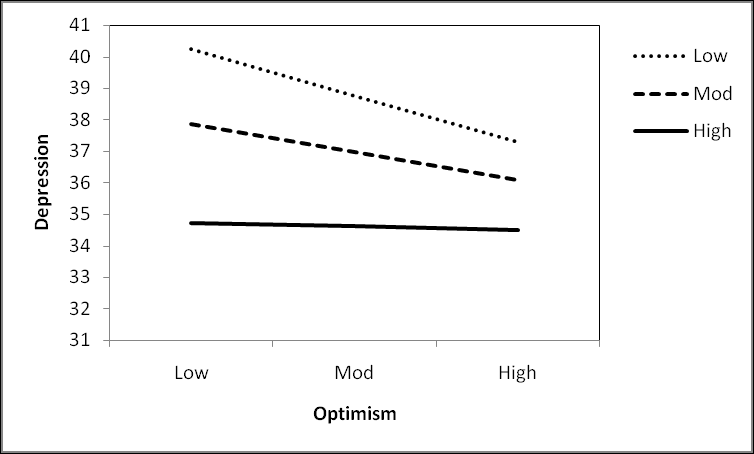
The slope of the interaction (Figure 1) indicated that optimism was significantly related to depression for those with low self-esteem, moderate self-esteem but not for people with high self-esteem.
| Variables | Β | SE | T | 95%CL |
|---|---|---|---|---|
| LLCI ULCI | ||||
| Pessimism | 0.47 | 0.1 | 3.55** | .74 .21 |
| Self Esteem | -0.6 | 0.1 | -6.45** | -1.26 |
| Self Esteem × Pessimism | 0.06 | 0 | 1.58 | -.01 .13 |
Table 3: ** Hayes PROCESS Macro results for the association between pessimism and depression with self-esteem as moderator.
Note: * = p ≤ .05, = p ≤ .01 Table 3:** Hayes PROCESS Macro results for the association between pessimism and depression with self-esteem as moderator.
As indicated in Table 3, pessimism was positively associated with depression (B = .47, t = -3.55, p = <.01). The findings support Hypothesis 1b, which states that pessimism will negatively predict depression among undergraduate students. The unstandardized regression coefficient (B = .47) indicated that there is a .47-unit increase in pessimism for every one-unit increase in depression.
Self-esteem did not moderate the relationship between pessimism and depression (B = .06, t = 1.58, p = <.05 [95% CI = -.01, .13]. The finding did not support Hypothesis 2c, which states that self-esteem will moderate the relationship between pessimism and depression. The overall variance in depression explained on account of the contributions of the variables in the regression model was 13%, R2 = 0.13, F (3, 517) = 10.89, p <.001.
Discussion
This study examined the moderating role of self-esteem in the association between life orientation (optimism vs pessimism) and depression among undergraduate students. The result revealed that optimism was significantly and negatively related to depression. This implies that an optimistic life orientation guarantees individuals’ physical and psychological wellbeing [15]. Corollary, the more positive one thinks about life consequences, the expectation of good outcomes with resilience and resistance to life challenges will be attainable [6]. This result is consistent with extant studies [29, 39, 40], which found optimism significant and had a negative association with depression. Hence, when students believe that they can deal with adverse life circumstances, they make situational attributions to those events, such as seeking positive affect and joy with expectations of positive life consequences, thereby reducing the risk factor for depression.
In addition, pessimism positively predicted depression among undergraduates. This finding supports previous studies that people with more pessimistic attitudes are at greater risk for severe depression [17, 41]. This indicated that negative thought concerning events in one’s life predisposes the individual to depression, as supported by Beck’s cognitive triad of depression (negative thought about oneself, the world and the future). Pessimistic thought could be triggered by hopelessness and helplessness in handling challenging daily events, as envisaged in Abramson, et al. hopelessness theory of depression. This coincides with the findings of Taylor [28], who asserted that pessimistic students are less likely absorbed in activity, cope less with problems and experience a lesser level of life adjustment with a high-risk factor for depression. This is inevitable since negativity in expectations could make one lose the sense of efficacy and acceptance of the incapability to change circumstances.
Self-esteem revealed several significant findings. First, it showed that it is a significant negative predictor of depression. This coincides with previous findings Bhanawat [23] Sharifzadeh, et al. which revealed that good self-esteem reduces the chances of being depression while low self- esteem positively relates to depression. Thus, individuals with a positive view of the self and zeal to effectively deal with life circumstances are less likely to be susceptible to depressive outcomes. The association between optimism and depression was moderated by self-esteem, thereby decreasing the proneness of depression among undergraduate students. The result aligns with extant studies [23, 32, 34], which revealed that optimistic individuals have a favorable view of themselves and believe they can deal effectively with any difficulty of life consequences, thereby reducing the risk factor in depression.
This implies that the introduction of self-esteem strengthened the optimistic approach of the students towards life circumstances, thereby decreasing the risk factor for depression among them. This result agrees with the vulnerability model of depression [31] and Beck’s Cognitive Triad of depression, which sees the manifestation of individual inclinations based on the belief system of self and life consequences. Previous studies [20, 23, 33] showed that the development of depression in young adults centres on individual self-esteem since it is the catalyst for individual holistic functioning in society. Hence, evaluating self-worth among undergraduate students is sacrosanct in attaining a balanced life devoid of depression.
However, Self-esteem did not moderate the relationship between pessimism and depression; thus, hypothesis 2b was rejected. This finding was supported by previous studies, which revealed that pessimistic individuals report greater levels of neuroticism and negative affect [42]. Pessimists were also found to have more significant right hemisphere brain activity [16], associated with an attentional focus on negative stimuli, a gloomy approach towards the future and low self- esteem. This generates a sense of insecurity and caution that sustains pessimistic thought processes and dysfunctional cognitive functioning in the face of life expectations and consequences, posing a risk factor for depression.
Implications
The results of the present study revealed that life orientation (optimism) leads to healthier behaviours and prospects towards quality of life. Thus, educationists and researchers should redesign and structure the educational curriculum to capture cognitive patterns and thought modification where students can develop positive mindsets and self-evaluations. This will help to reduce the risk factor of depression since depression is the offshoot of pessimistic, negative thoughts and patterns about life consequences.
In addition, the study findings exposed the debilitating effect of pessimism and low self-esteem on mental health by bringing to the fore that a pessimistic thinking pattern makes one focus more on failure, setbacks, disadvantages, weaknesses and misfortunes rather than seeing an opportunity in any obstacles. Thus, portraying thoughts of negativity as a risk factor for depression. Hence, proper sensitization and awareness should be championed concerning life orientation and self-esteem in families, communities and the educational sector through workshops, symposiums and seminars since good life orientation and self-esteem act as a springboard in decreasing the risk factor of depression and maintaining and sustaining mental health.
The study showed the imperativeness of self-esteem in the holistic functioning of individuals. This is pertinent because of its positive view of oneself, which comprises self-acceptance, respect and the capacity to cope with life’s challenges. It is expedient to inculcate positive self-esteem in our intervention strategies in schools to reduce the risk factor of depression since self-esteem helps in efficacious evaluation of oneself with a positive assessment of life consequences. Thus, positive and good self-esteem is sacrosanct in the transition of knowledge, reduced depression and proper life orientation among students. Thus, its verisimilitude in enhancing good mental health.
Limitations And Future Research Directions
The study has some limitations. First, participants were undergraduate students of varied backgrounds and cultures rather than a single background and culture. Equally, results may be perverted by the sampling method. Restricting the sample to undergraduate students from a single university in one Nigerian university may pose a risk to the validity of generalization by bringing to the fore the open likelihood that participants are not representatives of the generality of undergraduate students. Future studies should consider using the whole region or country settings. Second, all data gathered was self-reported, and non –differential misclassifications may be undoubtedly and could correlate with the observed associations. Further studies should examine the contributions of other factors (e.g. cultural, environmental, social or martial factors) that predispose individuals to depression. Nonetheless, our findings are consistent with previous research on the risks of depression.
Conclusion
The alarming rate of depression due to poor life orientation and self-esteem among undergraduates is now overwhelming. We conclude that life orientation directly affects depression among undergraduate students. Self- esteem is the boundary condition that weakens and influences depression. Thus, the relationship between life orientation and depression is better evidenced when self-esteem is presented. The present study revealed the imperativeness of self-esteem and good life orientation (optimism) in general wellbeing and reduced risk for depression among undergraduate students. This will help design intervention strategies and provide support services that will be apt in reducing depression among undergraduate students who are susceptible to a risk factor of depression.
Ethical Approval
All procedures followed were under the ethical standards of the responsible committee on human experimentation (institutional and national) and with the Helsinki Declaration of 1975, as revised in 2000 (5).
References
-
Levecque K, Anseel F, Beuckelaer AD, Heyden JVD, et al. (2017) Work organization and mental health problems in PhD students. Research Policy 46(4): 868-879.
-
Larcombe W, Finch S, Sore R, Murray CM, Kentish S, et al. (2016) Prevalence and socio-demographic correlates of psychological distress among students at an Australian university. Studies in Higher Education 41(6): 1074- 1091.
-
Othieno CJ, Okoth RO, Peltzer K, Pengpid S, Malla LO (2014) Depression among university students in Kenya: Prevalence and sociodemographic correlates. Journal of Affective Disorders 165: 120-125.
-
Sarokhani D, Delpisheh A, Veisani Y, Sarokhani MT, Manesh RE, et al. (2013) Prevalence of depression among university students: a systematic review and meta-analysis study. Depress Res Treat 2013: 1-7.
-
Alsubaie MM, Stain HJ, Webster LAD, Wadman R (2019) The Role of Sources of social support on depression and quality of life for university students. International Journal of Adolescence and Youth 2(6): 1-13.
-
Fatima T, Ambreen S, Khan MJ, Fayyaz W (2019) Relationship between life orientation (optimism and pessimism) and mental health. Pak Armed Forces Med J 69(5): 992-997.
-
Kamberi M, Hoxha F, Shala M, Shahini M, Vehapi S (2019) Anxiety predictors among college students in Kosovo. International Journal of Adolescence and Youth 24(1): 117-124.
-
Manimala S, Gautam S, Reddy G (2016) An overview on depression. Research and Reviews: Journal of Pharmacology and Toxicological Studies 4(3): 119-124.
-
World Health Organization (2018) Depression, Key Facts.
-
Dawood E, Mitsu R, Al Ghadeer H, Alrabodh F (2017) Assessment of depression and its contributing factors among undergraduate nursing students. International Journal of Nursing 4(2): 69-79.
-
Asu F (2018) 22% of Nigerians suffer from chronic depression: World Bank.
-
Sadeghi A, Yousefi A, Khedmati Z (2018) The role of life orientation and cognitive regulation on decreasing job stress. Health 10(2): 268-281.
-
Rozanski A (2014) Optimism and other sources of psychological wellbeing: a new target for cardiac disease prevention. Heart Failure 7(3): 385-387.
-
Conversano C, Rotondo A, Lensi E, Della Vista O, Arpone F, et al. (2010) Optimism and its impact on mental and physical wellbeing. Clin Pract Epidemiol Ment Health 6(1): 25-29.
-
Kiyanzard S, Kajbaf MB, Phayazi M (2016) Examine the relationship between happiness and life orientation (optimism and pessimism) students of Faculty of Psychology University of Isfahan. Indian Journal of Fundamental and Applied Sciences 6(1): 290-297.
-
Hecht D (2013) The neural basis of optimism and pessimism. Exp Neurobiol 22(3): 173-199.
-
Abdullah MQ (2018) Optimism/pessimism and its relationship with locus of control among children and adolescents. Mathew Journal of Psychiatry and Mental Health 3(1): 1-9.
-
Papworth S, Thomas RL, Turvey ST (2019) Increased dispositional optimism in conservation professionals. Biodiversity and Conservation 28(2): 401-414.
-
Pérez-Esparza R (2015) Ketamine for Treatment- Resistant Depression: a New Advocate. Rev Invest Clin 70(2): 65-67.
-
Choi YS, Shin HK, Hong DY, Kim JR, Kang YS, et al. (2019) Self-esteem as a Moderator of the effects of happiness, depression, and hostility on suicidality among early adolescents in Korea. J Prev Med Public Health 52(1): 30-40.
-
Civitci A (2010) Moderator role of self-esteem on the relationship between life satisfaction and depression in early adolescents. Emotional and Behavioural Difficulties 15(2): 141-152.
-
Minev M (2018) Self-esteem and depression in adolescents. Trakia Journal of Sciences 16(2): 119-127.
-
Makhubela M (2019) The relation between low self- esteem and depressive mood in a non-clinical sample: The role of gender and negative life events. Journal of Psychology in Africa 29(1): 54-59.
-
Anzaldi K, Shifren K (2019) Optimism, Pessimism, Coping, and Depression: A Study on Individuals with Parkinson’s disease. Int J Aging Hum Dev 88(3): 231- 249.
-
Sachsenweger MA, Fletcher RB, Clarke D (2015) Pessimism and homework in CBT for depression. Journal of Clinical Psychology 71(12): 1153-1172.
-
Aghaei A, Khayyamnekouei Z, Yousefy A (2013) General health prediction based on life orientation, quality of life, life satisfaction and age. Procedia Social and Behavioral Sciences 84: 569-573.
-
Seligman MEP, Tracy AS, Peterson C (2005) Positive psychology progress: Empirical validation of interventions. American Psychologist 60(5): 410-421.
-
Taylor S, Aspinwall LG, Kemeny ME, Schnedier S (1992) Optimism, coping, psychological distress and high- risk sexual behaviour among men at risk for Acquired Immunodeficiency Syndrome (AIDS). Journal of Personality and Social Psychology 63(3): 460-473.
-
Shifren K, Anzaldi K (2018) Optimism, wellbeing, depressive symptoms, and perceived physical health: a study among Stroke survivors. Psychology, Health & Medicine 23(1): 46-57.
-
Sowislo JF, Orth U (2012) Does self-esteem predict depression and anxiety? A meta-analysis of longitudinal studies. Psychological Bulletin 139(1): 213-240.
-
Orth U, Robinson RW, Widaman KF, Conger RD (2014) Is low self-esteem a risk factor for depression. Findings from a longitudinal study of Mecican origin youth. Dev Psychol 50(2): 622-633.
-
Gardner AA, Lambert CA (2019) Examining the interplay of self-esteem, trait-emotional intelligence, and age with depression across adolescence. Journal of adolescence 71: 162-166.
-
Zhou J, Li X, Tian L, Huebner ES (2018) Longitudinal association between low self-esteem and depression in early adolescents: The role of rejection sensitivity and loneliness. Psychology and Psychotherapy: Theory, Research and Practice 93(1): 54-71.
-
Hilbert S, Goerigk S, Padberg F, Nadjiri A, Übleis A, et al. (2019) The role of self-esteem in depression: A longitudinal study. Behavioural and cognitive psychotherapy 47(2): 244-250.
-
Mäkikangas A, Kinnunen U (2003) Psychosocial work stressors and wellbeing: Self-esteem and optimism as moderators in a one-year longitudinal sample. Personality and individual differences 35(3): 537-557.
-
Glaesmer H, Rief W, Martin A, Mewes R, Brahler E, et al. (2012) Psychometric properties and population-based norms of life orientation test revised (LOT-R). British Journal of Health Psychology 17: 432-445.
-
Rosenberg M (1965) Society and the adolescent self- image. Princeton NJ: Princeton University Press.
-
Zung WW (1965) A self-rating depression scale. Archives of General Psychiatry 12: 63-70.
-
Zayas A, Guil R, Guerrero C, Gil Olarte P, Mestre JM (2016) Resilience, optimism, and depression in caregivers of diabetic children. Quaesti-Virtual Multidisciplinary Conference 4(1): 143-152.
-
Zafar A, Murtaza H (2019) Optimism and depression among students of University of Gujrat. International Journal of Applied Psychology 8(3): 41-46.
-
Faye Schojoll HH, Schou Bredal I (2019) Pessimism predicts anxiety and depression in breast cancer survivors: A5-year follow-up study. Psycho-Oncology 28(6): 1314-1320.
-
Marshall GN, Wortman CB, Kusulas JW, Hervig LK, Vickers RR (1992) Distinguishing optimism from pessimism: Relations to fundamental dimensions of mood and personality. Journal of Personality and Social Psychology 62(6): 1067-1089.
- Occupational Stress and Mental Health Outcomes Among Police Officers: A Mini Review
- The Experience of Counterproductive Leadership on Mental Health and Impact on Retention in U.S. Marines: A Phenomenological Study
- Nomophobia in the Digital Age: A Study on College and University Students
- Emotional Regulation in Children with Autism and Learning Disabilities
- Antisemitism on American College Campuses and Its Impact on Jewish Students
- Exploring the Role of Empathy in the Associations of Family Functioning and Purpose in Life with Attitude towards Abortion among Undergraduates: A Moderation Analysis