
Concept, Dimensions and Perception of Healthy Lifestyle
The concept of healthy lifestyle is one of the most used in the promotion and health prevention. Its vagueness can generate problems of adjustment when it comes to understanding its ultimate objective and, above all, generate confusion in the investigations that use it to generate healthy behavior patterns. The dimensions on which the concept of healthy lifestyle is based are in themselves very disparate, intervening behaviors and actions executable, emotions, cognitions and perceptions, which makes its functionality much more complex and controversial when it comes to agreeing on its final content. Risk perception in lifestyle is intimately linked to the concept of perceived psychosocial vulnerability, because it is a concept that varies according to age and has a direct impact on psychosocial factors that affect lifestyle such as susceptibility, adaptation, coping and resilience. Our goal is to narrow and delimit the concept of healthy lifestyle from a theoretical perspective, so that a construct so widely used in psychology and health research can be addressed more objectively, with agreed parameters and taking into account its dimensions and the perception that people have of it.
Introduction
The concept of lifestyle, by definition, is controversial, given its dimensions, propagation, and non- specificity, even when its content is implicit. Historically, this concept has been used in numerous scientific disciplines, but the health- related fields (primarily the social sciences, health sciences, psychology, and sociology) have shown the most interest in its study and use The first studies to consider the emerging concept of life patterns or customs, subsequently referred to as lifestyles from a more sociological perspective, were based on the writings of Marx [1], Veblen [2], and Weber [3].
According to Rodríguez-Marín [4], Marx considered lifestyles to be directly related to the economy of the social groups, which is sustained by the income and production system. Subsequently, Veblen extended the concept of lifestyle, including motivational issues. Weber considered lifestyle to be independent of the sum of its underlying parts, In other words, he considers social, economic, and educational level (among others) as elements of lifestyle, without the need for them to be grouped together as a whole. Later, Adler [5] introduced this term in psychology, focusing on the relationship between the individual subject and his social environment.
Since its origin, researchers have shown little interest in defining the concept of lifestyle. A classic definition by Henderson, Hall, and Lipton [6] and considered by Rodríguez- Marín [4] affirms that lifestyle is an individual’s “day-to-day habits and behavior patterns” or, more simply, their “way of life”. According to the WHO [7], lifestyle constitutes “a general way of life as the interaction of living conditions, in a broad sense and the individual standards of conduct determined by socio-cultural factors and personal characteristics”.
Other definitions suggest that lifestyle is a strategic solution pursuing a goal or objective [8], a predictor of behavior [9], or a set of behavioral habits or patterns [10].
Some recent definitions suggest that lifestyle is the behavior carried out by individuals, chosen in a free and modifiable manner [11] or the way of living with regard to living conditions and individual behavior factors [12].
Although not expressly reflected in the definitions, the predominant trend focuses on the area of health. Some health models include lifestyles in their main objectives. Currently, health promotion emphasizes that individuals and their way of life may alter their state of health, disease process, or rehabilitation. This, without a doubt, is directly related to lifestyle. According to Bonal [13], “health promotion affects, influences, and acts on the modifiable determinants of health, such as unhealthy behavior, including lifestyle, which are also determinants of health”. Along these lines of the maximum promotion of health, there is the model of behavior or lifestyles, which attempts to modify unhealthy behaviors.
In his description of cross-cultural nursing [14, 15]. Leinninger focused his main objective on the adoption of healthy lifestyles. This was also the case with the Pender health promotion model [16], which is based on healthy behaviors that are directly related to lifestyle.
Many psychological models have also based their objectives on the lifestyle of the individual. The most representative of these models may be the Health Belief Model [17, 18], which is based on two main principles: on the one hand, the value granted by an individual to the health objective to be achieved and, on the other hand, the individual’s belief that their behavior may lead to the achievement of said objective. In other words, the model proposes that an individual’s objective must be to avoid illness, and furthermore, they must believe that this objective can be achieved through a healthy lifestyle.
Lifestyle plays a fundamental role in the management of healthy or unhealthy practices, which are ultimately those offering an improved quality of life [19, 20]. According to the WHO [21], non-communicable diseases are directly related to lifestyle, leading us to value, even more, the importance of maintaining a healthy lifestyle over time.
Our objective is to define and delimit the concept of healthy lifestyle from a theoretical perspective, so that this widely-used construct of health research may be approached more objectively, according to the established parameters and based on its dimensions and the perception of individuals regarding the same.
Dimensions of Lifestyle
Adjusting the dimensions associated with the concept of lifestyle can be difficult, given some of these issues mentioned above, such as its magnitude, dispersion, or vagueness. However, its dimensions and characteristics may be analyzed from distinct angles or perspectives, in order to alleviate or minimize these drawbacks.
According to a more theoretical perspective, lifestyle may oscillate between two positions: on the one hand, its full life history, including individual and/or collective experiences, and, on the other hand, predisposition and decision-making. This perspective suggests that the following dimensions describe lifestyles [22, 23]:
- Time dimension: Based on the assumption that individuals evolve over time and their way of thinking and acting changes according to their interactions with others and with themselves.
- Visible dimension: The degree of manifest clarity of a lifestyle is a function of its quality. Habits or behaviors that the individual considers negative will be hidden while those considered positive will be manifested and apparent.
- Spatial dimension: Each lifestyle is configured from a distinct perspective, depending on its location, social environment, and context.
- Commitment dimension: The level of commitment between some individuals and others, as well as between groups, is configured based on their social identity, as well as the dynamic interrelation generated between them.
- Reflexive dimension: This last dimension refers to the cultural and social interconnection generated between different individuals and social groups. Another means of dimensioning lifestyle involves focusing the objectives on variables or groups of variables that respond to a more or less healthy lifestyle. Various authors [24, 25, 26, 27, 28, 29, 30, 31, 32, 33] have referred to the following dimensions of lifestyle, with regard to health:
- Food and nutrition: This dimension is focused on the food that is ingested, its quality and characteristics, frequency, schedule, etc., given that eating habits directly affect health parameters and are a fundamental part of an individual’s balanced lifestyle. It has been found that unhealthy eating habits, along with certain cultural stereotypes of beauty, lead to eating disorders in young people.
- Physical activity and exercise: Actions related to exercise and physical activity, always in greater proportion to the individual’s state of rest. This activity is positively related to protection from many diseases and, in turn, significantly improves psychological well- being, reducing stress and anxiety and improving emotional balance.
- Consumption of tobacco, alcohol, and other drugs: Intake of addictive (legal and illegal) substances that alter the central nervous system and behavior and may cause serious damage to the body, depending on the amount and frequency of consumption.
- Leisure and free time: These are all actions aimed at the satisfaction and enjoyment of people during periods when they are not carrying out work or study activities. It has been found that these actions correlate positively with psychological and physical well- being since many of them are oriented towards sports and interpersonal relationships.
- Self-care and medical attention: This dimension refers to behaviors that are fully voluntary and directly related to personal hygiene, in general. It also refers to the self-observation of one’s own body, being attentive to possible dysfunctions that may require specialized medical attention.
- Sexual behavior: This dimension considers all behaviors related to sexual relations, both alone and in interaction with others. It also refers to the use of protective means to mitigate health risks, such as infections and/or unwanted pregnancies.
- Interpersonal relations: All actions resulting in social exchange with others, either within the leisure and free time sphere, or the work and family sphere. These actions may significantly improve the emotional and social balance of individuals when carried out appropriately.
- Psychological well-being: Referring to actions with emotional responses. The balance of emotional states is a priority for good psychological adjustment and has a direct impact on a healthy lifestyle.
- Sleep: This dimension refers to the absolute rest of the body, during which only physiological functions remain active. Sleep health is influenced by other lifestyle dimensions such as diet, physical exercise, or psychological well-being, among others. Poor sleep quality directly affects performance, concentration, and emotional balance in the waking state.
Perception of Lifestyle
People do not usually perceive their overall lifestyle, in all of its dimensions, as being adjusted or maladjusted to the concept of health. It is more common to perceive certain dimensions as being included and well-adjusted while others are maladjusted. These concepts of satisfaction with the lifestyle dimensions or dissatisfaction with them are in line with some classic motivation theories [34, 35] in which cognitive processes (thought) and emotions play an important role and serve as drivers of motivation to maintain health.
We should recall that satisfaction and dissatisfaction with lifestyle are behaviors perceived by the individual, meaning that the assessment of motivation is subjective. When the subjective perception is valued as being closer to the achievement of one’s goals, the fact that the individual can more easily achieve their goals is considered favorable.
Lema, et al. [28] made an interesting comparison of motivation based on the transtheoretical model [36, 37, 38]. The model was originally proposed for the treatment of addictions, but it adjusts perfectly to lifestyle. As observed in Figure 1, the model adjusts to 6 phases.
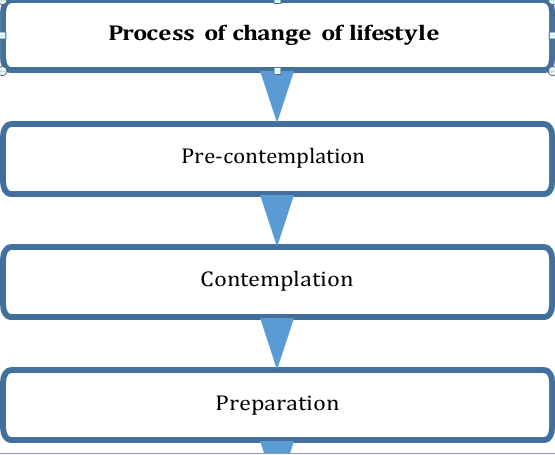
1. Pre-contemplation phase: When the individual is unaware that there is a problem with their lifestyle. In this phase, no patterns to be followed are proposed.
2. Contemplation phase: This is the stage in which the person considers that there may be a problem with their lifestyle, but at the same time, rejects any type of change. During this phase, the pros and cons of their lifestyle are considered, checking whether a sufficient balance exists between the two. 3. Preparation (determination) phase: During this phase, the motivation to make a change increases significantly. If the individual does not move on to the next phase, they will revert back to the previous phase. 4. Action phase: The person proceeds to change their lifestyle, attempting to modify the aspects considered problematic. 5. Maintenance phase: This is an especially important phase since it relates to the changes in lifestyle achieved and, above all, the attempt to avoid relapse. 6. Relapse phase: The person may return to the lifestyle exhibited prior to the change. This is a retreat to previous phases, and it is necessary to reconsider a return to action and maintenance.
In order to follow the transtheoretical model, the individual must enter a circle of deep reflection regarding their lifestyle, analyzing each of its dimensions and accepting the problems that are susceptible to change. Perhaps the most complicated step is in the first phase of pre-contemplation, which can be activated by the motivation to change.
The perception of lifestyle theoretically varies with age, as well as the variables associated with it, such as motivation, which, as we have seen, is fundamental for the potential changes according to the transtheoretical model. From this point of view, as García del Castillo [39] pointed out, motivation acts as a “behavioral engine” in all areas of life. The motivation for a lifestyle change will be diametrically different for a young person as opposed to an adult. The young person has a lower risk perception as compared to an adult, who has a high one.
A motivational cycle is activated by one or more of the following causes [40]:
- Need.
- Shortcoming.
- Desire.
- Pressure.
- Fear. Any of these causes may be the cause of imbalance and may activate the individual to attempt to restore their physical, psychological, and/or social balance.
The chain is extended in the perception of lifestyle, with two variables that may directly or indirectly influence it: the perception of risk and perceived psychosocial vulnerability.
The perception of risk in lifestyle.
According to Cruz, et al. [41], the perception of risk is created through an individual process, within a specific context that enables the individual to recognize harm and quantify their degree of vulnerability, in order to act to avoid risky behavior, whenever possible.
According to this perspective, we can analyze high-risk health behavior in distinct contexts, which may form part of lifestyle (Table 1).
| Eating habits | • Overeating |
|---|---|
| • “Snacking” between meals | |
| • Eating too many high-fat foods | |
| • Drinking carbonated beverages | |
| • Not following a balanced diet | |
| • Not watching one’s weight | |
| Drug consumption | • Smoking |
| • Drinking alcohol | |
| • Taking medication | |
| • Taking other drugs: cocaine, heroin, cannabis, etc. | |
| Activity and sleep | • Physical inactivity |
| • Making harsh physical efforts | |
| • Physical exhaustion | |
| • Staying up all night | |
| • Sleeping few hours | |
| • Breaking bedtime routines | |
| Personal hygiene | • Ignoring personal hygiene |
| • Not washing hands before eating | |
| • Not brushing teeth after meals | |
| • Not washing clothes | |
| Sexual relations | • Lack of pleasure in relations |
| • Lack of safety and hygiene | |
| • Promiscuity | |
| Couple and family | • Lack of communication |
| • Frequent arguments | |
| • Incompatibility of interests | |
| Friends and social environment | • Not having time for social relations |
| • Social isolation | |
| • Lack of interest in leisure activities | |
| Other high-risk behavior | • Reckless driving |
| • Lack of workplace safety measures | |
| • Divorce | |
| • Unemployment | |
| • Death of relatives and friends |
Table 1: High-risk health behavior in lifestyle (Modified from García del Castillo, 2012).
Perceived psychosocial vulnerability in lifestyle.
It may be noted that, in general, individuals are perceived as more vulnerable based on their age and/or state of health. Thus, the older the person, the higher the perception of vulnerability and vice versa. According to Ruiz [42], this concept is intrinsically related to other constructs such as risk, susceptibility, adaptation processes, coping, or resilience and is always associated with some type of threat.
A broad definition of vulnerability is found in Osorio [43]: “Vulnerability refers to the disadvantaged condition in .
which a subject, community, or system finds itself in the face of a threat and the lack of necessary resources to overcome the damage caused by a contingency.” From this definition, we can move on to the concept of social vulnerability, which entails the risk of suffering harm and the inability to cope and avoid possible injuries [44, 45].
The construct of psychosocial vulnerability within the framework of lifestyle and health is configured based on the individual’s degree of susceptibility to suffering health problems, as well as possible accidents or self-harm [46, 47, 48].
![Figure 2: Theoretical configuration of psychosocial vulnerability in lifestyle [49].](/fulltextimages/10541/fig_2.png)
Based on this conceptual premise, a theoretical scheme may be developed regarding psychosocial vulnerability in health settings, which brings together a series of elements supporting its configuration (Figure 2).
The variables that come into play in real and perceived psychosocial vulnerability play a fundamental role in its development and activation. They include:
- High-risk behavior, as previously discussed, is a fundamental component since it can generate negative consequences in lifestyle.
- Coping is activated in the face of a threat in order to attempt to reduce and/or eliminate problems. It is a guarantee of quality of life and lifestyle, it acts as a behavior modulator.
- Resilience, as an adaptation process, is a defining variable in the face of psychosocial vulnerability. A healthy lifestyle should be based on resilience in order to be maintained over time.
- Stress is an alarm response to a threat and may act as insurance if the individual anticipates its occurrence. Regarding lifestyle, stress should be controlled in the distinct manners in which it presents itself.
- Attachment acts as a conveyor belt between the lack of motivation and the willingness to engage in a behavior and the social and/or family support that stimulates it. Regarding lifestyle, it is essential to have the protection of someone who maintains the health-related behaviors.
- Emotional intelligence helps in the understanding of one’s emotions and those of others. Regarding lifestyle, it is an essential variable since it weaves together emotions and health- related behaviors.
From a theoretical point of view and based on the above, lifestyle could be defined as a set of individual behaviors based on the subjective perception and degree of vulnerability that each person has to suffer from disease problems. Along these lines, we can support these arguments with the definition of Callejo [50], which frames lifestyle as a differential and specific system of behaviors.
Conclusions
The healthy lifestyle concept is one of the most widely used in health promotion and prevention, and in many branches of health and related sciences, such as medicine, psychology, nursing, and other fields. Its ambiguous definition can lead to problems in terms of understanding its ultimate objective and, above all, it may generate confusion in research works that use it to generate healthy behavior patterns.
This imprecision results from the multifactorial nature of the construct since it brings together personal, cultural, and social factors that directly or indirectly influence what is defined as health behavior. The fact that no absolute consensus exists regarding the normality patterns may also contribute to the concept’s misuse. An example of this may be seen in the perception of risk based on an individual’s age, an issue that is clearly perceived, but that has direct repercussions on their real health behavior [39, 51, 52].
The concept of healthy lifestyle is based on dimensions that are highly different, in which executable behaviors and actions, emotions, cognitions, and perceptions all participate, making its functionality much more complex and controversial when determining its final content.
Therefore, and to clarify its dimensions, two aspects are proposed: one based on personal history including social interactions [22, 23] and another directly related to individual behavior actions and executions [25, 26, 28, 29]. Thus, we cover the entire spectrum of possibilities of the concept and their repercussions on individual and collective health.
Without a doubt, one of the most relevant conflicts regarding the study of lifestyle is how it is perceived. Perception can be real or subjective, therefore, an individual’s final behavior may lead them to become more conscious of one’s health or more relaxed, resulting in a major disruption of the maintenance of the same. From the subjective perception, a theoretical assumption may be generated, based on the transtheoretical model [36, 37, 38], leading to a reflective and executive analysis that culminates in lifestyle alterations in dimensions other than health behaviors.
Finally, it should be considered that the perception of risk in lifestyle is closely linked to the concept of perceived psychosocial vulnerability since this concept varies depending on age and has a direct impact on psychosocial factors affecting lifestyle such as susceptibility, adaptation, coping, and resilience [42, 43].
References
-
Marx K (1867) Das Kapital. Verlag von Otto Meissner.
-
Veblen T (1899) The Theory of the Leisure Class: An Economic Study in the Evolution of Institutions. Macmillan.
-
Weber M (1922) Wirtschaft und Gesellschaft. Grundriss der Vmtehendn Soziologie. Tubinga.
-
Rodríguez Marín J (1998) Estilos de vida y salud. Clínica y Salud 3(3): 233-237.
-
Adler A (1948) El sentido de la vida. Luis Miracle.
-
Henderson J, Hall M, Lipton HL (1980) Changing self destructive behaviors. In: Sotone FG, Cohen YN, Adler (Eds.). Health Psychology Jossey Bass.
-
WHO (1998) Informe sobre la salud en el mundo. La vida en el siglo XXI Organización Mundial de la Salud.
-
Sánchez-López MP, Aparicio M (2001) Estilo de vida: avances en su medida y sus relaciones con conceptos psicológicos. Revista de Psicología de la PUCP 19(1): 6-26.
-
Shulman BH, Mosak HH (1988) Manual for lije style assessment. Acelerated Development.
-
Rodríguez-Marín J, García del Castillo JA (1995) Psicología social de la salud. En J.L. Álvaro, A. Garrido & J.R. Torregrosa (Coord.). Psicología Social Aplicada. McGraw-Hill: 351-380.
-
Morales M, Gómez V, García C, Chaparro L, Carreño S (2018) Estilo de vida saludable en estudiantes de enfermería del estado de México. Revista Colombiana de Enfermería 16(13): 14- 24.
-
Arce N, Mendoza MA, Álvarez A, Reyes B, Sánchez M (2018) Estilo de vida, autoeficacia, consumo de alcohol y tabaco en trabajadores. Revista Iberoamericana de Producción Académica y Gestión Educativa 5(9).
-
Bonal R (2019) Modelos sobre promoción de salud en medicina familiar internacional implicacionesen medicina general integral. Edumecentro 11(2): 175-191.
-
Leininger M (1991) Culture Care Diverslty & Universality: A The-ory ofNursing. National League for Nursing Press.
-
Leininger M (1995) Transcultural Nursing. Concepts, Theories, Research & Practices. McGraw-Hill, In: (2nd Edn.).
-
Pender N (1990) Health Promotion In Nursing Practice. Appleton and Lange.
-
Hochbaum GM (1958) Public participation in medical screening programs: A sociopsychological study. Government Printing Office.
-
Rosenstock I (1974) Historical Origins of the Health Belief Model. Health Education Monographs 2(4) 328- 335.
-
Reyes MY, Meza ML (2021) Cambios en los estilos de vida durante el confinamiento por COVID-
-
Ciencia ergo-sum 28(4).
-
Tala Á, Vásquez EY, Plaza C (2020) Estilos de vida saludables: una ampliación de la mirada y su potencial en el marco de la pandemia. Revista Médica de Chile 148(8): 1189-1194.
-
WHO (2018) Enfermedades no transmisibles. OMS.
-
Clua R (2018) Estilos de vida de los usuarios de las salas de consumo higiénico de Barcelona. Health and Addictions/Salud y Drogas 18(2): 79-89.
-
Dumont G, Clua R (2015) Acercamiento socio- antropológico al concepto de estilo de vida. Aposta Digital. Revista de ciencias sociales 66: 83-99.
-
Almendra-Pegueros R, Baladia E, Ramírez Contreras C, Rojas-Cárdenas P, Vila-Martí A, et al. (2021) Conducta alimentaria durante el confinamiento por COVID-19 (CoV-Eat Project): protocolo de un estudio transversal en países de habla hispana. Revista de Nutrición Clínica y metabolismo 4(3).
-
Barragán Ledesma L, González Preza M, Estrada Martínez S, Hernández Cosain Y, Hernández Cosain E, et al. (2015) Lifestyle and dimensions in university students in the area of health. Science and Humanism in Health 2(2): 53-63.
-
Belem IS, Dias DA, Both J (2019) Different behaviors of the lifestyle of University students of the Physical Education course. Descriptive, Correlational or Qualitative Research 17(2): 1-14.
-
Chalapud LM, Molano NJY, Roldán E (2022) Estilos de vida saludable en docentes y estudiantes universitarios. Retos 44: 477-484.
-
Lema L, Salazar IC, Varela MT, Tamayo JA, Rubio A, et al. (2009) Comportamiento y salud de los jóvenes universitarios: satisfacción con el estilo de vida. Pensamiento Psicológico 5(12): 71-88.
-
Luna MC (2017) Relación del bienestar psicológico, estrés académico y el estilo de vida de los estudiantes de la Universidad Inca Garcilaso de la Vega. Tesis Doctoral. En línea:
-
Matsuo LH, Tureck C, De Lima LP, Hinnig PDF, Trindade EB, et al. (2021) Impact of social isolation by Coronavirus disease 2019 in food: A narrative review. Revista Nutrición 34: e200211.
-
Morin CM, Carrier J, Bastien C, Godbout R (2020) Sleep and circadian rhythm in response to the COVID-19 pandemic. Canadian Journal of Public Health 111(5): 654-657.
-
Pinillos Y, Rebolledo R, Herazo Y, Oviedo E, Guerrero M, et al. (2022) Estilo de vida en adultos jóvenes universitarios de Barranquilla, Colombia. Diferencias según sexo y estatus socioeconómico. Retos 43: 979-987.
-
Sudriá ME, Andreatta MM, Defagó MD (2020) Los efectos de la cuarentena por coronavirus (COVID-19) en los hábitos alimentarios en Argentina. Diaeta 38(171): 10- 19.
-
Kandel E, Schwartz J, Jessell T (1997) Neurociencia y conducta. Prentice Hall.
-
Reeve J (1994) Motivación y Emoción. McGraw-Hill, University of Iowa.
-
Prochaska J, DiClemente C (1982) Transactional therapy: toward a more integrative mode l of change. Psichoterapy: Theory Research and Practice 19(3): 276- 288.
-
Prochaska J, DiClemente C (2005) The transtheoretical approach. Oxford University Press, pp: 147-171.
-
Prochaska JO, Norcross JC (2001) Stages of change. Psichoterapy: Theory, Research and Practice, 38(4): 443-448.
-
García del Castillo JA (2012) Concepto de percepción de riesgo y su repercusión en las adicciones. Health and Addictions/Salud y Drogas 12(2): 133-151.
-
García del Castillo JA, Castillo López G, Álvaro; López Sánchez C, Dias P (2015) Configuración teórica de la motivación de salud desde la teoría de la autodeterminación. Health and Addictions/Saludy Drogas 15(2): 151-159.
-
Cruz A, Molerio O, Llopiz K, Aguinaga Villegas D, Gálvez Suarez E, et al. (2020) Percepción de riesgo e incidencia antitabáquica en el rendimiento académico de estudiantes universitarios de Ciencias Médicas. Propósitosy Representaciones 8(1): 433.
-
Ruiz N (2011) La definición y medición de la vulnerabilidad social. Un enfoque normativo. Investigaciones Geográficas Boletín del Instituto de Geografía UNAM 77: 63-74.
-
Osorio O (2017) Vulnerabilidad y vejez: implicaciones y orientaciones epistémicas del concepto de vulnerabilidad. Intersticios Sociales 13: 1-34.
-
Aristegui I, Beloki U, Díez A, Silvestre M (2017) Vulnerabilidad social percibida en contexto de crisis económica. Revista Española de Sociología 26: 17-39.
-
Buitrago FR, Ciurana RM, Fernández MCA, Tizón JLG (2020) Salud mental en epidemias: una perspectiva desde la Atención Primaria de Salud española. Atención Primaria 52(S2): 93-113.
-
Nichiata LYI, Bertolozzi MR, Ferreira R, Fracolli LA (2008) La utilización del concepto vulnerabilidad por enfermería. Revista Latinoam Enfermagem 16(5).
-
Lamas H, Murrugarra A (2011). Psychosocial vulnerability and resilience. Illustrated.
-
Terry Y, Bravo N, Elias KSY, Espinosa I (2020) Psychosocial factors linked to COVID-19. Scientific Information Magazine 99(6): 585-595.
-
García del Castillo JA (2015b) Concept of psychosocial vulnerability in the field of health and addictions. Health and Addictions/Saludy Drogas 15(1): 5-14.
-
Callejo J (2021) Identity And Lifestyles. Papeles del CEIC 21(4): 1-13.
-
Castillo M, Ruiz Olivares R (2019) La percepción de riesgo y su relación con el uso problemático del teléfono móvil en adolescentes. Revista Española de Investigaciones Sociológicas 168: 21- 34.
-
Guerra JA, Benavides RA, Zapata R, Ruiz JM, Ávila H, et al. (2022) Percepción de riesgo para VIH y sexo seguro en migrantes de la frontera norte de México. International Journal of Andrology 20(2): 80-85.
- Occupational Stress and Mental Health Outcomes Among Police Officers: A Mini Review
- The Experience of Counterproductive Leadership on Mental Health and Impact on Retention in U.S. Marines: A Phenomenological Study
- Nomophobia in the Digital Age: A Study on College and University Students
- Emotional Regulation in Children with Autism and Learning Disabilities
- Antisemitism on American College Campuses and Its Impact on Jewish Students
- Exploring the Role of Empathy in the Associations of Family Functioning and Purpose in Life with Attitude towards Abortion among Undergraduates: A Moderation Analysis