
Less Thinking, More doing: Rumination and Avoidant Problem- Solving Increase Risk of Depression in Response to Cyber Victimization
Cyber victimization (CV) is a prevalent and harmful stressor for college students that increases risk for depression. However, little is known about how CV leads to depression in this population. To investigate potential mechanisms of this relationship, the present study examined the intermediary roles of two established predictors of depression: rumination and maladaptive social problem-solving styles. Undergraduates (n = 410) self-reported CV, rumination, social problem-solving styles, and depression. CV exposure was associated with more rumination and depression, and rumination mediated the relationship between CV and depression. Avoidant Style, characterized by procrastination or avoidance of problems, but not Impulsive Carelessness Style, characterized by hurried, often tactless, attempts to solve problems, moderated the relationship between rumination and depression in this sample. The results support that rumination mediates CV and depression and demonstrate the moderating role of avoidant behaviors in explaining how rumination leads to depression. Future research should investigate how targeting rumination and avoidance can help prevent individuals who experience CV from developing depression.
Introduction
Cyber victimization (CV) is a prevalent, harmful experience among college students. CV refers to being targeted online or via technology with actions intended to harm (e.g., being targeted by hurtful content, embarrassing photos or videos, or private messages; [1, 2]. These concerns are compounded by the COVID-19 pandemic and associated increased dependence on online interactions [3]. Amongst the many adverse impacts of CV, such as anxiety, substance use, and suicidal ideation, increased risk for depression has been identified as particularly salient [4, 5]. For example, in a longitudinal study of 1,438 college students CV was a better predictor of future depression than in-person victimization [6].
The association between depression and rumination, the process of engaging in prolonged, past-oriented, repetitive, and negative thinking, is well established [7, 8]. Yet, the relationship between CV, rumination, and depression has been sparsely investigated. In adolescent samples, two studies found that rumination mediated the CV-depression relationship [9, 10]. Liu C [11] hypothesized that CV may function as a distal risk factor, which might in turn result in negative beliefs and less beneficial responses to stressors, prolonging rumination and leading to depression. In the sole investigation with undergraduates, rumination mediated the relationship between CV and depression over three weeks, perhaps because rumination diminished the ability to use adaptive emotion regulation strategies, primarily problem- solving and behavioral activation [12]. Problem-solving and behavioral activation are integral components of two of the leading theories of rumination: response style theory [13] and control theory [14].
According to response style theory, rumination is one possible response to negative affect that can become a habit that maintains depression, resulting in a negative feedback loop. Applied to problem-solving, the failure to solve problems can lead to rumination, subsequent avoidance and lack of action, and thus the maintenance of depression [8, 13]. Importantly, this theory does not explain what begins this negative feedback loop. Control theory proposes that slow and unsatisfactory progress towards one’s goal catalyzes rumination, and only tangible progress towards the goal or its abandonment can stop rumination [14]. Notably, poor problem-solving and avoidance, and consequently a lack of behavioral activation, hinder goal satisfaction.
Social problem-solving (SPS), a process of attempting to find ways of adaptively coping with problematic situations in everyday life, integrates elements of problem-solving, avoidance, and behavioral activation [15]. It has two dimensions: orientation and styles. Orientation refers to attitudes and emotional responses to a problem, and is described as positive (PPO), indicating an adaptive view that problems are solvable, and negative (NPO), indicating a maladaptive mindset that problems are unsolvable [15]. Style refers to the behaviors that people engage in to solve the problem, which are categorized as rational (RPS; systematic, effective), impulsive/carelessness (ICS; impulsive, hurried), or avoidant (AS; inaction, procrastination). RPS and PPO are considered adaptive elements of problem-solving, whereas ICS, AS, and NPO are maladaptive [15]. As with rumination, maladaptive problem-solving (AS, ICS, and NPO), has been strongly linked to depression in college student samples [10, 16]. Integrating these processes, rumination is theorized to contribute to depression by reframing thoughts as more pessimistic, which interferes with effective problem solving [7]. Further, rumination appears to be a form of avoidance by providing a distraction from engaging with one’s environment since preoccupation with negative thoughts during rumination can contribute to a lack of action [7].
Consistent with Nolen-Hoeksema S and Hasegawa A [7, 17] posited that rumination may function as a type of cognitive-behavioral avoidance. In a longitudinal study, rumination and AS together predicted higher levels of future NPO, but rumination and NPO did not predict future AS, suggesting that AS might catalyze a depression feedback-loop [17]. Contrastingly, it seems that ICS prospectively influences depression in a pathway independent of rumination: in another investigation, AS was related to rumination and depression at baseline, but only depression and ICS at baseline predicted depression six months later Hasegawa et al Supporting the hypothesis of independent pathways, after controlling for depression, AS and NPO, but not ICS, were correlated with rumination in a cross-sectional study of 227 undergraduates Hasegawa et al. The authors speculated that rumination facilitates avoidance of negativity by altering cognitions and behaviors, and avoidance likely prevents problem solving, which sustains further rumination and maintains depression.
The present study sought to better understand the mechanisms underlying the relationship between CV and depression guided by these theories. College students (N = 410) completed surveys assessing lifetime CV exposure, rumination, maladaptive SPS styles, and depression. The study aimed to cross-sectionally replicate the [12] findings. Thus, increased CV exposure was expected to be related to increased depression, and rumination was expected to mediate this relationship. Adding to this model, maladaptive SPS styles were examined as moderators of the rumination and depression relationship. Theory and limited empirical findings to date suggest that AS bears a unique relationship to rumination, and that they form a negative feedback loop that results in, and maintains, depression.
Method
Participants
Undergraduate students (N = 410) were recruited from a New England university using a web-based research scheduling system. Age of participants ranged from 18 to 25 (M = 19.31, SD = 1.37) with 52.4% identifying as female, 45.6% male, 1% not sure, .5% non-binary, .2% female-to- male transgender, and .2% male-to-female transgender. The race/ethnicity of the sample was as follows: 89.3% White, 2.9% Asian, 2.7% Black, 2% multiple identities, 1.5% Latinx, 1% American Indian/Native American or Alaska Native, and .7% not listed.
Procedures
The present study was approved by the university’s Institutional Review Board. Questionnaires and informed consent procedures were anonymously administered through Qualtrics, a secure survey-based data collection website. Participants were awarded extra credit applied toward introductory psychology courses.
Measures
Cyber victimization: CV was assessed using the Cyber Peer Experiences Questionnaire, (C-PEQ), a 30-item self- report questionnaire derived from the Social Networking Peer Experiences Questionnaire (SN-PEQ) [18]. It includes two subscales: CV and cyber aggression. Only the CV score was used. Items are answered using a Likert scale ranging from 1 (Never) to 5 (A few times a week) based on the event’s frequency in the past two months. Items are summed to form composite scores, with higher scores indicating higher levels of CV. The CV subscale demonstrated good internal consistency in a sample of undergraduates (α = .84); [19], and in the present sample (α = .86.) Rumination: Rumination was assessed using the Ruminative Responses Scale (RRS), a subscale of the Response Styles Questionnaire, which consists of 22 items on a Likert scale ranging from 1 (Almost never) to 4 (Almost always). Respondents answer how often they react this way when they are feeling down. Items are summed to form a composite score with higher scores indicating more rumination. The RRS has demonstrated good internal consistency in a sample of 250 undergraduates (α = .89), and in the present sample (α = .96). Social problem-solving: SPS was assessed using the 52- item Social Problem-Solving Inventory-Revised (SPSI-R) [20]. It consists of two problem orientations and three different problem-solving style dimensions. Items are answered on a Likert scale ranging from 0 (Not true at all for me) to 4 (Extremely true for me), and are summed to compute total scores. Higher ICS and AS subscales scores reflect a more maladaptive approach. The SPSI-R has demonstrated strong psychometric properties in studies of undergraduate students. For the present sample, internal consistency was α = .88 for the ICS and α = .86 for the AS subscales. Depression: Depression was assessed using the Center for Epidemiologic Studies Depression Scale-Revised, a self- report, 20-item measure (CESD-R) [21]. Items are answered on a Likert scale ranging from 0 (Not at all or less than 1 day) to 4 (Nearly every day for 2 weeks). Respondents answer regarding how they felt or behaved within the past week, and responses are summed. Higher scores are associated with more depression. In a similar sample, the CESD-R demonstrated high internal consistency (α = .93) [21]. Internal consistency for the present sample was α = .95.
Results
Analysis Overview
Analyses were performed using SPSS v27 and the associated PROCESS macro v3.5, Model 4; Mayes. Approximately 0.6% of the data was missing. According to Little’s MCAR test, it was missing at random, χ2(1810) = 1681.61, p = .985. Only participants that responded to all items were included in analyses (i.e., listwise deletion), yielding a final N of 410. All relevant assumptions as outlined by Hayes [22] were met prior to conducting analyses. Univariate outliers falling three standard deviations above or below the mean were winsorized; multivariate outliers were removed from subsequent analyses. When examining gender differences, data for non-binary, transgender, and unsure participants were excluded due to small sample size.
Independent t tests were conducted to examine mean- level gender differences, and Pearson correlation coefficients were computed to assess bivariate relationships. A mediation analysis was conducted examining the indirect effect of CV on depression through rumination. Finally, the conditional effects of maladaptive problem-solving on the established mediational effect was assessed. Two separate moderated mediation models were run: the first examined ICS, and the second examined AS, as the moderator. The relationships were assessed when AS and ICS were at the mean, one standard deviation above the mean, and one standard deviation below the mean. Bootstrapping with 5,000 samples and a 95% confidence interval was used to test significance of the effects. Gender was included as a covariate in all models. Unstandardized coefficients were reported throughout [22].
Descriptive Statistics, T Tests, & Correlational Analyses
Females reported higher rumination [t(393) = 6.20, p < .001, d = .63 (95% CI: .42, .83)], depression [t(393) = 5.43, p < .001, d = .55 (95% CI: .35, .75)], more CV experiences [t(393) = 2.43, p = .016, d = .25 (95% CI: .05, .44)], and higher AS [t(393) = 2.34, p = .020, d = .23 (95% CI: .04, .43) than males. Groups did not differ on endorsements of ICS, t(393) = -.93, p = .354.
All bivariate relationships were significant and in the expected directions Table 1. As predicted, increased CV exposure was associated with more rumination and maladaptive problem-solving; more rumination was associated with more maladaptive problem-solving styles. Higher CV, rumination, and maladaptive problem-solving were related to increased depression.
| Age | Gender | CPEQ | RRS | AS | ICS | CESDR | |
|---|---|---|---|---|---|---|---|
| Age | - | ||||||
| Gender | 0.08 | - | |||||
| Cyber Victimization (CPEQ) | -0 | -.12* | - | ||||
| Rumination (RRS) | 0 | -.30* | .30* | - | |||
| Avoidant PS (SPSI-R) | -0.1 | -.12* | .18* | .48* | - | ||
| Impulsive/Careless PS (SPSI-R) | 0 | 0.05 | .27* | .28* | .63* | - | |
| Depression (CESDR) | -0 | -.26* | .33* | .71* | .46* | .28* | - |
Table 1: Pearson Correlations.
Note. * significance at p < .05; gender is coded as Female = 0, Male = 1. Table 1: Pearson Correlations.
Mediation
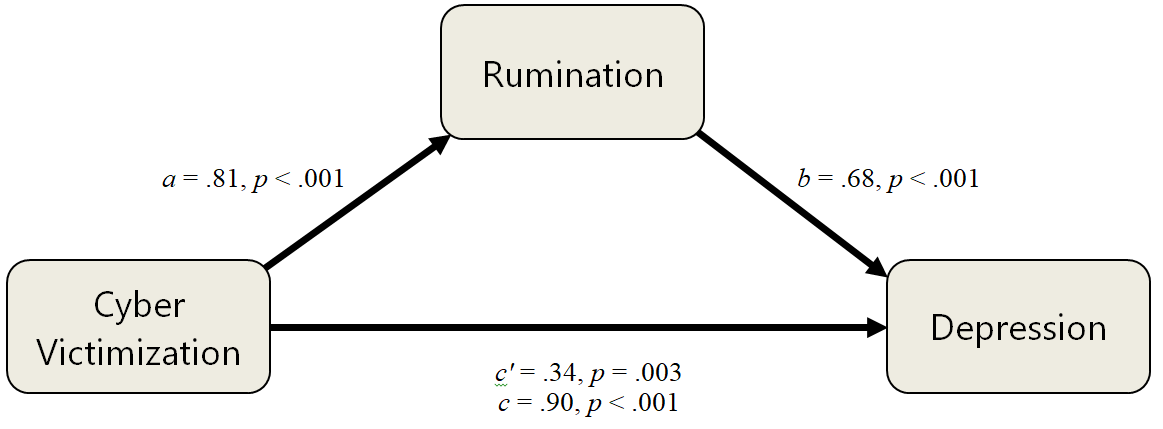
A mediation analysis was conducted to examine the indirect effects of CV on depression through rumination (Figure 1). Model coefficients are displayed in Table 2. Gender significantly covaried with rumination but not depression after controlling for rumination. Higher levels of CV significantly predicted higher levels of rumination (path a), and higher levels of rumination significantly predicted higher levels of depression (path b). The direct effect of CV on depression (c’) was significant, such that higher instances of CV predicted higher levels of depression. Importantly, the indirect effect (i.e., product of paths a and b) of CV on depression through rumination was significant, indirect effect = .56 (95% CI: .37, .76). Findings from this model suggest that higher instances of CV lead to higher rumination, which in turn leads to higher levels of depression.
| Consequent | |||||||
|---|---|---|---|---|---|---|---|
| Rumination | Depression | ||||||
| Antecedent | Coeff. | SE | p | Coeff. | |||
| CV | a | 0.81 | 0.1 | <.001* | c’ | 0.34 | |
| RUM | – | – | – | b | 0.68 | ||
| Gender | cv | -8.22 | 1.4 | <.001* | cv | -1.51 | |
| R2 = .16 | R2 = .52 | ||||||
| F(2, 390) = 38.44, p < .001 | F(3, 389) = 138.61, p < .001 |
Table 2: Model Coefficients for the Mediation Model.
Note. * significance at p < .01. Coefficients are unstandardized. Coeff = coefficient; SE = standard error; cv = covariate; a, b, and c’ represent the paths depicted in Figure 1. Table 2: Model Coefficients for the Mediation Model.
Conditional Process Analysis – ICS and AS Models
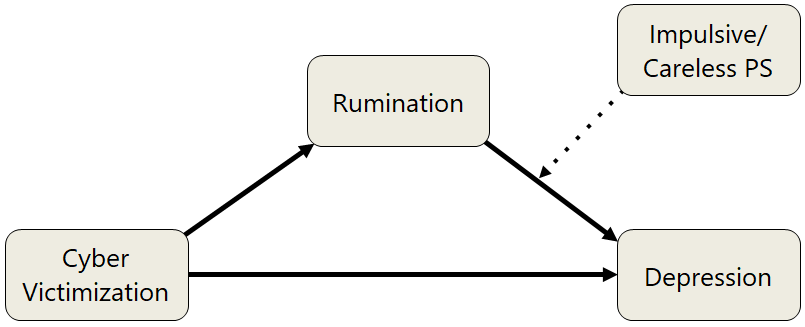
A moderated mediation analysis was conducted to examine whether the indirect effect of CV on depression through rumination differed in magnitude as a function of ICS problem-solving (Figure 2; model coefficients displayed in Table 3. Gender significantly covaried with rumination but not depression after controlling for rumination and ICS problem-solving. In correspondence with findings from the mediation model, higher CV predicted higher rumination (path a). The effect of rumination on depression was not contingent on ICS, as evidenced by the nonsignificant interaction coefficient (path b as a function of ICS) and the index of moderated mediation, index = .007, 95% CI: -.002, .017. Thus, the indirect effect of CV on depression through rumination does not depend on levels of ICS.
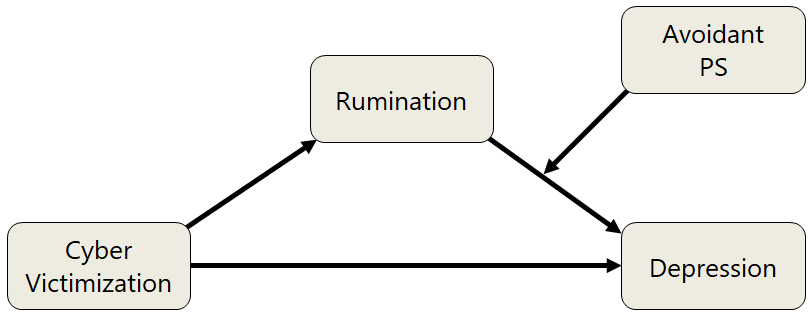
However, AS moderated this relationship Figure 3;
model coefficients displayed in Table 3. Gender significantly covaried with rumination but not depression after controlling for rumination and AS problem-solving. Higher levels of CV predicted higher rumination (path a), and the effect of rumination on depression was contingent on AS problem-solving, as evidenced by the significant interaction coefficient (path b as a function of AS) and the index of moderated mediation, index = .014, 95% CI: .005, .024. Specifically, when AS was low (-1 SD), the indirect effect was .42 (95% CI: .27, .60); when AS was average (at the mean), the indirect effect was .50 (95% CI: .33, .68); and when AS was high (+1 SD) the indirect effect was .58 (95% CI: .38, .79). Thus, as AS increases, the indirect effect of CV on depression through rumination increases. The findings suggest that the mediational effect in Figure 1 should be conceptualized as conditional, such that the indirect effect of CV on depression through rumination depends on levels of AS.
| Consequent | ||||||||
|---|---|---|---|---|---|---|---|---|
| Rumination | Depression | |||||||
| Antecedent | Coeff. | SE | p | Coeff. | SE | p | ||
| CV | a | 0.81 | 0.1 | <.001* | c’ | 0.28 | 0.1 | .015* |
| RUM | – | – | – | b 1 | 0.46 | 0.1 | <.001* | |
| ICS | – | – | – | b 2 | -0.2 | 0.3 | 0.436 | |
| RUM x ICS | – | – | – | b 3 | 0.01 | 0 | 0.107 | |
| Gender | cv | -8.11 | 1.4 | <.001* | cv | -2.23 | 1.2 | 0.056 |
| R2 = .16, F(2, 392) = 37.32, p < .001 R2 = .52, (5, 389) = 85.29, p < .001 | ||||||||
| CV | a | 0.82 | 0.1 | <.001* | c’ | 0.33 | 0.1 | .003* |
| RUM | – | – | – | b 1 | 0.31 | 0.1 | .012* | |
| AS | – | – | – | b 2 | -0.43 | 0.3 | 0.168 | |
| RUM x AS | – | – | – | b 3 | 0.02 | 0 | .007* | |
| Gender | cv | -7.92 | 1.4 | <.001* | cv | -2.08 | 1.1 | 0.064 |
| R2 = .16, F(2, 391) = 37.65, p < .001 R2 = .55, F(5, 388) = 95.21, p < .001 |
Table 3: Model Coefficients for the ICS and AS Conditional Process Models.
Note. * significance at p < .01. All coefficients are unstandardized. Coeff = coefficient; SE = standard error; cv = covariate; a, b, and c’ represent the paths depicted in Figure 1. Table 3: Model Coefficients for the ICS and AS Conditional Process Models.
Discussion
The present study sought to replicate previous mediational findings of rumination in the relationship between CV and depression, and to examine the unique role of AS in the context of CV. Most studies have been conducted with adolescents; thus the current study meaningfully contributes to the knowledge of CV in college students. Consistent with previous work, greater CV exposure predicted greater depression, and this relationship was mediated by rumination. AS moderated the rumination-depression association. Taken together, rumination in combination with avoidant behaviors exacerbated depression. As hypothesized, this moderating effect did not extend to ICS, highlighting the unique role of avoidance in the relationship between rumination and depression.
To better understand how CV impacts undergraduates, the present study sought to examine rumination as an explanatory factor between CV and depression. Rumination mediated this relationship, indicating that rumination plays a key role in the development/maintenance of depression. Responding to CV by ruminating can lead to depression, and create a negative feedback loop, causing more rumination as individuals continue feeling depressed, per response style theory. In adolescents, rumination mediated and moderated the relationship between CV and depression, perhaps because victimization may cause adolescents to ruminate about how their lives differ from their goals (e.g., they are bullied but aim to be socially accepted), in line with control theory [9]. Liu C [11] conceptualized similar results as evidence for response style theory, emphasizing that CV is a stressor that prompts individuals to ruminate. In past research, emotion regulation strategies, such as problem-solving and behavioral activation, are critical mechanisms that explain how rumination leads to greater depression. The unique role of AS in the present study reinforces the importance of problem solving and behavioral activation; when individuals avoid their problems rather than attempting to solve them (even if they are solving them impulsively) they experience more depression.
AS, but not ICS, moderated the relationship between rumination and depression. CV exposure led to increased rumination, and those with higher rumination who also endorsed higher tendencies to avoid problems were more likely to experience depression. Consistent with previous studies, in the present sample, AS and ICS were both related to depression and AS was related to more rumination [17, 23]. Higher ICS was also related to higher rumination, which was found cross-sectionally in just one of the four studies by Hasegawa and colleagues [24]. The current results are supportive of the conclusion of Hasegawa A [17] that ICS and rumination both predict depression, but through independent processes. Notably, rumination and impulsivity have been linked in past research [8]. Despite this connection, however, it does not appear that rumination and impulsivity work synergistically to cause or maintain depression.
However, avoidant behavior and rumination together appear to amplify the risks of depression. Though both maladaptive, AS seemingly reinforces feelings of inaction that one might be ruminating upon; comparatively, ICS, which includes hurried attempts to solve problems, does require some action. Researchers have posited that rumination functions as cognitive avoidance via attempting to avoid negative thoughts without attempting to cope with them [25]. In a serial mediation, Brockmeyer T [26] found that rumination predicted more avoidant behaviors, which predicted less motive satisfaction (defined as fewer positive reinforcements), which predicted greater depression. The moderation results of the present study may follow this same pattern: rumination predicts depression, and those with AS are at greater risk for depression because they do not get any positive reinforcement or motive satisfaction. These findings build upon previous studies [26, 27] showing relationships amongst executive function, problem-solving, rumination, avoidance, and depression by suggesting that cognitive avoidance may be a precedent of rumination, while avoidant behaviors may be a consequence.
When considering these findings, it is important to acknowledge their limitations. First, this study relied on self-report measures. The shortcomings of self- report victimization measures are well known [28]. That acknowledged, it is worth emphasizing that only frequently used, well validated measures were used [19]. Another aspect to be considered is the limited generalizability of the findings due to the predominantly White sample. This study built upon the studies conducted by Hasegawa and colleagues in a Japanese college sample, and these samples might demonstrate different relationships between depression, rumination, problem-solving and depression, which may extend the generalizability of these findings. Methodologically, the present study used a cross-sectional design, and this limits the interpretation of the mediational findings given that the mediators were collected at the same timepoint. While acknowledging the need for longitudinal replication of the current findings, this study’s findings were consistent with those found in both past cross-sectional [9] and longitudinal [11, 12] studies.
Despite these limitations, the current study replicated previous findings that rumination mediates the relationship between CV and depression in college students, indicating that rumination might be a key explanatory factor between victimization and depression in both adolescents and emerging adults [9, 12]. The moderating role of AS indicated that exposure to victimization can lead to rumination, and avoidant behaviors typical of AS lead to worsened mood. Future work should assess the longitudinal relationships between CV, problem-solving styles, rumination, and depression in college students. Another contribution of this study was its attempt to explicate the mechanisms linking rumination and depression. The results established the importance of avoidance in this relationship, and future research should include studying the type of rumination (e.g., brooding) and the content of rumination (e.g., related to CV experiences). Although 88% of undergraduates in the present study experienced CV, most published studies of CV focus on adolescents [29, 30]. The present findings provide a foundation for future longitudinal research to study how interventions that target rumination and avoidance may protect against depression in college students who have experienced CV [31, 32, 33, 34, 35, 36, 37, 38, 39, 40].
Conflict of Interest Statement
On behalf of all authors, the corresponding author states that there is no conflict of interest.
References
-
Landoll RR, La Greca AM, Lai BS, Chan SF, Herge WM (2015) Cyber victimization by peers: Prospective associations with adolescent social anxiety and depressive symptoms. Journal of Adolescence 42: 77-86.
-
Yildiz Durak H, Saritepeci M (2020) Examination of the relationship between cyberbullying and cyber victimization. Journal of Child and Family Studies 29(10): 2905-2915.
-
Tuck AB, Thompson RJ (2021) Social networking site use during the COVID-19 pandemic and its associations with social and emotional well-being in college students: Survey study. JMIR Formative Research 5(9): e26513.
-
Alrajeh SM, Hassan HM, Al-Ahmed AS, Hassan DA (2021) An investigation of the relationship between cyberbullying, cybervictimization and depression symptoms: A cross sectional study among university students in Qatar. PLOS ONE 16(12): e0260263.
-
Mitchell SM, Seegan PL, Roush JF, Brown SL, Sustaíta MA, et al. (2018) Retrospective Cyberbullying and Suicide Ideation: The Mediating Roles of Depressive Symptoms, Perceived Burdensomeness, and Thwarted Belongingness. Journal of Interpersonal Violence 33(16): 2602-2620.
-
Wright MF (2016) Cyber victimization on college campuses: Longitudinal associations with suicidal ideation, depression, and anxiety. Criminal Justice Review 41(2): 190-203.
-
Nolen-Hoeksema S, Wisco BE, Lyubomirsky S (2008) Rethinking Rumination. Perspectives on Psychological Science 3(5): 400-424.
-
Watkins ER, Roberts H (2020) Reflecting on rumination: Consequences, causes, mechanisms and treatment of rumination. Behaviour Research and Therapy 127: 103573.
-
Chu XW, Fan CY, Liu QQ, Zhou ZK (2018) Rumination mediates and moderates the relationship between bullying victimization and depressive symptoms in Chinese early adolescents. Child Indicators Research 12(5): 1549-1566.
-
Chang EC, Liu J, Yi S, Jiang X, Li Q, et al. (2020) Loneliness, social problem solving, and negative affective symptoms: Negative problem orientation as a key mechanism. Personality and Individual Differences 167: 110235.
-
Liu C, Liu, Z, Yuan G (2020) The longitudinal influence of cyberbullying victimization on depression and posttraumatic stress symptoms: The mediation role of rumination. Archives of Psychiatric Nursing 34(4): 206- 210.
-
Feinstein BA, Bhatia V, Davila J (2014) Rumination mediates the association between Cyber-victimization and depressive symptoms. Journal of Interpersonal Violence 29(9): 1732-1746.
-
Nolen-Hoeksema S (1991) Responses to depression and their effects on the duration of depressive episodes. Journal of Abnormal Psychology 100(4): 569-582.
-
Martin LL, Tesser A (1996) Some ruminative thoughts. In: Ruminative thoughts. pp: 1-47. Lawrence Erlbaum Associates.
-
D Zurilla TJ, Nezu AM, Maydeu-Olivares A (2004) Social problem solving: Theory and assessment. Chang EC, D’Zurilla TJ, et al. (Eds). American Psychological Association.
-
Nezu AM (1987) A problem-solving formulation of depression: A literature review and proposal of a pluralistic model. Clinical Psychology Review 7(2): 121- 144.
-
Hasegawa A, Kunisato Y, Morimoto H, Nishimura H, Matsuda Y (2018) How do rumination and social problem solving intensify depression? A longitudinal study. Journal of Rational-Emotive & Cognitive-Behavior Therapy 36(1): 28-46.
-
Landoll RR, La Greca AM, Lai BS (2013) Aversive Peer Experiences on Social Networking Sites: Development of the Social Networking-Peer Experiences Questionnaire (SN-PEQ). Journal of Research on Adolescence 23(4): 695-705.
-
Moore KD, Fairchild AJ (2019) Investigating construct validity of the Cyber-Peer Experiences Questionnaire. European Journal of Psychological Assessment 35(6): 763-770.
-
D Zurilla TJ, Nezu AM, Maydeu-Olivares A (2002) Social problem-solving inventory-Revised (SPSI-R). Multi- Health Systems.
-
Eaton WW, Smith C, Ybarra M, Muntaner C, Tien A (2004) Center for Epidemiologic Studies Depression Scale: Review and Revision (CESD and CESD-R). In: The use of psychological testing for treatment planning and outcomes assessment: 3rd (Edn.), Instruments for adults pp: 363-377. Lawrence Erlbaum Associates Publishers.
-
Hayes AF (2018) Introduction to mediation, moderation, and conditional process analysis: A regression-based approach 2nd (Edn.), Guilford Press.
-
Hasegawa A, Hattori Y, Nishimura H, Tanno Y (2015a) Prospective associations of depressive rumination and social problem solving with depression: A 6-month longitudinal study. Psychological Reports 116(3): 870- 888.
-
Hasegawa A, Yoshida T, Hattori Y, Nishimura H, Morimoto H, et al. (2015b) Depressive rumination and social problem solving in Japanese university students. Journal of Cognitive Psychotherapy 29(2): 134-152.
-
Dickson KS, Ciesla JA, Reilly LC (2012) Rumination, worry, cognitive avoidance, and behavioral avoidance: Examination of temporal effects. Behavior Therapy 43(3): 629-640.
-
Brockmeyer T, Holtforth MG, Krieger T, Altenstein D, Doerig N, et al. (2015) Preliminary evidence for a nexus between rumination, behavioural avoidance, motive satisfaction and depression: Rumination, behavioural avoidance, motive satisfaction and depression. Clinical Psychology & Psychotherapy 22(3): 232-239.
-
Nezu AM (1986) Cognitive appraisal of problem solving effectiveness: Relation to depression and depressive symptoms. Journal of Clinical Psychology 42(1): 42-48.
-
Lance CE, Vandenberg RJ (Eds.), (2015) More statistical and methodological myths and urban legends. Routledge.
-
Chen L, Ho SS, Lwin MO (2017) A meta-analysis of factors predicting cyberbullying perpetration and victimization: From the social cognitive and media effects approach. New Media & Society 19(8): 1194-1213.
-
Guo S (2016) A Meta-analysis of the predictors of cyberbullying perpetration and victimization: Cyberbullying prpetration and victimization. Psychology in the Schools 53(4) 432-453.
-
D Zurilla TJ, Chang EC, Nottingham EJ, Faccini L (1998a) Social problem-solving deficits and hopelessness, depression, and suicidal risk in college students and psychiatric inpatients. Journal of Clinical Psychology 54(8): 1091-1107.
-
D Zurilla TJ, Maydeu-Olivares A, Kant GL (1998b) Age and gender differences in social problem-solving ability. Personality and Individual Differences 25(2): 241-252.
-
Hasegawa A, Nishimura H, Mastuda Y, Kunisato Y, Morimoto H, et al. (2016) Is trait rumination associated with the ability to generate Effective problem solving strategies? Utilizing two versions of the Means-Ends Problem-Solving Test. Journal of Rational-Emotive & Cognitive-Behavior Therapy 34(1): 14-30.
-
Haugh JA (2006) Specificity and social problem-solving: Relation to depressive and anxious symptomology. Journal of Social and Clinical Psychology 25(4): 392-403.
-
Jenaro C, Flores N, Frías CP (2018) Systematic review of empirical studies on cyberbullying in adults: What we know and what we should investigate. Aggression and Violent Behavior 38: 113-122.
-
Kim H, Rackoff GN, Fitzsimmons-Craft EE, Shin KE, Zainal NH, et al. (2022) College mental health before and during the COVID-19 pandemic: Results from a nationwide survey. Cognitive Therapy and Research 46(1): 1-10.
-
Miller SE, Avila BN, Reavis RD (2020) Thoughtful friends: Executive function relates to Social Problem Solving and Friendship Quality in Middle Childhood. The Journal of Genetic Psychology 181(2-3): 78-94.
-
Noreen S, Dritschel B (2022) In the here and now: Future thinking and social problem-solving in depression. PLOS ONE 17(6): e0270661.
-
Robinson MS, Alloy LB (2003) Negative cognitive styles and stress-reactive rumination interact to predict depression: A Prospective Study. Cognitive Therapy and Research 27(3): 275-291.
-
Zhu C, Huang S, Evans R, Zhang W (2021) Cyberbullying among adolescents and children: A comprehensive review of the global situation, risk factors, and preventive measures. Frontiers in Public Health 9.
- Occupational Stress and Mental Health Outcomes Among Police Officers: A Mini Review
- The Experience of Counterproductive Leadership on Mental Health and Impact on Retention in U.S. Marines: A Phenomenological Study
- Nomophobia in the Digital Age: A Study on College and University Students
- Emotional Regulation in Children with Autism and Learning Disabilities
- Antisemitism on American College Campuses and Its Impact on Jewish Students
- Exploring the Role of Empathy in the Associations of Family Functioning and Purpose in Life with Attitude towards Abortion among Undergraduates: A Moderation Analysis