
The Impact of Outside Friendships on Relational Satisfaction for Dating and Married Couples
The influence of outside friendship on Couples’ relational satisfaction (RS) was explored with a sample of 444 romantically involved participants from central Alberta. There were, therefore, 222 couples, 89 of the couples were dating or engaged; 133 of the couples were Married or cohabitating. All couples were heterosexual. The primary focus of the study was to identify the relationship between the number and quality of outside friendships and relational satisfaction of the couples. Friendships were divided into three types: unshared (individual) friends, family friends, and shared (mutual) friends. A combination of the George-Wisdom Marital Satisfaction Scale and the Kansas Marital Satisfaction Scale measured relational satisfaction. Results found that the quality of friendships was one of the largest predictors of relational success for both marrieds and dating couples accounting for 37% of the variance for men and 47.5% of the variance for women. Additional results found that individual friendships are a serious liability to couple satisfaction, family and mutual friends are associated with greater couple satisfaction. Finally, in regression analyses the families supporting the relationship and liking the partner were the greatest predictors of relational satisfaction.
Introduction
Nietzsche’s stated “It’s not lack of love but lack of friendship that makes for unhappy marriages.” Nietzsche may have never published in a top Psychological journal, but his statement underlies the purpose of this study. While romantic relationships are designed to fulfill many affiliation needs, it cannot supply all of them. This research focuses on the question, What role does outside friendship play in supplying those needs? and, what impact does supplying those needs have on the relational satisfaction of the couple?
Several questions arise in this context. (a) What types of friendships enhance couple relational satisfaction? (b) What types of need fulfillment benefits the couple? (c) What types of need fulfillment detract from or threaten the couple’s relationship? (d) is the couple relationship even benefitted from outside friendships? On this latter point, past research has found that when couples are too dependent on each other for their needs, that the relationship stagnates and too much pressure is experienced [1, 2]. The general implication of these article is that no single individual can fulfill all the social needs of another, and that friends take up some of that slack.
Different forms of social contact can be broadly defined as friendships. For instance, there are individual friendships that involve one member of the couple but not the other. In this study these are called “Individual Friends”. Another source of social contact are family members. For the sake of this paper, these will be called “Family Friends”. Finally, there are friendships shared by the couple. This may include mutual friendship with another individual or another couple. These are called “Mutual Friends”. All three types may have an impact on the relational satisfaction of the couple.
In this study, Relational Satisfaction (“RS”) is measured by the George-Wisdom Marital Satisfaction Scale [3] and Kansas Marital Satisfaction Scale [4]. Broad categories of influencing variables include standard demographics, questions about specific friendships (including the issue of need fulfillment) and their influence on the couples’ relationship. Then we explore specific positive qualities (such as shared activities, support in times of loss) and negatives qualities (such as jealousy, threat or neglect) in the three categories of friendship. Finally, three different personality constructs (self-esteem, social skills, and agreeableness) are measured as possible predictors.
Literature Review
The impact of outside friendship on couple satisfaction boasts a rich literature over many decades. To provide context, we cite some of the broad themes that have been explored: the importance of a rich network of friends for couple satisfaction [5, 6, 7] the changing dynamic of friendship relationships over time [8]; the importance and frequency of family interactions [9] factors that increase or decrease the likelihood of the dissolution of a couple relationship [10, 11] the impact of friendships on key personality constructs such as self-esteem [12] the impact of Supportive communication on couples satisfaction [13] the destructive influence on couples satisfaction of social isolation due to the COVID pandemic [14]. The differential perception of relational satisfaction of the couple and friends of the couple [15] substantial gender differences in the amount and quality of help provided for a same-sex friend [16] how the quality of the couple relationship influence the type of friendships formed [17] and an innovative study that verified that the monetary value of time spent with friends (as measured by increase in couple satisfaction) is a thousand times more than an equivalent amount of time spent working for money [18]. All support the axiomatic conclusion: friendship is beneficial and important to couple satisfaction.
As stated earlier in the Introduction, this study explores the impact of three different types of friends: Individual Friends (enjoyed by one member of the couple but not the other), Family Friends, and Mutual Friends (individuals or couples who are friends of both members of the couple). Despite diligent search, authors did not find any research that employed a similar categorization. There is a considerable literature associated with Family Friends and a different literature that explores the impact of Mutual Friends. There is surprisingly little about Individual Friends except the potential threat of cross-sex friends to heterosexual couples.
Influence of individual friends on couple relationships. The bulk of literature in this area appears to focus on the threat of opposite sex friends for heterosexual, romantically involved couples. Allen and Baucom [19] investigate the different motivations of men and women for extra-dyadic sexual involvement. David Buss [20] and Dijkstra, et al. [21] explore the concept of “human mate guarding” and the strategies employed to prevent partner poaching or preventing one’s partner from defecting. A dissertation by Corretti [22] reported the negative impact of cross-sex friendships (number of friends, frequency of contact) on dating couples’ relational stability and satisfaction. Amati [23] found that intense non-family relationships (frequency of contact) and quality of friendship (satisfaction with the friendship) was associated with greater life satisfaction of couples. However, this article did not specify just individual friends and measured life satisfaction rather than couple relational satisfaction. Messman, et al. [24] notes that in a heterosexual couple relationship, that opposite sex friends pose a possible threat and explore the ways that individuals work to ensure that the relationship remains platonic. This is just a sampling of the literature on the impact of cross- sex friendships and the conclusion is evident: Cross-sex friends pose a significant threat to a heterosexual couple relationship.
Family friends in couple relationships. Jokes and stereotypes aside, the presence of in-law relationships are associated with greater RS [25] as is the support of parents of their children’s marriages [26]. Equally as strong was the finding that strain between parents and their married children was associated with poorer RS [27, 28]. approval from friends and family increases couples’ stability [29, 30] Ketokivi [31] with a sample of heterosexual Finns, found that family interactions generates ‘exclusive family intimacies’ that fulfills needs that other friendships cannot.
Mutual friends in couple relationships. There is strong support that couple to couple friendship increases couples’ relational satisfaction [32], helps to enhance the passion in a couple’s relationship [33], that greater involvement and greater self disclosure in couple to couple relationships enhances the relational satisfaction of both couples [34], and that as the relationship becomes closer the number of shared friends increases [35]. Greif, et al. [32] in their book Two Plus Two: Couples and their Couple Friends document many studies that verify the substantial benefit of couple to couple relationships in keeping a relationship alive and vibrant.
Personality constructs. While the present study does not focus on personality traits of the subjects, the influence of certain personality constructs on RS is so widely acknowledged that their measurement may be used as covariates in some of the analyses, or, in structural modeling. This allows us to determine their unique contribution to the dynamic of friendship variables and relational satisfaction. Past literature has revealed that high self-esteem, good social skills, and agreeableness are associated with greater relational satisfaction [36, 37, 38, 39, 40, 41, 42, 43, 44, 45]
Positive and negative qualities of friendship. The benefits of friendships were items selected from two online sources: The Mayo Clinic [46] and Christine Koh [47]. The Koh research include all eight selected items used in the present study; the Mayo Clinic provided support for six of them. The benefits of friendship in this study are: Counsel, shared goals, support in time of loss, inspiration to grow or improve, shared activities, entertainment, celebrating milestones, and a place of belonging/acceptance.
The six negative qualities were all selected from the content in Jan Yager’s book, When Friendship Hurts [48]. They include the following ways that negative qualities or events impact the couple relationship: generate feelings of jealousy/ threat, generate feelings of neglect, drain of energy time or resources, make life too busy or complicated, undermine the relationship through criticism or negativity, undermine the relationship through gossip, broken confidence or betrayal.
In that jealousy and neglect have been studied so extensively we continue further with these two constructs.
Jealousy. Jealousy plays a major role in the formation and continuation or ending of romantic relationships [49, 50, 51]. A common expectation of dating couples is that their partner gives up close personal friendships with persons of the opposite sex [52, 53] jealousy is often studied in the context of attachment style [54, 55, 56] and gender differences suggest that women experience more jealousy than men [52]. The topic of jealousy ties into the challenge of continued interaction with individual opposite-sex friends.
Neglect. Neglect is more likely in the context of same-sex friends, particularly if one feels their partner is spending too much time with friends at their expense. Perceived neglect is highly correlated with poorer RS [57] and a desire for the partner to actively engage [58]. Neglect is also associated with lessened intimacy between couples [59].
Peripheral research. Research about friendships in the workplace often provides parallels with the present study. Co-workers are often beneficial in helping friends deal with interpersonal stress [60]. Workplace friendships are an important source of informal support in marriage and child rearing [61]. High divorce rate among co-workers is significantly associated with divorce of the couples [62] members of a couple who are less committed to improving their marriage (“marriage work”) are more susceptible to the negative input of coworkers [63] suggesting, that the quality of friendships also has a significant impact on the couples’ satisfaction. Carlson, Thompson, Hackney, Crawford research reveals that when workplace friends support the individual, the couple often benefits and then they go on to explore some unique gender differences.
Hypotheses
- Based on these and other articles and the theoretical perspectives that undergird them, the following outcomes are anticipated:
- The benefit of outside relationships will enhance couples’ relational satisfaction far more than detract from it.
- Individual opposite-sex friends will have a negative impact on Relational Satisfaction for both.
- The number and frequency of interaction with Family Friends will be associated with greater relational satisfaction.
- The number and frequency of interaction with Mutual Friends will be associated with greater relational satisfaction.
- Positive personality constructs (self-esteem, social skills, agreeableness) by both the couple and the friends of the couple will be associated with greater relational satisfaction.
- The positive components of friendship will be associated with greater relational satisfaction; the negative components will be associated with poorer relational satisfaction.
- Outside friendship that exhibits support and encouragement of the relationship will be associated with greater couple satisfaction.
- Negative outside friendships will be associated with poorer relational satisfaction.
- Provision of needs by outside friends remains exploratory.
There are situations in which provision of such need enhances the relationship and just as clearly instances in which provision of need threatens or compromises the relationship.
Summary
The primary dependent variable is Relational Satisfaction (RS) a combination of the George-Wisdom Scale (GWS) and the Kansas Marital Satisfaction Scale (KMS). Major predictors include standard demographics, Three personality constructs (self-esteem, agreeableness, social skills); actual interactions in three primary types of friendships (Individual Friends, Family Friends, and Mutual Friends). Then, the global effect of friendship is assessed by conducting correlations and regressions with the 14 characteristics-of-friendship questions—eight positive characteristics; six negative characteristics.
Method
Participants
A total of 444 subjects participated. They were assessed as dyads and were identified as the “subject” and the “partner”. Thus, there were 222 subject-partner pairs: 133 couples were married or cohabiting and 89 couples were dating or engaged. All couples were heterosexual.
Gender breakdown included 222 women and 222 men. The ethnic composition of the group included 237 Whites (53%), 113 Blacks (25%), 61 Asians (14%), 26 Hispanics (6%) and 7 DTS or other (2%). The mean age of marrieds was 44.2 (range 21 - 81); the mean age of the dating couples was 25.3 (range 17 - 48). Marrieds’ educational levels found those married with a mean of 3.6 years of college and the dating couples with 3.2 years of college (range: <HS - doctorate) This study was approved by the university Ethics Board prior to data collection.
Materials
Materials included separate but identical questionnaires for the subjects and the partners. The questionnaire was crafted with gender-neutral wording allowing men or women to complete the same questionnaire. This questionnaire was presented in two formats: a hard-copy version and an online version accessed through SurveyMonkey Inc. There were slight differences of formatting of the two versions.
The questionnaires were structured in the following way: Half of the first page (or first screen in the online version) included instructions that identified the sponsoring organization, brief description of the study, assurance of confidentiality, informed consent, debriefing and further instructions about how to complete the hard-copy or the online versions. Instructions were followed by 12 demographic items, then 15 relational satisfaction questions, 39 questions assessing Individual Friends, Family Friends, and Mutual Friends; 14 questions about the general impact of friendships—asked for each of the three groupings (Individual, Family, Mutual) yielding a total of 42 questions; and concluded with 25 questions that measured social skills, self-esteem, and agreeableness. Procedure Students from an undergraduate research-methods class at a private liberal arts university in Central Alberta collected most of the data. Two different methods of assessment were used: 42 couples (N = 84) completed the hard copy version of the questionnaire and 180 (N = 360) completed the online version.
For hard-copies, each participant completed their survey, sealed it in a coded envelope (to ensure that couples were paired correctly) and returned the envelopes to the researcher who contacted them or to one of several collection points on campus. For online forms, completion of the questionnaire automatically forwarded data to the Survey Monkey data base.
All data were entered and analyzed. Irregular or incomplete forms were discarded prior to data entry. The most common type of discarded form was 94 individuals who completed the questionnaire but their partner did not.
Dependent Variables
The dependent variable was a composite of two different relationship satisfaction questionnaires: The 12-item George-Wisdom Relationship Satisfaction Scale (GWS) [3] and the 3-item Kansas Marital Satisfaction Scale (KMS) [4]. The George-Wisdom scale asks questions about 12 specific areas that measure relational satisfaction, including: security, feeling loved, experience of joy, appreciation, trust, feeling valued, shared activities, fun and laughter, encouragement, affection, commitment, and support.
The KMS asks three global questions about satisfaction with the relationship, satisfaction with their partner, and how well the partner fulfills their needs. All 15 items were assessed on 7-point scales; anchors varied based on the nature of the questions. The final measure of RS was the mean of the 15 items. These 15 questions, with a mix of specific and global, yielded excellent internal consistency (alphas of .92 for men and .93 for women) and were psychometrically sound (kurtosis and skewness measures between ± 1.25).
Demographics
The following demographics were assessed: gender, ethnicity (White, Black, Hispanic, Asian, other), relationship status (dating, engaged, married, cohabiting), duration of the relationship, age, number of children living at home, ages of their children, and level of education (<HS to Doctorate).
The education variable. Many studies include an education variable typically identifying the number of years of schooling. Rarely does this variable have any impact on life satisfaction or relational satisfaction. In the present study we asked three questions: (a) number of years of schooling (<HS to doctorate), (b) how good a student they were (very poor to outstanding), and (c) present attitude toward learning (total disinterest to passionate). The inclusion was frankly exploratory to see whether any of these variables, composites of the variables, or contrast between partners on the variables had an impact on Relational Satisfaction.
Independent Variables
Personality traits. Three personality traits were measured: Social Skills, Self-Esteem, and Agreeableness with a total of 25 questions. Each item was scored on 7-point scales, each scale measuring the presence of absence of a particular construct. Anchors of each varied based on the content of each. Seven items were reverse coded to control for response bias. Each trait was the mean of the relevant items. Thus, the final measure for all three ranged from little of the related quality (1) to a great deal (7). The measure of agreeableness was taken from the Big 5 Personality Inventory [64] selfesteem from the Kling & Hyde Self-Esteem Scale [44] and Social skills with the Social Skills Scale [65].
Impact of specific friendships. Three categories of friendships were assessed: Individual Friends, Family Friends, and Mutual Friends. Individual Friends involve individuals who were friends with one partner but not the other. Family Friends involve family members (biological or in-law) who may be friends with one or both partners. Mutual Friends were individuals or couples who were friends with the couple. For each of these three categories, participants were asked the number of friendships in each category and then responded to specific questions about the top two friends in each category.
For instance, for Individual Friends participants were asked the number of friends in this category (from none to > 5). Then they were asked to think of their closest Individual Friend. For this particular individual they were asked: (a) whether the friend was same or opposite sex; (b) frequency of interaction with this friend [from rarely (1) to > once a day (7)]; (c) does the friend meet certain needs not supplied by your partner [from never (1) to often (7)]; (d) the influence of this friend on them personally [from negative (1) to positive (7)]; (e) how supportive they are of your relationship with your partner [from antagonistic (1) to totally supportive (7)];
and how does this friend feel about your partner [from very negative (1) to very positive (7)]. In text that follows, this final question is often referred to as “like the partner”.
Then the participants were asked to think about their second closest Individual Friend and were asked the same questions. Then the same set of questions was employed to assess the top two Family Friends and the top two Mutual Friends. The same- or opposite-sex questions was not included; otherwise the questions were identical to those used above. Thus, participants answered questions for a total six different friends: two Individual Friends, two Family Friends, and two Mutual Friends.
General impact of friendships. The questionnaire identifies eight potential benefits of friendship (counsel, pursue meaningful goals, support, inspiration, shared activities, entertainment, celebrating milestones, and belonging/ acceptance). It further identifies six potential liabilities of friendship (jealousy/threat, feelings of neglect, draining energy, making life too complicated, criticism, gossip, broken- confidence/betrayal). These 14 influencers were measured for all three types of friendships (Individual, Family, Mutual). Thus, there were a total of 42 possible answers (14 topics x 3 types of friendship) in this section.
All questions were measured on 7-point scales with anchors of never/rarely (1) to occasionally (4) to frequently (7). The eight benefits of friendship were preceded by the sentence “How often do you feel that friendships enhance your relationship in the following way?” Then the topics followed (e.g., Providing constructive counsel, Pursuing meaningful goals together and so forth) with a scale to respond for the three types of friendship. The six liabilities of friendship were preceded by the question, “How often do you feel that friendships hurt your relationship in the following ways?” Then the topics followed (e.g. Generating feelings of jealousy or threat, generating feelings of neglect and so forth). The 7-point response scales were identical to those used for the benefits of friendship. Values for both individual qualities and composites of those qualities were used in analyses.
Nature of Analysis
Measure of psychometrics determine the fitness of continuous variables for further analysis. Bivariate correlations explore the primary influence of all predictors on relational satisfaction and on each other. T-tests and one- way ANOVAs determine whether significant differences occur within gender, ethnicity and type of relationship (dating vs. married). Regressions determine which factors uniquely influence men’s or women’s relational satisfaction and the strength of those relationships. Finally, structural equation modeling is employed to create a composite picture of the inter-relationship of friendship factors that impact relational satisfaction.
Results
Psychometrics. For all continuous variables used in analyses, almost all displayed from excellent (skewness and kurtosis between ± 1) to acceptable (skewness and kurtosis between ±1.6) [66]. No variable displayed problems with skewness, but among indicators there were instances of high kurtosis. This showed up particularly for questions related to supporting-the-relationship and liking-the-partner (for all three types of friendships) due to the majority of respondents rating “7” to indicate full support and liking. Among the 42 global indicators of friendship, there was occasionally high kurtosis for the opposite reason: For negative qualities (threat, neglect, criticism, betrayal) the majority of respondents rated “1” (never) for these qualities. The problem resolved when composites of these variables were created.
A phrase used throughout the Results and Discussion is “in all four settings”. This refers to the four possibilities for criss-crossed questions for the couple: The husband’s quality influences (a) his own RS, (b) his partner’s RS; the woman’s quality influences (c) her own RS and (d) her partner’s RS.
Internal consistency measures (coefficient α) of multiple-indicator variables found the following results: Note: the first alpha is for men, the second alpha for women. αs= .92, 93; self-esteem, αs= .72, .73; social skills, αs= .62, .59 agreeableness, αs= .75, .70.
The influence of demographics. Demographics, in general, had little impact on relational satisfaction. The age variables had a modest but significant influence in all four settings: if the man was older the man had lower RS (r = -.14, p = .02) as did the woman (r = -.12, p = .04). If the woman was older the man had lower RS (r = -.16, p = .01) and the woman did as well (r = -.15, p = .01). The educational variables were constructed in hope that we might find a significant influence if number-of- years-of-schooling was augmented by “how good a student were you?” And “how much do you enjoy learning now?” The results were disappointing. None of the three constructs (or combinations of the three or discrepancy between them) had any impact on relational satisfaction.
Gender differences. Men and women did not differ on ratings of relational satisfaction. However, there were some differences among the predictors. Women were found to (a) have better social skills [5.39 vs. 5.20; t(221) = -2.97, p = .003]; (b) be more agreeable [5.62 vs. 5.42, t(220) = -2.94, p = .004]; (c) spent more time in family interaction [4.69 vs. 4.34; t(216) = -3.73, p < .001]; (d) had fewer opposite-sex friends [.41 vs. .24, t(221) = 3.41, p = .001] and, in this data set, (e) were younger [35.7 vs. 37.6, t(221) = 6.877, p < .001].
Differences between married and dating couples. The following differences are found in the comparisons of the dating couples compared to the married or cohabiting couples. As a starting point the differences are not great. There were 10 instances in which Cohen’s d was greater than .4; nine instances of dating couples rating higher than marrieds; only one in which marrieds rated higher than dating. The differences follow in order from greatest effect to least based on Cohen’s d. Dating couples experience greater frequency of contact with mutual friends than marrieds [women: 4.33 vs 3.57; t(213) = 6.00, p < .001 d = .83; men: 4.31 vs 3.57; t(213) = 5.38, p < .001 d = .75]. Dating women have more individual friends [4.33 vs 3.57; t(213) = 6.00, p < .001 d = .55]. Dating women experience more liabilities from individual friends [2.08 vs 1.68; t(213) = 3.45, p = .001 d = .47]. Dating women have more needs met by family members [4.20 vs 3.53; t(213) = 3.44, p = .001 d = .47]. Dating men experience more liabilities from individual friends [2.10 vs 1.64; t(213) = 3.42, p = .001 d = .47]. Dating men also experience more benefits from individual friends [4.93 vs 4.34; t(213) = 3.07, p = .002 d = .42]. Dating men have more opposite-sex friends [.562 vs .308; t(213) = 2.99, p = .001 d = .41]. And, dating men have greater frequency of interaction with individual friends [4.19 vs 3.65; t(213) = 2.96, p = .003 d = .42]. The only instance of marrieds rating higher than dating couples (with a Cohen’s d > .4) was that married women had more family friends [4.07 vs 3.27; t(213) = -3.01, p = .003 d = -.41]. Since most differences involve only the relative difference of number of friends in different categories, in analysis that follow the two categories (marrieds and dating) are combined.
The Influence of Personality traits
The personality traits behaved as expected. The man’s self-esteem was associated with higher RS for himself (r = .24, p < .001) and for his partner (r = .15, p = .013). The woman’s self-esteem followed a similar pattern: Higher RS for herself (r = .27, p < .001) and for her partner (r = .18, p = .003). The man’s social skills had a significant impact on both the man’s RS (r = .28, p < .001) and the woman’s (r = .24, p < .001). Interestingly the woman’s social skills had only a modest impact on the man’s RS (r = .13, p = .032) and none at all on her own. The man’s agreeableness had a significant influence on his own RS (r = .22, p < .001) and on his partner’s (r = .19, p = .002). The woman’s agreeableness had no impact on either partner.
The Influence the Six Friends on Relational Satisfaction
First a brief overview and then detail: (1) For individual, opposite-sex friends, the impact on relational satisfaction was uniformly negative for both partners. (2) The actual number of friends enhanced relational satisfaction for Family and Mutual Friends but had no impact in the Individual Friend setting. (3) The power factors were “support of the relationship” and “like the partner”. In all three settings the impact was robust, predicting higher relational satisfaction for both men and women. Now detail.
Individual Friends. The number of individual friends and the frequency of interaction had no impact on RS for either partner. The number of men’s opposite-sex friends had a negative impact on both his own RS (r = -.23, p < .001) and his partner’s (r = -.18, p = .003). Women showed a similar pattern as the number of her opposite-sex friends had a negative impact on her own RS (r = -.16, p = .008) and her partner’s (r= -.23, p < .001).
“Needs being fulfilled” followed a similar negative pattern. If the man had his needs fulfilled by an individual friend it diminished his own RS (r = -.19, p = .004) and his partners (r = -.13, p = .031). When the woman’s needs were fulfilled by individual friends it diminished her own RS (r = -.28, p < .001) and her partner’s (r = -.15, p = .018).
The power factors were “support of the relationship” and “liking the partner”. Significance was < .001 for all correlations. For the man, high scores in these categories benefited his own RS (r_s = .34, .35) and his partners (_r_s = .24, .22). For the woman a similar pattern immerged: benefit to her own RS (_r_s = .44, .40) and to her partner’s (_r_s = .24, .22). Family Friends. The greater the number of family friends the greater the RS for both men and women. For the man, more family friends was associated with both his own RS (_r = .17, p = .007) and his partner’s (r = .13, p = .024). A similar pattern emerged for the woman: more family friends was associated with both her own RS (r = .21, p = .001) and her partner’s (r = .15, p < .015).
“Needs being fulfilled” by family members, in contrast to individual friends, had no negative impact on relational satisfaction for either the man or the woman. However, whether family relationships were positive or negative had a robust influence. Negative family relationships with the man had a negative impact on both his own RS (r = .31, p < .001) and his partners (r = .22, p < .001). A similar pattern emerged for women: Negative family relationships for the woman had a negative impact on both her own RS (r = .20, p = .001) and on her partners (r = .13, p = .025). Note: the positive correlation simply identifies positive family positive couple RS; negative family negative couple RS.
The power factors of “support of the relationship” and “liking the partner” were even more influential here; significance < .001 for all. For man, high scores in these categories benefited his own RS (_r_s = .43, .38) and his partners (_r_s = .31, .35). For women, benefit to her own RS (_r_s = .47, .52) and to her partner’s (_r_s = .29, .25).
Mutual Friends. As with family friendships, the greater the number of mutual friends the greater the RS for both men and women. For men, more mutual friends was associated with both his own RS (r = .24, p < .001) and his partners (r = .18, p = .003). For women the number of Mutual Friends enhanced her RS but only slightly (r = .12, p = .036).
“Needs being fulfilled” followed a pattern similar to individual friends. If the man had his needs fulfilled by Mutual Friends it diminished his own RS (r = -.26, p < .001) and his partners (r = -.23, p < .001). When the woman’s needs were fulfilled by mutual friends it diminished her own RS slightly (r = -.14, p = .020) but did not affect her partner.
The power factors of “support of the relationship” and “liking the partner” continued the general trend; significance < .001 for all. For the man, high scores in these categories benefited his own RS (_r_s = .31, .41) and his partners (_r_s = .22, .34). For women, there was benefit to her own RS (_r_s = .44, .45) and to her partner’s (_r_s = .28, .28).
The Influence the Positive and Negative Qualities of Friendship
To set the context, recall that eight positive qualities of friendships (counsel, set goals, support in times of loss, inspiration, activities, fun, celebrate milestones, provide a sense of belonging) and six negative qualities of friendship (jealousy/threat, neglect, drain energy, complicate life, criticism, betrayal) were explored in all three friendship contexts (Individual, Family, Mutual).
First an overview followed by detail: (1) The biggest result is that negative qualities had a much greater influence on diminishing relational satisfaction for both partners than positive qualities had on enhancing relational satisfaction. (2) For Individual Friends, not a single positive quality enhances RS for either partner. By contrast negative qualities of Individual Friends had a major effect on reducing RS for both partners. (3) For women the positive qualities of friendship had greater impact on her own RS than for men. For men the negative qualities of friendship had greater impact on his own RS than for women.
Table 1 provides detail for all 42 settings. To reduce clutter we combined the eight benefits of friendship for Individual, Family, and Mutual Friends. Similarly, we combined the six liabilities of friendship for Individual, Family, and Mutual Friends. The impact of these combined variables on Relational Satisfaction follows.
| Men Relational Satisfaction | Women Relational Satisfaction | |||||
|---|---|---|---|---|---|---|
| Variable | Pearson r | 1-tail sig | N | Pearson r | 1-tail sig | N |
| Man’s age | -.146* | 0.015 | 222 | -.179** | 0.004 | 221 |
| Woman’s age | -.118* | 0.04 | 222 | -.152* | 0.012 | 221 |
| Discrepancy on diligence as student | -.141* | 0.022 | 205 | -0.114 | 0.051 | 205 |
| Men: Self-esteem | .237** | <.001 | 222 | .150* | 0.013 | 221 |
| Women: Self-esteem | .183** | 0.003 | 221 | .271** | <.001 | 220 |
| Women: Social skills | .125* | 0.032 | 221 | 0.061 | 0.183 | 220 |
| Men: Agreeableness | .222** | <.001 | 222 | .189** | 0.002 | 221 |
| Women: Agreeableness | 0.027 | 0.344 | 221 | 0.029 | 0.335 | 220 |
| Men: Co-dependency | -0.11 | 0.052 | 222 | -0.107 | 0.056 | 221 |
| Women: Co-dependency | -0.079 | 0.121 | 221 | -0.101 | 0.068 | 220 |
| Men: Number of family friends | .171** | 0.006 | 219 | 0.109 | 0.054 | 218 |
| Women: Number of family friends | .192** | 0.003 | 208 | .236** | <.001 | 207 |
| Men: Number of mutual friends | .229** | <.001 | 221 | .163** | 0.008 | 220 |
| Women: Number of mutual friends | 0.076 | 0.139 | 208 | .124* | 0.037 | 207 |
| Men: Individual friends meet needs | -.182** | 0.005 | 204 | -.130* | 0.033 | 203 |
| Women: Individual friends meet needs | -.145* | 0.022 | 194 | -.270** | <.001 | 194 |
| Men: Mutual friends meet needs | -.262** | <.001 | 212 | -.227** | <.001 | 211 |
| Women: Mutual friends meet needs | -0.111 | 0.058 | 201 | -.144* | 0.021 | 201 |
| Men: individual support relationship & like partner | .365** | <.001 | 204 | .246** | <.001 | 203 |
| Women: individual support relationship & like partner | .297** | <.001 | 194 | .488** | <.001 | 194 |
| Men: family support relationship & like partner | .426** | <.001 | 220 | .346** | <.001 | 219 |
| Women: family support relationship & like partner | .282** | <.001 | 204 | .534** | <.001 | 204 |
| Men: mutual support relationship & like partner | .380** | <.001 | 212 | .305** | <.001 | 211 |
| Women: mutual support relationship & like partner | .294** | <.001 | 201 | .477** | <.001 | 201 |
| Men: set goals | .161** | 0.008 | 222 | 0.101 | 0.066 | 221 |
| Women: set goals | 0.052 | 0.223 | 222 | .124* | 0.033 | 221 |
| Men: support in time of loss | .199** | 0.001 | 222 | .163** | 0.008 | 221 |
| Women: support in time of loss | 0.055 | 0.206 | 222 | .226** | <.001 | 221 |
| Men: inspire | .156* | 0.01 | 222 | 0.108 | 0.055 | 221 |
| Women: inspire | 0.102 | 0.065 | 222 | .192** | 0.002 | 221 |
| Men: enjoy activities | 0.087 | 0.099 | 222 | 0.09 | 0.092 | 221 |
| Women: enjoy activities | .113* | 0.047 | 222 | .193** | 0.002 | 221 |
| Men: have fun | .116* | 0.042 | 222 | .148* | 0.014 | 221 |
| Women: have fun | .153* | 0.011 | 222 | .231** | <.001 | 221 |
| Women: celebrate milestones | .157** | 0.01 | 222 | .269** | <.001 | 221 |
| Men: provide place of belonging | .151* | 0.012 | 222 | .167** | 0.006 | 221 |
| Women: provide place of belonging | .201** | 0.001 | 222 | .244** | <.001 | 221 |
| Men: jealousy/threat | -.277** | <.001 | 222 | -.210** | 0.001 | 221 |
| Women: jealousy/threat | -.131* | 0.025 | 222 | -0.079 | 0.122 | 221 |
| Men: neglect | -.224** | <.001 | 222 | -.172** | 0.005 | 221 |
| Women: neglect | -.186** | 0.003 | 222 | -.200** | 0.001 | 221 |
| Men: drain of energy | -.266** | <.001 | 222 | -.132* | 0.025 | 221 |
| Men: critical | -.272** | <.001 | 222 | -.200** | 0.001 | 221 |
| Women: critical | -.191** | 0.002 | 222 | -.198** | 0.002 | 221 |
| Men: threat of betrayal | -.232** | <.001 | 222 | -.137* | 0.021 | 221 |
| Woman: threat of betrayal | -.182** | 0.003 | 222 | -.122* | 0.035 | 221 |
Table 1: Correlations between Relational Success with Key Variables for both Men and Women.
Note: Significant correlations are bolded Table 1: Correlations between Relational Success with Key Variables for both Men and Women.
Benefits and Liabilities of Individual Friends. Individual- Friend benefits had no impact on RS for either men or women. Individual-Friend liabilities for men had a negative impact on his RS (r = -.32, p < .001) but not on his partner. Individual Friend liabilities for women diminished her own RS slightly (r = -.11, p = .050) and her partner’s RS moderately (r = -.20, p = .002) Benefits and Liabilities of Family Friends: Family-Friend benefits for men had no impact on RS for himself and slight benefit for his partner (r = .13, p = .024). Family-Friend benefits for women had moderate benefit for herself (r = .20, p = .001) but none for her partner. Family-Friend liabilities for men had a negative impact on his RS (r = -.28, p < .001) and for his partner (r = -.12, p = .038). Family-Friend liabilities for women diminished her partner’s RS slightly (r = -.12, p < .038) but had no impact on her own.
Benefits and Liabilities of Mutual Friends: Mutual-Friend benefits for men had a positive impact on RS for himself (r = .19, p = .003) and slight benefit for his partner (r = .13, p = .029). Mutual-Friend benefits for women had moderate benefit for herself (r = .21, p = .001) and slight benefit for her partner (r = .13, p = .024). Mutual-Friend liabilities for men had a negative impact on his RS (r = -.24, p < .001) and for his partner (r = -.15, p = .012) . Mutual-Friend liabilities for women diminished her own RS (r = -.22, p < .001) and her partner’s RS (r = -.19, p = .002).
Percent of Relational Satisfaction Predicted by Friendship Factors: Regression analysis was conducted with Relational Satisfaction as the dependent variable. Two regressions were run; one with the men’s RS and the other with the women’s RS. Since there are so many potential predictors, composites were formed that combined highly correlated variables. One major composite involved Support and Liking. Across the three setting (Individual, Family, Mutual) the intercorrelations averaged .8. Thus, the three were combined into a single “SnL” variable (for men and women). The other composite combined the three Liability variables (Individual, Family, Mutual)—the intercorrelations were also close to .8. For the regressions, no variable was included as a potential predictor unless it correlated significantly with one of the two dependent variables. In both analysis, Stepwise regression was employed with a p to enter of .07 and a p to delete of .10.
Men’s relational satisfaction: For men, 8 variables entered the regression equation: R(1, 213) = .603, _R_2 = .364, p < .001. Thus, this analysis reveals that 36.4% of the variance in relational satisfaction for men is determined by friendship variables. Significant predictors ranked ordered from high to low are: The man’s combined support-and-like variable (β= .35), his woman avoiding opposite-sex friendships (β= -.18, the man avoiding opposite-sex friendships (β= -.16), avoiding needs met by individual friends (β= -.15), the man’s self esteem (β= .12) avoiding many children (β= -.12), the positive effect of family friends (β= .11), and age—the man being younger (β= -.11).
Women’s relational satisfaction: For women, 7 variables entered the regression equation: R(1, 214) = .651, _R_2 = .424, p < .001. Thus, this analysis reveals that 42.4% of variance in relational satisfaction is determined by friendship variables. Significant predictors rank ordered from high to low are: The woman’s combined support-and-like variable (β= .46), avoiding needs being met by individual friends (β= -.12), age—being younger (β= -.18), greater frequency of interaction with Family Friends (β= .14), having fewer children (β= -.13) avoiding opposite-sex friends herself (β= -.12, and her partner avoiding opposite sex friends (β= -.10).
Structural Equation Modeling: Recall that SEM serves at least three masters in constructing the model. First, you want a model that is a good fit of the data, and many fit indices allow the researcher to assess the quality of fit. Second, you want your model to be as parsimonious as possible without the loss of valuable information. If you connect all possible significant links, you can get a good fit, but the model will often be too complex to interpret. Finally, you want a model that has good face validity. It needs to make sense to the reader, even a reader who is not fluent in SEM.
The sample size (N = 222) is entirely adequate based on the Bentler and Chow criterion of a 5:1 ration of participants to free parameters [67]. With 17 free parameters (men, 13:1 ratio) and 20 free parameters (women, 11:1 ratio) both models are superior to the 5:1 criteria.
Relational Satisfaction for men: For the men’s model, Fit indices include: 𝒳2 (8, N = 222) = 6.506, p = .59, The Root Mean Square Error of Approximation (RMSEA) was < .001; the 90% CI ranged from 0 to .07. The Comparative Fit Index (CFI) was 1.000. These values indicate an excellent model fit [68].
The Model for men employs two dependent variables and 11 predictors. The primary dependent variable is men’s Relational Satisfaction. The greatest single predictor of RSm is the Support-and-Like (SnLmen) variable (β= .31)—which is also designated as a dependent variable.
Predictors of SnLmen include SnLwomen (β= .31) Family effect (β= .26), Liabilities (β= -.23), and Social Skills of the man (β= .13).
Predictors of RSmen include SnLmen (β= .31), partner’s opposite sex friends (β= -.16), the man’s opposite sex friends (β= -.13), family effect (β= .12), the man’s self esteem (β= .12), needs met by mutual friends (β= -.11), age of the man (β= -.10) , number of children (β= -.10), and SnLwomen (β= .08). Figure 1 includes the Structural Model for men.
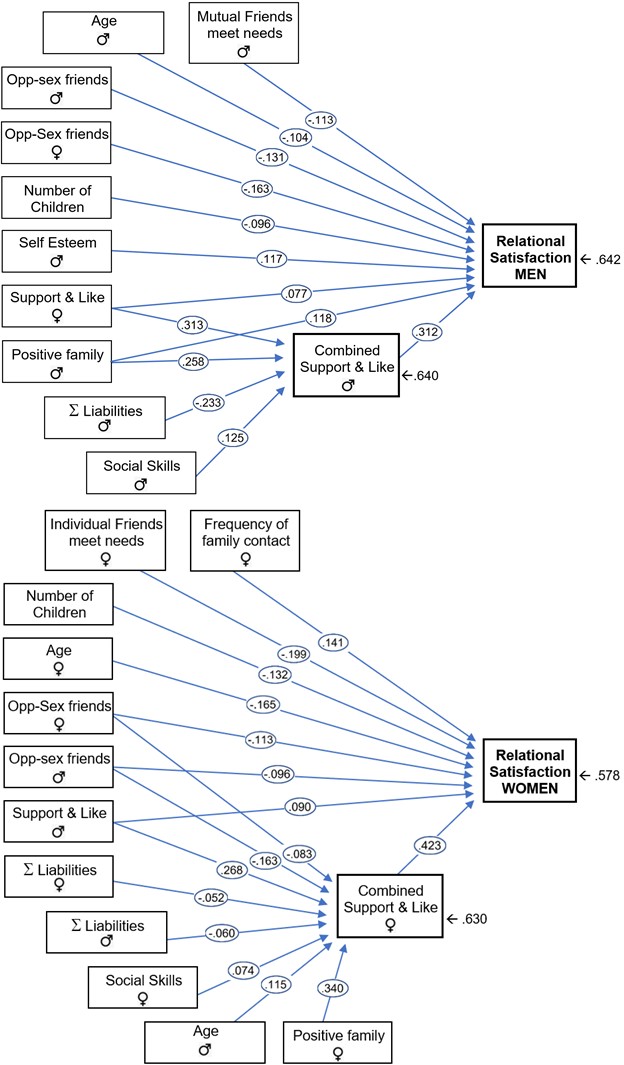
Relational Satisfaction for women: For the women’s model, Fit indices include: 𝒳2 (9, N = 222) = 12.929, p = .166, The Root Mean Square Error of Approximation (RMSEA) was .044; the 90% CI ranged from 0 to .09. The Comparative Fit Index (CFI) was .982. These values indicate an excellent model fit.
The Model for women (like the men’s model) employs two dependent variables and 13 predictors. The primary dependent variable is women’s Relational Satisfaction. The greatest single predictor of RS women is the Support- and-Like (SnL-women) variable (β= .42)—which is also designated as a dependent variable.
Predictors of SnL-women include Family effect (β= .34),
SnLmen (β= .27), man’s opposite sex friends (β= -.16), man’s agreeableness (β= .12), women’s opposite-sex friends (β= -.08), social skills of the woman (β= .07), liabilities of the man (β= -.06), and liabilities for the woman (β= -.05). Note: we retain the modest values for liabilities for sake of comparison with the men’s model.
Predictors of RS women include SnL women (β= .42), needs met by individual friends (β= -.20), the age of the woman (β= -.17), the frequency of family interaction (β= .14), the number of children (β= -.13), the woman’s opposite sex friends (β= -.11), the man’s opposite sex friends (β= -.10), and the SnLmen (β= .09). Figure 2 includes the structural model for women.
Some contrasts between the two models: The men’s model explains 35.8% of the variance in RSmen whereas the woman’s model explains 42.2% of the variance in RSwomen. The amount of variance explained by predictors of the Support-and-Like variable are very similar, 36% for men, 37% for women. The link between Support-and-Like and RSwomen (β= .43) is much stronger than the parallel link for men (β= .31). Both models support the negative impact of opposite-sex friends for both men and women. The Liabilities variable for men has a much stronger impact (β= -.23) than the parallel link for women (β= -.06). The negative impact of age and positive impact of social skills makes it into both models with similar effect. Finally, the number of children has a similar level of negative impact on Relational Satisfaction for both men and women.
| Support? | Statistics | |
|---|---|---|
| Rich network of friends → greater RS | Support | r = .252, p = .001 |
| As the relationship progresses over time, the number of shared friends increases | Non-significant | F(3, 373) = 2.145, p = .09 |
| As the relationship progresses over time, the number of shared friends increases | support | F(3, 373) = 2.145, p = .09 |
| Supportive family and friends increases couples’ stability and satisfaction | Support | r = .254, p = .003 |
| Kin friendships increase with the closeness of the couples’ relationship | Non-significant support | F(3, 372) = 0.012, p = .39 |
| Increase of network support → higher quality RS and less likelihood of divorce | Support | r = .175, p = .012 |
| Greater codependence → lower RS | Partial support | r = -.148, p = .025 |
| Higher self-esteem → higher RS | Partial support | r = .214, p = .004 |
| Better social skills → higher RS | Partial support | r = .232, p = .002 |
| Higher agreeableness → higher RS | Partial support | r = .231, p = .003 |
| More jealousy → lower RS | Support | r = -.550, p < .001 |
| Women more jealous than men | Contradict: | t(368) = 2.962, p = .002 |
| Women more jealous than men | Men more jealous | t(368) = 2.962, p = .002 |
| More couple to couple relationships → higher RS | Support | r = .205, p = .012 |
| More shared friends → greater passion of the couple | Support | r = .191, p = .001 |
| Neglect → lower RS | Support | r = -.212, p < .001 |
| Neglect → lowered intimacy | Support | r = -.123, p = .009 |
| Children at home → depression and lower RS | Support | r = -.280, p < .001 |
| Health of outside friendships → higher RS | Support | r = .252, p = .001 |
Table 2: Support or Contradiction of prior research findings in the Present Study.
Note: the phrase “partial support” in the Support? Column typically means there are gender differences in which one or more of the four possible comparisons (female-female, female-male, male-male, male-female) is significant but others are not. Table 2: Support or Contradiction of prior research findings in the Present Study.
Discussion
The two biggest takeaways of this study are: the critical importance of friendships for couple satisfaction, and, the power of friends supporting the relationship and liking the partner. For men, the structural models reveal that 35.8% of the variance in relational satisfaction is due to friendship variables; for women, 42.2% of the variance in relational satisfaction is based on friendship variables. In every setting (Individual, Family, Mutual, men, women) friends supporting the relationship and liking the partner were the greatest predictors of relational satisfaction for both members of the couple in all four settings. On to hypotheses.
A quick rundown of fully supported hypotheses includes that:
- The benefits of friendship were far greater than the liabilities.
- Opposite-sex friends had a negative impact on couple RS in all settings.
- More family friends and more positive interactions with the family were associated with greater RS.
- The number of Mutual Friends and quality of interaction with Mutual Friends predicted greater couple RS.
- Supporting the relationship and liking the partner was the greatest predictor of couple satisfaction in all four settings.
Partially supported hypotheses and other relevant findings are considered in paragraphs that follow. We begin with the impact of friends in the three settings: Individual, Family, and Mutual.
The impact of Individual friends
The two friends: The number of individual friends and the frequency of contact with these friends had no influence on relational satisfaction. For both men and women, opposite- sex friends places a serious damper on relational satisfaction. The threat or jealousy factor seems to be paramount here. Further, if personal needs were met by individual friends the diminishment of relational satisfaction was even greater. The only benefit of individual friends was if they supported the relationship of the couple and liked the partner.
Positive and negative qualities of friendship: In 24 instances of benefits of friendship (8 qualities x 3 settings) there was not one instance where an individual friend benefitted the couple relationship. On the negative side, of 15 possible detriments to relational satisfaction (the “complicate life” construct had little impact in any condition), 12 of the 15 found significant or marginal negative impact on the couple relationship. The two strongest negative influences of individual friends were jealousy/threat and neglect. These results suggest that family and mutual friends are far more likely to provide benefit to couple relational satisfaction.
The Impact of Family friends
The two friends. The influence of family differs from individual friendships in a number of ways. As a starting point the influence of jealousy/threat is reduced due to the absence of almost any form of sexual tension among people who are biologically related to each other. The Family was the only setting in which needs met by family members did not have a significant negative impact on the couple relationship. Another difference is that both the number of family friends and the frequency of contact was positively associated with couple satisfaction—in all four settings for the number of family friends, and only for the woman in frequency of contact.
The impact of family friends was the same as the other two friendship types on the enhancement of the couple relationship when the family supported the relationship and liked the partner. For the family, the influence was greater than either of the other two conditions and twice resulted in bivariate correlations higher than .5. This result is further supported by the regression analyses:
The downside of family relationships is when the couple is involved with a toxic family. In neither the Individual or Mutual-friends settings did the positive-negative effect on members of the couple impact relational satisfaction significantly. In the family setting, the strong positive correlation (in all four settings) suggests that a positive family has dramatic benefit for the couple; a neurotic, toxic family has a devastating negative impact on couple satisfaction. The beta weights in the structural model found the family effect the single greatest predictor of the Support and Like variable for women (β= .34) and the second greatest for men (β= .26).
For both men and women the greatest predictor of relational satisfaction was that the family supported the relationship and liked the partner. For the man, it was the man’s family support and for the woman it was the woman’s family support. As the structure and importance of the family has changed over the decades and centuries, its impact on couple relationships appears to be undiminished. Positive and negative qualities of friendship: For general benefits and diminishments of friendships, the family played a major role in both settings. On the positive side, the family’s major benefits occur with comfort in times of loss, celebrating milestones and providing a place of belonging. But then, families can be a serious liability in other settings.
Men appear to suffer more due to liabilities than women experiencing the same situation. For all six negative qualities of friendship men suffer from all the negatives—in most instances with p values less than .001: They are vulnerable to threat (not to sexual threat as is possible with individual friends), neglect, being drained of energy, finding life too complicated, suffering criticism at the hands of the family and feeling betrayed. This research suggests that women handle the “ups and downs” of family interactions with much great equanimity. For women only in the neglect and betrayal setting is their relational satisfaction seriously diminished. Perhaps woman’s conditioning equips her to better cope with the ups and downs of relationships.
The Impact of Mutual friends
The two friends: Families grow up, scatter, and parents typically die when children are in the 40-60-year age range. The great support for couple relationships-in many instances rivaling or surpassing the impact of family-are mutual friends.
Like family friends, the more the better. The number of mutual friends is a significant predictor of relational satisfaction for the couples. For men the impact is greater than the family, for women, a bit less; but significant for both. Unlike family, the frequency of contact with mutual friends has no impact on couple satisfaction.
Another contrast with family friends is that when need is fulfilled by mutual friends it has a serious negative impact on the couple relationship. Men, once again, are much more affected by needs being fulfilled by mutual friends. For women the impact is negative and significant but not nearly so robust. Positive and negative qualities of friendship: For general qualities of friendship, just like the family, mutual friends play a significant role in both positive and negative interactions. The greatest benefit of mutual friends is in the context of shared activities, having fun, celebrating milestones, and providing a place of belonging. “Activities” and “fun” did not show up in the family chart. Apparently, as time passes mutual friends take over these roles so central to a family when children are young.
On the negative side, mutual friends can be damaging to couple relationships for both partners with neglect and criticism. Men are more disturbed with the potential of threat and draining of energy. And the one setting where women suffer more than men, they are more likely to fear betrayal.
Provision of needs by friends: One of the primary objectives of the study was to examine how friends fulfilling needs (that could not be provided by their partner) benefitted couple relational satisfaction. On this point the present study failed. Results reveal that needs fulfilled by people outside the relationship was almost entirely negative. For Individual friends and Mutual friends, the correlations were uniformly negative and all but one was significant with correlation values ranging from -.08 to -.28. Family friends moderated the trend but didn’t manage to reverse it: If the man’s needs were fulfilled by family it had a negative impact on his own RS; if the woman’s needs were fulfilled by family it also had a negative impact on his RS—both were identical correlation (r = -.09ns). The women exhibited a parallel but opposite effect. Whether the man or the woman had needs fulfilled by family the effect on the woman was positive, but trivial (_r_s = .04ns, .01ns).
The authors still maintain that certain needs fulfilled outside of the couple relationship must be beneficial, it is just that this study did not ferret them out. There was only one questions about need fulfillment in each of the three settings. A future study would need to focus on just the need- fulfillment issue and explore a range of different needs that are potentially detrimental to the relationship and those that benefit it. It is axiomatic that outside sexual or affectionate need fulfillment would be detrimental. But male friends heading out together for some athletic event (that their wives are not interested in) or female friends headed out shopping or to some artsy event (that their husbands don’t enjoy) must be beneficial at some level. Undoubtedly some individual differences would moderate the benefit differently from one situation to another.
Power of supporting the relationship and liking the partner: The greatest impact of a friendship variable on Relational satisfaction for both men and women is supporting the relationship and liking the partner. Bivariate correlations ranged from .25 to .52 for all three types of friends (Individual, Family, Mutual) all significant at p < .001. Combining those two variables into a single “SnL” construct resulted in the greatest single impact in both regression equations and in the structural models for both men and women. For women beta values were .46 (regression) and .42 (SEM). The parallel beta values for men were .35 and .31.
Two thoughts immediately arise from the previous paragraph: (a) the power of the opinion of outside friends, and (b) substantial gender differences. The old joke about teenage compatibility “I love pizza, you love pizza; I hate your parents, you hate my parents; were we made for each other or what!!” is clearly not a strong foundation for a relationship. Even among individual friends (who seem to carry more liabilities than benefits) the correlations between SnL and Couple satisfaction range as high as .44. Then there is the downside; the reverse of a positive correlation. Friends who do not support the relationship or like the partner have an equally destructive effect on the success of the relationship.
Gender differences are unrelated to the issue of whether friendships are important. This study suggests that the opinions of friends do not have as great an impact on relational satisfaction for men as they do for women. That said the opinion of friends and family is still the greatest predictor of relational satisfaction for both. Is it any wonder that throughout history good, supportive friends have been celebrated as one of life’s most precious gifts. As Cicero stated, “Friendship doubles our joy and divides our grief.” And the reverse is suggested by another ancient, Solomon: “A perverse person stirs up conflict, and a gossip separates close friends.” The impact of personality traits: Of personality traits, Social Skills was the only trait that played a significant role in both correlations, regressions and in the structural model. In correlations, women’s social skills had a positive and robust effect on both men and women supporting the relationship and liking the partner (SnL) in all three settings (Individual, Family, Mutual)—the greatest predictor of Relational Satisfaction in both models. A similar pattern and magnitude emerged for men. As a predictor of Relational Satisfaction, only man’s social skills were predictive. In the structural models the man’s social skills are significant predictors of both the man’s SnL and the man’s Relational satisfaction. In the women’s model, Social skills is only a modest predictor of the woman’s SnL. The other variables don’t play nearly so prominent a role. The man’s agreeableness is associated with the both partners RS in bivariate correlations, but did not make the cut in the structural model. Emotional stability also played only a minor role The structural models, similarities and differences: The men’s and women’s models exhibit more similarity than differences; however, there are several notable differences worthy of notice. First is that friendship variables explain 35.8% of the variance in Relational Satisfaction for men and 42.2% of the variance for women. These results suggest that friendship and friendship-related variables plays a greater role in couple satisfaction for women than it does for men. A more notable difference is that the link between the SnL variable and RS is substantially stronger for women than for men (β= .43 vs. .31). Then, the general liabilities of friendship has a much greater (negative) impact on the SnL variable for men than for women (β= -.23 vs. -.06). Finally, as the previous paragraph documents the social skills of the man has a significant impact on the man’s model; the woman’s social skills has only a minor impact on her model.
The similarities include the negative impact of opposite sex friends in all four settings. Then, both models identify the negative effect of children, age, and needs met my individual or mutual friends. Finally, the dual impact of a healthy or a toxic family on the SnL variable—the greatest predictor of relational satisfaction for both men and women, is one of the strongest predictors in the entire model.
Areas for Improvement and Final Thoughts: As the authors worked with data set two thoughts were uppermost: First, that participants required a serious effort to get through an extensive questionnaire. Second, how rich the data set was and how well it covered the territory. The areas of general positive and negative effects of friendship were garnered from the literature and proved to be a rich source of insight into the nature of the relationships.
Directions for future research are provocative. Consider the theory that one person cannot fulfill all the needs of another, and, its corollary that friendships can provide those needs. Needs being fulfilled outside of the relationship had a consistent negative impact in all three relationship conditions (although it did not achieve significance for family members). As stated earlier, research focused entirely on need fulfillment outside the couple relationship is required. If many different settings were explored followed by analyses on the impact of each on couple satisfaction, a clearer picture may emerge.
Four over arching conclusions may be drawn from this research:
- Outside friendships have an enormous impact on the quality of couple relationships,
- Individual friendships pose a serious threat to couple satisfaction,
- Supporting the relationship and liking the partner is pivotal in the success of relationships, and
- Family is king when it comes to providing support for the relationship; as family influence wanes, mutual friendships take their place.
References
-
Nelson J (1995) Varieties of narcissistically vulnerable couples: Dynamics and practice implications. Clinical Social Work Journal 23(1): 59-70.
-
Hitchcock RR (2013) The relationship of friendship and shared values to couple satisfaction in premarital and married relationships. Asbury Theological Seminary.
-
George DM, Wisdom A (2016) A measure of marital satisfaction. Unpublished manuscript.
-
Schumm WA, Nichols CW, Schectman KL, Grigsby DD (1983) Characteristics of responses to the Kansas Marital Satisfaction Scale by a sample of 84 married mothers. Psychological Reports 53: 567-572.
-
Connolly J, Johnson AM (1996) Adolescents’ romantic relationships and the structure and quality of their close interpersonal ties. Personal Relationships 3(2): 185- 195.
-
Walsh CO (2016) How you and I become we: Examining partner, family, and friend incorporation in romantic relationships. Dissertation Abstracts International 76.
-
Bryant CM, Conger RD, Meehan JM (2001) The influence of in-laws on change in marital success. Journal of Marriage & the Family 63(3): 614-626.
-
Rozer JJ, Mollenhorst F, Volker B (2015) Romantic relationship formation, maintenance and changes in persona networks. Advances in Life Course Research 23: 86-97.
-
Johnson M, Leslie L (1982) Couple involvement and Network Structure: A test of the dyadic withdrawal hypothesis. Social Psychology Quarterly 45(1): 34-43.
-
Felmlee D, Sprecher S (2000) Close relationships and social psychology: Intersections and future paths. Social Psychology Quarterly 63(4): 365-376.
-
Dailey RM, Brody N, Knapp J (2015) Friend support of dating relationships: Comparing relationship type, friend and partner perspectives. Personal Relationships 22(2): 368-385.
-
Stanley JL (1993) The partnered lesbian and her friends: The impact of friendship on self-esteem and relationship satisfaction. University of Pennsylvania.
-
Kerpelman JL, Pittman JF (2018) Erikson and the relational context of identity: Strengthening connections with attachment theory. Identity 18(4): 306-314.
-
Haggerty BB, Bradbury TN, Karney BR (2022) The disconnected couple: intimate relationships in the context of social isolation. Current Opinion in Psychology 43: 24-29.
-
Agnew CR, Loving TJ, Drigotas SM (2001) Substituting the forest for the trees: social networks and the prediction of romantic relationship state and fate. Journal of Personality and Social Psychology 81(6): 1042-1057.
-
George DM, Carroll P, Kersnick R, Calderon K (1998) Patterns of helping among friends. Psychology of Women Quarterly 22: 685-704.
-
Etcheverry PE, Le B, Hoffman NG (2013) Predictors of friend approval for romantic relationships. Personal Relationships 20(1): 69-83.
-
Powdthavee N (2008) Putting a price tag on friends, relatives, and neighbours: Using surveys of life satisfaction to value social relationships. The Journal of Socio-Economics 37(4): 1459-1480.
-
Allen ES, Baucom DH (2004) Adult attachment and patterns of extra dyadic involvement. _Family_ _process_ 43(4): 467-488.
-
Buss DM (2002) Human mate guarding. Neuroendocrinology Letters 23(4): 23-29.
-
Dijkstra P, Buunk BP (1998) Jealousy as a function of rival characteristics: An evolutionary perspective. Personality and social psychology bulletin 24(11): 1158-1166.
-
Corretti CA (2019) An Investigation into the Effects of Cross-Sex Friendships on Heterosexual Romantic Relationship Dynamics. The University of Texas at Dallas.
-
Amati V, Meggiolaro S, Rivellini G, Zaccarin S (2018) Social relations and life satisfaction: The role of friends. _Genus_ 74(7): 1-18.
-
Messman SJ, Canary DJ, Hause KS (2000) Motives to remain platonic, equity, and the use of maintenance strategies in opposite-sex friendships. Journal of Social and Personal Relationships 17(1): 67-94.
-
Serovich J, Price S (1994) In-law relationships: a role theory perspective. International Journal of Sociology of the Family 24(1): 127-146.
-
Bost KK, Cox MJ, Burchinal MR, Payne C (2002) Structural and supportive changes in couples’ family and friendship networks across the transition to parenthood. Journal of Marriage & the Family 643(2): 517-531.
-
Reczek C, Liu H, Umberson D (2010) Just the two of us? How parents influence adult children’s marital quality. J Marriage Fam 72(5): 1205-1219.
-
Oruch TL, Bauermeister JA, Brown E, McKinley BD (2013) Early family ties and marital stability over 16 years: The context of race and gender. Family Relations 62(2): 255-268.
-
Felmlee DH (2001) No couple is an island: A social network perspective on dyadic stability. Social Forces 79(4): 1259-1287.
-
Parks M, Stan C, EggertL (1983) Romantic involvement and social network involvement. Social Psychology Quarterly 46(2): 116-131.
-
Ketokivi K (2012) The intimate couple, family and the relational organization of close relationships. Sociology 46(3): 473-489.
-
Greif GL, Deal KH (2012) Two plus two: Couples and their couple friendships. New York Taylor & Francis Group: 232.
-
Welker KM, Baker L, Padilla A, Holmes H, Aron A, et al. (2014) Effects of self-disclosure and responsiveness between couples on passionate love within couples. Personal Relationships 21(4): 692-708.
-
Slatcher RB (2010) When Harry and Sally met Dick and Jane: Creating closeness between couples. Personal Relationships 17: 279-297.
-
Milardo RM (1982) Friendships networks in developing relationships: converging and diverging social environments. Social Psychology Quarterly 45(3): 162- 172.
-
Utz S, Beukeboom CJ (2001) The role of social network sites in romantic relationships. Journal of Computer- Mediated Communication 16(4): 511-527.
-
Watson D, Hubbard B, Wiese D (2000) General traits of personality and affectivity as predictors of satisfaction in intimate relationships: Evidence from Self- and Partner- ratings. Journal of Personality 68: 413-449.
-
Smith L, Ciarrochi J, Heaven PC (2008) The stability and change of trait emotional intelligence, conflict communication patterns, and relationship satisfaction: A one-year longitudinal study. Personality and Individual Differences 45(8): 738-743.
-
Wenzel A, Graff-Dolezal J, Macho M, Brendle JR (2003) Communication and social skills in socially anxious and non-anxious individuals in the context of romantic relationships. Research & Therapy 43: 505-519.
-
Flora J, Segrin C (1999) Social skills are associated with satisfaction in close relationships. Psychological Reports 84(3): 803-804.
-
Villa MB, Del Prette ZAP (2013) Marital satisfaction: the role of social skills of husbands and Wives. Paideia 23(56): 379-387.
-
Klosterman M (2012) Self-esteem and relationship perception. Ursidae: The Undergraduate Research Journal at the University of Northern Colorado 2(2): 97- 103.
-
Erol RY, Orth U (2013) Actor and partner effects of self- esteem on relationship satisfaction and the mediating role of secure attachment between the partners. Journal of Research in Personality 47(1): 26-35.
-
Kling KC, Hyde JS, Showers CJ, & Buswell BN (1999) Gender differences in self-esteem: a meta- analysis. Psychological bulletin 125(4): 470-500.
-
Fischer JL, Spann L (1991) Measuring codependency. Alcoholism Treatment Quarterly 8(1): 87-100.
-
Mayo Clinic Staff (2022) Friendships: enrich your life and improve your health.
-
Koh C (2021) How to nurture adult friendships. Boston Mamas (online).
-
Yager J (2010) When friendship hurts: How to deal with friends who betray, abandon, or wound you. Simon and Schuster.
-
White GL (2008) Romantic jealousy: Therapists’ perceptions of causes, consequences, and treatments. Journal of Couple & Relationship Therapy 7(3): 210-229.
-
Williams SA (2005) Jealousy in the cross-sex friendship. Journal of Loss and Trauma, 10(5): 471-485.
-
White GL (1981) Jealousy and partner’s perceived motives for attraction to a rival. Social Psychology Quarterly 44(1): 24-30.
-
Hansen GL (1985) Dating jealousy among college students. Sex Roles 12(7-8): 713-721.
-
McMullin I (2011) Love and entitlement: Sartre and Beauvoir on the nature of jealousy. Hypatia 26(1): 102- 122.
-
Guerrero LK (1998) Attachment-style differences in the experience and expression of romantic jealousy. Personal Relationships 5(3): 273-291.
-
Miller MJ, Denes A, Diaz B, Buck R (2014) Attachment style predicts jealous reactions to viewing touch between a romantic partner and close friend: Implications for internet social communication. Journal of Nonverbal Behavior 38(4): 451-476.
-
Gaines SO, Reis HT, Summers S, Rusbult CE, Cos CL, et al. (1997) Impact of attachment style on reactions to accommodative dilemmas in close relationships. Personal Relationships 4(2): 93-113.
-
Sanford K (2010) Perceived threat and perceived neglect: couples’ underlying concerns during conflict. Psychological Assessment 22(2): 288-297.
-
Sanford K, Wolfe KL (2013) What married couples want from each other during conflicts: an investigation of underlying concerns. Journal of Social and Clinical Psychology 32(6): 674-699.
-
Ackroyd E (2011) Review of recovering intimacy in love relationships. A clinician’s guide. Sexual and Relationship Therapy 26(2): 207-212.
-
Beach SR, Martin JK, Blum TC, Roman PM (1993) Effects of marital and co-worker relationship on negative affect: Testing the central role of marriage. American Journal of Family Therapy 21(4): 313-323.
-
Crouter AC, Manke B (1994) The changing American workplace: implications for individuals and families. Family Relations 43(2): 117-124.
-
Shellenbarger S (2003) Co-workers can wreck a marriage: at the office, divorce is contagious. In: Wall Street Journal, (3rd Edn.).
-
Helms HM, Crouter AC, McHale SM (2003) Marital quality and spouses marriage work with close friends and each other. Journal of Marriage and Family 65(4): 963-977.
-
Cervone D, Shadel WG, Jencius S (2001) Social-cognitive theory of personality assessment. Personality and Social Psychology Review 5(1): 33-51.
-
Segrin C, Givertz M (2003) Methods of social skills training and development. Handbook of communication and social interaction skills 135-176.
-
George DM, Mallory P (2022) IBM SPSS Statistics 27 Step by Step. London Routledge.
-
Bentler P, Chow C (1987) Practical issues in multivariate analysis. Sociological Methods and Research 16(1): 78- 117.
-
Hu LT, Bentler PM (1999) Cutoff criteria for fit indexes in covariance structure analysis: Conventional criteria versus new alternatives. Structural equation modeling: a multidisciplinary journal 6(1): 1-55.
- Occupational Stress and Mental Health Outcomes Among Police Officers: A Mini Review
- The Experience of Counterproductive Leadership on Mental Health and Impact on Retention in U.S. Marines: A Phenomenological Study
- Nomophobia in the Digital Age: A Study on College and University Students
- Emotional Regulation in Children with Autism and Learning Disabilities
- Antisemitism on American College Campuses and Its Impact on Jewish Students
- Exploring the Role of Empathy in the Associations of Family Functioning and Purpose in Life with Attitude towards Abortion among Undergraduates: A Moderation Analysis