
The Direct and Mediated Influence of Perceptual Variables on Physical Attractiveness and Relational Satisfaction in Romantically Involved Heterosexual Couples
A 2015 PAID article, in a study of married couples, revealed that a rating of the physical attractiveness of one’s spouse was a significant predictor of relational satisfaction for both the husband and the wife. This unexpected finding proved to be the springboard for the present research. How is the perception of the attractiveness of one’s romantic partner related to factors other than objective beauty? A sample of 201 heterosexual couples (N = 402) explored which factors impact a rating of perception of physical attractiveness (PPA), including: objective physical attractiveness (OPA), standard demographics (e.g., age, ethnicity), power factors (e.g., wealth, position, accomplishments), physical characteristics (e.g., height, weight, BMI), personal qualities (e.g., self-esteem, emotional stability, agreeableness, social skills), physical health and vitality, and efforts to look good in a public or private setting. We then explored the impact of PPA on the relational satisfaction of the couple. The 2015 results were largely replicated, however, the present study revealed much more. Primary takeaways included: (a) There were substantial gender differences concerning the dynamic of factors that influenced the rating of PPA; (b) there were equally robust gender differences on the impact of the PPA (and other variables) on relational satisfaction; (c) OPA played a surprisingly minor role in the entire dynamic; and (d) structural equation models provided detail on the similarities and differences of dynamics for men and women. Avenues of future research are explored.
Introduction
A 2015 article [1] in Personality and Individual Differences provided the motivation for the present research. That article dealt with congruence between stimulus factors of married couples (N = 641 couples) and its influence on the relational satisfaction of the couples. An unexpected finding was that physical attractiveness was one of the three greatest predictors of relational satisfaction for both men and women. More specifically, the woman’s attractiveness rating was significantly associated with both her own and her husband’s relational satisfaction (abbreviated “RS” throughout the paper). Likewise, the man’s attractiveness was associated with both his own and his wife’s RS.
There is only one other study that employed similar methods with a similar sample (N = 651 couples), and results were identical. Seventy years ago, Kirkpatrick et al. [2] found that, with a sample of married couples, physical attractiveness was associated with greater marital satisfaction for both partners. The present research will, once again, seek to replicate and expand on those finding.
In the Discussion of the 2015 article we explored possible explanations for this unexpected finding. It certainly contradicts the conventional wisdom about beauty and marital success. Many of the most beautiful celebrities seem to be afflicted with multiple partners, multiple marriages and multiple divorces. But the first insight in the Discussion was that this sample was not ultra- beautiful celebrities. Of the 1282 participants, none rated 10 on attractiveness (on a 10-point scale). So, for people of more moderate levels of beauty, their perception of the physical attractiveness of their partner had a significant impact on relational satisfaction.
The measure of physical attractiveness in the 2015 study was a self-rating on a 10-point scale (1 is low, 10 is high) by the participant and the participant’s spouse. The mean value of these two measures was entered as the physical attractiveness score. It is this perception of physical attractiveness that was the predictor of relational success.
This raised the next question. What factors influence the rating of attractiveness of one’s spouse or romantic partner? When an 85-year old husband tells his 83-year old wife “you are the most beautiful woman in the world,” he is not suggesting that she enter the next beauty pageant. Clearly, factors other than the elusive “objective rating of physical attractiveness” play a major role in the rating of the physical attractiveness of one’s romantic partner.
Guided by this and other research, the present study seeks to (a) create a scale that assists in measuring objective physical attractiveness (OPA), (b) compile a list of factors that may influence the rating of the perception of physical attractiveness (PPA) of one’s romantic partner, and (c) explore the impact of both PPA and OPA on the relational satisfaction of couples.
Additional influences explored in the present study that may have an impact on rating of Physical Attractiveness include (referenced below) standard demographics, power factors (such as wealth, position, accomplishments), physical health and vitality, efforts to look good in a public or private setting, height, weight, BMI, the participants rating of their partner’s self-esteem, emotional stability, agreeableness and social skills. In addition, the authors have created an instrument to provide a more objective measure of physical attractiveness (OPA) for each individual in the study to determine how closely PPA and OPA correlate, and how these variables influence each other and the primary dependent variable, relational satisfaction. An additional point of interest deals with participants involved in the study. In the George et al. study, all participants were legally married couples. In the present study, many of the same variables are explored with, in addition to married couples, dating and engaged couples and those who are cohabiting.
In text that follows, to enhance clarity, whenever a quality is the name of a variable it is capitalized. Example: “self-esteem” is measured by the variable “Self-Esteem”.
Literature Review
Murnstein [3] Partner-selection theory proposed that we gain three types of information about partners as the relationship progresses. The first type is “stimulus” information typically obtained at the beginning of a relationship. Stimuli include highly visible and easily identifiable characteristics such as demographic information (e.g., gender, ethnicity), physical characteristics (e.g., height, weight, level or attractiveness, age, body build) personality traits (e.g., extroversion, agreeableness, Social Skills) and other information that is acquired early in the relationship (e.g., point or origin, level of education, religious preference, interests, passions). The Murnstein theory was the foundation for selecting predictors in the George, et al. [1] article, and is used as an organizing construct of predictors in the present study.
Factors that Influence the Rating of Objective Physical Attractiveness. The measure of objective physical attractiveness for both men and women has been heavily researched: It has been discovered that physical attractiveness is significantly influenced by: The waist-to-chest ratio (WCR) or the waist-to-hip ratio (WHR) for men [4, 5, 6, 7, 8] height, weight and the BMI [9, 10, 11, 12], feminine characteristics of women’s faces [13, 14, 15, 16], by women’s skillful use of cosmetics and attractive accesorization [17, 18, 19, 20, 21], by being younger [5], by the color and style of clothing [22, 23, 24, 25], facial shape [26, 27], and for women, bust size/shape and the waist-to-hip ratio (WHR) [7, 12, 28, 29, 30, 31, 32]. All these were considered in the authors’ efforts to create an objective measure of physical attractiveness.
Factors that Influence the Perception of Physical Attractiveness. Then there is the interplay of Objective Physical Attractiveness (OPA) and one’s Perception of Physical Attractiveness (PPA). Both the George study [1] and the Kirkpatrick, et al. [2] assessed the influence of the perception of the physical attractiveness of their spouses as the predictor of relational success. It is widely documented that positive illusions play a major role when one rates the attractiveness of their romantic partner [33, 34, 35] and that these judgments are often associated with greater relational satisfaction [36].
Researchers have also found that power factors in terms of wealth, level of income, SES, accomplishments, leadership, and social status have a significant impact on the perception of physical attractiveness, particularly when women are judging the attractiveness of men [8, 36, 37, 38, 39, 40, 41].
Other Predictors: Research has further determined that personality factors may have an influence on the perception of physical attractiveness and relational satisfaction [1, 42, 43]. Traits that tend to be predictive of these qualities include Agreeableness [44, 45], absence of anxiety [46], Social Skills [47], and Self-Esteem [46]. It is also found that the personality of the observers significantly influences their rating of attractiveness of others [42].
Then stimulus characteristics [3]—qualities that are easily observed early in any relationship—also play a role in the rating of physical attractiveness and perhaps, to a lesser extent on relational satisfaction. These include weight and body mass index (BMI) [9, 48], how well-groomed the person is [11, 18, 22], men prefer women who weigh less than a healthy weight based on BMI standards [12], tall men are typically regarded as more handsome [49], men who are strong, athletic, and exhibit excellent health and vitality are rated more handsome [50, 51] and younger individuals of both sexes are regarded as more attractive [52].
Hypotheses
Based on these and other articles the following outcomes are anticipated:
- The results of the 2015 article will be duplicated in that the PPA of the man will be associated with both his own and his partner’s RS and that the PPA of the woman will be associated with both her own and her partner’s RS.
- Personality traits will have some influence on both the perception of physical attractiveness and on relational satisfaction.
- Stimulus variables will have a significant effect on perception of physical attractiveness and on relational satisfaction.
- The objective measure of physical attractiveness will be significantly correlated with the perception of physical attractiveness.
- There will be a greater influence for men than for women on the impact of their partner’s attractiveness on Relational Satisfaction.
Method
The present study involved 201 couples from Alberta, Canada. Since all couples were heterosexual, the total N included 201 men and 201 women. Exclusive dating and engaged individuals were treated as a single group (N = 100 couples). Also married and cohabiting were classed together, there were 101 couples in this category. The ethnic breakdown of the sample included 241 (60%) Whites, 78 (19%) Blacks, 36 (9%) Asians, 32 (8%) Hispanic, and 15 (4%) in the DTS or other category. The mean age of the dating/engaged couples was 29.9 years with a range of 16 to 66 years. The parallel numbers for marrieds was 37.5 with a range of 18 to 85. The entire group had higher than average education with mean education rating of 3.1 years of university. The general denomination breakdown of the group included 30 Catholics (7%), 344 from a variety of Protestant denominations (86%), 23 Atheists or Agnostics (6%) and 5 DTS or other (1%).
Material and Procedures
Materials included questionnaires that were available as an online link or as a hard copy. The content of both questionnaires was identical except for some minor adaptations in the instructions.
The instructions for both included identification of the sponsoring organization, brief description of the study, assurance of confidentiality, informed consent, instructions about debriefing, how to answer the questions, and instruction about how to deal with questions they found uncomfortable or difficult. The study was approved by the University Ethics Board prior to collection of data.
Questions then occurred in the following order: Standard demographics, a number of “stimulus variables” such as age, income, level of health, physical attractiveness, height, weight and others. This was followed by the 26 questions that measured relational satisfaction. The questionnaire finished with 31 questions, randomly distributed, that measured Self-Esteem, Social Skills, Agreeableness, and Emotional Stability. The questionnaire finished with an expression of appreciation and instructions about how to access the results of the study.
Participants were acquired by students enrolled in a research methods class at a liberal arts university in central Alberta, Canada. Students contacted individuals they knew to ask their willingness to participate in the study. Contacts were made in person, by telephone, e-mail or social media. Whether the hard copy or the online version was used depended on the preference to the participant.
For hard copy forms, participants placed the completed questionnaire in coded envelopes (to ensure couples were paired correctly) which were returned to the researcher or to one of several designated collection points on campus. For online forms, researchers sent a link to access the questionnaire. Participants completed them online and the final click returned all data to the Survey Monkey data base.
Variables
Dependent Variable: The dependent variable was a composite of three different relationship-satisfaction questionnaires: The 12-item George-Wisdom Relationship Satisfaction Scale (GWS) [53] the 3-item Kansas Marital Satisfaction Scale (KMS) [54] and the 11-item Karney- Bradbury Marital Satisfaction measure (KBMS) [55]. The GWS scale asks questions about 12 specific areas that measure relational satisfaction, including: security, feeling loved, experience of joy, appreciation, trust, feeling valued, shared activities, fun and laughter, encouragement, affection, commitment, and support. The KMS asks three global questions about satisfaction with the relationship, satisfaction with their partner, and how well the partner fulfills their needs. The KBMS poses 11 pairs of qualities and asks respondents to rate which quality better describes their relationship on a 7-point scale. The eleven include: interesting-boring, bad-good, full-empty, lonely-loved, sturdy-fragile, discouraging-hopeful, enjoyable-miserable, strong-weak, warm-chilly, rewarding-draining, and expectation met-expectations not met. All 26 items were assessed on 7-point scales; anchors varied based on the nature of the questions. The final measure of RS was the mean of the 26 items. These 26 questions, with its mix of specific and global, yielded excellent internal consistency (alphas of .96 for men and .95 for women) and were psychometrically sound (kurtosis and skewness measures between ± 1).
Demographics: Demographics included gender, ethnicity (White, Hispanic, Black, Asian, Other and DTS), denominational preferences (Catholic, many Protestant denominations, agnostic, atheist, and other), relationship status (exclusive dating, engaged, married, cohabiting), duration of the relationship, year of birth for both partners (to determine age), total family income (eight choices ranging from <$10K to > $500K), and highest level of education (ranging from < High School to Doctorate).
For variables that follow, a “criss-cross” technique is employed to reduce response bias. Participants answered questions about themselves and about their partner. An example: for Health and Vitality, men answered the following two questions: “Compared to other men in your age range how would you rate your overall Health and Vitality?” and “Compared to other women in her age range, how would you rate the overall Health and Vitality of your partner?” The value used for each variable was the mean of the subject’s self-rating and the partner’s rating of the subject. By computing the mean of the man’s and the woman’s responses, greater objectivity is achieved. This “criss- cross” method for reducing bias and exploring contrasting perspectives is widely employed in couples’ research [56]. That said, since the study is perceptual in nature, there are a number of instances in which the perception of the man or the perception of the woman is used rather than the criss- crossed value. Wording in the Results section will clarify when which (criss-crossed or perception) is utilized.
Predictor Variables: Health and Vitality, was based on a 7-point scale ranging from much poorer [than average] (1) to much better (7). Efforts to Look Good in Public, and to Look Good in Private were both rated to 7-point scales ranging from none at all (1) to moderate effort (4) to obsessive (7). Height and Weight were both crisscrossed with participants identifying their height and weight. The BMI was then calculated based on mean scores of both partners for these measures.
The perception of physical attractiveness (PPA) was also crisscrossed but employed a 10-point scale. For both men and women the high end (10) listed 3 legendary beauties for each sex, the low end (1) three mythical exceptionally ugly individuals. The mid value was 5.5. Although a criss- crossed value for PPA were calculated and occasionally utilized, almost all analyses recorded here represent the single perceptual value: the man rating of his partner’s attractiveness (PPAf) or the woman rating her partner’s attractiveness (PPAm).
Objective Physical Attractiveness (OPA): This study introduced a scale designed to measure objective physical attractiveness (OPA). The men were rated on five different components of physical attractiveness: facial shape/beauty, hair, eyes, body shape and posture/carriage. The women were rated on six different components of physical attractiveness: facial shape/beauty, hair, eyes, waist to hip ratio, bust, and posture/carriage. These were each rated on 7-point scales with “7” representing extraordinary beauty (for each of the five or six categories) and “1” representing exceptionally unattractive. The researchers who recruited participants, since they knew them personally, did the rating.
Since it is difficult to differentiate between, say, a “4” or a “5” on any given beauty-related quality, a worksheet was created by the professor and students in the research- methods class. This worksheet contained actual pictures (including individuals that were Caucasian, Hispanic, Black, or Asian) that represented the seven levels of the rating scale. There was a separate page for each quality: facial shape/ beauty, hair, eyes, body shape, and posture, carriage, and for women, bust size and shape.
For instance, for hair, the “7” pictured examples of men (or women on a different sheet) with exceptionally striking hair. “6” showed hair styles that were very attractive but not so much as the “7”. And so on, down to “1” that displayed men with exceptionally unattractive hair. The mid value (4) represented what the researchers agreed was pretty much an average for North American culture. The same procedure was used for the other rated categories.
The final OPA rating was the mean of the five (or six) qualities. Researchers were allowed to adjust the final value by up to one point (on the 7-point scale) if they felt the average did not accurately define the attractiveness of the individual.
Other Predictors: The study hypothesized that power factors such as positions of leadership, wealth, or accomplishments may also have an influence on PPA and on RS. These were measured in the following way.
For the Leadership variable, a participant identified the highest level of leadership they had ever held and then rated the highest level of Leadership held by their partner. Then the partner made the same two judgments. A scale was created by the researchers to rate a person’s leadership on a 7-point scale of very low (1) to very high (7). The mean score of three raters was used to measure Leadership.
Accomplishments were rated in a similar way. Each participant was instructed to identify their three greatest accomplishments, then do the same for their partner. Their partner made the same six ratings. Once again, a scale was created to identify the relative “goodness” of accomplishments based on a scale created by the researchers. For instance, making an Olympic team or CEO of a large company would rate a “7”; whereas graduated from high school would rate only a “2”. Each participant then received an Accomplishment score based on the mean score of three raters.
There were four different personality variables assessed; however, in a rare twist, the participants are not rating themselves but their partner on each of the 31 items. The rationale is that the study is interested in how perceptual factors influence relational variables, not some objective reality.
The measures include Self-Esteem [57]; Emotional Stability and Agreeableness measured by the Big 5 [58] and Social Skills measured on the Carlsmith Social Skills Scale [59].
All four variables were measured on 7-point scales ranging from low to high on each quality. The 31 questions were randomly distributed in the questionnaire. Sixteen items were reverse coded to control for response biases. The value for each variable was the mean of the items that measured it.
Results
Psychometrics
The data set included 201 men and 201 women paired as couples. Of 39 dependent and independent variables considered in analyses, 33 exhibited excellent psychometric validity (Kurtosis and Skewness between ±1.0) [60]. The other six variables exhibited acceptable psychometrics with no kurtosis or skewness values outside ±2.0.
Alpha reliability measures on multiple-indicator variables rated from good to excellent. Variables included Marital Satisfaction (α = .96 for men, .95 for women); Self- Esteem (α = .81 for men, .84 for women); Emotional Stability (α = .85 for men, .86 for women); Agreeableness (α = .78 for men, .73 for women); and Social Skills (α = .73 for men, .66 for women).
Relationship-Status, Gender, and Ethnic Differences
Dating Versus Married. The differences between these two groups turned out to be quite modest—no significance values less than .02 were observed. Dating men experienced higher esteem [M_s = 5.10 vs 4.82, _t(199) = -2.06, p = .04], and were more emotionally stable [M_s = 4.44 vs 4.07, _t(199) = -2.21, p = .03]. Married men had higher PPA [M_s = 7.15 vs 6.83, _t(199) = 2.18, p = .03], and higher OPA [M_s = 6.97 vs 6.69, _t(199) = 2.05, p = .04]. Married women were more emotionally stable [M_s = 5.33 vs 4.98, _t(199) = 2.06, p = .04], registered a higher PPA [M_s = 7.16 vs 6.80, _t(199) = 2.36, p = .02], and had a lower BMI [M_s = 22.89 vs 24.23, _t(199) = -2.37, p = .02]. Since differences are so minimal, for the remainder of the paper we will consider all 201 couples as a single group.
Gender Differences: By contrast, several gender differences were substantial. All are significant at the .001 level and exhibit Cohen’s d values ranging from .26 to 1.76. Men were found to be Older [M_s = 33.7 vs 31.7, _t(200) = 7.88, p < .001];
were rated more objectively physically attractive (OPA) [M_s = 6.84 vs 6.12, _t(200) = 7.09, p < .001]; were Taller [M_s = 70.7 vs 64.7, _t(200) = 25.03, p < .001]; and had a higher Leadership rating [M_s = 3.45 vs 2.96, _t(200) = 5.61, p < .001]. Women Dressed better in Public [M_s = 4.64 vs 4.19, _t(200) = -7.38, p < .001]; and in Private [M_s = 4.01 vs 3.68, _t(200) = -6.22, p < .001].
For the four personality traits (where women rated the men and men rated the women) women rated men lower than men rated women on all four qualities, including: Self-Esteem [M_s = 5.39 vs 4.96, _t(200) = -5.10, p < .001]; Emotional Stability [M_s = 5.16 vs 4.26, _t(200) = -7.71, p < .001]; Agreeableness [M_s = 5.84 vs 5.56, _t(200) = -3.64, p < .001]; and Social Skills [M_s = 5.49 vs 5.17, _t(200) = -4.18, p < .001].
Correlations with Primary Dependent Variables
Correlates with the Man’s Relational Satisfaction. What follows are bivariate correlations between all variables and the man’s RS with significance < .001; The N for all correlates is 201. RSmen is associated with: his Agreeableness (r = .54), his Self-Esteem (r = .53), his Social Skills (r = .53), his Emotional Stability (r = .45), perceiving his woman as more attractive—PPAf (r = .29), her Agreeableness (r = .24), her OPA (r = .23), her Social Skills (r = .23), her Emotional Stability (r = .21), and her Self-Esteem (r = .21).
Correlates of the Woman’s Relational Satisfaction. What follows are bivariate correlations between all variables and the woman’s RS with significance < .001; The N for all correlates is 201. RSwomen is associated with: her Agreeableness (r = .41), his Agreeableness (r = .39), her Social Skills (r = .39), her Emotional Stability (r = .37), his Self-Esteem (r = .35), his Social Skills (r = .34), her Self-Esteem (r = .33), perceiving her man as more attractive—PPAm (r = .27), her Leadership (r = .25), her OPA (r = .22), and him perceiving her as more attractive—PPAf (r = .21).
Correlates of the Man’s Rating of the Woman’s Physical Attractiveness. What follows are bivariate correlations between all variables and the man’s rating of his partner’s physical attractiveness—PPAf with significance < .001; The N for all correlates is 201. PPAf is associated with: her Agreeableness (r = .44), her Health and Vitality (r = .39), his Self-Esteem (r = .36), his Social Skills (r = .32), how he Dresses in Private (r = .32), her Social Skills (r = .30), her Self-Esteem (r = .29), her Emotional Stability (r = .27), his Emotional Stability (r = .25), how she Dresses in Private (r = .25), his Agreeableness (r = .24), negatively with her BMI (r = .20, p = .002), and her height (r = .18, p = .005). Note: the OPAf doesn’t make the cut (r = .16, p = .025).
Correlates of the Woman’s Rating of the Man’s Physical Attractiveness. What follows are bivariate correlations between all variables and the woman’s rating of her partner’s physical attractiveness—PPAm with significance < .001; The N for all correlates is 201. PPAm is associated with: how well she Dresses in Private (r = .38), how well he Dresses in Private (r = .28), his Health and Vitality (r = .28), how well she Dresses in Public (r = .27), her Health and Vitality (r = .26), her being Younger (r = -.25), his Height (r = .24), his being Younger (r = -.23), her Accomplishments (r = .22), negatively with his BMI (r = -.21), her Leadership (r = .21), his Accomplishments (r = .20). The objective attractiveness of the man is close but doesn’t make the cut: OPAm (r = .20, p = .004).
Regressions
Two regressions are conducted: factors that predict the man’s physical attractiveness (PPAm) and factors that predict the woman’s physical attractiveness (PPAf). We reserve the prediction of Relational Satisfaction for both men and women for the structural models.
Predictors of Men’s Physical Attractiveness (PPAm). For men, 6 variables entered the regression equation: R(1, 194) = .513, _R_2 = .263, p < .001. Thus, this analysis reveals that 26.3% of the variance in PPA for men is explained by predictors. Significant predictors ranked ordered from high to low are: The man’s Health and Vitality (β = .25), being Younger (β = -.21), his OPA (β = .21), his level of Leadership (β = .16), his partner’s Self-Esteem (β = .12), and how well he Dresses in Private (β = .10).
Predictors of the Women’s Physical Attractiveness (PPAf). For women, 6 variables entered the regression equation: R(1, 194) = .561, _R_2 = .314, p < .001. Thus, this analysis reveals that 31.4% of the variance in PPA for women is explained by predictors. Significant predictors ranked ordered from high to low are: The woman’s Health and Vitality (β = .27), how the woman Dresses in Private (β = .23), the woman’s Accomplishments (β = .20), the woman’s Height (β = .17), the woman’s OPA (β = .15), and a low BMI (β = -.12).
Structural Equation Modeling Recall that SEM serves at least three masters in constructing the model. First, you want a model that is a good fit of the data, and many fit indices allow the researcher to assess the quality of fit. Second, you want your model to be as parsimonious as possible without the loss of valuable information. If you connect all possible significant links, you can get a good fit, but the model will often be too complex to interpret. Finally, you want a model that has good face validity. It needs to make sense to the reader, even a reader who is not fluent in SEM.
The sample size (N = 201) is entirely adequate based on the Bentler and Chow criterion of a 5:1 ration of participants to free parameters [61]. With 18 free parameters (men) and 20 free parameters (women) both models are superior to the 5:1 ratio.
Relational Satisfaction for Men. For the men’s model, Fit indices include: 𝒳2 (3, N = 201) = 2.016, p = .57, The Root Mean Square Error of Approximation (RMSEA) was < .001; the 90% CI ranged from 0 to .10. The Comparative Fit Index (CFI) was 1.000. These values indicate an excellent model fit [62]. Note: all predictors are allowed to covary.
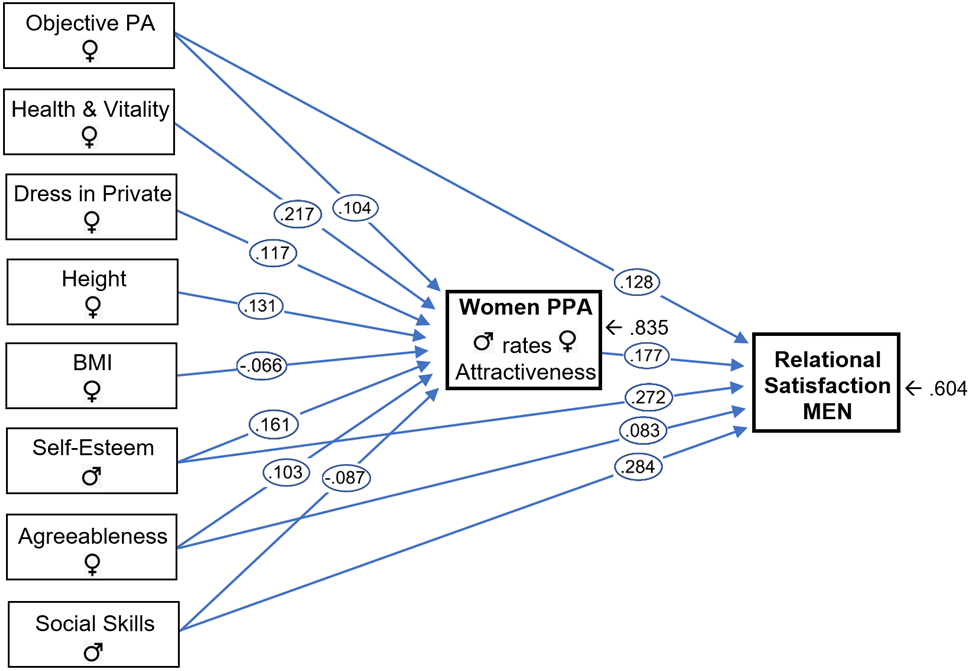
The Model for men employs two dependent variables and nine predictors. The two primary dependent variables are men’s Rating of Attractiveness of his woman (PPAf) and the men’s Relational Satisfaction (RSmen).
Predictors of the man’s rating his woman’s attractiveness (PPAf) include women’s Health and Vitality (β = .22), the man’s Esteem (β = .16), the woman’s Height (β = .13), how attractively the woman Dresses in Private (β = .12), her objective physical attractiveness (OPAf, β = .10), the woman’s Agreeableness (β = .10), the man’s Social Skills (β = -.09), and the woman’s BMI (β = .07).
Predictors of RSmen include the man’s Social Skills (β = .28), the man’s Self Esteem (β = .27), the PPAf variable (β = .18), the OPAf (β = .13), and the woman’s Agreeableness (β = .08.). The residual for RSmen of .604 (the amount of variance not explained) indicates that 39.6% of variance in RSmen is related to factors that predict his rating of physical attractiveness of his woman. Figure 1 includes the Structural Model for men.
Relational Satisfaction for Women. For the women’s model, Fit indices include: 𝒳2 (5, N = 201) = 3.443, p = .632, The Root Mean Square Error of Approximation (RMSEA) was < .001; the 90% CI ranged from 0 to .08. The Comparative Fit Index (CFI) was 1.00. These values indicate an excellent model fit.
The Model for women (like the men’s model) employs two dependent variables and 11 predictors. The two primary dependent variables are the women’s Rating of Attractiveness of her Man (PPAm) and the women’s Relational Satisfaction (RSwomen).
Predictors of how attractive the woman rates her man (PPAm) include how well the woman Dresses in Public (β = .33), if the woman’s OPAf is lower (β = -.22), the man’s Height (β = .19), the woman’s Emotional Stability (β = .18), the man’s Social Skills (β = .17), the woman’s Accomplishments (β = .10), the man’s BMI is lower (β = -.10), the average Age is lower (β = .08), Educational Discrepancy (β = .07), and how attractively the woman Dresses in Private (β = .07) .
Predictors of RSwomen include the Emotional Stability of the woman (β = .25), the woman’s Social Skills (β = .22), Educational Discrepancy with her man (β = -.13), the PPAm variable (β = .12), and the woman’s Accomplishments (β = .07). Figure 2 includes the structural model for women. The residual for RSwomen of .75 (the amount of variance not explained) indicates that 25% of variance in RSwomen is related to factors associated with her rating of physical attractiveness of her man. Figure 2 displays the full structural model.
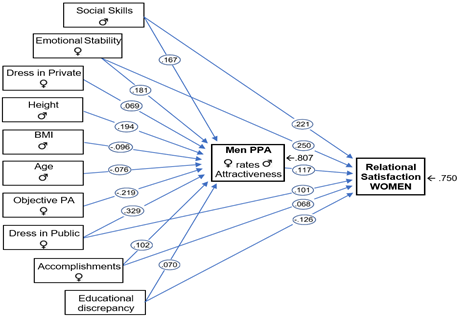
Some differences between the men’s and women’s models. The most substantive contrast between the two diagrams is that the men’s model explains 39.6% of the variance in man’s RS whereas the women’s model explains only 25% of the variance in the woman’s RS. This suggests that the beauty-related factors have a greater impact on a man’s RS than on women’s RS. OPAf impacts both his rating of her PPA and his own RS whereas OPAm has no impact on either parallel variable in the women’s model. The OPAf has a robust impact in the women’s model but only to decrease her rating of Physical Attractiveness of the man. The woman’s Health has a robust impact on his rating of her PA whereas the man’s Health doesn’t impact either dependent variable in the woman’s model. How the woman dresses both in public and in private impacts her rating of his PA. For men, how the woman dresses in public has no impact on the model but how she dresses in private does increase his rating of her PPA. The man’s esteem has a robust impact on both his rating of her PPA and his own RS whereas the woman’s esteem has no impact in either model. The woman’s Agreeableness impacts both the man’s rating of her PPA and his own RS; Agreeableness is not a predictor in the Woman’s model. The woman’s Accomplishments enhances both the rating of his PPA and her own RS; Accomplishments is not a predictor in the men’s model.
Some similarities between the men’s and women’s models. For both models the man’s Height and BMI and woman’s Height and BMI both influence, respectively, his rating of her PPA and her rating of his PPA—height positively and BMI negatively. The man’s Social Skills increases his own RS but reduces his rating of her PPA. The Social Skills of the man also plays a major role in the woman’s diagram, improving her own RS and yielding a higher rating of his PPA.
Discussion
The discussion will take place in the following order. (a) confirmation or non-confirmation of the results of the George, Luo and colleagues article [1], (b) The contribution of the measure of objective physical attractiveness (OPA). Next, we consider a number of issues as revealed in the structural model, including: (c) the differential impact of PPA in the structural models for men and women, (d) the impact of OPA in the model; (e) the influence of Self-Esteem, Emotional Stability and Social Skills; (f) attractiveness of Dress in Public and Private, and (g) the impact of Height and BMI for both men and women. We continue with a consideration of gender differences and conclude with a summary of the study’s most important takeaways, weaknesses of the study and implications for future investigations.
Confirmation of Findings of the 2015 Article. Recall that the study was designed, among other things, to replicate the George and colleagues [1] and the Kirkpatrick, et al. [2] results. There were only two components of the George et al. study that could be exactly replicated (variables were measured identically), that is, the impact of PPA (the criss- crossed values) on RS and the impact of discrepancy of PPA (if one is more attractive than the other) on RS. Bivariate correlations are used in the discussion that follows as they allow for exact comparisons.
For the former topic (impact of PPA on RS), results were replicated with one exception—correlations listed are in the order of present study then 2015. The woman’s PPA was associated with her man’s RS (_r_s = .21, .22) and her own (_r_s = .22, .28). The man’s PPA was associated with his woman’s RS (_r_s = .25, .30) But contrasting with the 2015 study, not his own (_r_s = .09ns, .25). In fact, the overriding thrust of the results of this study in general, is that the man’s PPA or OPA does not have as great an impact on relational satisfaction for the women as the women’s PPA and OPA has for men.
Discrepancy of PPA was not central to this study, however, identical calculations were possible for both studies. The measure was simply the absolute value of the man’s PPA minus the woman’s PPA. All values are positive with a large value indicating a large discrepancy and a small value indicating similarity of physical attractiveness. A discrepancy for men or women (the values are identical for both) significantly diminished the man’s RS in the present study (r = -.15, p = .02); less so in the 2015 study (r = -.09, p = .02). The discrepancy for the woman did not significantly impact her RS in either study (_r_s = -.09ns, -.06ns). Once again, the theme of physical attractiveness playing a greater role in the man’s RS is noted.
The Contrast between Self-Rating and Partner-Rating. The impact of the self-rating and the partner-rating of physical attractiveness, revealed two broad themes: (a) The self-rating had little or no impact on RS; (b) the partner rating had substantial impact on RS. The woman’s self-rating of PPA had no impact on either the man’s or the woman’s RS (r_s = .03ns, .04ns). The man’s self-rating followed a similar course: No impact on his own RS (_r = -.02ns) and slight enhancement of the woman’s RS (r = .13, p = .04).
These results contrasted with the partner ratings for both men and women in which the impact on the rater is greater than the impact on the one being rated. The man’s rating of the woman’s attractiveness is associated with his own RS (r = .29, p < .001) and his partner (r = .22, p < .001). The woman’s rating of the man’s attractiveness is associated with her own RS (r = .27, p < .001) but barely impacts her partner’s (r = .12, p = .02). This image is consistent with gender stereotypes displayed in many movies (and in real life): When the woman tells her terminally unattractive husband “Honey, you are soooo attractive” the comment is typically met with a grunt of disgust. When the man praises the beauty of his woman (regardless of her actual level of beauty) she often swoons with pleasure.
Objective Physical Attractiveness. The impact of OPA (Objective Physical Attractiveness) was not impressive. That may be due to one or both of the standard two reasons: (a) the measure is flawed, or (b) there really isn’t much of an effect. The authors feel that, despite effort, the present instrument seemed to do no better at operationalizing this illusive construct than others. There were significant effects consistent with beauty being more important to the man than to the woman. The man’s OPA had no effect on his own RS nor on his partner’s (r_s = .04ns, .09ns). The women’s OPA was significantly associated with the man’s RS (r = .23, _p < .001) and her own (r = .22, p < .001).
Correlates of OPA with the perceptual measures (PPA) were not high. Men’s OPA correlated .33 with the man’s PPA (criss-crossed); the woman’s OPA correlated .24 with the woman’s PPA. For self-ratings, Men’s OPA correlated .31 with his self-rating; women’s OPA correlated .20 with her self-rating. The lowest scores occurred with the rating of the partner. Men’s OPA correlated .20 with his partner’s rating; the women’s OPA correlated .16 with the man’s rating. The issue of significance is quite beside the point. The reality is that correlations between OPA and any of the perceptual variables are objectively low. These findings support the original premise of this research: the perception of the physical attractiveness of one’s romantic partner is affected by many factors other than OPA.
Differences as Revealed in the Structural Model
Differential Impact of Physical Attractiveness for Men and Women. The hypothesis that the overall impact of beauty-related variables would have a greater impact on men’s relational satisfaction than woman’s, was confirmed. Almost 40% of the variance in men’s RS is associated directly or indirectly with beauty related variables whereas only 25% of the variance in Women’s RS was predicted. Also, the direct link between Perception of Physical Attractiveness and Relational Satisfaction was substantially stronger for men (β = .18) than for women (β = .12). Further the objective measure of physical attractiveness (OPA) was a significant predictor of both the man’s rating of his partner’s physical attractive and his own relational satisfaction. For women, OPA did not enter the equation as predictors of either variable; with the exception that the woman’s OPA was negatively associated with rating of the man’s PPA. As the discussion continues reasons for these differences are explored.
Social Skills, Emotional Stability, and Self-Esteem. For any of the trait variables remember that this is the woman’s rating of her partner and the man’s rating of his partner. Thus, the variables are entirely perceptual with no effort toward an objective measure. The womens’ Social Skills (as perceived by her husband) did not have any impact on the rating of PPA or RS for either men or women. By contrast, mens’ Social Skills were a major player. If the man was judged to have good Social Skills it was associated with greater RS for the woman (β = .22) and a higher rating of PPA of her man (β = .17). For the man, his Social Skills also played a major, but contrasting, role in the men’s model. Excellent Social Skills was the greatest single predictor of his relational satisfaction (β = .28). Good Social Skills was also associated with a lower rating of his the woman’s attractiveness (β = -.09).
The man’s rated Emotional Stability did not play a role in either the men’s or the women’s model. Also, the woman’s Emotional Stability had no impact on the men’s model but was a major player in her own. Her own Emotional Stability (as judged by her man) was the single greatest predictor of her own relational satisfaction in the structural model (β = .25). It also strongly affected her rating of her husband’s physical attractiveness (β = .18). Recall, again, that this is the man’s rating of his woman’s Emotional Stability.
By contrast, the woman’s rating of her man’s Self- Esteem was not a predictor in the woman’s model but was a robust predictor in the men’s model. The woman’s rating of the man’s Self-Esteem was a substantial predictor of his perception of her attractiveness (β = .16) and an even greater predictor of his own relational satisfaction (β = .27).
Attractiveness of Dress in Public and Private. How the man dressed in public (for all to see) or in private (for only his partner to see) had no impact on either the mens’ or the womens’ model. However, both public and private dress of the woman played a significant role in both models. For men a woman dressing nicely in private was associated with his rating her more attractive (β = .12) but had no impact on his own RS. The woman dressing well in public was the greatest single predictor of her rating of the attractiveness of her man (β = .33) and also significantly predicted her own relational satisfaction (β = .10)—perhaps suggesting that a woman who dresses nicely in public regards herself positively; resulting in greater life satisfaction (measured here as relational satisfaction). How the woman dressed in private was also a significant predictor of her rating the attractiveness of her man (β = .07).
Tallness and BMI. Height and BMI (for both men and women) had no impact on RS for either men or women. However, both variables had parallel effects for rating the attractiveness of their partner’s PPA. The woman’s BMI was negatively associated (β = -.07) and her height was positively associated (β = .13) with the man’s rating of her physical attractiveness. An identical (but stronger) pattern emerged for men: The man’s BMI was negatively associated (β = -.10) and his height was positively associated (β = .19) with the woman’s rating of his physical attractiveness.
Gender Differences. Men had higher OPA and greater leadership skills and women dressed better in public and private. The differences were substantial (Cohen’s d values ranged from .40 to .56) but are not surprising, except for the man having greater OPA. The authors, however, suggest that it is probably a flaw in the instrument rather than an objective difference. What was more intriguing was that for the three personality constructs women judged their men more harshly (that is, possessing less of these desirable qualities) than men judged their women. The differences were substantial: t values ranging from -3.6 to -7.7; Cohen’s d values ranging from -.26 to -.54; all significance < .001. Neither theory nor literature lends support to this unusual finding.
Conclusion
The biggest takeaways are the replication of the 2015 research with the shift toward an understanding that men’ relational satisfaction is more influenced by beauty- related factors than are women. The second might be a more thorough exploration of factors that impact both the rating of one’s partner’s physical attractive and relational satisfaction. Third is that the structural models for men and women point to a very different dynamic of factors associated with predictors of physical attractiveness and relational satisfaction. Finally, is the perceptual nature of the study. By including the perspectives of both partners in the relationship, and the more unusual instance of subjects rating only their partner’s personal qualities (Self-Esteem, Agreeableness, Emotional Stability, Social Skills) rather than their own, underlines the impact of perception rather than objective reality.
The efforts at objectifying physical attractiveness was disappointing. The only interesting findings that employed this variable included: (a) the OPA of the woman has a significant impact on both the man’s rating of the woman’s PPA and his own relational satisfaction. It was also associated with the woman rating her partner substantially less attractive. (b) the OPA of the man had no impact on any of the analyses. And (c) The very low bivariate correlations between OPA and the PPA of both men and women—undergirded the premise of the study: Judgement of the attractiveness of one’s romantic partner is related to many factors other than any objective beauty.
The final two paragraphs point out weaknesses of the study, yes, but also reveal avenues for more comprehensive results in future studies.
The first is the low amount of variability in PPA explained by predictors. For women (in regressions), ten predictors explained only 26.3% of the variance in her rating of the man’s physical attractiveness. For men, eight predictors explained only 31.4% of the variance of his rating of the woman’ physical attractiveness. The numbers may be disappointing, but it does provide motivation to see if a more complete set of predictors can explain a greater proportion of that variance [63, 64, 65, 66, 67].
The second involves the measure of objective physical attractiveness. The Authors give themselves high marks on only one aspect of the measure of OPA: a set of pictures (for each physical-attractiveness quality) to assist the rater in creating a more objective judgment. However, it was a mistake to relegate rating the attractiveness to a single individual who knew them personally. In the future, the measure could be improved by: (a) use of opposite-sex objective raters who do not know the target personally. If resources allow, more than three raters would be desirable. (b) Make use of pictures and videos to assist the raters. The videos would allow raters to consider more factors than just a static physical image. With cell phones’ capacity to shoot video, this is not nearly the barrier it might have been in the past. (c) As much as possible standardize factors such as dress or accesorization for the video. For instance, when subjects are videoed, they might be instructed to use clothing, makeup, and accesorization to present a pleasing image.
References
-
George D, Luo S, Webb J, Pugh J, Martinez A, et al. (2015) Couple similarity on stimulus characteristics and marital satisfaction. Personality and Individual Differences 86: 126-131.
-
Kirkpatrick C, Cotton J (1951) Physical attractiveness, age, and marital adjustment. American Sociological Review 16(1): 81-86.
-
Murstein BI (1970) Stimulus-value-role: A theory of marital choice. Journal of Marriage and Family 32: 465- 481.
-
Swami V, Smith J, Tsiokris A, Georgiades C, Sangareau Y, et al. (2007) Male physical attractiveness in Britain and Greece: a cross-cultural study. Journal of Social Psychology 147(1): 15-26.
-
Swami V, Furnham A (2008) The psychology of physical attraction. Routledge/Taylor & Francis Group.
-
Fan J, Dai W, Liu F, Wu J (2005) Visual perception of male body attractiveness. Proceedings of the Royal Society B: Biological Sciences 272(1560): 219-226.
-
Cloud JM, Perilloux C (2015) Drawing conclusions about perceptions of ideal male and female body shapes. Evolutionary Psychological Science 1(3): 163- 171.
-
Garza R, Heredia RR, Cieślicka AB (2017) An eye tracking examination of men’s attractiveness by conceptive risk women. Evol Psychol 15(1): 1474704917690741.
-
Swami V, Greven C, Furnham A (2007) More than just skin-deep? A pilot study integrating physical and non-physical factors in the perception of physical attractiveness. Personality and Individual Differences 42(3): 563-572.
-
Swami V, Hernandez EG (2008) A beauty-map of London: ratings of the physical attractiveness of women and men in London’s boroughs. Personality & Individual Differences 45(5): 361-366.
-
Prichard I, Polivy J, Provencher V, Herman CP, Tiggemann M, Cloutier K (2015) Brides and young couples: Partners’ weight, weight change, and perceptions of attractiveness. Journal of Social and Personal Relationships 32(2): 263-278.
-
Kościński K (2013) Attractiveness of women’s body: Body mass index, waist–hip ratio, and their relative importance. Behavioral Ecology 24(4): 914-925.
-
Burriss RP, Welling LL, Puts DA (2011) Men’s attractiveness predicts their preference for female facial femininity when judging for short-term, but not long-term, partners. Personality and Individual Differences 50(5): 542-546.
-
Little AC, Jones BC, DeBruine LM (2011) Facial attractiveness: evolutionary based research. Philosophical Transactions of the Royal Society B: Biological Sciences 366(1571): 1638-1659.
-
Perrett DI, May KA, Yoshikawa S (1994) Facial shape and judgements of female attractiveness. Nature 368(6468): 239-242.
-
Shiramizu V, Docherty C, DeBruine LM, Jones BC (2020) Sexual orientation predicts men’s preferences for sexually dimorphic face-shape characteristics: A replication study Plos one 15(11): e0242262.
-
Regan PC (2011) Cinderella revisited: women’s appearance modification as a function of target audience sex and attractiveness. Social Behavior and Personality: An International Journal 39(4): 563-576.
-
Etcoff NL, Stock S, Haley LE, Vickery SA, House DM (2011) Cosmetics as a feature of the extended human phenotype: Modulation of the perception of biologically important facial signals. PloS one 6(10): e25656.
-
Haselton MG, Mortezaie M, Pillsworth EG, Bleske-Rechek A, Frederick DA (2007) Ovulatory shifts in human female ornamentation: Near ovulation, women dress to impress. Horm Behav 51(1): 40-45.
-
Jones AL, Kramer RS (2016) Facial cosmetics and attractiveness: Comparing the effect sizes of professionally-applied cosmetics and identity. PloS one 11(10): e0164218.
-
Mileva VR, Jones AL, Russell R, Little AC (2016) Sex differences in the perceived dominance and prestige of women with and without cosmetics. Perception 45(10): 1166-1183.
-
Townsend JM, Levy GD (1990) Effects of potential partners’ costume and physical attractiveness on sexuality and partner selection. The Journal of Psychology: Interdisciplinary and Applied 124(4): 371- 389.
-
Kershner AM (2018) Do Clothing Style and Color Affect Our Perceptions of Others. Pennsylvania: Arcadia University.
-
Johnson K, Lennon SJ, Rudd N (2014) Dress, body and self: Research in the social psychology of dress. Fashion and Textiles 1(1): 1-24.
-
Buckley HM (1983) Perceptions of physical attractiveness as manipulated by dress: Subjects versus independent judges. The Journal of Psychology: Interdisciplinary and Applied 114(2): 243-248.
-
Valenzano DR, Mennucci A, Tartarelli G, Cellerino A (2006) Shape analysis of female facial attractiveness. Vision Research 46(8-9): 1282-1291.
-
Jones BC, Little AC, Burt DM, Perrett DI (2004) When facial attractiveness is only skin deep. Perception 33(5): 569-576.
-
Dixson BJ, Grimshaw GM, Linklater WL, Dixson AF (2011) Eye-tracking of men’s preferences for waist-to- hip ratio and breast size of women_._ Archives of Sexual Behavior _40_(1): 43-50.
-
Dixson BJ, Duncan M, Dixson AF (2015) The role of breast size and areolar pigmentation in perceptions of women’s sexual attractiveness, reproductive health, sexual maturity, maternal nurturing abilities, and age. Archives of sexual behavior 44(6): 1685-1695.
-
Schmalt HD (2006) Waist-to-hip ratio and female physical attractiveness: The moderating role of power motivation and the mating context. Personality and Individual Differences 41(3): 455-465.
-
Grillot RL, Simmons ZL, Lukaszewski AW, Roney JR (2014) Hormonal and morphological predictors of women’s body attractiveness. Evolution and Human Behavior 35(3): 176-183.
-
Confer JC, Perilloux C, Buss DM (2010) More than just a pretty face: men’s priority shifts toward bodily attractiveness in short-term versus long-term mating contexts. Evolution and Human Behavior 31(5): 348- 353.
-
Taylor SE, Brown JD (1988) Illusion and well- being: a social psychological perspective on mental health. Psychological bulletin 103(2): 193.
-
Barelds DPH, Dijkstra PN (2009) Positive illusions about a partner’s physical attractiveness and relationship quality. Personal Relationships 16(2): 263-283.
-
George DM, Wisdom A, Linrud A, Hall S, Ballais M, et al (2020) The Influence of Self-and Partner-Enhancement, Perceptual Congruence and Personal Identity on Relational Satisfaction among Married Couples, Dating Couples and Same-Sex Roommate Dyads. In Interpersonal Relationships. IntechOpen.
-
Meltzer A, McNulty J, Jackson G, Karney B (2014) Sex Differences in the Implications of Partner Physical Attractiveness for the Trajectory of Marital Satisfaction. Journal of Personality & Social Psychology 106(3): 418- 428.
-
Greitemeyer T (2007) What do men and women want in a partner? Are educated partners always more desirable. Journal of Experimental Social Psychology 43(2): 180- 194.
-
Roszell P, Kennedy D, Grabb E (1989) Physical attractiveness and income attainment among Canadians. The journal of psychology 123(6): 547-559.
-
Ha T, Overbeek G, Engels RC (2010) Effects of attractiveness and social status on dating desire in heterosexual adolescents: An experimental study. Archives of Sexual Behavior 39(5): 1063-1071.
-
Gouda-Vossos A, Brooks RC, Dixson BJ (2019) The interplay between economic status and attractiveness, and the importance of attire in mate choice judgments. Frontiers in psychology 10: 462.
-
Fales MR, Frederick DA, Garcia JR, Gildersleeve KA, Haselton MG, et al. (2016) Mating markets and bargaining hands: Mate preferences for attractiveness and resources in two national US studies. Personality and Individual Differences 88: 78-87.
-
Fink B, Weege B, Neave N, Ried B, Do Lago OC (2014) Female perceptions of male body movements. In: Weekes- Shackelford VA, Shackelford TK (Eds.), Evolutionary perspectives on human sexual psychology and behavior, pp: 297-322.
-
Cash TF (2012) Cognitive-behavioral perspectives on body image. Encyclopedia of Body Image and Human Appearance: 334-342.
-
Meier B, Robinson M, Carter M, Hinsz V (2010) Are sociable people more beautiful? A zero-acquaintance analysis of agreeableness, extraversion, and attractiveness. Journal of Research in Personality: 293-296.
-
Yang D, Tu CC (2021) Influence of College Students’ Agreeableness on Interpersonal Relationships: Moderating Role of Empathy. Education and Urban Society 53(4): 383-401.
-
Wenzel A, Emerson T (2009) Mate selection in socially anxious and nonanxious individuals. Journal of Social and Clinical Psychology 28: 341-363.
-
Neumann KF, Critelli JW, Tang C (1986) Male physical attractiveness as a potential contaminating variable in ratings of heterosocial skill. The Journal of social psychology 126(6): 813-814.
-
Sobal J, Rauschenbach BS, Frongillo EA (1995) Obesity and marital quality: Analysis of weight, marital unhappiness, and marital problems in a U.S. national sample. Journal of Family Issues 16(6): 746-764.
-
Brewer G, Riley C (2009) Height, relationship satisfaction, jealousy, and mate retention. Evolutionary Psychology 7(3): 477-489.
-
Brewer G, Howarth S (2012) Sport, attractiveness and aggression. Personality and Individual Differences 53(5): 640-643.
-
Sell A, Lukazsweski AW, Townsley M (2017) Cues of upper body strength account for most of the variance in men’s bodily attractiveness. Proceedings of the Royal Society B: Biological Sciences 284(1869): 20171819.
-
Mathes EW, Brennan SM, Haugen PM, Rice HB (1985) Ratings of physical attractiveness as a function of age. Journal of Social Psychology 125(2): 157.
-
George DM, Wisdom A (2016) George-Wisdom marital satisfaction scale. Unpublished manuscript.
-
Schumm WA, Nichols CW, Schectman KL, Grigsby DD (1983) Characteristics of responses to the Kansas Marital Satisfaction Scale by a sample of 84 married mothers. Psychological Reports 53: 567-572.
-
Osgood CE, Suci GJ, Tannenbaum PH (1957) The measurement of meaning. University of Illinois Press.
-
Szinovacz ME, Egley LC (1995) Comparing one-partner and couple data on sensitive marital behaviors: The case of marital violence. Journal of Marriage and the Family pp: 995-1010.
-
Rosenberg M (1965) Rosenberg self-esteem scale. Journal of Religion and Health.
-
Cervone D, Shadel WG, Jencius S (2001) Social-cognitive theory of personality assessment. Personality and Social Psychology Review 5(1): 33-51.
-
Carlsmith MM, Ellsworth PC, Aronson E (1976) Methods of research in social psychology. Menlo Park, CA: Addison Wesley.
-
George DM, Mallory P (2022) IBM SPSS Statistics Step by Step. London: Routledge.
-
Bentler P, Chow C (1987) Practical issues in multivariate analysis. Sociological Methods and Research 16(1): 78- 117.
-
Hu LT, Bentler PM (1999) Cutoff criteria for fit indexes in covariance structure analysis: Conventional criteria versus new alternatives. Structural equation modeling: a multidisciplinary journal 6(1): 1-55.
-
Brewer G, Howarth S (2012) Sport, attractiveness and aggression. Personality and individual differences 53(5): 640-643.
-
Cowan G, Bommersbach M, Curtis SR (1995) Codependency, loss of self, and power. Psychology of Women Quarterly 19(2): 221-236.
-
Luo S, Klohnen EC (2005) Assortative mating and marital quality in newlyweds: A couple-centered approach. Journal of Personality and Social Psychology 88(2): 304- 326.
-
Luo S, Chen H, Yue G, Guangjian Z, Zhaoyang R, et al. (2008) Predicting marital satisfaction from self, partner, and couple characteristics: is it me, you, or us?. Journal of Personality 76(5): 1231-1265.
-
Robert P Burriss, Welling LM, Puts DA (2011) Men’s attractiveness predicts their preference for female facial femininity when judging for short-term, but not long- term, partners. Personality and Individual Differences 50(5): 542-546.
- Occupational Stress and Mental Health Outcomes Among Police Officers: A Mini Review
- The Experience of Counterproductive Leadership on Mental Health and Impact on Retention in U.S. Marines: A Phenomenological Study
- Nomophobia in the Digital Age: A Study on College and University Students
- Emotional Regulation in Children with Autism and Learning Disabilities
- Antisemitism on American College Campuses and Its Impact on Jewish Students
- Exploring the Role of Empathy in the Associations of Family Functioning and Purpose in Life with Attitude towards Abortion among Undergraduates: A Moderation Analysis