
Paddle Board and Three Different Sport Modalities: Kayak, Stand up Paddle (Sup) and Paddle-Yoga
The paddle surf is a relative recent sport, that started at the beginning of this century. However, through history, human beings have had always methods and techniques to navigate over rivers or lakes for fishing. Recently the inflatable stand-up paddleboard (iSUP) enables the athlete to visit and explore remote liquid areas. Over the board of the paddle surf, at least three different sportive practise are possible, two propelling modes (kayak and SUP) and one stretching mode (Pilates or Yoga- SUP). Some risks for injuries and preventive measures are described in the text.
Introduction
The use of the paddle board is very varied and multidisciplinary. One use is as a kayak boat, which involves propelling oneself in a sitting posture with a straight back and using a double blade paddle. The other Stand Up Paddle boarding (SUP) implies the use of a long single blade paddle using at either side. In this case the person is standing up and on his/her feet on the board that is located on the flat water, reducing considerable to support the body surface while introducing other mass muscles and balances keys into the sport (bent knees and core work). The other good and sportive use for the paddle plank is the yoga or Pilates-paddling, where several yoga or Pilates postures are performed over the board which is on the water surface. This exercise increase the sense of mind-body control because the water surface is not a stable medium, despite the fact that the big board offers a big enough front to make the healthy movement in unhurt and safe natural space. The three modes increase benefits in balance, strength and overall fitness (Figure 1).
For the two formers propelling forms, the waves, water steady flows and wind are essential natural variables to enable the sport that happens. The kayak mode of propelling is faster than the SUP, because of the use of the double blade and the maximum surface of the body contacting the board. It is advisable to star the crossing with the wind against you (windward) to make the way back, already tired, with the wind in your favour (leeward) while avoiding unnecessary risks, better paddling in flat waters. That is why the aerobic and anaerobic preparation of the athlete is so relevant for the good and safe consecution of the sport with a lack of injuries. How to read the natural water (i.e. seas, slow rivers, estuaries without fishing activity, or lakes), together with the knowledge of the weather, the tidal and the stages of the moon are crucial signals to qualify and guide the rowing person to reach successfully the port safe and sound (Figure 2). In a research made in Australia the different preferences for places of practicing SUP were quantified: in beach or bays (74%), creeks (13%), slow rivers (9.7%), lakes (1.9%), canal or dam (0.6%) or harbour (0.6%) [1, 2]. Curiously, once you have sailed over a specific water place, that area will no longer be the same in your “brain spatial map” as it was before the water trip, ever again.
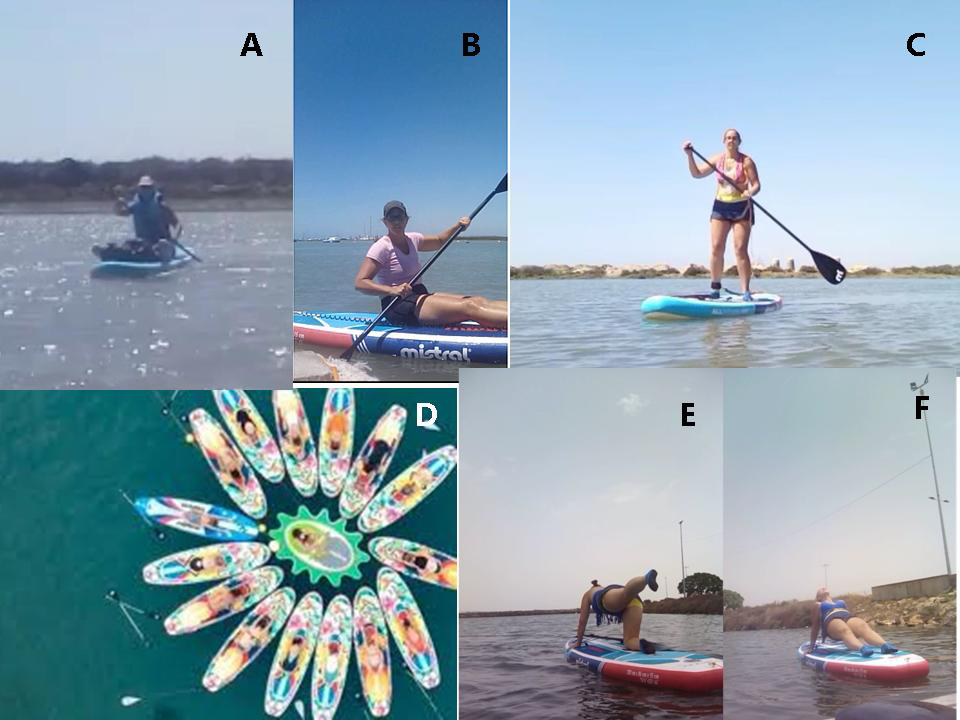
Figure 1: Different uses for the paddle boarding: A) and B) the kayak mode, C) the SUP mode and D), E) and F) the Yoga or Pilates mode. In A, B and C pictures the propelling mode is a paddle, A and B use a double blade, which implies faster movements and bigger control on the whole board surface. Picture C uses a single and longer blade that enable better views, major balance exercise and slower paddling.
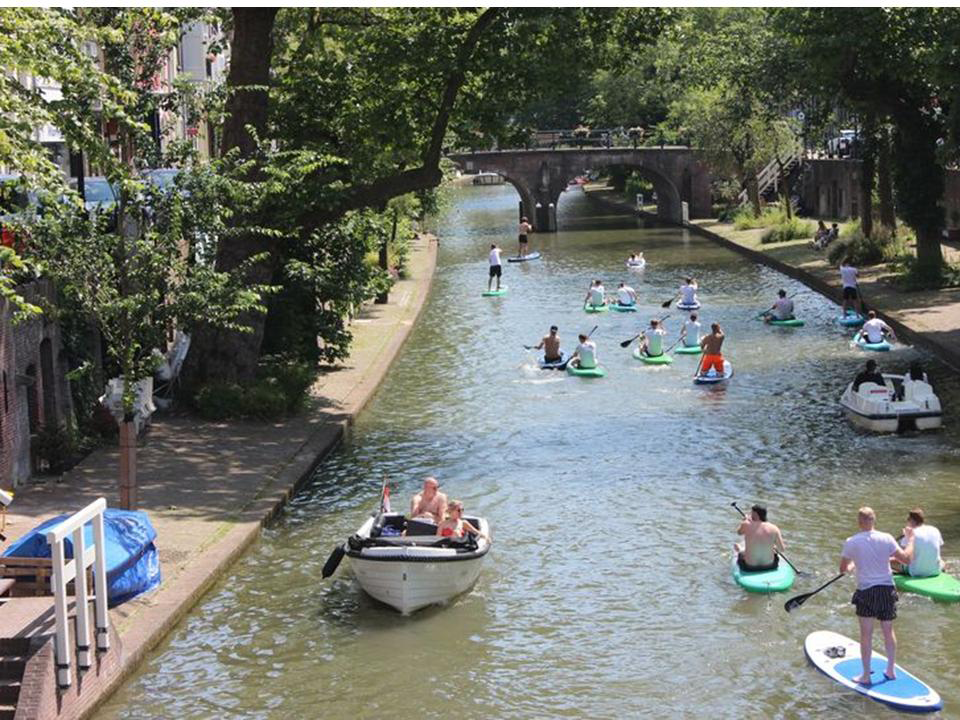
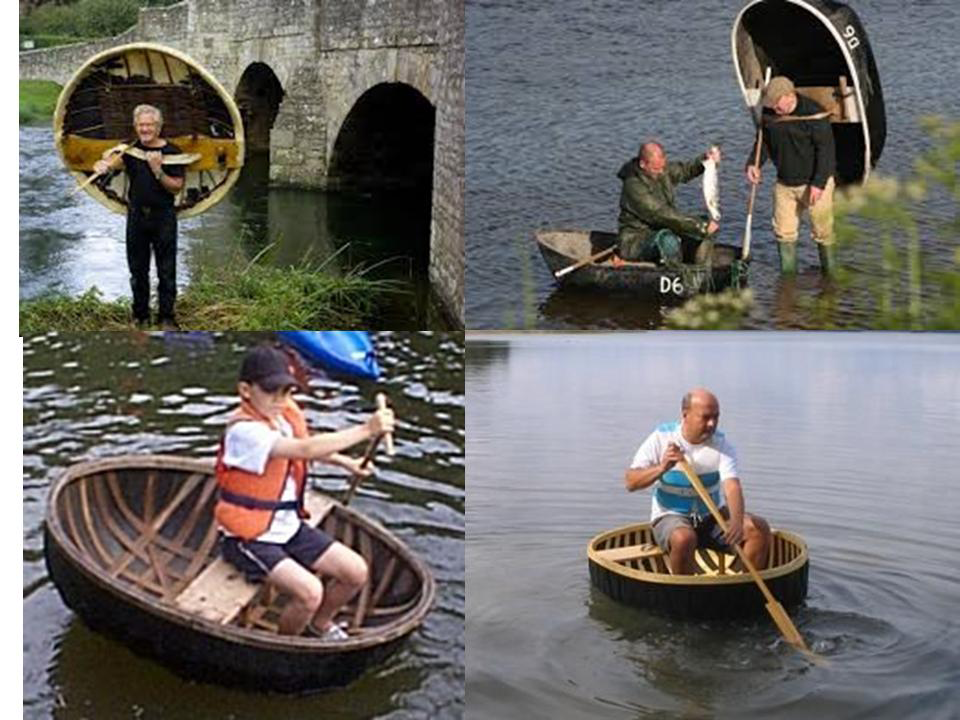
The origin of the SUP occurred in Hawaii [2] but is now practised all over the world, specially it has been extended since the invention of the inflatable stand-up paddleboard (iSUP). In Tel Aviv, Israel, lifeguards were using a stand up board called hassakeh, since the first decades of the twentieth century [3]. But that is a very ancient idea borrowed from fishermen from very old previous cultures (Phoenicians, Greeks, Assyrians, etc). In Europe, Wales and Ireland, a lightweight road boat used with similar purposes is the coracle (Figure 3). Made of wood or bamboo with an outlayer of an animal skin and propelled by a broad bladed paddle the oval shape made it very similar to half a walnut shell, reducing the required depth of water in river conditions, but making it an unstable craft, with a keel-less flat bottom. Some scholars believe that Moses was found in a small coracle around 1393 BC, on the Nile river in Egypt.
Navigation on rivers or lagoons have also influenced culture (music, books) and inspired types of roles as adventurers such as Huckleberry Finn, written by Mark Twain in 1884. Huck is a boy about “thirteen or fourteen or along there” years old who, with his friend named Tom Sawyer, used to travel along, up and down the Mississippi river on timber rafts (Figure 4).

Figure 4: Drawings and paintings depicting Hucklberry´s way to propel across and along the wide and long Mississippi “Great River” which is the primary river of the largest drainage in the United States. In the images it is noticeable how the way to move on the river is using a long pole without a paddle, due to the shallow depth of the rivers.
In this activity people is exploring natural environments such as slow rivers, calm lakes, quiet seas or oceans, canals or dams or harbour [1]. When the stand up paddle board is inflatable (iSUP), the options for exploring are increased, because transporting the large board in a deflated state makes much easier the possibility to reach remote or unknown places to scout. In this way, the simplest way of sailing and rowing on a iSUP through the “veins of the earth” happens. This sport makes it possible to get closer to the fluid element of the planet and glide gently over the water in a clean, light, cheap and non-polluting way.
The board is having the thruster design with three keels or fins in its contact part with the water, because three points (traceries), offers major stability, an optimal balance between speed, grip and manoeuvrability: one main, central, long and removable keel between 15 and 30 centimetres with two lateral, smaller and permanent stabilizer-keels. They act as pivot points to make possible smoother change of directions or turns and increase grip to the water adding control and balance [3]. The length of the fin and its measurements depends on the water characteristics, but in paddle boarding it makes possible the shallow water navigation, with a shoal smaller than 30 cm or even shallower, without the main fin although it might imply less control.
Body Internal Balance
However, aquatic sports in recreation or competitive modes, require a continuous re-hydration because of fluid loss due to the sun and salt exposure, the air temperature and humidity together with the aerobic prolonged duration and strength exercises [4]. Being negligent on this respect might compromise the exercise performance or cause increase body temperature and heart rate, leading to detrimental health outcomes such as renal failure or heat illness in extreme circumstances [4]. Osmoreceptors located in the hypothalamus perceive plasma fluctuations and provide thirst sensations, however they might not be very accurate with an intense physical activity resulting in the individual already is in a dehydrated state before the feeling of needing to re-hydration happens.
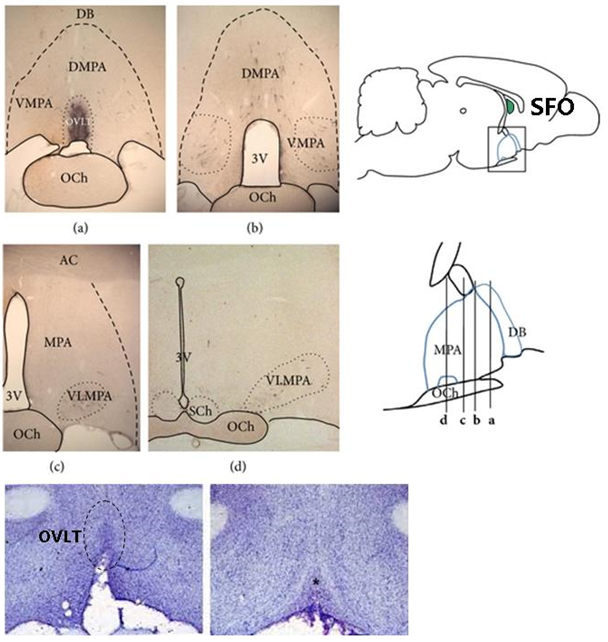
Figure 5: Different levels of the rodent brain in a rostro-caudal approach of the hypothalamus, which depict the Organum Vasculosus of the Lamina Terminals (OVLT) and the Subfornical Organ (SFO), which is represented in the sagittal section on the right with the green shape. The OVLT is located close to the more anterior section of the optic chiasm (Och). This region in mammals is involved in the modulation of thirst and fluid regulation of the body through synchronized vasopressin release.
The Organum Vasculosum of the Lamina Terminalis (OVLT) (Figure 5) and the subfornical organ (SFO) are both located around the third ventricle of the hypothalamus in mammals. They are regulating the sodium and water balance for the thirst and water intake through the secretion of vasopressin which is adjusting the osmolarity in 282-295 nOsm/Kg [5]. Water in our bodies helps to eliminate waste, maintains blood circulation all throughout our body, aids in the digestion and nutrient absorption and maintains the body temperature. According to the Navy Seal Nutrition Guide a human male needs to consume an average of 1 to 2.3 litters of water per day [5].
Using functional magnetic resonance image techniques and regional cerebral blood flow (rCBF) in the ventricles, it was investigated how physical exercise induced-sweating in humans activated the OVLT and its neuronal correlates of dehydration (medial thalamus, limbic and paralimbic cortices, frontal, temporal and parietal cortices) [6]. Aquatic sports have the peculiarity of some sort of delay in the thirst feeling, maybe because of the water, fresh air or humidity typical in natural environment where these sports happen. Sweat or perspiration of the body to induce vasopressin release might not be a clue, in aquatic sports. That is why the rowers are encouraged to make a wise judgement for the care of their own hydration and nutritional state before, during and after a race. Then it might be required to carry, specially in races lasting longer than an hour, enough liquid in environmental friendly bottles [4, 5, 7].
Activities Prone to Injuries
Without any instruction or information a paddler is more prone to injury, because of bad postures, inadequate use of certain muscles or muscle overload. These are usually happening in the upper body: elbow, shoulder and back [1]. An investigation made in Germany (Cologne) proved the high risk of injury to occur with SUP in wild water (33.3%), being even more dangerous than SUP surfing in the beach. A higher percentage of injuries was reported when using a hardboard (29.6%) compared with using a iSUP (14.9%). It is remarkable how this sport is practiced by athletes from all ages, from 0 – 90 years [2]. The main reasons for injury in SUP were overuse, contact with the board or ground (27.1%), being the upper body areas more affected. The lesions occurs in muscle/tendons and joints in upper arm/ shoulder followed by wrist/hand, knee, elbow/forearm and foot. However, compared with extreme water sports (such wind surfing, kite surfing, cable wakeboarding), SUP is substantially less dangerous [2].
For instance, in kayak mode, at certain point it is necessary to add an oscillating rowing movement with a waist twist to involve the abdominal (core) muscles and free the back and arms. Frequent stops to regain and recuperate strength in safe places without currents (even using an anchor) are highly recommended. In recreational paddling SUP, not competing with other paddlers but in a natural environment (air, flows, obstacles, etc.), it was proved the paddling cadence in small proportion (45 strokes per minute [spm]) were better gross efficiency (GE) and economical. The GE is the percentage ratio of external work performed to the total production of energy. That means, in terms of body metabolisms, the smaller cadences of paddling sequences are better in producing energy to move compared to higher cadences when paddling faster at 55 or 65 spm. This study showed how lower perceived sense of exertion may likely translate to faster speed, greater endurance and a general better performance [8].
To prevent these injuries, it would be advisable to previously work-out with warm-up exercises beforehand in the abdominal and oblique muscles, as well as with the muscles in the arms (biceps, triceps, deltoids) and pectorals. Moreover it is also recommended to carry the appropriate equipment (i.e. non-slip shoes) and during practise, breaks and pauses are suggested to avoid muscle overload. Concerning to the liquids for proper hydration, pure water or with mineral salts, including baking soda and lemon juice, are recommended [5].
The non-propelling mode of this board is the Pilates or Yoga- SUP. This variant is better recommended to those people who has already experienced the carpet or mat Pilates or yoga, because it implies some advanced skills. The originalities of this combination are two: first one that happens in a natural environment, that is over the liquid of the nature water, providing clean and pure air to breath while the controlled exercises are happening. This experience might be interrupted for animals, surprising loss of balance or concentration, or unexpected board movements due to tides. But these elements are adding extra fun because they are unavoidable and interesting variables to the exercise. Meditation is not so clean as the practise over a mat, but body balance gains in exchange. The second contribution of this practise is the extra effort of the abdominal muscles (core) while postures are performed, to preserve balance in a mobile medium such as water. Those postures are already difficult to obtain in balance on the ground then over the water more muscles are required to be activated for the complete exertion. Moreover, attentional resources are focus on balance in an extra effort because they happen over the water.
Contrary to what is extended believed, the board paddling is not a relaxing exercise, not even in its Pilates or Yoga variant. Undoubtedly it enables a better breathing in a natural environment, the cardio exercise is relaxing a posteriori and the sound of the air making bubbles when getting into the water in movement or falling down of the paddles while paddling are very pleasant, soften and calming. However, the attentional resources required to make a good practise of this sport make it far away from a drowsy practise. Actually the more common risks or dangers in board paddling appear when attention omissions or miscalculation happen, concerning to the preparation of sport infrastructures (liquids, leashes, clothing, etc) or to the signs of nature (way back, wind changes, sudden tidal changes, etc).
Another possible danger to take into account when navigating in wetlands is the mud and mire that surround rivers or lakes. This sludge has the peculiarity of yielding to the footprint. The more effort is made for removing the foot out, the more and more sinking is the leg into the slush, similar to quicksand. In some cases, people have found themselves submerged in mud up to their waists. In those cases, having the horizontal support point of the paddle board can definitively help you to get out from the mud without asking for help.
Conclusions
The paddle surf is a relative recent sport, that is continually innovating [i. e. inflatable stand-up paddleboard (iSUP)]. Over the board of the paddle surf, three different sportive practise are possible, two propelling modes (kayak and SUP) and one stretching mode (Pilates or Yoga-SUP). Contrary to what is believed, the board paddling is not a relaxing exercise, not even in its Pilates or Yoga variant. The attentional resources required to make a good practise of this sport make it far away from a drowsy practise. Compared with extreme water sports (such wind surfing, kite surfing, cable wakeboarding), SUP is substantially a less dangerous aquatic sport. This non-polluting sport practice represents an approach to Nature and its charms in a healthy and safe way, with minimal or beardable risks.
Acknowledgements
We would like to thank Prof. Swaab at the Netherlands Institute for Neuroscience for his suggestions of improvement. We would like to thank to the editor and reviewers for their valuable enhancements.
Credit of Images Photographs presented in this work come from files with a free license in the public domain as Wikipedia Commons. In other cases the copyrights belongs to their respective owners.
References
-
Schram B and Furness J (2017) Exploring the utilisation of Stand Up Paddle Boarding in Australia. Sports 5(3): 53.
-
Balke M, Fischer M, Kegler T, Höher J, Balke M (2021) Injuries and use od safery equipement in Stand-Up Paddle Boarding. Orthop J Sports Med 9(8): 1-8.
-
Casey R (2011) Stand ud paddling: flatwaters to surf and rivers. In: The Montaineers Book, Seatle, WA, USA.
-
McArthur R, Duque-Anne J, Furness J, Kemp-Smith K, Simas V, et al. (2021) Effect of Stand-Up Paddle Boarding on hydratation status in recreational and competitive individuals. Int J Exerc Sci 14(6): 756-767.
-
Cooney S (2015) How to increase your stand up paddling performance, Beginner to elite. SuzieTrainsMaui Ed. CreateSpace Independent Publishing Platform.
-
Farrel MJ, Bowala TK, Gavrilescu M, Phillips PA, McKinley MJ, et al. (2011) Cortical activation and lamina terminalis functional connectivity during thrist and drinking in humans. Am J Physiol Regul Integr Comp Physiol 301(3): R623-31.
-
Starrett K, White P (2018) Waterman 2.0. Optimized movements for lifelong, pain free paddling and surfing. MobilityWOD Inc, The Ready State.
-
Castaneda-Babarro A, Santos-Concejero J, Viribay A, Gutierrez-Santamaria B, Mielgo-Ayuso J (2020) The Effect of different cadence on paddling gross efficiency and economy in Stand-Up Paddle Boarding. Int J Environ Res Public Health 17(3): 4893.
- Occupational Stress and Mental Health Outcomes Among Police Officers: A Mini Review
- The Experience of Counterproductive Leadership on Mental Health and Impact on Retention in U.S. Marines: A Phenomenological Study
- Nomophobia in the Digital Age: A Study on College and University Students
- Emotional Regulation in Children with Autism and Learning Disabilities
- Antisemitism on American College Campuses and Its Impact on Jewish Students
- Exploring the Role of Empathy in the Associations of Family Functioning and Purpose in Life with Attitude towards Abortion among Undergraduates: A Moderation Analysis