
Characterization of Primary School Teachers’ Beliefs about Narrative Writing and their Relationship with Cognitive Style
This article reports a study that seeks to characterize the beliefs of elementary school teachers about the composition of narrative texts, and their relationship with the field independence-dependence cognitive style. The sample is composed of 87 language teachers (77 women and 10 men), from 14 educational institutions in the municipalities of Ubaté, Vélez, Ipiales and Todos a Aprender Program of Nariño in Colombia. The study is mixed and descriptive nature. The participating teachers answered the first instrument corresponding to the Questionnaire on Transmissive and Transactional Beliefs about the process of writing narrative texts. The second is called the Masked Figures Test. It was adapted from the National Pedagogical University. The results indicate that 6 out of 10 teachers have transmissive beliefs, which indicates that the participant considers writing as an act of moving or transcribing words from the board to the notebook. Regarding transactional beliefs, it is highlighted that participants conceive writing as a process composed of several stages called time to read, plan, write, revise, correct, share, rewrite, and publish. Finally, the Masked Figures Test used to identify the cognitive style of the participants shows that there is no tendency for field independence-dependence, since the average score was 25,11.
Introduction
Beliefs constitute internal representations that are formed during the course of a person’s entire life [1] and they can contribute positively or negatively to professional training [2, 3, 4, 5, 6, 7, 8, 9, 10, 11, 12, 13, 14, 15, 16, 17, 18, 19, 20, 21, 22, 23, 24, 25, 26, 27, 28, 29]. Likewise, Ortega and Gasset [24] point out that these conditions influence thoughts, the way of perceiving reality, value judgments, and the decisions that are chosen or not made as navigation maps that guide the different decisions and practices carried out in the classroom [8]. They can also be transformed through reflection and experience, specifically in pedagogical practice; however, Blázquez, et al. [30] emphasize that they are difficult to modify since they have been built in formal educational contexts, and are deeply rooted. It should be noted that beliefs are usually constant during educational practices, play a causal role in decision-making, and in the development of certain activities proposed by the teacher in the classroom.
From this perspective, it is pertinent to highlight that the beliefs held by teachers influence the choice of activities implemented during the writing process, and consequently affect the quality of the texts. In this regard, White, et al. [31] point out findings from two lines of research, which they called transmissive beliefs and transactional beliefs, related to writing. Both beliefs play a mediating role in the processing of new information, serve as mental examples to construct and evaluate one’s own classroom practice, and influence the didactic transposition that occurs in the different teaching- learning processes [19]. In this regard, people who hold transmissive beliefs have a lower cognitive demand compared to people who hold transactional beliefs Rosales. The last one requires greater mastery, or experience in the writing task. In that sense, transmissive beliefs have been directly associated with reproductive learning of low reflexivity, and meaningfulness. Teachers who hold this type of beliefs understand writing as a unidirectional act in which they act as a simple intermediary that transfers information orally, or in writing, after obtaining it from other sources [16].
On the other hand, transactional beliefs have been related to the construction of meaning, the use of deep processing strategies, the global interpretation of the text, and the recall of information. In this sense, it is understood that people who possess this type of beliefs perceive reading-writing as a dynamic, active and participatory process on the part of those who write the text [21]. Similarly, Hernández and Rodríguez [17] mention that people who present this type of beliefs assume writing as an essentially transformative activity, mediated by the subjectivity of the writer who goes beyond previously known information.
On the other hand, the concept of cognitive style is defined by Hederich and Camargo [15] as the habitual, and constant way a person uses to solve problems, think, perceive, and remember. It is also related to specific conscious, and automatic patterns for processing, storing, and retrieving information, which contributes to the development of knowledge. For his part, Hederich [14] postulates that cognitive style is the result of the combination of several factors, or variables that intervene in individuals, such as: family, cultural, sociocultural, environmental, gender, or age. In this regard, Gero, et al. [12] define cognitive style as the preference of strategies that a person uses to solve a problem. They also argue that difficulties in communication and collaboration between teachers and students increase as the gap between the cognitive styles of the interacting subjects grows.
In summary, transmissive and transactional epistemological beliefs and teachers’ cognitive style play an important role in the configuration of literacy practices [22, 23, 24, 25, 26, 27, 28, 29, 30, 31, 32, 33]. In this regard, White, et al. [31] point out that there is a correlation between the type of beliefs about literacy, and its relationship with the field independence-dependence cognitive style. In this sense, it is emphasized that in order to transform or maintain the practices that teachers have about the stages of the writing process, it is necessary to investigate:
What kind of beliefs do language teachers have about the process of writing narrative texts, according to the field independence-dependent cognitive style?
Problematic
The literature shows that the development of literacy contributes significantly to all formative stages, and areas of knowledge of students. However, Borzone [3] and Vine-Jara [33] mention that there are students who finish primary, and secondary school without reading, and writing well. From this perspective, the Saber 5° Standardized Tests that have been applied in Colombia in recent years show that only 1 in 10 students reach a higher level, and 65% of students are at the minimum, and insufficient levels. In this regard, Hernández and Rodríguez [16] emphasize that teachers do not conceive writing as a strategic learning activity, which is why they tend to evaluate more superficial aspects, such as spelling, and punctuation, and not complex aspects, such as critical reading, text coherence, and reflections. It should be emphasized that reading and writing are skills that do not develop naturally, but require intentional actions on the part of teachers in the classroom. Therefore, teachers should guide their students to develop both skills as a learning tool oriented with a real, and explicit purpose [32].
In the same way, Castelló, et al. [6] highlight that students present difficulties in understanding, and producing academic texts. Therefore, students do not have the necessary competencies to assume the writing tasks that are developed every day in the classroom. In the same sense, the difficulties presented by students in academic literacy may derive from various factors. One of them is the beliefs held by elementary school teachers, since according to Piñeros, et al. [26] about 95% conceive writing as a simple activity of moving words, or letters from the board to the notebooks, and not as an act that contributes to represent, analyze, review and transform knowledge [28].
Likewise, Di Stefano and Pereira [9] state that the beliefs held by teachers influence the teaching-learning process of reading and writing. It should be noted that these are the beliefs that guide, influence the selection of strategies, and cognitive operations deployed by the teacher in the classroom. In this sense, it is pertinent to inquire about the beliefs that teachers have regarding the writing of narrative texts, since they are the main ones in charge of determining the dynamics of what happens inside the classroom. However, beliefs have a strong mediating effect on cognitive, linguistic processes, attitudes, and motivation for text composition [10].
Methodology
Study Design
A descriptive study was conducted to characterize the beliefs that teachers have about the process of composing narrative texts, according to the field independence- dependence cognitive style between July and October 2023. Data were collected in 14 educational institutions in the municipalities of Ubaté, Vélez, Ipiales, and the Todos a Aprender Program in Nariño, Colombia. Methodological approach is described in five main areas: participants, collection instrument, procedure, ethical approval and statistical analysis.
Participants
The study was carried out with 87 language teachers working in official, and private institutions in the participating municipalities. The selection criteria were the following: to be language teachers, to accompany pedagogical processes in elementary school, and to work in the urban sector. It should be noted that in Colombia, in order to become a teacher, candidates must have one of the following degrees: teacher training, bachelor’s degree, professional degree, master’s degree, doctoral, or postdoctoral. For admission to the educational institutions, applicants must satisfactorily pass the proposed tests, and stages to be appointed as a teacher. The mode of selection of the participants corresponds to a convenience sampling.
| Characteristics of the sample members | |||
|---|---|---|---|
| Age | |||
| Frequency | Percentage | Cumulative percentage | |
| Under 25 years old | 6 | 6,9 | 6,9 |
| Between 26 and 35 years | 19 | 21,8 | 28,7 |
| Between 36 and 45 years | 34 | 39,1 | 67,8 |
| Between 46 and 55 years | 20 | 23,0 | 90,8 |
| Over 55 years old | 8 | 9,2 | 100,0 |
| Total | 87 | 100,0 | |
| Academic level | |||
| Teacher Trainee | 7 | 8,0 | 8,0 |
| Graduate | 23 | 26,4 | 34,5 |
| Professional | 8 | 9,2 | 43,7 |
| Specialist | 15 | 17,2 | 60,9 |
| Master’s degree | 32 | 36,8 | 97,7 |
| Doctorate | 2 | 2,3 | 100,0 |
| Total | 87 | 100,0 | |
| Work experience | |||
| Less than 5 years | 9 | 10,3 | 10,3 |
| Between 6 and 10 years | 16 | 18,4 | 28,7 |
| Between 11 and 15 years | 14 | 16,1 | 44,8 |
| Between 16 and 20 years | 21 | 24,1 | 69,0 |
| More than 20 years | 27 | 31,0 | 100,0 |
| Total | 87 | 100,0 | |
| Gender | |||
| Men | 10 | 11,5 | 11,5 |
| Women | 77 | 88,5 | 100,0 |
| Total | 87 | 100,0 |
Table 1: General characteristics of the participants.
(Source: Investigation data). Table 1: General characteristics of the participants.
Collection Instrument
Data were collected from the implementation of two instruments. The first one is entitled Transmissive, and Transactional Beliefs Questionnaire. This instrument is composed of 38 items divided into 8 stages about the process of writing narrative texts. It should be noted that four phases were implemented in the design of the instrument, which are described below: First Phase: in order to design the instrument, a systematic review of the literature was carried out, which contributed to the definition of the categories called time stages for: reading, planning, writing, revising, correcting, sharing, rewriting, publishing; which can be implemented during the process of composing narrative texts. Besides, it was added the review of research related to the validation of instruments that inquire about the beliefs held by teachers, and students about the writing process. Second Phase: the first version of the transactional and transmissive beliefs instrument was written. This consisted of 50 items related to each of the proposed stages of the text composition process. It should be noted that the instrument seeks to inquire about the beliefs presented by practicing teachers about the process of writing narrative texts. Third Phase: this consisted of validating the instrument by expert peers. Six (6) PhDs and one (1) Master’s degree in the areas of Educational Sciences, Social and Humanistic Sciences, and Natural Sciences contributed to this process. It should be noted that the teachers are assigned to educational institutions in the official, and private sectors. For the validation of the instrument, a rubric was designed with the objective of verifying the reliability of the questions, and adjusting the instrument according to suggestions, and/or recommendations.
Likewise, a scale of 1 to 4 was used in the rubric to indicate the relevance of the item in the instrument. The statements were as follows: ● 1. It is not important to include this item in the instrument.
- 2. Somewhat important to include this item in the instrument
- 3. Important to include this item in the instrument
- 4. Very important to include this item in the instrument It is worth mentioning that the rubric gives the expert pair the possibility of writing suggestions, and comments for each of the statements. This phase contributed to making modifications, or eliminating some of the proposed items. Finally, the instrument condenses 38 items related to the 8 categories established for this research. Fourth Phase: in this phase, the instrument was piloted with doctoral students of the Faculty of Education at Antonio Nariño University, Bogotá. This process allowed consolidating the instrument for implementation in the target population. The above, in order to characterize the beliefs held by teachers who accompany pedagogical processes in elementary school. It should be noted that a Likert Scale type instrument was used in the pilot study to investigate transmissive and transactional beliefs related to the reading-writing process. The instrument consists of 38 items (questions) divided into two types of beliefs: 19 transmissive (TBA) and 19 transactional (TBM).
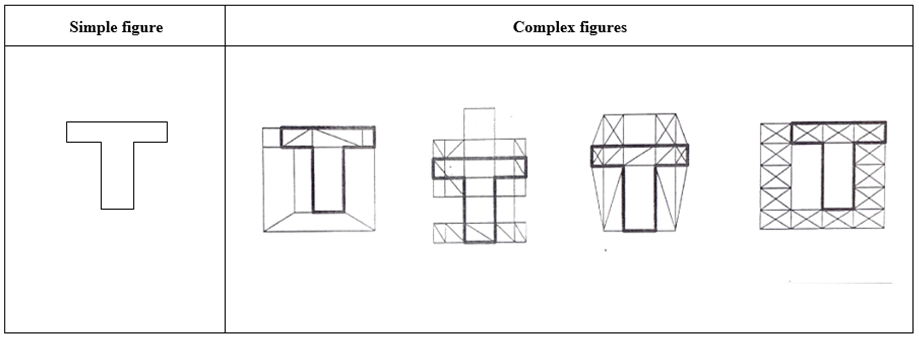
The second is called the Masked Figures Test in the Sawa version of the Gottchadt figures, with adaptations made by the cognitive styles group of the National Pedagogical University. This instrument consists of the participant finding, and tracing simple figures in complex figures in a given time. The simple figure is exactly the same, and it is in the same direction as when it appears alone. It should be noted that in this test there may be more than one correct answer; however, only one should be marked. It is recommended that you use a pen of a color other than black. Figure 1 shows an example of the Masked Figures Test. It should be noted that if the participant finds a number close to 50 figures, his/her cognitive style is independent (FI). On the other hand, if the participant’s score is close to Figure 1, his/her cognitive style is field dependent (FD).
(Source: National Pedagogical University). Figure 1: Masked Figures Test.
Procedure
The research took place in 14 Educational Institutions in the urban sector in different municipalities of Colombia. Once the appointment was arranged with each of the institutions, and with the previous authorization of the principal, and/or coordinator of the educational institution. The researcher implemented the instruments with previous consent of each of the participating teachers. It should be noted that both instruments (questionnaire of transmissive and transactional beliefs and the Masked Figures Test) were applied individually, and in physical format in 1-hour time slots.
Ethical Approval
Each participating teacher signed an informed consent form in which the objective of the research was described and the voluntary participation, and the possibility of withdrawing at any time, without any consequence, was made explicit. Likewise, the confidentiality of the data, and the anonymity of the responses were assured. This is a descriptive study in which two instruments were applied, so it presents no known risks for the participants. The research from which this article was derived, it was approved by the Ethics Committee at Antonio Nariño University.
Statistical Analysis
The Statistical Package for Social Sciences (SPSS), version 25 was used for the statistical analysis. All the data were entered in a Microsoft Excel master spreadsheet, and then processed by the statistical program.
Results
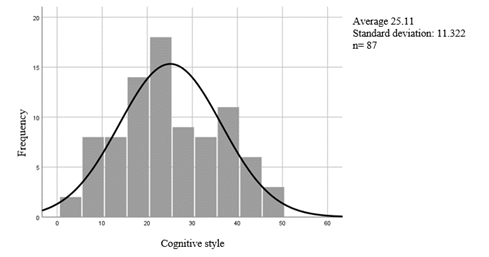
In relation to the cognitive style variable, it is indicated that the score achieved by the participants in the Masked Figures Test (MFT) has a normal distribution. For this sample, the variable yielded a minimum score of 3 points and a maximum score of 50 points. On average, the participating teachers obtained a mean score of 25.11 points with a standard deviation of 11.32. Figure 2 shows the distribution of the cognitive style variable.
(Source: Investigation data). Figure 2: Results Masked Figures Test.
The following Table presents the scores of the Masked Figures Test grouped into three categories: dependent, intermediate and independent.
| Frequency | Percentage | Cumulative percentage | |
|---|---|---|---|
| Dependents | 29 | 33,3 | 33,3 |
| Intermediates | 30 | 34,5 | 67,8 |
| Independents | 28 | 32,2 | 100,0 |
| Total | 87 | 100,0 |
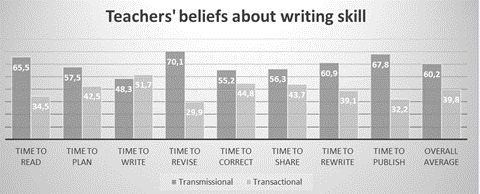
On the other hand, the results show that 6 out of 10 teachers present transmissive beliefs (TBM) about the writing process. From this perspective, teachers with this type of beliefs conceive this skill as an act of mobilizing concepts and writing from the board to the notebooks, and not as a process composed of stages that allows representing, analyzing, revising, and transforming knowledge. In relation to this, Daisey, [7] and Munita [23] state that a teacher who values and enjoys reading in his or her personal space, enthusiastically shares his or her passion, and contributes significantly as a mediator between the reading and literary learning of children, and young people.
(Source: Investigation data). Figure 3: Results Masked Figures Test.
Discussion
The following, it is a description of the beliefs held by teachers about each of the stages of the writing process:
Time to Read
This category shows that 6 out of 10 teachers hold transmissive beliefs (TBM) that reading is one of the most monotonous activities to pass the time. It should be noted that the participating teachers with this type of belief state that when they reread a text of their authorship, it is because someone asks them to do, so it is not because they seek to contribute to the quality of the text.
On the other hand, only 34.5% of the respondents stated that most days of the week, they read for at least fifteen minutes, and that it is necessary to reread the texts they write several times in order to produce better versions of the text. These results coincide with research conducted by Elche et al. [6] who says that teachers have instrumental conceptions about reading. Therefore, they place little value on books or visiting libraries; in addition, limited knowledge related to literary works.
Time to Plan
One of the characteristics of expert writers is that they plan their compositions more than novice writers [4]. In this sense, in the study population it was found that 60% do not make a writing plan when writing a narrative text. It should be noted that omitting this stage in the writing process has repercussions on the low quality of the texts produced.
Time to Write
The writing of a good text is not achieved in the first version, because it requires the implementation of several stages that contribute to the quality of the compositions [5]. In relation to this category, 48.3% of the participants believe that writing only serves to transmit information to other people. They also assert that writing is an exclusive activity for experts; therefore, most of the time, it is difficult for them to start writing a narrative text.
Time for Revision
This stage has a fundamental role in the composition of narrative texts, since it contributes to their quality. It consists of rereading what has been written to find possible spelling, cohesion, and coherence errors in the text [4]. In this sense, the sample shows that 7 out of 10 teachers do not take into account planning when writing a narrative text, and that when they do, so it is only to review spelling aspects.
Time for Corrections
Writing is a process that allows consolidating a text step by step. In the correction stage, Romero-González, et al. [28] suggest that it is necessary to take into account the observations made in previous stages. In this sense, Gutama [13] points out that in text correction it is relevant to take into account the structure of the text, and not only the orthographic aspects. However, this research shows that 52% of the participants believe that most of the times they deliver a written text, they do not check if the structure is well organized. Likewise, teachers believe that it is not necessary to correct it in several days in order to reach a better version of it.
Time to Rewrite
Riera, et al. [27] point out that the use of rubrics contributes to achieving a better version of the written text; however, 3 out of 5 teachers consider that the texts that are written are achieved with the first writing. In this framework, teachers assert that it is not necessary to rewrite them again because when a text is reread, or rewritten, it is only necessary to correct spelling aspects. On the other hand, Szady [34], Pereira, et al. [25] mention that it is necessary to rewrite the texts, so that they reach a better quality.
Time to Publish
How many ideas that are produced every day in the classroom are never known to mankind? Thousands and thousands of ideas are lost because they are never published. In fact, Jiménez, et al. [18] mention that most of the time, students conceive their teacher as the only reader. In relation to this background, it was found that 7 out of 10 teachers believe that they write to fulfill their academic duties; therefore, they are not interested in publishing or submitting texts of their authorship, or that of their students in existing local, national, and/or international contests.
Conclusion
It is highlighted that beliefs have a significant impact on the teaching and learning strategies, and methodological orientations implemented by teachers to develop reading, and writing skills in the classroom. Therefore, exploring how their students learn, and their relationship between cognitive style contributes to performance in academic achievement. It should be noted that the development of both skills corresponds to a competence inherent to the teaching profession, for which one must be motivated, and updated on their work in the classroom [35]. In this sense, the relevance of teachers updating their teaching practice, and knowing not only their beliefs, and cognitive style, but also that of their students, allows them to design contextualized learning strategies to strengthen reading and writing. From this point of view, teachers have the responsibility to promote them in all areas of knowledge, and stages of the educational process.
In accordance with the above, and within the framework of the research, most of the participating teachers have transmissive beliefs about the stages of the writing process called time to: read, plan, write, revise, correct, share, rewrite and publish. Therefore, these teachers still conceive writing as an act of moving concepts from the board, or from books to notebooks; and not as a process that allows representing, analyzing, and transforming knowledge. In particular, about 70% of the participants do not take into account the planning stage when writing a narrative text; then, how are teachers going to motivate, and promote the different stages of the writing process, if they do not implement them in their work? From this point of view, the role of the teacher should be to facilitate meaningful, and comprehensive learning by attending to the needs, and interests of the students. In other words, teachers should approach their students in a critical, argumentative, and proactive manner, taking into account the characteristics of the activities, and resources, contents, and cognitive components, teaching, and evaluation methods, motivational components, and the student’s own implications in learning. Also consider schedule, scenarios, behaviors, procedures, among others, for greater academic performance according to the characteristics of the context, and the strategies implemented by students to access knowledge.
In summary, the classroom is one of the best scenarios to motivate, and promote the development of reading and writing. In this sense, the teaching-learning process of these skills improves when teachers reflect on their beliefs related to the writing of narrative texts. However, other variables should be considered, such as the learning style when performing a task and the student’s ability to self- regulate learning, according to his or her preferences, and to appropriate the elements required for academic achievement. From this perspective, it is understood that both, teacher and student are active subjects of an intentional, planned, and systematic educational process in which processes, difficulties, and needs are taken into account in order to provide, and develop meaningful activities; that is, activities that favor learning, and engage students in their work in the educational context.
Conflict of Interest
On behalf of all authors, the corresponding author states that there is no conflict of interest.
References
-
Vera Bachmann D, Meneses Clavero P (2012) Construcción de una escala para medir creencias acerca del proceso educativo en profesores rurales, CAPE-R. Liberabit 18(2): 183-193.
-
Borg S (2015) Teacher cognition and language education: Research and practice. Bloomsbury Publishing.
-
Borzone AM (2022) There are children who finish primary without reading and writing well.
-
Caldera R (2003) The cognitive approach to writing and its methodological consequences in the school. Educere 6(20): 363-368.
-
Cassany DY, Morales O (2008) Reading and writing at the university: Hacia la lectura and critical writing of scientific genres. Revista Memoralia 5(2): 69-82.
-
Camelo González MJ (2010) The qualitative improvement of writing from metacognition. Colombian Applied Linguistics Journal 12(1): 54-69.
-
Castelló M, Mateos M (2015) Faculty and student representations of academic writing at Spanish universities / Faculty and student representations of academic writing at Spanish universities. Cultura y Educación 27(3): 477-503.
-
Daisey P (2009) The reading experiences and beliefs of secondary pre-service. Reading Horizons: A Journal of Literacy and Language Arts 49(2): 6.
-
Dewey J, Caparrós A (1989) How we think: New exposure of the relationship between thinking and the educational process. Paidos.
-
Di Stefano M, Pereira MC (2004) The teaching of reading and writing at higher level: processes, practices and social representations. In: Carlino P (Ed.), Read and write at the university_._ International Reading / Reading and Life Association, pp: 23-41.
-
Difabio de Anglat H (2013) Evaluation of concepts of academic writing in doctoral candidates in education. Investigative News in Education 13(3): 241-261.
-
Elche Larrañaga M, Sánchez García S, Yubero Jiménez S (2019) Reading, leisure and academic performance among university students in the socio-educational area. Education XX1: magazine of the Faculty of Education 22(1).
-
Gero K, Calderwood A, Li C, Chilton L (2022) A design space for writing support tools using a cognitive process model of writing. In: Proceedings of the First Workshop on Intelligent and Interactive Writing Assistants_,_ pp: 11- 24.
-
Gutama Chilpe EG (2023) Guide for using pictograms to correct reading-writing problems in the second year of Basic General Education afternoon session at the Sayausí educational unit, year 2022 (Bachelor’s thesis).
-
Hederich Martínez C (2005) Cognitive style in the field independence-dependence dimension: Cultural influences and implications for education. Universitat Autònoma de Barcelona.
-
Hederich C, Camargo A (2000) Cognitive style and academic achievement in the city of Bogotá. Colombian education magazine 40: 147-172.
-
Hernández Rojas GY, Rodríguez Varela EI (2018) Writing beliefs and practices. Comparison between different academic communities, mexican Journal of Educational Research 23(79): 1093-1119.
-
Hernández Rojas G, Cossío Gutiérrez EF, Martínez Compeán ME (2023) Learning and reflecting through writing academic journals. Mexican educational research magazine 28(97): 563-585.
-
Jiménez SY, Rubi EL (2010) The value of reading in relation to reading behavior. A study on reading habits and lifestyle among children. Ocnos. Journal of reading studies (6): 7-20.
-
Jones RCW, Backonja MM (2013) Review of neuropathic pain screening and assessment tools. Current pain and headache reports 17: 1-8.
-
Lerner D (2001) Reading and writing at school: what is real, what is possible and what is necessary. Mexico: Economic Culture Fund, pp: 1-6.
-
Miras M, Solé I, Castells N (2013) Beliefs about reading and writing, production of written summaries and learning results. Mexican educational research magazine 18(57): 437-459
-
Moreano Villena G, Villegas Regalado F, Darcourt Márquez AL, Chalén J (2022) Teaching credentials, self-regulated learning and performance in writing: an approach from Muestral Evaluation 2018.
-
Munita F (2018) The subject didactic teacher: “lectors who teach and teachers who read”. Alabe Research Journal on Reading and Writing pp: 17.
-
Ortega y Gasset J (2001) Ideas and Beliefs. In: Obras Completas, Madrid, Spain: Alianza Editorial 5.
-
Pereira MC, Valente E (2014) From revision to rewriting: appeals from the written productions of university students.
-
Piñeros Garzón AM, Orjuela Aldana D, Torres Sanmiguel A (2018) A critical look at the scriptural practices of the fifth grade of the primary basics, Notebooks of Hispanic Linguistics (31): 173-190.
-
Riera SEA, Girona TM, Rivera DMS (2022) Digital tools for revising and rewriting academic texts. In Journey Effective Learning with TIC in UCM. Complutense University of Madrid pp: 233-243.
-
Romero-González AN, Álvarez-Álvarez MDLN (2020) The academic writing of university humanities students based on their productions: transversal study. Mexican Journal of Educational Research, 25(85): 395-418.
-
Rosa M, Martinez E (2022) Teaching credentials about writing with the support of ICT. Education and Science 26: e13729-e13729.
-
Blázquez FY, Tagle T (2010) Teacher training: a study of students’ and teachers’ beliefs about the English teaching and learning process. Revista Iberoamericana de Educación 54(4): pp: 1-12.
-
White MJ, Bruning R (2005) Implicit writing beliefs and their relation to writing quality. Contemporary educational psychology 30(2): 166-189.
-
Valverde-Riascos Y (2014) Reading and writing with meaning and meaning, as a pedagogical strategy in the training of teachers. Fedumar pedagogy and education 1(1).
-
Vine-Jara AE (2020) Academic Writing: Perceptions of Students of Human Sciences and Engineering Sciences at a Chilean University. _Íkala_ 25(2): 475-491.
-
Szady B (2015) The chronicle in Latin America. The case of Black Label. Correspondences & analysis, 5: 173-185.
- Occupational Stress and Mental Health Outcomes Among Police Officers: A Mini Review
- The Experience of Counterproductive Leadership on Mental Health and Impact on Retention in U.S. Marines: A Phenomenological Study
- Nomophobia in the Digital Age: A Study on College and University Students
- Emotional Regulation in Children with Autism and Learning Disabilities
- Antisemitism on American College Campuses and Its Impact on Jewish Students
- Exploring the Role of Empathy in the Associations of Family Functioning and Purpose in Life with Attitude towards Abortion among Undergraduates: A Moderation Analysis