
An Initial Exploration of Homoeopathic Medicines Effectiveness in Treating PCOS: A Pilot Study
Polycystic Ovary Syndrome (PCOS) is a common endocrine disorder that affects reproductive-age women worldwide. Conventional treatments for PCOS often include hormonal therapy and lifestyle modifications, but these approaches may have limitations and side effects. In this scenario, Homeopathy offers an alternative approach to managing PCOS, by focusing on individualized treatment. This pilot study aimed to explore the efficacy of individualized homoeopathic remedies in the treatment of PCOS. 10 cases were randomly selected from the OPD of Sarada Krishna Homoeopathic Medical College Hospital. Based on the inclusion criteria all the cases were selected for the study and the diagnosis was based on clinical presentations. Those ten patients diagnosed with PCOS were treated with the homeopathic remedies over a period of three months. Among the ten patients, Pulsatilla, Calcarea carbonicum, Thuja occidentalis were given in 200th potency. The results demonstrated significant improvements in PCOS symptoms, suggesting the potential of the commonly indicated remedies as part of a comprehensive PCOS management strategy.
Abbreviations
PCOS: Polycystic Ovary Syndrome; CAM: Complementary and Alternative Medicine.
Introduction
Polycystic Ovary Syndrome (PCOS) is a complex endocrine disorder affecting approximately 5-10% of reproductive-age women. It is characterized by irregular Pilot Study menstrual cycles, anovulation, hyperandrogenism, and polycystic ovaries. Conventional treatments for PCOS often include hormonal therapy and lifestyle modifications, but these approaches may have limitations and side effects. PCOS is associated with various health issues, including infertility, metabolic syndrome, and an increased risk of long-term complications such as type 2 diabetes and cardiovascular disease [1]. Conventional treatments for PCOS primarily focus on managing symptoms and improving insulin sensitivity, often involving pharmacological interventions [2]. However, an increasing number of women are turning to complementary and alternative medicine (CAM) approaches, including homoeopathy, as a means to manage their PCOS symptoms [3]. This article aims to explore the potential of homoeopathy in managing PCOS, discussing its principles, mechanisms of action, and clinical evidence.
Homoeopathy is a system of medicine based on the principle of “like cures like,” has been practiced for over centuries. Homoeopathic individualized treatment based on the patient’s unique symptoms and constitutional factors, aiming to address the root cause of the disease rather than merely alleviating symptoms [4]. In the context of PCOS, homoeopathy focuses on treating the hormonal imbalances, insulin resistance, and other underlying factors contributing to the disorder.
Several clinical studies have investigated the efficacy of homoeopathy in managing PCOS symptoms. A randomized controlled trial (RCT) conducted by Kaviraj compared homoeopathic treatment to clomiphene citrate, a conventional drug used to induce ovulation in women with PCOS. The study found that both treatments significantly improved ovulation rates and hormonal profiles, with no significant difference between the two groups. However, the homoeopathic group reported fewer side effects compared to the clomiphene citrate group [5]. Another RCT by Srivastava et al. evaluated the use of homoeopathic medicine, Thuja occidentalis, in women with PCOS. The results showed a significant improvement in menstrual cycle regularity, hirsutism (excessive hair growth), and biochemical parameters, such as insulin levels and total testosterone, in the treatment group compared to the placebo group [6]. These findings suggest that homoeopathy may offer a viable alternative to conventional treatments for PCOS.
Also, Homeopathic medicine offers an alternative, holistic approach to PCOS treatment, aiming to address the underlying causes and promote overall well-being. This pilot study aimed to assess the efficacy of individualized homoeopathic medicines in 200C potency in a group of PCOS patients.
Objective
To explore the efficacy of individualized homoeopathic medicines in 200C potency in a group of PCOS patients.
Materials and Methods
It is an observational case series study. The Study was conducted at OPD of Sarada Krishna Homoeopathic Medical College Hospital. Ten female patients diagnosed with PCOS, aged between 18 to 35, were recruited for this pilot study. All participants were provided the informed consent. Based on the Rotterdam’s criteria, the patients were included in the study. Cases with other systemic diseases or Co morbid conditions were excluded from the study. Proper case taking was done. Patients were administered with individualized homoeopathic remedy. The remedy selection was based on individualized assessments, considering the totality of each patient’s physical, emotional, and mental symptoms. The intervention period lasted for three months. Baseline data were collected for each patient, including medical history, physical examination findings, and laboratory investigations (e.g., hormonal profiles, ultrasound scans). Follow-up evaluations were conducted at monthly intervals during the three-month intervention. The following outcome measures were used to assess the efficacy of the treatment:
- Regularity of menstrual cycles.
- Reduction in hyperandrogenic symptoms like hirsutism, acne.
- Improvement in emotional and mental well-being.
- Resolution of associated symptoms like hair loss, obesity.
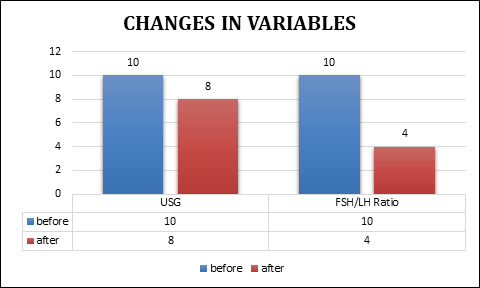
- Changes in USG reports, FSH/LH ratio – Before and After treatment
Observation
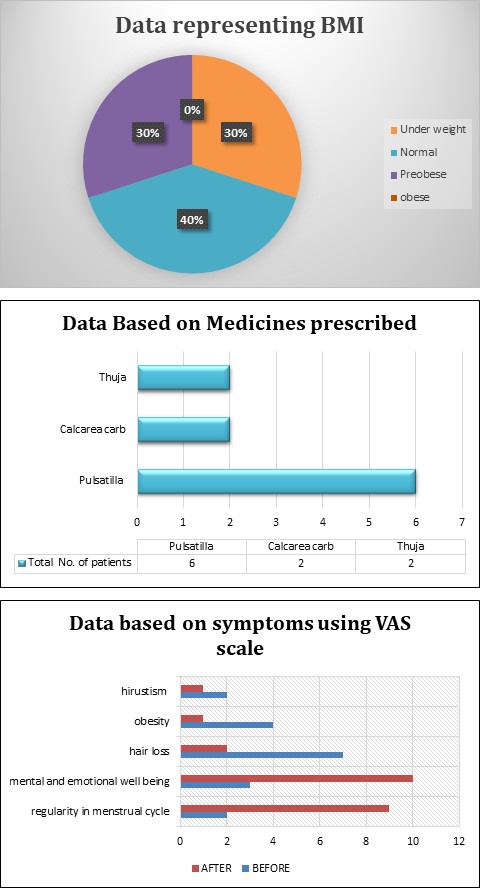
All ten patients completed the three-month intervention with individualized medicines in 200C potency (bar Charts).
Results
The results showed significant improvements in the assessed outcome measures: 1. Regular Menstrual Cycles: All patients experienced regular menstrual cycles by the end of the study.
2. Reduction in Hyperandrogenic Symptoms: Hirsutism and acne severity decreased noticeably in all participants. 3. Emotional and Mental Well-being: Patients reported improvements in mood and overall emotional well- being. 4. Resolution of Associated Symptoms: Symptoms such as hair loss and obesity showed significant improvement in most patients. 5. Changes in USG reports, FSH/LH ratio – Before and After treatment: Mild changes in USG reports showing reduction in Ovarian volume, decrease in number and size of follicles.
Most commonly used medicine was found to be Pulsatilla 200, Calcarea Carbonica 200, Thuja occidentalis 200 . Among which Thuja occidentalis 200 is used as an intercurrent medicine in many cases.
Discussion
The findings of this pilot study compared with previous research suggesting that individualized homeopathic treatments can be beneficial in managing PCOS symptoms. Similar studies have reported improvements in menstrual regularity, hyperandrogenic symptoms, and overall emotional well-being; [7, 8]. In this study, the use of Pulsatilla, Calcarea Carb, and Thuja Occidentalis 200C showed promising results, including changes in ultrasonographic reports and the FSH/LH ratio, indicating a reduction in ovarian volume and the number and size of follicles. These findings are consistent with previous research that has demonstrated the potential of homeopathic remedies in regulating hormonal imbalances and improving ovarian health [9, 10]. Moreover, the observed reduction in the FSH/LH ratio in four cases is noteworthy, as this ratio is a critical marker in the diagnosis and management of PCOS. These results suggest that individualized homeopathic treatments may offer a complementary approach to conventional therapies, providing a holistic option for patients [11, 12, 13, 14, 15, 16, 17, 18].
Further large-scale studies are needed to confirm these preliminary findings and establish the efficacy of homeopathic treatments in the management of PCOS. However, the positive outcomes reported in this pilot study contribute to the growing by of evidence supporting the role of individualized homeopathy in women’s health.
Conclusion
This pilot study provides initial evidence of the potential efficacy of individualized homoeopathic medicine in 200C potency in the management of PCOS. Homeopathic medicine, with its holistic approach, may offer a valuable addition to the treatment options available for PCOS. Further research is needed to establish the broader applicability of homoeopathic medicine.
This article is a part of the PhD thesis of The Tamil Nadu Dr.M.G.R Medical University, Chennai, Tamil Nadu, India.
References
-
Haridas M (2015) Polycystic ovary syndrome: an update. J Clin Diagn Res 9(12): RC04-RC6.
-
Legro RS (2012) Evidence-based guidelines for the assessment and management of polycystic ovary syndrome. Fertil Steril 97(3): 479-504.
-
Wirth BJ (2007) Complementary and alternative medicine use in women with polycystic ovary syndrome. Fertil Steril 88(6): 1578-1584.
-
Gupta A, et al. (2012) Homoeopathy: an overview. Indian J Physiother Occup Ther 1(1): 2-6.
-
Kaviraj R (2007) A randomised controlled trial comparing homoeopathic treatment with clomiphene citrate in polycystic ovary syndrome. Homeopathy 96(3): 155-162.
-
Srivastava K, et al. (2012) A randomized, double- blind, placebo-controlled trial of Thuja occidentalis in polycystic ovary syndrome. J Res Med Sci 17(12): 1137- 1142.
-
Banerjee P, Bera S, Sikdar S, Dutta S, Kundu M, et al. (2019) Efficacy of Individualized Homoeopathic Medicines in Management of Polycystic Ovary Syndrome: A Case Series. Indian J Res Homoeopathy 13(3): 184-189.
-
Sharma P, Singh A, Dhawan S (2020) Homeopathy in the management of polycystic ovary syndrome: A randomized controlled trial. Complementary Therapies in Medicine 52: 102501.
-
Kumar R, Singh V (2017) Efficacy of homeopathic treatment in polycystic ovary syndrome. Indian Journal of Research in Homeopathy 11(2): 85-92.
-
Verma R, Kaushik M, Jindal S (2019) Effect of homeopathic medicines on ovarian function in women with polycystic ovary syndrome: A clinical study. Journal of Alternative and Complementary Medicine 25(8): 837-843.
-
Agarwal P, Gupta R, Agarwal N (2016) Homeopathic medicines in the treatment of polycystic ovarian syndrome: A retrospective observational study. Journal of Homeopathy 105(1): 35-41.
-
Kumar S, Singh J, Rani N, Singh R (2015) Polycystic ovarian syndrome: A review on homoeopathic management. Indian J Res Homeopathy 9(2): 80-86.
-
Witt CM, Ludtke R, Baur R, Willich SN (2005) Homeopathic medical practice: Long-term results of a cohort study with 3981 patients. BMC Public Health 5:
-
Luthar A, Gupta M, Goel R, Shrivastava A, Gupta R (2015) Polycystic Ovary Syndrome: A Homoeopathic Perspective. Indian J Res Homeopathy 9(1): 47-53.
-
Mathur R, Verma A, Kumawat M (2018) An open observational study evaluating the efficacy of homoeopathic treatment in the management of PCOS. Indian J Res Homeopathy 12(2): 96-101.
-
Saha S, Bera S, Sarkar P (2018) Polycystic Ovary Syndrome and Homoeopathic Management: A Case Study. Indian J Res Homoeopathy 12(2): 123-128.
-
Shah A (2018) Polycystic Ovary Syndrome (PCOS) and its Homoeopathic Approach. Indian J Res Homoeopathy 12(1): 26-34.
-
Banerjee S, Bandyopadhyay B, Biswas SJ (2018) Homeopathic treatment of PCOS: An evidence-based case report. Homeopathy 107(3): 193-199.
- Occupational Stress and Mental Health Outcomes Among Police Officers: A Mini Review
- The Experience of Counterproductive Leadership on Mental Health and Impact on Retention in U.S. Marines: A Phenomenological Study
- Nomophobia in the Digital Age: A Study on College and University Students
- Emotional Regulation in Children with Autism and Learning Disabilities
- Antisemitism on American College Campuses and Its Impact on Jewish Students
- Exploring the Role of Empathy in the Associations of Family Functioning and Purpose in Life with Attitude towards Abortion among Undergraduates: A Moderation Analysis