
Family-Work Conflict and Compliance with Safety Behaviour: Moderating Role of Perceived Organizational Support among Officers and Men of Nigeria Police Force
Police officers often face unique stressors due to the high-demand nature of their work, which may lead to conflicts between family responsibilities and work obligations. These conflicts can negatively impact their adherence to safety protocols and behaviours, thereby increasing risks for officers and their communities. The present study adopted a cross-sectional survey design to investigate the interplay between family-work conflict and compliance with safety work behaviour among police officers and the moderating role of perceived organizational support in such association. A sample of (N = 600) police officers and men (age range 25-45 years; M = 32.40 years; SD = 4.93) recruited through multi-stage sampling from six police zones in Nigeria participated in this study. Self-report measures of the Safety Behaviour Scale, Family-Work Conflict Scale, and Perceived Organizational Support Scale were used for data collection, while the Hayes regression-based PROCESS Macro for SPSS was used for data analysis. The results revealed that family-work conflict has a significantly negative relationship with compliance to safety behaviours, while perceived organizational support positively correlated with compliance to safety behaviours. In addition, the interaction effect between perceived organizational support and family-work conflict on compliance with safety behaviours was significant, indicating that perceived organizational support moderated the relationship between family-work conflict and compliance with safety behaviours. The findings underscore the importance of fostering a supportive organizational environment to enhance safety compliance, even in family-work conflict. This contributes to the growing literature on occupational health psychology and provides actionable insights for law enforcement agencies to improve officers’ wellbeing and operational safety.
Abbreviations
SOPs: Standard Operating Procedures; PPE: Personal Protective Equipment; JD-R: Job Demands-Resources; FWC: Family-Work Conflict; HVSA: High-Visibility Safety Apparel.
Introduction
In contemporary workplaces, compliance with safety behaviours is paramount to fostering a secure and efficient environment for employees [1]. As organizations increasingly prioritize health and safety protocols, adherence to these behaviours becomes essential. Workplace safety behaviours refer to actions, practices, or habits that employees and employers adopt to prevent accidents, injuries, and other health risks [2]. These behaviours are critical to maintaining a safe and productive work environment. They often align with occupational safety standards, regulations, and organizational policies. However, compliance with safety behaviours refers to adhering to practices, protocols, and guidelines designed to ensure personal and collective safety in various environments, such as workplaces, public spaces, or specific industries [3]. Extant studies Afework A, et al. [1] have asserted the importance of compliance with safety behaviours in the workplace, as it plays a critical role in reducing the incidence of accidents and promoting overall employee wellbeing. Safety management practices, such as management commitment, comprehensive safety training, and effective communication, are essential in fostering a culture prioritizing workers’ health and safety. Studies indicate that these practices significantly influence safety behaviour compliance, particularly in high-risk environments, such as law enforcement and manufacturing industries, where hazards are prevalent [4]. For instance, a study by Song SY, et al. [5] revealed that traffic-related fatalities accounted for a substantial percentage of law enforcement fatalities, emphasizing the necessity of high- visibility safety apparel (HVSA) to enhance protective behaviours. Thus, prioritizing safety compliance safeguards employees and contributes to an organizational climate that values health, ultimately improving performance and reducing costs associated with workplace incidents.
Furthermore, compliance with safety behaviours is critically significant in the policing profession, particularly in high-pressure environments, which has remained a critical aspect of ensuring the wellbeing of officers, their colleagues, and the communities they serve [4]. It encompasses adherence to established protocols, practices, and behaviours designed to minimize risks, prevent harm, and enhance operational effectiveness. This aligns with the National Policing Institute [4] postulation that sustained training, leadership, and culture-building efforts are vital to embedding safety as a core value in policing.
These measures include following standard operating procedures (SOPs) during operations such as arrests, searches, or vehicle pursuits, using personal protective equipment (PPE) where applicable (e.g., body armour, gloves, or helmets), conducting regular inspections of equipment and vehicles to ensure they are safe and operational, risk assessment and management via conducting thorough risk assessments before engaging in high-stakes situation, identifying potential hazards and implementing measures to mitigate risks, remaining vigilant to dynamic changes in the environment during operations, training and continuous improvement via participating in regular training sessions on situational awareness, de-escalation techniques, and tactical skills, emphasizing safe practices during firearm handling, vehicle operation, and physical confrontations, staying updated on legal and procedural changes that impact safety, encouraging open communication among team members to share situational awareness and safety concerns via following chain-of-command and radio communication protocols to ensure coordinated efforts. These behaviours are essential for minimizing risks and hazards that could lead to accidents, injuries, or other harmful outcomes.
However, non-compliance with established safety behaviours in the workplace can lead to adverse consequences beyond immediate physical harm [6]. According to Ijaola, et al. [7], employees who disregard safety protocols jeopardize their health and create an unsafe environment for their colleagues, fostering a culture where risks are tolerated rather than mitigated. These non-compliance safety behaviours can result in increased workplace accidents, leading employers to face significant financial liabilities, diminished productivity, and potential legal repercussions. Furthermore, the consequences extend to the broader organizational culture, where negligence may breed mistrust and disengagement among employees, undermining morale and cooperation. Additionally, non-compliance can manifest subtly, such as perpetuating microaggressions related to safety compliance norms, inhibiting open communication and reinforcing a cycle of avoidance rather than proactive engagement [7]. Thus, the implications of non-compliance resonate deeply within the organizational fabric, demanding comprehensive safety management strategies that prioritize adherence and cultural integrity.
Furthermore, compliance with safety behaviours in law enforcement is paramount, particularly given the high- stress nature of police work, which can be exacerbated by family-work conflict [8]. This conflict often impacts officers’ adherence to safety protocols, as personal and familial responsibilities may distract or detract from their professional focus. Work-family conflict is a form of inter- role conflict where the demands of work and family roles are incompatible in some way [9]. According to Moreira, et al. [10], it connotes the struggle to balance competing family and work responsibilities. Conflict arises when participation in one role makes it difficult to fulfil the requirements of another.
Family-work conflict among police officers arises from their profession’s demanding and unpredictable nature, which often leads to significant emotional and physical strain [11]. The inherent stressors within law enforcement include long hours, exposure to traumatic events, and the pressure to maintain public safety, which can interfere with an officer’s ability to engage meaningfully with family life. Empirical studies indicate that this conflict can be exacerbated by the organizational climate, characterized by inadequate supervisory support and poor communication channels, which contribute to feelings of isolation and job-related burnout [12]. For instance, when officers lack sufficient resources to balance their roles at home and work, the resulting strain can diminish their overall job satisfaction and wellbeing [13]. Consequently, interventions to improve organizational support systems are essential for mitigating family-work conflict, enabling officers to maintain their crucial safety behaviours while nurturing their familial relationships. However, family-work conflict has been identified as a workplace hazard that impacts employees’ overall performance, including their ability to adhere to safety behaviours [14]. Thus, as family demands increase, employees’ ability to comply with workplace safety procedures tends to diminish. This is particularly true when family obligations interfere with work responsibilities, leading to deteriorating safety performance, as noted in extant studies [15].
However, extant studies de Sousa C, et al. [16], Sachau DA, et al. [17], Zhao XR, et al. [18] have identified the proximal influence of POS in mitigating adverse work outcomes such as organizational cynicism, turnover intention and organizational work-role conflict, which has the propensity to cushion the negative effect of work-family conflict on compliance to safety behaviours. POS refers to employees’ perceptions of how much their organization values their contributions and cares about their wellbeing [19]. Research has shown that when employees perceive strong organizational support, they are more likely to engage in safe behaviours and demonstrate commitment to organizational goals, including safety [20]. Thus, high levels of POS are linked to improved safety communication, increased compliance with safety policies, and reduced workplace accidents [21].
This is pertinent because organizational support connotes the emotional, informational, and practical or instrumental support that employees receive from their organization in reward for their contributions to its functionality [22]. Thus, building and maintaining social support greatly enhances positive work attitudes such as overall quality of life. Hence, high levels of POS can buffer against work-family conflict by fostering a supportive work environment where employees who feel valued and supported are less likely to experience family-work role conflict.
Furthermore, with a specific focus on the nexus between work-family conflict and compliance with safety behaviour, the present study aimed to investigate, first, whether work- family conflict has a significant relationship with compliance to safety behaviour, secondly, whether organizational support has a significant negative relationship with compliance to safety behaviour; and thirdly, whether organizational support will moderate the relationship between work-family conflict and compliance to safety behaviour.
Despite the growing recognition of the effects of family- work conflict on workplace safety [23, 24], research on how this conflict influences police officers’ compliance with safety behaviours and the intervening variables that mitigate such adverse effects, particularly in Nigeria, remains limited. Thus, the current study investigated the moderating role of organizational support in the relationship between work- family conflict and compliance with safety behaviours among police officers.
Theoretical Model and Development of Hypothesis
The theoretical framework of the present study was anchored on the Job Demands-Resources (JD-R) model [25]. The job demands and resources model is a flexible framework for understanding how various job demands and resources influence employee wellbeing and performance. The JD-R model [25] posits that the interplay between job demands and resources determines work outcomes. Thus, the model suggests that work environments consist of demands (e.g., FWC) and resources (e.g., POS). Resources help individuals manage demands and reduce stress. Thus, FWC represents a job demand that could hinder compliance with safety behaviours. As a job resource, POS could buffer the adverse effects of FWC, enabling better safety compliance. This framework integrates work dynamics to explain how and why family-work conflict affects safety compliance and the conditions under which this relationship is mitigated. It highlights the importance of organizational interventions, such as support systems, in counterbalancing the strain caused by job demands [26] to enhance safety compliance despite the challenges of FWC.
Relating this model to work-family conflict, compliance with safety behaviour and organizational support, first, family-work conflict occurs when the demands of family life interfere with work responsibilities. It is a form of stressor that drains personal resources such as time, energy, and focus, creating strain. FWC is categorized as a “job demand” because it requires effort to manage and adapt, leading to potential burnout if not mitigated. Hence, high FWC can increase emotional exhaustion, reduce cognitive functioning, and impair employees’ adherence to compliance with workplace safety behaviours. Thus, when employees experience high levels of FWC, their ability to focus on safety protocols may decrease.
The strain caused by FWC can lead to reduced mindfulness and effort directed toward complying with safety standards, increasing the risk of accidents and unsafe practices. Applying the model in this context, POS serves as a “job resource” that buffers the negative effects of job demands like FWC. This is pertinent because high POS can enhance employees’ resilience, reduce stress, and provide emotional and instrumental support. For instance, employees who feel supported by their organization may experience less stress when dealing with FWC, as they can access flexible work arrangements, counselling, or understanding from supervisors. Thus, the Job Demands- Resources gives a nuanced insight into how the balance (or imbalance) in perceived support between employees and their organization influences workplace outcomes, such as work-family conflict and compliance with safety behaviours.
Literature Review
Family-Work Conflict and Compliance with Safety Behaviour
The dynamic interplay between family obligations and workplace demands has become increasingly prominent, particularly in high-stress occupations like policing. This is pertinent since Work-family conflict refers to tension arising when the demands of work and family roles are incompatible or competing in some way [27]. This phenomenon occurs when the demands of work encroach on family responsibilities, leading to negative outcomes such as decreased wellbeing and job performance.
According to Tsang et al. [28], the family-work role conflict affects personal relationships and compromises adherence to essential compliance with safety behaviours vital in maintaining public safety and personal well-being. For instance, Officers exposed to high levels of occupational stress may struggle to maintain familial relationships, as their coping mechanisms can influence interactions with family members. Thus, high-stress working conditions in police work, characterized by irregular hours and exposure to traumatic incidents, disproportionately strain familial relationships, leading to discord at home. This indicates that the stress and coping styles of police officers directly affect how their adult offspring perceive and engage with the familial dynamic, underscoring the cyclical nature of stress within these households. Family-work conflict presents significant challenges for employees, as the demands of their profession often spill over into personal lives, affecting both job performance and familial relationships [27]. This conflict can manifest as role ambiguity and stress, leading to feelings of inadequacy in fulfilling both family and work obligations. According to Tsang et al. [28], achieving a shared understanding of roles and role demands within the work setting can mitigate such conflicts, suggesting that clarity in expectations and responsibilities is essential for effective job performance.
Furthermore, family-work conflict significantly impacts employees’ work outcomes and attitudes, often exacerbating stress levels at work and home. This spiral affects how such individuals engage with the familial dynamic, underscoring the cyclical nature of stress in the work life and wellbeing.
Thus, based on the above contexts and in line with the reviewed literature, the researchers posit the following: H1: Family-work conflict will have a significant negative relationship with compliance to safety behaviours among police officers.
The Moderating Role of Organizational Support
Perceived organizational support (POS) is crucial in mitigating family-work conflict among employees, particularly in enhancing compliance with safety behaviours [29]. This is pertinent because perceived organizational support reflects the extent to which employees believe their organization values their contributions and cares about their wellbeing [30], depicting that POS is closely tied to employee engagement, job satisfaction, and organizational commitment [31]. For example, when employees feel valued and supported by their organization, they are more likely to experience reduced stress levels and better work-life balance, which fosters adherence to compliance with safety protocols. Research indicates that employees who perceive high levels of organizational support are more likely to prioritize their wellbeing and adhere to compliance with safety measures under challenging conditions [21], including the ongoing turmoil surrounding issues of policing and societal unrest. Aligning with the above assertion, Zhao et al. [18] assert that employees who feel supported by their organization are more inclined to adhere to compliance with safety behaviours, reducing family-work conflict and fostering a healthier work- life balance. Applying the Job Demand Resources theory (JD- R) [25] to the family-work demand role in a work setting, employees aim to conserve and protect their resources (like time, energy, and emotional well-being). In this context, organizational support (e.g., from leaders, co-workers, or the organization as a whole) can act as a resource that helps mitigate the emotional exhaustion or frustration that might come with family-work conflict. However, the JD-R model suggests that job resources like POS motivate employees and moderate the impact of job demands on outcomes. Thus, employees who perceive high organizational support may be less likely to experience family-work conflict, orchestrated by family and work pressures, as they feel supported and less depleted of their resources based on the support system they enjoy.
Furthermore, POS can act as a buffer against the detrimental effects of family-work conflict, empowering employees to manage their responsibilities both at work and home more effectively [32]. Thus, strengthening organizational support mechanisms is essential in cultivating a resilient workforce compliant with safety norms amidst challenging circumstances. Hence, perceived organizational support plays a crucial role in this dynamic synergy since employees who feel supported by their organization are more inclined to adhere to compliance with safety behaviours, reducing family-work conflict and fostering a healthier work-life balance [33]. Invariably, this reciprocal relationship between safety compliance and perceived support underscores employees’ need to prioritize welfare and safety training as integral components of their operational framework. Further, strengthening
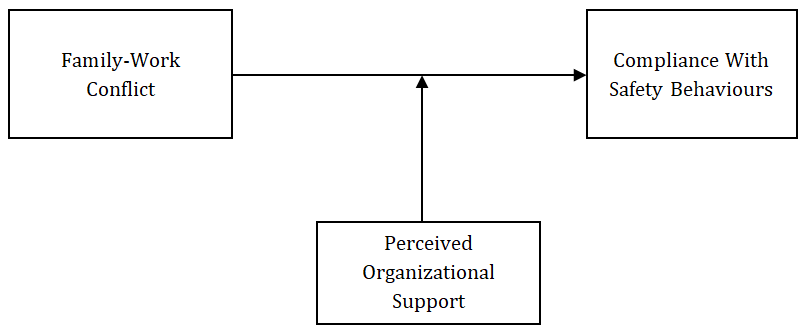
Conceptual Framework
organizational support mechanisms is essential in cultivating a resilient police force compliant with safety norms amidst challenging circumstances.
Thus, Given This Insight, the Researchers Posit the Following: H2: Perceived organizational support (POS) will have a significant positive relationship with compliance to safety behaviours among police. H3: Perceived organizational support will moderate the relationship between family-work conflict and compliance with safety behaviours, such that the negative relationship between family-work conflict and compliance with safety behaviours will be low rather than high among police officers with high perceived organizational support.
Materials and Methods
Participants
A Zone-based cross-sectional survey design was adopted to investigate family-work conflict, perceived organizational support and compliance with safety behaviours among police officers in Nigeria. The participants were 600 police officers between the ages of 25 to 45 years (519 males (86.5%); 81 females (13.5%); Mean age = 32.40; SD = 4.93) recruited through the Multi-stage sampling method participated in the study. It involved taking a proportionate sample from six zones (one zone each from the 17 zones that is spread across the six geographical zones) of Nigeria, namely, South-east (Zone 4-Umuahia), North West (Zone 1-Kano), South-south (Zone 6- Calabar), North Central (Zone7 Abuja), South-West (Zone 17 - Akure) and North-east (Zone 15 – Maiduguri). The first stage involved purposively selecting two zones each from the six geographical zones, namely south-east, south-south, North-east, North-west, North-central and South-west. In the second stage, each Zone was treated as a stratum- Formation. To ensure equal representation, proportionate samples were taken from each Zone, and an equal number of police officers were selected from each Zone or formation. The inclusion criteria were as follows: male and female police officers between the ages of 25 to 45 years, the police officer must be in any of the zones sampled, not over 45 years, and have at least a First School Leaving Certificate. Police officers who met the inclusion criteria were selected from each stratum through randomized sampling. One hundred police officers were selected from each stratum or Zone in the six zones used in the study. Thus, 600 police officers were selected randomly. The participants’ ranks ranged from Constable to Deputy Superintendent of Police, with 100 officers (16.7%) ranked as Constables, 83 (13.8%) as Corporals, 168 (28%) as Sergeants, 101 (16.8%) as Inspectors, 81 (13.5%) as Assistant Superintendents of Police, and 67 (11.2%) as Deputy Superintendents of Police. For educational qualification, 181
(34.9%) hold WACE/GCE, 172 (33.1%) hold OND/Diploma, 158 (30.4%) hold HND/Degree, 6 (1.2%) hold M.Sc., while 2 (0.4%) holds Ph.D. Regarding marital status, 86 (14.3%) were single, 457 (76.2%) were married, and 57 (9.5%) were widows/widowers. The majority of participants identified as Hausa/Fulani (n = 236, 39.3%), followed by Igbo (n = 82, 13.7%), Yoruba (n = 103, 17.2%), and other ethnic groups (n = 179, 29.8%).
Measures
Compliance with Safety Behaviours: Compliance with safety behaviours was assessed by Neal et al. [34]— compliance with Safety Behaviour Scale. Sample items include; “I use all the necessary safety equipment to do my job”. The scale is a 3-item scale responded on a 5-point rating scale ranging from 1 (strongly disagree) to 5 (strongly agree). A higher score indicates greater compliance with safety behaviours. Neal et al. [34] reported a reliability coefficient of .93. In the present study, the researchers reported a reliability index of .89.
Family-work Conflict: The work-family conflict was measured with the 10-item Work-family Conflict Questionnaire developed by Netemeyer [35]. It consists of two dimensions: Work-Family intervention (five items, e.g., “My work demands affect my home life”) and family– work intervention (five items, e.g., “I find it difficult to concentrate on my work due to the family stress”). The items are responded to on a 7-point Likert scale ranging from 1 (Completely Disagree) to (Completely Agree). Higher scores from the summation of the scores indicate high family-work conflict. Netemeyer [35] reported a reliability index of 0.91. In the present study, the researchers reported a reliability index of .83.
Perceived Organizational Support: Perceived Organizational Support was measured with Eisenberger et al. [36] 17-item un-dimensional Perceived Organizational Support scale. The measure was used to assess employee’s perceptions of organizational support. Sample items include; “My organization cares about my wellbeing” and “My organization takes pride in my accomplishments at work”. A high score indicates experience of greater organizational support. The scale is responded to in a 7-point Likert format ranging from 1 (Strongly Disagree) to 7 (Strongly Agree). Eisenberger et al. [36] reported an alpha reliability coefficient of .74 to .95 and item-total correlations ranging from .47 to .83. This scale has been used in the Nigerian context with an acceptable reliability index [37]. This present study yielded Cronbach α of .89.
Procedure: The Police Formations/Zones granted us permission to conduct the study in their divisions. The police officers and men who participated in the study gave consent to the study. All participants were duly informed that their participation was voluntary and that their data would remain confidential, which is ensured by the non- inclusion of any means of identification. With the assistance of 24 research assistants (police officers and men- four from each Zone), the study’s aims were elucidated to the participants, and their roles were equally explained. Data was collected during regular working hours, particularly during their morning brief. It was considered that a combination of officers and men of varying formations would give a reasonably representative sample of police workforce characteristics.
The administration of each questionnaire lasted between seven to ten minutes. Out of 720 copies of the questionnaire distributed, 651 were returned, while 51 of the returned copies were discarded because they were not correctly filled. Thus, the data were analyzed with 600 correctly filled copies, yielding a valid response rate of 83.3%.
Ethical Consideration
The study was approved by the Ethical Committee (blinded for review). All the ethical standards according to the Helsinki Declaration of 1975, as revised in 2013, concerning human experimentation (institutional and national) were followed.
Data Analysis
For the current study, the quantitative data were analyzed employing descriptive and inferential statistics using SPSS version 21. Pearson’s correlation was adopted to examine the relationships between demographic factors, predictors, and outcome variables. Data was analysed using Hayes regression-based PROCESS Macro for SPSS, version 3.00. The robust PROCESS macro for SPSS is suitable for measuring the moderation effects [38], and it is preferable to ordinary regression analysis in moderation research.
PROCESS conducts regression-based path analysis and creates product terms to analyze interaction effects automatically, centring the predictor variables prior to analysis. The Hayes PROCESS is currently the most acceptable method in tests of moderation in psychological research and management sciences [see 22, 39].
Further, if the interaction of predictor and moderator (product term) were significant, it would mean that the association between the relationship variable (family-work conflict) and the outcome variable (compliance with safety behaviour) was either stronger or weaker in the presence of the moderator (perceived organizational support).
Results
| Variables | M | SD | 1 | 2 | 3 | 4 | 5 | 6 | 7 | 8 |
|---|---|---|---|---|---|---|---|---|---|---|
| 1.Age | 32.4 | 4.93 | - | |||||||
| 2.Gender | 1.25 | 0.43 | -0.19 | - | ||||||
| 3.Ethnicity | 1.75 | 0.92 | -0.04 | -0.08 | - | |||||
| 4.Rank | 2.75 | 1.56 | -0.15 | -0.16 | 0.15 | - | ||||
| 5.Edu_Qual | 1.36 | 0.48 | -0.06 | -0.06 | 0.02 | .73** | - | |||
| 6.FWC | 18.58 | 7.37 | 0.1 | 0.11 | 0.24 | -0.03 | 0.03 | - | ||
| 7.POS | 2.19 | 0.86 | 0.1 | -0.07 | -0.18 | 0 | 0.2 | -0.22 | - | |
| 8.CWSB | 9.49 | 3.15 | -0.02 | -0.01 | -0.11 | -0.04 | -0.06 | -.56** | .48** | - |
Table 1: Means, Standard Deviations, and Zero-Order Correlations for Demographic Variables, Family-Work Conflict, POS and Complia
Note: N = 600 **p < .01; *p < .05; Gender (0 = male; 1 = female). Table 1: Means, Standard Deviations, and Zero-Order Correlations for Demographic Variables, Family-Work Conflict, POS and Compliance with Safety Behaviours.
Table 1 indicated that some variables were added as controls; however, none correlated with compliance with safety behaviours among police officers and men. Family- work conflict showed a significant negative relationship with compliance with safety behaviours (r = -.57, p<.01). This implies that as family-work conflict increased, compliance with safety behaviours among police officers was reduced. The result also indicated that perceived organizational support had a significant positive correlation with compliance with safety behaviours (r = .49, p<.01). This implies that as perceived organizational support increased, compliance with safety behaviours among police officers and men increased.
| Variables | β | SE | T | 95% LLCI | CL ULCI | ∆R2 | F |
|---|---|---|---|---|---|---|---|
| Family-Work Conflict | -0.2 | 0 | -4.50** | -0.3 | -0.12 | ||
| POS | 0.4 | 0 | 3.54** | 0.61 | 2.22 | ||
| POS x FWC | 0.1 | 0 | 2.71* | 0.17 | 0.25 | 0.5 | 13.88** |
Table 2: ** Hayes PROCESS Macro results for the association between family-work conflict and compliance with safety behaviour wit
Note: * = p ≤ .05, = p ≤ .01, β = Regression Coefficient; SE = Standard Error; t = population t value; p= Probability Level; LLCI and ULCI = Lower and Upper Limit Confident Interval; ∆R2Adjusted R square Table 2:** Hayes PROCESS Macro results for the association between family-work conflict and compliance with safety behaviour with perceived organizational support as moderator.
Results in Table 2 showed that family-work conflict was negatively associated with compliance to safety behaviour (B = –0.21; 95% CI [–0.30, –0.12]; p > .01), thus confirming Hypothesis 1, which stated that family-work conflict would have a significant negative relationship with compliance to safety behaviour was supported. The unstandardized regression coefficient (B = –0.21) indicated 21 unit decrease in compliance with safety behaviour for every one-unit rise in family-work conflict. This implies that the negative relationship between family-work conflict and compliance to safety behaviour would indicate that higher levels of family- work conflict are associated with lower compliance to safety behaviour.
Perceived organizational support was positively associated with compliance to safety behaviour (B = 0.42; 95% CI [0.61, 0.22]; p < .01), thus confirming hypothesis 2, which stated that Perceived organizational support would be positively associated with compliance to safety behaviour among police officers. The unstandardized regression coefficient (B = 0.42) indicated that for every one-unit rise in perceived organizational support, there was a 42- unit increase in compliance with safety behaviour. This implies that the positive correlation between perceived organizational support and compliance to safety behaviour would indicate that higher levels of perceived organizational support are associated with higher compliance to safety behaviour.
The interaction of family-work conflict and compliance to safety behaviour in their association with perceived organizational support was significant (B = 0.09, 95% CI [0.17, -0.25], p = .05). Thus, Hypothesis 3 was supported, which stated that perceived organizational support would moderate the relationship between family-work conflict and compliance with safety behaviour among police officers.
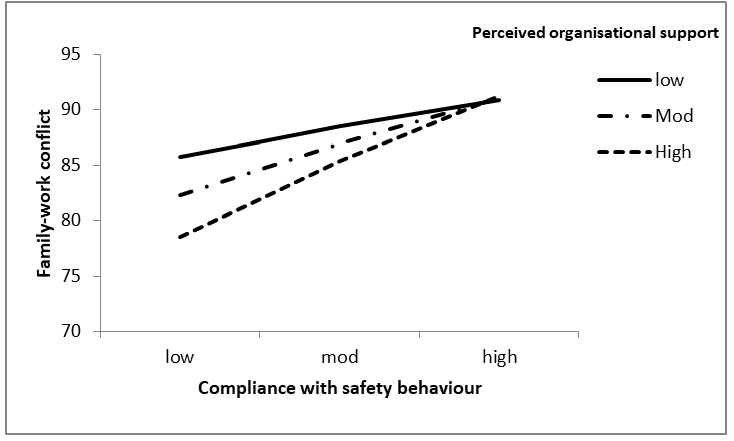
This shows that perceived organizational support strengthened the negative relationship between family- work conflict and compliance with safety behaviours. Hence, indicating that perceived organizational support moderated the relationship between family-work conflict and compliance with safety behaviours.
The slope of the interaction (see Figure 2) indicated that family-work conflict was significantly related to compliance with safety behaviours for those with low perceived organizational support (β = .39, p = < .01), moderate perceived organizational support (β = .67, p = < .01), and high perceived organizational support (β = .98, p = < .01). The entire model accounted for 46% of the variance in compliance with safety behaviours, R2 for the model was .46, F (6, 1774) = 13.88, p< .01.
Discussion
This study investigated the moderating role of perceived organizational support in the relationship between family- work conflict and compliance with safety behaviour among police officers in Nigeria.
First, the researchers hypothesized that family-work conflict would negatively associate with compliance to safety behaviour among police officers. The result was supported because family-work conflict had a negative association with compliance to safety behaviour among police officers. This aligns with extant studies Quansah PE, et al. [40], Siu OL, et al. [41], which reported that greater experience of family- work conflict was associated with decreased compliance safety behaviour. According to Handelzalts JE, et al. [27], family-work conflict creates stress, distraction, and fatigue, which impair an individual’s ability to focus on and adhere to safety protocols in the work setting. Thus, the emotional burden of family-related issues can spill over into the workplace. Invariably, employees dealing with family conflict may experience irritability or frustration, leading to careless behaviour or neglect of safety practices due to distorted cognition and coordination.
For instance, family-work conflict (FWC) represents a critical challenge for police officers, who often navigate the demanding expectations of their profession alongside personal and familial responsibilities.
This dual pressure can lead to significant stress and burnout, undermining not only individual wellbeing but also overall job performance and compliance with safety behaviours, which can be deleterious to their wellbeing. For example, high-stakes environments, such as those faced by police officers, can further exacerbate these family-work conflicts as the irregular hours, emotional toll, and exposure to traumatic events often spill over into family life, leading to incongruity in managing family and work role demands [11]. Aligning with the above assertion, Griffin JD, et al. [42] assert that such role demands conflict often stems from the demanding nature of police duties, which frequently require long hours and unpredictable shifts, subsequently encroaching on family time and personal relationships. Thus, such an imbalance can lead to heightened stress levels, affecting mental wellbeing and job performance, which are crucial for compliance with safety behaviours necessary in law enforcement.
Furthermore, the result showed that perceived organizational support positively correlated with compliance with safety behaviours. This indicated that police officers who reported a high perception of organizational support in their workplace had less risk of compliance to safety behaviours in their work environment. This is consistent with previous studies Liu S, et al. [43], which reported a positive relationship between perceived organizational support and increased compliance to safety behaviours in a work context. Thus, perceived organizational support may be a protective factor against non-compliance with safety behaviours. This is evident because perceived organizational support is crucial in mitigating negative work-related issues and outcomes [33], particularly in enhancing compliance with safety behaviours. For instance, when employees feel valued and supported by their organization, they are more likely to experience reduced stress levels and better work- life balance, which fosters adherence to safety protocols. Research indicates that officers who perceive high levels of organizational support are more likely to prioritize their wellbeing and adhere to safety measures under challenging conditions, including the ongoing turmoil surrounding issues of policing and societal unrest [44].
As expected, perceived organizational support (POS) moderated the relationship between family-work behaviour and compliance with safety behaviours among police officers. This implies that strengthening organizational support mechanisms is essential in cultivating a resilient police force compliant with safety norms amidst challenging circumstances. This coincides with extant studies Moserle G, et al. [29], Adu IN, et al. [33], which revealed that POS acts as a buffer against the detrimental effects of family-work conflict, empowering police officers to manage their responsibilities both at work and home more effectively. Furthermore, as noted in previous studies, when organizational support is perceived positively, it contributes to broader compliance with safety norms, thereby creating a culture that prioritizes employee welfare and public safety within the community [44]. POS moderates the relationship by cushioning the adverse effects of family-work conflict, ensuring that employees remain committed to compliance with safety behaviours even when personal challenges arise. Corollary, high POS can reduce the negative effects of family-work conflict by providing resources (e.g., emotional support and flexible schedules) or simply making employees feel less isolated in managing their dual roles [45]. For instance, police officers who feel supported are more motivated to uphold organizational norms, such as safety compliance, even when dealing with personal challenges. This is because POS enhances an employee’s capacity to cope with stress, reducing the spillover effects of family-related stress on workplace behaviours. Thus, enhancing POS could be a strategic intervention to mitigate family-work conflicts and promote safety compliance among law enforcement personnel.
Implications of the Study Findings
The present study has both theoretical, empirical, and practical implications. Theoretically, it provides insight that competing demands between work and family domains create role strain, impairing performance in one or both areas. This implies that understanding how external and internal factors influence safety behaviours in high-stress professions like law enforcement is imperative to maintain a healthier work-life balance among employees, particularly law enforcement agencies.
Empirically, the findings of this study illuminate the intricate relationship between family-work conflict and compliance with safety work behaviour among police officers, with perceived organizational support emerging as a critical moderating factor. Specifically, the research indicates that higher levels of perceived support from the organization significantly mitigate the adverse effects of family-work conflict on officers’ adherence to safety protocols. This suggests that police organizations should prioritize fostering an environment of support, which can be achieved through initiatives such as flexible scheduling and comprehensive mental health resources. The implications extend beyond individual wellbeing; enhanced compliance with safety behaviours directly contributes to overall departmental effectiveness and public safety. By addressing the nuances of family-work conflict and leveraging perceived organizational support, police organizations can cultivate a culture that values officer safety and enhances operational efficiency, leading to more positive outcomes for officers and their communities. Thus, this scientific enquiry has opened up more evidence-based research on compliance with safety, family-work role demand, and the importance of organizational support in the context of law enforcement agencies for a healthier work-life balance.
Practically, the findings of this study reveal significant insights into the dynamics between family-work conflict and safety compliance among police officers, underscoring the crucial role of perceived organizational support. Specifically, the research indicates that higher levels of perceived support within law enforcement agencies attenuate the adverse effects of family-work conflict on safety behaviour compliance. Consequently, law enforcement agencies must prioritize the development of supportive organizational cultures such as flexible scheduling, wellness programs, and robust communication channels that acknowledge the intricate balance between officers’ familial and professional obligations.
Thus, calls for these targeted interventions, enhances officer morale and promote adherence to safety protocols. By fostering an environment where officers feel supported, agencies can improve individual wellbeing and overall organizational effectiveness, leading to a safer operational framework for officers and their communities.
Limitations of the Study/Suggestions for Further Studies
This research has some notable limitations. First, the present findings may not be generalized to other paramilitary settings and diverse conditions due to its domain specifics. Second, this study is based on self- reported data, which are prone to the risk of social desirability responses. Even though the possible problem of common error bias was reduced through confidentiality and anonymity in participants’ responses. Thus, care should be taken in the interpretation and extrapolation of the result findings. Furthermore, future research should adopt a longitudinal study and mixed-method approach to give a deeper insight into officers’ work-family conflict experiences and compliance with safety behaviours for wider extrapolation of the findings.
Conclusion
The interplay between family-work conflict and compliance with safety behaviours among police officers is significantly influenced by perceived organizational support. This study provides insight that when officers feel valued and supported by their organization, their ability to manage the competing demands of family and work is remarkably enhanced, leading to greater adherence to safety protocols. The findings suggest that institutions should focus on fostering a supportive environment that acknowledges the challenges faced by police personnel, which will ultimately contribute to higher compliance levels in safety behaviours. Additionally, understanding the nuanced dynamics of how work-related stressors impact officer performance is crucial, especially in a context marked by historical and ongoing conflicts, such as those highlighted in the situation surrounding police interactions in Nigeria and the broader socio-religious tensions impacting community trust and safety in our contemporary time. Hence, fostering supportive organizational strategies is essential for improving both officer wellbeing and community security. In sum, the study suggests that when officers perceive substantial support from their organization, the adverse effects of family-work conflict on safety compliance are mitigated, promoting a safer work environment. These insights imply that to enhance officer safety and operational efficiency, law enforcement agencies must prioritize structured support systems, such as flexible schedules and mental health resources, to alleviate family pressures. Furthermore, fostering an organizational culture that values employee wellbeing, improves compliance with safety protocols, and enhances overall job satisfaction and performance. Therefore, policy interventions to reinforce organizational support mechanisms may significantly reduce family-work tensions and ensure adherence to necessary safety practices within the police force.
Acknowledgements
The authors acknowledge the police officers and men who participated in the study. Author Contributions: All authors contributed equally and approved the final paper.
Data Availability Statement: The data sets generated and analyzed during this study will be available from the corresponding author on request.
Declaration Of Conflicting Interests: The author(s) declared no potential conflicts of interest concerning this article’s research, authorship, and/or publication.
Funding: The author(s) received funding from TetFund with Grant Approval no:
Informed Consent: All procedures followed were under the ethical standards of the responsible committee on human experimentation (institutional and national) and with the Helsinki Declaration of 1975, as revised in 2013. We obtained informed consent from all Police personnel participants to be included in the study.
References
-
Afework A, Tamene A, Tafa A (2024) Compliance with standard occupational health and safety measures and associated factors among small-scale metal industry workers in central Ethiopia. Risk Manag Health Policy 29(17): 399-409.
-
Barbosa PAR (2023) Compliance and its contributions to safety at work. Ius Novum 17(3): 47-56.
-
Bensonch C, Argyropoulos CD, Dimopoulos C, Mikellidou CV, Boustras G (2022) Analysis of safety climate factors and safety compliance relationships in the oil and gas industry, Safety Science pp: 151.
-
National Policing Institute (2024) The role of law enforcement culture in officers safety during driving and road operations. Arlington, Virginia, USA.
-
Song SY (2013) Personal protective clothing: Law enforcement officers’ attitudes and safety behaviour assessments toward high-visibility safety apparel. Scholarly Commons.
-
Kardas P (2024) From non-adherence to adherence: Can innovative solutions resolve a longstanding problem?. European Journal of Internal Medicine pp: 6-12.
-
Ijola I, Akerele AO, Osas EE, Samuel S (2021) Perceived implications of non-compliance with safety practices in construction projects: construction professionals’ awareness level. International Journal of Real Estate Studies 15(1): 16-26.
-
Hammer LB, Johnson RC, Crain TL, Bodner T, Kossek EE, et al. (2016) Intervention effects on safety compliance and citizenship behaviors: Evidence from the work, family, and health study. Journal of Applied Psychology 101(2): 190-208.
-
Nnadozie EE, Ike OO, Chuke NU, Eze IC. (2022) The influence of psychological ownership on the association between satisfaction with work-family balance and intention to stay among nurses in south-eastern Nigeria public hospitals. International Journal of Africa Nursing Sciences 17(5): 1-6.
-
Moreira A, Encarnação T, Viseu J, Au-Yong-Oliveira M (2023) Conflict (Work-Family and Family-Work) and Task Performance: The Role of Wellbeing in This Relationship. Adm Sci 13: 94.
-
Ahmad R, Islam T (2019) Does work and family imbalance impact the satisfaction of police force employees? A “net or a web” model. Policing: An International Journal of Police Strategies and Management 42(4): 585-597.
-
Carvalho C, Mónico L, Pinto A, Oliveira S, Leite E (2024) Effects of Work–Family Conflict and Facilitation Profiles on Work Engagement. Societies. 14(7): 110.
-
Howard WJ, Donofrio H, Boles J (2004) Inter-domain work-family, family-work conflict and police work satisfaction. Policing An International Journal 27(3): 380-395.
-
Twumasi E (2022) Work-Family Conflict and Safety Behaviour among Dual-Earner Couples; Does Family Supportive Supervisor Behavior Matter?. International Journal of Economics, Business and Management Studies 9(2): 157-170.
-
Turner N, Hershcovis MS, Reich TC, Toffoli EN (2014) Work-family interference, psychological distress, and workplace injuries. Journal of Occupational and Organizational Psychology 87(4): 715-732.
-
de Sousa C, Viseu J, Vincent P, Vinagre H, Romana F, et al. (2023) Moderating Effect of Work-Family Conflict on the Relationship between Perceived Organizational Support and Job and Life Satisfaction: A Study during the COVID-19 Pandemic. American Journal of Industrial and Business Management 13: 1175-1193.
-
Sachau DA, Gertz J, Matsch M, Palmer AJ, Englert D (2011) Work-Life Conflict and Organizational Support in a Military Law Enforcement Agency. Journal of Police and Criminal Psychology 27(1): 1-15.
-
Zhao XR, Wang J, Law R, Fan X (2020) A Meta-Analytic Model on the Role of Organizational Support in Work- Family Conflict and Employee Satisfaction. International Journal of Contemporary Hospitality Management 32: 3767-3786.
-
Wattoo MA, Zhao S, Xi M (2018) Perceived Organizational Support and Employee Wellbeing: Testing the Mediatory Role of Work-Family Facilitation and Work-Family Conflict. Chinese Management Studies 12: 469-484.
-
Zhang L, Wu P (2020) Impact of Work-Family Interface on Job Satisfaction of Teachers: The Mediating Role of Perceived Organizational Support. Academic Journal of Humanities & Social Sciences 3: 19-29.
-
Eisenberger R, Shanock L, Wen X (2020) Perceived Organizational Support: Why Caring about Employees Counts. Annual Review of Organizational Psychology and Organizational Behavior 7: 101-124.
-
Ike OO, Chuke NU, Nnamchi O (2024) Organizational cynicism and turnover intention among nurses: Do perceived organizational support moderates the relationship. SAGE Open Nursing 10(5).
-
Xie Q, Xia N, Yang G (2022) Do Family Affairs Matter? Work–Family Conflict and Safety Behavior of Construction Workers. Journal of Management Engineering 38(1): 1-17.
-
Zhang J, Fu Y, Guo Z, Li R, Guo Q (2022) How Work-Family Conflict Influenced the Safety Performance of Subway Employees during the Initial COVID-19 Pandemic: Testing a Chained Mediation Model. Int J Environ Res Public Health 19(17): 11056.
-
Bakker AB, Demeuroti E (2017) Job Demands-Resources Theory: Taking Stock and Looking Forward. Journal of Occupational Health Psychology 22: 273-285.
-
Bakker AB, Demerouti E, Sanz-Vergel A (2023) Job Demands-Resources Theory: Ten Years Later. Annual Review of Organizational Psychology and Organizational Behavior 10: 25-53.
-
Handelzalts JE, Kalfon-Hakhmigari M, Garthus-Niegel S (2024) Work-family conflict: emphasis on families in modern work environments. Journal of Reproductive and Infant Psychology 42(2): 139-141.
-
Tsang SS, Liu ZL, Nguyen TVT (2023) Family–work conflict and work-from-home productivity: do work engagement and self-efficacy mediate? Humanit Soc Sci Commun 10: 419.
-
Moserle G, Foti G, Finstad GL, Bazzoli A, Curcuruto M, Morgan J (2024) Prosocial Behavior and Workplace Safety: Analysis of the Role of Emotional Intelligence and Perceived Organizational Support in Two UK and US Samples. Sustainability 16(21): 9190.
-
Hao J, Wang J, Liu L, Wu W, Wu H (2016) Perceived organizational support impacts on the associations of work-family conflict or family-work conflict with depressive sympotms among Chinese doctors. Int. J. Environ. Res. Public Health 13: 326.
-
Iqbal M, Ahmad S, Ullah M, Siddiq A, Ali A, Ali N. (2022) Moderating Effect of Work-Family Conflict on the Relationship of Perceived Organizational Support and Job Satisfaction: A Study of Government Commerce Colleges of Kp, Pakistan. Journal of Positive School Psychology 6: 2282-2291.
-
Sun J, Jiao H, Zhao J (2011) The moderating effect of perceived organizational support in job engagement and work-family conflict. Chin J Appl Psychol 17: 31-35.
-
Adu IN, Twumasi E, Boakye KM, Kyei-Frimpong M (2023) Does Organizational Support Moderate the Influence of Family-Work Conflict on Career Progression?. FIIB Business Review 12(10): 1-13.
-
Neal A, Griffin MA, Hart PM (2000) The impact of organizational climate on safety climate and individual behavior. Safety Science 34(1-3): 99-109.
-
Netemeyer RG, Boles JS, McMurrian R (1996) Development and validation of work-family conflict and family-work conflict scales. Journal of Applied Psychology 81(4): 400-410.
-
Eisenberger R, Huntington RC, Sowa D (1986) Perceived organizational support. Journal of Applied Psychology 71(3): 500-507.
-
Onyishi IE (2006) Relationship between perceived organizational support and organizational citizenship behaviour in a Nigerian sample. Nigerian Journal of Psychological Research 5: 37-51.
-
Hayes AF (2018) Introduction to mediation, moderation, and conditional process and analysis: A regression- based approach. In: 2nd (Edn.), Guilford Press.
-
Nwufo JI, Ike OO, Nwoke MB, Eze J, Chukwuorji JC, et al. (2023) Social anxiety and internet addiction among adolescent students in a sub-Saharan African country: Does family functioning make a difference? South African Journal of Psychology 53(2): 275-285.
-
Quansah PE, Eggley VE, Fanyinkah KD (2020) Family- work conflict and safety performance: An unexamined relationship in the Ghanaian mining industry. International Journal of Scientific and Research Publications 10(11): 411.
-
Siu OL, Ng TK (2021) Family-to-work interface and workplace injuries: The mediating roles of burnout, work engagement, and safety violations. International Journal of Environmental Research and Public Health 18(22): 11760.
-
Griffin JD, Sun I (2017) Do work-family conflict and resiliency mediate police stress and burnout: A study of state police officers. American Journal of Criminal Justice 43(3): 1-17.
-
Liu S, Yang X, Mei Q (2019) The effect of perceived organizational support for safety and organizational commitment on employee safety behavior: a meta- analysis. International Journal of Occupational Safety and Ergonomics 27: 1154 -1165.
-
Joshua GB, Tsuma E, Egessa R, Onyango R (2024) Moderating Role of Perceived Organizational Support on the Effect of Occupational Stress Management Practices on Employee Engagement amongst Law Enforcement Officers in Uasin Gishu County, Kenya. African Journal of Empirical Research 5(2): 170-179.
-
Zheng J, Wu G (2018) Work-Family Conflict, Perceived Organizational Support and Professional Commitment: A Mediation Mechanism for Chinese Project Professionals. Int J Environ Res Public Health 15(2): 344.
- Occupational Stress and Mental Health Outcomes Among Police Officers: A Mini Review
- The Experience of Counterproductive Leadership on Mental Health and Impact on Retention in U.S. Marines: A Phenomenological Study
- Nomophobia in the Digital Age: A Study on College and University Students
- Emotional Regulation in Children with Autism and Learning Disabilities
- Antisemitism on American College Campuses and Its Impact on Jewish Students
- Exploring the Role of Empathy in the Associations of Family Functioning and Purpose in Life with Attitude towards Abortion among Undergraduates: A Moderation Analysis